
- A
- “Abilment for Justus of the Pees,” 67, 68
- Accidents in the lists, 11
- Additional or reinforcing pieces, 40
- Ameliorations in the tourney, 39
- Antiquarian Repertory, 44, 48
- Anzogenrennen, 100, 114
- A Outrance, The term, 9
- Archæologia, 69
- Archæological Journal, 69, 102
- Armatura Spigolata, 108
- Armet with disk behind, 83
- Armorial de la Toison d’Or, 44, 143
- Armouries of the Tower of London, by Charles J. ffoulkes, 91
- Armour of the Black Prince, 29
- — imported from Germany, 38
- — for the lists, 38, 40
- — German and Italian forms, 38, 40
- — worn by Maximilian I. at Worms in 1495, 39
- — for running with pointed lances (Scharfrennen), 40, 98, 99
- — for combats on foot, 41, 105
- — bards and trappers of the fifteenth century, 45, 65
- — imported from Italy and Germany, 107
- — made in England, 107
- Armyng points, 69
- “Armyng” swords, 114
- Articles of combat for the tournament at Westminster in 1511, 118
- Ashmolean MSS., 44;
- “Certain Triumphs,” 81
- Attaints made at the tournament at Westminster in 1511, 120
- B
- Bards, 22, 108, 109
- “Barriers” and foot combats, 41, 54, 86, 105, 117, 122, 124, 131, 133
- “Barriers and Foot Combats,” a paper by Viscount Dillon, 126
- Bases, 108, 116
- Bâton of illegitimacy, 86
- Bayard, 111
- Bayard’s fight at “barriers,” 111
- Beauchamp pageants, 45
- Bec de faucon, 54
- Behourd, The, 2
- Bertrand du Guesclin, 28
- Bibliothèque de Bourgogne, 44
- Bisague, 69
- Blending of the tournament with the pageant, 41, 78
- Boeheim Wendelin, 85;
- His Waffenkunde, 42
- Boucicaut, 32
- Brantôme, 166
- Brasses, 10, 65
- Breastplates for rennen and stechen, 95
- Bulk of the armour of the sixteenth century made in Germany, 86
- Bulls against tournaments, 11
- Bundrennen, 100, 104
- Burgmaier Hans, 89, 104
- Burgonet, 106
- Burres, 69
- C
- Cap of Maintenance, The, 37
- Carrousels or Karoussels, 85, 107
- Carter’s Painting and Sculpture, 23
- Casualties at tournaments, 115
- Caxton’s Epilogue, 82
- — reference to the Royal Joust at London in 1390, 35
- Cervillière, 37
- Chain-mail, 21
- Challenges for the pas d’armes L’Arbre de Charlemagne in 1443, 59
- Challenge by an esquire of Arragon in 1400, 49
- Chamfron, The, 74, 109
- Chapitres d’Armes, 9, 48, 57, 58, 114, 122
- Chargers for the tourney and their equipment, 43
- — often ridden blindfolded, 43
- Charles the Bold, 43, 81, 88
- Charles V, the Emperor, 88
- Chastelain’s Chroniques, Jacques de Lalain, 44
- Chaucer’s Knight’s Tale, 27
- “Checques” or scoring tablets, 120
- Chroniclers of the Tournament, 9
- — Mediæval Latin, 9
- Chronicle of Robert of Gloucester, 11
- Chronique de Monstrelet, 44
- Chroniques de St. Remy, 102
- Collar of SS, 55, 66
- Collections of Armour, 84
- Colombière’s Theater d’Honneur et de Chevalrie, 153
- Combat à outrance near Vannes, 30
- — on horseback at Arras in 1425, 53
- — between three Portuguese and three Frenchmen in 1415, 53
- Combat at Arras between five Frenchmen and five Burgundians, 55
- — à outrance between de Ternant and Galiot de Baltasin in 1446, 109
- Combats on foot, 105
- Commines, P. de, 80
- “Comyng in to the felde,” 67, 70
- Consilium Albiense, 2
- Coronal of the lance, 15, 69
- Cost of jousting harnesses in the sixteenth century, 91
- Coup ou la lance des Dames, 15
- Coup de Jarnac, 165
- Course au pavois, 100
- Course of Gestech, run at Jena in 1487, 84
- — à la targe futée, 99
- — à la queue, 27
- — appelée Bund, 100
- Crests, 36, 37, 42
- Crinet, 109
- Crowds attending tournaments apt to become partisans, 12
- Cuirass employed in Rennen, 98
- Cushion or mattress placed on horse’s chest in jousting, 93
- Cuisses, 70
- Cyclas, 21
- D
- Dagworth, Sir Nicholas, 28
- — brass in Blickling Church, 28
- Death of Duke Philippe le Bon in 1467, 77
- Decline of the tournament, 85
- Decline of armour and its causes, 138
- Decoration of lists temp. Henry VIII, 116
- Deeds of Arms at Bordeaux in 1389, 32
- — — — in 1402, 51
- — — — at Valentia in 1403, 51
- Definition of Esquires and Kings of Arms, 63
- Definition of Scharfrennen, 97
- Degradation of a Knight, 124
- De La Marche, 73
- Demi-harnesses, 109
- De Pluvinal, 85
- Differences in costume between knights and esquires, 65
- Dillon, Viscount, 63, 68, 85, 105, 108
- Disorderly tournament at Rochester in 1251, 16
- Duel at Montereau in 1387, 30
- — between the Dukes of Brittany and Bourbon, 46
- — between the Bastard of Burgundy and Lord Scales in 1467, 76
- Dugdale, Sir William, 148
- Dülgen or Dilgen (Dichlinge) jousting-cuisses, 64, 98
- Duke of Orleans challenges Henry IV of England, 51
- Duties of “pursuivants d’armes,” 129
- E
- Edicts issued against tournaments, 11, 13
- Effigies, 10, 20, 21
- Effigy in St. Bride’s Church, Glamorganshire, 37
- — Hoveringham Church, 65
- — of Sir Richard Beauchamp, 66
- Eglington Tournament in 1839, 139-142
- Ehrenpforte, 89
- English iron found unsuitable for armour making, 107
- Enriched armour, 67, 109
- Espinette, The, 36
- Excerpta Historica, 82
- Expression, The, “trapped and barded” defined, 109
- F
- Fatal accident in jousting to the Earl of Pembroke in 1390, 37
- — — — — Henri II of France, 104, 126
- Favine’s Theatre of Honour and Knighthood, 2, 6, 152
- Feats of Arms at Entença, 31
- — — Edinburgh in 1448, 64
- — — near St. Omer in 1446, 71
- — — at Bruges in 1446, 72
- — — at Arras in 1446, 73
- Fees to officers of arms, 135
- Feldrennen, 101
- Feldturnier, 101
- Fêtes d’armes at St. Ingelbert in 1389, 5
- — at Paris in 1559, 104, 125
- — at Bruges in 1468, 78
- Fêtes de l’Arbre d’Or in 1468, 79
- ffoulkes, Chas. J., 91
- Field of the Cloth of Gold, 122
- Fifteenth Century, The, 38
- Fight on foot between John Astley and Philip Boyle of Arragon, 67
- Fine “hoasting” harness of the middle of the sixteenth century at Berlin, 109
- First joust of the Comte de Charolais at Brussels in 1452, 74
- First coming into the tiltyard of Prince Charles of Wales in 1619, 134
- Fitzstephen, William, 9, 10
- Fourteenth century a period of transition, 23
- Freiturnier, 106
- French King’s ordinance in 1409, 49
- Friedrich of Saxony running in Gestech, 97
- Freydal, 87, 88, 94, 97, 100, 101, 103, 105
- Froissart, 23, 44, 155
- Fussturnier, 106
- G
- Garde-rein, 95
- Garter, Institution of the Order of the, 4
- Gedritts, A, 99
- Gemeine deutsche Gestech, 93, 94, 104
- Germany captures the trade in armour from Milan, 38
- Geschiftrennen, 99
- Geschifttartscherennen, 100, 104
- Geschiftscheibenrennen, 100, 105
- Gestech or Stechen, 93
- Gestech im Beinharnisch, 93, 97, 104
- Gestech im hohen zeug, 93
- Gestech ran at Leipzig in 1489, 96
- Glossarium, Du Cange, 1
- Göding, Heinrich, 89
- Gothic armour, 65
- Gothic armour of the connoisseur, 66, 108
- Grand Assize, The, 147
- Grand-guard, 63
- Grand tournament at Brussels in 1428, 54
- Grapers, 69
- Great armour-smiths of the fifteenth century, 66
- Great armour-smiths’ families, 38
- Great wardrobe of Edward III, 26
- Great jousting-helm, 94
- Greaves, 70
- Grelots, 103
- Gunpowder and early ordnance, 23
- Gurlitt, 85, 106
- H
- Hach d’armes, 62
- Haenel, Professor, 85, 89
- Halbierung, 101
- Hall’s Chronicle, 85, 116
- — florid account of the tournament at Westminster in 1511, 119
- Hammer-headed axes, 74
- Hardyng’s Chronicle, 18
- Harness for the tourney became sharply divided from “hoasting” armour, 40
- Harnesses in Paris and London, for Gestech, 94
- — at Nuremburg, for Gestech, 96
- — for Freiturnier, 106
- — for Fussturnier, 106
- — for Realgestech, 106
- Hastiludia, or spear-play, 2
- Hastilude at Lincoln, 26
- Hefner’s Trachten, 23
- Helm for Kolbenturnier, 41
- Helmet for foot-fighting, 67
- Henry VIII imports German armour-smiths, 107
- Henry VIII and Maximilian I take great delight in the tourney, 115
- Henry VIII a successful jouster, 124
- Heraldic bearings, 22
- Hewitt’s Ancient Armour, etc., 36, 45, 69, 154
- History of the Life and Acts of Richard Beauchamp, Earl of Warwick,
- by John Rouse, 45
- Histoire Des Ducs De Bourgogne, 53
- “Hoasting” armour, 107
- Hohenzeuggestech, 93, 94, 104
- Holinshed’s Chronicles, 25, 85, 116
- Horda Angel-Cynnan, 52
- Horses charged at an amble in jousting, 94
- Horse’s collar of bells, 96
- “How a man schall be armyd at his ese when he schal fighte on foote,” 71
- “How lances shall be broken,” 80
- I
- Illuminations in Chronicles, 10
- — of jousting at the tilt, 67
- — depicting the arming of a man for a combat on foot, 70
- Illustrations of Geschifttartscherennen and
- Geschiftscheibenrennen, 100
- — —Anzogenrennen, 100
- — — Krönlrennen, 100
- — — tournaments of the sixteenth century, 67
- Influence of the tournament, 138
- J
- Jambers, 108
- Jean de Féore de St. Remy, 45
- Jocelin of Brakelond, 12, 16
- John Astley’s fight on foot with Phillippe Boyle of Arragon in 1442, 56
- Joust, The: William of Malmesbury’s definition, 3
- Joust at the tilt: its origin and salient features, 102
- — Cuirass employed, 103
- Jousting armour at Dresden, 84
- — exploits of Richard Beauchamp, Earl of Warwick, 52
- — helm, 93
- — shield, 64, 96
- — salade, 98
- — cuisse, 98
- — lances, 41
- — in the open, 39
- — traditions of Burgundy transferred to Germany and Austria, 81
- — played a great part in the daily routine of the German Courts, 42
- Jousts of courtesy with pointed lances, 97
- — — Peace, 9
- — — War, 9
- — at Blei in 1256, 17
- — of the early part of the fourteenth century, 23
- Jousts pictured in Codex Balduini Treverencis, 25
- Joust at Cheapside in 1330, 25;
- at Dunstable in 1341, 25;
- those held in 1347, 26;
- at Northampton, Dunstable, Canterbury, Bury, Reading, and Eltham, 26;
- at Rennes in 1357, 28;
- jousts held in honour of the marriage of Charles VI of France, 31;
- jousting in Scotland in 1398, 37;
- at the coronation of Queen Jane, 52;
- jousting at the tilt at Dijon in 1443, 59;
- at Tours in 1446, 61;
- at Ghent in 1445, 62;
- between John Astley and Philip Boyle, 67;
- between John Astley and Pierre de Masse, 1438, 68;
- jousts and pageants at Lille in 1453, 75;
- jousting at Paris in 1468, 81;
- “iust roial” at the marriage of Richard Duke of York, 81;
- joust at the tilt between William IV of Bavaria and the
- Pfalzgraf Friedrich of the Rhine in 1510, 103;
- joust at Paris in 1513, 114;
- at Naumburg in 1505, 114;
- at Lille in 1513, 114;
- jousts at the tilt in honour of the coronation of Henry VIII, 116;
- at Richmond in 1510, 117;
- at Greenwich in 1513, 120;
- at Greenwich in 1517, 121;
- jousting at the Field of the Cloth of Gold, 122;
- jousting at Greenwich in 1536, 124;
- jousts and barriers held in 1558, 125;
- jousts at Westminster in 1581, 131.
- Joûte Allemand, 93
- Joûte au harnois de jambe, 93
- Joûte à la haute barde, 93
- Joûtes à outrance, 9
- Judicial combats properly classed with the tournament, 8
- — Duel, The, 145
- — — temp. Richard II, 154;
- at Paris 1386, 155;
- between Dukes of Hereford and Norfolk, 156;
- between men and their wives, 158;
- with spiked clubs, 159;
- duel at Arras in 1431, 161;
- at Quesnoy in 1405, 161;
- at Smithfield in 1446, 163;
- duel compounded in 1446, 162;
- duel at Valenciennes in 1455, 163;
- in France in 1547, 165;
- at Haddington in 1548, 165.
- — duels became rare temp. Queen Elizabeth, 166
- — duel of the knightly order in 1603, 167
- — — ordered in 1571, 167; and in 1817 Jupon, 28
- Justes mortelles, 97
- Juvenal des Ursins, 31, 155
- K
- Kampfschurz, 105
- “Kerchief of Plasaunce,” 27
- King Philippe Augustus sends a challenge to King Richard I, 13
- King Edward III invades France, 26
- King Henri IV challenges Mayenne to single combat, 127
- King René’s writings illustrated by himself, 46
- “Kinges of Armes and Hauraldes,” 131
- Kings of Arms, 16
- Knight-errantry, 11
- Knightly panoply of the thirteenth century, 21
- Knightly armour of late in the thirteenth century, 28
- Kolbenturnier, 41, 94
- Kolben or baston, 41
- Krönlrennen, 101
- L
- Lance, The, 18, 69, 90, 96, 98, 108
- Lances rebated in 1252, 3, 15
- Lance-heads, 41
- Lance-rest, 40, 95
- La Statuta d’Armes de Turneys temp. Henry V, 53
- Latest phrase of cap-à-pie armour, 138
- Laton, 66
- Law for judicial combats in abeyance for a long period, 167
- Law for trial by combat repealed anno 1818, 168
- Leitner, Querin von, 85
- Letters of safeguard, 115
- Lists, 77, 122, 147
- Lists described, 14;
- their officials, 15;
- only five authorized in England, 14;
- frequently artificially lighted, 42;
- strewn with sand or tanning refuse, 40
- Lists for foot combats, 67
- Lists at Dijon in 1443, 57;
- at West Smithfield in 1467, 76
- Literature concerning tournaments, 85
- Locking gauntlet, 49, 106
- Lombarde, 10
- M
- Magenblech, 98
- Main courses of the joust, 92
- Maneige Royal, 85
- Manifer or mainfare, 64
- Mantling or Lambrequin, 37, 95
- Manuscripts in Burgundian Library, 143
- Marche, De La, 77, 78
- Marie of Burgundy, 88
- Matthieu de Courci, 65
- Matthew Paris, 9
- Matthew of Westminster, 9
- Mattress, A, protects the horse’s breast, 39
- “Maximilian” armour, 108
- Maximilian I, 43, 87
- — — engages armour-smiths at Milan, 39
- — of Austria a successful jouster, 124
- Maximilian II mounted for Scharfrennen, 99
- Mechanism in shields for Genschifttartscherennen
- and Geschiftscheibenrennen, 100
- Mêlée, The, 46, 100;
- much supplanted by the joust, 41
- Mémoires de la Marche, 44, 76
- Mémoires de Sire de Haynin, 46
- Menestrier, 85
- Method of tilting described, 39
- Meyrick, 63, 69
- Meyrick’s Critical Essay on Antient Armour, 46
- Milan the chief seat for the manufacture of body-armour, 38
- Military and Religious Life in the Middle Ages, 62
- Modern revivals of the tournament, 139
- Monkish chronicles, 34
- Monstrelet, 44
- Montfaucon, 153
- Moton or Bisague, 69
- Motons, 83, 95
- Mounted models at Dresden, 84
- Much that is fanciful and unreal written about tournaments, 85
- N
- Narrow escape from death of Henry VIII in tilting, 123
- New forms of jousting with variants, 86
- New forms of civil dress always reflected in armour, 107
- New modes of armour of fifteenth century had their birth in Italy, 66
- Nugæ Antiquæ, 46
- Number of courses usually run at a joust tended to increase, 29
- O
- Ordeal, Early form of, 147
- Order of the Garter, 26
- — Golden Fleece, 44
- “Ordinance of kepyng of the Felde,” 131
- Ordinances, statutes, and rules promulgated by John Tiptoft in 1466, 46
- Origin of the joust, 3
- Origines Juridiciales, 148
- Orle or wreath, 37
- P
- Pageantry combined with tournaments often of incredible puerility, 116
- Paper on “A MS. Collection of Ordinances of Chivalry of the fifteenth century,” 67
- Paris, Matthew, on the Round Table, 3
- Pas d’armes at Arras in 1435, 55;
- at L’Arbre de Charlemagne near Dijon in 1443, 57;
- at West Smithfield in 1467, 76;
- at Greenwich temp. Henry VII, 82;
- at Ayre in Picardy in 1494, 111;
- Pas de la Pélerine in 1446, 71;
- L’Arbre d’Or in 1468, 61;
- at end of fifteenth century, 48;
- at Westminster in 1501, 113
- — — frequently combined with masques and mummeries, 75
- Pas-gard, The, 63, 106, 108
- Patents taken out in England for models of horses for jousting
- fitted with mechanical appliances for impulsion, 91
- “Peasecod-bellied” breastplates, 104
- Peffenhauser, Anton, 91, 106
- Penalties inflicted for the infraction of tournament rules, 12
- Pensill, The, 70
- Père, Daniel, 13
- Permanent lists, 107
- Perquisites of officials of lists, 15
- Persons exempted from judicial duels, 148
- Peytral, The, 109
- Pfannenrennen, 101, 105
- Pfeifenharnis, 109
- Philippe le Bon, 45
- Pictorial representations of jousts and tournaments, 23
- Pictures of jousts in the Gewehrgallerie, Dresden, 89;
- picture at Dresden of models of horses impelled for
- charging by a mechanical apparatus, 90;
- of the procession to the lists at the tournament at
- Westminster in 1511, 117;
- of a legal duel, 151;
- of an informal legal duel, 153;
- of a knightly judicial duel, 164
- Pièces d’avantage, 63
- Poldermiton, The, 64, 96
- Position of peaks or tapuls on the breastplate, 110
- Preuilli, Geoffroi de, 1
- Prince Dolphin of Auvergne, 132
- Prizes, 16, 76, 86, 111, 114, 125, 127
- Proofs by fire and water, 146
- Q
- Queue, The, 40, 95
- Quintain, The, 6, 75
- R
- Ranulph de Glanville, 148
- Rasthaken or queue, 104
- Realgestech, 103, 106
- Realistic tournament at Paris, 31
- Records of tournaments in the College of Arms, London, 85;
- among the Ashmolean, Harleian, and Cottonian MSS, 85
- Reinforcing pieces, 63, 64;
- first appear in England in the reign of Edward IV, 40;
- worn at Ghent in 1445, 63
- René d’Anjou, 55, 131
- Rennen, 89;
- at Minden between August of Saxony and Johann von Ratzenberg, 99
- Representations of the tourney on tapestry and carvings on ivory, 10
- Revival of the tournament in the reign of Queen Elizabeth, 125, 126
- Robert of Gloucester, 9
- Rockenburger, Sigmund, 99
- Roger de Hoveden, 9;
- his Annals, 12
- “Roiall iustes” at Smithfield in 1358;
- at London in 1359, 27;
- and 1362, 28
- Roll of purchases for the tournament at Windsor Park in 1278, 18
- Roll in the Heralds’ College of the “iusts” at Westminster
- in honour of Queen Katherine, 117
- Romance of Richard Cœur de Lion, Sir Ferumbras, and others, 23;
- Roman de Rou, 9;
- du roy Miliadus, 23;
- Perceforest, 27;
- Petit Jehan de Saintré, 45;
- Three King’s Sons, 130
- Round Table (Tabula Rotunda) Definition, 6;
- Reason for the institution given by Dugdale, 4;
- Round Table held by the Earl of Mortimer at Kenilworth in 1279, 3, 17;
- Actual Round Table at Winchester, 4;
- Henry III forbad the holding of a round table in 1251, 13;
- Round Table at Windsor in 1344, at Valenciennes in same year, 6;
- at Windsor in 1343, 1345, 1352, 4, 26;
- at Lichfield in 1348 or 1349, 26
- Routine of an early tournament, 15
- Royal Jousts, 24;
- in 1513, 1515, 1519, 1520, 121;
- 1539, 124
- Rules for the tournament promulgated by King René, 46
- — — — the Mêlée and for “Barriers,” 47
- — in France for judicial combats, 151;
- for conducting them in England temp. Richard II, 160;
- temp. Richard III, 161;
- temp. Henry VIII, 165
- Running at the Ring, 6, 7
- Rüsthaken, or lance-rest, 95, 104
- S
- Sabatons, 70
- Saddles: each form of joust had its special type, 39, 42, 43, 93, 94, 98, 102
- Safeguards granted for tournaments, 85
- Sainte-Palaye on the tournament, 139
- Scharfrennen, or Rennen, 89, 93, 97;
- realistic representation at Dresden, 99
- Scharmützel at Dresden in 1553, 106;
- at Eltham in 1515, 121;
- at Westminster in 1581, 132
- Schaufflein, Hans, 88
- Schwänzel, 95, 99
- Scoring of points in jousting, 49, 131
- Scoring “Checques,” 127, 129, 130
- Seals, 10
- Seigneur de la Marche, 45
- Serious accidents in jousting, 55, 56
- Seusenhofer, Conrad, 92, 108
- Shields, 37, 99, 100, 101, 104
- Singular judicial duel between Jews, 153
- — form of judicial duel, 159
- Skirmish at Toury in 1380, 29
- Societé de Bibliophiles Belges, 46
- “Solemne iusts enterprised in 1400,” 49
- “Solemn Triumphes” at Richmond in 1494, 84;
- at London in 1502, 114
- Some fashions of armour in the sixteenth century very ineffective, 107
- Speyer, Peter von, 109
- Spurs, 99
- Standard of mail, 65
- Statuta de Armis, 19
- Stechen, 89
- Stephen, King, 10
- Stirnplätter, 63, 98
- Strengthening jousting harness, 38
- Subterranean jousting at Montereau in 1420, 53
- Suits at Paris and Dresden for jousting at the tilt, 103
- Schweifrennen: see Scharfrennen, 97
- T
- Tabula Rotunda held at Wallenden in 1252, 3
- Tapestry at Valenciennes, 42, 83
- Taxes levied on tournaments, 12
- Tenans, Rôle of the, 33
- “Tenants” at the tournament at Westminster in 1511, 118
- Terms: “tourney” and “joust” often confounded with one another, 3
- Testamenta Vetusta, 28
- Theuerdank, 88
- Thomas of Walsingham, 17
- Tilt, The, 39, 67
- Tilting in Tudor times, 102
- “Tilting in Tudor Times,” a paper by Viscount Dillon, 130
- Tilt, tourney and barriers, 133
- “To arme a man,” 67, 71
- “To cry a Justus of Pees,” 67, 69
- “To cry a tourney,” 25
- Tomaso da Missaglia, 66
- Tonlet armour, 67, 108
- Tournaments, Origin of, 1;
- Definition by Roger de Hoveden, 1;
- by Claude Favchet, 1;
- Introduction claimed for Germany, 2;
- Rules of 1066, 1;
- Introduced into England from France, 10;
- Revived in England by Richard I, 12;
- tournaments of twelfth and thirteenth centuries, 11;
- rough and brutal up to reign of Edward I, 11;
- Banned by Church and State, 11;
- controlled by Royal Ordinances, 12;
- very popular in France, 13;
- Edicts issued against them, 14, 16;
- Forbidden in 1302, 24
- Tournaments held in 1247 and 1248, 16;
- at Brackley in 1250, 12;
- at Neuss, 11;
- at Chalòns in 1274, 16;
- at Condé in 1327, 24;
- at London in 1342, 25;
- at Mons, 28;
- at Nantes, 30;
- at Cambray in 1385, 29;
- at St. Ingelbert about 1389, 32;
- at London in 1390, 34;
- at Windsor about 1395, 35;
- at Brussels in 1452, 74, 75;
- on the coronation of Edward IV, 76;
- at Paris in 1515, 114;
- at Hampton Court in 1570, 126;
- at Westminster in 1572, 129;
- at Westminster in 1581, 132;
- at Windsor in 1593, 133
- Tournaments attained their highest development about the middle
- of the fifteenth century, 85;
- were much fostered at the Courts of Aix and Burgundy, 43;
- closely associated with pageants and mummeries in the
- sixteenth century, 86;
- neglected in the reigns of Edward VI and Queen Mary, 124;
- greatly prevailed at the German Courts, 86
- Tournament of the Royal Amaranthus in 1620, 137;
- the revival at Brussels in 1905, 142-144
- Tourney. The term and its application, 114;
- as practised by the Londoners in the reign of King Stephen, 10
- Tourney books. René d’Anjou’s, 41, 93;
- Electors of Saxony, 89;
- Duke Henry of Braunschweig-Luneberg, 92;
- Duke William IV of Bavaria, 92;
- Maximilian I at Sigmaringen, 42, 89;
- Zuganovitz Stanislaus, 92
- Traité de Tournois, par Louis de Bruges, 45
- Traicte de la forme et Devis d’ung Tournois, 131
- Transition from chain-mail to plate-armour, 21, 65
- Trappers, 91, 103, 116
- Treatises against judicial duels, 167
- Trial by combat: civil cases, 149;
- criminal cases, 149;
- the custom never took deep root in England, 148;
- its scope and history, 146;
- working of the institution in Germany, 157;
- judicial duel at Westminster in 1380, 154;
- at Sedan, 166;
- combat allowed as late as 1817, 168
- Triumph at Earl’s Court in 1912, 144-45
- Triumph of Maximilian, 89, 109
- “Triumphant iusts and turnies” in the second year of Henry V, 53
- Trivet, 16
- Typtofte Rules anno 1446, 46
- V
- Vamplate, The, 36, 40, 98
- Varlets, 14
- Vauldray, Claude de, 111
- Verein für historische Waffenkunde, 89
- “Volante-Piece,” The, 63
- W
- Wace, 9
- Waffenkunde, 93, 106
- Wallace Collection of Armour, 94
- Wappenmeisterbuch of Hans Schwenkh, 92, 103
- Water Quintain in 1585, 133
- Way, Albert, 67
- Weapons for foot-fighting, 105
- Weisskünig, 89, 100
- Welsch Gestech or Italian Joust, 93, 102, 104
- White Hoods, 26
- William of Malmesbury, 9
- William of Newbury, 9, 10, 11
- “Woalant piece over the head,” 82
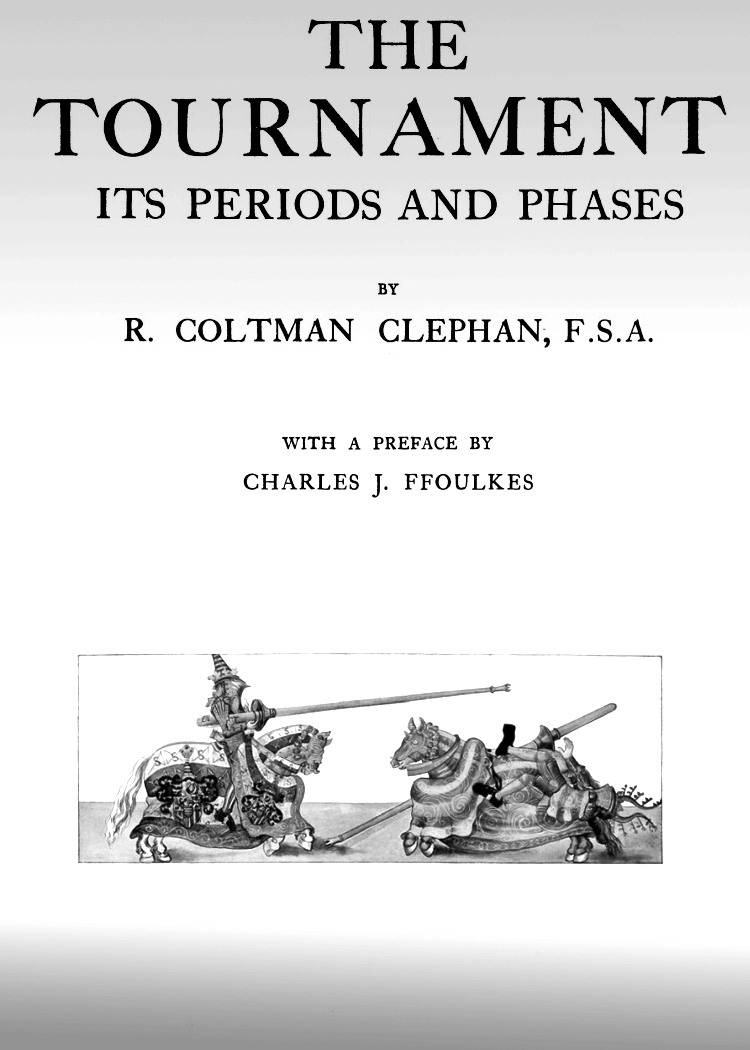
About This Book
The book traces the development and changing practice of the medieval and early modern tournament across Europe, examining types of contests, ceremonial rules, and evolving weapons and armour. Drawing on a wide range of primary sources—including Continental material rarely translated—it distinguishes myth and romanticized accounts from documentary evidence, highlights common anachronisms in illuminations and chronicles, and details how technical changes and regulations altered combat and spectacle. Chapters survey regional variations, armour construction, tilting technique, and the social and ceremonial functions of tournaments, concluding with an account of their later, more regulated and less combative phases.