
WeRead Powered by ReaderPub
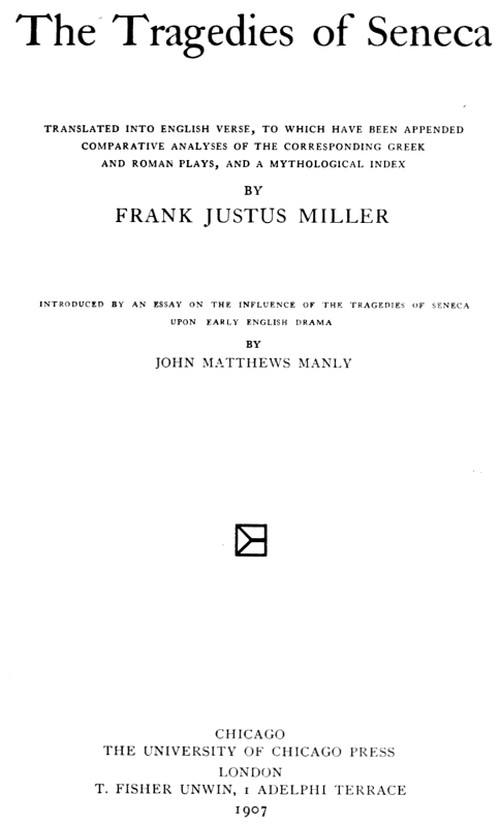
The Tragedies of Seneca / Translated into English Verse, to Which Have Been Appended Comparative Analyses of the Corresponding Greek and Roman Plays, and a Mythological Index cover

The Tragedies of Seneca / Translated into English Verse, to Which Have Been Appended Comparative Analyses of the Corresponding Greek and Roman Plays, and a Mythological Index

Chapter 75: Transcriber's Note.
Open in WeRead

Explore more books like this:

About This Book

A collected English-verse rendering of a Roman tragedian's surviving plays, presenting verse translations of major tragedies alongside an introductory essay on their impact upon early English drama. The volume pairs faithful verse translations—using English blank verse for spoken passages and adapted lyric meters for choral sections—with comparative analyses contrasting each drama with its Greek prototypes and a mythological index of characters. Editorial notes discuss textual choices and metrification, and the arrangement highlights both the rhetorical, didactic qualities of the originals and their affinities with Greek tragic models.


Transcriber's Note.

Variable spelling and hyphenation have been retained.

Minor punctuation inconsistencies have been silently corrected.

Corrections:

The first line indicates the original, the second the correction.

p. 31

  • Hating his bolts of flame at the coming of Bacchus.
  • Halting his bolts of flame at the coming of Bacchus.

p. 38

  • And not on thy acocunt hath fate
  • And not on thy account hath fate

p. 49

  • Whose hearts are fainting in your breats, behold,
  • Whose hearts are fainting in your breasts, behold,

p. 105

  • With serpent vernom, mixing all; and in the broth
  • With serpent venom, mixing all; and in the broth

p. 258

  • What honor comes from such an end at this?
  • What honor comes from such an end as this?

p. 263

  • Hercules: Whate're is great enough for woman's wrath.
  • Hercules: Whate'er is great enough for woman's wrath.

p. 338

  • Atreus: Because they were thy chidlren.
  • Atreus: Because they were thy children.

p. 501

  • See Asytanax.
  • See Astyanax.

p. 517

  • He was pursuaded by Pelias
  • He was persuaded by Pelias

Erratum

p. 512

There is no entry for Othrys in the Index