
The Project Gutenberg eBook of The Trail of a Sourdough
Title: The Trail of a Sourdough
Author: May Kellogg Sullivan
Release date: June 13, 2009 [eBook #29113]
Most recently updated: January 5, 2021
Language: English
Credits: Produced by Malcolm Farmer and the Online Distributed
Proofreading Team at https://www.pgdp.net (This file was
produced from images generously made available by the
Library of Congress)
THE TRAIL OF A
SOURDOUGH
Life in Alaska
BY
MAY KELLOGG SULLIVAN
Author of "A Woman Who Went to Alaska"
RICHARD G. BADGER
THE GORHAM PRESS
BOSTON
Copyright 1910 by Richard G. Badger
All Rights Reserved
The Gorham Press, Boston, U. S. A.
SOURDOUGH DEFINED
While the word Sourdough (sour dough) is perfectly familiar to those in Alaska and along the Pacific Coast it may not be amiss to give a brief explanation to our Eastern readers.
A Sourdough is a miner who has spent one winter in Alaska and "has seen the ice go out." Mrs. Sullivan is a Sourdough herself. In all she has made seven trips to Alaska extending over a period of ten years.
When miners are beyond the pale of civilization, with a supply of flour but no baking powder, yeast or potatoes, they cut from each batch of bread dough a little piece, to be kept until it turns sour, and then used as leaven for the next baking.
It is through this custom that the miners themselves came to be called sourdoughs.
PREFACE
This little book is my second Brain-child. The first, entitled "A Woman Who Went to Alaska," has been so cordially received by the reading public that I have been induced to send another in its footsteps. It is with great pleasure and perfect confidence that I do this.
To my Alaskan readers it is unnecessary to state that these little tales are deduced from every day life, as they are easily recognizable. To those not yet favored by a residence in this Northland I would say that I have written each tale with a well defined purpose. With truthfulness could each one have been more vividly, yes startlingly, told; but I have no wish to unduly disturb my readers. It has been my aim, however, to picture not only character, but also the vast and wonderful gold producing region, so plainly that even the young may better know Alaska, and learn somewhat from glimpses of the trials, privations and successes of its early pioneers.
To these last Trail-blazers no "Chee-chako" can ever do justice. Their courage, bravery, patience under difficulties, and stoicism under severe trial can never be properly appreciated except by their fellow sufferers.
My readers will find in the book much of the folklore and a touch of the mysticism so common to all people of the northland.
Counting myself one of the least among them I have been a witness to their struggles and triumphs, and for this reason I do most heartily dedicate this little book to the memory of each horny-handed pack-laden miner "musher" who has ever lifted a finger to assist, encourage, or strengthen the author of The Trail of a Sourdough.
The name of these helpers is Legion. That their cabins may be warm and roomy, winter dumps high and numerous, sluice boxes filled with nuggets, and lives long and happy is the earnest wish of
CONTENTS
| Chapter | Page | |
| I | The Miner's Reasons | 11 |
| II | Under the Tundra | 22 |
| III | The Hidden Ledge | 44 |
| IV | A New Klondyke | 81 |
| V | Estella the Eskimo | 106 |
| VI | Why Midas Failed | 132 |
| VII | The Old Stone House | 172 |
| VIII | A Miner's Own Story | 192 |
| IX | Eyllen's Water Witch | 214 |
ILLUSTRATIONS
| Page. | |
| The Heart of Alaska in Winter | frontispiece |
| A Huskie | 21 |
| Dressed in his fresh miner's rig | 25 |
| A welcome shelter | 43 |
| The scene on shore was a repetition of that on the neighboring beach at Skagway | 51 |
| A Messenger of cheer | 80 |
| Panning out | 105 |
| Upon his mother's back, beneath her parkie | 115 |
| The little one clinging tightly to her hand she approached the door | 121 |
| The pretty woman was a full-blooded Eskimo | 138 |
| Poling up the river | 171 |
| When Old Tillie was Young | 181 |
| She scanned the horizon | 216 |
| "Holy Mother Mary! I believe it's gold" | 223 |
| Father Peter | 229 |
| The Lord of the Northland | 258 |
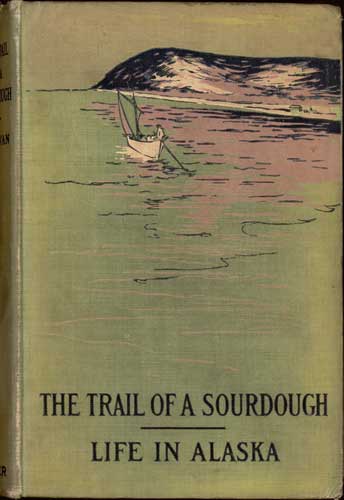
The cover design is a picture of Cape Nome, Alaska.
The Trail of a Sourdough
CHAPTER I
THE MINER'S REASONS
A furious blizzard was raging. Six or eight miners of various ages were huddled around the stove in a little road-house where they were likely to remain storm-bound for several days.
"Chuck some more wood into that bloomin' fire and fill up my pipe if you fellers want a yarn from me," said one, when they had besieged him for a story with which to pass the time.
"You wanted to know yesterday when I staked that claim for the woman, who and where she is, also my reasons for stakin' it; and I promised to tell you when I got the chance. One or two of you grumbled considerable at my stakin' for a person away in the States, and maybe when I have finished my story you won't feel any different; but I can't help it, and it is none of your —— business. The deed is done, and well done, and Rosa Nell (that ain't her name, as you can see by the initial stake if you want to dig it out from under the snow) is the half owner today of one of the handsomest quartz ledges on the whole Seward Peninsula. Walls of grey slate and trachyte, and the yellow stuff is good and plenty. Zounds, boys! I wish I had a bumper," and the speaker threw his furry cap to the ceiling.
"Never mind the bumper, pard, you know it's the last of March when no live mining camp in this country has a thing but empty bottles to bump with. Behold the size of the glass dump outside yonder if you don't believe me", remarked the keeper of the place in vindication of his house; but with sore regret in his voice.
"The story, the story! We want the story", sang out one and another by the stove, "the fire is just a whoopin' and 'twill soon be goin' out".
"Well, then, here goes," said the miner addressed. "It happened two years ago. I sold one of my Nome claims for fifteen hundred dollars with slight prospecting, (like a blasted fool that I was) and after blowin' in a good third or more of the money concluded to buy a thousand dollar outfit and go to Norton Sound. It was late in October; the storms came on, and the upshot of it was that we were ship-wrecked off the coast and were finally put in at a small camp nearly a hundred miles from where we wanted to winter. I had taken two men with me named Long and Hartley, and though we saved, by hard fightin' in one way and another, the most of our supplies, we were without shelter, except a couple of tents, with an Arctic winter—our first in this country, upon us.
"Gee-Whilikins! Boys, it makes my black hair white to think of it! What we suffered for two months in those tents was awful; for the camp was full and there was not a vacant cabin anywhere. If there had been, you know we were absolutely without money to buy or build with. How I cursed myself for havin' foolishly spent hundreds of dollars on 'box rustlers' at the Casino,—but that is another story, boys, so we'll pass it.
"In our new camp we had many Eskimos and all kinds of people. Among others there was a little blue-eyed woman perhaps thirty years of age; maybe more—maybe less. She was also evidently not where she had intended to be, just like ourselves, but was a teacher, left over from some stranded expedition, probably. Anyhow, there she was, and there we were. We a-livin' in the tents, and the thermometer forty degrees below zero. The teacher was stayin' with some of the Missionary folks only a quarter of a mile away, and she was all right.
"In December the dogs of the camp began to go mad. Every few days one or two had to be killed. Some men, you know, don't water their dogs once in six weeks, if at all, and as everything is froze hard in winter, the poor brutes go mad, exactly as in summer in the States, from heat.
"One night, Long and I smoked in the little road-house close by, but Hartley went to his bunk in the tent and turned in. He had not slept, but lay with closed eyes, he said, tryin' hard to get warm under his fur robe; when the tent flap was brushed aside, and in rushed a mad dog, snapping and foaming. At the first movement Hartley supposed we had returned to go to bed, but was instantly undeceived as the crazy brute made directly for him.
"Hartley threw out his hands and leaped from his bunk, seizing an axe that lay upon the floor. With that he made for the dog, and finally drove him from the tent; but only after he had been badly bitten in several places.
"The first we knew he rushed in, half dressed, where we were. He was pale with fright, covered with blood, and his eyes seemed starting from their sockets.
"Whiskey, for God's sake!' he pleaded, panting for breath. 'Hydrophobia, and so far from home. This is hard lines, ain't it, boys?' between gulps, the blood dripping from the hand that tremblingly held the glass.
"With that he broke down utterly and cried like a baby. We washed and dressed his wounds as best we could, and put him to bed in the road-house as it was then past midnight, while three of the boys rigged themselves in their furs and hunted the blasted brute that had done the mischief. They found him gnashing his teeth alongside an outhouse, and a good dose of cold pills settled him forever.
"Next mornin' we sent a man to the little teacher to ask for medicine for Hartley, and immediately she and another woman came over. They brought lint bandages, carbolic acid, and other things and bathed the wounds; but, best of all, they cheered up the poor fellow by telling him that he need have no fear of hydrophobia, as the bite of the Eskimo dogs in winter does not have the same effect that the bite of other dogs has in hot weather. By the repeated visits and ministrations of the women, poor Hartley, in a few weeks, recovered.
"However, the little teacher was not satisfied. She knew we must suffer terribly in our tents, and wanted us to make other arrangements. At last she thought of a plan for us: An old log school-house, long since deserted for the new one built near by, was unused except as a store-room. This building had been originally made warm and tight by moss chinking, a heavy door, and closely caulked windows. Some of the latter were now broken, and the snow sifted in upon the dirt floor, but these things could be remedied.
"The little woman had planned it all before we knew it. She had asked and gained consent of the owners before she opened her story up to us. The baggage then in the cabin was to be piled in one corner, the windows were to be mended as well as possible along with the chimney in the middle of the roof; and for a trifling consideration each month we were to have the use of the building. It was a god-send to three men only partly sheltered by canvas in January, latitude sixty-five; and if you don't believe me, boys, just try tents yourselves next winter, and find out.
"Did we spend the remainder of the winter in that old school-house? You bet we did. After puttin' considerable time on the old chimney, makin' some new stove-pipe and a patent damper of our own from coal-oil cans, and usin' the sides of some of the same in place of glass in the windows, we did get fixed some sort of comfortable. Anyhow, we had a house over our heads that could not blow down in a blizzard, and a solid door which kept out mad dogs at night. To be sure, when the spring rains came, the roof of turf, upon which the grass began to grow, leaked in several places; but we spread our canvas tent over it, weighted it down with stones at the corners, and got along finely.
"The gist of my story is still to come. One day along in February the little woman sent for me. She wanted to see me very particular, the messenger said. When I saw her a few minutes later her eyes were shinin' like stars in the night time. She wanted me to go with another man to stake a creek about fifteen miles to the north of us. She had heard from some source that the creek was good.
"Would I go the next day if she furnished the outfit? Of course I said, yes, and our plans were hastily laid for the next day. We had some trouble to get good dogs for the trip, and before our preparations were completed the whole camp was onto our racket and wanted to go along.
"Now, you know on such occasions, above all others, one does not want the whole country at one's heels, so we tried our best to shake them. We postponed our trip until the second day; the women in the meantime gettin' our grub cooked. We then took the bells off our dog collars and packed our sleds behind closed doors; but it was no go. In spite of all our precautions three dog-teams followed our trail as we slipped stealthily out of camp at midnight. The moon shone brightly and the snow was not too deep. The boys kept at a respectful distance behind us, and we mushed along between low hills mostly up the streams on the ice.
"To make my story shorter, we staked what we wanted of the creek, and let the other fellows in on what was left. After that, without sleeping, but with a hasty meal, we put back home again as fast as our dogs would travel.
"Three months later, when the snow was about gone, and we thought the time ripe for prospectin', I took my two men and an outfit and gave that blamed old creek a fair trial. We hustled and rustled to beat the band. We shovelled, panned, built dams, and worked like beavers in water above our knees. We moved our tents further up on the bank at midnight at the risin' of the creek durin' a hard rain—but, egad! after two weeks of that sort of thing, no gold could we find. Not a color! We cursed and tore around something fierce among the Queen's English, but it did not help matters a particle.
"When we reported to the little woman she would not believe a word of it. She did not think we had tried to find it. Perhaps we had not gone deep enough. We should have waited until midsummer when we could have done better work; and a lot of other things of like description. When I insisted that we had done the very best we possibly could, and that there was positively no gold there, she still persisted in sayin' she wanted that bunch of claims recorded. In vain I told her it was no use; the creek was no good, and to record the claims was a waste of money.
"While I talked, the little woman stood lookin' in an absent-minded way before her. When I had finished she turned toward me with considerable spirit, and almost with anger said, the tears comin' into her eyes meanwhile, 'I will never again ask you to stake a claim for me, so there! and she ran into the next room and shut the door.
"The claims were never recorded.
"Well, boys, she kept her word, and I wish she hadn't. I would be willin' to let her pick out creeks for me forever, for, say, let me tell you, fellows," dropping his voice and taking the pipe from between his teeth he knocked its ashes out upon the cold hearth, "that creek bed was solid stream tin; pure cassiterite, the best on the Seward Peninsula, and a whole fortune for anyone; but we did not know it.
"Next time a woman like that one tells me to do any recordin' of claims I'll do it, you bet; for somehow, I can't explain it, but there are others besides Eugene Field's kids who are good at 'seein' things at night,' and a woman can sometimes feel things that we fellows can't see in broad daylight.
"Now you have my reasons for stakin' for her yesterday. If any of you fellows want to kick at what I have done, you can just take it out in kickin'—yourselves. Our new ledge is a jim-dandy; and seem' as I cheated the woman out of her cassiterite, I'm bound to make it good in yellow gold.
"But I'm goin' to turn in now, boys, and I'll listen to you to-morrow. Good night."
CHAPTER II
UNDER THE TUNDRA
In a little three-room cabin in Nome, a middle-aged woman, wearing glasses, knitted a gray woollen sock for her boy, as she called him.
"Yes", she said musingly, "my husband and I came here during the rush of 1900. My son, Leroy, had come the year before to pave the way for us, as he called it, and this he tried his best to do. He staked some gold claims and a town lot, and put up a one-room cabin, building on to the latter after we arrived. His idea was to get his father and me away from the farm (which he hated) and start us in mining in Alaska, he being exceedingly enthusiastic on this subject and positive that we would enjoy it as well as he did."
At the conclusion of this introduction to the story the woman laid down her knitting and pushed her glasses up to the top of her head. Then with an amused expression about the corners of her mouth, she said:
"The story of all the actual mining that Pa Morrison and I ever did is not a long one, but it is one he would much rather I did not often relate. However, as you wish to hear it, and he is too busy at his book-keeping in the next room to know what is going on, I will tell you how we began mining in Alaska.
"We had landed safely upon the beach with all our necessary belongings, as well as feather-beds and pillows, also fruit-cake and other good things for Christmas. My son had met us with open arms and shown us with much pleasure to his tiny cabin on a nearby street. To this place all our boxes were in due time hauled by dog-team, and a big tent set up temporarily alongside the cabin.
"While unpacking articles to be immediately used we had not forgotten our mining tools, gold pan, picks and shovels, as well as rubber boots, and all were spread out in fine array in the sunshine beside the tent.
"Much of our clothing had been especially selected with a view to our new occupation, and there were dozens of new blue and brown denim jumpers and overalls, bandana handkerchiefs, woollen socks and shirts for Pa, as well as short, warm dresses and stout aprons for me.
"To enumerate all would take too long. Enough to say that in our anxiety to get to work at the real object of our coming, we rushed the adjustment of affairs in our camp through with all speed, and two days after landing at Nome, Pa and I started out to do some mining on our own hook upon our first gold claim."
Here the woman paused to take breath, and picking up her knitting to inspect it for a moment, seemed somewhat reluctant to proceed.
"Was the claim far from town?" some one asked, in order to bring her back to her narrative, and at the same time not to appear too anxious.
"Oh, no," she said, brightening considerably. "Leroy is always such a good and thoughtful fellow, and he had selected this cabin for us near the west end of town, close to the cemetery, on the tundra. It was only a short walk for us, he said, and the ground must, undoubtedly, be rich, as much gold had been taken out of the beach-diggings next the tundra where our claim was located.
"It was reported that the beach contained from one to three pay streaks before a depth of three feet was reached; that nuggets worth as much as twenty dollars were found in the beach-diggings, and the tundra was good pay dirt from the 'grass roots down'.
"Well, my husband and I started for the claim, as I said—we started Snake River bridge, Pa paying his ten cents toll, while I went across free as was the custom that summer, and we trudged down the road on the sandspit to the cemetery. Dressed in his fresh miner's rig, (that was an accidental pun) taken so lately from our big packing boxes, Pa marched with all the dignity a man of his height and thinness can assume, with a gold pan under one arm, and a shiny pick and shovel upon his shoulder. I followed close behind."
At this stage of the story Mrs. Morrison cast a quick glance at the door of the adjoining room where her husband was writing. Then opening a table drawer close at hand, she took out two kodak views and handed them to her listeners.
"He must not know where I keep these pictures or he would burn them as sure as fate; I have dubbed them 'before and after'."
They examined the views she handed them. A stout, resolute looking woman with a pleased expectant countenance, short dress, huge basket on right arm. The man beside her holding his broad brimmed miner's hat in his hands, his unused gold pan, pick and shovel, at his feet. For a background a tent, a bit of the river, and bridge.
In the "After" picture the scene was changed. Dejection was depicted on both faces. Their clothing was soiled and their implements had seen usage, but were now flung upon the ground in disorder.
"A friend took these snap-shots of us," she explained, returning the photos to their places, "and Leroy likes to preserve them 'just for fun' he says.
"To go back to my story, we made our way along as best we could by inquiring (for Leroy had been obliged to go to the creeks to attend to some work in progress; so could not go with us; in fact, he did not know of our intention of sallying out upon the tundra), and finally arrived at the cemetery. We spent little time in looking at the few rude head-boards and scattered mounds of those quiet sleepers by the sea, but bestowed more attention upon the beach-miners on our left. Here, at the edge of the water, and even standing in the surf, were many men at work, beach-mining with Long-Toms' or other contrivances, and all wore high-topped rubber boots.
"Looking about for the claim in which we were so much interested, we finally found the corner stakes, and the St. Charles cream can in which the location notice had been placed by Leroy a few months before.
"Then Pa wanted me to read the paper to him, which I did, after seating myself on a big hummock of tundra and properly adjusting my spectacles.
"The paper ran thus: 'We, the undersigned citizens of the United States, have discovered placer gold in the ground hereinafter described, and hereby claim for placer-mining purposes twenty acres on the tundra west of Nome and 100 feet north of the cemetery.' Then followed the distance between stakes, the name of the witness, our own names, and that of Leroy as our agent, the date of the location, etc.
"By this time Mr. Morrison was hungry. So after replacing the location notice on the initial stake under the old cream can, just as we found it, we lunched heartily on ham sandwiches, doughnuts, pie and cheese. A quart bottle of coffee had added much to the weight of the basket on the way.
"We now turned our attention to the tundra. Of what was it composed? How deep was it? Was it easily handled? Would it burn? Was it wet? And how large an extent of country, or rather territory, did it cover. These were only a few of the questions that Pa Morrison now flung at me in quick succession, leaning as he did meanwhile on the handle of the shovel.
"I grew impatient.
"'I really cannot answer your questions, Pa Morrison, and you know it; but as to the extent of the tundra I think I can safely say that it covers the whole of this gold claim and a good deal more besides, for I can see as far as the hills yonder without my glasses that it all looks alike,' and I tugged with might and main at some small trailing vines imbedded in the deep mosses.
"'As to the depth of this tundra you have the shovel in your hands and can soon investigate if you see fit to do so', I continued as Pa still stood looking dubiously about him without so much as making a jab with his shovel.
"'Then there is the composition of this tundra to be studied. If I understood the flora of Alaska I would give you the desired information quick, but I don't, and I am too old to begin to study it now. I believe, however, that I can tell a gold nugget when I see it, and if you will bestir yourself and turn up a few, I will agree to analyze them to your heart's content,' giving him what was meant to be a conciliatory smile which was entirely lost because he never looked my way.
"With that he set to work. Down into the deep moss and tangled vines of the tundra he plunged that new and shining shovel with force enough to jar the teeth out of his head. This was kept up for fully ten minutes, while I rummaged around among the hummocks for the lovely many colored mosses, and mentally tried to count the different kinds of tiny plants, numbers of which were blossoming in artistic colors and profusion under our feet.
"'Mary.'
"'Do you think a hole four feet square instead of six would be big enough?'
"'O, yes, certainly. Anything, if it is only one foot square,' said I, sarcastically, for I had a consuming anxiety to get down to those nuggets which lay 'just at the grass roots' and Pa was so awfully slow.
"We had talked this matter over the day before, and had decided upon a hole six feet square.
"'If I were in your place, Mary, I wouldn't be too smart,' said he testily, and then rested again upon the shovel handle. His face was flushed and heated. He breathed hard. Dead silence for a long minute.
"'I wish I'd brought the axe,' said he.
"'What for?'
"'To cut these beastly vines and roots with.'
"'Dear me! Shall I go home and fetch it?'
"'No, you needn't', crossly. 'By the time you got here with it you would have to go right back to get supper. It is half past one o'clock now, and I have been at work an hour.'
"'But you were going to work all day, weren't you?' He had scarcely made an impression on that tundra, and not a single nugget had we seen.
"With that he planted a few more good, hard jabs into the thicket of moss, vines and leaves, trying to get the hole four feet square anyway, after my rather uncalled for taunt about its size.
"In the meanwhile I was not wasting my time. I was using the pick upon a cluster of bunch grass hummocks, wishing to fill the gold pan with dirt from underneath that I might wash it out and see if it contained 'colors'.
"Somehow I felt more subdued like, perhaps because I was growing tired; but Pa seemed to be affected differently. I could hear him grumbling to himself, and that was a bad sign. By and by his shovel struck something hard. He uttered an oath.
"'Pa Morrison!' I exclaimed, 'Ain't you ashamed of yourself? To think of your swearing like that. It's awful! Give me that shovel instantly.'
"'I won't!'
"'Give me that shovel, I say,' for we were both church members and had been for many years, and I was inexpressibly shocked at his profanity, and wished to remove the cause.
"'Shut your head, Mary Morrison! Whose doing this mining, will you tell me?'
"'O, of course you are, but then I wanted to help you if I could,' trying to speak quietly and coming close enough to take the instrument of dispute from his hand if he would let me.
"No reply.
"'What did you strike, Pa, that made the shovel ring just now?'
"'Shovel!—ring!—It was ice! bloomin', blasted, infernal ice, I tell you,' he shouted in a rage, standing in black muck almost to his knees, with the same material bespattered over him from head to foot. Indeed his red and perspiring face showed a couple of great, black smirches with which he had unknowingly beautified himself.
"He was fairly sizzling with wrath. 'Git down here yourself, and go to work, and see how you like it,' he shouted excitedly, forgetting his English and everything but that we had encountered an astonishingly hard proposition, and it had gotten the best of us. Like an old clock he was wound up and could not stop.
"'No gold, no nuggets, no grass roots even; nothing but muck and ice!' and another mouthful of big, strong words gurgled from that man's lips like water from an uncorked jug.
"'Don't, Mr. Morrison, don't do that,' said I, in a voice cold as the ice in that four foot hole, 'you may be heard by some one who will report you to the church trustees, and then you will be expelled. At your age it would be a positive disgrace.'
"'Shut your mouth, I tell you,' he yelled, 'I ain't no baby! I know what I'm doing, and I know what I want to do, but it ain't mining on this confounded tundra!'
"At this I clapped my hands over my ears to shut out such language, but he kept on just the same.
"'Did we lease our farm for a whole year with all the machinery and stock, pack up our household furniture and come three thousand miles over this water like the blooming old idiots we are, to dig in a muckhole full of ice? Did we tell our banker that he should have the very first gold we took out of the ground to pay the two hundred dollar mortgage on our town lots? Does this look much like lifting mortgages from anything?'
"As I made no reply he insisted, 'Does it, I say?'
"'No, Pa Morrison, it doesn't,' I admitted, 'but wait a minute and let me talk.'
"'Well, ain't you talking now?' he rejoined irritably.
"Without noticing his exasperating words or tone I said calmly:
"'I remember hearing Leroy say when we first arrived that the tundra is a hard and peculiar proposition. Many have failed at mining it, but to those who go to work at it in the right way, at the proper time it will prove a bonanza. Now, probably you and I have not gone at it properly.'
"A surly silence ensued, during which Pa worked slowly, with anything but a good grace. Leroy was right. The tundra was a hard and peculiar proposition. Nothing like it had we ever seen before. For miles on three sides of us it spread itself like a carpet of green, dotted often with tiny pools of clear water, shining like glass in the June sunshine. Miles away to the northward rolled the smooth-topped hills, only one of them bearing a small, rocky crest; while further away, and forming a background to these, lay the snow-tipped Sawtooth."
To the south of us and close at hand spread the wonderful waters upon whose broad and beautiful bosom we had so lately sailed, and whose gently sweeping surf was today making sweet music among the sands and pebbles on the beach.
"Many ships lay at anchor beyond. However, it was neither the scenery, nor the water, nor the ships that we were now called upon to consider; but a layer of ice, the depth of which we did not know, lying between us and the much desired golden nuggets. The ground lay level and open to the sun, with nothing to prevent its thawing except this peculiar blanket of tundra mosses, vines, and plants, which formed an insulator as perfect as if made to order. It was now the middle of June. There was no doubt but that the ice would remain as it was all summer.
"Giant powder might possibly be used, but it was dangerous and expensive. I would never allow Father to handle the stuff. Better let it all go forever. Probably Pa was right about our being foolish to come here. We could go home again as many people were doing. There lay the steamers making preparations to sail; but how our friends at home would laugh at us!
"On the other hand was it not too soon to pronounce on this tundra, and really no fair trial of the ground or mining? Then, too, our son probably had his own plans for us which must be more intelligent ones, for had he not had some experience and a year's residence in this place?
"There were the creek claims, besides. They must surely be very different and easier to work.
"Reasoning thus I had wandered away a short distance by myself in order to let Pa's temper cool, and had forgotten the panning I had started out to do.
"I now returned. Taking up the gold pan I filled it with dirt and muck from the four foot hole taken directly above the objectionable ice, and though I found its weight almost more than I could carry, and Pa did not offer to help me in the least, I carried it to a small pool of water at no great distance and began to pan it.
"How heavy it was to be sure. There might be gold in it yet. I would see presently. I had watched men panning on the beach that morning and I believed I could do it as it appeared very easy.
"Immersing the pan in the water, after pinning my skirts carefully higher, I began the rotary motion so necessary to separate the gold from the sand and dirt. A moment of this employment and I was breathing heavily and felt very warm. I put the pan down and flung off my sun-bonnet, pulling my sleeves a notch higher before continuing. Again the rotary movement with various dips of the edge of the big pan to let the waste material pass away. Small pebbles showed themselves and had to be picked out, the heavier material sinking in the natural order of things, to the bottom.
"I was watching the outcome with great interest, though panting for breath and covered with perspiration. Suddenly the soft earth under my right foot gave way, and I found myself, gold pan and all, in the mud and water up to my knees.
"I thought of Pa and his recent profanity, but I shut my teeth resolutely together, wringing out the edges of my petticoats and pulling my rubber boot tops still higher.
"Fishing for the gold pan I brought it to light. Of course its contents were lost, my hands and clothes were muddied and my efforts wasted; but I would not give it up yet.
"Another pan of the same material was brought and a second trial was made, with success this time as the pan was not filled so full.
"Finally, after shaking, twisting, dipping, picking out pebbles, washing off sand, and resting a moment at intervals, it was finished.
"There was gold in the pan.
"A few small 'colors', bright and shining as if made so by much scouring of beach sand, appeared in the bottom of the gold pan to gladden my longing eyes, and I hastened to show them to Pa Morrison, whose head and shoulders were still visible in that four foot hole.
"'Humph!' said he, in much disgust, as I exhibited the result of my labors. 'Is that all?'
"'Why, yes.'
"'And no nuggets?'
"'No nuggets.'
"At that he flung the pick he had been using in the ice upon the ground.
"'I'm going home', he said shortly.
"Now I hardly knew whether he intended to say he was going to the United States, or to the little cabin and tent on Front Street, but rather than run the risk of exploding another bomb of wrath like the last one by asking a question, I kept quiet and made preparations to go back to our tent.
"On the beach we washed our hands and smoothed our clothing as best we could; but the frown which had lodged on Pa's forehead remained.
"That evening when Leroy had returned from his work and we had eaten our eight o'clock supper with the sun still shining very brightly upon the tent, the boy lighted his pipe and asked for the story of the day's doings.
"I then gave it from the beginning. When I reached Pa's discovery of the ice in the prospect hole on the tundra, Leroy laughed heartily. Then seeing the aggrieved look on his father's face, and, I suppose, a bothered one on my own, he became more serious, and drawing closer, took my hand in both of his.
"'I never intended you to begin mining in that way, Mother,' he said, simply, in a low voice. 'I want you here to help me keep house, to mend my clothes, to bake bread and fry griddle cakes, and do the many little things for Father and me that only you can do. In this way I can keep my health and give all my time to my mining.'
"'I want you, Father,' he continued, laying his hand affectionately on his pa's knee, 'to do my book-keeping, reckoning the time and wages of my men at work on the claims. Accounts of assessment work on twenty claims, besides new prospecting in different localities, will give you something to do after cutting the kindling for Mother; and neither of you need feel that you are useless nor idle. Part of these gold claims are yours, and in your own names, and you can both make short 'mushing' trips of inspection over the country when you like; though the new railroad up Anvil will be finished in a few weeks, and then you can ride. Under no consideration must either of you think for one moment of buying steamer tickets back to the States inside of a year. At the end of that time we will be taking out so much gold that you will not wish to leave, I assure you. I am almost thirty years old now, Mother, and you and Father are all I have,' he said softly, pressing my hand.
"Then I kissed his forehead and promised to stay, and I have never been sorry. Father said he would try it a year, and then see about staying longer, and here we are still in Nome after four years without once going 'outside'.
"And you like it here?" they asked.
"Very much indeed, because our ground is turning out finely, and Leroy is so good to us.
"About that tundra claim, however, nothing was ever done. Pa could never be induced to step his foot upon it again, and being so determined in the matter, we just let it drop.
"There it is yet, St. Charles cream can, stakes, and all; but the four foot hole, with its icy foundations, is nowhere to be seen, having been long ago levelled by wind and weather."