
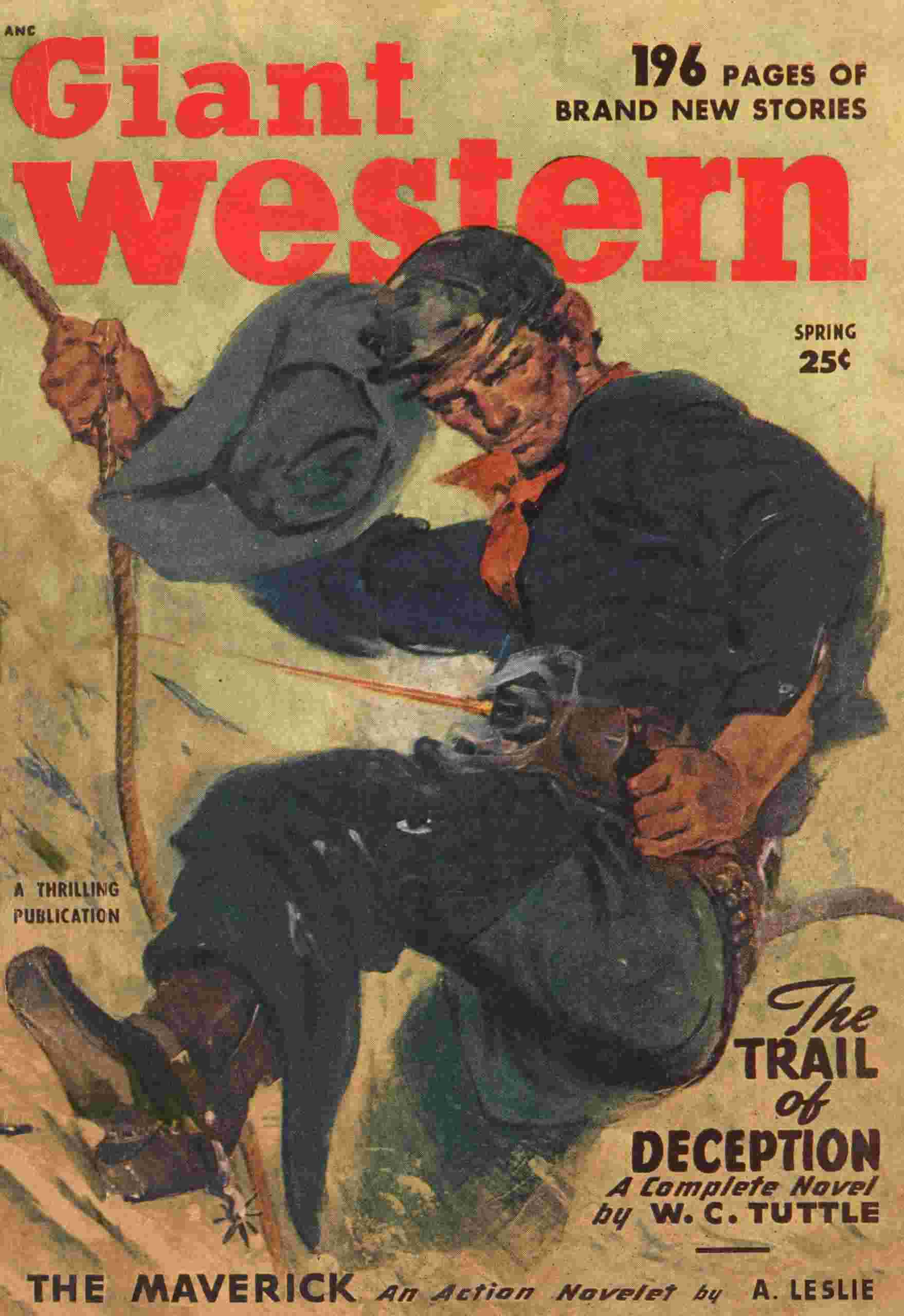
The Project Gutenberg eBook of The trail of deception
Title: The trail of deception
Author: W. C. Tuttle
Release date: October 8, 2025 [eBook #77016]
Language: English
Original publication: Chicago, IL: Best Publications, Inc, 1948
Credits: Roger Frank
The Trail of Deception
Jim Bailey was reported dead—which gave him a clear field for a profitable game!
I
Jim Bailey was thoroughly disgusted and discouraged, as he sat down on a park bench. It was nearly dark, and the lights were blinking around him. Jim was only twenty-five years of age, fairly-well dressed, fairly good-looking; an average young man, trying to buck the world.
For two days he had tried to find a job, but with no success. He had two dollars in his pocket, owed ten dollars room rent, due right now—and an assurance from the landlady that unless he produced the back rent tonight—
Jim was a bookkeeper. That is, he tried to keep books, if he could have found some books to keep.
He tried to tell himself that he would be all right, if it was not for Cliff De Haven, that doggone chiseler! Cliff was an actor—a hoofer. That is, he was when there was a job for him. When there wasn’t he shared Jim’s room, but not in any financial sense of the word. He also ate at Jim’s expense. Cliff was a hard man to insult. At least, Jim Bailey found him so. Maybe Jim didn’t use the right words.
Cliff always had a big deal coming up. Last night he had told Jim that he was all set for the biggest deal of his life and that Jim would profit thereby. Cliff chummed with a down-at-the-heel private detective named Bob Hawley. Jim hated Hawley. Often he ate with Cliff, and Jim paid the check. Yes, if he could get rid of Cliff De Haven—but what was the use?
It was about eight o’clock when Jim got off the bench and walked to his room. He simply could not pay the bill, so there was no use trying to fool the landlady any longer.
The landlady was not in sight as Jim came in. He looked into the series of pigeon-holes at the desk, took out a letter addressed to Cliff De Haven and a folded sheet of paper, on which was printed in the landlady’s familiar hand:
Dear Mr. Bailey: Unless you can pay me ten dollars tonight, I must ask you to vacate early in the morning.
Jim Bailey crumpled the paper and tossed it into the wastebasket. No use keeping it. He went up to his room, where he tossed his hat aside and sat down on the edge of the bed. The built-in wardrobe door was open, facing him as he sat, and he got up quickly and investigated. His best suit was missing, his one best shirt, his best pair of shoes. On the table was a penciled note, which said:
Sorry, old man, but I had to put on a little dog. Will see you tomorrow. Also borrowed your watch, as I needed something to make a little flash. Thanks.Cliff.
Jim threw the letter aside in disgust. It was like Cliff to do a thing like that. Suddenly it occurred to him that Cliff had neglected to empty the pockets, in which were several letters, cards and things like that. He had probably dressed and got out in a hurry, knowing that Jim would soon be back.
Jim expected a visit from the landlady, but she did not put in an appearance, so he went to bed, leaving the door unlocked. Cliff would probably show up before daylight, full of apologies and other things.
But Cliff did not show up. Jim got up about eight o’clock. He had an old suit-case, but little to put in it until Cliff came back with that suit and clothes. He went out to get some breakfast and ran into a new chambermaid at the bottom of the steps. He inquired about the landlady, and the woman said she was sick.
“Will she be here today?” he asked.
“She will not,” replied the woman. “She has some sort of infiction.”
Jim went out to the street, grinning. He said half-aloud, “I’ll bet she bit herself.”
He ate breakfast in a cheap restaurant and bought a paper, mostly for the want-ads. He glanced at the front page and his own name seemed to jump up at him. A smash-up between a truck and a street car—gasoline explosion—several people killed and injured! Only two bodies identified. Robert Hawley, a private detective. The other was, according to the police, Jim Bailey, address unknown. Partly-burned papers in his pocket and a wrist watch positively identified him. Hawley was identified by unburned articles in his possession.
Jim Bailey leaned against a post and drew a deep breath. His suit! His watch! He looked vacantly at the traffic along the street. Jim Bailey was dead—it said so in the paper. Walking in sort of a daze he went back to his room. Address unknown. He sat down on the edge of the bed and tried to realize what had happened. Jim Bailey was dead. That was a good joke.
He started to light a cigaret, then remembered the letter for Cliff De Haven. It was there on the table. There was no letterhead on the envelope, and the postmark was blurred. He opened the letter and looked it over. Cliff would never read it. It said:
You will find transportation waiting for you at the S. P. ticket office. Come to Pinnacle City and contact me at once. Office on the main street. Bob Hawley says you can do the job. Remember, your name is Jim Meade. Don’t talk with anyone, until we can get together on this deal, and don’t mention anything that Bob has told you. Wear no fancy clothes—you’re supposed to be in meager circumstances.
Jim Bailey read it twice and then sat there, an unlighted cigaret between his lips. This must have been the deal that Cliff had mentioned. He studied the postmark again and now he could see that it was Pinnacle City, Arizona. What sort of a deal was this, he wondered? Cliff was supposed to go to Pinnacle City, take the name of Meade—and what else?
Pinnacle City sounded interesting, like a small town. Jim Bailey had always lived in a big city. A sudden thought caused him to squint at the faded wall-paper of his room. Just suppose this Ed McLean had never—of course he had never seen Cliff De Haven. Bob Hawley had told McLean about Cliff. Why not take a chance? No job, no home, no ties of any kind. Jim Bailey grinned slowly.
“Wear no fancy clothes,” he quoted aloud. “You’re supposed to be in meager circumstances. Brother, you meant me!”
He took his almost-empty suit-case and left the house. There was no one in the lobby. He walked to the ticket office, where he asked about the transportation. After being shunted from desk to desk, he was sent into an office, where the man said:
“Have you anything for identification?”
Jim Bailey shook his head. “Not a thing. Oh, yes—this letter.”
It was the one sent to Cliff De Haven. The man looked at it.
“You look honest, young man,” he said smiling. “Here is your ticket, and here is the ten dollars expense money.”
Jim Bailey walked out of the office and headed for the depot.
“Good-by, Jim Bailey,” he said to himself. “I feel like a new man. Maybe I’ll just get kicked in the pants, maybe they’ll dump me into a nice Arizona jail. That is in the hands of the gods. There is one angle, though, in which I can excel—and that is in forgetting that my name ever was Cliff De Haven. If I live and prosper, I’ll send ten dollars to that landlady.”
The town of Northport is twenty-five miles north of Pinnacle City. Passengers for Pinnacle City get off the train at Northport, and take the stage. Northport itself is no metropolis, with its one street and few false-fronted buildings. Jim Bailey looked it over and decided it would be a good place to get out of at once. However, the stage would not leave for an hour, so he sat down in the little stage-depot and tried to enjoy a smoke.
The nearer he got to Pinnacle City the less he thought of this personal masquerade he was going to attend.
Northport was depressing. At least it was until a young lady came from the depot, carrying a valise, which she placed on a seat. She was little over five feet tall, with dark, wavy hair, a beautiful olive complexion, and wonderful eyes. Jim Bailey decided that there wasn’t anything wrong with those lips either. Jim Bailey admired beauty, but was woefully girl-shy. He had felt that a girl was a luxury far beyond his pocket-book.
An old timer came into the depot, grizzled, bow-legged, clad in overalls, flannel shirt and high-heeled boots. He stared at the girl for a moment and blurted:
“Mary Deal—or I’m a sizzlin’ sidewinder!”
“You’re not, Uncle Len,” laughed the girl. “How are you?”
“I’m finer’n frawg-hair, Mary. Golly, I’m shore glad to see yuh. It’s been—uh-h-h-h—Mary, I plumb forgot.”
“About Uncle Clint?” asked the girl. The man nodded.
“Why didn’t somebody send me a wire?” she asked. “Even a letter might have given me time to get here. I never knew it had happened for over two weeks after he was buried.”
The stage driver nodded sadly. “Yeah, I know,” he said. “Ed McLean was to have let yuh know, Mary. He knowed you was at college. He said he just forgot.”
“Well, I suppose it can’t be helped,” she said. “But I did want to be here, you see. After all he did for me—”
“Yeah, I know. It was too bad, Mary. Is that yore valise? I’ll put it on the stage.”
The driver looked at Jim Bailey.
“Are you my other passenger?” he asked.
“I believe I am, sir,” replied Jim.
“Good! My name’s Carson. What’s yours?”
“My name is Jim Meade.”
“Fine. Mary Deal, meet Jim Meade.”
They both smiled. Len Carson said, “I like to make my passengers used to each other. It’s a long ways to Pinnacle City.”
“Can’t I ride on the seat with you, Uncle Len?” asked Mary.
“I’d shore love to have yuh,” replied the driver, “but I can’t. Company passed a rule agin it, Mary. Four, five weeks ago I had a whisky drummer on the seat with me. Hit a chuck-hole and lost m’ drummer. Hung him up by the seat of the pants on a manzanita snag, ten feet down on the side of Coyote Canyon. If he hadn’t been wearin’ awful tough britches, I’d have lost him. He sued the stage company for ten thousand dollars, but they settled for a hundred and a new pair of pants. Sorry, but I cain’t take chances, Mary. Women’s clothes wouldn’t hold up nothin’, snagged on a manzanita.”
Mary laughed and got into the old stage. Jim followed her in, and the stage headed for Pinnacle City. Len Carson was a wild driver, but he had never wrecked a stage. It was the first time that Jim had ever ridden over a road like that, and it rather frightened him, but Mary only laughed.
“Why are you going to Pinnacle City?” she asked.
“I don’t know,” replied Jim. “My plans are rather vague.”
“I haven’t been there for over eight months,” she said. “I’ve been away to school.”
“Is your home in Pinnacle City?” he asked.
“It was,” she replied. “I don’t know what will happen now.”
Jim looked at her curiously, and she explained.
“I have no father or mother. Clint Haverty adopted me several years ago. He was wonderful to me. He died a few weeks ago, but no one notified me in time to attend his funeral. I came as soon as I heard about him.”
“That wasn’t a fair deal,” said Jim.
“No, it wasn’t.”
“Was he a relative?”
Mary shook her head. “No, we were not related in any way. Uncle Clint knew my mother, and when she died I went to live at the Lazy H. But he’s dead now and I don’t know what will happen.”
“Has he any relatives?”
“He has two cousins in Pinnacle City, Ace and Dick Haverty. They own the Box Four H outfit. Uncle Clint never liked them.”
“This Box Four H and the Lazy H, and all that is Greek to me,” confessed Jim. “I have never been out of a city in my life before. I suppose they are places where cattle are raised.”
“That’s right, Mr. Meade. You’ll soon learn. Have you ever ridden a horse?”
“No, I never have. Is it difficult?”
“I don’t know,” said the girl smiling. “I’ve worked with horses ever since I can remember. You will learn—the hard way.”
“Everything I have ever learned was the hard way,” Jim admitted.
II
In spite of the dust and the rough road, the ride to Pinnacle City seemed short to Jim Bailey. Pinnacle City was booming with some new mining strikes. Jim left his valise in the stage depot and located Ed McLean’s office.
The lawyer was short, fat and nearly bald. Seated behind his desk, he looked at Jim Bailey thoughtfully. This young man didn’t exactly look like ready money.
“Well, young man, what can I do for you?” he asked.
“I am Jim Meade,” replied Bailey soberly.
McLean twitched visibly and his pale-blue eyes blinked.
“Jim Meade?” he asked. “You—uh—ah, yes, Jim Meade. Well, I—”
“I am answering your letter,” explained Jim.
“Oh!” the lawyer’s relief was explosive. “For a moment, I had an idea—sit down! I want to look at you. Hm-m-m-m. You don’t look very prosperous, but that is good.”
McLean leaned back in his chair, an expression of satisfaction on his face. Apparently Jim Bailey met with his approval.
“You’ll do,” he half-whispered. “Have you met anybody—talked with anybody?”
“I met a girl on the stage. Mary Deal.”
“Did she come in this morning?” asked McLean quickly. “I was expecting her, but I didn’t know when she was coming. Did she talk with you?”
“Yes, some. I told her my name was Meade.”
“Hm-m-m! Still, that name wouldn’t mean anything to her.”
“You were expecting her?”
“Yes—I wrote to her. But forget girls. This deal is a big one, and we can’t afford to miss out on it, my friend. How are you fixed for funds?”
“I am not.”
“I see. Well, go easy. Here is fifty dollars. Your room will not cost over a dollar a day. Don’t drink, don’t gamble. Let me handle everything. And above all, don’t try to explain anything.”
“Isn’t that a rather ridiculous order?” asked Jim. “After all, what could I explain?”
“True. But if anybody asks you questions about where you come from and what you are doing here—evade them.”
“When do I learn what this deal is all about?” asked Jim.
“Didn’t Hawley tell you anything about it?”
Jim shook his head, wondering if Hawley should have told him.
“Does Hawley get a cut out of the deal?” he asked.
“I’ll take care of Hawley. As soon as we can get together, I’ll explain everything. Too many people come in here. I’ll get in touch with you tonight, if I can, and we’ll go into the deal.”
Jim got his suit-case at the stage depot and secured a room at the hotel. He signed the register with the name of Jim Meade, and gave his address as San Francisco. The lobby was full of roughly-dressed men, some of them wearing chaps and spurs—and guns. Jim Bailey didn’t like that idea. He stopped at the top of the stairs and saw several of them examine the register.
“I feel like a criminal,” he told himself, “and I haven’t done a thing—yet.”
The food was good in the little restaurant, but Jim spent most of his time watching the people. In all his life he had never seen as many hard-looking men, but they seemed good-natured, having a good time. There were cowboys, cattlemen, miners, prospectors, and a sprinkling of dapper-looking gamblers. Just after dark he met Ed McLean on the street.
“I’ve been looking for you, Jim,” the lawyer said. “We can’t talk tonight, but I typed out some stuff for you to memorize. Put this in your pocket and study it in your room. See you tomorrow.”
Jim went back to his room and studied the paper. It read:
You are Jim Meade, born twenty-seven years ago in Denver, Colo. Your mother was Gale Haverty, your father was Henry Meade. He was a small merchant, and died fifteen years ago. Your mother died nine years ago. You heard vaguely of relatives in the Pinnacle country, and came here, hoping to get work.
Jim studied the few lines carefully. It still didn’t make sense. He repeated it over to himself several times, tore the note into small pieces and sifted them out the window, where they blew away in the breeze.
“Haverty?” queried Jim to himself. “That’s the name of the man who died and left the big ranch—the one Mary—” He stopped and thought things over. “But where does Jim Meade enter into the deal? Maybe Jim Bailey is getting in over his head. Well, I’ve got to know a lot more about it than this, before I get excited.”
Mary Deal sat on the big porch of the Lazy H and talked things over with Tellurium Woods, the old cook, who had been there for years. Tellurium was as wide as he was high, and he was only five feet, three inches tall. Except for a tuft above each ear, Tellurium was as bald as a billiard-ball.
“You’ll jist have to blame Ed McLean for not bein’ told about Clint dyin’,” sighed Tellurium. “I reckon he was too busy to do much thinkin’. Ed McLean and the Cattlemen’s Bank are the executioners of the will, which ain’t been read yet. I heard it was to be read tomorrow. You’ll get the Lazy H—that’s a cinch. Clint wouldn’t give Ace and Dick Haverty the sleeves out of his vest.”
Mary had no comments. A rider came up to the ranch-house and drew up at the porch. The rider was tall and thin, with a long, rather humorous-looking face. He took off his sombrero and grinned at them.
“I’m lookin’ for the ramrod of this spread,” he said quietly.
“If I ain’t mistaken, pardner,” replied Tellurium, “you’ll find Tex Parker down around the corrals.”
“Much obliged, mister—and ma’am,” he said soberly, and rode down across the yard.
“There goes Arizona,” said Mary.
“Huh? I didn’t git it.”
Mary laughed. “When I was at school, I thought of Arizona a lot, Tellurium—and Arizona was always a tall cowpoke on a long-legged horse, squinting into the sun.”
“Yeah, I know what yuh mean. That hombre looks like real folks, and he packs his gun low and handy. I like his grin.”
The tall cowboy found Tex Parker at the stable. Tex was a raw-boned cowboy, hard-faced, with little sense of humor. He sized up the stranger questioningly.
“Yo’re Tex Parker? Good! I’m knowed as Skeeter. Smith is the last designation. Glad to meet yuh.”
Skeeter Smith dismounted and leaned against the fence. “What can I do for yuh, Smith?” asked the foreman.
“A job,” replied Skeeter. “I was up in Pinnacle City, kinda askin’ around, and somebody told me that the bank was runnin’ the Lazy H; so I went to see the head-man of the bank, and he said you was startin’ a roundup next week.”
“I see,” said Parker. He didn’t like the idea of the bank taking things over like that. After all, nothing had been settled.
“I’m just a pilgrim,” said Skeeter. “Kinda moseyin’ around all the time, lookin’ at things and places. Right nice lookin’ spread you’ve got here. I’ve been rated as a top-hand with cows.”
Tex Parker smiled. “You pack yore gun awful low for jist a pilgrim,” he remarked.
“Long arms,” said Skeeter soberly. “Kinda lazy, too. Hate to have to crook m’ elbow too much. How about a job for a while?”
The foreman nodded. “All right, Smith. I’ll show yuh a bunk, and you can dump yore war-bag. Start workin’ in the mornin’.”
“Right nice and pleasant of yuh, Parker. Thanks.”
Skeeter Smith left his war-bag in the bunk-house, got on his horse and headed back for Pinnacle City. Tex Parker was thoughtful, as he went back to the stable.
“I’d like to know who that rannahan is,” he remarked to himself. “Pilgrim! Oh, well, all I want is a good cow-hand—and he talks like a good one.”
On the porch Tellurium and Mary were talking about Len Carson, the stage-driver.
“Ol’ Len’s a character,” laughed the cook. “I think he was exaggeratin’ about the drummer. I don’t believe he ever fell into Coyote Canyon. I heard the drummer made a derogatory re-mark about some woman in Pinnacle City, and Len knocked him off the seat. Didja hear about Len gettin’ held up? No?
“Yeah, that happened about a month ago. Two fellers stuck up the stage. Got away with some gold from the Santa Isabella mine, and some registered mail, I heard. Had masks on. Len wasn’t able to say who they looked like.”
“Len never told me about it,” said Mary. “In fact, we didn’t have much chance to talk.”
“You mentioned a passenger named Meade,” said Tellurium. “Yuh know, I’ve been thinkin’ about that name, and I kinda remembered Clint speakin’ of somebody named Meade. It seems to me that it was some relate of his’n, but I can’t be sure.”
“I suppose there are a lot of people by that name,” said Mary.
“Yeah, I reckon there must be. Well, I’ve got to start cookin’.”
Tellurium bow-legged his way into the house, headed for the kitchen. He whistled off-key, but with enthusiasm.
III
Jim Bailey’s first night as Jim Meade was fraught with bad dreams and bed-bugs. Stampeding cattle and bucking horses trampled him into the dust while Mary Deal hung suspended over the side of a cliff, her skirt twisted into a manzanita snag. Jim wanted to be a hero, and save her, but his former landlady showed up and chased him through the brush. However, the bugs were very real.
The bank had notified Ace and Dick Haverty to come in at ten o’clock that morning to listen to the reading of Clint Haverty’s will, and they were in, dressed in their Sunday clothes, looking very uncomfortable. They were a hulking pair of unshaved, unwashed cattlemen, expecting nothing from the estate of their uncle.
Ed McLean, the attorney, was there. No one had invited Mary Deal. Thomas Estabrook, the white-haired banker, was there, grim-visaged, as became a banker. Ed McLean, after a short preamble extolling the virtues of Clinton Haverty, opened the sealed envelope. The will was short and to the point, witnessed by the postmaster and the proprietor of the hotel.
It left the Lazy H ranch—buildings, furniture, all live-stock and money in the bank—to Jim Meade, son of his sister, Gale, and Henry Meade, last heard of in Denver, Colorado. It gave Ace and Dick Haverty each a silver dollar, but did not even mention Mary Deal. Mace Adams, the grizzled sheriff of Pinnacle City, was in at the reading.
“I have never heard of Jim Meade,” Estabrook said. “Didn’t Clint say anything to you about him, Ed?”
“I asked him about Meade, when he signed the will,” replied the lawyer. “He said, ‘It is up to you to find him.’ I have no idea where to look, Mr. Estabrook. Of course, we can—”
“Wait a minute!” exclaimed the sheriff. “Meade? Why, there’s a stranger at the hotel, and I’m sure he signed that name.”
“That,” said McLean, “would be a coincidence.”
“That would be my opinion, too,” said the banker meaningly.
The sheriff found Jim Bailey at the hotel, sprawled in a chair, reading an old paper.
“Your name is Meade—Jim Meade?”
“Why yes,” nodded Jim. He saw the insigna of office on the sheriff’s vest, and swallowed painfully.
“Come up to the bank with me,” said the sheriff. “If your name is Meade, we need you.”
Jim Bailey got slowly to his feet. “The—the bank hasn’t been robbed, has it?” he asked haltingly.
“Not yet,” smiled the sheriff. “This is about a will.”
Jim Bailey went with him. The presence of Ed McLean was reassuring, at least. The two Havertys looked at him indifferently.
“He says his name is Jim Meade,” announced the sheriff.
“I see,” mused the banker. “Your name is Jim Meade?”
Jim Bailey nodded. “What is all this about?” he asked.
“Do you claim that you are the nephew of Clinton Haverty?” asked McLean pompously.
“Clinton Haverty?” parroted Jim. “Why, I—I don’t know.”
“You don’t know?” snorted the banker. “What are you doing in Pinnacle City, young man?”
“I happen to be minding my own business,” retorted Jim hotly. He didn’t like the attitude of Thomas Estabrook, and showed it.
“Let me handle this,” suggested the lawyer. “We understand that you are Jim Meade. The question is—are you related to the late Clinton Haverty?”
“I told you that I don’t know. I have heard that I had some relatives in this country, but I don’t know their names. I came here, looking for work.”
“What sort of work?” asked the banker.
“I am a bookkeeper.”
“Where and when were you born?” asked McLean.
“In Denver,” replied Jim. “I am twenty-seven.”
“That checks,” said McLean. “What was your mother’s maiden name—her first name?”
“Gale,” replied Jim quietly. The effect was good. “My mother died about nine years ago.”
It suddenly occurred to Jim that it was ridiculous for him not to know that his mother’s name had been Haverty, but no one asked him.
“What was your father’s given name?” the banker asked.
“Henry,” replied Jim Bailey. “He died fifteen years ago.”
The banker sighed and looked at McLean, who was lighting his pipe.
“What is this all about—or am I not supposed to know?” Jim demanded.
“Young man,” replied the banker, “Clinton Haverty died a few weeks ago and the bulk of his holdings have been left to a Jim Meade, who was born in Denver, twenty-seven years ago. It is very coincidental that you should come here at this time, but your answers seem definite. Of course, this will cannot be probated for a while, at least until the judge recovers from an illness. The court will, of course, demand all possible proof before accepting you as the legal heir to the Lazy H. The reading of this will was held up by me until such a time as Mary Deal could be present. I supposed, of course, that she would be mentioned. However, Mr. McLean neglected to tell me that she was not included.”
“I don’t know what to say,” said Jim Bailey. “I had no idea of anything like this. It rather—er—floors me, gentlemen.”
“All we git is a silver dollar apiece, eh?” grunted Ace Haverty. “That wasn’t worth ridin’ in for!”
“In these clothes, too!” added Dick Haverty.
“You didn’t expect he’d leave you anything, did you?” asked the banker curiously.
“Not ’less he had some loose debts hangin’ around,” replied Ace. Dick roared with laughter, slapping his leg.
“That’s a good’n!” he gasped. “Ace, yo’re a dinger!”
“I believe that is all, gentlemen,” said the lawyer. “Nothing more can be done until the will is offered for probate.”
“How about giving Meade a job in the bank?” asked McLean. It would do away with the problem of expense money.
The banker shook his head.
“There is no opening,” he replied, “and if there was, I’d have to know a lot about a man—a lot more than we know about Mr. Meade.”
Jim Bailey went back to the hotel, feeling that the banker was suspicious. Jim knew now what McLean’s game was and wondered just what he would have to do for McLean, in case he got the Lazy H. But Jim was not without certain fears. If they ever did discover his real identity, or prove that he was not Jim Meade—Jim Bailey didn’t like to think about it. He was anxious to have a long talk with Ed McLean, but realized McLean had to be careful.
It didn’t take long for the news of the will to become known. The general opinion was that Clint Haverty had done entirely wrong in not including Mary Deal in the will. As far as the two Haverty boys were concerned, they got too much. Tellurium Woods, the Lazy H cook, and Archie Haas, horse wrangler, came to Pinnacle City after dark. These two had stayed away from liquor up to the limit of their ability. They met with Cactus Spears, the deputy sheriff, who was a fraternal soul, dogged by thirst. Cactus was small, wiry, with a long nose and inquiring eyebrows. Archibald Haas was a long-armed, big-footed person, whose I.Q. was just below zero, but companionable. These three entered the Antelope Saloon and spaced themselves closely against the bar.
They drank soberly and solemnly, bowing to each other before each drink. Sam Ballew, the bartender, looked upon them with evident apprehension. They had started this way before and ended up in a blaze of glory.
“I unnerstand the Lazy H is roundin’ up t’morrow,” Cactus said.
“Thaz true,” replied Tellurium. “We’ve gotta count all the li’l dogies. The bank wants it.”
“Wha’ they goin’ do with ’em?” asked Archibald, “Put ’em in the shafe?”
It wasn’t funny. Even the bartender didn’t laugh.
“I shuppose you have heard ’bout Mary not bein’ mentioned in Clint’s will,” Cactus said.
“Heaven’s m’ home!” gasped Tellurium. “You mean— Cactus, old friend, yo’re lyin’ to me. You mean—yuh do?”
Patiently Cactus told them of the will and its contents. Archibald cried on the bar, but Tellurium, built of more solid fiber, cursed the name of Meade. In fact, he went back far beyond the immediate ancestry of Jim Meade, and laid the family tree out cold. When he had finished, or rather, run out of wind, Cactus added:
“If that gallinipper thinks he can come here and take things away from that li’l gal—he’s mishtaken.”
“Absholutely and positive,” agreed Tellurium. “We’ll run him out of here sho fasht that it’ll take sheven days of brill’nt shunshine to let his shadder catch up with him.”
“I vote f’r immediate mashacree,” piped up Archibald.
“Oh, yo’re jus’ im—im—petuous,” said Cactus. “Tha’s all—jist an ingpetuous pershon. Ol’ impetuous.”
“I’m Archibald,” corrected the horse-wrangler.
“Gotta go eashy,” warned Tellurium. “Might scare him. Wait’ll he goes to bed. Then we’ll schneak in on him.”
“Tha’s shenshible,” agreed Cactus. “Then what’ll we do to ’im?”
“Don’t rush me,” replied Tellurium. “I’ve got wonnerful ideas, but don’ rush me, Cactus. Let’s have ’nother dram.”
They had several. Luckily Mace Adams, the sheriff, didn’t find his deputy. He had warned Cactus to keep away from strong drink. It impaired the dignity of the office. It didn’t help Cactus’ own dignity either, because he became more bow-legged than ever. But they had decided to visit the iniquities of Clint Haverty on the victim of his choice.
“’F I didn’ do shomethin’,” declared Tellurium, “I could never look that sweet young lady in the fasch again.”
“I’m with you to the bitter end,” declared Cactus.
“Bit ’er end?” queried Archibald. “Esplain it to me, Tellurium.”
“Have ’nother drink, Archibald,” invited Cactus. “You’ve got to be drunk to obscure yore natural stupidity. Yore natural reshources are depleted, don’t-cha know it.”
“I’m jus’ a horsh-wrangler,” sobbed Archibald.
“Well, jus’ don’t tell the horshes, or you’ll have trouble with ’em.”
“The horshes know me,” said Archibald.
“Don’t get too familiar with ’em,” advised Cactus. “The firs’ thing you know they’ll be wranglin’ you. Have drink?”
“It makes me sick, thinkin’ about Mary,” said Tellurium.
“Don’t worry,” advised Cactus. “We’ll do her proud.”
Jim Bailey was getting ready for bed, when his door banged open and the three men came in. Cactus had a gun in his hand, waving it in wide circles, while Tellurium had a lariat-rope. Archibald was too drunk to more than lend his moral support to the project. Jim Bailey was clad in some old pajamas, and it might be recorded that the entrance of these men frightened him.
“Schtop runnin’ ’round like that!” Cactus ordered.
“I’m not moving,” assured Jim Bailey.
“Good!” grunted Tellurium, shaking out the loop.
“What’s the matter with you?” asked Jim. “What have I done?”
“It’s that will,” explained Tellurium. “You ain’t gonna git it, I’ll tell yuh that. This is yore finish, Misser Meade.”
Tellurium suddenly flung the loop. Perhaps Tellurium’s sense of direction was no better than Cactus’, because the loop missed Jim Bailey by three feet and circled the lamp on the table. The next moment the room was as dark as a dungeon.
For the next twenty seconds or more, there was only the sound of strong men in mortal combat, the crash of a chair, the upsetting of the table. Then Tellurium’s voice rang in triumph.
“I’ve got him! C’mon, grab the rope, and we’ll drag him out.”
Willing hands helped him in the dark. They yanked the door open, dragged their struggling victim the length of the dark hall and down the stairs. It was a soundless voyage, except for the scuffling feet, the dragging of the victim. Old Hank Voigt, the hotelkeeper, gazed in open-mouthed wonder, his glasses balanced on the end of his long nose, as they came down the stairs.
The three men were almost at the bottom of the stairs, before their victim, roped around the legs, came bumping down behind them, taking the brunt of the bumping on that part of him designed by nature for such things as bumps.
Cactus backed over a chair and went sprawling, and the other two ceased hauling when the victim landed on the floor-level.
“Wh-what’s goin’ on here?” blurted Old Hank. “What’s Archibald done?”
Tellurium leaned against the desk, panting wearily, blinking. Beside him, hanging onto the rope, was Jim Bailey, his pajamas flopping. At the foot of the stairs sat Archibald Haas, his two legs roped, a pained expression on his face, together with a fast-swelling eye. Cactus got slowly to his feet. Tellurium stared at Jim Bailey, looked over at Archibald and said:
“Didja ever see such hair on a dog?”
“Dog?” queried Jim Bailey blankly.
“You!” snorted Tellurium. “What’r you doin’, hangin’ onto that rope, feller?”
Jim Bailey swallowed heavily. “You—you said, ‘Grab the rope,’ and I—I grabbed.”
“Who hit me?” asked Archibald, getting loose and to his very unsteady feet. “I crave to know who hit me—that’s what I’ve got a cravin’ t’ know.”
Cactus sat down in a chair, tears running down his cheeks. Tellurium shrugged helplessly, while Jim Bailey leaned against the counter and tried to reason out a few things. Hank Voigt said:
“Young feller, you better go back and hide yore shame. There’s a two-foot rip in the back of them drawers.”
Jim Bailey went up the stairs in nothing flat, clutching at his rear. Tellurium looked Archibald over critically.
“Archibald, if yo’re through foolin’, we’ll go home,” he said.
“I’d love it,” said Archibald soberly. “Yuh know, when I’m in the city I jist cain’t re-lax.”
Jim Bailey went back to his room, righted the table and managed to light the lamp. The chimney was broken, but the rest of the lamp was all right. Some oil had spilled, and the place smelled of kerosene, but Jim was too upset to care. Those men might have killed him.
He could not quite figure out just why he helped them haul Archibald Haas down the stairs. Perhaps he had been a bit confused. He was about to blow out the guttering lamp and go to bed, when someone knocked softly on his door.
It was Ed McLean, the lawyer. He glanced at the lamp, sniffed disgustedly and sat down.
“I came up the back stairs,” he explained. “Didn’t want to be seen coming up here. What happened a while ago? I heard Cactus Spears trying to explain it to the sheriff.”
Jim Bailey told him what his experience had been, and McLean’s comment was, “Drunken fools!”
“Not too drunk,” corrected Jim nervously. “I don’t like it. What is this deal, McLean? I am beginning to realize that you want control of this estate—but what do I get?”
“Keep your voice down,” warned the lawyer. “These walls are mighty thin. You get control of the Lazy H. After that, I get financial backing and buy you out. Simple, isn’t it?”
“You buy me out, eh?” said Jim quietly. “How much?”
Ed McLean looked narrowly at Jim. Maybe this wasn’t as easy as it had looked.
“How much do you expect?” he asked.
“All I can get. Tonight has proved to me that I am not here for my health.”
“Oh, they were just drunk.”
“You die just as dead when a drunk kills you, McLean. What about this Mary Deal?”
“She has no legal claims. She wasn’t even legally adopted.”
“I’m not talking about that. Why didn’t this Haverty person name her in the will?”
McLean shrugged his shoulders, and Jim continued:
“That banker is suspicious, McLean. The will should have been read two weeks ago. Me being here right on the dot is a coincidence that the banker doesn’t want to swallow. And another thing I’d like to mention. If that banker stops to think things over, he’ll realize I should have known that my mother’s maiden name was Haverty. Me knowing I had relatives around here and not knowing the name!”
McLean scowled thoughtfully. “Bob Hawley said you were dumb,” he remarked.
“I am, McLean. If I wasn’t I’d leave here tomorrow. Just what will I make out of this deal?”
“Ten thousand dollars.”
“I see. From what I can learn, listening around, there must be more cash than that in the local bank. The ranch and cattle are worth over a hundred thousand. There was something else. I heard two men talking in the lobby and one said, ‘The best gold prospect of them all is located on the Lazy H.”
“A prospect doesn’t mean a paying mine,” said McLean.
“Taking it all in all, isn’t ten thousand small money for my share of the deal, McLean?”
“All right,” said the lawyer grimly. “How much do you want?”
“At least half.”
“Ridiculous!”
Jim Bailey shrugged. “Fifty percent. Without me you are lost.”
Finally the lawyer nodded. “All right. I’d like to punch Bob Hawley right in the nose.”
“He would probably take it lying down,” said Bailey dryly. “You make out the papers, McLean.”
“Papers? You—do you—wait a minute! You mean papers on our agreement?”
“Why not?” asked Jim. “I’m afraid we don’t trust each other.”
“We better!” snapped the lawyer, getting to his feet. “There will be no papers.”
“Suit yourself. I might claim more than fifty percent. In fact, I might take over the whole of the estate.”
“Listen, my friend,” warned the lawyer, “you play the game my way or you won’t get anything. I’m not threatening you—I’m merely stating facts. Accidents happen. Think it over, and I’ll talk with you later. Doublecrossing won’t pay dividends in this part of the country.”
McLean walked out and closed the door. This time Bailey locked it and went to bed. He pounded the pillow into shape and lay down. He wasn’t in the habit of talking to himself, but he did say:
“Cliff De Haven, I don’t wish you any bad luck, but I do wish you had lived to take over this job.”
IV
Clint Haverty had told Mary one day that she did not need to worry about her future and he had not even mentioned her in his will. She had nothing now, but she did not complain. Clint Haverty had been more than generous with her, and she was very grateful. The crew of the Lazy H had finished up their first day of the spring count, and the new man, Skeeter Smith, had proved himself a good worker with cattle.
Late in the evening, after the men had eaten, Skeeter drifted around to the front porch, smoking a cigaret, and found Mary sitting there alone.
“Hello,” she said.
Skeeter sat down on one of the steps.
“It’s shore nice around here, Ma’am,” he said.
“I love it,” she said quietly. “It has been my home for eight years. I love the sunsets, the sunrise and the moonlight.”
“They’re pretty,” he admitted. “The boys was tellin’ me about the readin’ of that will, and I’d like to say that I’m sorry.”
“Thank you, Mr. Smith,” she said simply.
“Folks don’t call me mister—I’m Skeet.”
“They don’t call me ma’am either.”
“I reckon we’re even.”
“Is your home in Arizona?” she asked.
“Home? No, I haven’t any home—Mary. Wherever I hang my hat. I’m sort of a pilgrim I reckon.”
“I’ll have to be a pilgrim now, I suppose,” said Mary. “I can’t make this my home much longer. As soon as the will is probated the new owner will take over the Lazy H.”
“Yeah, I reckon that’s how they do it. Life’s a funny thing. Yuh never know what you’ve got—not for sure. Where will yuh go?”
“Oh, I suppose I can find a job—maybe.”
“Yeah, I reckon so. Still, a woman can always marry somebody, and not have to work.”
“I haven’t given much thought to marriage,” she said.
“I didn’t dare to,” grinned Skeeter. “Have you ever seen the feller they’re givin’ the Lazy H to?”
“I came in from Northport on the stage with him.”
“Yeah? What sort of a feller is he, Mary?”
“Oh, just—well, I’d say he was average—as far as I could see. I didn’t know he was the heir to the Lazy H at that time.”
“City feller, I suppose.”
“Oh, yes. He said he had always lived in a city.”
Dell Howard, one of the cowboys, came around the corner.
“Skeet, do yuh want to ride to town with me and Dan?” he asked. Skeeter got to his feet.
“I’ll be with yuh, Dell,” he replied, and to Mary he said:
“Keep yore chin up, Mary. Speakin’ as a drifter, the things yuh worry most about never happen. A feller died once and willed me his socks, but I never got ’em.”
“What happened to them?” asked Mary.
“Oh, nothin’ much. They buried him with ’em on before they read his will. See yuh later.”
Going up the street in Pinnacle City that evening, Skeeter Smith and Dell Howard found Cactus Spears and Jim Bailey talking in front of the hotel. Dell introduced Skeeter to Cactus, who in turn introduced Jim to them.
“Meade, eh? So yo’re the heir to the Lazy H?” Dell asked.
“That’s what they say,” replied Jim. No one had any comments, nor anything else, it seemed to Jim. Dell said:
“I’ll go to the postoffice, before it closes, Skeet,” and went on.
“Glad to have met yuh, Smith,” Cactus said. “I’ve got to go to the office.”
That left Jim Bailey and Skeeter Smith together.
“This happens all the time,” Jim said. “As soon as they find out who I am they leave me alone. They resent me.”
“Don’t feel too bad about it,” advised the tall cowpoke. “If you can prove that yo’re entitled to the property, I don’t see what they can do about it.”
“Something happened last night,” said Jim soberly.
“Yeah, I heard about that at supper tonight. Tellurium was tellin’ us how Archibald got his black eye.”
“It wasn’t funny—not to me.”
“You was prejudiced,” grinned Skeeter.
“One man threatened me with a gun.”
“Yeah, I reckon he did. But that’s nothin’, he didn’t shoot. They resent you takin’ over the Lazy H of course. But if you are entitled to it, why worry? They’ll make yuh prove it.”
“But suppose the court won’t accept my proof?” asked Jim.
“That,” replied Skeeter seriously, “would be too bad. Folks in this kind of country believe the court is right.”
“What do you mean?”
“If the court says yo’re a fraud—they’ll hang yuh.”
“They wouldn’t do that!” exclaimed Jim.
“My friend,” said Skeeter earnestly, “there’s boot-hills made up of tombstones of men who made that same remark and believed they were right. This is no country to doublecross the people. I’ll see yuh later, Mister Meade.”
Jim went back into the hotel and sat down. That was the second warning he had received on a double-cross. If he double-crossed Ed McLean he’d suffer, and if he double-crossed the people, they’d hang him.
“Fifty percent is entirely too little for my job,” he told himself. “I should get it all—and a bonus.”
Still, he mused, fifty percent of a hundred thousand dollars was an awful lot of money. And then the thought struck him that Ed McLean had been all too quick to agree to a fifty-fifty split. It wasn’t what a lawyer would do. Offer ten percent, and then agree to a fifty percent. There was something fishy about the whole thing. Of course, he could understand why McLean did not want any written agreements.
Jim was very careful to lock his room that night, but no one came to mar his slumber.
It was after ten the next morning when Jim Bailey came down from his room. It was very hot in Pinnacle City, and the little hotel lobby was deserted. Jim flung his key on the desk and had turned toward the door when he heard a sound that was very much like a partly muffled shot.
Through the open doorway he could see several men over in front of the Antelope Saloon, looking across the street. Two of them started to cross the street, traveling at a fast pace. At that moment Hank Voigt, the hotelkeeper, skidded around to the entrance of the hotel, and fairly fell into the place.
“Bank robbery!” he exclaimed. “Bank robbery!”
He caught his balance and looked at Jim Bailey.
“Well, do somethin’!” he barked at Jim.
“Do what?” asked Jim, watching more men run from across the street. Hank flopped his arms helplessly.
“Shot at me,” he said in amazement. “Imagine that, will yuh?”
“I shall try, Mr. Voigt.”
“Well—good! You’ll— There goes the sheriff!”
Jim Bailey walked out and went up to the bank, where a goodly crowd had gathered.
Cactus Spears was trying to keep them out of the bank.
“Thomas Estabrook is prob’ly dead,” he reported. “We’ve sent for the coroner. Now, dang yuh, keep out and give us room!”
No one seemed to know any of the details. Thomas Estabrook was dead, sprawled behind the counter, a gun on the floor beside him. He had apparently tried to defend himself. The robber, or robbers, had left via the rear doorway. No money had been touched, the bandits frightened away after having shot the banker.
Old Hank Voigt said he didn’t see how many men were in there. He had gone to make a deposit, and as he came into the doorway he heard a shot fired. A moment later a bullet blew splinters from a side of the doorway near his head, and he didn’t stop running until he skidded into his own hotel.
Estabrook was alone in the bank at that time, the bookkeeper having gone to Northport to have a tooth repaired. He was expected to be back later in the day. The sheriff closed the bank for the day.
Jim Bailey saw Ed McLean at the bank, but did not get a chance to talk with him. Jim went back to the hotel and sat down on the shaded porch. The town buzzed over the killing of their banker, who was a much respected citizen. McLean sauntered over to the hotel porch and sat down with Jim.
“Well,” he remarked quietly, “there is another coincidence. The one man we feared has been removed.”
“I hadn’t thought about that,” said Jim. “It was a terrible thing.”
“I have some news for you,” said the lawyer. “I had a talk with the judge a while ago. He won’t be back on the bench for another two weeks. We discussed the will, and I suggested that you be allowed to live at the Lazy H, at least, until the will has been probated. The judge said that if I was satisfied that you are the legal heir to the Lazy H, it will be all right for you to take up your residence out there. I said I was satisfied.”
Bailey thought it over for a while.
“Meaning,” he remarked, “that I must be out there with Mary Deal, who—”
“Hang it!” snapped the lawyer. “Can’t you understand that she wasn’t even mentioned in the will? She has no more claim than I have!”
“Pinnacle City seems to think she has, McLean.”
“Hang Pinnacle City!”
“With pleasure, McLean—and Pinnacle City feels the same way about me. I have a feeling that the men at the Lazy H hate me, and if I am out there—I have heard that a broken neck is quite a nuisance.”
“They won’t harm you.”
“Perhaps not. And you would benefit thereby, not having to pay my hotel expenses. Well, after all, why not?”
“Sure,” nodded the lawyer. “If they wanted to hang you they could do it here as well as at the ranch. I’ll take you out there this afternoon. Pack up your stuff.”
Jim Bailey grinned. Pack up his stuff! He could just about carry it all in a folded handkerchief. McLean got to his feet, sighed with relief and promised to be after Jim in a little while.
Old Hank Voigt listened to Jim’s explanation for leaving the hotel. He shook his head sadly.
“I’d like to wish you luck, young man,” he said, “but it’ll take more’n that to help yuh. There’s so many different ways of causin’ a demise around a ranch. Accidental shot, bad broncs, some knot-headed ol’ cow, which recognizes you as the one who took her calf to market—oh, a lot of legitimate ways of openin’ your earthly envelope. But, as I say,—or didn’t I?”
“You said quite a lot, Mr. Voigt.”
“Yeah, I reckon I covered the subject pretty well. Well, if I don’t see yuh again, it’s nice to have knowed yuh, my boy.”
Jim Bailey winced over the handshake—not the physical hurt, but the implied fact that he was rushing in where angels fear to tread.
He tried to grin, as he said, “I shall do my best.”
“I’d advise that yuh get some overalls, boots and a gun, and don’t be too slick-jawed. When yore face starts to itch, that’s time enough to shave.”
“I have never fired a gun, Mr. Voigt,” said Jim. “Why, I might shoot myself—or somebody else.”
“That’s what they’re made for, my boy—somebody else.”
“I would hate to take that chance.”
“You’d hate to take that chance?” Hank Voigt looked at him in amazement. “You—uh—yo’re claimin’ the Lazy H, ain’t yuh?”
“Yeah, I am.”
“Huh! Gaggin’ on a fox-tail and tryin’ to swaller a stack of hay!”
“I don’t believe I understand, Mr. Voigt.”
“You run along and keep claimin’, my boy, and maybe it’ll dawn on yuh some day.”
“Well, thanks, anyway; you’ve been nice to me.”
“You paid and I ain’t cravin’ no cowranch.”
V
Ed McLean had his own horse and buggy. They tossed the valise into the back of the vehicle and headed for the Lazy H. Jim told the lawyer what Hank Voigt had said, but McLean only laughed.
“Hank is quite a joker,” he said.
“I hope he was joking, McLean.”
“Of course he was. We’re all set now. Estabrook might have made trouble for us, but it is clear sailing from now on.”
“I hope you are right, but something tells me that everything is not right. These people, as I understand it, do not always depend on the law to settle their troubles. The court might accept me as the legal and lawful heir to the Lazy H, but some of these cowpokes, as they are called, might not.”
“Forget that part of it. They’re law-abiding people. Just because they carry guns and talk a queer lingo they are not necessarily killers.”
“Maybe not. I was thinking about that new man at the Lazy H. Skeeter Smith, I believe. He intimated that they hang a man for a doublecross in this country.”
Ed McLean shot a side glance at Jim Bailey.
“O-o-oh!” he exclaimed. “Just why did he say that?”
“Oh, we were talking about my claims. I intimated that perhaps the court might not accept my credentials. He said that if the court decided that I was a fraud the people would probably hang me.”
“Bosh!” snorted the lawyer. “My friend, you talk too blasted much! Let others do the talking, you listen.”
“Of course,” remarked Jim, “my life doesn’t mean anything to you, McLean. All you are interested in is using me for a cat’s-paw. You want the Lazy H. If this deal works out, very likely you will get it. We are a fine pair of crooks.”
“And we can’t afford to fall out, remember that, Jim.”
“Remember that yourself, McLean. I will not be bossed. You may suggest something, but don’t order. I’ve taken orders all my grown-up life and I don’t like it.”
“I’ll remember that, Jim. Sometimes you rub me the wrong way.”
“Sorry. I am going to need some overalls and boots. And if you know where I can get a gun—”
“What in the world would you do with a gun?”
“That,” replied Jim soberly, “is something that no man knoweth, until the experiment has been made. I want to be a man among men.”
“I see,” replied Ed McLean. “Well, I’d offer good odds that the first time you pull that gun, you’ll be the only horizontal one among the men.”
Mary Deal was the only one to greet Jim Bailey with a smile. Tex Parker turned and walked away, and Tellurium backed into the kitchen. There was an extra room in the ranch-house, which was turned over to Jim. Ed McLean talked quite a while with the foreman, and then came up to have a few words with Tellurium, out at the wood-pile.
“Listen t’ me, McLean!” Tellurium griped. “Do you think I’m going to cook good food for that anteloper?”
“The word is interloper,” corrected McLean.
“The word,” declared the cook, “is no!”
“You need a job, don’t you, Tellurium? Well, just remember that this young man is the heir to the Lazy H.”
“You don’t need t’ rub it in. As far as a job is concerned I can stretch m’ apron at any spread west of the Mississippi. Don’t tell me what I’ve got to do. You keep up this yappin’, and you won’t be hired to misquote law to a strange dog in this man’s country.”
“Look at it this way,” suggested McLean. “The young man can’t help that he was Clint Haverty’s nephew.”
Tellurium thought about that.
“All right. In mem’ry of Clint Haverty, I’ll feed him. But I ain’t goin’ to nurse him along. The boys won’t like it. He won’t be welcome, but if he can stand it we’ll try.
“That’s fine, Tellurium. You’re sensible.”
“You git out of here, before I split yuh with the axe. Sensible! Huh!”
McLean went back to Pinnacle City in a happy frame of mind. At least the expense problem was settled. He even decided to get Jim Bailey some boots and overalls. As far as the gun was concerned, he felt that Jim was a little too new for things like six-shooters.
Jim soon found that he was a pariah at the Lazy H. He ate with the cowboys and they snubbed him completely. The food was plentiful and very good. Archibald Haas was still sporting a discolored eye, and he looked daggers at Jim Bailey, remembering that Jim had helped Tellurium and Cactus drag him down the hotel stairs. Mary ate alone, and after supper that night, Jim went out on the porch, where Mary was sitting.
“Did you enjoy your supper?” she asked pleasantly.
“I enjoyed the food,” he replied, “but the company was entirely anti-me.”
Mary nodded sadly. “I’m sorry, Jim,” she said. “It isn’t a thing that I can help. I have talked with the boys, but they all have minds of their own.”
“I understand,” he said quietly. “They treated me the same way in town. Mary, let me ask you a question. If I left this country, gave up this inheritance, would you get the Lazy H?”
Mary shook her head. “No, I am not—was not, I mean—related to Clint Haverty. It would go to Ace and Dick Haverty because they are the next of kin—all his remaining relatives, as far as anyone knows.”
“I have seen them both,” said Jim. “I think I’ll stay.”
“I believe you are sensible, Jim. Your going away would not help me in the least.”
“Mary, tell me something about Clint Haverty. Didn’t he ever tell you that you might share in the estate?”
“He told me that I would have nothing to worry about.”
“I see. Was he all right physically and mentally?”
“The only thing on earth wrong with Clint Haverty, as far as anyone knew, was bad eyesight. He didn’t want anyone to know his eyes were bad; and he wouldn’t wear glasses. I read most of his letters to him.”
“He died a natural death, I suppose?” Jim asked.
“Oh, didn’t you hear?” asked Mary.
“Only that he died, Mary.”
“He was thrown from his horse, coming back from Pinnacle City, and had a skull fracture. He usually rode a bad horse, and the doctor says this one threw him and then kicked him in the head.”
“I didn’t know that,” sighed Jim. “I am afraid of horses.”
“You’ll get over that,” laughed Mary. “In a few months you’ll be wearing chaps and riding the hills with the rest of the boys.”
“It sounds very romantic, but I still don’t believe I will.”
Skeeter Smith finished supper and came around to the porch to enjoy a cigaret. After the customary greetings, he said to Jim:
“If yo’re goin’ to own and operate the Lazy H, here’s somethin’ you ought to know, Meade. The Lazy H is bein’ robbed. At least, this is the opinion of Tex Parker and the boys.”
“Tex has said that several times, Skeeter,” said Mary.
“I know. He says it shows up in the count. Tex has gone to town to talk with the sheriff. This is serious, Mary.”
“How does one steal a cow?” asked Jim.
Skeeter’s brows lifted slightly, and he glanced at Mary, who was smothering a smile.
“The methods,” replied Skeeter, “vary.”
“I see,” remarked Jim vaguely. “I really didn’t know.”
There was no conversation for a while. Then Skeeter said:
“How do you like the cattle country, Mr. Meade?”
“I am afraid of it,” replied Jim honestly.
Skeeter smiled. “The thing for you to do is to get on a bronc and learn it first-hand.”
“A bronc is a horse, isn’t it, Mr. Smith?”
“It is—and call me Skeeter.”
“Thank you. I have never ridden a horse, but I suppose I must learn. First I must get some overalls and boots, I suppose. Then I can get a gun and—”
“Wait!” Skeeter laughed. “Have you ever fired a six-shooter?”
“Never. But I supposed—”
“You won’t need a gun. The longer yuh can get along without a gun, the better off you’ll be. Take my advice, Jim, learn to ride and rope, brand, judge beef and all that. That six-shooter don’t brand yuh as a cowpoke—it brands yuh as a man, who, for some reason or another, expects trouble to cut his trail some day.”
“Thank you, Skeeter—you have been very kind to me.”
Skeeter laughed and got to his feet.
“My friend,” he said, “somewhere in the Bible, I believe it says somethin’ about being cautious about them who come bearin’ gifts.”
“But you haven’t brought me any gifts, Skeeter.”
“Friendship is a gift.”
“You mean that I should beware friendship?”
“Until it has been tried and proved—yeah.”
Skeeter went back to the bunk-house. Jim said: