
“Mary, he is a queer sort of cowboy, don’t you think?”
“Yes,” replied the girl. “He is different. I believe he would make a wonderful friend, and I would hate to be his enemy.”
“I don’t believe I have ever had a real friend, Mary.”
“Few people ever do, Jim. Uncle Clint used to say that a friend was someone who knew all about you, but liked you in spite of it.”
“In my case,” said Jim slowly, “I could hardly expect it.”
“In the morning,” said Mary, “I’ll ask Archibald to saddle a horse for you, Jim. You might as well learn to ride as soon as you can.”
“You are too kind to me, Mary,” he said earnestly.
“Say that tomorrow evening and I’ll believe you,” she said dryly....
It was midafternoon next day at the Lazy H. Archibald Haas sat on the corral fence in the shade of a sycamore and looked at Jim Bailey, astride an ancient charger called Peter the Hermit, so named from his habit of staying alone as much as possible.
“That there lump on the front end of the saddle,” explained Archibald, “is the horn. It’s used to dally a rope around, not to be hugged. If yuh cain’t think of anythin’ to do with yore extra hands, let ’em dangle, they won’t fall off.”
“I might,” suggested Jim Bailey wearily.
“Uh-huh—yuh might. Now, the thing t’ do,” suggested Archibald, “when the horse starts lopin’, you try and lope with him. You and Pete ort to git together. And when he trots, brace yore legs. No use of him goin’ one way and you the other. And another thing; that horse is rein-broke. Yuh don’t have to take holt of one rein with both hands and yank his jaw loose. Try it again.”
At supper time Jim Bailey staggered to the house. Peter the Hermit didn’t stagger at all, he lay down where he was. This was almost too much for his ancient bones. Archibald Haas said to Mary:
“All he needs is the finishin’ touches.”
“What do you mean, Archie?” she asked.
“Jist shoot him and put him out of his misery.”
“You’ll not shoot Peter the Hermit!”
“’Course not. I didn’t mean him.”
VI
Jim Bailey was in bad shape next morning. He was barely able to limp to the breakfast table. The rest of the crew had eaten and gone away, long before Jim Bailey came to breakfast. Archibald Haas was there.
“I’ve got a bronc all saddled for yuh,” he said.
Jim Bailey groaned.
“This’n is a little faster than Pete,” Archibald said. “And more durable.”
Tellurium placed Jim’s breakfast on the table, stepped back and looked Jim over appraisingly.
“I found a pair of boots for yuh,” he said. “They ain’t no Sunday specimens, but they’ve got heels. You’ve got to have heels.”
“What I need,” groaned Jim, “is two new legs, two new arms and a headache tablet.”
“Does it hurt yuh to set down?” asked Archibald.
“It does,” replied Jim grimly, “but it also hurts me to stand up or lie down.”
“Didja ever try hangin’ by yore hands?” asked Tellurium soberly.
Archibald stood in the kitchen doorway, yawned widely and announced:
“Here comes that knot-headed lawyer from Pinnacle.”
Jim didn’t want to talk with Ed McLean. In fact, he didn’t want to talk with anybody, but McLean came up to the kitchen. Hot weather gave McLean a beaded complexion and he continually polished his bald head with a pink handkerchief. Jim could see that the lawyer was not in good humor. He refused breakfast curtly.
Jim finished and limped outside with McLean, who led him down by the corral, where he could talk without being overheard.
“In my mail last evening,” said McLean, a bit grimly, “I got a letter and a clipping from a friend of mine in Frisco. The clipping deals with the death of Bob Hawley.”
“Bob Hawley?” asked Jim quickly. “Is Bob dead?”
Ed McLean looked at Jim Bailey, and his expression was not exactly friendly.
“According to the time element,” he replied, “Bob Hawley must have died the night before you left San Francisco. Bob Hawley told me that your name was De Haven.”
“Well,” said Jim, “is that remarkable?”
“According to this clipping—yes. The body believed to be that of Jim Bailey has been identified as that of Cliff De Haven, and the police are looking for Jim Bailey, who roomed with De Haven. They would like to know why De Haven had articles on his person, which identified him as Bailey.”
Jim Bailey thought the thing over carefully. It would be easy to explain to the police, as far as he was concerned. He said:
“Well?”
“You,” said the lawyer accusingly, “are an impostor.”
Jim Bailey laughed, “So the pot calls the kettle black, eh?”
“You can tell me the truth, Bailey,” McLean said. “I don’t want the San Francisco police tracing you to Pinnacle City.”
“They won’t get that far,” said Jim, and proceeded to tell the lawyer exactly what happened.
“So De Haven merely appropriated your suit, eh?”
“That’s all. I took his letter—and took a chance.”
“All right. I’ll go back now. What makes you so lame?”
“Learning to ride a horse,” groaned Jim.
“Stay off the bad ones,” warned the lawyer. “At least, stay off them, until this deal is finished. I need a live heir to the Lazy H.”
Ed McLean drove away, and Archibald came down from the kitchen, carrying a pair of old, high-heel boots. The heels were worn off on the outside, indicating that the owner had been bow-legged.
“They ain’t much—but they’ll help,” Archibald said.
Leaning against the corral fence, Jim painfully pulled them on. They were a little tight, but not too bad. Walking was difficult, especially with his aching legs. There was an old pair of overalls and an old sombrero hanging on a peg in the stable. The overalls were tight but the sombrero was loose.
Archibald looked him over approvingly.
“Right now,” he declared, “yo’re three looks and a whoop from bein’ a tenderfoot. I ain’t sure whether you’d be diagnosed as a broken-down cowpoke, or a up-and-comin’ sheepherder. However, my friend, you won’t scare the cows.”
Mary came down to the stable. She wanted to be sure that no tricks were being played on Jim. When she saw him she emitted a smothered shriek, and he laughed heartily.
“How do I look, Mary?” he asked.
“How do you feel?” she whispered huskily.
“Terrible.”
“You look just that way, Jim. Are you going to ride again?”
“I am going to try.”
Archibald came out with a Roman-nosed sorrel, saddled and bridled. There was little comparison between this horse and Peter the Hermit, except that they both had four legs. Mary said:
“Do you think he’s capable of handling Blondy, Archie?”
“Well,” replied the wrangler, “I figure that Blondy is the only horse around here capable of handling him. He won’t buck. You know Blondy. If he gits four, five miles away from the ranch, he’ll come back in spite of hell and high-water.”
Mary nodded, and watched Jim get into the saddle. It was a very painful procedure, and Jim’s face showed it.
“Don’t go too far,” she advised. “If you get lost, give Blondy his head, and he’ll come home. And if he wants to come home, don’t try to stop him; it makes him mad.”
“I shall do my best,” replied Jim.
“You let Blondy do that, you jist set,” advised Archibald.
Mary shook her head as Jim disappeared down an old road.
“You ain’t worryin’ about that gallinipper, are yuh?” asked the wrangler.
“Not worrying, no,” she replied. “I didn’t think he would have the nerve to get on a horse today.”
Archibald chuckled. “Not only that, but he looks almost human in them clothes, Mary.”
“People’s ideas of humanity differ, I’m afraid,” said the girl.
Jim Bailey soon found out that Blondy was not like Peter the Hermit. Blondy wanted to go places. Mary had said that Blondy would bring him home; so why worry? There was a cooling breeze in the hills, which made riding pleasant. He struck a trail, leading up through a wide swale, and sent Blondy over it in a swinging walk.
For the first time in his life Jim Bailey felt freedom. He was not going any certain place, and he was not going home until the horse decided to go back. All he had to do was enjoy the scenery. The sore muscles were much easier now, and he began to like riding.
At the top of the swale they found another well-worn trail, and kept on going. For an hour or more they followed trail after trail, until Jim began to wonder how long before Blondy would feel the urge to go back to the ranch. By this time they were high in the breaks, where he could see the blue haze of the valley. There were cattle along the trail, wild-eyed creatures, moving quickly aside into the brush. Two deer broke out of a thicket and went bouncing into the heavy cover. It was all very new to Jim Bailey. Suddenly Blondy stopped short, shaking his head. Jim booted him gently, but the horse whirled, almost upsetting his rider, struck a down-trail through the brush, and went along at a swinging walk. Jim laughed aloud. Blondy was going home.
It seemed that Blondy was taking a short-cut, instead of going around the way they came. The trail was steep, and the hoofs of the horse cut deep into the dirt, angling down into a canyon. They struck the bottom and kept on going down through a mesquite thicket, where the trail was almost too narrow. Those mesquite claws slashed at Jim’s overalls and boots, and now he understood why cowpokes wore leather chaps.
Suddenly they broke into an opening, possibly two acres in size. Just ahead, standing against the edge of the brush, were two saddled horses. Near the horses were two men, one of them kneeling down beside a roped yearling. A few feet away was a tiny pile of sticks, a thin spiral of almost colorless smoke indicating the branding fire. Blondy stopped short, and one of the horses nickered softly.
Both men whirled, the one lurching to his feet. Jim started to call a greeting to them, when a gun flamed and he felt Blondy jerk back from the impact of the bullet. Another shot blasted, and Jim found himself pitching into space as the horse fell sideways. Only slightly dazed from the fall, Jim got to his feet, dimly realizing that these men were shooting at him. A bullet tugged at his sleeve, and Jim Bailey had a sudden urge to get as far away as possible in the least space of time.
It has been said that it is impossible to run fast in high-heel boots, but Jim Bailey disproved this theory. It was the first time he had ever been obliged to run in order to save his life, and he made the best of it. There was no soreness left in his legs, and he went into that heavy brush with all the dispatch of a frightened cottontail. Not only did he go into the brush, but he kept right on going, while bullets whistled past him.
Finally he sprawled, exhausted, and waited for the worst. He could not hear any sounds of pursuit. A half-hour passed, but there were no sounds, except the buzzing of a bee, the call of a bird. Jim got carefully to his feet. Something else buzzed near him, and he instinctively held still. After a few moments a diamond-back rattler slowly uncoiled and slid easily away in the undergrowth. Jim Bailey shivered. The snake had rattled not over five feet away.
Cautiously he made his way back to the cleared space. There was Blondy, flat on his side, but no sign of the two men. He went to the horse, but the animal was dead. Jim’s heart sank. He knew it was a long way back to the Lazy H, but in just what direction?
“It must be downhill,” reasoned the young man, “because we came all the way uphill. If I ever get out of this alive, I’ve had all I want of the West.”
It was after sundown that evening, when Skeeter Smith came riding along the base of the hills north of the Lazy H. He saw a man stumble out of the mouth of a small canyon. The man stopped in the open, looking around. When he saw Skeeter he ducked down behind some brush. He was acting so queerly that Skeeter approached him cautiously.
It was Jim Bailey, scratched and torn, his face bleeding, hands cut. One sleeve of his shirt was entirely gone, the rest of the garment in tatters. One bare knee protruded from a split overall leg, and there were cactus spines in that knee.
“Meade! What happened to you?” Skeeter gasped.
“I’ve been walking,” replied Jim wearily.
“Yeah, I reckon you’ve been doin’ somethin’. Here,” Skeeter slipped his left foot out of the stirrup, “hook your foot into that stirrup and come up behind me.”
“You mean two on one horse?”
“That’s right. Hook that stirrup and I’ll help yuh on. Don’t stand there like a billy-owl—climb up.”
With his help, Jim managed to get up behind Skeeter. He drew a deep breath.
“I went riding and somebody shot my horse,” he said.
“They did? Well, that’s interestin’. Shot yore horse, eh?”
“Tried to shoot me, too,” complained Jim. “Are you sure you know the way back to the ranch? I think you’re going the wrong way.”
“Yore compass is busted, pardner,” chuckled Skeeter.
“I feel completely busted,” said Jim. “Even the snakes buzzed at me.”
The boys were all at the ranch, waiting for supper when the two men rode in. Mary was anxious over the safety of Jim. They mopped him off with water and put his blistered feet to soak, while Archibald, with the aid of pliers, began taking out cactus spines.
Jim told them what had happened to him and Blondy. No one offered sympathy. Tex Parker asked Jim if he could find the spot where they had killed Blondy.
“I hope not—ever,” Jim said.
Tex said, “Let’s eat, boys. We’ll have to watch the buzzards to find Blondy and get that saddle back. It sounds to me like somebody was doin’ some range-brandin’ on other people’s cows. That could be their only reason for smokin’ up the kid. I wish I’d been in his place.”
“You’d prob’ly stayed in the canyon,” said Tellurium. “Come and git it—before I dump it out!”
Jim managed to hobble to the table and ate a good meal though he was one mass of sore spots.
“Soon’s yuh git ready for bed,” Tellurium said, “I’ll sneak in with the horse-liniment. That’s a he-man’s cure for everythin’ from ingrown toenails to dandruff. How do you like bein’ a cowpoke?”
“Ask him that in the mornin’,” advised Dell Howard, “he’s sound asleep.”
VII
Skeeter Smith went to Pinnacle City alone that evening. When he tied his horse at the saloon hitch-rack, he saw a light in Ed McLean’s office. The lawyer was working on some papers as the tall, lean cowpoke came in. The fat lawyer shoved the papers aside and leaned back in his chair, wondering what caused the newcomer at the Lazy H to come into his office. Skeeter said “Howdy” and sat down.
“What can I do for you, sir?” asked McLean, reaching for his pipe on the desk-top.
“I thought yuh might like to know that Jim Meade rode into the hills today and some rustlers shot the horse from under him. The kid had to walk home, and he’s pretty sick of his job.”
“Job?” queried the lawyer. “He is not working for the Lazy H.”
“Well,” drawled Skeeter, “we’ll call it a deal, instead, eh?”
McLean puffed violently at his empty pipe, his eyes watching the lean face opposite him.
“Deal?” queried McLean quietly.
“Yeah—deal.” Skeeter leaned forward, lowering his voice.
“I want in on this deal, McLean,” he said.
McLean stared at Skeeter, but encountered only a pair of level, gray eyes. He swallowed painfully and looked at his pipe.
“I don’t understand what you mean,” he protested.
“No?” Skeeter smiled slowly. “What would you say if I told yuh that I know Jim Meade?”
“I’d say you lied—unless you mean the Jim Meade at the Lazy H. He’s the only Jim Meade in this deal.”
Skeeter shook his head. “Yo’re wrong, my friend. I know the real Jim Meade, the only one.”
“That is a lie—and I know it’s a lie!” snapped McLean.
“Clint Haverty told yuh that Jim Meade was dead, didn’t he? Jim Meade was supposed to have been killed seven years ago in a mine explosion in Colorado.”
“Clint Haverty said he was!” snapped McLean. “What are you driving at, Smith?”
“Clint Haverty’s idea of willin’ a ranch to a dead man.”
Ed McLean realized that he had fallen into his own trap. He looked slit-eyed at the tall cowboy and said harshly:
“What’s your price, Smith?”
“What does the kid get?” asked Skeeter.
“Half—I suppose.”
“All right—I’ll take half of your half, McLean.”
“By what right?” snapped McLean hotly. “Why, you—”
“Think it over,” advised Skeeter calmly. “I can ruin yore deal, McLean. And don’t try any funny stuff.”
“What do you mean, Smith?”
“Well,” grinned Skeeter, “you might shoot yourself and ruin the whole deal. I’d like to make some big money.”
Skeeter got up and walked out, closing the door quietly behind him. Ed McLean went to the doorway. In the lights from the Antelope Saloon he saw Skeeter Smith ride away from the hitch-rack, heading back to the Lazy H. McLean sat down at his desk, his expression very grim.
“I don’t dare tell Bailey,” he said to himself. “He’d get so frightened he’d leave. Half of my half, eh? Why, the poor fool, who does he think I am, anyway? If anybody thinks he can stop me from making this deal—let him try.”
He put on his hat, put out the light, locked the front door and went out the rear entrance to his small stable. McLean kept a buggy horse in the stable, but that horse was also a very good saddler.
Aching in every joint, and reeking of horse-liniment, Jim Bailey sat on the ranch-house porch, his swollen feet encased in a pair of Tellurium’s old slippers. Cactus Spears, the deputy sheriff, and Tellurium, the cook, sat on the steps, discussing Jim’s adventure with the rustlers. Cactus said complainingly:
“If you could only remember what color them horses was. They didn’t happen to be pink, did they?”
“Pink?” queried Jim Bailey. “They might have been.”
“Pink!” snorted Tellurium. “Why not green?”
“Not this time of year,” said Cactus. “Most of ’em are ripe now. No, I don’t think you’d find a green one, Tellurium.”
“No, it’s a little late, I reckon,” nodded the cook soberly.
“The boys are watchin’ the buzzards today?” asked Cactus.
Tellurium nodded. “That’s the only way they’ll ever find the saddle and bridle, Cactus. Jim ain’t got no idea where he met his Waterloo.”
Cactus grinned. “You must have went awful fast, Jim,” he remarked.
“I have no recollection of speed nor effort,” replied Jim seriously. “One moment I was there by the horse, being shot at, and the next moment I was yards away from there, hiding under a bush with a snake.”
“Yea-a-ah,” drawled Tellurium, scratching his chin, “I’ll betcha the snake took one look at him and said, ‘No use strikin’ at him, ’cause he’s too blamed fast.’”
After a short pause Tellurium said:
“He’s shore hard on the rollin’ stock of this here ranch. Poor Ol’ Peter the Hermit is all stove up, and Blondy has done gone. I dunno what caballo we’ll issue to him next.”
“If caballo means horse—banish the thought,” said Jim, rubbing the cramped calf of one leg.
Mary came from the main room of the house and joined them.
“We’re wonderin’ what horse to give Jim next,” said Cactus.
“I think he got off very lucky,” said Mary. “Two men shooting at him, getting lost in the hills and all that. It was quite an experience.”
“It shore was,” agreed Cactus, getting to his feet. “I’ll have to go back to town and tell Mace Adams that Jim didn’t stop to look at the colors of the horses. See yuh later, folks.”
The boys came in from work that evening, but had not found the dead horse. Tellurium wanted to go to town after supper. He asked Archibald to go along, but Archibald had a poker date at the bunk-house; so Tellurium asked Jim Bailey to go along. Skeeter Smith and Tex Parker went in ahead of them. Jim had to wear the old slippers, but most of the pains had left him.
Tellurium and Jim rode in the ranch buckboard. Tellurium had a grocery order, and left Jim to his own devices. In front of the hotel a little later Jim met Ed McLean. The lawyer looked disgruntled over something, and his eyes showed the need of sleep. He looked Jim over critically.
“You’re a fine looking heir to the Lazy H.”
Jim Bailey looked back grimly at the fat lawyer.
“You don’t need to be sarcastic, McLean. I darn near got killed yesterday.”
“Yes, I heard about it. You keep out of the hills.”
His tone made Jim Bailey angry. He flared up.
“Don’t try to order me around,” he said. “I’ve told you that before. I’ve got a mighty good notion to throw the whole deal back at you, and leave this country.”
“Oh, you have, have you? Listen to me, Bailey.” McLean came in closer, lowering his voice. “You’re not leaving here.”
“I’m not, eh? Who will stop me?”
“I will—and mighty quick!”
Jim Bailey took aim. Never in his life had he hit a man, but now he hit Ed McLean smack on the nose with every ounce of muscle at his command. It dropped the lawyer squarely on the broad seat of his pants. Then, in a half-hysterical move, Bailey reached down, grasped one of McLean’s ears, yanked his head sideways and yelled into the upturned ear:
“You and who else, McLean?”
If McLean knew, he did not answer.
Jim Bailey stepped back and looked around. Skeeter Smith had emerged from the hotel doorway, and was looking at him, a queer grin on his face.
“That was a funny thing to do, wasn’t it?” Jim asked.
“It looked funny to me,” replied Skeeter.
Ed McLean got slowly to his feet, one hand clutching at his bleeding nose. He did not say anything—just went across the street to his office. Several people had seen what happened, and they looked curiously at Jim Bailey. Tellurium was loading some boxes into the buckboard in front of the general store.
“I guess Tellurium is ready to go back to the ranch,” Jim said.
“Yeah, he’s loadin’ up,” agreed Skeeter, and watched Jim Bailey walk up the sidewalk.
“You and who else?” parroted Skeeter Smith to himself. “I wonder what McLean said to him?”
Jim Bailey and Tellurium rode back to the ranch.
“What’s itchin’ yuh, Kid?” the cook asked. “You ain’t talkin’ none.”
“I knocked a man down on the street,” replied Jim.
Tellurium said, “Whoa!” and slowed the team down to a walk.
“You knocked a man down?” he asked incredulously.
“I struck him right on the nose. You see, I never hit a man before.”
“Yuh mean yuh intended to hit him?”
“Oh, absolutely.”
“Hm-m-m-m! Who was he?”
“Ed McLean, the lawyer.”
“McLean, the—you ain’t jokin’ with Ol’ Tellurium, are yuh?”
“No, I’m not joking, Tellurium. I knocked him down.”
“Well, man, howdy!” exclaimed the cook. “Son, yo’re improvin’. Yessir, Arizona is makin’ a man out of yuh. Well, well!”
“Was it terrible?” asked Jim quickly.
“In a way—yeah, it shore was.”
“In a way? In what way?” asked Jim.
“I didn’t git a chance to see it done. I’d have loved it.”
Jim Bailey drew a deep breath. “You don’t like McLean?”
“Well, I never sent him any love and kisses, son.”
The boys in the bunk-house didn’t believe Tellurium until Skeeter Smith came back and told them the same story. There was so much speculation over the reasons for it that the poker game broke up. Dell Howard said soberly:
“It kinda sounds like he might have some Haverty blood in him, at that. Clint Haverty would poke yuh in the nose as quick as he’d look at yuh. Well, it won’t hurt the looks of McLean’s nose, anyway. It might perk him up a little bit.”
“The funny thing about it,” remarked Skeeter, “was the fact that after he knocked McLean down, he grabbed one of McLean’s ears, yanked his head sideways and yelled in his ear, ‘You and who else?’”
“Maybe,” remarked Tex Parker, “we’ve underestimated the boy.”
“He’s been after me to git him a six-gun,” said Tellurium.
“Hold him off,” said Dell Howard. “We all want to live until after the ranch changes hands.”
VIII
At the request of relatives the body of Thomas Estabrook was shipped to Philadelphia. The incoming head of the Cattlemen’s Bank was James Wells, a new man to the country. Ed McLean, still suffering from a sore nose and outraged feelings, lost no time in taking up the matter of the Haverty will with the new banker. Wells, naturally, had no suspicions, and McLean was very persuasive. Wells said he was willing to leave everything to the court and McLean breathed easier.
However, McLean was far from satisfied with the way things were going. Jim Bailey had proved belligerent and Skeeter Smith had thrown a monkeywrench into McLean’s machinery. Between the two of them it would seem that McLean could expect very little from the Lazy H.
There was some small activity around the Lazy H that morning. Mary was upstairs, watching through a window, while Tellurium and Archibald were safely ensconced in the kitchen. Sitting on a corral fence near the stable were Jim Bailey and Cactus Spears. Jim was examining an old Colt .41, with a sicklebill handle, and Cactus was patiently explaining the deal.
“It’ll cost yuh twenty dollars, but I’m willin’ to wait for my money, until yuh—until the court passes judgment on yuh, if yuh live that long. Anyway, I’d get the gun back—I hope.”
“What do you mean—if I live that long, Cactus?”
“The way you’ve been handlin’ that hog-leg would indicate a awful sudden de-mise for you—or somebody.”
“I can learn, can’t I?” asked Jim.
“Do you know what a moot is?” asked Cactus soberly.
“A moot? No, I don’t believe I do, Cactus.”
“Well, this is a moot question. You’ve got a long ways t’ go, before you ain’t a menace to yourself. After that, yo’re a menace to everybody else.”
“I want to learn how to handle a gun,” sighed Jim. “I feel it is necessary, Cactus.”
“All right, we’ll try her again. You don’t shoot with both hands. If that was the right way, they’d put two handles on it. That there thing is the hammer. That point on the face of it is supposed to puncture the cap on the shell, not yore left thumbnail, as heretofore demonstrated.
“That doo-jingus under there is the trigger. Yuh don’t yank it. Now, let’s get together on it. Go ahead and cock it. He-e-ey! Don’t point it at my knee! That’s better. Now it’s cocked. Grip it in yore right hand. That’s right. Now, yuh place the first finger of yore right hand around the trigger and—”
Wham! Part of Cactus’ left heel disappeared, the gun bucked out of Jim’s hand and fell behind him and Cactus Spears swiftly bow-legged his way toward the house and safety!
“Come back here and show me something!” called Jim, but Cactus merely flinched and kept on going into the kitchen.
“I hope yo’re satisfied!” barked Tellurium. “Git away from that door—it’s thin wood!”
“Look at m’ boot-heel!” complained Cactus.
“Too bad it wasn’t yore head,” said Tellurium. “Bringin’ a gun out to that kid! He can’t shoot.”
Jim Bailey came up and peered through the window at them.
“Git away from there, you—you menace!” howled Archibald, grabbing at the curtain.
“I can’t shoot any more—this gun is empty,” called Jim.
“Good!” breathed Cactus. “He shot twice accidently and three times unconsciously. One thing—he ain’t scared of the gun.”
“I suppose yuh call that a virtue!” snorted Tellurium. “I was out there, cuttin’ wood, and that first bullet hit the axe.”
“I done told him to select a simple target for his first shot,” sighed Cactus.
“Yuh mean—he was really shootin’ at Tellurium?” gasped Archibald.
“That’s enough out of you!” snorted Tellurium. “You was scared so bad yuh ate two yeast-cakes, thinkin’ they was crackers!”
“I thought they tasted kinda fuzzy. They won’t hurt me, will they?”
“Keep out of the sun,” advised Tellurium. “If they ever get heated up and start to raise—you better tie yore feet down.”
Jim walked around and sat down on the porch, placing the gun beside him. Mary came out, and he smiled at her.
“Lesson over, Jim?” she asked.
“I ran out of ammunition—and instructors,” he replied. “I am not what you would call an apt pupil, Mary.”
“You will learn,” she said encouragingly.
“I doubt it. I never do anything well. In fact, all I know is how to keep a set of books and not too well, at that. Out here, all that seems so far away and hazy, like something you dream and try to remember.”
“Don’t you love it out here?” she asked.
“Love?” Jim smiled slowly. “No, I can’t say I do. I don’t fit in, Mary. You see, at first I thought most everybody out here was rather dumb. When I try to do the things that they do, I know I am the dumb one.”
“You’ll learn, Jim,” she said quietly. “After you have owned the Lazy H for a while, you wouldn’t trade one little dogie for a whole city. You’ll never want to go back there.”
Jim shook his head slowly. “I don’t understand you, Mary. You will be the only one really to suffer, and still you don’t resent me. Everybody else resents me.”
“Why should I?” she asked. “It isn’t my ranch.”
“But don’t you resent the fact that—that Clint Haverty did not leave you anything?”
“No, Jim, it is not resentment. It hurt a little—at first.”
“You’re a mighty sweet girl,” said Jim slowly, but he did not look at her as he said it. “I think you are the sweetest girl I have ever known. I’ve always been afraid of girls—but I’m not afraid of you.”
There was a chuckle in Mary’s voice as she said:
“You’re not trying to make love to me, are you, Jim?”
“No,” replied Jim, getting to his feet. “I—I couldn’t do that. I guess I just wanted you to know that I appreciate you. I don’t know anything about love—except that it should be honest.”
Then he walked off the porch and went down to the stable. Tellurium came out cautiously and squinted at his back.
“He didn’t find no more shells, did he, Mary?” asked the cook.
“I don’t think so, Tellurium; there’s his gun on the porch.”
“He ain’t such a bad feller, Mary,” remarked the cook. “I don’t reckon he’d hurt anybody intentionally, but, man, what he’d do to yuh accidently! I’d better put that gun away before he finds some more shells. He’s got more, ’cause Cactus gave him almost a full box.”
“I’m sure Jim will be careful next time, Tellurium.”
“He will, huh? Listen, my dear, if he was jist six times more careful next time, there wouldn’t be enough of us left to go to the polls next election. What he needs is a pea-shooter with a busted spring.”
Archibald found a quart of hard liquor hidden in the oat-box at the stable that afternoon. Some one of the cowpokes had cached it there, but Archibald wasn’t choosey. He took his liquor where he found it. Then he notified Tellurium and they went down to the stable and sat on the oat-box. They didn’t need anything for a chaser. After a few drinks Tellurium said thoughtfully:
“Archie, I’ve been doin’ some thinkin’ f’r myself.”
“Gettin’ yore brain all wrinkled, huh?” remarked Archie, who was not interested in Tellurium’s conclusions. “Hit her again, she’s still a-standin’ up.”
They had another drink.
“Yuh know, Archie,” Tellurium said, “I’ve been cogitatin’ to myself. Why didn’t Clint leave somethin’ to Mary? Don’t answer that—you’ll only confuse me. He loved her like a daughter, and you know it.”
“What’r yuh tryin’ t’ do—make me cry?”
“I’m tryin’ to make yuh understand, Archie. There’s been crooked work done. What’d Clint care about this young gallinipper? Why, he never seen Jim Meade in his life. Archie,” Tellurium lowered his voice to a stage-whisper, “there’s dirty work at the crossroads.”
“Which one?” asked Archibald.
“Yo’re a big help,” sighed Tellurium. “What I mean is this; that will ain’t right. Clint Haverty never intended it thataway.”
“There’s three, four big swallers left for each of us,” said Archibald, “and we don’t want the owner of that bottle to find us. We’ll hide the empty in the oats.”
“Archibald,” said Tellurium severely, “how good are you as a holdup man?”
Archibald stared owl-eyed at Tellurium.
“Yo’re tryin’ to dig into m’ past, huh?” he grunted. “Yo’re a-gettin’ me drunk, so yuh can put some deadwood on me, huh?”
“Archie, yo’re the past-master of the Loco Lodge!”
“All right—heap me with honors, but yuh can’t slicker me. Let sleepin’ dogs lie—that’s my motter. Well, who do yuh want to rob?”
Tellurium whispered quietly, and Archibald nodded dumbly. It was a crazy scheme, but it appealed to Archibald.
“We go to town right after supper,” said Tellurium, “and don’t forget to put a big handkerchief in your pocket, Archie.”
“I’ll be there with bells on,” declared Archibald.
“You can leave the bells here—this ain’t no shivaree.”
Ed McLean was more than a little worried over the way things were going. That punch in the nose indicated that Jim Bailey had a mind of his own and might make trouble. And there was that hard-eyed, cold-jawed Skeeter Smith, who knew too much. McLean had no idea of giving Skeeter Smith any part of the Lazy H. If things came to a bitter showdown, he’d swear that Jim Bailey had fooled him; that McLean had accepted him at face value. Bailey had no proof otherwise. Bob Hawley, the detective, was dead, and he had McLean’s only contact to secure the right man.
McLean sat at his desk that night, thinking things over. Personally, he felt secure, but he wanted more than personal security—he wanted ownership of the Lazy H. He had schemed long and hard to put over this deal. He looked at his old safe, half in the shadows from the lamp on his desk, wondering if there could be any scrap of paper in that safe that would, or could, incriminate him, in case of an investigation. He felt sure that everything dangerous had been removed, but as he looked at the safe, he felt a desire to sift things again and be sure.
He went over to the safe and twisted the dial carefully, swung the heavy door open and began taking out the papers, placing them on his desk. A sudden draught caused a paper to flutter off the desk, and a chill breeze struck the back of his neck.
Slowly he turned his head, realizing that someone had opened the rear door. Two masked men were standing there, one of them covering him with a six-shooter. The man growled behind his mask:
“Don’t move! Keep yore hands in sight.”
The other man stepped over to the desk, grasped a handful of the papers and started to put them in his pocket. In fact, he had some of them in his coat pocket, when a voice behind him said:
“Drop the papers!”
His hand came away from his pocket, dragging papers out, and he dropped them on the pile of papers atop the desk.
“Back over by the door,” growled the voice again, and the first two masked men obeyed. One of them whispered:
“My gosh—another set!”
He was right, there were two more masked men behind them. McLean, white-faced, watched one of the second pair sweep up the papers and dump them into a sack.
“Is the safe empty?” asked the holdup man.
“Yes,” whispered McLean huskily.
Swiftly the two men backed away, and went outside. The first two were watching McLean narrowly. They too backed out, leaving the frightened attorney still on his knees beside the safe.
Slowly he got to his feet, walked to the rear door and looked out into the night. There was nobody in sight. He locked the door and went back to his desk, where he sat down heavily, staring at his empty safe. Every paper was gone. Suddenly he said aloud:
“What am I worried about, anyway? There was not an incriminating paper in the safe. This is a job for the sheriff.”
He put on his hat, locked the door and went down to the sheriff’s office. Cactus Spears was there, but McLean didn’t want to talk with the deputy. He found the sheriff at the Antelope Saloon, ensconced in a draw-poker game. Also in the game was Skeeter Smith. McLean waited until the sheriff dropped out of a pot. “Mace, can I have a word with you?” he asked.
The sheriff followed him outside, where McLean told him what happened in the office.
“Two different sets?” the sheriff said. “Ed, that sounds like you must have dreamed it. Why on earth would those four men want your papers?”
The lawyer shook his head. “Sheriff, I wish I knew,” he said.
“Couldn’t you identify any of the four?”
“No, I couldn’t, damn ’em! Things like that confuse you.”
“Well, I don’t know of anythin’ we can do about it, Ed. They’re gone—and so are yore papers. Maybe they’ll send ’em back to you.”
“I suppose I’ll have to wait and see,” sighed McLean.
Tellurium Woods and Archibald Haas rode slowly on their way back to the Lazy H. Not much had been said since they entered Ed McLean’s office. Finally Tellurium spoke.
“Archie, did you get a good look at them two?”
“Yeah. Yeah, I seen ’em good.”
“Good enough to identify ’em?”
“Nope—good enough to stand where they told me to.”
“Yuh know,” remarked Tellurium, “it’s awful funny that two other men should get an idea jist like mine. It shows I’m smart.”
“Yeah,” agreed Archibald, “yo’re smart, Tellurium—but them two was the smartest.”
“How do yuh figure that?”
“They brought a sack.”
IX
The news of the robbery at McLean’s office was brought back to the ranch by Skeeter Smith, and Jim Bailey heard it next morning at breakfast. He realized that if there had been anything incriminating in that safe, it was too late to do anything about it now. And, strangely enough, Jim Bailey didn’t care. He had lost all desire to help McLean. Naturally, he wanted Mary to get some of the Lazy H, but that was something beyond his control. As far as his share of the deal was concerned, he never did feel that he would ever receive it. He didn’t trust McLean at all, and the longer it went, the less his trust.
Ed McLean came out to the Lazy H that afternoon. He said he was out to get a breath of fresh air, but he soon got Jim alone.
“I heard about your robbery,” said Jim. “Did they get anything?”
“They took every paper out of my safe,” replied McLean, “but little good it will do them—I saw to that. Day after tomorrow that will is to be probated. I’ve talked with the judge. All you have to do is appear in court with me and answer questions. If anybody in Pinnacle City thinks that they can stop me from getting control of this ranch, they’re badly mistaken.”
“I can,” declared Jim Bailey soberly.
“You?” gasped the lawyer. “Don’t be a fool, Bailey.”
Jim Bailey laughed shortly. “I’m through with it, McLean—and you better be, too.”
“Yellow, eh?” sneered the lawyer.
Jim shrugged. “I’ll take it on one consideration, McLean.”
“What’s that?”
“That as soon as I get the ownership of the Lazy H, I turn it over to Mary Deal.”
“Well, what a fool you’ve turned out to be! Do you think for a minute that I’d—so you’re stuck on the girl, eh? Well, if—”
“Turn it over to her,” said Jim doggedly, “and we’ll both pull out. You say I am yellow. I suppose that means, I’m afraid. I am. I believe that robbery last night was done because four men do not believe that will was on the square. My acceptance by the court won’t change their minds. You know as well as I do that the will was not on the square, McLean. Clint Haverty did not cut Mary Deal out of her share—and you know it.”
McLean’s eyes slitted, as he looked at Jim Haverty. If looks could kill, Jim Bailey would have died in his tracks.
“What else do you know that’s funny?” asked the lawyer tensely.
“I know that when you go into court to probate that will, Jim Bailey won’t be there. When I came here, I fell for your crooked deal, because I didn’t know these folks. It looked like a chance for easy money. But I don’t want that easy money now.”
Ed McLean stared grimly into space. His plans were shattered if this foolish kid persisted in not doing his part.
“You’re letting a pretty face keep you from a fortune,” he said.
“We will leave the woman out of it, McLean. I’m walking out. Even if the Haverty brothers get the Lazy H—I can’t help it.”
“So that is your final word, eh, Bailey?”
“That is final, McLean.”
“All right, you’re the loser,” said the lawyer and started over to get into the buggy. “I’ll see you in court,” he said, and drove away.
“He’ll see me in court?” queried Jim to himself. “What has he got under his hat, I wonder?”
He walked up to the house and met Archibald Haas.
“How about some pistol practice, Jim?”
Jim smiled. “Are you willing to take chances?”
“Shore—if yuh want to try it. A feller never knows when he’ll need a gun. It’s good to be able to shoot.”
“Yes, I believe you are right, Archibald; I’ll get the gun. One never does know when a gun might be useful.”
Archibald led the way far down a dry-wash, where even the worst shot in Arizona would not endanger lives. After an hour of instructions, Archibald threw the undamaged tin can into the brush. “Ten feet, or a hundred, yuh miss ’em all plenty far,” he said.
“That last shot would have killed a man,” said Jim.
“Yeah, I know—but I ducked. You ain’t cut out for no gunman, Jim. You shut yore eyes, grit yore teeth, and git stiff enough to skate on. Then the gun jumps out of yore hand and I spend my val’able time, diggin’ the sand out of it. Didja ever try a shotgun?”
“Would I do better with one?”
“Well, yuh couldn’t do any worse.”
Jim flopped disgustedly on the porch, and tossed the gun aside. Tellurium came out, wiping his hands on his apron, grinning a little.
“Mucho boom—no hit, eh?” he remarked.
“That’s right. I simply cannot shoot a six-shooter, Tellurium.”
“Well, it’s a good thing to find out. Mary went to town a while ago. She wondered if you’d like to go along, but you was too busy throwin’ lead and I wouldn’t go and get yuh—too dangerous.”
“I’d have been honored to go with her,” said Jim. “Sorry. When will she be back?”
“I dunno. She said she might go down and visit with Mrs. Voigt for a while; mebbe stay for supper—she didn’t know. Was McLean around, checkin’ up to find out who robbed him last night?”
“No, I don’t believe he was,” laughed Jim. “He said they did not get anything of value from his safe.”
“I jist wondered,” said Tellurium, and went into the house.
Jim sat there and thought it over. He knew that Tellurium and Archibald had gone to town last night. Could those two old timers have been one of the two pairs of masked men? It would be like them to do a thing like that, trying to help Mary Deal. But who were the other two, he wondered?
Mary Deal did not come home for supper, but no one was concerned. Tellurium sat up until midnight, waiting for her, but she did not come. Jim heard Tellurium moving about the main room and came out to see what was wrong. The old alarm clock on Jim’s dresser showed the time to be almost half-past twelve. Tellurium was standing at a window, peering out into the night.
“What is wrong?” asked Jim. The cook turned away from the window and looked at Jim.
“Mary ain’t home yet,” he said, a worried note in his voice. “She wouldn’t stay this late—alone—not unless she said she’d stay there all night.”
“What could happen to her?” asked Jim anxiously.
Tellurium shrugged. “Quien sabe? Put on yore pants, kid, we’re headin’ for town—me and you.”
Tellurium hitched up the buckboard team, and they headed for Pinnacle City. Tellurium knew where the Voigt family lived; so he hammered on the door until Mrs. Voigt came. Mary had eaten supper with them, and had left about seven o’clock. She had said that she was going home.
It was too late to seek more information; so they drove back to the ranch, hoping that Mary might be home, but she was not; so Tellurium went to the bunk-house and awakened the boys. They all gathered in the main room, where they talked it over.
“She rode Irish,” said Tellurium. “He’d come home.”
The boys nodded.
“No one would harm Mary,” Tex Parker said.
“Maybe she fell off the horse, or was thrown,” suggested Jim.
“Mary is a good rider,” said Dell Howard, “and Irish never bucked in his life. Mary broke him thataway.”
“All right,” said Tex, “we’ve got to do somethin’. Tellurium, you and Jim stay here—the rest of us go to town. We’ll search along the road, and check on everybody in town. Somebody must have seen her after she left Voigt’s place. C’mon boys.”
They hurried out, heading for the stable.
“You might as well go to bed, Jim,” Tellurium said. “No use settin’ up.”
“This,” replied Jim, “is no time to sleep.”
It was a long night. Dell Howard and Buck Ives came back for breakfast and to see if Mary had returned.
“We can’t find any trace of her in Pinnacle City,” Dell told them. “We’re makin’ up two posses for the search.”
“I’m goin’ with yuh,” declared Tellurium. “I’d go crazy, not doin’ anythin’. Jim can take care of the ranch.”
“I’d like to go along,” said Jim.
“You’d do us more good right here,” said Dell.
The three of them rode away in a cloud of dust. Jim wandered around the place, not knowing what to do. Dell Howard had tossed the ranch mail on the table, and Jim glanced at it. There was a paper from Phoenix, a small mail-order catalogue, and one letter in a plain brown envelope. Jim looked at the name, a puzzled expression on his face. It was addressed to Jim Meade, care of the Lazy H, Pinnacle City, Arizona.
Slowly he opened it, wondering who would write him. Inside was a single sheet of soiled paper, on which had been written in ink, the letters faded;
YOU STICK ON THIS DEAL AS AGREED OR SHE WON’T NEVER COME BACK.
It was unsigned, undated. Jim sat down in a chair and stared at the open doorway, the paper clutched in his hand.
“Stick to the deal, or she won’t never come back,” he whispered. “That must be McLean’s work.”
He read the note again, holding it to the light, the ink was that weak. He heard a horse walking across the yard outside. He shoved the paper into his pocket and went to the doorway. It was Irish, Mary’s saddle-horse, the reins tied up. Irish nickered at him, and he went out to the animal, which seemed to be all right.
Jim tied Irish to the porch-rail and went into the house. He had no idea just what he was going to do, but he was going to do something. He put on those hated, high-heel boots, borrowed an old belt and holster, and buckled on his .41. Anything was better than sitting there at the ranch-house.
Mary’s stirrup leathers were too short, but luckily, they were of the buckle-type, and he was able to lengthen them. Irish didn’t seem to mind. In fact, the little bay gelding rubbed his nose against Jim’s elbow.
“You came home, Irish,” said Jim, “so why can’t you take me to Mary?”
The horse made no audible reply. Jim remembered that he had forgotten to load the gun, so he filled the cylinder with stub-nosed .41’s, replaced it in the holster, and headed down past the stable. He was going back the way he had gone when Blondy was shot. It might be the wrong way, but it was the only way he had ever traveled on a horse. Anyway, he reasoned, with the hills full of searching riders, one was as good as another.
It seemed that Mace Brown, the sheriff, had enlisted every rider in the country, split them into three sections, and given each one a certain territory. No one had any idea of what had happened to Mary, nor where to search. It was a blind trail, but the men were all anxious for action.
Ed McLean stood grimly in his office and watched the riders sweep out of Pinnacle City. He had been forced to play his ace-in-the-hole, and he wondered how Jim Bailey had reacted. He was sure they had left Bailey at the Lazy H, because he was not worth taking along on the search. There was not a scrap of evidence to connect McLean with the disappearance of Mary Deal and if the worst came to the worst—McLean shrugged. After all, he must protect himself. The court would consider that will tomorrow, and now he was very sure that Jim Bailey would not back out of his part in the deception.
There was only one angle that worried McLean and that was the possibility that Jim Bailey never received that letter. It was an annoying thought, and he finally decided to ride out to the Lazy H and have a few words with Bailey. He saddled his horse and rode out, only to find the ranch-house deserted. He went in and looked around. On the floor of the main room, near a table, was the opened envelope in which the note had been mailed.
McLean put the envelope in his pocket, a grin on his fat lips. No one would ever be able to identify the penciled writing on that envelope, and as far as the note was concerned, McLean was not afraid of that. After satisfying himself that no one was at the ranch, he rode back to Pinnacle City.
X
Near sunset, Jim Bailey began to take stock of his situation. He had ridden miles, but had not seen a human being and just now he had no idea where he was. He had lost all sense of direction, but strangely enough, was not worried. The fact that darkness comes swiftly after sundown had no terrors for him.
He rode along a cow-trail, angling up around the point of a hill, and saw a group of buildings below him. He drew up, partly screened by the tall brush. The place consisted of a roughly-built ranch-house, of two or three rooms, a series of tumble-down corrals and a huge, sway-backed stable. Two loose horses browsed around the littered yard.
As Jim looked the place over, two riders came in from behind the house, traveling slowly. Suddenly one of them pointed out past the stable. A moment later the other rider reined swiftly to the right and galloped down past the corrals and drew up in the heavy brush between Jim and the ranch-house. Jim could not see him, but sensed he had concealed himself. The other rider dismounted, dropped his reins to the ground and went into the house.
The actions of the two men seemed strange to Jim Bailey. In a few minutes five riders came in past the stable and drew up at the house. He saw the man come outside, bareheaded, and talk with them. After a short conversation he went back, got his hat, climbed into his saddle, and rode away with them.
Jim felt that these five men were one of the searching parties and that this man had joined them. But why did the other one hide from them, he wondered? After a few minutes he saw the other man ride back past the corrals, dismount at the house and go inside.
Jim decided not to go down there. He had noticed there was a road leading away from the ranch, and he surmised that it would lead to Pinnacle City. The man was in there quite a while, but finally came out, carrying a sizable bundle, which he tied on the back of his saddle. The man seemed to be keeping watch of the surroundings and after he mounted his horse he kept turning his head, looking things over.
Then he turned his horse and headed back the same way they had come to the ranch. Why Jim Bailey elected to follow this man, he had no idea. He rode off the point of the hill and swung in behind the horseman who rode slowly, but in the opposite direction from Pinnacle City.
Jim Bailey kept the man in sight through a long, brushy swale, following a well-used cow-trail. It was growing darker all the time, but he could still see the man after they went out of the swale. He was bearing off across rough country, and Jim was afraid he would lose track of him. He didn’t dare hurry. Objects became more indistinct, until suddenly he realized it was dark. The last he saw of the other rider, he was heading over some broken country, and holding a fairly straight line.
There was a full moon, but its effect was of little value this early in the evening. Jim stopped and tried to take stock of his position. After looking around he had no idea which way he had come. Irish was perfectly willing to rest.
“If we go on,” Jim said aloud, “we can’t be more lost than we are now. Just why I followed that man I don’t know, Irish. Well, he must have a destination in mind and that is what I need most right now—a destination.”
So Irish went on, dodging brush and piles of rock, circling brushy washouts, until Jim suddenly realized that he was on the rim of a mighty canyon. Far across the canyon he could see moonlight shining on the cliffs. Somewhere a coyote lifted its voice in displeasure, and Jim’s spine tickled a little. Another and still another added their voices, until they sounded like gabbling geese.
Jim turned Irish gently and started along the rim. Stunted pines and huge, gnarled manzanitas grew along the rim. The flinty rock scraped under Irish’s shod hoofs. Suddenly a horse nickered ahead. The animal was tied to a manzanita snag, standing full in the moonlight. It was the horse Jim had followed.
He rode into the shadow of some small pines and dismounted. He tied Irish securely and went back to the other horse. The rider was not there, but Jim found an old trail down the sharp side of the cliff. At that, it wasn’t much of a trail, but even in the moonlight he could see the fresh scrapes of boot-marks.
Jim looked the situation over carefully. Twenty feet down, the trail was in absolute darkness.
“Suppose Mary is down there,” he said to himself. “Suppose they hid her down there. Why would that man go down the trail, unless he had a very urgent reason—and what could the reason be? This man hid from the posse, while the other went along. That, in itself, looked suspicious.”
He looked at the moon, at the depths of the canyon, and added, half-aloud:
“While asking questions, Bailey—what in the devil are you doing up here—all alone—and lost?”
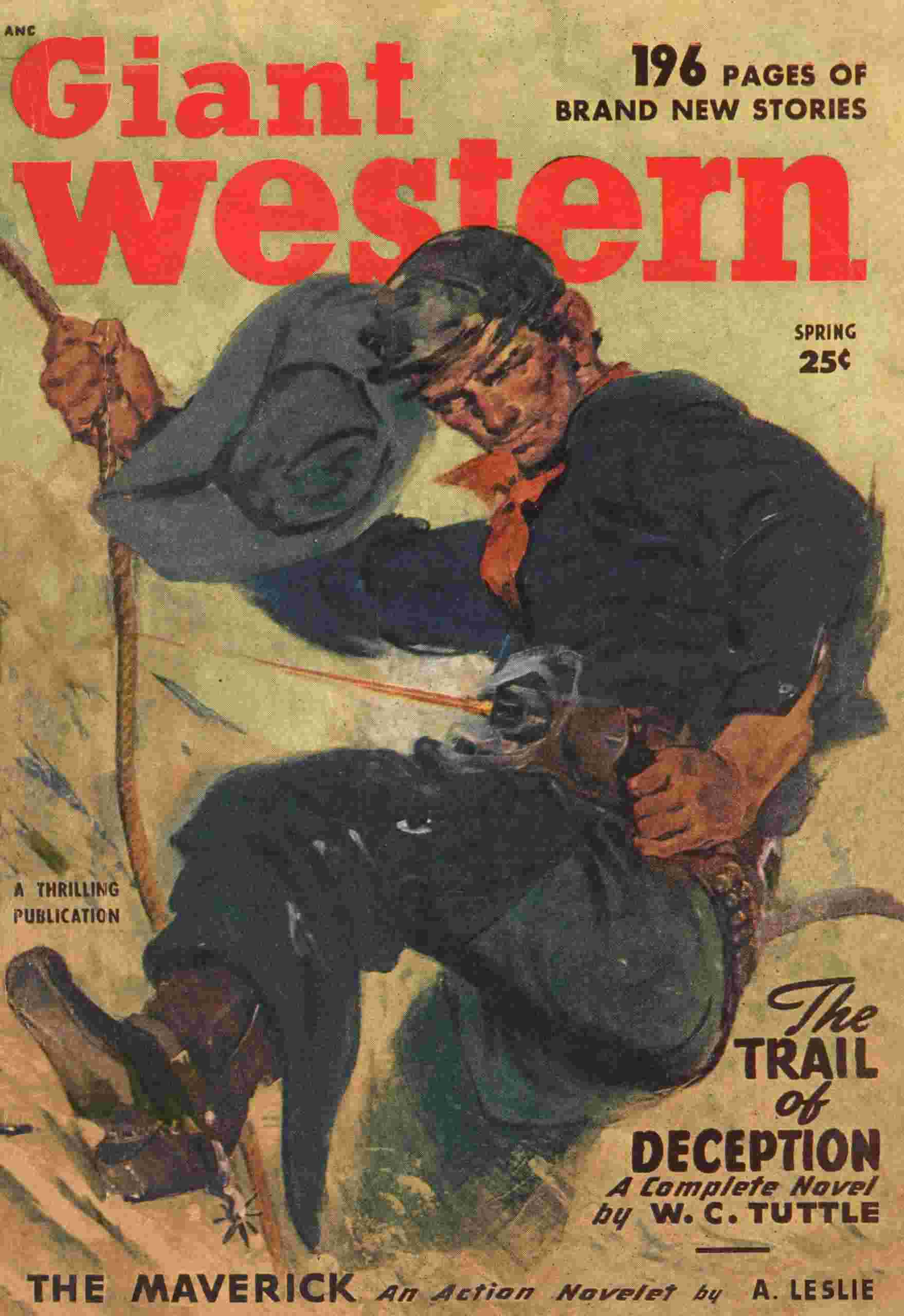
Shivering a little, he slid off the rim and started down the trail, leaning in against the bank, carefully digging his high-heels into the dirt and against the rocky projections. Jim Bailey was frightened. The light had gone now, and he had to go slowly, feeling his way. It seemed hours since he had left the rim. It was like going down a slanting ladder, feeling ahead for each rung. Something scraped against his cheek, and he stopped, groping around with his left hand. It was a rope.
It was larger than an ordinary lariat, and he was able to discover that it was tied around some sort of an old snag. Cautiously he investigated. Just below him the trail broke almost sheer. Evidently the rope was there to help men go down the impossible part of that trail. Below was only a dark mass, like a lot of houses piled on top of each other.
Jim took a deep breath, grasped the rope tightly, turned around and went down slowly, his feet seeking purchase on the side of the wall. It was hard on his hands, that rough rope, but he was making progress slowly. He had gone down about a dozen feet, when he felt a heavy tug on the rope. He thought for a moment that he had been discovered, but a continuous tugging indicated that someone was coming up the rope. Jim thought wildly of trying to go back, but it was impossible. One of his flailing legs caught around the rope, giving it one turn, and he started down fast. The rope burned his hands, but he didn’t even feel it. Suddenly he crashed into somebody.
The rest of the descent was rather hazy for Jim Bailey. He lost control of the rope with his left hand, his right was jerked loose and he went into space for a few feet, landing in sliding rubble, to bring up sharply on a smooth space, against a rock.
All he had heard from the other man was a startled curse when he had crashed into him, but he knew the other was not far away. Jim realized he had cut his cheek, because the blood was trickling into his mouth, and his hands felt as though they had been burned. Still he was sure no bones had been broken.
But Jim Bailey stayed put. He was in a dark corner and he was not going to move until the other man started something. His gun had stayed in his holster, and now he took it out. The feel of that gun was reassuring, even if he knew he couldn’t hit anything with it.
Then he heard the other man off to his right. He was cursing in an undertone, his rough clothes rasping against rock. Then he lifted his voice to a conversational level and said:
“Who is it? Quien es?”
Jim did not answer. The man cursed some more, flinging rocks into the dark spots. One barely missed Jim’s head, and it made him mad. He picked up a shattered part of the rock and flung it back at the man. Judging from the response, it must have registered, but the man wasn’t sure from what direction it had come.
“Come out of there, or I’ll kill yuh!” rasped the man.
Jim thought he had been seen, but a moment later the man fired a shot, almost at right-angles to where Jim was hidden. The man was evidently searching out the darkest spots for his bullets. Jim hunched lower, the old .41 gripped in both hands.
Wham! The man fired again and the bullet smashed into the rocks almost directly behind Jim, who swung the muzzle of his gun, shut his eyes and yanked the trigger. The .41 blasted flame, almost jumped out of Jim’s two-handed grip, and the hidden man yelped, either in pain or surprise.
“Don’t tell me I hit something!” exclaimed Jim, aloud.
The man didn’t say; he was cursing bitterly, and Jim heard him rasping around over the rocks. Anyway, he wasn’t doing any more shooting. Jim eased his position cautiously, watching further up the rocks, where the moonlight streaked them with blue. From the sounds it seemed as though the man was trying to get away.
Jim suddenly realized that if his enemy were able to get back to that rope, and climb up to the trail, he might take the rope along. Without the rope it might be impossible ever to get back to the rim. The thought made him panicky for a moment, and he crawled out into the moonlit strip. But nothing happened.
Trying to find his way back, he almost went over the sheer edge of the cliff. Peering down, he could see, possibly a hundred feet below, to where the moonlight streaked the rocks. He edged his way back and a loose rock, the size of a football, crashed beside him. Several pieces banged into him, but not against his head. Quickly he slid into the heavy shadow again, thankful to be alive, but realizing that the other man was above him now.
Jim worked cautiously now. He could hear the man once in a while, but was unable to locate him exactly. Jim suddenly realized how tired he was. His face was swollen, his hands swollen too, and he had bruises too numerous to mention. He found loose rock, which gave under his knees as he crawled carefully upward. He remembered that he had landed in loose rock and dirt. Perhaps this was the place.
Above him he could hear the rasp and scrape of what sounded like someone sliding on rock. He stood up, and something brushed his arm. It was the rope again. He grabbed for it, but it was yanked out of his hands. The man had reached the trail and taken the rope.
In sudden desperation Jim braced against the wall, cocked his gun, gripped it in both hands and shot almost straight up. There was no target, nothing to shoot at. He jerked back, losing his footing for the moment, and a fraction of a second later a heavy object crashed into him, and his consciousness went out in a shower of shooting stars.