
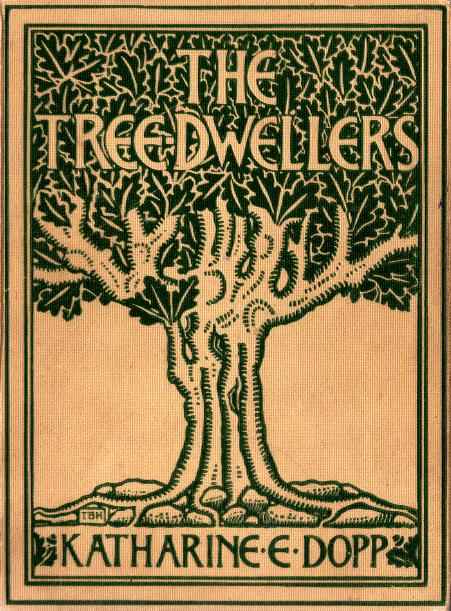
The Project Gutenberg eBook of The Tree-Dwellers
Title: The Tree-Dwellers
Author: Katharine Elizabeth Dopp
Illustrator: Howard V. Brown
Release date: April 18, 2008 [eBook #25098]
Most recently updated: January 3, 2021
Language: English
Credits: Produced by Louise Hope, Chris Curnow, Joseph Cooper and
the Online Distributed Proofreading Team at
https://www.pgdp.net
This text uses utf-8 (unicode) file encoding. If the apostrophes and quotation marks in this paragraph appear as garbage, you may have an incompatible browser or unavailable fonts. First, make sure that the browser’s “character set” or “file encoding” is set to Unicode (UTF-8). You may also need to change your browser’s default font.
Preface
Table of Contents
List of Illustrations
The Tree-Dwellers
Suggestions to Teachers
Industrial and Social History Series
By KATHARINE ELIZABETH DOPP, Ph.D. |
|
Book I. THE TREE-DWELLERS. THE AGE OF FEAR. Illustrated with a map, 14 full-page and 46 text drawings in half-tone by Howard V. Brown. Cloth. Square 12mo. 158 pages. For the primary grades. Book II. THE EARLY CAVE-MEN. THE AGE OF COMBAT. Illustrated with a map, 16 full-page and 17 text drawings in half-tone by Howard V. Brown. Cloth. Square 12mo. 183 pages. For the primary grades. Book III. THE LATER CAVE-MEN. THE AGE OF THE CHASE. Illustrated with 27 full-page and 87 text drawings in half-tone by Howard V. Brown. Cloth. Square 12mo. 197 pages. For the primary grades. Book IV. THE EARLY SEA PEOPLE. FIRST STEPS IN THE CONQUEST OF THE WATERS. Illustrated with 21 full-page and 110 text drawings in half-tone by Howard V. Brown and Kyohei Inukai. Cloth. Square 12mo. 224 pages. For the intermediate grades. Book V. THE EARLY HERDSMEN. FIRST STEPS IN TAMING THE GRASS-EATING ANIMALS. Illustrated with 24 full-page and 74 text drawings in half-tone by Howard V. Brown and Louis Jensen. Cloth. Square 12mo. 232 pages. For the intermediate grades. Book VI. THE EARLY FARMERS. FIRST STEPS IN THE CULTIVATION OF PLANTS. Illustrated with 32 full-page, 23 half-page, and 30 text illustrations by William Wallace Clarke and Howard V. Brown. Cloth. Square 12mo. 236 pages. For the intermediate grades. |
A map of the Tree-dwellers’ country, showing the relative
position
of the geographical features referred to in this book.
Copyright, 1904,
By Katharine Elizabeth Dopp
Entered at Stationer’s Hall
All rights reserved
Edition of 1930
Made in U.S.A.
The series, of which this is the first volume, is an attempt to meet a need that has been felt for several years by parents and physicians, as well as by teachers, supervisors, and others who are actively interested in educational and social progress. The need of practical activity, which for long ages constituted the entire education of mankind, is at last recognized by the elementary school. It has been introduced in many places and already results have been attained which demonstrate that it is possible to introduce practical activity in such a way as to afford the child a sound development—physically, intellectually, and morally—and at the same time equip him for efficient social service. The question that is perplexing educators at the present time is, therefore, not one regarding the value of practical activity, but rather one of ways and means by which practical activity can be harnessed to the educational work.
The discovery of the fact that steam is a force that can do work had to await the invention of machinery by means of which to apply the new force to industrial processes. The use of practical activity will likewise necessitate many changes in the educational machinery before its richest results are realized. Yet the conditions that attend the introduction of practical activity as a motive power in education are very different from those that attended the introduction of the use of steam. In the case of steam the problem was that of applying a new force to an old work. In the case of practical activity it is a question of restoring a factor which, from the earliest times until within the last two or three decades, has operated as a permanent educational force.
The situation that has recently deprived the child of the opportunity to participate in industrial processes is due, as is well known, to the rapid development of our industrial system. Since the removal of industrial processes from the home the public has awakened to the fact that the child is being deprived of one of the most potent educational influences, and efforts have already been made to restore the educational factor that was in danger of being lost. This is the significance of the educational movement at the present time.
As long as a simple organization of society prevailed, the school was not called upon to take up the practical work; but now society has become so complex that the use of practical activity is absolutely essential. Society to-day makes a greater demand than ever before upon each and all of its members for special skill and knowledge, as well as for breadth of view. These demands can be met only by such an improvement in educational facilities as corresponds to the increase in the social demand. Evidently the school must lay hold of all of the educational forces within its reach.
In the transitional movement it is not strange that new factors are being introduced without relation to the educational process as a whole. The isolation of manual training, sewing, and cooking from the physical, natural, and social sciences is justifiable only on the ground that the means of establishing more organic relations are not yet available. To continue such isolated activities after a way is found of harnessing them to the educational work is as foolish as to allow steam to expend itself in moving a locomotive up and down the tracks without regard to the destiny of the detached train.
This series is an attempt to facilitate the transitional movement in education which is now taking place by presenting educative materials in a form sufficiently flexible to be readily adapted to the needs of the school that has not yet been equipped for manual training, as well as to the needs of the one that has long recognized practical activity as an essential factor in its work. Since the experience of the race in industrial and social processes embodies, better than any other experiences of mankind, those things which at the same time appeal to the whole nature of the child and furnish him the means of interpreting the complex processes about him, this experience has been made the groundwork of the present series.
In order to gain cumulative results of value in explaining our own institutions, the materials used have been selected from the life of Aryan peoples. That we are not yet in possession of all the facts regarding the life of the early Aryans is not considered a sufficient reason for withholding from the child those facts that we have when they can be adapted to his use. Information regarding the early stages of Aryan life is meager. Enough has been established, however, to enable us to mark out the main lines of progress through the hunting, the fishing, the pastoral, and the agricultural stages, as well as to present the chief problems that confronted man in taking the first steps in the use of metals, and in the establishment of trade. Upon these lines, marked out by the geologist, the paleontologist, the archæologist, and the anthropologist, the first numbers of this series are based.
A generalized view of the main steps in the early progress of the race, which it is thus possible to present, is all that is required for educational ends. Were it possible to present the subject in detail, it would be tedious and unprofitable to all save the specialist. To select from the monotony of the ages that which is most vital, to so present it as to enable the child to participate in the process by which the race has advanced, is a work more in keeping with the spirit of the age. To this end the presentation of the subject is made: First, by means of questions, which serve to develop the habit of making use of experience in new situations; second, by narrative, which is employed merely as a literary device for rendering the subject more available to the child; and third, by suggestions for practical activities that may be carried out in hours of work or play, in such a way as to direct into useful channels energy which when left undirected is apt to express itself in trivial if not in anti-social forms. No part of a book is more significant to the child than the illustrations. In preparing the illustrations for this series as great pains have been taken to furnish the child with ideas that will guide him in his practical activities as to illustrate the text itself.
Mr. Howard V. Brown, the artist who executed the drawings, has been aided in his search for authentic originals by the late J. W. Powell, director of the United States Bureau of Ethnology, Washington, D.C.; by Frederick J. V. Skiff, director of the Field Columbian Museum, Chicago, and by the author. Ethnological collections and the best illustrative works on ethnological subjects scattered throughout the country have been carefully searched for material.
I wish to take this opportunity to express my gratitude to Professor Dewey for the suggestions he has given me with reference to this series, and to acknowledge that without the inspiration that has come through his teaching I should probably never have undertaken a work of this kind. To Dr. W. I. Thomas, professor of sociology and anthropology in the University of Chicago, I am indebted for suggestions upon anthropological phases of many of the subjects presented. To Dr. S. W. Williston, professor of paleontology in the University of Chicago, I am indebted for a careful examination of the book from the standpoint of the paleontologist. Among the many friends who have given me help and inspiration, I would mention especially, Professor Ella Flagg Young, of the University of Chicago; Superintendent F. A. Manny, of the Ethical Culture Schools, New York City; Mrs. Charlotte W. Williams, of Chicago; my sister, Miss Elspa M. Dopp, of the State Normal School, St. Cloud, Minn.; and Mr. W. W. Charters, of the University of Chicago. To the late Director J. W. Powell, of the United States Bureau of Ethnology, and to Director Frederick J. V. Skiff, of the Field Columbian Museum, Chicago, I am under obligations for courtesies extended which have enabled me to gain access to illustrative materials.
K. E. D.
| PAGE | |
| Dedication | 7 |
| Preface | 8 |
| Contents | 12 |
| Illustrations | 13 |
THE TREE-DWELLERS
|
|
| 15 | |
| 17 | |
| 20 | |
| 23 | |
| 28 | |
| 31 | |
| 35 | |
| 38 | |
| 43 | |
| 47 | |
| 50 | |
| 53 | |
| 56 | |
| 59 | |
| 61 | |
| 66 | |
| 69 | |
| 72 | |
| 75 | |
| 81 | |
| 85 | |
| 89 | |
| 93 | |
| 99 | |
| 102 | |
| 106 | |
| 112 | |
| 116 | |
| 119 | |
| 122 | |
| 125 | |
| 128 | |
| 130 | |
| Suggestions to Teachers | 132 |
| a. Method | 134 |
| b. Typical Modes of Activity | 136 |
| c. Supplementary Facts | 142 |
| d. Animal Life | 142 |
| e. Special Suggestions | 147 |
“Many wild beasts lived then”