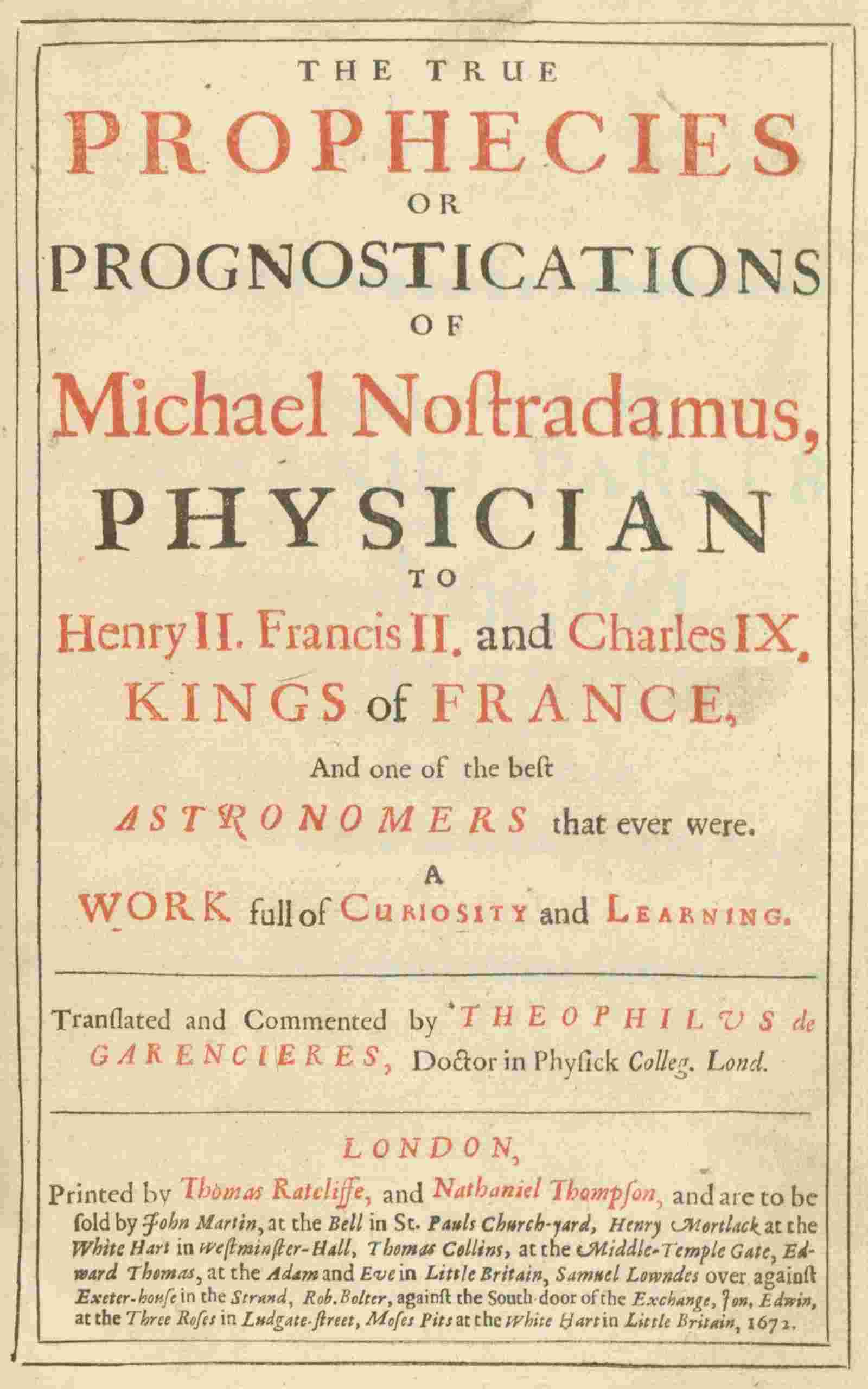
CENTURY II.
I.
French.
Vers Aquitaine par insults Britanniques,
De par eux mesmes grandes incursions,
Pluyes, Gelees, feront terroirs iniques,
Port Selyn fortes fera invasions.
English.
Towards Gascony by English assaults,
By the same shall be made great incursions,
Rains, Frosts, shall marre the ground.
Port Selyn shall make strong Invasions.
ANNOT.
Three Prophecies are contained in this Stanza, the first that the English shall
make an incursion in Gascony; the second, that there shall be a great dearth
by Rains and Frosts; the third, that the Turks shall make great Incursion.
II.
French.
La teste glue sera la teste blanche,
Autant de mal que France a fait leur bien,
Mort a l’Anthene, grand pendu fus la branche,
Quand prins des siens, le Roy dira combien.
English.
The Glue-head shall do the white head
As much harm, as France hath done it good,
Dead at the Sails yard, a great one hang’d on a Tree,
When a King taken by his own, shall say, how much?
ANNOT.
I did never find that word of Glue-head before in any Author, and I believe if
Cotgrave were alive again, it would puzzle him to give the interpretation thereof.
The third and fourth signifie, that one shall be hanged on the Sails-yard, and another
on a Tree, when a King shall be taken by his own Men, and shall say how much?
that is, how much money shall I give you to set me free.
III.
French.
Par la chaleur Solaire sur la Mer,
De Negrepont, les Poissons demy cuits,
Les Habitans les viendront entamer,
Quand Rhode & Genes leur faudra le Biscuit.
English.
By the heat of the Sun upon the Sea
Of Negrepont, the Fishes shall be half broiled,
The Inhabitants shall come to cut them up,
When Rhodes and Genoa shall want Biscake.
ANNOT.
Negrepont is an Island of the Archipelago near Morea, anciently called Eubœa. Rhodes
is another Island, and, Genoa a City in Italy, by the Seaside. The rest is plain.
IV.
French.
Depuis Monac jusqu’aupres de Sicile,
Toute la plage demoura desolée,
Il ny aura Fauxbourgs, Cité, ne Ville,
Que par Barbares pillée soit & volée.
English.
From Monaco as far as Sicily,
All the Sea coast shall be left desolate,
There shall not be Suburbs, Cities, nor Towns,
Which shall not be pillaged and plundred by Barbarians.
ANNOT.
Monaco is a Town seated by the Sea-side in Italy, between Provence and Genoa.
This Prophecy hath been once already fulfilled, when the famous Pyrate Barbarossa,
being sent by the grand Seignor, to help the French King against the Emperour
Charles the V. in his return home, plundered all that Coast, and carried away an innumerable
multitude of people into slavery.
V.
French.
Quand dans Poisson, Fer & Lettre enfermée,
Hors sortira qui puis fera la Guerre,
Aura par Mer sa classe bien ramée;
Aparoissant pres de Latine Terre.
English.
When in a Fish, Iron and a Letter shall be shut up,
He shall go out that afterwards shall make War,
He shall have his Fleet by Sea well provided,
Appearing by the Roman Land.
ANNOT.
The words and the sense are plain.
VI.
French.
Aupres des Portes & dedans deux Citez,
Seront deux Fleaux & onc n’aperceu un tel,
Faim, dedans Peste, de Fer hors gens boutez,
Crier secours au grand Dieu immortel.
English.
Near the Gates and within two Cities
Shall be two Scourges, I never saw the like,
Famine, within Plague, people thrust out by the Sword,
Shall cry for help to the great God immortal.
ANNOT.
This needeth no Interpretation.
VII.
French.
Entre plusieurs aux Isles deportez,
L’un estre nay a deux dens en la gorge,
Mourront de Faim, les Arbres esbroutez,
Pour eux neuf Roy, nouvel Edict leur forge.
English.
Among many that shall be transported into the Islands,
One shall be born with two Teeth in his mouth,
They shall die of hunger, the Trees shall be eaten,
They shall have a new King, who shall make new Laws for them.
ANNOT.
This is so plain, that it needeth no explication.
VIII.
French.
Temples Sacrez, prime facon Romaine,
Rejetteront les goffes Fondemens,
Prenant leurs Loix premieres & humaines,
Chassants non tout, de Saints le cultement.
English.
Churches Consecrated, and the ancient Roman way,
Shall reject the tottering Foundations,
Sticking to their first humane Laws,
Expelling, but not altogether the worshipping of Saints.
ANNOT.
This Prophecy, is concerning the beginning of the Reformed Religion, when the
Roman Church rejected it, yet nevertheless, for shame they left off many of their
fopperies, for ever since they never appeared so great Worshippers of Saints as
before.
IX.
French.
Neuf ans le Regne le maigre en paix tiendra,
Puis il cherra en soif si sanguinaire,
Pour luy grand peuple sans Foy & Loy mourra,
Tué par un beaucoup plus debonaire.
English.
Nine years shall the lean one keep the Kingdom in Peace,
Then he will fall into such a bloody thirst,
That a great people shall die without Faith or Law,
He shall be killed by one milder than himself.
ANNOT.
It is a lean man that shall keep in Peace the Kingdom, for the space of nine years,
and then shall become cruel; so that he shall put to death many people without Law,
or regard of his promise.
X.
French.
Avant long temps le tout sera rangé,
Nous esperons un siecle bien senestre,
L’Estat des masques & des seuls bien changé,
Peu trouveront qui a son rang vueille estre.
English.
Before it be long, all shall be set in order,
We look for a sinister Age,
The state of the Visards and of the alone shall be changed,
They shall find few that will keep their ranks.
ANNOT.
All the difficulty of this consisteth in what he meaneth by the Visard and alone,
for my part, I believe he aimeth at the Popish Clergy and Monks; the first by reason
of their Hypocrisy, the other by reason of their solitariness. The rest is plain.
XI.
French.
Le prochain, fils de l’Aisnier parviendra,
Tant eslevé jusqu’au au Regne des fors,
Son aspre gloire un chascun la craindra,
Mais les enfans du Regne jettez hors.
English.
The eldest Son of l’Aisnier shall prosper,
Being raised to the degree of the great ones,
Every one shall fear his high glory,
But his children shall be cast out.
ANNOT.
This is an Horoscope, for the Interpretation of which we are beholding to, Mr.
Mannessier of Amiens, who saith that the Father of the Lords l’Aisniers writ to
Nostradamus his friend, to know his childrens fortune, who sent him those four Verses
for an answer, by which it is evident that the eldest should be an eminent Man, as it
fell out, being one of the chiefest men in the Province of Anjou, and one of the chiefest
instruments to make Peace between Louis the XIII. and his Mother Mary of Medicis,
after the Battle of Pont de Cé.
The fourth Verse saith, that some of his other Children should be expelled the
Kingdom, as it happened by reason of a false report raised against one of them, which
compelled him to retire into Portugal till the truth was known, as it was afterwards
to his great repute and honour.
XII.
French.
Yeux clos ouverts d’antique fantaisie,
L’habit des seuls sera mis a neant,
Le grand Monarque chastiera leur frenesie,
Ravir des Temples le Thresor par devant.
English.
Eyes shut, shall be open by an antick fancy,
The cloths of the alone shall be brought to nothing.
The great Monarck shall punish their frenzy,
For having ravished the Treasure of the Temple before.
ANNOT.
I can fasten this upon no body, but upon some Monks, which are called here The
alone, because of their solitary life, who shall be punished by a King, for having robbed
the Church.
XIII.
French.
Le corps sans ame plus n’estre en sacrifice,
Jour de la mort mis en Nativité.
L’Esprit Divin sera l’ame fœlice,
Voiant le Verbe en son Eternité.
English.
The body without the soul shall be no more admitted in Sacrifice,
The day of the death shall be put for the Birth-day,
The Divine Spirit shall make the Soul happy,
By seeing the Word in its Eternity.
ANNOT.
The first Verse seemed to Prophecy the Reformation of Religion, and the change
of opinion concerning the Lords Supper, which should be no more a Sacrifice (as the
Roman Church calleth the Mass) of a body without a soul, but only a commemoration
of the Lords death, as the second Verse confirmeth, saying, The day of the death
shall be put for the Birth-day, seeing, that by the commemoration of that death, we are
renewed into a newness of life, and as it were born again. The last two Verse are
easie.
XIV.
French.
A Tours, Gien, Gergeau, seront yeux penetrans,
Descouvriront le long de la grande Sereine,
Elle & sa Suite au Port seront entrans,
Combat poussez Puissance Souveraine.
English.
At Tours, Gien, Gergeau, shall be piercing eyes,
Who shall discover along the great Syren,
She and her Attendans shall enter into the Port,
By a fight shall be thrust out the Soveraign Power.
ANNOT.
Tours, Gien, and Gergeau are Cities upon the River of Loire, which is called here
the great Syren, because of the length of its course, the meaning then is, that those
Cities shall be watchful, and stand upon their guard, and shall fight against a King,
which if it hath already come to pass in the Civil Wars, or shall happen hereafter, I
cannot affirm.
XV.
French.
Un peu devant Monarque trucidé,
Castor, Pollux, en nef astre crinite,
L’Airain public, par Terre & Mer vuidé,
Pisa, Ast, Ferrare, Turin Terre interdite.
English.
A little before a Monarch be killed
Castor, and Pollux shall appear, and a Comet in the Ship;
The publick brass, by Land and Sea shall be emptyed,
Pisa, Ast, Ferrare, Turin, Countreys forbidden.
ANNOT.
The meaning of this is, that a little before a Monarck be killed, Castor and Pollux
two Meteores so called, as also a Comet in that constellation of the Heavens, called
the ship of Argos, and the Publick Brass, that is, the Canons by Land and Sea shall be
emptied, and these Towns of Italy, viz. Pisa, Ast, Ferrare, Turin, shall be excommunicated
by the Pope.
XVI.
French.
Naples, Palerme, Sicile, Syracuse,
Nouveaux Tyrants, fulgures, feu Cœlestes,
Force de Londres, Gand, Bruxelles, & Suse,
Grand Hecatombe, Triomphe, faire Festes.
English.
Naples, Palermo, Sicily, Syracusa,
New Tyrants, Lightnings, Celestial fires,
Army from London, Ghent, Bruxelles, and Suse,
A great Hecatomb, Triumphs, and Feasts.
ANNOT.
There is nothing difficult but the word Hecatomb, which is a Greek word, signifying
a Sacrifice of an hundred Oxen.
XVII.
French.
Le Camp du Temple de la Vierge Vestale,
Non esloigné d’Ethene & Monts Pyrenées,
Le grand conduit est chassé dans la Male,
North gettez Fleuves, & Vignes mastinées.
English.
The Camp of the Temple of the Vestal Virgin,
Not far from Ethene and the Pyrenean Mountains,
The great Conduit is driven in the Clock-bag,
Rivers overflown in the North, and the Vines spoiled.
ANNOT.
There is so many faults in the impression of this, and so hard to be rectified, that I
had rather leave it to the liberty of the judicious Reader, then make my self ridiculous
in not giving him satisfaction.
XVIII.
French.
Nouvelle Pluie, subite, impetueuse,
Empeschera subit deux excercites,
Pierre, Ciel, Feux, faire la Mer pierreuse,
La mort de sept, Terre & Marin subites.
English.
A new Rain, sudden, impetuous,
Shall suddenly hinder two Armies,
Stone, Heaven, Fire, shall make the Sea stony,
The death of seven shall be sudden upon Land and Sea.
ANNOT.
The first two Verses signifie, that a sudden and impetuous Rain shall hinder two
Armies from fighting.
The two last Verses foretell several Prodigies, the which happening, seven persons
shall suddenly die upon the Sea and Land.
XIX.
French.
Nouveaux venus, lieu basty sans defence,
Occuper place pour lors inhabitable,
Prez, Maisons, Champs, Villes prendre a plaisance,
Faim, Peste, Guerre, arpent long labourable.
English.
New comers shall build a place without fence,
And shall occupy a place that was not then habitable,
They shall at their pleasure take Fields, Houses and Towns.
There shall be Famine, Plague, War, and a long arable field.
ANNOT.
This is so plain, that it needeth no Interpretation.
XX.
French.
Freres & Sœurs en divers lieux captifs,
Se trouveront passer pres du Monarque,
Les contempler ses deux yeux ententifs,
Des plaisant vont, Menton, Front, Nez les marques.
English.
Brothers and Sisters shall be made slaves in divers places,
And shall pass before the Monarck,
Who shall look upon them with attentive eyes,
They shall go in heaviness, witness their Chin, Forehead and Nose.
ANNOT.
This is obvious to the meanest capacity.
XXI.
French.
L’Ambassadeur envoié par Biremes,
A my chemin incogneus repoulsez,
De Sel renfort viendront quatre triremes,
Cordes & Chaines en Negrepont troussez.
English.
The Embassadour that was sent in Biremes,
In the midleway shall be repulsed by unknown Men,
From the Salt to his succours shall come four triremes,
Ropes and Chains shall be carried to Negrepont.
ANNOT.
Bireme is a Galley that hath two ranges of Oares, Trireme is one that hath three
ranges. The meaning then of this is, that an Embassadour shall be sent in a Galley
with two ranges of Oares, and that he shall be met in his way by unknown men, that
is, Pyrates; there shall come to his succours from the Salt, that is, from the French
four Triremes, that is four Galleys, every one having three ranges of Oares, but they
shall all be carried to Negrepont, an Island belonging to the Turk.
XXII.
French.
Le Camp Ascop d’Europe partira,
Sadioignant proche de l’Isle submergée,
D’Arton classe Phalange partira,
Nombril du Monde plus grand voix subrogée.
English.
The Camp Ascop shall go from Europe,
And shall come near the drowned Island;
From Arton shall go an Army by Sea and Land,
By the Navel of the World a greater vice shall be substituted.
ANNOT.
The Author hath darkned this Stanza with so many barbarous words, as Camp
Ascop, drowned Island, D’Arton, Navel of the World, that it is very like either he did
not understand himself, or would not be understood by others.
XXIII.
French.
Palaces Oiseaux, par Oiseau dechassé,
Bien tost apres le Prince parvenu,
Combien qu’hors Fleuve ennemy repoulsé,
Dehors saisy, trait d’Oiseau soustenu.
English.
Palais Birds, driven away by a Bird,
Soon after that, the Prince is come to his own,
Although the enemy be driven beyond the River,
He shall be seased upon without, by the trick of the Bird.
ANNOT.
The meaning of this is, that many Courtiers (called here Palace Birds) shall be
justled out of favour by another principal Bird, that is a great Courtier, as soon as the
Prince shall come to his own.
The two last Verses seem to foretell that the said principal Courtier shall seize
upon the Prince, notwithstanding that some succour shall come to his help, which
shall be beaten back beyond the River.
XXIV.
French.
Bestes farouches de faim Fleuves traner,
Plus part du Champ encontre Ister sera,
En Cage de Fer le grand fera traisner.
Quand rien enfant de Germain n’observera.
English.
Wild Beasts for hunger shall swim over Rivers,
Most part of the field shall be near Ister,
Into an Iron Cage he shall cause the great one to be drawn,
When the Child of German shall observe nothing.
ANNOT.
Ister is a River, German is a proper name of some considerable person, whose Son
shall not observe or take notice when that eminent person mentioned here, shall be
drawn into an Iron Cage.
XXV.
French.
La Garde estrange trahira Forteresse,
Espoir & umbre de plus haut mariage,
Garde deceüe Fort prins dedans la presse,
Loire, Saone, Rhosne, Gar, a Mort outrage.
English.
The Garrison of strangers shall betray the Fort,
Under the hope and shadow of a higher Match,
The Garrison shall be deceived, and the Fort taken in the crowd,
Loire, Saone, Rhosne, Gar, shall do harm to Death.
ANNOT.
There is no difficulty but in the last Verse, where you must observe that Loire,
Saone, Rhosne, and Gardon, which for the Verses sake is contracted into Gar; are
Rivers of France, which are threatned here of overflowing, and causing the death of
many people.
XXVI.
French.
Pour la faveur que la Cité fera,
Au grand qui tost perdra Camp de Bataille,
Le sang d’ans Pau le Thesin versera,
De sang feux, mors, noyez de coup de taille.
English.
Because of the favour the City shall shew,
To the great one, who soon after shall loose the Battle,
The Thesin shall pour blood into the Pau,
Of blood, fire, dead, drowned, by Edgeling.
ANNOT.
This is plain, if you observe that the Thesin is a River of Italy, and the Pau another,
into the which the Thesin runneth.
XXVII.
French.
Le Divin Verbe sera du ciel frappé,
Qui ne pourra proceder plus avant,
Du resserrant le secret estoupé,
Quon marchera par dessus & devant.
English.
The Divine Word shall be struck by Heaven,
So that he shall proceed no further,
The secret of the close Keeper, shall be so closed up,
That people shall tread upon, and before it.
ANNOT.
By the Divine Word, you must not understand the second person of the Trinity,
or else all this Stanza would be absurd; but you must understand a Divine or Theologian,
called in Greek θεόλογος, which signifieth a Divine Word. The meaning
therefore of it, is, that a Theologian shall be struck by Heaven; that is, shall die, so that
he shall proceed no further in his work, which I suppose by the two last Verses, was
the Philosophers stone; for in the two last Verses he saith, that the secret of the
close Keeper, that is, of him that wrought secretly, shall (by his death) be so
closed up, that people shall tread on, and before it.
XXVIII.
French.
Le penultiesme de Surnom de Prophete,
Prendra Diane pour son jour & repos,
Loing vaguera par Frenetique teste,
Et delivrant un grand peuple d’Impos.
English.
The last, but one of the Sirname of the Prophet,
Shall take Diana for his day and his rest,
He shall wander far by reason of his Frenetick head,
Delivering a great people from impositions.
ANNOT.
This is concerning a false Prophet, which is called here the last but one of that
Surname, who shall make Diana (that is Monday which is dedicated to Diana) his
Sunday or Sabbath day, and so wandring to and fro in a Frenetick manner, shall perswade
many people to pay no Taxes.
XXIX.
French.
L’Oriental sortira de son Siege,
Passer les Monts Apennins, voir la Gaule,
Transpassera le Ciel, les Eaux & Neige,
Et un chacun frappera de sa Gaule.
English.
The Oriental shall come out of his Seat,
Shall pass over the Apennine Mountains, and see France,
Shall go over the Air, the Waters and Snow,
And shall strike every one with his Rod.
ANNOT.
It is an Eastern Prince, who leaving his Countrey, shall come over the Apennine
Mountains, which divide Italy, and come as far as France, destroying all before
him.
XXX.
French.
Un qui les Dieux d’Annibal infernaux,
Fera renaistre, effrayeur des Humains,
Onc plus d’horreur ne plus dire journaux,
Qu’avint viendra par Babel aux Romains.
English.
One that shall cause the infernal Gods of Hannibal
To live again, the terror of Mankind,
There was never more horror, not to say ill dayes,
Did happen, or shall, to the Romans by Babel.
ANNOT.
This Prophecy was concerning Charles V. Emperour, who sacked Rome, took
the Pope Prisoner, and filled it with more horror and slaughter than Hannibal did,
though a Heathen.
XXXI.
French.
En Campanie le Cassilin fera tant,
Quon ne verra que d’Aux les Champs couvers,
Devant apres la pluye de long temps,
Hormis les arbres rien lon verra de verts.
English.
In Campania the Cassilin shall so behave himself,
That nothing shall be seen but Fields covered with Garlick,
Before, and after it, shall not Rain for a good while,
Except the Trees, no Green shall be seen.
ANNOT.
This hath a dependance upon the foregoing Stanza; for Campania is the Province
wherein Rome is seated, and Cassilin, called Campania di Roma, is the same as Castillan,
because Charles V. was not only Emperour, but also King of Spain, the
chief Province of which is Castilia: therefore the Author describeth here the misery
and devastation of Campania di Roma by the Castilian, who left nothing in the
ground, but Garlick, which is their most delicate food, and nothing Green but the
Trees.
XXXII.
French.
Lait Sang, Grenovilles, escouldre en Dalmatie,
Conflit donné, peste pres de Balene,
Cry sera grand par toute Esclavonie,
Lors naistra Monstre pres & dedans Ravenne.
English.
Milk, Blood, Frogs shall reign in Dalmatia,
A Battle fought, the Plague near Balene,
A great cry shall be through all Sclavonia,
Then shall be born a Monster, near and within Ravenna.
ANNOT.
Dalmatia and Sclavonia, are Countreys joyning to the Adriatick Sea, belonging
to the Venetians. Ravenna is a City in Italy, the rest needeth no interpretation.
XXXIII.
French.
Dans le torrent qui descend de Verone,
Par lors qu’au Pau guidera son entrée,
Un grand Naufrage, & non moins en Garonne,
Quand ceux de Genes Marcheront leur contrée.
English.
In the torrent which cometh down from Verona,
About the place where it falleth into the Pau,
A great Shipwrack, and no less in Garonna,
When those of Genoa shall go into their Countrey.
ANNOT.
Verona is a City in Italy, belonging to the Venetians, through the middle of which
runneth a River called Adde, which falleth into the River Pau, about which place
there shall be a great Shipwrak; as also another in the River of Garonna, which passeth
at Bordeaux, the time that the Author marketh, is when those of Genoa shall
go into their Countrey, that is to say, when some Ships of Genoa shall come to
Bordeaux.
XXXIV.
French.
L’Ire insensée du Combat furieux,
Fera a Table par Freres le Fer luire,
Les departir, blessé, curieux,
Le fier duel viendra en France nuire.
English.
The mad anger of the furious fight,
Shall cause by Brothers the Iron to glister at the Table,
To part them one wounded, curious,
The fierce Duel shall do harm after in France.
ANNOT.
It is the short History of two Brothers, who fought at the Table, whereby one
that was curious to part them was wounded, they afterwards fought a Duel, in whose
imitation many since have been fought, to the great harm of the French Gentry.
XXXV.
French.
Dans deux Logis de nuit le feu prendra,
Plusieurs dedans estoufez & rostis,
Pres de deux Fleuves pour seur il adviendra,
Sol, l’Arc, & Caper, tous seront amortis.
English.
The fire shall take by night in two Houses,
Many shall be stifled and burnt in it;
Near two Rivers it shall for certain happen,
Sun, Arc, Caper, they shall all be mortified.
ANNOT.
By Sun, Arc, Caper, he meaneth the Sun being in the Signs of Sagitarius and Capricornus.
This Prophecy was fulfilled about 90. years ago in the City of Lion, seated upon
two Rivers, viz. the Rhosne and the Saone, for about that time several Merchants
coming to the Fair, some went to lodge at the Silver Head, in the street de la Grenete,
where being in an upper room, as they were talking of their businesses, and passing
the time merrily, the fire took in the Kitchen where was abundance of Oil,
which did burn so suddenly and so violently, that the lower part of the House was
presently consumed. Those Merchants that were in the upper room towards the
street, begun to look for their Clock-bags, that were lockt up in a Trunk; but while
they were busie about opening the Trunk, the Stair-case fell, and the fire got into
their Room, then begun they to cry for help through the Windows. They would
willingly have thrown themselves down the Windows, but they were barred with
Iron, so that they could not save themselves, the House being a fire on all sides;
Moreover, the neighbours taking more care of their own Houses, then of those Strangers,
did run every one to his own concerns, so that they all miserably perished.
Parradin in his 3. Book of the History of Lyon, Chap. 22.
XXXVI.
French.
Du grand Prophete les Lettres seront prinses,
Entre les Mains du Tyran deviendront,
Frauder son Roy seront ses entreprinses,
Mais ses rapines bien tost le troubleront.
English.
The Letters of the great Prophet shall be intercepted,
They shall fall into the hands of the Tyrant,
His undertakings shall be to deceive his King,
But his extortions shall trouble him soon.
ANNOT.
It is some eminent Churchman, whose Letters shall be intercepted, by which he
intended to betray his King, therefore his actions shall be called in question, and being
found guilty of extortion, he shall suffer for it.
XXXVII.