
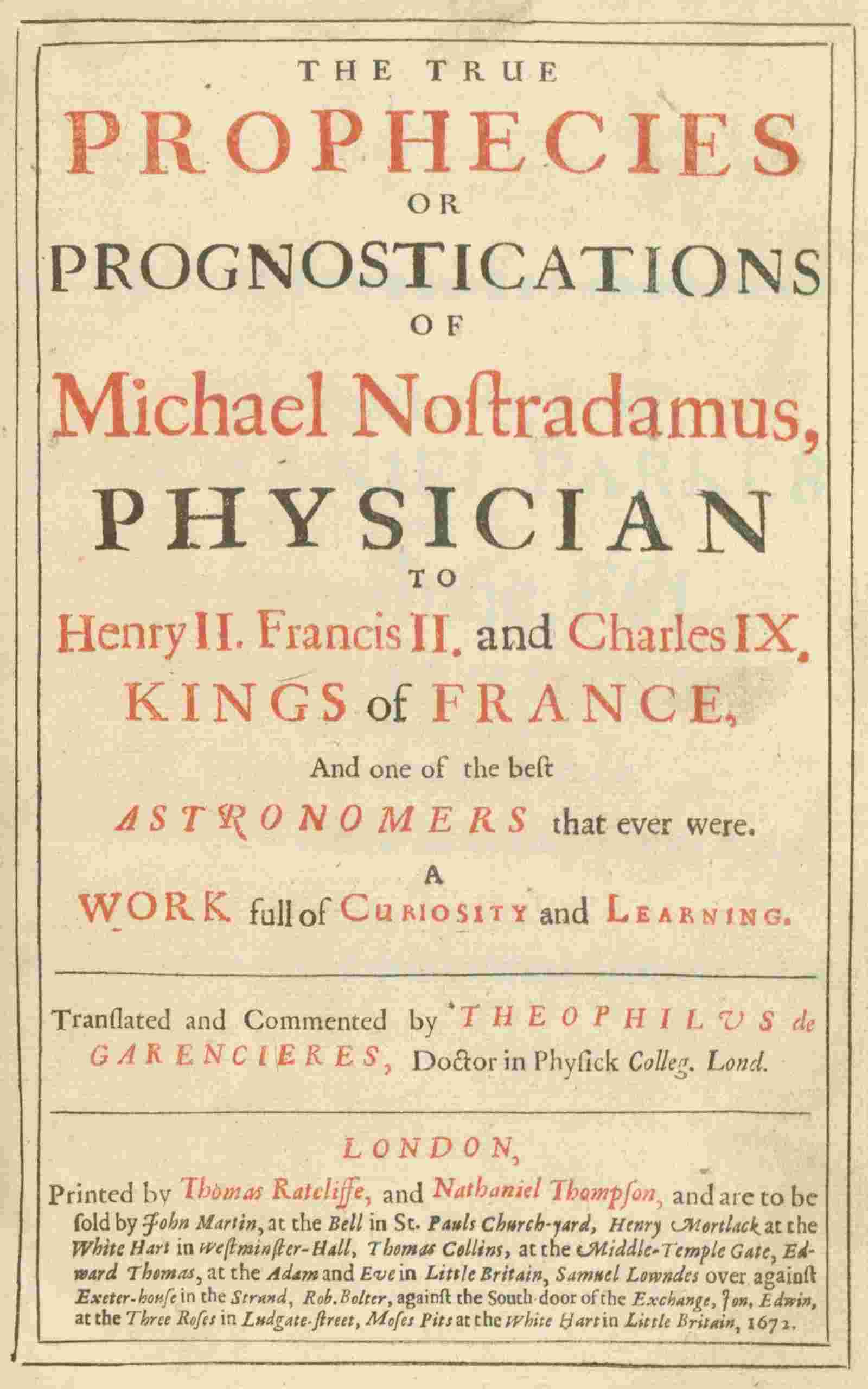
THE
LIFE
OF
Michael Nostradamus,
Physitian in Ordinary to HENRY the II. and
CHARLES the IX. Kings of France.
Michael Nostradamus, the most renowned and famous Astrologer, that hath been these many Ages, was born in St. Remy, a Town of Provence, in the year 1503. upon a Thursday, the 14th of December, about noon. His father was James Nostradamus, a Notary of the said Town, his Mother was Renata of St. Remy, whose Grandfathers by the Fathers and Mothers side, were men very skilfull, in Mathematick and Physick, one having been Physitian to Renatus, King of Jerusalem, and Sicily, and Earl of Provence, and the other Physition to John, Duke of Calabria, Son to the said Renatus, whence cometh that our Author saith in his Commentaries, that he hath received from hand to hand the Knowledge of Mathematicks, from his ancient Progenitors. After the death of his great Grandfather by the Mothers side, who first gave him a slight tincture, and made him in love with the Mathematicks, he was sent to School to Avignon. After that he went to Mount Pelier, to study Philosophy and Physick, till a great Plague coming, he was compelled to go to Narbonne, Thoulouse, and Bourdeaux, where he first began to practise, being then about 22 years of age. Having lived four years in those parts, he went back again to Monpelier, to get his degrees, which he did with a great deal of applause. Going to Thoulouse, he past through Agen, where Julius Cæsar Scaliger stayed him, with whom he was very familiar and intimately acquainted, though they fell out afterward; there he took to wife a very honourable Gentlewoman, by whom he had two Children, a Son and a Daughter, all which being dead, and seeing himself alone, he resolved to retire himself into Provence his Native Countrey. After he had gone to Marseille, he went to Aix, where the Parliament of Provence sitteth, and was there kept three years at the City Charges; because of the violent Plague that raged then in the year 1546. as you may read in the Lord of Launay’s Book, called the Theater of the World, who describeth that Plague according to the informations our Author gave him. Thence he went to Salon de Craux, a City distant from Aix one dayes Journey, and in the middle way between Avignon and Marseille; there he Married his second Wife Anna Ponce Genelle, by whom he had three Sons and one Daughter, the eldest was Michael Nostradamus, who hath written some pieces of Astrology, Printed at Paris in the year 1563.
The second was Cæsar Nostradamus, who hath deserved to be numbred among the French Historians, by reason of the great Volume he hath written of Provence.
The third was a Capuchine Frier. Cæsar did insert in his History the propagation of that Order in Provence. The fourth was a Daughter.
Nostradamus having found by experience that the perfect knowledge of Physick dependeth from that of Astrology, he addicted himself to it, and as this Science wanteth no allurement, and that besides his Genius he had a peculiar disposition and inclination to it; he made such a progress in it, that he hath deserved the Title of the most illustrious one in France, insomuch that making some Almanacks for recreation sake, he did so admirably hit the conjuncture of events, that he was sought for far and near.
This success was the cause of an extraordinary diminution of his fame; for the Printers and Booksellers seeing his fame, did print and vent abundance of false Almanacks under his name for lucre sake, whence it came that his reputation suffered by it, and was the cause that the Lord Pavillon wrote against him, and that the Poet Jodele made this bitter Distichon.
To which may be answered.
Or thus
Nevertheless the Beams of Truth did shine through the Clouds of Calumny; for he was singularly esteemed of by the Grandees, Queen Katharine of Medicis, who had a natural inclination to know future things.
And Henry the II. King of France, who sent for him to come to the Court in the year 1556. and having had private conference with him about things of great concernment, sent him honourably back again with many gifts. He went from Salon to the Court upon the 14 of July in the year 1555. and came to Paris upon the 15 of August. As soon as he was come to Town, the Lord Constable of Montmorency went to see him at his Inn, and presented him to the King, who received him with much satisfaction, and commanded that his lodging should be at the Palace of the Cardinal of Bourbon Archbishop of Sens.
There he was taken with the Gout for ten or twelve days, after which his Majesty sent him one hundred Crowns in Gold in a Velvet Purse, and the Queen as much. Their Majesties desired him to go to Blois to see the Princes their Children, and to tell them his opinion of them. It is certain that he did not tell them what he thought, considering the Tragical end of those three Princes, viz. Francis the II. Charles the IX. and Henry the III.
Having been so much honoured at Court, he went back again to Salon, where he made an end of his last Centuries, two years after he dedicated them to the King Henry the II. in the year 1557. and in his Luminary Epistle discovereth unto him the future events that shall happen from the Birth of Lewis the XIV. now Reigning, till the coming of Antichrist.
While he was at Salon he received there the Duke of Savoy, and the Lady Margaret of France, Sister to Henry the II. who was to Marry the said Duke according to the treaty of the general Peace made at Cambresis, both entertained him very familiarly, and honoured him often with their presence. The Duke came in October and the Lady in December.
When Charles the IX. went a progress through his Kingdom, he came into Provence, and did fail not to go to Salon to visit our Author, who in the name of the Town went to salute him, and make a Speech, this was in the year 1564. the 17 of November.
The extraordinary satisfaction that the King and the Queen Mother received from him was such, that being both at Lion, they sent for him again, and the King gave him 200 Crowns in Gold, and the Queen almost as much, with the quality of Physician in Ordinary to the King, with the Salaries and profits thereunto appertaining. Being come back to Salon he lived about 16 Months longer, and died upon the 2 of July 1566. in his Climacterical year of 63. having all his senses about him: His Disease was a Gout at first, which turned into a Dropsie; the time of his death it seemeth was known to him; for a friend of his witnesseth, that at the end of June in the said year he had writen with his own hand upon the Ephemerides of John Stavius these Latine words, Hic prope mors est; that is, near here is my death, and the day before his death that friend of his having waited on him till very late took his leave, saying, I shall see you again to morrow morning, you shall not see me alive when the Sun riseth, which proved true. He died a Roman Catholick, having received all his Sacraments, and was solemnly buried in the Church of the Franciscan Friers at Salon, on the left hand of the Church door, where his Widow erected him a Marble Table fastened in the Wall with this Epitaph, with his Figure to the Life, and his Arms above it.
The Inscription of his EPITAPH is in imitation of that of Titus Livius, and is thus.
D. M.
Ossa clarissimi Michaelis Nostradami, unius omnium pene mortalium digni, cujus Divino calamo totius Orbis ex astrorum influxu futuri eventus conscriberentur. Vixit annos LXII. menses VI. dies X. Obiit. Salonæ CIↃ IↃLXVI. Anna Pontia Gemella, conjugi optimo. V. E.
Which may be rendred thus:
Here lies the Bones of the most famous Nostradamus, one who among Men hath deserved by the opinion of all, to set down in writting with a Quill almost Divine, the future Events of all the Universe, caused by the Cœlestial influences; he lived 62. years 6. Months and 10. days, he died at Salon, in the year 1566.
Anna Pontia Gemella wisheth to her most loving Husband the true Happiness.
He had a Brother named John Nostradamus, famous for several Works that he hath written, the Catalogue of which is in the Book of Mr. du Maine de la Croix, Intitled, the Library.
As for our Author, he hath left several Works, among which is a Book of Receits, for the preservation of health, Printed at Poitiers, in the year 1556.
Another concerning the means of beautifying the Face and the Body, that was Printed at Antwerp by Plantin in the year 1557. which he Dedicated to his Brother John Nostradamus, an Attorney at the Parliament of Aix.
Besides this, he Translated from Latine into French the Paraphases of Galen, upon the Exhortation of Menedotus, which was Printed at Lyon by Antony du Rhosne, in the year 1557.
But before we conclude, it will not be amiss to give some recreation to the Reader, by relating a merry passage that happened to Nostradamus being in Lorrain, for being in the Castle of Faim, belonging to the Lord of Florinville, and having in cure the Mother of the said Lord; it chanced one day that they both walking in the Yard, there was two little Piggs, one white, and the other black, whereupon the Lord enquired of Nostradamus in jest, what should become of these two Piggs? he answered presently, we shall eat the black, and the Wolf shall eat the white.
The Lord Florinville intending to make him a Lyar, did secretly command the Cook to dress the white for Supper; the Cook then killed the white, drest it, and spitted it ready to be rosted when it should be time; In the mean time having some business out of the Kitchin, a young tame Wolf came in, and eat up the Buttocks of the white Pig, that was ready to be rosted; the Cook coming in the mean time, and fearing least his Master should be angry, took the black one, killed it, and drest it, and offered it at Supper. Then the Lord thinking he had got the Victory, not knowing what was befallen, said to Nostradamus, well Sir, we are eating now the white Pigg, and the Wolf shall not touch it. I do not believe it (said Nostradamus) it is the black one that is upon the Table. Presently the Cook was sent for, who confessed the accident, the relation of which was as pleasing to them as any meat.
In the same Castle of Faim, he told many that in a little Hill that was near the Castle, there was a Treasure hidden, which should never be found, if it were sought with design, but that it should be discovered when the Hill should be digged for some other intent. There is a great probability in this prediction, for there was an ancient Temple built upon it, and when they dig there, many times several Antiquities are found. All France telleth several Histories foretold by the Author, but I am unwilling to write any thing without good warrant. His Stanza’s are sufficient to prove the extraordinary Talent he had in foretelling future things.