
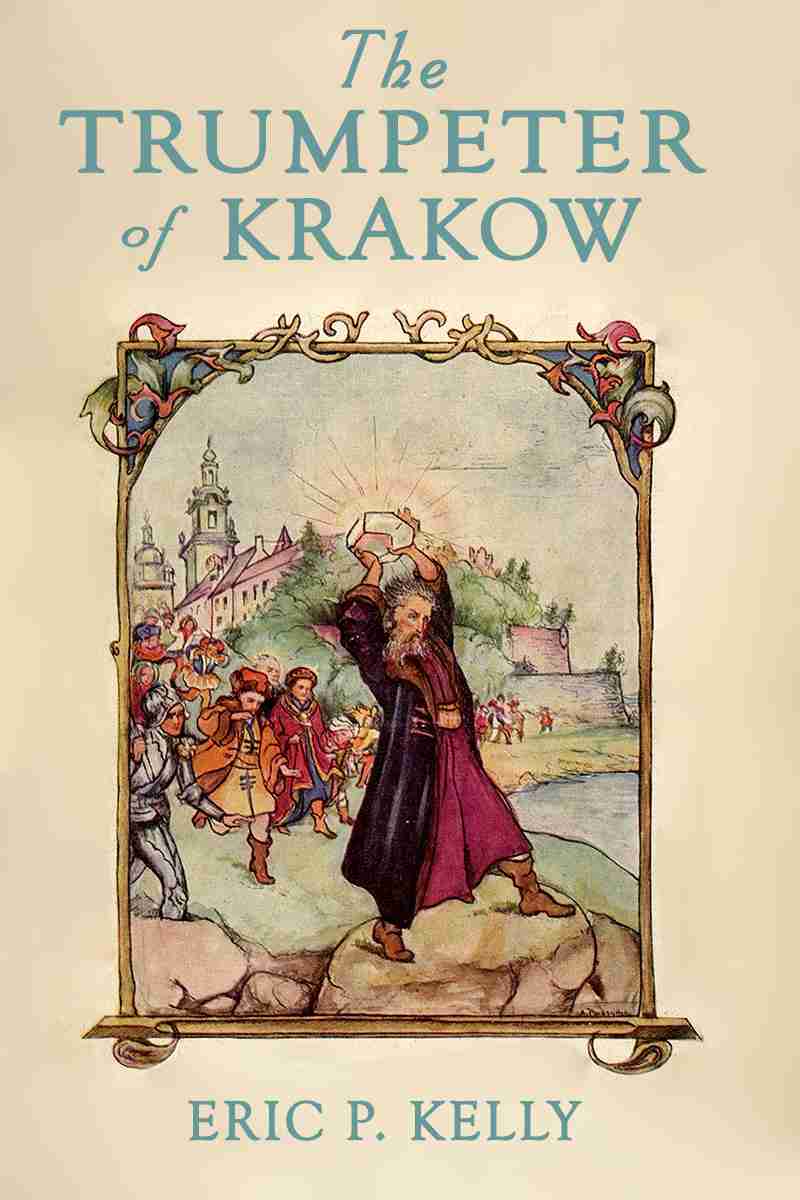
The Project Gutenberg eBook of The trumpeter of Krakow
Title: The trumpeter of Krakow
A tale of the fifteenth century
Author: Eric P. Kelly
Illustrator: Angela Pruszynska
Release date: January 2, 2024 [eBook #72600]
Language: English
Original publication: New York: The Macmillan Company, 1928
Credits: Al Haines, Jen Haines & the online Distributed Proofreaders Canada team at https://www.pgdpcanada.net
* A Distributed Proofreaders Canada eBook *
This eBook is made available at no cost and with very few restrictions. These restrictions apply only if (1) you make a change in the eBook (other than alteration for different display devices), or (2) you are making commercial use of the eBook. If either of these conditions applies, please contact a https://www.fadedpage.com administrator before proceeding. Thousands more FREE eBooks are available at https://www.fadedpage.com.
This work is in the Canadian public domain, but may be under copyright in some countries. If you live outside Canada, check your country's copyright laws. IF THE BOOK IS UNDER COPYRIGHT IN YOUR COUNTRY, DO NOT DOWNLOAD OR REDISTRIBUTE THIS FILE.
Title: The Trumpeter of Krakow
Date of first publication: 1928
Author: Eric Philbrook Kelly (1884-1960)
Date first posted: Feb. 6, 2020
Date last updated: Feb. 6, 2020
Faded Page eBook #20200211
This eBook was produced by: Al Haines, Jen Haines & the online Distributed Proofreaders Canada team at https://www.pgdpcanada.net
Copyright, 1928,
By THE MACMILLAN COMPANY.
Twenty Seventh Printing, 1957
PRINTED IN THE UNITED STATES OF AMERICA
TO
EDWARD LOWELL KELLY
LOUVILLE HOWARD MERRILL
| CONTENTS | ||
| PAGE | ||
| The Broken Note | 3 | |
| CHAPTER | ||
| I | The Man Who Wouldn’t Sell His Pumpkin | 9 |
| II | Krakow | 18 |
| III | The Alchemist | 36 |
| IV | The Good Jan Kanty | 51 |
| V | In the Street of the Pigeons | 63 |
| VI | The Tower of the Trumpeter | 76 |
| VII | In the Alchemist’s Loft | 85 |
| VIII | Peter of the Button Face | 96 |
| IX | Button-Face Peter Attacks | 113 |
| X | The Evil One Takes a Hand | 123 |
| XI | The Attack on the Church | 133 |
| XII | Elzbietka Misses the Broken Note | 147 |
| XIII | The Great Tarnov Crystal | 161 |
| XIV | A Great Fire Rages | 179 |
| XV | King Kazimir Jagiello | 192 |
| XVI | The Last of the Great Tarnov Crystal | 209 |
| Epilogue. | The Broken Note | 214 |
| ILLUSTRATIONS | ||
| The Trumpeter of Krakow | Frontispiece | |
| (This Illustration was Missing from Book when scanned) | ||
| Page | ||
| Guild Towers in the Old City Wall | 19 | |
| The Church of Our Lady Mary and the Cloth Hall | 27 | |
| Joseph Caught at the Dog’s Collar | Facing | 30 |
| The Court of the University of Krakow | 53 | |
| St. Katherine’s Church | 99 | |
| The Romanesque Towers of St. Andrew’s Church | 103 | |
| The Florian Gate | 135 | |
| The Tower of the Town Hall | 165 | |
| The Royal Palace of the Kings | 189 | |
| He Hurled the Crystal Into the Air | Facing | 193 |
| The Court of the Royal Palace | 205 | |
Ancient Oath of the Krakow Trumpeters
“I swear on my honor as a Pole, as a servant of the King of the Polish people, that I will faithfully and unto the death, if there be need, sound upon the trumpet the Heynal in honor of Our Lady each hour in the tower of the church which bears Her Name.”
THE TRUMPETER OF KRAKOW
THE BROKEN NOTE
It was in the spring of the year 1241 that rumors began to travel along the highroad from Kiev in the land of Rus that the Tartars of the East were again upon the march. Men trembled when they heard that news and mothers held their children close to their breasts, for the name “Tartar” was one that froze folks’ blood in their veins. As the weeks went on, the rumors grew thicker and there began to come through to Poland, our land of the fields, the news that the country lands of the Ukraine were ablaze. Then it was heard that Kiev had fallen, then Lvov, the city of the Lion, and now there was naught between the savage band of warriors and the fair city of Krakow, save a few peaceful villages and fertile fields.
The Tartars came through the world like a horde of wild beasts. They left not one thing alive nor one green blade of wheat standing. They were short, dark men of shaggy beards and long hair twisted into little braids, and they rode on small horses which they covered with trophies that they had gained in war. Brave they were as lions, courageous they were as great dogs, but they had hearts of stone and knew not mercy, nor pity, nor tenderness, nor God. On their horses they carried round shields of leather and iron, and long spears often trailed from their saddles. About their shoulders and thighs they wore skins of animals. Some decorated their ears with golden rings—here and there one wore a gold ring in the nose. When they traveled, the dust rose high into the sky from beneath the hoofs of their little horses, and the thunder of the hoofbeats could be heard many miles away. They were so numerous that it took days for the whole horde to pass any one given point, and for miles behind the army itself rumbled carts bearing slaves, provisions, and booty—usually gold.
Before them went always a long, desperate procession of country people driven from their humble homes by the news of the coming terror; they had already said farewell to the cottages where they lived, the parting from which was almost as bitter as death. So it has always been in time of war that the innocent suffer most—these poor, helpless peasants with their carts and horses and geese and sheep trudging along through the dust to escape, if God so willed, the terrible fate which would befall them were they left behind. There were old people in that procession too feeble to be stirring even about a house, mothers nursing children, women weak with sickness, and men broken-hearted at the loss of all that a lifetime of labor had brought. Children dragged themselves wearily along beside them, often bearing their pets in their arms.
To this company Krakow opened her gates, and prepared for defense. Many of the nobility and rich citizens had, in the meantime, fled to the west or taken refuge in monasteries far to the north. The brothers of the monastery at Zvierzyniec, a short distance outside the city, took in all the refugees that the building could accommodate, and then prepared to stand siege. But the great, weary, terror-mad mob that had fled ahead of the band of Tartars was content enough to make the city itself its destination. And once within its walls all turned their faces toward the south. For there, in the south of the city, towering on its rocky hill high over the Vistula River, was the great, irregular, turreted mass that was the Wawel—the fortress and castle of the kings of Poland from the time of Krakus, the legend king, and the home of the dukes and nobles who formed the king’s court.
It had been decided to make no attempt to defend the city outside the castle gates, since that would entail a great loss of life; and so for several days the city dwellers who remained and these refugees from all the country about poured into the fortification and were housed inside its walls. The old castle gates which were then on Castle Highway opposite the Church of St. Andrew were at last shut and barricaded, and the walls were manned with citizen soldiery prepared to give their lives for the protection of the city and their families.
The Tartars fell upon the city in the night and, after burning the outlying villages, pillaged the districts that lay about the churches of St. Florian, St. John, and the Holy Cross. The whole night long was one of hideous sounds—the crackling and fury of flames, the snarling and yelling of the enemy when they found that the prey had fled, their roars of triumph when they came upon gold and treasure. As morning dawned the watchers from the Wawel looked out over the town and saw but three churches not already in flames. These were the Church of Our Lady Mary near the great market, the Church of St. Andrew with its stalwart towers at the Castle Gate, and the Church of St. Adalbert in the market place. Already a colony of Jews in the Black Village had perished, also those refugees and town dwellers who had not rushed inside the walls of defense. There remained but one man—or rather a youth—still alive in the midst of all that destruction.
He was the trumpeter of the Church of Our Lady Mary, and he had taken solemn oath to sound the trumpet each hour of the day and night from a little balcony high up on the front of the church. As the first golden rays of the sun changed the Vistula from a dark line to a plash of dancing gold, he mounted this balcony to sound the Heynal—the hymn to Our Lady which every trumpeter in the church had in the past sworn to play each hour of the day and night—“until death.” He felt with a strange joy the glow of the sun as it fell upon him that morning, for the night had been very dark both with its own shadow and with the gloomy blackness of men’s ruthlessness.
About his feet, down in the town highway, stood groups of short, fierce men gazing up at him curiously. Here and there the roof of a house was shooting upward in flames and belching forth clouds of black smoke. Hundreds of dwellings lay charred and ruined by the conflagration. He was alone in the midst of a terrible enemy—he might have fled on the previous day and gained the castle with the refugees and the town dwellers, but he had been true to his oath and remained at his post until he should be driven away. Now it was too late to retreat.
He was a very young man, perhaps nineteen or twenty, and wore a dark cloth suit that was caught at the knees with buckles, like the knickerbockers of a later generation; dark, thick hose extended from the knees to the tops of his soft, pointed sandals, and a short coat falling just below the waist was held together in front by a belt. The head covering was of leather and something like a cowl; it fell clear to his shoulders and ran up over the head in such a way that only his face and a bit of hair were visible.
“My mother and sister are safe,” he thought. “May God be praised for that! They are gone these ten days and must be now with the cousins in Moravia.”
It came to him then what a sweet thing life is. The sun over the Vistula was now reflected in the windows of the Cathedral of the Wawel where the priests were already saying mass. At the tops of all the gates he could see guards in full armor upon which the sunlight flashed. A banner with a white eagle hung in the air above the gate at the great draw.
“Poland lives,” he thought.
And then it came to him, young as he was, that he was part of the glorious company of Polish men that was fighting for all Christendom against brutal and savage invaders. He had not seen much of death before that minute—he had heard of it only as something vague. And now, he himself was perhaps going out to meet it, because of his oath, because of his love for the Church, because of his love for Poland.
“I shall keep my word,” he mused. “If I die it shall be for that. My word is as good as my life.”
Had a painter caught his expression then, he would have caught only the expression of a very great peace—an expression that signified somehow that God was very close. There was no moment of weakness, no faltering, no suffering even—for he did not think of what might come after his duty was performed. The sand in the hourglass already marked the hour for the trumpet to sound.
“Now, for Poland and Our Lady I will sound the Heynal,” he said, and raised the trumpet to his lips.
Softly he blew at first—then, thrilled with a sense of triumph, he felt in his heart a joy that was almost ecstatic. He seemed to see in a vision that though he might now die alone and for naught save what perhaps some scoffing ones might call a foolish honor, still that bravery was to descend as a heritage to the people to whom he belonged, and was to become a part of their spirit, their courage, their power of everlasting—all this that moment brought.
A Tartar below crouched to his bow and drew back the arrow as far as he could draw. The string whirred. The dark shaft flew like a swift bird straight for the mark. It pierced the breast of the young trumpeter when he was near the end of his song—it quivered there a moment and the song ceased. But still holding to the trumpet the youth fell back against the supporting wall and blew one last glorious note; it began strongly, trembled, and then ceased—broken like the young life that gave it birth, and at that moment those below applied the torch to the wooden church and it, too, rose in flames to Heaven, with the soul of the youth among them.
CHAPTER I
THE MAN WHO WOULDN’T SELL HIS PUMPKIN
It was in late July of the year 1461 that the sun rose one morning red and fiery as if ushering in midsummer’s hottest day. His rays fell upon the old city of Krakow and the roads leading up to it, along which rolled and rocked a very caravan of peasants’ wagons. They were drawn mostly by single horses hitched into place by the side of a rough pole that served for shaft; for wheels there were stout pieces of board nailed tightly together and cut round about, baked with fire at the rim to harden them; for body they had but rude cross boards as a floor, with sides and ends of plaited willow reeds, so that the wagons had the appearance of large baskets traveling on wheels. As they moved along a road often rough from holes and stones, out through fields sometimes, and even across streams, the wagons pitched about like little boats on a wind-swept sea.
In many cases the drivers were walking alongside the carts, flicking their long whips now and then above the horses’ backs to give the animals a little encouragement, while upon the seats sat the patient figures of women and children.
In the wagons was all manner of merchandise—vegetables, flowers, ducks, hens and geese, pigs, butter and milk. Here a driver was conveying a load of skins, here one had nothing but black earth for enriching city gardens. Another, driving a load of poultry, wore around his neck, like beads, garland after garland of dried mushrooms strung upon strings. At the back of the picture rose the foothills of the Carpathians, misty and golden in the early sun, and at a distance the Vistula River curved like a silver bracelet about the Wawel Hill. All about was the early-morning smell of wet grass and fresh earth and growing things.
Market day had begun. All night some of these wagons had been traveling along the highways that spread out from the great highway that was the Krakow, Tarnov, Lvov, Kiev route. Some had been on the march for two days and two nights, so distant were the borders of the province. Here were men and women in town dress from the larger centers, here were barefooted peasants in long coats and round hats, here were peasant women in rough garments but with head scarfs and shawls of dazzling colors, here were the inhabitants of a Jewish village, twelve men in black robes and black hats, with the characteristic orthodox curls hanging down in front of their ears.
Here were boys belonging to the retinue of a local szlachcic or country gentleman, their leather costumes showing up to advantage beside the rather dingy dress of the male portion of the peasantry. Here and there were women with little babies, here and there were old people trudging by the sides of their wagons up to market, as they had done for thirty or forty years past.
But every man in that caravan carried some sort of weapon, either a short knife at the belt, or quarterstaff in the hand, or huge-headed ax at the bottom of the wagon. For thieves were abroad in great number at times of market, and it was even said that there were country gentlemen of ruined fortune who were not above recouping themselves now and then at the expense of some such caravan. Usually, however, it was on the return trip that the thieves were numerous, for then each villager and peasant had gold or silver as the result of the day’s bargaining.
Although practically all these wagons carried cargoes of goods, there was one which seemed strangely empty for market day. It had two horses instead of the usual one, its shaft pole was stouter than those of the other wagons, its occupants were better dressed than the peasants and seemed somehow not like actual workers of the soil. In it rode the driver, a man of perhaps forty-five years, a woman—his wife—some ten years younger, and a boy who sat at the open end of the wagon, dangling his legs above the dirt and mud of the highway.
“Now, wife,” said the man, snapping a long whip at the off horse—his wife was sitting beside him on a rude seat at the front of the wagon—“that high tower you see is a watch tower on the Wawel Hill of Krakow. Should we go as flies the stork we should reach there by the eighth hour. See, in the distance are the two towers of the Church of Our Lady. It is a welcome sight to my eyes after these three weeks on a rocking cart.”
The woman threw back a gray hood from her face and looked ahead with longing eyes. “It is Krakow, then,” she said, “the city of my mother. Often has she told me of its glory, and yet I never had hoped to see it. God knows I wish I might see it differently and with less pain in my heart. But God gives, and man receives, and we are here at last.”
“Yes,” said the man.
For a long time they traveled along in silence. The man was musing on his early experiences in Krakow, the woman on her lost home in the Ukraine, and the boy letting his imagination run riot in speculation as to the sights that he should see in the great city.
Their thoughts were brought suddenly from their own affairs to a commotion among the carts behind them. Drivers were reining in their horses and swinging them to the left of the road, narrow as it was, in order to let some one pass. The man whose thoughts had been thus interrupted turned around, trying to discern who it might be who was pushing forward through the long line of carts, and in a moment he saw that it was a rider on a small horse.
“Way, way,” the rider was shouting. “Do you peasants think that the whole road belongs to you? . . . Stay on your farm, where you belong,” he shouted angrily at a peasant driver whose horse reared suddenly from the edge of the road to the middle. “Give me room to pass. You have no business on the highroad with an animal that jumps about like that.”
“I had gone in the ditch else,” replied the peasant without surliness.
The rider glanced sharply at the contents of the man’s wagon and being assured that it contained nothing but fresh straw to be sold to brick-makers, dashed ahead until he was even with the cart which held the man and woman and boy.
The last named had been watching his advance curiously. Now this boy, Joseph Charnetski, was in his fifteenth year. He was not by any means handsome, though he could not be called ugly. His hair and his eyes were dark and his face was somewhat round and very pleasant. He wore rather rich, though travel-soiled, nether garments, not leather like those of the retainers, nor of coarse sacking like the peasants’ clothes, but of a good quality of homespun, and a thick, buttoned coat of the same material, which fell skirtlike nearly to the knees. On his feet were brown leather boots, whose tops were soft and loose, and so high that they reached almost to the bottom of the coat. On his head he wore a round hat like a turban.
The instant the rider perceived the boy, “Chlopak, chlopak (boy, boy),” he exclaimed in a rather croaky voice, “tell your old man to hold his horses. You come and hold mine.”
The boy obeyed, but as he leaped from the wagon and grasped at the horse’s bit thong, he came to the conclusion that the stranger was no friend. In those days when the world was just emerging from a period of darkness and cruelty, it was a necessity that each man should be constantly upon his guard against other men. Robbers abounded—jealous friends often descended to mean tricks; men of noble birth and breeding thought nothing of defrauding poor peasants, and among the poor peasants themselves were those who would commit crimes for the sake of gold.
Therefore when Joseph grasped at the horse’s bit rein he had already come to the conclusion, perhaps from something in the stranger’s looks or speech or manner, that he was one to be treated with caution. He was attired in a retainer’s suit of thick cloth. The jacket was short but concealed a coat of very light chain armor beneath. He wore for breeches not knickerbockers but a single leather garment that combined doublet and hose in one. The cap was round, with a hanging jewel, probably glass, dangling behind against his neck.
It was the face, however, that betrayed the soul beneath. It was a dark, oval, wicked face—the eyes were greenish and narrow and the eyebrow line above them ran straight across the bridge of the nose, giving the effect of a monkey rather than a man. One cheek was marked with a buttonlike scar, the scar of the button plague that is so common in the lands east of the Volga, or even the Dnieper, and marks the bearer as a Tartar or a Cossack or a Mongol. The ears were low-set and ugly. The mouth looked like the slit that boys make in the pumpkins they carry on the eve of Allhallows. Above the mouth was a cropped mustache which hung down at the ends and straggled into a scanty beard. The man carried at his waist a short curved sword and from the inside of his jacket could be seen protruding the jeweled handle of an Oriental dagger.
No sooner had the boy caught at his rein than the man was off his horse and with a leap had gained the wagon. Joseph’s father reached quickly under the wagon seat for a short cross-hilted sword.
“Not one step nearer,” he shouted as the man came toward him with hand outstretched as if to take his hand. “Who you may be I know not, but I stand as a Christian till I find out what your errand is.”
The stranger stopped, smiled at the ready sword still in its scabbard, though with a sudden respect in his smile, then pulled off his hat and made a bow. “I take it that you are Andrew Charnetski,” he said.
“You take too much,” answered the driver. “To strangers I am Pan[1] Andrew Charnetski.”
|
Pan is a formal Polish term signifying Sir or Mr. |
The stranger bowed again. “I spoke as to an equal,” he said. “I am Stefan Ostrovski of Chelm. But now I am come from Kiev where I have been on state business. It is known that one Muscovite has some important business with our Lithuanian provinces and I, though I may not say by whom, was sent to learn——” He broke off suddenly as if wishing to give the impression that his business was such that he might not speak of it in public fashion. “But on my way home men told me that a band of Tartars had come north from the Krim pillaging much of the country about. Among the houses which they had burned and the fields which they had destroyed were the house and fields of one Andrew Charnetski—nay, I ask pardon—of Pan Andrew Charnetski, who was reported to have escaped with his wife and son in the direction of Krakow, where they were said to have friends. This being true, and since I was traveling in the same direction, I sought a description of Pan Andrew and his family, and this morning when I saw a true Ukrainian cart, drawn by two horses and not by one, and bearing a man and woman and boy such as had been described to me, I took the assurance to present myself and make my greetings to you.”
Pan Charnetski scrutinized the face, the clothing, and the figure of the stranger closely. “The half is not yet told,” he said.
“Nay,” answered the other, “but the rest is perhaps a tale for you and me behind some heavy door when we reach the city of Krakow just ahead. I have heard——” He spoke significantly, then with his hands he described a circle in the air.
Charnetski watched him with his eyelids drawn half shut so that he could focus his attention upon the man and see naught of the world outside. His heart was not so cold and steady, however, as one might think from looking at his calm, composed features. In truth at the stranger’s gesture his heart was beating a tattoo against his ribs. He knew that almost every word the man had uttered was false; he knew that his name was not Ostrovski even though there had been members of that family in Chelm—not one feature of the man’s countenance was Polish. And there was that in the tone of the last words that had suggested a threat. Charnetski realized also that here was no chance meeting. It was fourteen days and more since they had left the border. This man, he reasoned, had followed them all that distance, or had perhaps been sent by some person of higher rank to intercept them before they gained entrance to the city.
“You have heard naught that concerns me,” he answered shortly. “And now since the carts are leaving me behind, will you kindly return to your horse? I have nothing to say that will be of importance to you, nor do you interest me in any way.”
Charnetski spoke truly, for the carts ahead were already some distance away and the drivers behind were shouting at him angrily for blocking the traffic.
“On the contrary,” answered the stranger, “you have that which interests me greatly. And I will not leave you until we are safe behind some door in the city. Here, boy,” he shouted at Joseph, “lead my horse along behind the wagon, for I intend to ride the rest of the way.”
Pan Charnetski’s cheeks blazed. “Now, by the lightning, you make yourself too free here,” he articulated. “State what business you have quickly and be done.”
The man glanced around the cart and he saw on the wooden floor just in front of the driver’s seat a huge yellow pumpkin. “Ha,” he said, “a pumpkin, and at this time of the year. I suppose they raise pumpkins in the winter on the steppe. What shall be the price of that pumpkin?”
“It is not for sale,” answered Charnetski.
“No?”
“I said no.”
“What if I offer its weight in gold?”
“All’s one.”
“You will not sell?”
“I tell you, no.”
“Then”—the stranger drew his sword quickly—“then you will fight for it!” And he stepped forward toward the driver.
Charnetski hesitated no longer. In the flash of an eye he had vaulted across the seat, dodged a blow of the saber, and caught the stranger’s right wrist in a grip of steel. The sword dropped with a clang. Charnetski did not let the man go, however. He threw his left hand into the small of the stranger’s leg and with clutch upon arm and leg hoisted him high and tossed him out of the cart. He fell in the mud, sputtering with rage and calling curses of every description upon Charnetski’s head. And at this minute Joseph, with admirable foresight, swung the man’s horse about and struck him smartly upon the right flank. The horse reared and capered, then dashed off down the road in the direction from which the wagons had come; at the same instant the boy leaped upon the cart and shouted to his father who climbed back to the seat and swung the long lash over the horses’ heads. They were off in a second, leaving the stranger in the middle of the highway, turning now to the right and now to the left as if uncertain whether to pursue his horse or his enemy. And Charnetski, swinging about, picked up the sword from the bottom of the cart and hurled it into the road.
Some time later they reached the Kazimierz, the Jewish city founded by King Kazimir more than one hundred years earlier. Passing through this, they came to the bridge across the Vistula which would admit them to the city of Krakow itself. Finding, however, that this bridge was undergoing repairs, they were forced to take the next bridge to the north; thence they proceeded to the fortified gate called Mikolayska, where they were challenged by the gatekeeper.
CHAPTER II
KRAKOW
“Charnetski, Christian, wife and son,” said Pan Andrew to a custodian who wore light armor and carried a halberd.
He gave them a quick glance and motioned for them to pass. Another man in black peered into the cart to see what was inside and, finding nothing, concluded that these were farm folk come up to the city to buy, and accordingly demanded but a few pieces of iron coin as tax. This paid, they took the road which ran from Mikolayska Gate to the Sukiennice, the old Cloth Hall, which stood then, as it does to-day, in the very center of the city.
Krakow was flooded with a golden sunlight. Joseph, who saw for the first time a large city, gaped in very astonishment as he glanced left and right about him.
Front and rear, their cart formed part of the long, straight train of carts coming to the city loaded with products of the farms. Through this line were breaking from time to time splendid horsemen wearing breastplates of steel that shone like precious metal and carrying long swords dangling from the saddles. One of these men who pushed through the crowd just in front of their horses was so splendidly arrayed that the boy took him for a very high noble, or perhaps the King himself, the peace-loving King, Kazimir Jagiello, the fourth of the name of Kazimir, and he exclaimed:
“That must be the King, father. See the shining armor and the jewels upon his saddle. And the sword must be of gold, for it shines like fire. And look,” he pointed eagerly, “see the Polish eagle worked in silver upon the saddlecloth. There beyond it is the white knight of Lithuania. Is he not indeed the King?”
“No, son, no. That is but one of the guard that waits on the nobles at the royal castle.”
All about them rose in the bright sunlight palaces, churches, towers, battlement walls, and Gothic buildings, as yet for the most part unadorned by the rich sculpture that was to come in a few years under the influence of the Italian Renaissance. In the distance rose against the turquoise-blue sky the cathedral on the Wawel Hill, its Romanesque tower showing high above the city. Close at hand were the two towers of the Church of Our Lady Mary, not as they appear to-day since the hand of the master architect and of the renowned sculptor, Wit Stwosz, altered them, but rising unbelfried and uncrowned above the cemetery, where white gravestones clustered at the base of the church.
In the very middle of the market, surrounded by smaller wooden buildings, was the great Cloth Hall, used for the sale and exchange of cloth goods, already swarming with merchants who had been traveling all night, and for many nights perhaps, in order to close bargains early on market day before the money of purchasers had been, spent elsewhere.
Camped in the square outside the Cloth Hall were a number of Tartars who had come from the distant East to sell fine swords and cloths and jewels plundered from Muscovites, or Bulgarians, or Greeks, or other travelers in the steppes. Facing the east as the rising sun had crept over Wawel Hill, they had chanted their morning prayer of praise to the great Allah. Their singing could have been heard mingling with the clashing of the great bell on the Church of Our Lady Mary and the chanted service of the Armenian merchants who had come in from Trebizond and the lands beyond the Black Sea with carpets and spices and fine rugs.
Here for the moment in this great international capital of East and West was worshiped every god that man knows; it might even be said that God himself was worshiped under many names and in many languages and dialects. Here were Turks, Cossacks, Ruthenians, Germans, Flemings, Czechs, and Slovaks, with their wares to sell, and Hungarians with their wines from the mellow plains of Transylvania.
As for money, there might be found zloty and guilder and groschen, silver in bars and precious stones, also plenty of token “in kind”; that is to say, certain varieties of merchandise such as amber, dates bound in packages, or even vegetables in containers, each of which had a recognized value over all the trade routes of the Hanseatic League. For the League merchants were represented here as well—prosperous Germans or Dutchmen in long robes with fur collars—and they did business in every language known to man.
While the boy drank in these unusual sights on all sides, there suddenly floated down from above the sweet notes of a trumpet. Looking directly upward he could see the golden bell of a trumpet protruding from one of the tower windows of the Church of Our Lady Mary, and as he looked the full dignity of the church burst upon him, its quiet strength which appealed to the eye being strangely mingled in his senses with the trumpet song which fell upon his ears.
There were two towers rising high above the traffic of the street; rising unequally, he now noticed, for the nearer tower seemed a bit squat beside the farther one. It was from the higher tower that the trumpeter was playing.
The tune was a little morning hymn, the Heynal, brought into Poland, some said, in the earliest days of Christianity by missionaries who came from the south. It was a simple little air, intensely sweet and appealing, but at a certain place the trumpeter broke the tune off abruptly, leaving but the echo of an unfinished strain to float down from above. It was as if some one at that moment had taken the trumpet from his lips.
Joseph turned to his father in astonishment. “Isn’t he going to finish the song?”
The father smiled. “It is a long story, my son, and one that I will tell you at a later time.”
The trumpet sounded again from another window, then from the farther side, and finally at the north side toward the Florian Gate. Four times the trumpeter had sounded the Heynal, ending always with the broken note.
“He plays rather poorly,” added Pan Charnetski.
Now though Pan Charnetski was a country gentleman, he was accomplished in many crafts. After having graduated from the University of Krakow, he decided not to remain in one of the professions but rather to live on his father’s estate and manage it as had been the custom for the men in his family. He had retained a love of music which he had studied in the University and played well upon brass instruments, the straight trumpet, the curved trumpet, and the trumpet with keys. Therefore when he said that the trumpeter in the tower had not played well he knew of what he was talking.
The cart was now passing close to the Cloth Hall, and Joseph ceased to question his father any further concerning the song with the broken note because of the strange scenes which claimed his attention.
Here stood a group of merchants in bright gowns. Wealthy they must have been because their long coats were of fine cloth, some lined with fur and trimmed with many silks. Beneath the coats were costumes of tight-fitting cloth. Joseph saw one man with the color of the cloth in the trouser of the right leg different from the color of the cloth of the left trouser, which to the boy had a ludicrous look. But when he noticed that many other men wore the same kind of garment, tight-fitting to leg and thigh, and of different color upon each leg, he ceased to smile and began to wonder. The wonder did not leave off for a while, either, for other curiosities in dress caught his eye. The hats and head coverings were in their way as remarkable as the tight garments. Turbans were worn uniformly; some with pointed peaks, others simply masses of gayly colored cloth heaped up high on the head in twists and folds; grotesque ornaments, too, were worn on the head—one man even had a stuffed or an imitation rooster, with legs and comb and all, perched on the crown of his high hat. The merchants wore curious leather footgear, most of the sandals being of soft leather with long twisted points. One man had sticks thrust into the leather at the toes, making his sandals appear at least two feet long.
At the stalls around the Cloth Hall were all manner of wares which the sellers were advertising with loud cries. Here was a grain counter with different colored grains in open sacks. A woman in a blue gown which hung from a yoke at the shoulder, and with, a piece of cloth of the same color wound deftly around her head for a hat, was selling a few grains of corn to a traveling musician. He wore a long yellow garment all of a piece, including head covering like a cowl, and falling to the knees, below which the legs and feet were bare. This garment, was caught at the waist by a bright yellow belt. He carried under one arm a bagpipe with three protruding tubes, two for music, if it might be called such, and one for his mouth. In one hand he held a pouch of leather into which the woman was slipping grains of corn.
The Charnetskis drove by the stalls and shops of the glove makers where there were women working and buying, all dressed in bright-colored gowns; past the needle makers in leather aprons who sprawled over benches; past the sword makers with their neat forges and rows of shining steel blades; past the tub makers who were assembling wooden staves into tub bodies; past the smiths in their long black aprons leading horses into position where they could be shod. Here and there the red signs of the barber and bloodletter, here and there the huge flasks of green and blue denoting the stores of the apothecaries. True Catholics had upon the walls of their shops an ikon or a picture of the Holy Mother of God from the sacred shrine of Chenstohova; almost every merchant had some distinctive figure above the door of his shop to distinguish it from his neighbor’s; for example there was a hatter with the sign “Under the White Elephant,” and there was a shoemaker who had a stone head of Kazimir the Great for the satisfaction of himself and his customers. The numbering of public buildings was not known in that age, and buildings were distinguished by some such emblem which usually stood above the outer gate or door.
Everywhere could be heard the cries of vendors shouting or singing their wares or professions, the flower-girls, the knife sharpener, the baker’s boy, and the butcher’s apprentice.
“Co brakuje, co brakuje,” they all shouted in a chorus. “What do you lack? What do you lack?”
Occasionally to Joseph’s delight, a monkey could be seen, brought here by traders from the east or south, one playing around a booth, another carried, much bedecked with ribbons, in the arms of some merchant’s or perhaps burgomaster’s lady.
Once or twice amid the clamor of the market rang the clanking of chains as poor wretches about to be fastened to the church walls by iron collars, or stuck in the pillory, or perhaps even to suffer a worse fate, were marched to the church for a last prayer before the sentence of the law was passed upon them. Life was a precarious thing in many ways in those days, and men and women for very slight offenses were beheaded or banished or thrown into terrible prisons.
Now they passed a procession of pilgrims on the way to some shrine, men and women from the villages dressed in their good clothes with the parish priest marching ahead of them and leading the chant which they were singing. The cross bearer was a young man with stalwart shoulders and bright eyes; he had need of his strength, too, for he had sworn to carry the holy image of Our Lord from his native village to Chenstohova, which was many miles distant. This company had already been on the road about ten days. There were boys and girls, too, in the procession, and some had their minds upon serious things, but others were looking for the first time upon the glory of medieval Krakow, and would no doubt in their prayers ask forgiveness for too much attention to worldly things.
The cart turned into Grodzka or Castle Street after leaving the market place and went directly toward the Wawel. Near the Wawel Pan Andrew swung the horses to the right and passed through a city gate and into a meadowy lane. In front of a large rambling palace that stood there, he drew up by the side of the road and leaped to the ground not far from a pair of iron gates that marked the entrance. At these gates he was accosted by an armed guard who, with a rather hostile air, blocked the entrance completely with his spear.