
The King did not reply. “Take him away,” he said to a guard.
A captain in armor came forward. “Deliver this Bogdan at sunrise to the guards of the Florian Gate. Tell them to see that he has safe-conduct through to the border, but that his chains are not to be struck off until he reaches the frontier. After that let happen what will, but if he so much as sets foot again upon Polish soil he shall be hanged to the nearest tree.”
When they had departed, he said to Pan Andrew:
“In this my right and duty of kingship in the Commonwealth of Poland I commend you most heartily as a man who has been of great service to his country. It is a most extraordinary and gracious thing that a family such as yours should be so faithful to its word through so many years and be willing to suffer so much for an oath once given. Therefore to you go my whole thanks.”
He took the gold chain from his throat. It was a thing of wondrous beauty, of heavy solid links cut out of the purest metal.
“Wear this,” he said placing it with his own hands over Pan Andrew’s shoulders. “This chain shall ever be to you the token of your faithfulness. I shall see to it that the state makes return to you for the property which you have lost, for in so losing it you have conferred a favor upon us all. Had the crystal been taken by these thieves and delivered to the Khan of the Tartars it is probably true that by now the Ukraine had begun to be overrun by Tartars and the armies of Ivan. In due time I shall see to it that a more formal and proper reward is given you.”
Here Jan Kanty made a sign that the interview was finished and the whole company fell upon their knees before the King.
He, too, stooped, but only to pick up the crystal which had lain upon the floor before him during the entire interview. It seemed to Joseph, glancing up at that moment, that the instant the King’s eyes were fixed upon the stone he became suddenly oblivious to everything else that was before him, and stood as one in a dream or trance gazing into the depths of the fearsomely beautiful thing.
CHAPTER XVI
THE LAST OF THE GREAT TARNOV CRYSTAL
Joseph and his father were still kneeling when there came unexpectedly a certain happening that changed the whole complexion of the day. It came from the alchemist.
He had been listening attentively through all the talk, he had followed back and forth the give-and-take of conversation, the balancing of argument, the gestures, the decisions, even though his eyes had seemed but half open. Just at this final moment he sprang up from his place behind the others like a dog leaping for a bone, and snatched the Tarnov Crystal out of the hands of the King.
Gripping it, he rushed like one gone wholly mad straight for the door, brushing aside a guard who fell back in astonishment.
“Stop him,” cried Jan Kanty, “he will do something desperate.”
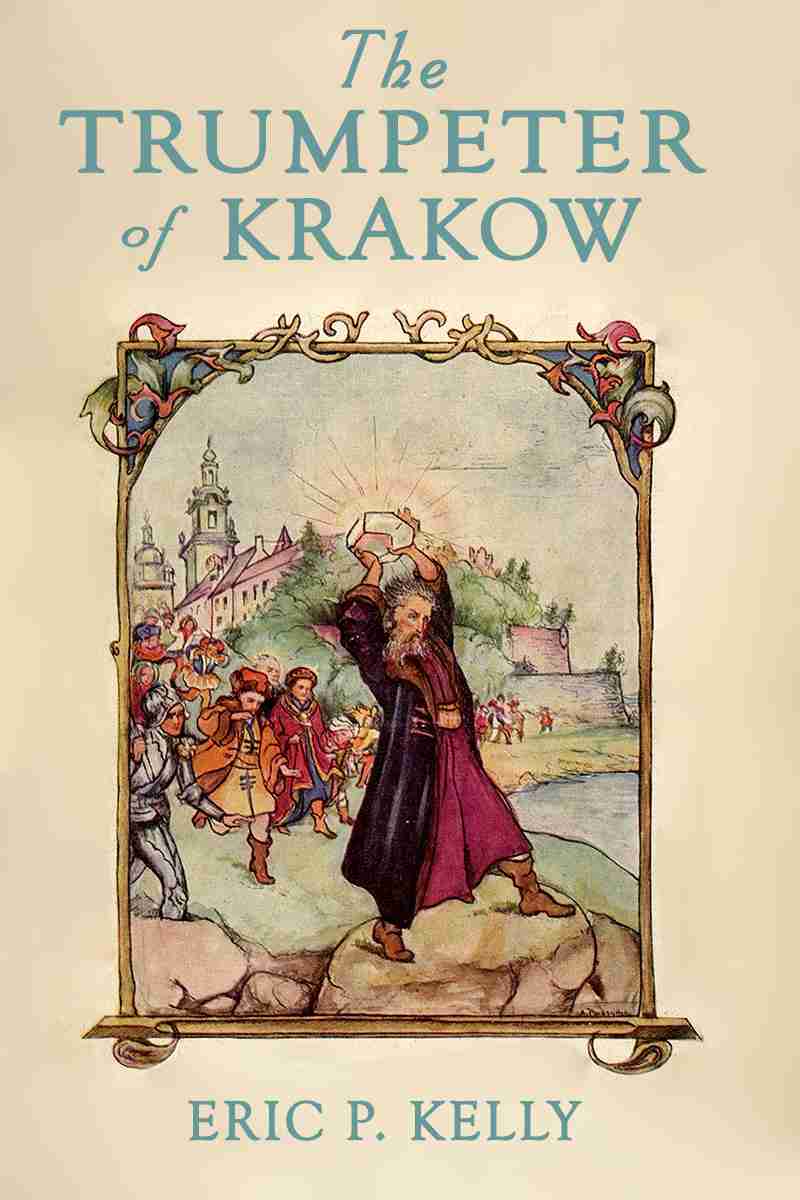
They might better have tried to stop the wind. He was through the door and out on the balcony and down the steps to the court below, where the guards, though astonished, had yet no pretext for seizing him since he was an honored guest, one of the party of Jan Kanty. Through the little entrance to the court he went at top speed, just as the King, the scepter bearers, and the guards, followed by Pan Andrew and Joseph, with Jan Kanty behind, raced along the balcony and shouted to the guards below. These at once set out in pursuit, shouting in turn to guards at the farther gates. But the alchemist was traveling like a hurricane, and passing the men at arms at the very entrance to the castle, he was off down the slope to the meadows below where he swung to the left and bore toward the spot where the Vistula curves about the base of the Wawel.
Pan Andrew and Joseph continued in pursuit with the guards, but the King with Jan Kanty, seeing the alchemist’s direction, hurried to the extreme end of the fortifications where one looks down directly to the river. At the very water’s edge the alchemist turned and beckoned to his pursuers to stop, threatening by his motions to throw himself into the current which at that time of the year was swollen and swift. They paused, helpless, waiting until he chose to speak.
“Listen,” he cried, gazing first at the pursuing party that stood not far distant from him on the shore, and then directly upward where Jan Kanty and the King were leaning over the wall.
A curious figure he presented as he stood there for a moment in silence, his garments sadly disordered, his hair twitched hither and thither by the wind, his features working from emotion—the globe of amazing beauty in his hands.
“Listen!” His voice now rose shrill and screaming. “It was I that stole the crystal from Pan Andrew. The first sight of it drove honesty from my head as it has driven honesty from the heads of many who have seen it. I saw there all that magicians and astrologers of all ages have devoutly wished for. I saw there the means of working out a great name for myself, of becoming famous, of becoming envied over all the world. I was tempted and I fell, but I shall see to it that no more trouble comes from this accursed stone.”
He paused, overcome by the effort of so much speaking, but in a second a flood of wild laughter burst from him. “There was the student Tring,” he shouted, “yes, Tring—who used to be my student. Because I looked so much into the crystal my mind grew weak and he knew and I knew. It was he who said that if we but possessed the secret of turning brass into gold then we should have power without stint, and it was he who first directed me to read in the glass what formula I might find therein for such magic. What did I find there? . . . Only the reflections of my own crazed brain. And at last between us we have done nothing but cause want and misery and suffering all over Krakow. It is because of our madness that half the city is now but a heap of ashes, that men and women and children are homeless and in poverty.”
With these words his voice shrank to a wail, and he stood, a pitiful figure, his shoulders drooping, and his face turned toward the ground.
“Cease, man! We are thy friends,” shouted the scholar.
“Nay. Such as I have no friends. But”—his shoulders suddenly straightened—“with such jewels as this that cause strife between man and man, and war between nation and nation—here—now—I make an end!”
Then raising himself to such a height that for a moment he appeared to be a giant, he swung about and hurled the crystal into the air with all his force.
The sun struck it there as it seemed for a moment to hang between earth and sky like a glittering bubble or a shining planet. Then it fell, fell, fell—until it dropped with a splash into the black, hurried waters of the Vistula River, so that the circles for a moment beat back the waves of the rushing torrent—then all was as before.
Deep silence fell upon the onlookers. There was in the man’s act something solemn, something unearthly, something supernatural—his emotion was so great and the crystal had been such a beauteous thing; and when Jan Kanty said, “Let us pray,” the whole company fell upon their knees. When he had finished a simple prayer they went forward and took up the alchemist where he had fallen, for he had dropped down as if he had been suddenly overcome by a sickness. They carried him back to the tower of the Church of Our Lady Mary where his niece and Pan Andrew’s wife watched over him.
Meanwhile the King called the scholar into conference, and after much parley, and much weighing of pros and cons, it was decided that no attempt should be made to rescue the crystal from the bed of the river. There had been in its history too much of suffering and misfortune to make it a thing at all desirable to possess, in spite of the purity of its beauty.
And should its hiding place become known—should a foreign power again seek to obtain it, what chance had such a power with the King’s army and the fortified city of the Wawel forever ready in its defense? Surely never had treasure a safer resting place.
And so to this day it has never been disturbed, though in later centuries many men have sought for it, and it rests somewhere in the Vistula River near the Wawel, where the alchemist, Kreutz, threw it in the year 1462.
Pan Andrew received from the state enough recompense to rebuild his house in the Ukraine and he repaired there that same year, taking with him Elzbietka and the alchemist who was broken in health for a long time as the result of his experiences. When he came to his senses a few days after he had thrown the crystal into the river, he had returned to his right mind fully though he had no remembrance of the dark scenes in which he had played a part. The student Tring must have left for his home in Germany directly after the fire, for he was never seen again in Krakow. In later years he gained some fame in his own native village by the practice of magic, in which it was said that he often called upon the devil himself for assistance.
Joseph continued his studies in the university until he reached his twenty-second year, and then he returned to the Ukraine to manage his father’s estates. He was shortly afterward married to Elzbietka, the friend of his boyhood days. . . . And now since we have come to the happy end of all things in this tale, may we close with the thought that every Pole carries in his mind—with the words that are foremost in the Polish National Hymn:
May God Save Poland
EPILOGUE
THE BROKEN NOTE
It is the year 1926. The Vistula River now no longer turns at the Wawel Hill and plunges straight through the Krakow plain dividing the city of Kazimierz from the city of Krakow, but instead swings far to the left and surrounds the whole plain, now the new city. The castles and towers and cathedral of the Wawel still rise proudly on the hill as in former days; St. Andrew’s which has defied fire, siege, and war for eight centuries raises its head—two towers—above Grodzka Street; the old Cloth Hall, beautified during the Renaissance, still stands in the middle of the central Rynek. And although the glory of former days is departed from the city and the kings no longer sit in the castle on the hill, there has come with the years the growth of a new glory, the glory of culture as seen in the university of fourteenth century origin, in the schools of fine arts and music and handicraft and trade. From all Poland come students to study and to live in this venerable city, which is Gothic in every corner and every gable save where here and there a bit of Romanesque wall or arch has survived the Tartar, or the Cossack, or the Swede.
But the chief glory of the city is the Church of Our Lady Mary. It no longer stands apart, a monument visible from afar as of old—other palaces and buildings have shut it in, and one sees its towers only, until one is close upon it. Then the sudden magnificence leaps upon the visitor. A splendid silence lurking in its high roof descends suddenly like the thousands of pigeons that thunder down for particles of bread. Beneath one’s feet is the old city cemetery; there on the walls are the tablets and shrines; there at the south doorway are the iron collars that once clasped the throats of petty criminals as they stood supplicating the prayers and pennies of the faithful. Inside, the church is a veritable miracle of beauty. Above its exquisite wood carvings and choir rises a vaulted roof of sky blue, studded with stars. Images of stone look down from breaks in the Gothic fluting—tablets, banners, altars, shrines all strike alike upon the sight in amazing beauty.
But listen: is the organ playing? Whence come those notes that float down from above like God’s own music from heaven? They come from the towers, for the hour is striking on the bell, and a trumpeter is playing at one of the open tower windows. And that tune? It is the Heynal, the same tune played by a young man so many centuries ago when the Tartars burned the city—and listen, the trumpeter breaks off his song in the middle of a note. . . . Four times he sounds the Heynal, once at each of the four windows, west, south, east, north. And many a man or woman or child on hearing that song thinks of the days when the young life was given to country and God and duty. . . . Poland has been through many fires since that time—she has had centuries of war, a century of extinction. But in all that time the Heynal has sounded with each passing hour and men have sworn each year to keep the custom unto the very end of time. Hark, it is sounding now.
May it bring in an epoch of peace to all men!
NOTES
The author wishes to acknowledge his indebtedness to the following persons for their services in aiding his research: Professor Roman Dyboski of the English Department of the University of Krakow; Director Frederic Papee of the university library, and his assistants, Dr. Sophia Ameisen and Dr. Wojciech Gelecki; Director Adam Chmiel of the Old Archives Building; Miss Helene d’Abancour de Franqueville of the library of the Krakow Academy; Miss Helena Walkowicz, a student in the university, and Madame Sophia Smoluchowska of Krakow.
The Aqua Phosphorata mentioned on page 108 was a luminous liquid compounded by the alchemist. Phosphorus as we know it to-day was first made by Brandt in 1699. In 1602, however, Scipio Begatello exploited the qualities of the famous Bologna Stone and its luminous qualities, discovered by Vincenzo Cascariolo about 1595, and there are other suggestions that similar substances were used by earlier alchemists and magicians.
In the illustrations Miss Pruszynska has followed faithfully fifteenth and sixteenth century models. Two old volumes, the Codex of Baltazar Behem in the University Library, and the Pontifical Ciolka in the Czartoryski Museum, Krakow, have furnished the models for the dress, architecture, customs, and colors. For greater detail in dress, the book of the celebrated Polish artist, Matejko, Costumes in Poland of Other Days, was the authority. The decorations of the illustrations are in the style of the Wit Stwosz altarpieces of the Church of Our Lady Mary.
In the Iuramenta or Book of Oaths in the Old Archives of the City of Krakow may be found the modified oath of the Krakow trumpeters as it existed in the year 1671. It had been enlarged and translated from Latin into Polish. In 1740 the Book of Oaths was rebound in the form in which it now exists. Appended is a translation of the oath.
IURAMENTUM TUBICINIS
“I swear to Almighty God that I will be obedient to their honors the gentlemen of the Krakovian council, and faithful to the whole city in the service which I render with the trumpet, also that I will be diligent scrupulously in keeping watch, to the extent of my duties, to wit: the sounding of the alarm of fire whenever and wherever it appears, in the city, or behind the city, likewise to sound upon the trumpet the hours of the night and day (appointed), and without the permission of his honor the Burgomaster I will sound the trumpet at no man’s request. I will be clean in all things and watch the fires in the tower. And all this observe which belongs to my duties, so help me God.”
THE END
TRANSCRIBER NOTES
Misspelled words and printer errors have been corrected. Where multiple spellings occur, majority use has been employed.
Punctuation has been maintained except where obvious printer errors occur.
[The end of The Trumpeter of Krakow by Eric Philbrook Kelly]