
The Project Gutenberg eBook of The Two Dianas, Volume 2 (of 3)
Title: The Two Dianas, Volume 2 (of 3)
Author: Paul Meurice
Dubious author: Alexandre Dumas
Illustrator: E. Van Meyden
Release date: February 6, 2022 [eBook #67338]
Most recently updated: October 18, 2024
Language: English
Original publication: United States: Little, Brown, and company, 1894
Credits: Laura Natal Rodrigues (Images generously made available by Hathi Trust Digital Library.)
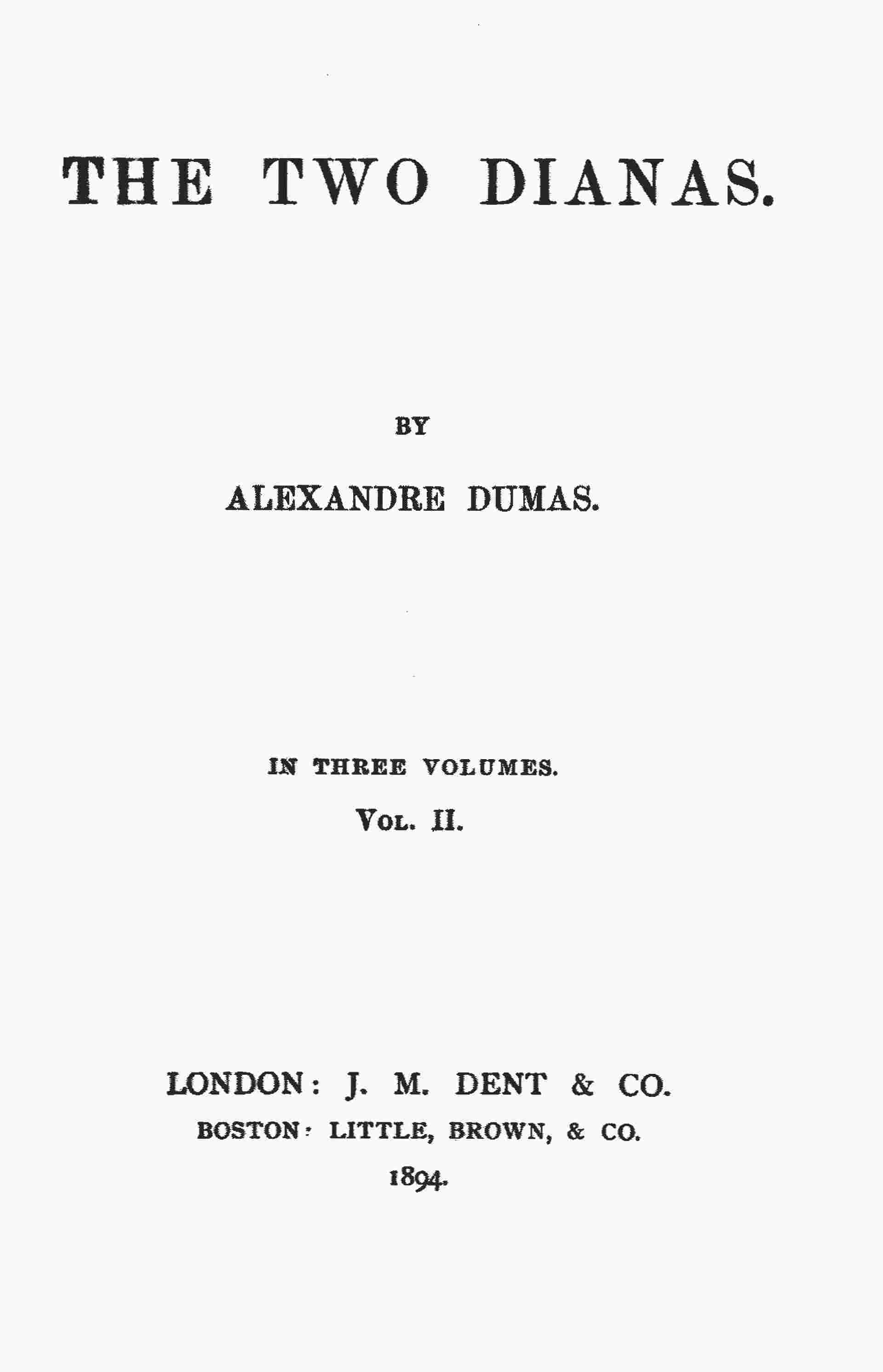
THE TWO DIANAS.
BY
ALEXANDRE DUMAS.
IN THREE VOLUMES.
VOL. II.
LONDON: J. M. DENT & CO.
BOSTON, LITTLE, BROWN, & CO.
1894.
ILLUSTRATIONS
PORTRAITS.
ORIGINAL ILLUSTRATIONS
DRAWN AND ETCHED BY E. VAN MUYDEN.
Glimpses at Divers Men of the Sword
CONTENTS
Chapter
I. In which Divers Occurrences artfully fall
out Together
II. How Arnauld du Thill caused Arnauld
du Thill to be hanged at Noyon
III. Arnauld du Thill's Bucolic Dreams
IV. The Arms of Pierre Peuquoy, the Hopes of
Jean Peuquoy, and the Tears of Babette Peuquoy
V. Sequel to the Misfortunes of Martin-Guerre
VI. In which Martin-Guerre's Character begins
to be Rehabilitated
VII. A Philosopher and a Soldier
VIII. Wherein Mary Stuart's Loveliness flits
across the Course of the Story with as
Transient a Gleam as it casts upon the
History of France
IX. The Other Diane.
X. A Grand Scheme for a Great Man
XI. Glimpses at Divers Men of the Sword
XII. The Cleverness of Stupidity
XIII. December 31, 1557
XIV. During the Bombardment
XV. Within the Tent
XVI. Small Craft sometimes save Large Men-of-War
XVII. Obscuri sola sub Nocte
XVIII. Between Two Chasms
XIX. Arnauld du Thill, though Absent, continues
to exert a Fatal Influence on
the Destiny of Poor Martin-Guerre
XX. Lord Wentworth at Bay
XXI. Love disdained
XXII. Love requited
XXIII. Le Balafré
XXIV. Partial Dénouement
XXV. Happy Omens
XXVI. A Quatrain
XXVII. The Vicomte de Montgommery
XXVIII. Joy and Anguish
XXIX. Precautionary Measures
XXX. The Secret Prisoner
XXXI. The Comte de Montgommery
XXXII. The Knight-Errant
XXXIII. In which Arnauld du Thill appears once
more
XXXIV. Justice in a Quandary
THE TWO DIANAS
CHAPTER I
IN WHICH DIVERS OCCURRENCES ARTFULLY FALL OUT
TOGETHER
Three weeks had elapsed. The last days of September were at hand; and no change of moment had taken place in the respective situations of the different characters represented in this tale.
Jean Peuquoy had paid to Lord Wentworth the trifling sum at which he had shrewdly had his ransom fixed. More than that, he had obtained leave to settle at Calais. We ought to say, however, that he seemed to be in no haste to commence operations. He seemed to be of a very inquisitive and yet careless disposition; in fact, the honest burgher might be seen from morning till night sauntering about on the walls, and talking with the soldiers of the garrison, while apparently thinking no more about the weaver's trade than if he were an abbé or a monk.
Nevertheless, he had either not tried or not been able to induce his cousin Pierre to be his companion in this life of idleness; and the skilful armorer had never turned out more or more finely executed work.
Gabriel's melancholy increased from day to day. He received nothing but general news from Paris. France was beginning to breathe again. The Spaniards and English had wasted too much precious time in besieging and reducing places of no importance; thus the country had had an opportunity to recover its balance, and it seemed as if both France and the king would be saved. This news, to which the heroic defence of St. Quentin had had no small share in imparting such a favorable character, no doubt was cheering to Gabriel; yet he heard not a word of Henri II., of Coligny, of his father, or of Diane! That reflection cast a shadow upon his brow and made it impossible for him to respond, as he might have done at another time, to Lord Wentworth's friendly overtures.
The easy-going and unreserved governor seemed really to have taken a great liking to his prisoner. His ennui, and a little feeling of chagrin during the last few days, had no doubt had their share in arousing this feeling. The society of a young and clever gentleman of the French court was an invaluable distraction in stupid Calais. Thus it was that Lord Wentworth never allowed two days in succession to go by without calling upon Vicomte d'Exmès, and insisted upon his dining with him three times a week at his own table. This excessive affection was rather oppressive to Gabriel, all things considered; for the governor laughingly swore that he would not release his hold upon his captive till the last extremity; that he would never consent to let him go on parole; and that until the last crown of Gabriel's ransom should be well and truly paid, he would not yield to the cruel necessity of parting from so dear a friend.
After all, this might well be only a refined and courtly way of expressing suspicion of him, so Gabriel did not dare to persist in his excuses; besides, his delicacy led him to suffer uncomplainingly while awaiting the convalescence of his squire, who, it will be remembered, was to go to Paris to procure the sum of money agreed upon as the price of Vicomte d'Exmès's liberty.
But Martin-Guerre—we should say, his substitute Arnauld du Thill—was very deliberate in his convalescence. After a few days, the surgeon who had been called to look after the wound, which the scamp had sustained in a scuffle, had ceased to visit him, announcing that his task was done, and his patient entirely restored to health. A day or two of rest, and the excellent nursing of pretty Babette, Pierre's sister, would be quite sufficient to complete the cure, if indeed it were not already completed.
Upon receiving that assurance, Gabriel had informed his squire that he must start for Paris on the next day but one without fail; but when the morning of that day arrived, Arnauld complained of dizziness and faintness, which made him likely to fall if he took but a few steps without Babette's accustomed support. Thereupon two days' more of delay were asked and granted. At the end of that time a sort of general debility caused poor Arnauld's arms and legs to become perfectly useless; and this new symptom, which was caused doubtless (so he said) by the excessive pain he had suffered, had to be treated with hot baths and a very rigid diet. But this last regimen gave rise to such utter weakness that more delay was considered indispensable, to give the faithful fellow time to build himself up once more with tonics and generous draughts of wine. At least his nurse Babette declared to Gabriel, with tears in her eyes, that if he required Martin-Guerre to set out at once, he would expose him to the danger of dying of inanition on the road.
This extraordinary convalescence was thus prolonged to much greater length than the illness itself, in spite of the tender care of Babette,—a malicious person might say, thanks to that same tender care,—until two weeks had elapsed since the surgeon had pronounced him cured, and it was nearly a month since Gabriel's arrival at Calais.
This could not be allowed to go on forever. Gabriel finally lost his patience; and even Arnauld du Thill, who at first had sought and found all manner of expedients with the best grace in the world, now announced, with a very self-sufficient and triumphant air, to poor broken-hearted Babette, that he could not afford to make his master angry, and that, after all, his best course would be to start at once so that he might the sooner return; but Babette's red eyes and downcast look proved that she hardly understood that kind of reasoning.
The evening before the day when, according to his formal announcement, Arnauld proposed finally to take his departure for Paris, Gabriel took supper with Lord Wentworth.
The governor seemed to have even more melancholy than usual to shake off, for he carried his gayety almost to the point of madness.
When he left Gabriel after escorting him to the courtyard, lighted at that hour only by a lamp which was already flickering, the young man, just as he was wrapping himself in his cloak before going out, saw one of the doors opening into the courtyard partly ajar. A woman, whom Gabriel recognized as one of those employed in the house, glided up to him, with a finger on her lips, and holding a paper toward him with the other hand, said in a low voice,—
"For the French gentleman whom Lord Wentworth entertains so often."
She handed him the folded paper; and before Gabriel had recovered sufficiently from his stupefaction to question her, she was already gone.
The youth, in his perplexity, being naturally of an inquiring mind, and perhaps a little rash, reflected that he had a quarter of an hour's walk to take in the dark before he would be able to read the note at his ease in his own room; and that seemed a long while to wait for the key to a riddle which piqued his curiosity. So without more ado he determined to ascertain at once if anything was required of him. He looked about, and seeing that he was quite alone, drew near the smoking lamp, unfolded the note, and read, not altogether unmoved, the following words:—
"Monsieur, I do not know you, nor have I ever seen you; but one of the women who wait upon me tells me that you are a Frenchman, and are, as I am, a prisoner. This gives me courage to appeal to you in my distress. You are doubtless held for ransom. You will probably soon return to Paris. You can see there my friends, who have no idea what has become of me. You might tell them where I am; that Lord Wentworth is holding me a prisoner without allowing me to communicate with a living, soul, and refusing to name any price for my liberty; and that, shamefully abusing the cruel privilege which my unfortunate position gives him, he has the effrontery every day to speak to me of a passion which I repulse with horror, but which my very scorn and his certainty of impunity may excite to the use of force. A gentleman, and above all, a fellow-countryman, will surely come to my aid in this wretched extremity; but I still have to tell you who I am for whom—"
The letter came to an end there, and was unsigned. Some unexpected interruption or sudden accident had probably caused her to break off thus abruptly, and yet she had chosen to send the letter, even though it were unfinished, so that she might not lose any precious opportunity, and because, although not complete, it still said everything that she wished to say except the name of the lady who was being subjected to such odious restraint.
That name Gabriel did not know, nor could he recognize the trembling, hurried handwriting; and yet a strange feeling of anxiety, an extraordinary presentiment, crept into his heart. Pale with emotion, he drew near the lamp again to read the letter once more, when another door behind him opened, and Lord Wentworth himself came out, preceded by a little page, and crossed the courtyard on his way to his sleeping apartment.
As he recognized Gabriel, to whom he had said good-night some time before, the governor stayed his steps in surprise.
"Are you still here, my friend?" he said, approaching him with his customary friendly manner. "What has detained you? No mishap, I trust, or sudden illness?"
The straightforward young man, without replying, simply held out to Lord Wentworth the letter that had been handed him. The Englishman cast his eye upon it, and became even paler than Gabriel; but he succeeded in maintaining his presence of mind, and while pretending to read it, was really making up his mind how to deal with the matter.
"What an old fool she is!" said he, crumpling the letter in his hand and throwing it on the floor in well-feigned contempt.
No words could have served to throw Gabriel off the scent more quickly or completely, for he was continually absorbed in his own thoughts, and had already begun to lose interest in the unknown. However, he did not abandon his suspicions at once, but responded rather evasively,—
"You don't tell me who this prisoner is whom you are detaining here against her will, my Lord?"
"Against her will, indeed!" said Wentworth, in a perfectly unembarrassed tone. "It is a kinswoman of my wife,—a little crack-brained, if any one ever was,—whom her family wished to send away from England, and who has, much to my disgust, been put in my charge in this place, where it is easier to keep an eye on lunatics as well as on prisoners. However, since you have penetrated this family secret, my dear fellow, I think I might as well tell you the whole story on the spot. The particular mania of Lady Howe, who has read too many of the poems of chivalry, is to imagine, despite her fifty years and her gray hairs, that she is an oppressed and persecuted heroine; and she tries to interest in her behalf, by fables with more or less foundation in fact, every good-looking young cavalier who comes within her reach. Upon my soul, Gabriel, it seems to me as if my old aunt's romancing has enlisted your sympathy for her. Come! confess that her billet-doux did cause you a little anxiety, my poor fellow?"
"It's a strange story that you tell me, my Lord, you must agree," said Gabriel, coldly; "you have never spoken to me of your kinswoman that I remember."
"No, to be sure I have not," rejoined Lord Wentworth; "for one does not ordinarily care to admit strangers into one's confidence as to private family matters."
"But how does she come to say that she is French?" asked Gabriel.
"Oh, to arouse your interest more successfully, in all probability," was Wentworth's reply, with a smile which began to be rather forced.
"And this passion which she claims that you inflict upon her, my Lord?"
"The delusion of an old woman who mistakes ancient memories for new hopes," rejoined Wentworth, who was beginning to grow restive.
"Is it to avoid being laughed at, my Lord, that you keep her out of everybody's sight?"
"Ah, how many questions you ask!" exclaimed Lord Wentworth, frowning darkly, but still without any outburst. "I had no idea you were of such an inquiring mind, Gabriel. But it's quarter to nine, and I have your agreement to be in your own quarters before the curfew sounds; for your freedom as a prisoner on parole does not extend so far as to allow any infringement of the police regulations of Calais. If Lady Howe interests you so deeply, we can return to the subject to-morrow. Meanwhile, I beg you will say nothing about these delicate family matters; and I have the honor to wish you good-evening, Monsieur le Vicomte."
Thereupon the governor saluted Gabriel, and re-entered the house. He desired to retain his self-control to the end, and feared that he might become too much excited if the conversation were to continue.
Gabriel, after a moment's hesitation and thought, left the governor's mansion to return to the humble abode of the armorer. But Lord Wentworth had not remained so entirely master of himself to the last as to do away with all suspicion in Gabriel's heart; and the young man's doubts, which were added to by his secret instinct, assailed him anew on his way through the streets.
He determined to say nothing more on the subject to Lord Wentworth, who was not likely to give him any information, but to watch and make inquiries, and to find out if he could whether the fair unknown was really a countrywoman of his own, and the Englishman's prisoner.
"But, mon Dieu! even if that is proved to demonstration," thought Gabriel, "what can I do then? Am I not myself a prisoner here? Are not my hands bound, and has not Lord Wentworth a perfect right to call upon me for my sword, which I wear only by his favor and at his pleasure? There must be an end to this state of things; and I must be able to have matters on a different footing, in case of need. Martin-Guerre must absolutely and without more trifling be off to-morrow. I will tell him so myself this very evening."
So when the door had been opened to Gabriel by one of Pierre Peuquoy's apprentices, he went up to the second floor, instead of stopping, as he generally did, at his own room on the first floor. Probably everybody in the house was asleep at that hour, Martin-Guerre no doubt like the others. If so, Gabriel concluded to awaken him and make known to him his firm determination. He noiselessly approached the room occupied by his squire, so that he might disturb nobody's slumbers.
The key was in the outer door, which Gabriel softly opened; but the inner door was closed, and Gabriel could hear through the partition bursts of laughter and the clinking of glasses. Thereupon he knocked with some force, and announced himself in an imperious voice. The noise ceased abruptly; and as Gabriel only called the louder, Arnauld du Thill hurriedly opened the door to his master. In fact, he made too much haste, and failed to allow sufficient time for a fluttering dress, which was vanishing through an opposite door, to disappear completely before Gabriel came in.
He took it to be some little love-making with the housemaid; and as he was not very prudish in his ideas, he could not refrain from smiling as he reprimanded his squire.
"Aha, Martin," said he, "I think you must be much better than you pretend! A table all set, three bottles, and two covers! I seem to have frightened away your companion at the banquet. Never mind! I have seen now very decisive proofs of your recovery, and I am more than ever free from hesitation about ordering you to start to-morrow."
"That was my intention, you know, Monseigneur," said Arnauld, rather abashed; "and I was just saying my adieus—"
"To a friend? Oh, yes!" said Gabriel, "that shows your kind heart; but friendship must not make us forget our duty, and I must insist that you be on your way to Paris before I rise to-morrow. You have the governor's safe-conduct; your outfit has been ready for some days: your horse is as thoroughly rested as yourself; your purse is full, thanks to the confidence of our good host, who has only one regret, worthy man, and that is that he is unable to advance the whole of my ransom. You lack nothing, Martin; and if you start early in the morning you ought to be in Paris in three days. Do you remember what you are to do when you are safely there?"
"Yes, Monseigneur. I am to go at once to the house in the Rue des Jardins de St. Paul, to inform your nurse of your safety; to ask her for the ten thousand crowns required for your ransom, and three thousand more for your expenses and debts here; and as tokens of my authority, I am to show her this line from you, and your ring."
"Useless precautions, Martin, for my good nurse knows you well, my faithful fellow! but I have yielded to your scruples. Remember to see that this money is got together as quickly as possible, do you understand?"
"Never fear, Monseigneur. When I have the money, and have handed your letter to Monsieur l'Amiral, I am to come back even faster than I went away."
"No wretched quarrels on the way, above all things!" "There is no danger, Monseigneur."
"Well, then, adieu, Martin, and good luck to you!"
"In ten days you will see me here again, Monseigneur, and at sunrise to-morrow I shall be a long way from Calais."
On this occasion Arnauld kept his promise. He allowed Babette to go with him next morning to the city walls. He embraced her for the last time, swearing solemnly that she should see him again very soon; then he drove his spurs into his horse, and was off in high spirits like the rascal that he was, and speedily disappeared at a bend in the road.
The poor girl made haste to get back to the house before her terrible brother should have arisen; but she had to send word down that she was ill, so that she might indulge her grief alone in her chamber.
Thereafter it would not be easy to say whether she or Gabriel awaited the squire's return the more impatiently. They were both doomed to wait a long while.
CHAPTER II
HOW ARNAULD DU THILL CAUSED ARNAULD DU THILL TO
BE HANGED AT NOYON
During the first day Arnauld du Thill had no unfortunate encounter, and pursued his journey with reasonable celerity. He met parties of the enemy from time to time along the road,—German deserters, disbanded Englishmen, and Spaniards insolent in the pride of conquest; for there were more foreigners than Frenchmen at this time in our poor debased France. But to all questioners Arnauld proudly exhibited Lord Wentworth's safe-conduct; and all of them, not without some regretful grumbling, thought best to respect the signature of the governor of Calais.
Nevertheless, on the second day, in the neighborhood of St. Quentin, a detachment of Spaniards undertook to get the better of him by claiming that his horse was not included in the safe-conduct, and that they might conclude to confiscate him; but the false Martin-Guerre was firm as a rock, and demanded to be taken to their commander, whereupon they released the sharp fellow and his horse without more ado.
However, the adventure served as a useful lesson to him, and he resolved henceforward to avoid as far as possible all meetings with armed bands. But it was a difficult matter; the enemy, although they had gained no decisive advantage by the capture of St. Quentin, nevertheless occupied all the surrounding country. Le Catelet, Ham, Noyon, and Chauny were in their hands; and when Arnauld found himself before Noyon, on the evening of the second day, he made up his mind that his best plan was to avoid the town by a detour, and not put up for the night until he came to the next settlement.
In order to do this he had to leave the high-road. Arnauld, being but little acquainted with the country, lost his way; as he was trying to get back into the right road again, he suddenly found himself at a turn in the path in the midst of a detachment of armed men, who likewise seemed to be in search of something.
It is easier to imagine than describe Arnauld's intense satisfaction when he heard one of them cry out as soon as he caught sight of him,—
"Hallo! If here isn't that miserable Arnauld du Thill now!"
"Arnauld du Thill on horseback?" said another of the party.
"Great Heaven!" said the squire to himself, turning pale, "I seem to be known hereabouts; and if I am really recognized, it's all over with me."
It was too late, however, for him to turn about and make his escape, for the soldiers were all around him. Fortunately it was already pretty dark.
"Who are you, and where are you going?" one of them asked him.
"My name is Martin-Guerre," replied Arnauld, trembling with fear; "I am the squire of Vicomte d'Exmès, now a prisoner at Calais, and I am on my way to Paris to procure the money for his ransom. Here is a safe-conduct signed by Lord Wentworth, governor of Calais."
The leader of the troop called one of his men, who carried a torch, and began with very serious mien to examine Arnauld's pass.
"The seal is all right," said he; "and the pass seems to be genuine. You have told the truth, my friend; and you may go on about your business."
"Thanks," said Arnauld, breathing again.
"One word more, my friend. You have not chanced to meet on your way a man who had the appearance of a fugitive, a rascally gallows-bird, who answers to the name of Arnauld du Thill?"
"I don't know any such man as Arnauld du Thill," was Arnauld du Thill's hasty reply.
"Perhaps you don't know him, my friend; but you might have met him among these by-paths. He is about your height, and as well as one can judge in this darkness, of somewhat the same build. But he is by no means so well dressed as you, I must admit. He wears a brown cape, round hat, and gray leggings, and he should be in hiding somewhere in the direction that you came from. The villain! Oh, if he but fall into our hands just once more, that devilish scoundrel!"
"What has he done, pray?" inquired Arnauld, hesitatingly.
"What has he done? This is the third time that he has escaped from us. He claims that we made his life too hard for him. I think he's right too! When he ran away the first time he carried off his master's light o' love. Surely that deserved punishment. Then he had nothing to pay for his ransom. He has been sold over and over again, and has passed from hand to hand, and was the property of anybody who wanted him. It was no more than fair that since he could be of no value to us, he should entertain us; but that made him proud, and he didn't choose to do it any longer, so he ran away again. Now, this makes the third time that he has done it, and if we catch the blackguard again!"
"What will you do to him?" asked Arnauld, again.
"The first time we beat him; the second time we half killed him; and the third time we will hang him!"
"Hang him!" echoed Arnauld, in alarm.
"To the nearest tree, my good fellow; and without trial. He is ours. To hang him will amuse us, and teach him a lesson. Look to your right, my friend. Do you see that gallows? Well, we shall string up Arnauld du Thill on that very gallows the moment we succeed in capturing him."
"Oh, indeed!" said Arnauld, with rather constrained merriment.
"It's just as I tell you, my friend! so if you meet the rascal, just take him in hand, and bring him to us; we will not forget the service. Until then, farewell."
Thereupon they were leaving him, but he, feeling immensely relieved, called them back.
"Pardon me, masters, but one good turn deserves another! I am completely astray, you see, and have not the slightest idea where I am; so just set my compass right for me, will you?"
"That's very easily done, my friend," said the trooper. "Those walls behind you and the postern-gate that you can just distinguish in the darkness are part of Noyon. You are looking too far to the right, toward the gallows; look more to the left, where you see the pikes of our comrades glistening, for our company is doing guard-duty to-night at that postern. Now, turn about and you have in front of you the road from Paris through the wood. About twenty paces from here the road forks. You may turn to the right or left, as you think best. The roads are of equal length, and come together at the ferry over the Oise about a fourth of a league from here. Having crossed the ferry, bear always to the right. The first village is Auvray, a league from the ferry. Now you know as much as we do, my friend. A pleasant journey to you!"
"Thanks, and good-evening," said Arnauld, putting his horse to a trot.
The directions they had given him were very accurate. Twenty paces away he came to the fork, and left the selection to his horse, who chose the left-hand road.
The night was very dark, and the forest doubly so. However, in about ten minutes Arnauld arrived at a clearing in the woods; and the moon, breaking through the clouds, cast a feeble and uncertain light upon the road.
At that moment the squire was thinking of the fright he had had, and of the strange adventure which had put his sang-froid to the test. Though his mind was at ease as to the past, he could not contemplate the future without misgiving.
"This must be the real Martin-Guerre, whom they are hunting under my name," he thought. "But the gallows-bird has got away! I shall find him at Paris as soon as I get there myself, very likely, and a fine contest I shall have on my hands in that case. I know that nothing but impudence can carry me through; but it may be my destruction. Why need the blackguard have escaped h He is getting to be a great nuisance certainly; and it would be a great kindness to me if those brave fellows would hang him. He is decidedly my evil genius."
This edifying monologue was yet unfinished when Arnauld, who had a very keen and practised sight, saw or thought he saw, a hundred paces or so ahead of him, a man, or more properly speaking, a shadow, which, as he drew near, suddenly disappeared in a ditch.
"Hallo! another ill-timed meeting,—an ambush perhaps," thought the prudent Arnauld.
He tried to plunge into the woods, but the ditch was impassable for horseman and horse. He waited a few moments, then ventured to look around. The phantom, which had raised its head, disappeared as quickly as before.
"Can it be that he is as much afraid of me as I am of him?" said Arnauld to himself. "Are we equally anxious to avoid each other? Well, I must do something, since this infernal undergrowth prevents my going across through the woods to the other road. Must I go back to the fork in the road! That would be the surest way. May I not bravely put my horse on the run and pass my man like a flash? That would be the shortest way to do. He is on foot, and unless a shot from an arquebuse—but no, I won't give him time for that."
No sooner resolved than carried out. Arnauld drove both spurs into his horse's sides, and went by the man in ambush or hiding like a streak of lightning.
The man did not stir.
That rather lessened Arnauld's terror; he pulled up his horse, and even went back a few steps, acting upon a thought that had suddenly occurred to him.
Still the man gave no sign of life.
Thereupon all Arnauld's courage came back to him; and now, almost certain that he was right in his conjecture, he rode straight up to the ditch.
But at this juncture, and before he had time even to utter an exclamation, the man gave one leap, and releasing Arnauld' right foot from the stirrup with a sudden movement, and throwing it roughly over the saddle, he cast the squire from his horse, fell to the ground upon him, and seized him by the throat with his knee on his chest.
All this took place in less than twenty seconds.
"Who are you? What do you want?" asked the victor of his fallen foe.
"Let me get up, I beseech you!" said the almost strangled voice of Arnauld, who felt that he had met his master. "I am a Frenchman; but I have a safe-conduct from Lord Wentworth, governor of Calais."
"If you are a Frenchman," said the man,—"and in truth you seem not to have an accent like all these demons of foreigners,—I have no need of your passport. But what made you approach me in such an extraordinary way?"
"I thought that I saw a man in the ditch," said Arnauld, as the pressure on his chest was somewhat relaxed; "and I was coming to see if it wasn't a wounded man, and if there wasn't something I could do for him."
"Your purpose was good," said the man, withdrawing his hand and taking away his knee. "Come, get up, comrade," he added, extending his hand to Arnauld, who was soon on his feet. "I gave you rather a—rather a rough welcome; but you must excuse me, because I have no mind just now to have anybody interfering with my affairs. But you are a fellow-countryman, which is a very different matter; and far from injuring me, you may do me a great service. Let us get to know each other first. My name is Martin-Guerre; and yours?"
"Mine? Mine? It's Bertrand," said Arnauld, with a start; for being alone with him at night, and in that dense forest, this man, whom he ordinarily ruled completely by virtue of his cunning and shrewdness, now quite as completely had him in his power by virtue of his strength and courage.
Fortunately for Arnauld, the darkness assured his remaining unrecognized, and he did his best to disguise his voice.
"Well, friend Bertrand," continued Martin-Guerre, "let me tell you that I am an escaped prisoner, and that I got away this morning for the second time (my captors say for the third) from these Spaniards and English and Germans and Flemings; in short, from this whole catalogue of foes who have settled down upon our poor land like a swarm of locusts. For may I be hanged if France is not at this moment another Tower of Babel! For the last month I have belonged, just as you see me now, to twenty jabberers of different nationalities; and each patois was always harsher and more outlandish to listen to than the last. I was tired to death of being harried from village to village, which was done to me so much that I began to think they were simply making sport of me, and amusing themselves by tormenting me. They were forever blackguarding me about some pretty little witch named Gudule, who was supposed to have fallen in love with me so madly apparently as to have run away with me."
"Aha!" ejaculated Arnauld.
"I am just telling you what they told me. Well, their raillery tired me so much that one fine morning I took to my heels, all alone, however. As bad luck would have it, they caught me, and pounded me so that I had to pity myself. But what was the good of it all? They threatened to hang me if I did it again, but that only made me all the more anxious to attempt it; and this morning, seizing a favorable opportunity while they were arranging their quarters at Noyon, I gave my tyrants the slip again finely. God knows how eagerly they have been hunting for me to hang me! But as I am strongly opposed to that conclusion of the affair, I have been perched up in a tall tree here in the woods all day, waiting for night to come; and I couldn't help laughing, although rather feebly, to see them pass right under my feet, cursing and swearing. When it became dark, I left my observatory. Now, in the first place, I have lost myself in the woods, having never been here before; and in the second place, I am dying of hunger, not having had a morsel between my teeth for twenty-four hours, except a few leaves and roots, which do not make a bountiful meal. That is why I fell down from weakness, as you can easily understand."
"Phew!" said Arnauld. "I didn't understand it that way just now; on the contrary, you seemed to me, I must confess, to be quite vigorous."
"Oh, yes," said Martin, "because I pommelled you a little. However, don't be angry about it. It was the fever of hunger that lent strength to my arm. But now you are my Providence; for you, being a fellow-countryman, surely will not let me fall into the hands of those fellows again, will you?"
"No, to be sure I will not, if I can help you in any way," replied Arnauld du Thill, who was reflecting in his shrewd way upon what Martin had said.
He began to see light on the subject of regaining his advantage, which had been put in some peril by the strong grasp of his double.
"You can do a great deal for me," Martin-Guerre went on ingenuously. "Are you not somewhat acquainted with this neighborhood?"
"I belong in Auvray, a quarter of a league from here," said Arnauld.
"Are you on your way there?"
"No, I am just coming from there," replied the crafty knave, after a moment's hesitation.
"Does Auvray lie in that direction, then?" asked Martin, pointing toward Noyon.
"Exactly so," replied Arnauld; "it is the first village out of Noyon on the road to Paris."
"On the road to Paris!" cried Martin; "well, just see, then, how a man may get turned around in the woods! I fancied that my back was turned to Noyon, whereas I was really coming back to it; that I was going toward Paris, whereas I was really getting farther away. The cursed country is entirely strange to me, as I was just telling you. So it seems that I must travel in the direction from which you came to avoid walking into the wolfs jaws."
"You are quite right, Master! I am going to Noyon; but walk with me a few steps. We shall find at the ferry over the Oise, close by, another road which will take you to Auvray more directly."
"I am very much obliged, friend Bertrand," said Martin; "to be sure, I want to be as sparing of my steps as possible, for I am very tired and very weak, having, as I was telling you, about as little sustenance in me as I well could have. You don't happen to have anything to eat about you, friend Bertrand, do you? If you have, you will have saved me twice over,—once from the English, and again from starvation, which is quite as terrible as they."
"Alas!" was Arnauld's reply, "I haven't a crumb in my haversack! But if you care for a draught of good wine, why, my calash is quite full."
In fact, Babette had taken care to fill her unfaithful swain's calash with vin de Chypre,—a very potent wine of the period; and Arnauld up to that time had indulged very sparingly, so as to retain his rather easily upset reasoning powers amid the perils of the road.
"I think I should be more than glad of a drink!" cried Martin-Guerre, enthusiastically. "A draught of wine is sure to enliven me a bit."
"Well, then, take it and drink away, my good fellow!" said Arnauld, offering him his calash.
"Thanks! And may God requite you!" said Martin, who set to work unsuspiciously to drown his sorrows in the wine, which was as treacherous as he who offered it, and whose fumes almost immediately began to work upon his brain, which was easily affected on account of his long abstinence from food.
"Well, well," said he, hilariously, "this light wine of yours doesn't lack fire!"
"Oh, mon Dieu! it's quite harmless!" said Arnauld; "I drink two bottles at every meal. But as the evening is very fine, let us sit here on the grass awhile; and do you take a good rest, and drink at your leisure. I have time enough; and I shall be all right if I reach Noyon before ten o'clock, which is the hour for closing the gates. But you, although Auvray still flies the standard of France, are nevertheless likely to meet with troublesome patrolling parties if you follow the high-road so early; while if you leave it, you will lose your way again. The best course will be for us to stay here awhile, and quietly talk matters over. Where were you made prisoner?"
"I don't quite know," said Martin-Guerre, "for there are two contradictory versions of that matter, just as there are of almost the whole of my unfortunate life,—one which I believe myself, and another which I hear from others. For instance, I am assured that it was at the battle of St. Laurent that I surrendered at discretion; while my own idea is that I was not present on that occasion, and that it was somewhat later than that I fell into the hands of a party of the enemy all by myself."
"What do you mean?" asked Arnauld, feigning incredulity. "Have you two histories, pray? Your adventures seem very interesting and instructive, to say the least of them. I must confess that I am extravagantly fond of such tales. Just take a good drink to freshen up your memory, and tell me something of your life. You are not from Picardy?"
"No," replied Martin, after a pause, which he occupied in drinking three fourths of the contents of the calash; "no, I am from the South,—Artigues."
"A fine country, they say. Is your family there?"
"My wife and children, my good friend," replied Martin, who had become very expansive and confidential under the influence of the Chypre.
Being stimulated partly by Arnauld's questions and partly by his constant libations, he began to narrate with great volubility his whole history, even to its least detail,—his youth, his love-affairs, and his marriage; that his wife was a very charming woman, notwithstanding a slight failing in regard to her hand, which was too quick and too heavy at once. In truth, a blow from a woman was no dishonor to a man, although it was rather tiresome in the long run. That was why Martin-Guerre had left his too-emphatic wife. Then followed a circumstantial account of the causes, details, and sequel of the rupture between them. However, he loved her still at heart,—his dear Bertrande! He still wore on his finger his iron marriage-ring, and over his heart the two or three letters which Bertrande had written the first time they ever were separated. As he told of this, the honest fellow wept. It was decidedly tender-hearted wine. He would have liked to go on with the details of everything that had happened to him since he entered the service of Vicomte d'Exmès; that a demon had pursued him; that he, Martin-Guerre, was double, and did not recognize himself at all in his other existence. But this portion of his narrative seemed less interesting to Arnauld du Thill, who kept luring him back to talk of his childhood and his father's house, of his friends and kinsfolk at Artigues, and of Bertrande's charms and failings.
In less than two hours the treacherous Arnauld, by dint of skilful and persistent questioning, knew all that he cared to know about the former habits and the most private concerns of poor Martin-Guerre.
At the end of two hours Martin, with his head on fire, rose, or rather tried to rise; for as soon as he moved, he stumbled and fell heavily back onto his seat.
"Well, well, what's the matter?" said he, with a loud laugh which was a long while dying out. "Upon my soul, your saucy wine has done its work! Give me your hand, pray, my friend, so that I may be able to stand up."
Arnauld courageously went about hoisting him up, and at last succeeded in getting him on his legs, but not in a posture of classical equilibrium.
"Hallo, there! what a number of lanterns!" cried Martin. "Oh, what a fool I am! I took the stars for lanterns."
Then he began to sing at the top of his voice,—