
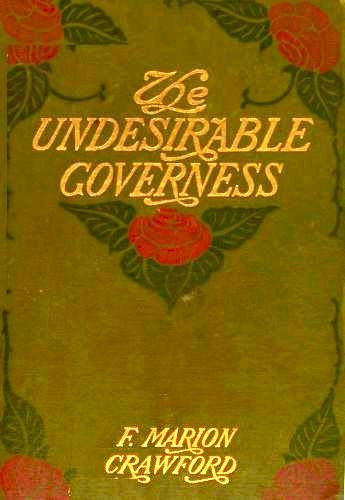
The Project Gutenberg eBook of The Undesirable Governess
Title: The Undesirable Governess
Author: F. Marion Crawford
Illustrator: Arthur Wallis Mills
Release date: June 3, 2020 [eBook #62317]
Most recently updated: October 18, 2024
Language: English
Credits: Produced by Chuck Greif and the Online Distributed
Proofreading Team at http://www.pgdp.net (This file was
produced from images available at The Internet Archive)
|
Chapter I, II, III, IV, V, VI, VII, VIII. List of Illustrations (etext transcriber's note) |
THE UNDESIRABLE GOVERNESS
THE MACMILLAN COMPANY
NEW YORK · BOSTON · CHICAGO
ATLANTA · SAN FRANCISCO
MACMILLAN & CO., Limited
LONDON · BOMBAY · CALCUTTA
MELBOURNE
THE MACMILLAN CO. OF CANADA, Ltd.
TORONTO
THE UNDESIRABLE
GOVERNESS
BY
F. MARION CRAWFORD
AUTHOR OF “SARACINESCA,” “THE DIVA’S
RUBY,” “THE WHITE SISTER,” ETC.
ILLUSTRATED
New York
THE MACMILLAN COMPANY
1910
All rights reserved
Copyright, 1909, 1910,
By THE MACMILLAN COMPANY.
Set up and electrotyped. Published April, 1910.
Norwood Press
J. S. Cushing Co.—Berwick & Smith Co.
Norwood, Mass., U.S.A.
LIST OF ILLUSTRATIONS
Used by permission of the Pall Mall Magazine
THE UNDESIRABLE GOVERNESS
CHAPTER I
“By-the-bye,” began Colonel Follitt, looking at his wife across the tea-things, “have you done anything about getting a governess?”
“No,” answered Lady Jane, and a short pause followed, for the subject was a sore one. “I have not done anything about getting a governess,” she added presently, in the tone suitable to armed neutrality.
“Oh!” ejaculated the Colonel.
Aware that it would be hardly possible to find fault with the monosyllable, he slowly stirred his tea. He took it sweet, with cream, for in spite of a fairly successful military career and a well-developed taste for sport, he was a mild man. He was also a ladies’ man, and preferred feminine society, even in his own home, to that of fellow-sportsmen and former brother officers. Lady Jane had, indeed, no other fault to find with him; but this one sometimes constituted a serious grievance.
“You talk,” said Lady Jane presently, “as if the matter was urgent.”
“I said ‘oh,’” answered her husband mildly.
“Precisely,” retorted the lady; “but I know very well what you meant.”
“If I meant anything, I meant that those two girls are all over the place and need some one to look after them.”
“I really think I’m able to take care of them myself for a few days,” answered Lady Jane stiffly.
“No doubt, no doubt. But, all the same, I caught them potting rooks in the park this morning with my best gun; and Barker tells me that yesterday, when the men were at dinner, they managed to get Schoolboy and Charley’s Aunt out of the stables on the sly and rode races bareback in the paddock, till he came back. I don’t know why they did not break their necks.”
Lady Jane did not seem much moved by this intelligence, for the Follitts were a sporting family, and she had been used to their ways for a quarter of a century.
“I will speak to them,” she said, as if that would insure their necks.
At this point their eldest son came in quietly and sat down half-way between his father and mother. Colonel Follitt was a well-set-up, tough-looking man, who looked younger than his age and dressed just a little younger than he looked. There were a few lines in his face, his well-trimmed moustache was only just beginning to turn grey, and he had the eyes of a boy. His wife was neither fair nor dark, and quite as well-preserved as he, besides having the advantage of being ten years younger. But the eldest son of this good-looking couple seemed prematurely old. He was tall, thin, and dark, and had the general air and cut of a student. He could ride, because all the Follitts rode, and he shot as well as the average man who is asked to fill a place for a couple of days with an average shooting-party; but he much preferred Sanskrit to horses, and the Upanishads to a day on the moors. From sheer love of study he had passed for the Indian Civil Service after taking his degree; but instead of taking an appointment he had plunged into the dark sea of Sanskrit literature, and was apparently as much at home in that element as a young salmon in his native stream. His father mildly said that the only thing that might have made him seem human would have been a little of the family susceptibility to feminine charm. But though he was heir to a good estate, he had not yet shown the least inclination to marry, and pretty governesses came and went unnoticed by him. Like most students, he was very fond of his home, but he made frequent journeys to London at all times of the year for the purpose of making researches in the British Museum. Even the most careful mother could feel little or no anxiety about such a son, and Lady Jane, for reasons of her own, sometimes wished that his brothers would take up their quarters in the neighbourhood of the British Museum for six months at a time.
She gave him his tea now, just as he liked it, and a long silence followed. He sat quite still, looking into his cup with the air of pleasant but melancholy satisfaction peculiar to students who have just left their books.
He looked up at last, towards his mother, with a far-away expression.
“By-the-bye,” he asked, “when is the new governess coming?”
A vague smile just moved Colonel Follitt’s neat moustache, but Lady Jane’s fine brow darkened.
“I am considering the question,” she answered, as a judge sometimes replies to a barrister’s clever insinuation, saying that the Court will “bear the point in mind.”
Noting her manner, and well understanding what it meant, Lionel thought it necessary to make some explanation.
“I was thinking of those girls,” he said with profound gravity.
“A little holiday will do them good,” said Lady Jane.
“So far as that goes,” answered Lionel thoughtfully, “a woman’s education is complete when she has forgotten her arithmetic and has learned to play the piano well enough to drive people out of the house.”
“My dear,” retorted Lady Jane, “your sisters are not learning to play the piano.”
“Thank goodness! That is spared us. But they are forgetting their arithmetic.”
“According to you,” replied his mother, “it is a step in the right direction.”
“It’s all very well, but that’s no reason why they should climb to the top of the King’s Oak by the lodge and pepper every horse that passes with buckshot from a catapult.”
Again the Colonel’s moustache moved; but his son wore none, and not the shadow of a smile disturbed the grave lines of his mouth.
“I will speak to them,” said Lady Jane.
“I wonder what you’ll say!”
Before Lady Jane had time to explain what she would say, her second son appeared. He was a startling contrast to his elder brother and less than two years younger: he was a sort of red-haired Hermes; his colouring completely spoiled his beauty, which would have been, perhaps, too perfect for a man, if his complexion had not been freckled like a trout’s back and if his hair had been of any colour but that of inflamed carrots. As it was, he was just a very fine specimen of young humanity, and it would never have occurred to any one to call him even handsome. He was a credit to the family, though he had only got a pass degree at Oxford, for he had been Captain of the boats at Eton, and had pulled Four for the ‘Varsity in a winning year. It is true that he showed no taste for any profession or career, and seemed to have made up his mind to spend the rest of his life at home, because there was no finer hunting country in Great Britain; but then, there would always be bread-and-butter and horses for him, without seeking those necessities elsewhere, and if Lionel did not marry, he, Jocelyn, would take a wife. In the meantime he seemed quite unconscious of the admiration that was plentifully accorded to him by that large class of young women who prefer a manly man to a beauty-man. At all events he was absolutely reticent about his own affairs, and neither his mother nor his brothers could be sure that he had ever said a word to a woman which might not be repeated by the town crier. But there was no mistaking the glances that were bestowed upon him, nor the tone of voice in which some of the very nicest girls spoke to him. They could not help it, poor things. Jocelyn sat down on a low stool between his mother and Lionel, with his heels together, his knees apart, his shoulders bent forward, and his eyes fixed hungrily on the buttered toast. He looked like a big, cheerful mastiff, expecting to be fed by a friendly hand.
Lady Jane proceeded to satisfy his very apparent wants.
“I say,” he began, as he watched the cream mingling with the tea, “what is the new Miss Kirk’s name?”
Miss Kirk had been the last governess—a lovely creature with violet eyes and hair that curled at her temples. Lady Jane had found her photograph in the pocket of a shooting-coat belonging to the Colonel which had been brought to her maid to have a button sewn on, and the circumstance had led to the young lady’s abrupt departure. More or less similar circumstances, in some of which her two younger sons had been concerned, had produced similar results in a number of cases. That is why the question of the new governess was a sore point at King’s Follitt.
“No one has yet answered my advertisement,” answered Lady Jane, “and none of our friends seem to know of just the right person.”
“How very odd!” observed the Colonel. “We generally get so many more answers than we want.”
“What those girls need is a keeper,” said Jocelyn, with an audible accompaniment of toast-crunching.
“You might get one from the County Lunatic Asylum,” suggested Lionel thoughtfully. “You could get one for about the same price as a good governess, I should think.”
“I don’t mean that,” answered Jocelyn. “I mean a gamekeeper. They’ve gone in for poaching, and it’s time it was stopped.”
“Eh? What?” Colonel Follitt did not understand.
“They’ve been snaring hares all over the park. That’s one thing. Then, they are catching all the trout in the stream with worms. If that isn’t poaching, what is? Rather low-down form, too. Worms!”
This roused the Colonel. “Really! Upon my word, it’s too bad!”
“What becomes of the game and the fish?” inquired the Colonel.
“They give them to the postman, and he brings them chocolates in exchange,” answered Jocelyn. “They lie in wait for him behind the hedge on the Malton road.”
“Upon my word!” cried the Colonel again. “There’s no doubt about it, Jane, you must get a governess at once. By-the-bye, where are they now?”
“Poaching,” answered Jocelyn, crunching steadily.
“They are welcome to the hares,” said the Colonel; “but catching trout with worms is a little too much! In March, too!”
While he was speaking his youngest son had entered—a lean young athlete who bore a certain resemblance to both his elder brothers, for he had Lionel’s quiet, dark face, together with something of Jocelyn’s build and evident energy. “I think so too,” he said crossly, as he sat down beside his brother at the corner of the tea-table. “It’s high time that governess came.”
“What’s the matter now?” asked Jocelyn.
Every one looked at Claude, who seemed slightly ruffled, though he was usually the most even-tempered of the family.
“Oh, nothing! At least, I suppose not. They had the new motor out on the moor this afternoon.”
“My new motor!” cried Lady Jane, roused at last.
Motoring was her contribution to the list of the family sports.
“Yes,” answered Claude, very quietly now. “Ferguson and I were out looking after the young birds. Rather promising this year, I should say.”
He vouchsafed no further information, and began to sip his tea, but Lady Jane was trembling with anger.
“Do you mean to say that they were actually out on the moor—off the road? Where was Raddles? You can’t mean to say that he let those two——” Lady Jane was unable to express her feelings.
“Oh, yes. As soon as I got home I went to see about it, for I supposed you wouldn’t be pleased. They had locked the poor devil up in the storeroom of the garage, and he couldn’t get out. It’s really time something was done.”
“But didn’t you try to stop them?” asked Lady Jane. “Why didn’t you get in and bring them home yourself?”
“They bolted as soon as they saw us,” answered Claude, “and a pony sixteen years old is no match for a new motor. When I last saw them they were going round Thorley’s at about twenty-five miles an hour.”
“How long ago was that?” asked Lady Jane, for to tell the truth her anger was mingled with some anxiety.
“About three o’clock,” answered Claude.
Colonel Follitt rose. “We had better go and look for them at once,” he said gravely.
But at that moment the subjects of his uneasiness walked in together, pink and white, smoothed and neat, and smiling innocently in a way that would have done credit to a dachshund that had just eaten all the cake on the table when nobody was looking.
They were a pretty pair, about fourteen and fifteen, the one fair, the other dark, with a fresh complexion. In the dead
silence they stood quietly beside the tea-table, apparently waiting for their mother to fill their cups.
“Do you mind telling us where you’ve been?” she inquired, in a tone that boded no good.
The two girls looked at each other and then looked at her. “We’ve been on the moor,” they said together, with a sweet smile.
“So I gathered from what Claude has just told us.”
Lady Jane looked from Gwendolen to Evelyn, and then at Gwendolen again. She had always found it hard to face the air of mild innocence they put on after doing something particularly outrageous.
“Oh, well, since Claude has told you all about it, of course you know. I hope you don’t mind very much.”
“Raddles says the motor’s all right, and that it’s a very good test, because if it will stand that it will stand anything.”
This reassuring statement was vouchsafed by Evelyn, who was the elder sister and the fair one, and, if anything, the calmer of the two. Both had the sweetest possible way of speaking, and seemed quite surprised that their doings should not be thought quite normal.
“It was awfully low-down of you to go and tell, all the same,” Gwendolen observed, smiling at Claude.
“I thought it rather natural,” he answered, “as it seemed quite probable that you had broken your necks.”
“You deserved to, I must say,” said Lady Jane tartly, “though I’m glad you didn’t. I shall send you both to a boarding-school to-morrow.”
But this appalling threat had been used too often to produce anything more than an excess of meek submissiveness. The delinquents at once assumed the air and bearing of young martyrs, took their cups quietly, and sat down side by side on a little sofa.
“I’ll tell you what, you two,” said the Colonel: “I won’t have any one fishing with worms in my trout streams.”
“Why? Is it any harm?” asked Evelyn, apparently surprised.
“Harm!” cried Jocelyn. “It’s poaching, it’s spoiling the fishing outright, and it’s against the law in the close season—that’s all.”
“We didn’t know,” said Gwendolen.
“And you’d better not ride Schoolboy without my leave,” put in Jocelyn.
“Nor take Charley’s Aunt out of her box without asking me,” added Claude.
“Nor borrow my best gun to pot rooks with,” said the Colonel.
“Nor dare to go near any of the motors, and especially not the new Mercèdes,” enjoined Lady Jane very severely.
But by-and-by, when she was dressing for dinner, and had reached the stage of having her hair done, she looked through the evening paper, as she usually did during that tedious process, and she found in the column of advertisements the one she had last inserted, and she read it over.
Governess Wanted, to take charge of two girls of 14 and 15 respectively; family residing in Yorkshire and London. Must have first-rate degree and references. Charm of manner, symmetry of form, and brilliancy of conversation especially not desired, as husband and three grown-up sons much at home.—Apply by letter to J. F., P.O. Hanton, Yorks.
CHAPTER II
Considering the nature of Lady Jane’s advertisement and the brutal frankness of its wording, she had no right to be surprised because no one answered it immediately. It is not every young or middle-aged spinster of superior education and impeccable manners who will readily admit that she is entirely lacking in charm, symmetry of form, and talent for conversation. Lady Jane had reckoned on this, and was tolerably certain that no governess would offer herself who did not fulfil the conditions so literally as to have had trouble in finding employment anywhere else.
On the day following the small events I have just narrated, Lionel went to town, as he often did, in order to consult a manuscript in the British Museum. He said that he might be away three or four days, or possibly a week.
That very evening, to her great satisfaction, Lady Jane at last received an application in answer to the tempting offer she had set forth in the column of Wants. The letter was dated from an address in Kensington, and was written in a singularly clear and unadorned hand which pleased Lady Jane at first sight. The writer said that she was twenty-three years of age, and had taken a first at a woman’s college, which she named. She gave references to the wives of two distinguished men, who wrote mysterious capital letters after their names and whom Lady Jane promptly found in Who’s Who. With regard to the unusual qualifications required by the advertisement, the applicant added, with a touch of sadness, that she fulfilled them only too well. Though not positively deformed, she limped slightly and had one shoulder higher than the other; it was quite needless, she said, to add that she had no charm of manner, and she could assert with confidence that, although she did not suffer from shyness and had no impediment in her speech, it was a painful effort to her to join in ordinary conversation. In conclusion, she said that in spite of her physical disadvantages she had never been ill a day in her life, and was able to walk long distances without fatigue. In fact, walking was good for her lameness. If desired, she would come on trial for a fortnight, or would make the journey merely to show herself, if her expenses were paid. She signed herself “Ellen Scott,” and hoped for an early answer.
This certainly looked promising. Lady Jane was in a hurry, and in order to gain time she telegraphed to the two ladies mentioned in the letter, inquiring as to Miss Scott’s character, and the answers were perfectly satisfactory. She then wrote to say that, on the whole, the candidate had better come for a fortnight. She added that she expected Miss Scott to dine in her own room.
Lady Jane was alone in her morning room when the new governess arrived and was ushered in. Lady Jane took a good look at her before asking her to sit down. On the whole she thought that Miss Scott had not overstated the case against her appearance. Her limp had been perceptible as she crossed the room, her left shoulder was certainly higher than the other, and figure she had none, in any æsthetic sense. Her feet were small; but afterwards, when she sat down, Lady Jane saw that the sole of her right shoe was much thicker than the other. Her complexion was not good. It had probably once been clear and rather fair, without much natural colour, but was now disfigured by a redness on one cheek which was almost a blotch, and her small nose was distinctly red. She had nice brown eyes, it is true, and a frank expression when she looked at Lady Jane, but after a moment or two the latter was sure that one eye wandered a little. As if conscious of her defect, or weakness, Miss Scott looked down at once, and when she raised her lids again both eyes were once more focussed in the same line. Her plain dark hat was put on rather far back, and her brown hair was drawn straight up from her forehead and was twisted into a little hard bun behind. All this Lady Jane took in at a glance.
“Won’t you sit down?”
Miss Scott seated herself on the edge of a high chair, but said nothing.
“You must be tired,” observed Lady Jane, not unkindly, though rather as a matter of course.
“No,” answered Miss Scott, in a submissive tone, “I am not at all tired.”
She spoke as if she were rather sorry that she was not, as it seemed to be expected of her; and a pause followed, during which Lady Jane felt a little awkwardness at finding herself face to face with the undesirable governess she had sought, and who knew herself to be undesirable, and was prepared to be apologetic.
“I think I ought to tell you,” said Lady Jane at last, “that my girls are a little wild—rather sporting—I daresay you understand the sort of thing I mean. I hope you have a good deal of firmness of character.”
Miss Scott said nothing to this, but nodded gravely as if to say that if she possessed any firmness she would use it. She was evidently a silent young person.
“They are not nasty-tempered at all,” Lady Jane continued. “On the contrary. But they are perfect little pickles. Just to give you an idea—the other day they actually locked the chauffeur in and took out my own new motor. I really hope you will be able to prevent that sort of thing.”
Again Miss Scott gravely nodded, and this time her right eye certainly wandered a little.
“I daresay you would rather go to your room and settle yourself a little before seeing them,” suggested Lady Jane.
“Please, I think I should like to see them at once.”
Lady Jane rang, and told the man who came to send her the two girls.
“Beg pardon, my lady, but the young ladies are gone out.”
“Oh, indeed? Don’t you think you could find them?”
“I’ll try, my lady,” answered the footman with perfect gravity, “but it may take an hour or two, as your ladyship knows.”
“Oh, yes. Well, then, you had better show Miss Scott to her room, and send somebody to look for them. You see,” she added, turning to the new governess, “they have got altogether out of the habit of regular hours. I hope you’ll be quite comfortable.”
“Thank you,” said Miss Scott, who had risen; and she followed the footman meekly with her limping gait.
Lady Jane Follitt had rarely experienced a more intimate satisfaction than she felt when her husband and two younger sons straggled into luncheon, and each in turn glanced quickly at the new governess, and then sat down with an expression of visible disappointment. The Colonel, who was a mild and kindly man, addressed one or two remarks to the newcomer, which she answered as briefly as possible in her somewhat monotonous voice, but Jocelyn and Claude ignored her existence. The girls sat on either side of her, very neat and quiet and well-behaved, but they eyed her from time to time with the distrust which a natural enemy inspires at close quarters. They were taking her measure for the coming contest, and in the mind of each girl there was already a conviction that it would not be an easy one. They had seen all sorts: the one whose gentle ways and pleasant conversation delighted the Colonel; the one that used to blush and stammer whenever Jocelyn came into the room; the one who was almost a match for Claude at lawn tennis, and who could ride nearly as well as the Follitts themselves, because she was the daughter of an old-fashioned sporting parson, who had spent his substance on horse-flesh, and broken his neck in the hunting field; they had seen Miss Kirk, with her violet eyes, who drew all men in the house after her as easily as the Pied Piper of Hamelin led away the little children; but they had never till now seen one who gave them the impression that she meant business, and would probably get the better of them. If she did, there would be an end of snaring hares and angling for trout, of riding bareback, and of peppering the passing horses on the Malton road with buckshot from catapults. The future was shrouded in deep gloom, through which stalked hideous spectres of geography, arithmetic, and the history of England. They would be told to sit up straight and not to ink their fingers, and they would be taken to walk instead of being let loose after their meals like a brace of terrier pups, to roam the park and harass man and beast.
There was one chance left. Miss Scott might be a musician. There had been one governess of that sort, too, and the girls had enjoyed long hours of sweetest liberty while she was hammering away at the piano in the schoolroom.
“Do you play?” asked Evelyn in a sweet low voice.
“Oh, no,” answered Miss Scott. “I don’t know one note from another.”
The last ray of hope was extinguished, the gloom deepened, and Evelyn relapsed into mournful silence after exchanging a depressed glance with Gwendolen.
These fateful forebodings soon proved to be only too well grounded, and before two days had passed Lady Jane was thoroughly convinced that she had found the long-sought treasure; her own face grew more and more serene, and she motored with a light heart, undisturbed by the tormenting suspicion that a lovely creature with violet eyes might be at that very time telling the story of her life to the Colonel, or sympathising with Lionel’s difficulties in pursuit of learning, or blushing under Jocelyn’s nose, or possibly being taught to ride in the paddock by Claude. Not one of them all would go near Miss Scott if he could help it, not one would so much as speak to her unless it were absolutely necessary.
And yet the undesirable governess seemed quite happy in her surroundings, and even smiled sometimes, when she spoke to the girls. It was a pleasant smile, and she had good teeth; and possibly, if any of the men had thought of looking at her face, it would have occurred to them that, if it had not been for her one blotchy cheek, and her red nose, and her way of putting her hair straight back from her forehead that made her look like a skinned rabbit, her face might not have been ugly. But if such a thought had crossed Lady Jane’s mind, she would have consoled herself by reflecting on poor Miss Scott’s lameness and her slightly deformed shoulder. There was that wandering eye, too, which was another source of comfort; and then there was the undeniable fact that the girls were kept in the schoolroom in the morning, and that Miss Scott was always with them when they went out.
With the inhuman cruelty of youth, the two girls deliberately tried to walk the lame governess off her feet; but to their amazement and mortification she kept pace with them without difficulty, and was at least as fresh as they were after a tramp of seven or eight miles over the moor. They were still further astonished when they found that she could beat them out and out at tennis, with no apparent effort. They had always supposed that a lame person could not run; but Miss Scott ran like a deer, and, indeed, she seemed less lame then than when she was only walking.
It was not often that her eye wandered when she was with them, but when it did they felt sure that she was watching them both at the same time, though they were on opposite sides of her; and the sensation was most unpleasant.
They asked her questions about herself, particularly when they were at their lessons, because a little conversation was always a pleasant change; and though she answered very briefly at such times, she did not seem to mind talking of her life at home when they were out for a walk. There was nothing mysterious about Miss Scott: her mother had died when she was very young, and her father was a learned man and a student, who spent his life among books; they lived in Kensington; he had taught her till she had gone to the college, where she had worked hard because she knew that she must earn her living, but had been very happy because she had made friends; that was where she had learnt to play tennis so well, and she told the girls all about the life there, with a great many amusing little stories. In fact, except during lessons, or when, in the wickedness of their hearts, they tried to get away from her for such illicit purposes as worm-fishing, snaring hares, or popping at rooks with their brothers’ guns, they found her a pleasant companion.
“I shall be glad,” said Lady Jane at the end of the first week, and with a really friendly smile, “if you will stay on. I see that you have a very good influence on the girls.”
“Thank you,” answered Miss Scott, and her eye wandered unmistakably.
Lady Jane informed the Colonel of her decision, and he had rarely seen her in a more delightful humour. Miss Scott, she said, was really the ideal governess in every way. She knew her business, she was quiet, modest, and unassuming. All previous governesses had possessed three sets of manners: one for the drawing-room, and of a kind which Lady Jane considered perfectly odious; the second manner was for the schoolroom, and had usually been unsatisfactory; the third was the way they had with the servants, which was of such a nature that the whole household detested them. But Miss Scott was quite different in that respect. By means known to herself, Lady Jane had ascertained that the household approved of her; that the butler included her in what might be called “the clause of favoured nations,” by bestowing his best attention on her small wants at table; that any of the footmen would have cheerfully blacked her shoes; that the housemaids brought her hot water as often as if she had been one of the family, and that Lady Jane’s own maid considered her a “perfect lady.”
“I am glad that you are satisfied at last, my dear,” answered the Colonel thoughtfully. “She’s not much to look at, but she can’t help that, poor soul.”
“Precisely,” answered Lady Jane, with evil glee; “she can’t help it.”
In due time Lionel came back, having been absent nearly a fortnight. He arrived not long before dinner, when Miss Scott was not about, having disappeared to her own quarters for the evening, as usual.
When he had almost finished dressing, Claude dropped in on his way down. Lionel had always been more intimate with him than with Jocelyn.
“The Lady has done it this time,” observed the younger brother, sitting on the arm of an easy-chair before the fire.
“Has the new governess come?” asked Lionel absently.
“Yes, and I rather think she has come to stay for life. Avoid looking at her if you meet her, my dear chap. The Gorgon wasn’t in it with her. She would turn a Bengal tiger to stone.”
Lionel looked at his brother with curiosity, for he had not often heard him express himself so strongly. “What’s the matter with her?”
“I forget all the things,” answered Claude; “but I know that she has a big blotch on one cheek and a red nose, and she looks like a skinned hare, and she’s got a hump on one shoulder, and she’s lame, and——”
“Good gracious!” Lionel’s jaw had positively dropped at the description, and he was staring at his brother in a most unusual way.
“I forgot,” continued Claude: “one eye wanders——”
“I say,” interrupted Lionel, in a tone of irritation, now that his first astonishment had subsided, “it’s not good enough, you know. My credulity was badly injured when I was young. What’s the new governess’s name?”
“Miss Scott,” answered Claude; “and I really don’t think I’ve exaggerated. The Governor is awfully depressed about it. The worst of the thing is that she is turning out to be the long-sought treasure, and the Lady is in the seventh heaven.”
“It’s very odd,” observed Lionel thoughtfully. “Is there any one stopping?”
“The Trevelyans are coming to-morrow, and I believe there is to be a big end party this Saturday.”
“What Trevelyans?” asked Lionel. “Is it the mad lot, or their ballooning cousins?”
“The balloonists,” answered Claude. “They are quite as crazy as the others, though.”
“I think I prefer them to the mad ones, myself. The Lincolnshire ones make me rather nervous. I always expect to hear that another of the family has had to be locked up, and it might happen to be the one I had just been talking to. I suppose Miss Scott doesn’t come to dinner, does she?”
“Rather not!”
The two brothers went down together, and during dinner Lionel, who still distrusted Claude’s description of the new governess, asked questions about her of the others, and though no one said anything very definite before the servants, the fact that she was lame and far from good-looking was made quite clear to him, as also that his mother was thoroughly satisfied with her services. Indeed, Lady Jane enlarged upon the subject in a way that was almost tiresome.
Lionel was not usually the most punctual member of the household, but on the following morning he was the first in the breakfast-room, and was standing before the fire reading a newspaper, when the door opened quietly and Miss Scott entered alone, closing it after her. She came forward towards Lionel with her beginning of a smile, as if they had met before. He held out his hand