
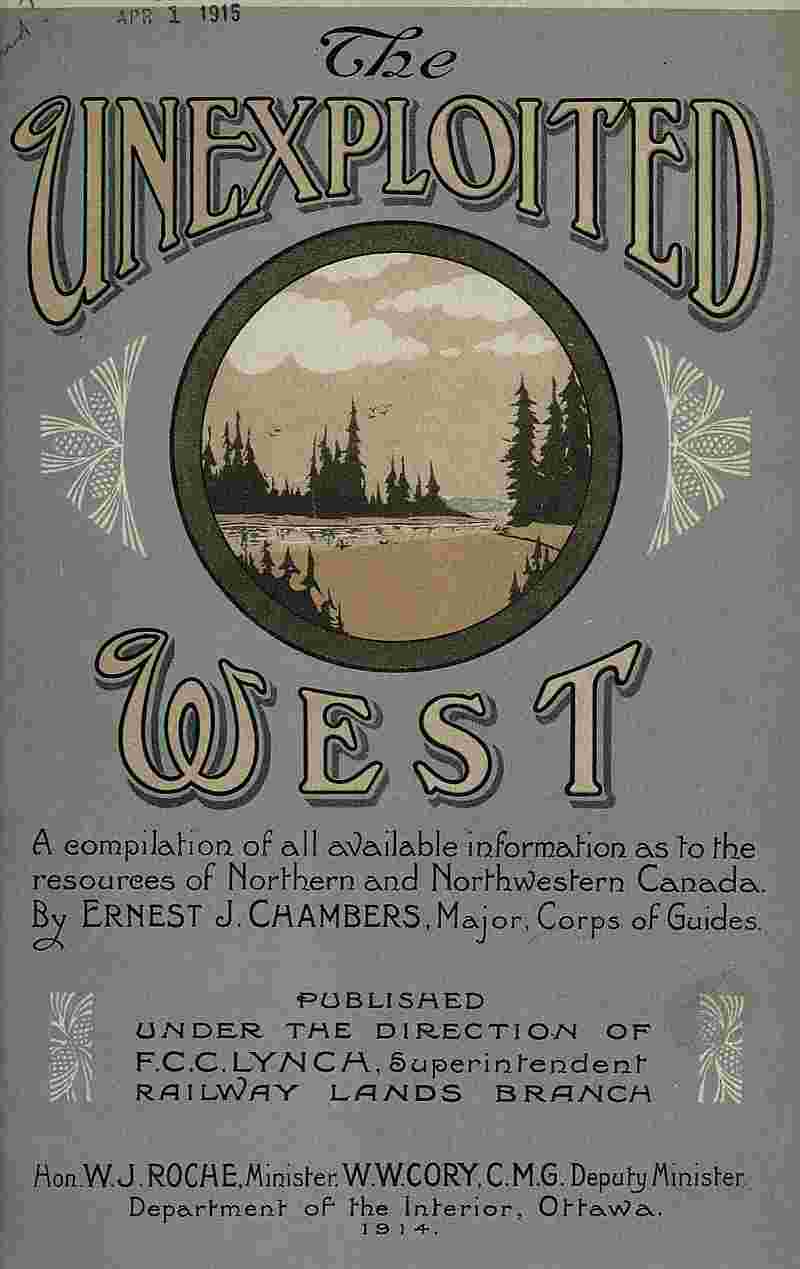
The Project Gutenberg eBook of The Unexploited West
Title: The Unexploited West
Author: Ernest J. Chambers
Release date: June 20, 2015 [eBook #49245]
Most recently updated: October 24, 2024
Language: English
Credits: Produced by Marcia Brooks, Cindy Beyer, Ross Cooling and
the online Project Gutenberg team at
http://www.pgdpcanada.net with images provided by The
Internet Archives-US
THE
UNEXPLOITED WEST
A COMPILATION
of all of the authentic information available
at the present time as to the
Natural Resources of the Unexploited Regions
of
NORTHERN CANADA
By
Major ERNEST J. CHAMBERS, Corps of Guides
Gentleman Usher of the Black Rod
Published under the direction of
F. C. C. LYNCH
Superintendent of the Railway Lands Branch
Department of the Interior
Hon. W. J. ROCHE, Minister
OTTAWA
Printed by J. de L. TACHE, Printer to the King’s Most
Excellent Majesty
1914
Department of the Interior,
Ottawa, September 19, 1913.
Honourable W. J. Roche,
Minister of the Interior,
Ottawa.
Sir,—I have the honour to transmit herewith the manuscript of a compilation of all available information on the Unexploited West by Major Ernest J. Chambers, Gentleman Usher of the Black Rod. This work, which was undertaken by Major Chambers under instructions from this Department, is drawn from all known sources. The information contained herein covers the whole of the unexploited portions of Canada, west of Hudson bay, and it is intended to fill a growing demand for complete information regarding this territory.
I have the honour to be, Sir,
Your obedient servant,
F. C. C. Lynch,
Superintendent of Railway Lands.
PREFACE.
The stream of immigration steadily flowing westward in ever-increasing volume is rapidly exhausting the reserves of vacant land in that part of the Canadian west which used to be known, to the detriment of the territory farther to the north, as “The Fertile Belt.”
Already settlement has overflowed the northern frontier of the “belt of supposed limited fertility” and many thousands of acres of agricultural land have been surveyed by the Dominion Government immediately north of the North Saskatchewan and in the Peace river valley, and the surveys are being rapidly extended to keep up with the pressure of advancing settlement. While the trend of immigration is turning northward, the eyes of the capitalist are attracted in the same direction. Information concerning the resources of the country once ignored is now sought for. Facts about the climate, the soil, the timber, the rivers, the lakes, the minerals, the fish, the game obtained at the risk of life and limb by fur trader, explorer, missionary, geologist and sportsman, even those facts regarded not so long ago as merely interesting, have now a practical value.
The once prevalent notion that the whole of the immense territory north of the North Saskatchewan was a sterile, frost-bound waste destined for all time to remain a wilderness, is now largely a thing of the past, and the opportunities which the latent resources of the silent places of the unexploited northwest afford to the enterprising and adventurous at the present moment challenge the attention of the world.
With interest powerfully attracted to the more easterly sections of the country under review by the recent extensions northward of the limits of the prosperous provinces of Ontario and Manitoba, and with easy means of communication with the larger divisions farther west assured, thanks to the progress of the construction of railways northward to Port Nelson on Hudson bay and to McMurray in the Athabaska country, it certainly looks as though the long neglected Northland were coming to its own at last.
By connecting with the three thousand miles of almost uninterrupted steamboat communication on Athabaska, Peace, Slave and Mackenzie rivers, and Athabaska and Great Slave lakes, the railway being pushed into the Athabaska country will place the whole of Mackenzie basin within easy reach of the prospector, the explorer, the sportsman and the tourist. The line being constructed to Hudson bay, as soon as steamboat connection is established therewith, will lay the very heart of that alluring El Dorado which we call the Barren Lands, with its herds of musk-oxen and caribou and its mineral wealth, open to the prospector and the sportsman, for, via Chesterfield inlet, Baker lake and the Thelon, there is a splendid, uninterrupted waterway from Hudson bay for a distance of five hundred and fifty miles into the interior.
The exceptional attractions which the Northland holds out to the sportsman are certain to contribute largely towards the discovery and development of the natural resources of the country. A couple of years ago Mr. W. T. Robson, General Advertising Agent of the Canadian Pacific Railway, submitted to a convention of railway men a thoughtful paper on the value of the tourist sportsman as a means of publicity for undeveloped country, in which he pointed out that the cultured business men who find their greatest pleasure, relaxation and physical benefit from trips into the wilds, are quick to discern the commercial value of water powers, timber and minerals, and he related a number of instances where hunting trips had resulted either in the discovery of unexpected natural resources or in large investments in the country visited.
The object of the present publication is to present, with some degree of systematic arrangement, all of the authentic information available at the moment as to the natural resources of the less-known and unexploited portions of northern Canada lying west of Hudson bay and James bay and east of the main range of Rocky mountains.
This general definition of area brings within the scope of this volume the whole of that portion of the old provisional district of Keewatin recently divided by act of parliament between the provinces of Ontario and Manitoba, those portions of the provinces of Saskatchewan and Alberta north of the unsettled and unsurveyed territory, the basin of Mackenzie river, and that immense country north of the new provincial lines extending from Mackenzie basin to Hudson bay, which has apparently, undeservedly, come to be known as “Barren Lands” or “Barren Grounds.”
In these immense regions there are wide areas of which we in this year of grace 1912 know as little as was known of Bow river valley in 1812, and that was nothing. On the other hand considerable is known in a general way about certain portions of every one of the great districts which form this vast territory, or, to be quite exact, considerable has been written about them. The subject matter has been so widely distributed that no one could be expected to be familiar with it all.
Practically the first authoritative data as to the natural resources of Canada’s unexploited northland was contained in the published evidence of a British parliamentary committee which sat in 1749 to enquire into the resources of the country administered by the Hudson’s Bay Company. With this as a nucleus, a considerable amount of information on the subject has gradually accumulated. The journals of officials of the big fur-trading companies have contributed to this fund of information and so have the writings of missionaries, the reports of British, Canadian and United States official government explorers, the narratives of sportsmen and adventurous travellers, and the patrol records of that inimitable and ubiquitous body the Royal Northwest Mounted Police. A very wide range of information regarding the various sections of these territories, too, has been placed on record as a result of several Canadian parliamentary investigations.
Some idea of the large amount of literature relating to the great northland which has accumulated, can be obtained from the fact that in the preparation of the present book nearly three hundred publications have been consulted, necessitating an amount of reading which was not anticipated when the task was undertaken. Much of this reading was absolutely unproductive, a considerable portion of the books written by men who have lived in or travelled through the country being merely narratives of travel and adventure, containing no direct information of any value as to natural resources.
For various obvious reasons many books written by scientific and observant men who have visited the still new west are of little value in throwing light upon the questions of the natural resources of the country. One of these reasons is referred to by Sir Alexander Mackenzie, who states in the introduction to his narrative:—“I could not stop to dig into the earth, over whose surface I was compelled to pass with rapid steps; nor could I turn aside to collect the plants which nature might have scattered in the way, when my thoughts were anxiously employed in making provision for the day that was passing over me.” The distances to be travelled in the far Northland are generally so great that the slender stores of supplies carried by the explorer and traveller do not permit of time being devoted to thorough investigation by the way. Again, much of the travelling in the unsettled north has been done in winter, when the surface of the ground was covered with snow, making an examination of the soil and rocks impossible.
Nevertheless, the literature relating to the new Canadian northwest is so voluminous that it contains, scattered throughout it, an aggregate amount of practical information regarding the resources of even the more remote sections of the country that, as assembled within the two covers of a single volume, will probably astonish most readers.
The present volume, according to the instructions the undersigned received from the Department of the Interior, is purely and simply a compilation. Care has been taken to avoid the temptation to try and produce a work of original literary merit, and in the following pages it will be found that the compiler has introduced only as much original writing as is necessary to introduce intelligibly the various quotations, or to establish the connections between them, his aim being to present all the data available in the original text, or as near to it as the exigencies of compilation and space would permit.
With the object of properly introducing some of the chief authorities quoted and of placing the reader, from the beginning, au fait with the circumstances under which the principal information regarding the resources of the country was obtained, the presentation of the data has been prefaced by a brief historical chapter.
At the end of the book a list of the written authorities from which quotations are made will be found.
It will be observed that, to avoid confusion, the vast region under review has been divided into five distinct territorial units, and that the matter relating to each unit is in turn divided into four sections, relating respectively to the resources in the way of arable land, timber, minerals, and fish and game. The compiler found that this system of classification was satisfactory in his two previous volumes of a somewhat similar type, “Canada’s Fertile Northland,” and “The Great Mackenzie Basin,” and a continuation of the system will facilitate reference between the present volume and those which were its forerunners and its inspiration.
Perhaps I might be permitted here a word of personal explanation. I have had only a slight acquaintance with any part of this great waiting Northland, having campaigned a little over its southern margin between North Saskatchewan and Beaver rivers, in Fort Pitt district, during the operations against Big Bear’s Indians in 1885; but what I saw of the country then, with its park-like groves of fine trees, its valleys covered with luxuriant grasses, its sylvan lakes teeming with fish, and every prospect a gem of nature’s own perfect landscape gardening, made such an impression on my mind that I have ever since felt a personal interest not only in that particular section but in the vast regions beyond which have not the charm of the soft and lovely scenery of Loon lake and Beaver river. Having this feeling towards the country I have followed as a hobby the literature relating to it, and it has been naturally a pleasure to contribute my mite in helping it along towards its ultimate destiny.
The idea of the present volume was not mine but that of the late Mr. Robert E. Young, D.L.S., Superintendent of Railway Lands and Chief Geographer, the most enthusiastic believer in the Northland who ever lived, probably, and whose untimely death was a grievous loss to the country. If this book possesses any merits it is due altogether to his original suggestion, to his wide knowledge and to his enthusiastic and kindly co-operation.
ERNEST J. CHAMBERS.
The Senate, Ottawa.
May 11, 1912.
CONTENTS.
| CHAPTER I. | |
| historical. | |
| “The Fertile Belt.”—Influence of a Catchy Expression.—Northern Canada Still a Terra Incognita.—The Hudson’s Bay Company.—Early Explorations.—Kelsey, Hearne, Mackenzie, Franklin, Back, Simpson and Dease.—The More Recent Explorers, Official and Unofficial.—Parliamentary Investigations. | 1 |
| CHAPTER II. | |
| the keewatin area.—Agriculture and Arable Land. | |
| Early Agricultural Experiments and Their Success.—Evidence Before the Parliamentary Committee of 1749.—Testimony of Official Explorers and Residents.—Many Areas Fit for Agriculture Described.—Wild Fruits Grow in Profusion.—Successful Gardens.—Much Country Capable of Improvement by Drainage.—Climate Inland Warmer Than Farther East.—Natural Hay Meadows.—The Clay Belt. | 30 |
| CHAPTER III. | |
| the keewatin area.—Tree Growth and Timber Resources. | |
| Considerable Areas of Good Timber.—The Range of the More Important Trees.—The Banskian Pine.—Forests of Trees in Many Places that Would Make Good Logs, and Much Pulp Wood.—Occasional Beautiful Forests of Aspen Poplar.—Magnificent Coniferous Forest Northwest of Lake Winnipeg.—Water Power on the Nelson.—Destruction Wrought by Forest Fires.—Ample Supply of Timber For Fuel. | 64 |
| CHAPTER IV. | |
| the keewatin area.—Economic Minerals. | |
| The Rocks in Many Cases Highly Magnetic.—Norite Rock Similar to That at Sudbury About Trout Lake.—Peat in the District North of Lake Winnipeg.—A Large District Underlain By Keewatin and Huronian Rocks “Has Large Possibilities.”—Gypsum.—Building Granites.—Quartz Veins on Grassy River Below Reed Lake.—A Possibility of Nickel Occurring. | 81 |
| CHAPTER V. | |
| the keewatin area.—Game, Fur-bearing Animals and Fish. | |
| Flocks of Wild Fowl That Obscure the Sky.—Six Species of Seal in Hudson Bay.—Stocked with Animals of Various Kinds.—White Fish Abound in Most of the Lakes and Streams.—Saw Eleven Moose in One Day.—The Commercial Value of the Sturgeon Fisheries.—Future Summer Playgrounds.—Barren Lands Caribou at Churchill. | 88 |
| CHAPTER VI. | |
| northern saskatchewan.—Agriculture and Arable Land. | |
| An Early Scientific Explorer’s Enthusiastic Description of Part of the Country.—“Capable of Any Extent of Cultivation.”—An Old Hudson’s Bay Company Official Who Considered it “A Splendid Country to Settle in.”—Mr. Crean Reports That “It is No Experiment” to Raise Wheat in North Saskatchewan.—Missionary Farmers and Their Accomplishments.—Capable of Supporting “A Dense, Thriving Population.”—“A Splendid Ranching Country.”—Heaviest Rains Just When They Are Needed. | 95 |
| CHAPTER VII. | |
| northern saskatchewan.—Tree Growth and Timber Resources. | |
| A Rare Bit of Sylvan Beauty.—Ash-Leaved Maples Successfully Grown From Seed.—Notes By the Way on Available Water Powers.—Much Country Covered with Small Timber Not Generally of Commercial Value.—Some Areas of Good Timber Which Will be Invaluable To the Settlers. | 117 |
| CHAPTER VIII. | |
| northern saskatchewan.—Economic Minerals. | |
| Large Amount of Iron Ore In the Northeastern Corner of The Region, On The North Eastern Side of Lake Athabaska.—Indications Favourable For the Discovery of Coal.—Nickel and Traces of Cobalt on Reindeer Lake.—Medicinal Waters.—Bituminous Springs and Pit Coal on Cree River.—Tar Sands Near Buffalo Lake. | 124 |
| CHAPTER IX. | |
| northern saskatchewan.—Game, Fur-bearing Animals and Fish. | |
| “So Fine a Country For The Chase That It May Be Regarded As An Extensive Preserve.”—The Wood Buffalo Used To Roam Over It, But Do Not Now.—Moose and Caribou Plentiful.—The Indians Kill The Moose For Their Hides.—Fish of Various Kinds in Abundance.—Sturgeon That Weigh A Hundred Pounds.—One Indian Killed Eighteen Moose During One Season. | 127 |
| CHAPTER X. | |
| northern alberta.—Agriculture and Arable Land in the Eastern Section of “Athabaska Country.” | |
| A Section of The West Where Officials of the Hudson’s Bay Company Were Directed to Cultivate Gardens.—Some Points Where Wheat has been Grown, Including the Sample Which Took First Prize at the Philadelphia Centennial Exhibition.—Crude Indian Gardens at Cowpar Lake.—Livestock Grazing Out in December and January. | 131 |
| CHAPTER XI. | |
| northern alberta.—Agriculture and Arable Land in the Western Section or “Peace River Region.” | |
| Where Wheat Has Been Grown with Remarkable Success for Many Years.—Scientific Explorers Early Recognized This as a Wheat Growing Country.—A Head of Cabbage Fifty-three and a Half Inches in Circumference.—Livestock Live Out of Doors in Winter.—According to a Church of England Missionary, Peace River Enjoys the Finest Climate in the World. | 143 |
| CHAPTER XII. | |
| northern alberta.—Tree Growth and Timber Resources. | |
| An Abundance of Timber in the Vicinity of Chipewyan.—Much of the Country Has Been Swept By Fires.—Most of the Timber is Along the Rivers.—Millions of Cords of Pulp Wood.—Spruce and Black Bark Poplar the Principal Varieties.—The Water Power Possibilities Described as Tremendous. | 175 |
| CHAPTER XIII. | |
| northern alberta.—Economic Minerals. | |
| Travellers, Explorers and Prospectors Describe the Country as a Veritable Store House of Mineral Wealth.—Gold Found in the Bars in Peace River.—Indications of Plentiful Supply of Iron.—Lignite Found in Abundance.—Historic Deposits of Salt.—The Famous Athabaska Tar Sands.—Their Commercial Value.—Indications of Petroleum.—Boring Experiments.—Natural Gas Under a Wide Area.—Travellers Use Natural Gas Jets to Boil their Camp Kettles. | 180 |
| CHAPTER XIV. | |
| northern alberta.—Game, Fur-bearing Animals and Fish. | |
| The Land of the Wood Buffalo.—Where the Last Remnants of American Bison Living in a Wild State Roam.—A Splendid Moose Country.—The Home of Numerous Fur-bearing Animals.—The Prolific Fisheries of Lake Athabaska and Other Waters. | 195 |
| CHAPTER XV. | |
| mackenzie river region.—Topography, Agriculture and Arable Land. | |
| Mackenzie River a King of Northern Waters.—Over Three Thousand Miles of Water Way.—Domestic Cattle Have Succeeded.—Barley Always Ripens at Fort Simpson.—Potatoes and Other Vegetables have for Many Years Been Grown at Fort Good Hope, a few Miles from the Arctic Circle.—Wheat and Barley Grown at Liard for Many Years.—Interesting Comparison With the Russian Province of Tobolsk.—A Large Town as Far North as Fort Wrigley.—Why Better Results in Grain Growing May Be Expected in the Future. | 208 |
| CHAPTER XVI. | |
| mackenzie river region.—Tree Growth and Timber Resources. | |
| Forests About Great Slave Lake and Slave River.—Remarkable Extension of Forest Growth Northward Down the Mackenzie.—Wide Distribution of the Economically Important Canoe Birch.—Magnificent Forests of Spruce and Big Cottonwood Trees in Liard Valley.—Useful Birch and Large Spruce Grow Within the Arctic Circle.—Trees that are Centuries Old.—Northern Tree Growth May Be Hastened by Drainage. | 261 |
| CHAPTER XVII. | |
| mackenzie river region.—Economic Minerals. | |
| The Territory Has Never Been Thoroughly Examined for Minerals.—Tar Springs on the North Shore of Great Slave Lake.—The Devonian Rocks Throughout Mackenzie Valley are Nearly Everywhere More or Less Petroliferous.—Lignite Discovered in Many Places, Also Gypsum.—Large Deposits of Excellent Salt.—Indications of Gold and Copper.—Indians Report Finding Mica. | 281 |
| CHAPTER XVIII. | |
| mackenzie river region.—Game, Fur-bearing Animals and Fish. | |
| Over Forty Moose Killed in One Season Near Fort Simpson.—Caribou of Both Woodland and Barren Lands Varieties Plentiful.—Pass Great Slave lake in Countless Numbers.—Mountain Sheep Plentiful in the Mountainous Districts.—Incredible Numbers of Geese, Swan and Ducks in Season.—Inexhaustible Supplies of Fish.—The Speckled Trout, Lake Trout, Grayling, Herring, Inconnu, etc. | 288 |
| CHAPTER XIX. | |
| barren lands or “arctic prairie.”—Topography, Soil, Climate and Flora. | |
| Explorers Declare The Term Barren Lands a Misnomer.—Some Notes about the Chief Rivers and Known Lakes.—An Inland Waterway for Steamers Via Chesterfield Inlet a Distance of Five Hundred and Fifty Miles Into the Interior.—The Progression of The Seasons.—The Country Similar to the Tundra of Siberia.—A Limited Amount of Agriculture May Be Possible in Places.—Natural Prairies in the Valley of the Thelon. | 303 |
| CHAPTER XX. | |
| barren lands or “arctic prairie.”—Tree Growth and Timber Resources. | |
| Phenomenal Extensions of Tree Growth Within Barren Lands Along the Valley of Thelon River.—Black Spruce, Larch, White Spruce, Banksian Pine and Birch.—Valuable Timber Along the Thelon, About the East End of Great Slave Lake and Between Great Bear Lake and Coppermine River. | 317 |
| CHAPTER XXI. | |
| barren lands or “arctic prairie.”—Economic Minerals. | |
| Deposits of Native Copper in the Far North.—Several Areas West of Hudson Bay Contain Rocks Similar to Those at Sudbury.—Belts of Huronian Rocks that are Expected by Geologists to be Eventually of Great Economic Importance.—Vast Probable Mineral Bearing Country in the Interior Which Can Now be Reached Via Chesterfield Inlet.—Iron, Gold and Silver in Small Quantities North of Lake Athabaska.—Free Gold in Melville Peninsula.—Lignite and Soft Coal Along the Arctic Coast. | 324 |
| CHAPTER XXII. | |
| barren lands or “arctic prairie.”—Game, Fur-bearing Animals and Fish. | |
| Where Millions of Caribou Roam at Large.—Actual Value of These Immense Herds Very Great.—Can They Become Domesticated or Replaced by the Lapland Reindeer?—The Home of the Musk-Ox and Many Fur-bearing Animals.—The Polar Bear.—Where the Wild Geese Nest.—Lakes, Rivers and Sea Coasts Teeming With Fish.—The Arctic Salmon, Trout, White Fish and Grayling. | 342 |
| BIBLIOGRAPHY | 362 |
| INDEX | 370 |
LIST OF ILLUSTRATIONS.
“Wheat field at Stanley, Churchill river”
“Oat field at Ile à la Crosse”
“Portage near Long Spruce rapids, Nelson river”
“Farm at Mount Nebo on Green lake trail, 65 miles from Prince Albert”
“Prairie Land on lower Nelson river”
“Portaging canoe at Long Spruce rapids, Nelson river”
“Typical country on Hudson Bay Railway Survey”
“Moose crossing Limestone river”
“Potatoes at Anglican Mission, Lac la Ronge”
“Oat field at Anglican Mission, Lac la Ronge”
“Prairie along Clearwater river”
“Landscape in Clearwater valley”
“Indian Family arriving at McMurray for Treaty”
“Flour Mill at Fort Vermilion”
“Sheridan Lawrence’s Farm at Fort Vermilion”
“Vegetable Garden 15 miles west of Fort St. John”
“The 23rd Base Line between Townships 88 and 89, Range 14, West of the 6th Meridian”
“Oil Well at McKay, Athabaska river”
“Royal Northwest Mounted Police Barracks at Smith Landing”
“Looking Across Slave river from Fort Smith”
“Roman Catholic Mission at Chipewyan”
“An Eskimo Boy at Arctic Red river”
“Mission Garden at Fort Providence”
“Eskimos in Kyaks on Arctic Red river”
“Staff and Pupils, Church of England Mission, Hay river”
“Spruce Timber on Peel river inside the Arctic Circle”
“Anglican Church, School and Rectory at Fort Simpson”
“Roman Catholic Mission at Fort Resolution”
“Some of the Difficulties of Northern Transportation:—Crossing a Swamp”