
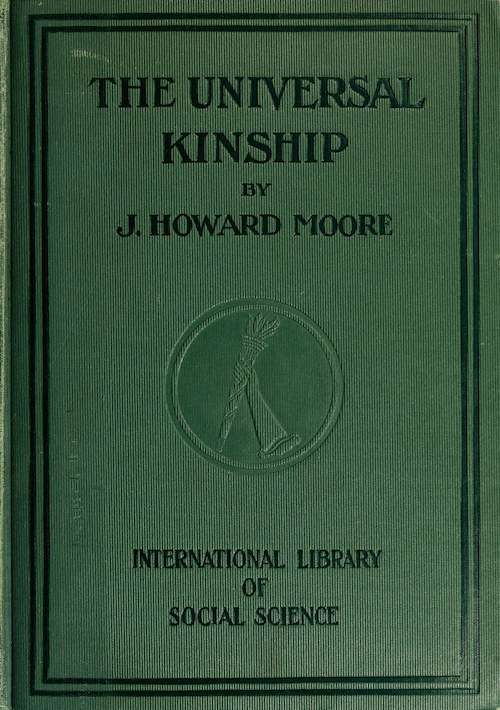
The Project Gutenberg eBook of The Universal Kinship
Title: The Universal Kinship
Author: J. Howard Moore
Release date: February 9, 2020 [eBook #61363]
Most recently updated: October 17, 2024
Language: English
Credits: Produced by L. Reeves from scans generously made available
by the Internet Archive.
The Universal Kinship
By
J. Howard Moore
Instructor in zoology, Crane Manual Training High School, Chicago
‘A Sacred Kinship I would not forego
Binds me to all that breathes.’
— Boyesen.
Chicago
Charles H. Kerr & Company
56 Fifth Avenue
1906
To
my dear mother and father
who have done so much for me in the long years
that are past and gone
Preface
The Universal Kinship means the kinship of all the inhabitants of the planet Earth. Whether they came into existence among the waters or among desert sands, in a hole in the earth, in the hollow of a tree, or in a palace; whether they build nests or empires; whether they swim, fly, crawl, or ambulate; and whether they realise it or not, they are all related, physically, mentally, morally—this is the thesis of this book. But since man is the most gifted and influential of animals, and since his relationship with other animals is more important and more reluctantly recognised than any other, the chief purpose of these pages is to prove and interpret the kinship, of the human species with the other species of animals.
The thesis of this book comes pretty squarely in conflict with widely-practised and highly-prized sins. It will therefore be generally criticised where it is not passed by in silence. Men as a rule do not care to improve. Although they have but one life to live, they are satisfied to live the thing out as they have started on it.
Enthusiasm, which in an enlightened or ideal race would be devoted to self-improvement, is used by men in weaving excuses for their own inertia or in singing of the infirmities of others.
But there is a Future. And the creeds and ideals, men bow down to to-day will in time to come pass away, and new creeds and ideals will claim their allegiance. Shrines change as the generations come and go, and out of the decomposition of the old comes the new. The time will come when the sentiments of these pages will not be hailed by two or three, and ridiculed or ignored by the rest; they will represent Public Opinion and Law.
M.
Chicago, 1905
Contents
- Human Nature a Product of the Jungle
- Egoism and Altruism
- The Ethics of the Savage
- The Ethics of the Ancient
- Modern Ethics
- The Ethics of Human Beings Toward Non-human Beings
- The Origin of Provincialism
- Universal Ethics
- The Psychology of Altruism
- Anthropocentric Ethics
- Ethical Implications of Evolution
- Conclusion