
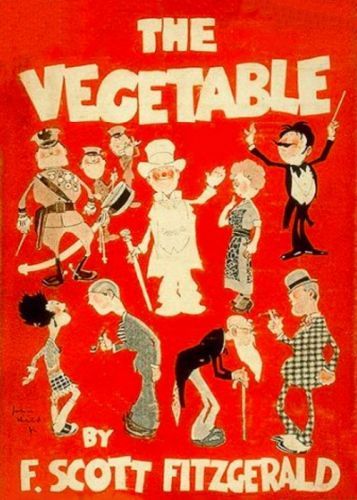
The five Senators stand up.
Judge Fossile [to Jerry]. The verdict of a just nation. Is there any one here to say why this verdict should not stand?
Dada, who all this time has been absorbed in the contemplation of the heavens, suddenly throws down his telescope with a crash.
Dada [in a tragic voice]. It’s too late!
All. Too late?
Dada. Too late for the world to end this afternoon. I must have missed the date by two thousand years. [Wringing his hands.] I shall destroy myself!
Dada tries to destroy himself. He produces a pistol, aims at himself, and fires. He flounders down—but he has missed.
Doris [standing over him and shaking her finger]. You miss everything! I’m going to send for the lunatic-asylum wagon—if it’ll come!
Dada [shaking his finger back at her]. Your parents brought you up very unsuccessfully——
Judge Fossile. Silence! I will pronounce sentence of impeachment on this enemy of mankind. Look upon him!
They all look dourly at Jerry.
Now, gentlemen, the astronomers tell us that in the far heavens, near the southern cross, there is a vast space called the hole in the sky, where the most powerful telescope can discover no comet nor planet nor star nor sun.
They all look very cold and depressed. Jerry shivers. Fish picks up Dada’s abandoned telescope and begins an eager examination of the firmament.
In that dreary, cold, dark region of space the Great Author of Celestial Mechanism has left the chaos which was in the beginning. If the earth beneath my feet were capable of expressing its emotions it would, with the energy of nature’s elemental forces, heave, throw, and project this enemy of mankind into that vast region, there forever to exist in a solitude as eternal as—as eternity.
When he finishes a funereal silence falls.
Jerry [his voice shaken with grief]. Well, Judge, all I’ve got to say is that no matter what you’d done I wouldn’t want to do all those things to you.
Judge Fossile [thunderously]. Have you anything more to say?
Jerry [rising through his defeat to a sort of eloquent defiance]. Yes. I want to tell you all something. I don’t want to be President. [A murmur of surprise.] I never asked to be President. Why—why, I don’t even know how in hell I ever got to be President!
General Pushing [in horror]. Do you mean to say that there’s one American citizen who does not desire the sacred duty of being President? Sir, may I ask, then, just what you do want?
Jerry [wildly]. Yes! I want to be left alone.
Outside the wall Mr. Stutz-Mozart’s Orang-Outang Band strikes up “The Bee’s Knees.” The Senators arise respectfully and remove their hats, and General Pushing, drawing his sword, stands at the salute.
Four husky baggage smashers stagger out of the White House with the trunks of the Frost family, and hurry with them through the gate. Half a dozen assorted suitcases are flung after the trunks.
The music continues to play, the Senators continue to stand. The Frost family gaze at their departing luggage, each under the spell of a different emotion.
Charlotte is the first to pick up her grip. As she turns to the Senators, the music sinks to pianissimo, so her words are distinctly audible.
Charlotte. If it’s any satisfaction to you, I’m going to be a different wife to him from now on. From now on I’m going to make his life perfectly miserable.
Charlotte goes out to a great burst of jazz. Dada, with some difficulty, locates his battered carpet-bag.
Dada. I find I missed the date by two thousand years. Eventually I will destroy myself.
Dada is gone now, hurried out between two porters, and Doris is next. With dignity she selects her small but arrogant hand-bag.
Doris. All I want to say is if Cecil B. Demille ever saw the White House he’d say: “All right, that may do for the gardener’s cottage. Now I’ll start building a real house.”
As she leaves she tries desperately to walk out of step with the music and avoid the suggestion of marching. The attempt is not altogether successful.
President Jerry Frost now picks up his bag.
Jerry [defiantly]. Well, anyways I showed you you couldn’t put anything over on me. [Glancing around, his eye falls on the “Special Tree.” He goes over and pulls it up by the roots.] This was given to me by some natives. That sign’s mine, too. I had it invented. [He pauses.] I guess you think I wasn’t much good as a President, don’t you? Well, just try electing me again.
General Pushing [sternly]. We won’t! As a President you’d make a good postman.
At this sally there is a chorus of laughter.
Then Charlotte’s voice again. Does it come from outside the gate, or, mysteriously enough, from somewhere above?
Charlotte [very distinctly]. Shut the door! I can smell that stuff up here!
A bewildered look comes into Jerry’s eyes. He says “What?” in a loud voice.
Then with the tree in one hand and his grip in the other, he is hurried, between two porters, briskly toward the gate, while the Orang-Outang Band crashes into louder and louder jazz and
The Curtain Falls
ACT III
Now we’re back at the Frosts’ house, and it’s a week after the events narrated in Act I. It is about nine o’clock in the morning, and through the open windows the sun is shining in great, brave squares upon the carpet. The jars, the glasses, the phials of a certain memorable night have been removed, but there is an air about the house quite inconsistent with the happy day outside, an air of catastrophe, a profound gloom that seems to have settled even upon the “Library of Wit and Humor” in the dingy bookcase.
There is brooding going on upon the premises.
A quick tat-tat-tat from outdoors—the clatter of someone running up the porch steps. The door opens and Doris comes in, Doris in a yellowish skirt with a knit jersey to match, Doris chewing, faintly and delicately, what can surely be no more than a sheer wisp of gum.
Doris [calling]. Char-lotte.
A Voice [broken and dismal, from up-stairs]. Is that you, Doris?
The Voice. [It’s Charlotte’s. You’d scarcely have recognized it.] I’ll come down.
Doris. Heard anything from Jerry?
Charlotte. Not a word.
Doris regards herself silently, but with interest, in a small mirror on the wall. In comes Charlotte—and oh, how changed from herself of last week. Her nose and eyes are red from weeping. She’s chastened and depressed.
Doris [with cheerful pessimism]. Haven’t heard a word, eh?
Charlotte [lugubriously]. No. Not one.
Doris [impressed in spite of herself]. Son of a gun! And he sneaked away a week ago to-night.
Charlotte. It was that awful liquor, I know. He sat up all night and in the morning he was gone.
Doris. It’s the funniest thing I ever heard of, his sneaking off this way.... Say, Charlotte, I’ve been meaning to say something to you for a couple of days, but I didn’t want to get you depressed.
Charlotte. How could I possibly be any more depressed than I am?
Doris. Well, I just wanted to ask you if you’d tried the morgue yet. [Charlotte gives a little scream.] Wait a minute. Get control of yourself. I simply think you ought to try it. If he’s anywhere you ought to locate him.
Charlotte [wildly]. Oh, he’s not dead! He’s not dead!
Doris. I didn’t say he was, did I? I didn’t say he was. But when a fella wanders out tight after drinking some of this stuff, you can’t tell where you’ll find him. Let me tell you, Charlotte, I’ve had more experience with this sort of thing than you have.
Charlotte. The detective is coming to report this morning.
Doris. Has he been combing the dives? You ought to have him comb the dives, Charlotte. I saw a picture last week that ought to be a lesson to any woman that loses her husband in a funny way like this. The woman in this picture lost her husband and she just combed the dives and—there he was.
Charlotte [suspiciously]. What was he doing?
Doris. Some vampire was sitting on his lap in a café. [Charlotte moans.] But it does show that if you do have the dives combed, you can find ’em. That’s what this woman did.... There’s where most men go when they wander out like that.
Charlotte. Oh, no, Jerry wouldn’t go to the dives, or the—the morgue, either. He’s never drank or done anything like that till that night. He’s always been so mild and patient.
This is a new note from Charlotte.
Doris [after a thoughtful pause]. Maybe he’s gone to Hollywood to go in the movies. They say a lot of lost men turn up there.
Charlotte [brokenly]. I don’t know what to do. Maybe I’m re-responsible. He said that night he might have been P-President if it hadn’t been for me. He’d just been analyzed, and they found he was per-perfect.
Doris. Well, with no reflections on the dead or anything like that, Charlotte, he wasn’t so wonderful as you make out. You can take it from me, he never would have been anything more than a postman if you hadn’t made him be a railroad clerk.... I’d have the dives combed.
Charlotte [eulogistically]. He was a good husband.
Doris. You’ll get over it.
Charlotte. What?
Doris. Cheer up. In a year or so you’ll never know you ever had a husband.
Charlotte [bursting into tears at this]. But I want him back.
Doris [reminiscently]. Do you know the song? Do you know the song? [She sings:]
You always get the other kind
And when you think that he is your friend
You look around and find him scratching
’Round some other hen——”
She has forgotten her ethical connection and begins to enjoy the song for itself, when Charlotte interrupts.
Charlotte [in torture]. Oh, don’t! Don’t!
Doris. Oh, excuse me. I didn’t think you’d take it personally.... It’s just about colored people.
Charlotte. Oh, do you suppose he’s with some colored women?
Doris [scornfully]. No-o-o! What you need is to get your mind off it for a while. Just say to yourself if he’s in a dive, he’s in a dive, and if he’s in Hollywood, he’s in Hollywood, and if he’s in the morgue——
Charlotte [frantically]. If you say that word again, I’ll go crazy!
Doris.—well, in that place, then, just say: “I can’t do anything about it, so I’m going to forget it.” That’s what you want to say to yourself.
Charlotte. It’s easy enough to say, but I can’t get my mind——
Doris. Yes, you can. [Magnanimously.] I’ll tell you about what I’ve been doing. I’ve had sort of a scrap with Joseph.
Charlotte. Joseph who?
Doris. Joseph Fish. He’s that fella I brought around here, only you didn’t meet him. I told you about him. The one I got engaged to about ten days ago. His patents were in the mortuary business.
Charlotte. Oh.
Doris. Well, I been trying to make him stop chewing gum. I offered to give it up if he would. I think it’s sort of common when two people that go together are always whacking away at a piece of gum, don’t you?
There’s a ring at the door-bell.
Charlotte. That’s the detective.
Doris [prudently]. Have you got that liquor hidden?
Charlotte. I threw that horrible stuff away. Go let him in.
Charlotte goes to the door and ushers in the detective. The detective wears an expression of profound sagacity upon his countenance.
Have you found him?
The Detective [impressively]. Mrs. Frost, I think so.
The Detective. Alive.
Charlotte. Where is he?
The Detective. Wait. Be calm. I’ve had several clews, and I’ve been following them up one at a time. And I’ve located a man, who answers to the first name of Jerry, that I think is your husband.
Charlotte. Where did you find him?
The Detective. He was picked up trying to jimmy his way into a house on Crest Avenue.
Charlotte. Good heavens!
The Detective. Yep—and his name is Jerry. He had it tattooed on his arm.
Charlotte. Good God!
The Detective. But there’s one thing that’s different from your description. What color is your husband’s hair?
Charlotte. Brown.
The Detective. Brown? Are you sure?
Charlotte. Am I sure? Of course I’m sure.
The Detective [to Doris]. Do you collaborate that?
Doris. When he left here it was brown.
The Detective. Well, this fella’s hair was red.
Charlotte. Oh, it’s not Jerry then—it’s not Jerry.
Doris [to Charlotte]. Well, now, how do you know? Maybe— [She turns to the detective.] You see, this fella had been drinking some of this funny liquor you get around here sometimes and it may just have turned his hair red.
Charlotte [to the detective]. Oh, do you think so?
The Detective. I never heard of a case like that. I knew a fella whose hair was turned white by it.
Doris. I knew one, too. What was the name of the fella you knew?
Charlotte. Did this man claim to be my husband?
The Detective. No, madam, he didn’t. He said he had two wives out in Montana, but none that he knew of in these parts. But of course he may have been bluffing.
Doris. It doesn’t sound like Jerry to me.
The Detective. But you can identify him by that tattoo mark.
Charlotte [hastily]. Oh, he never had one.
The Detective. Are you sure?
Charlotte. Oh, yes.
The Detective [his face falling]. Well, then, he’s not our man, because this fella’s tattoo marks are three years old. Well, that’s a disappointment. That’s a great disappointment for me. I’ve wasted some time over this man. I’d been hoping he’d—ah—do.
Charlotte [hastily]. Oh, no, he wouldn’t do at all. I’ll have to have the right man or I won’t pay you.
The Detective. Well, now then, I’ve been following up another clew. Did your husband ever have aphasia?
Charlotte. Oh, no, he’s always been very healthy. He had some skin trouble about——
Doris. He doesn’t mean that, Charlotte. Aphasia’s where a man runs off and commits murder and falls in love with a young girl under another name.
Charlotte. Oh, no, he’s never done anything like this ever before.
The Detective. Suppose you tell me exactly what did happen.
Charlotte. Well, I told you he’d been drinking something that had spirits of nitrogen in it.
The Detective. Spirits of nitrogen!
Charlotte. That’s what the man said. It was sympathetic gin that this man had persuaded Jerry into buying.
The Detective. Yes.
Charlotte. And he’d been talking all evening about all the things he could have done if I hadn’t stood in his way. He had some examination he’d just taken.
Doris [explaining]. A psychical examination.
The Detective [wisely]. I see.
Charlotte. And my sister came over with the man she’s going to marry, and she came up to see me, and when she came down Jerry was asleep in his chair. Well, I didn’t go down. I wish I had now. And my sister here and her fellow went away. Then I went to bed, and it seems to me I could hear Jerry talking to himself in his sleep all night. I woke up about twelve, and he was saying something loud, and I told him to shut the door, because I could smell that awful sympathetic gin way up-stairs.
The Detective. Yes.
Charlotte. And that’s all. When I came down next morning at seven, he was gone.
The Detective [rising]. Well, Mrs. Frost, if your man can be located, I’m going to locate him.
Doris. Have you thought of combing the dives?
The Detective. What?
Doris. Have you combed the dives? It seems to me that I’d make the rounds of all the dives, and I wouldn’t be a bit surprised if you’d see this man with somebody sitting on his knee.
The Detective [to Charlotte]. Does he run to that?
Charlotte [hurriedly]. Oh, no. Oh, no.
Doris [to Charlotte]. How do you know?
A brisk knock at the door. Doris opens it eagerly, admitting a small, fat, gray-haired man in a state of great indignation.
The Detective [to Charlotte]. Is this the pursued?
The Man [sternly]. You are speaking to Mr. Pushing. I employ or did employ the man who lives in this house.
Charlotte [wildly]. Oh, where is he?
Mr. Pushing. That’s what I came here to find out. He hasn’t been at work for a week. I’m going to let him go.
Doris. You ought to be ashamed of yourself. He may be dead.
Mr. Pushing. Dead or alive, he’s fired. I had him analyzed. He didn’t have any ambition, and my analyzer gave him nothing but a row of goose-eggs. Bah!
Charlotte. I don’t care. He’s mine.
Doris [correcting her]. “Was” mine.
The Detective. Maybe you could tell me something about his habits in business hours.
Mr. Pushing. If you’ll come along with me I’ll show you his analyzed record. We’re having it framed. [Contemptuously.] Good morning.
He goes out. The Detective, after a nod at Charlotte and Doris, follows him.
Doris. Well, I should think you’d be encouraged.
Charlotte. Why?
Doris. Well, that detective found a fella that’s something like him. The same first name, anyway. That shows they’re getting warm.
Charlotte. Somehow it doesn’t encourage me.
Uncertain steps on the stairs. Dada appears wearing a battered hat and carrying a book under his arm.
Doris. Hello, Dada. Where you going?
Dada [hearing vague words]. Hm.
Charlotte. He’s going down to the library.
Dada [in spirited disagreement]. No. You were wrong that time. I’m not going to the park. I’m going to the library.
Doris [sternly]. Where do you think your son is?
Dada. The——?
Doris [louder]. Where do you think Jerry is, by this time?
Dada [to Charlotte]. Didn’t you tell me he was away?
Charlotte nods drearily.
Dada [placidly]. Hasn’t come back yet?
Doris. No. We’re having the dives combed.
Dada. Well, don’t worry. I remember I ran away from home once. It was in 1846. I wanted to go to Philadelphia and see the Zoo. I tried to get home, but they took me and locked me up.
Doris [to Charlotte]. In the monkey house, I bet.
Dada. [He missed this, thank God!] Yes, that’s the only time I ever ran away.
Doris. But this is a more serious thing, Dada.
Dada. Boys will be boys.... Well, it looks like a nice day.
Charlotte [to Doris]. He doesn’t care. He doesn’t even understand what it’s all about. When the detective searched his bedroom he thought it was the plumber.
Doris. He understands. Sure you do, don’t you, Dada? You understand what it’s all about, don’t you, Dada?
Dada [aggravatingly]. The——?
Charlotte. Oh, let him go. He makes me nervous.
Doris. Maybe he could think out some place where Jerry’s gone. He’s supposed to think so much.
Dada. Well, good afternoon. I think I’ll go down to the library. [Dada goes out by the front door.]
Doris. Listen, Charlotte. I was going to tell you about Joseph—to get your mind off yourself, don’t you remember?
Doris. I’ve gotten sort of tired of him. Honestly, I ought to get myself psychoanalyzed.
Charlotte. Why don’t you throw him over then? You ought to know how by this time.
Doris. Of course, having been unlucky in your own marriageable experience, you aren’t in a position to judge what I should do.
Charlotte. Do you love him?
Doris. Well, not—not especially.
Charlotte. Then throw him over.
Doris. I would—except for one thing. You see, it’d be sort of hard.
Charlotte. No, it wouldn’t.
Doris. Yes, it would. It wouldn’t be any cinch.
Charlotte. Why?
Doris. Well, you see I’ve been married to him for three days.
Charlotte [astounded]. What!
Doris. That isn’t very long, but you see in marriage every day counts.
Charlotte. Well, then, you can’t throw him over.
Doris. It’s next to impossible, I guess.
Charlotte. Was it a secret marriage?
Doris. Yes, there was nobody there but I and Joseph and the fella that did it. And I’m still living at home. You see, this girl that Joe was keeping waiting to see whether he was going to marry me or not, got impatient, and said she couldn’t be kept waiting any longer. It made her sort of nervous. She couldn’t eat her meals.
Charlotte. So you got married. And now you’re tired of him.
Doris. No, not exactly that, but it just sort of makes me uncomfortable, Charlotte, to know that you can’t throw over the man you’ve got without causing a lot of talk. Suppose he took to drink or something. You know everybody can’t get rid of their husbands as easy as you did.
Charlotte. One husband was always enough for me.
Doris. One may be all right for you, Charlotte, because you’re a monographist, but supposing Rudolph Valentino, or the Prince of Wales, or John D. Rockefeller was to walk in here and say: “Doris, I’ve worshipped you from a distance on account of the picture that you sent to the fame and fortune contest of the movie magazine, that got left out by accident or lost or something. Will you marry me?” What would you say, Charlotte?
Charlotte. I’d say no. I’d say, give me back Jerry.
Doris. Would you let having a husband stand in the way of your life’s happiness? I tell you I wouldn’t. I’d say to Joe: “You run up to the store and buy a bag of peanuts and come back in about twenty years.” I would, Charlotte. If I could marry Douglas Fairbanks I’d get rid of Joseph in some peaceful way if I could—but if I couldn’t I’d give him some glass cough-drops without a minute’s hesitation.
Charlotte [horrified]. Doris!
Doris. And I told Joseph so, too. This marriage business is all right for narrow-minded people, but I like to be where I can throw over a fella when it gets to be necessary.
Charlotte. If you had Jerry you wouldn’t feel that way.
Doris. Why, can’t you see, Charlotte, that’s the way Jerry must have felt?
Charlotte, overcome, rises to go.
And, Charlotte, I don’t want to depress you, but if he is—if it turns out that he is in the mor—in that place—I know where you can get some simply stunning mourning for——
Charlotte begins to weep.
Why, what’s the matter? I just thought it’d cheer you up to know you could get it cheap. You’ll have to watch your money, you know.
Charlotte hurries from the room.
Doris. I wonder what’s the matter with her.
Joseph Fish [outside]. Oh, Doris!
Doris goes to the window.
Doris. How did you know I was here?
Fish [outside]. They told me at your house. Can I come in?
Doris. Yes, but don’t holler around so. Haven’t you got any respect for the missing?
Fish comes in.
Fish. Doris, I’m awfully sorry about——
Doris. Oh, Joseph, haven’t you got any sense? Sitting there last night everything was perfect, and just when I was feeling sentimental you began talking about embalming—in the twilight. And I was just about to take out my removable bridge....
Fish. I’m sorry.... Have they found your sister’s husband yet?
Doris. No.
Fish. Has he gone away permanently? Or for good?
Doris. We don’t know. We’re having the dives combed. Listen, has any one in your family ever had aphasia?
Doris. Where you go off and fall in love with girls and don’t know what you’re doing.
Fish. I think my uncle had that.
Doris. Sort of dazed?
Fish. Well, sort of. When there was any women around he got sort of dazed.
Doris [thoughtfully]. I wonder if you could inherit a thing from your uncle. [She removes her gum secretly.] What are you chewing, Joe?
Fish. Oh, just an old piece of something I found in my mouth.
Doris. It’s gum. I thought I asked you not to chew gum. It doesn’t look clean-cut for a man to be chewing gum. You haven’t got any sense of what’s nice, Joseph. See here, suppose I was at a reception and went up to Mrs. Astor or Mrs. Vanderbilt or somebody, like this: [She replaces her own gum in her mouth—she needs it for her imitation.] How do you do, Mrs. Vanderbilt? [Chew, chew.] What do you think she’d say? Do you think she’d stand it? Not for a minute.
Fish. Well, when I start going with Mrs. Vanderbilt will be plenty of time to stop.
From outside is heard the sound of a metallic whistle, a melodious call in C major.
Doris. Don’t ask me.
Fish. It’s pretty. It must be some kind of bird.
The whistle is repeated. It is nearer.
There it is again.
Doris goes to the window.
Doris. It’s only the postman.
Fish. I never heard a postman with a whistle like that.
Doris. He must be a new one on this beat. That’s too bad. The old one used to give me my mail wherever I met him, even if he was four or five blocks from my house.
The sound again—just outside the door now.
I’ll let him in.
She goes to the door and opens it. The figure of the new postman is outlined in the doorway against the morning sky. It is Jerry Frost.
But for a particular reason neither Doris nor Joseph Fish recognize him. He is utterly changed. In the gray uniform his once flabby figure appears firm, erect—even defiant. His chin is up—the office stoop has gone. When he speaks his voice is full of confidence, with perhaps a touch of scorn at the conglomerate weaknesses of humanity.
Jerry. Good morning. Would you like some mail?
Doris [taken somewhat aback]. Why, sure. I guess so.
Jerry. It’s a nice morning out. You two ought to be out walking.
Fish [blankly]. Huh?
Jerry. Is this number 2127? If it is, I’ve got a good-looking lot of mail for you.
Doris [with growing interest]. What do you mean, a good looking lot of mail?
Jerry. What do I mean? Why, I mean it’s got variety, of course. [Rummaging in his bag.] I got eight letters for you.
Doris. Say, you’re new on this beat, aren’t you?
Jerry. Yes, I’m new but I’m good. [He produces a handful of letters.] I’m the best one they ever had.
Fish. How do you know? Did they tell you?
Jerry. No, I just feel it. I know my job. I can give any other mailman stamps and post-cards and beat him with bundles. I’m just naturally good. I don’t know why.
Doris. I never heard of a mailman being good.
Jerry. They’re mostly all good. Some professions anybody can get into them, like business or politics for instance, but you take postmen—they’re like angels, they sort of pick ’em out. [Witheringly.] They not only pick ’em out—they select ’em.
Fish [fascinated]. And you’re the best one.
Jerry [modestly]. Yes, I’m the best one they ever had. [He looks over the letters.] Now here’s what I call a clever ad. Delivered a lot of these this morning. Children like ’em, you know. They’re from the carpet company.
Fish. Let’s see it. [He takes the ad eagerly.]
Jerry. Isn’t that a nice little thing? And I got two bills for you here. I’ll hide those, though. Still, maybe you want to clear up all your accounts. Some people like to get bills. The old lady next door wanted to get hers. I gave her three and you’d think they were checks. Anyways, these two don’t look very big, from the outside, anyhow. But of course you can’t tell from the outside.
Doris. Let me see them.
Fish. Let me see them too.
They squabble mildly over the bills.
Jerry. The thing is for everybody in the house to write what they guess is the amount of the bill on the outside of the envelope, and then when you open the envelope the one who guessed the closest has to pay the bill.
Fish. Or he could get a prize.
Jerry. Something like that. [He winks at Doris.] And here’s a couple of post-cards. They’re sort of pretty ones. This one’s—the Union Station at Buffalo.
Fish. Let me see it.
Jerry. And this one says Xmas greetings. It’s four months late. [To Doris.] I guess these are for you.
Doris. No, they’re for my sister.
Jerry. Well, I haven’t read what’s written on the back. I never do. I hope it’s good news.
Doris [inspecting the backs]. No, they’re from an aunt or something. Anything else?
Jerry. Yes, here’s one more. I think it’s one of the neatest letters I’ve had this morning. Now, isn’t that a cute letter? I call that a cute letter. [He weighs it in his hand and smells it.] Smell it.
Doris. It does smell good. It’s a perfume ad.
Fish. Say, that sure does smell good.
Jerry. Well, I’ve done pretty well by you this morning. Maybe you got a letter for me.
Doris. No, there’s none to-day.
Jerry. Funny thing: I came near leaving that pink letter with a little girl down the street who looked as if she needed one pretty bad. I thought that maybe it was really meant for her, and just had the wrong name and address on by mistake. It would of tickled her. I get tempted to leave mail where it really ought to go instead of where it’s addressed to. Mail ought to go to people who appreciate it. It’s hard on a postman, especially when he’s the best one they ever had.
Doris. I guess it must be.
Fish. Yeah, it must be tough.