
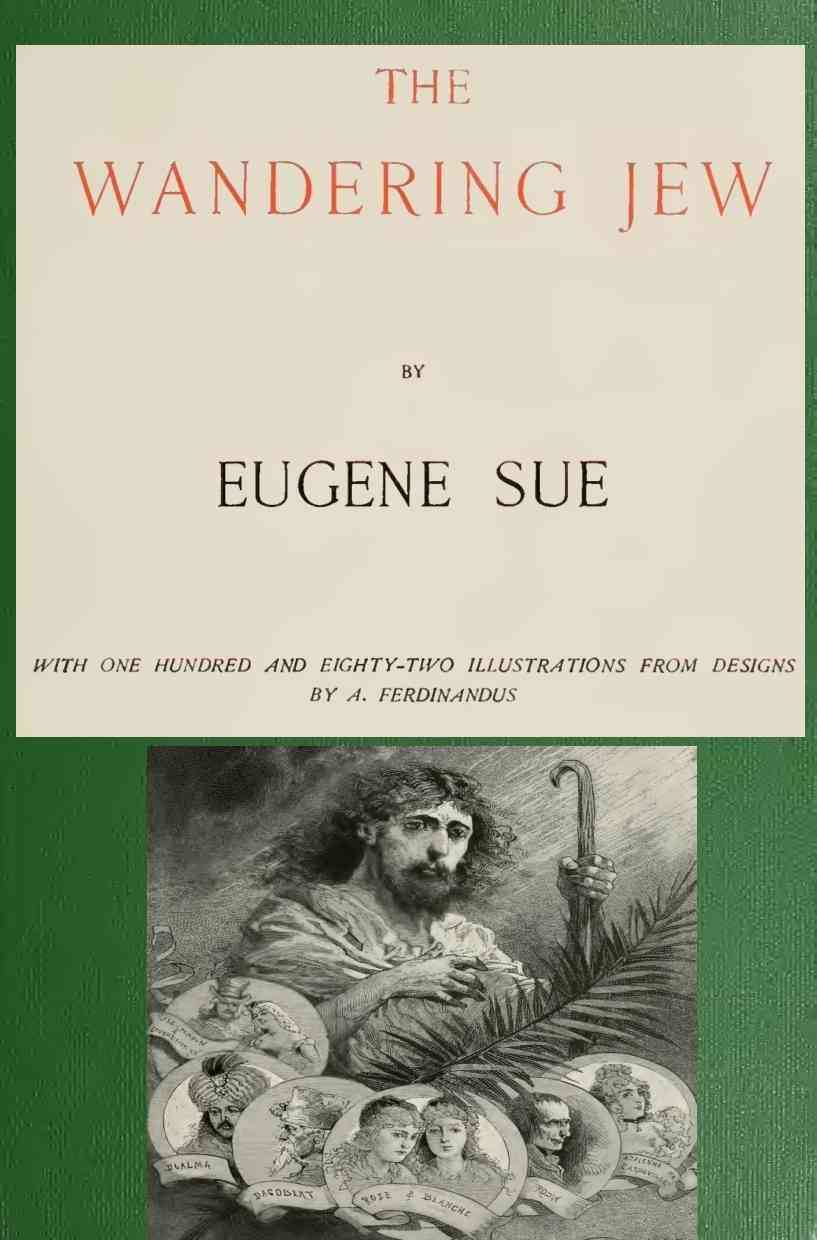
CHAPTER XIV. THE DECISION.
Morok, who wore his left arm in a sling, having slowly ascended the staircase, saluted the burgomaster respectfully. At sight of the repulsive countenance of the lion-tamer, Rose and Blanche, affrighted, drew back a step nearer to the soldier. The brow of the latter grew dark, for he felt his blood boil against Morok, the cause of all his difficulties—though he was yet ignorant that Goliath, at the instigation of the Prophet, had stolen his portfolio and papers.
“What did you want, Morok?” said the burgomaster, with an air half friendly and half displeased. “I told the landlord that I did not wish to be interrupted.”
“I have come to render you a service, Mr. Burgomaster.”
“A service?”
“Yes, a great service; or I should not have ventured to disturb you. My conscience reproaches me.”
“Your conscience.”
“Yes, Mr. Burgomaster, it reproaches me for not having told you all that I had to tell about this man; a false pity led me astray.”
“Yell, but what have you to tell?”
Morok approached the judge, and spoke to him for sometime in a low voice.
At first apparently much astonished, the burgomaster became by degrees deeply attentive and anxious; every now and then be allowed some exclamation of surprise or doubt to escape him, whilst he glanced covertly at the group formed by Dagobert and the two young girls. By the expression of his countenance, which grew every moment more unquiet, severe, and searching, it was easy to perceive that the interest which the magistrate had felt for the orphans and for the soldier, was gradually changed, by the secret communications of the Prophet, into a sentiment of distrust and hostility.
Dagobert saw this sudden revolution, and his fears, which had been appeased for an instant, returned with redoubled force; Rose and Blanche, confused, and not understanding the object of this mute scene, looked at the soldier with increased perplexity.
“The devil!” said the burgomaster, rising abruptly; “all of this never occurred to me. What could I have been thinking of?—But you see, Morok, when one is roused up in the middle of the night, one has not always presence of mind. You said well: it is a great service you came to render me.”
“I assert nothing positively, but—”
“No matter; ‘tis a thousand to one that you are right.”
“It is only a suspicion founded upon divers circumstances; but even a suspicion—”
“May give you scent of the truth. And here was I, going like a gull into the snare!—Once more, what could I have been thinking of?”
“It is so difficult to be on guard against certain appearances.”
“You need not tell me so, my dear Morok, you need not tell me so.”
During this mysterious conversation, Dagobert was on thorns; he saw vaguely that a violent storm was about to burst. He thought only of how he should still keep his anger within bounds.
Morok again approached the judge, and glancing at the orphans, recommenced speaking in a low voice. “Oh” cried the burgomaster, with, indignation, “you go too far now.”
“I affirm nothing,” said Morok, hastily; “it is a mere supposition founded on—” and he again brought his lips close to the ear of the judge.
“After all, why not?” resumed the magistrate, lifting up his hands; “such people are capable of anything. He says that he brings them from the heart of Siberia: why may not all this prove to be a tissue of impudent falsehoods?—But I am not to be made a dupe twice,” cried the burgomaster, in an angry tone, for, like all persons of a weak and shifting character, he was without pity for those whom he thought capable of having beguiled his compassion.
“Do not be in a hurry to decide—don’t give to my words more weight than they deserve,” resumed Morok with a hypocritical affectation of humility. “I am unhappily placed in so false a position with regard to this man,”—pointing to Dagober—“that I might be thought to have acted from private resentment for the injury he has done me; perhaps I may so act without knowing it, while I fancy that I am only influenced by love of justice, horror of falsehood, and respect for our holy religion. Well—who lives long enough will know—and may heaven forgive me if I am deceived!—In any case, the law will pronounce upon it; and if they should prove innocent, they will be released in a month or two.”
“And, for that reason, I need not hesitate. It is a mere measure of precaution; they will not die of it. Besides, the more I think of it, the more it seems probable. Yes this man is doubtless a French spy or agitator, especially when I compare these suspicions with the late demonstration of the students at Frankfort.”
“And, upon that theory, nothing is better fitted to excite and stir up those hot-headed youths than—” He glanced significantly at the two sisters; then, after a pause, he added with a sigh, “Satan does not care by what means he works out his ends!”
“Certainly, it would be odious, but well-devised.”
“And then, Mr Burgomaster, look at him attentively: you will see that this man has a dangerous face. You will see—”
In continuing thus to speak in a low tone, Morok had evidently pointed to Dagobert. The latter, notwithstanding his self-command, felt that the restraint he had imposed upon himself, since his arrival at this unlucky inn, and above all wince the commencement of the conversation between Morok and the burgomaster, was becoming no longer bearable; besides, he saw clearly that all his efforts to conciliate the favor of the judge were rendered completely null by the fatal influence of the brute-tamer; so, losing patience, he advanced towards him with his arms folded on his breast, and said to him in a subdued voice: “Was it of me that you were whispering to Mr. Burgomaster?”
“Yes,” said Morok, looking fixedly at him.
“Why did you not speak out loud?” Having said this, the almost convulsive movement of his thick moustache, as he stood looping Morok full in the face, gave evidence of a severe internal conflict. Seeing that his adversary preserved a contemptuous silence, he repeated in a sterner voice: “I ask you, why you did not speak out loud to Mr. Burgomaster, when you were talking of me?”
“Because there are some things so shameful, that one would blush to utter them aloud,” answered Morok insolently.
Till then Dagobert had kept his arms folded; he now extended them violently, clenching his fists. This sudden movement was so expressive that the two sisters uttered a cry of terror, and drew closer to him.
“Hark ye, Mr. Burgomaster!” said the soldier, grinding his teeth with rage: “bid that man go down, or I will not answer for myself!”
“What!” said the burgomaster, haughtily; “do you dare to give orders to me?”
“I tell you to make that man go down,” resumed Dagobert, quite beside himself, “or there will be mischief!”
“Dagobert!—good heaven!—be calm,” cried the children, grasping his hands.
“It becomes you, certainly—miserable vagabond that you are—not to say worse,” returned the burgomaster, in a rage: “it becomes you to give orders to me!—Oh! you think to impose upon me, by telling me you have lost your papers!—It will not serve your turn, for which you carry about with you these two girls, who, in spite of their innocent looks, are perhaps after all—”
“Wretch!” cried Dagobert, with so terrible a voice and gesture that the official did not dare to finish. Taking the children by the arm before they could speak a word, the soldier pushed them back into the chamber; then, locking the door, and putting the key into his pocket, he returned precipitately towards the burgomaster, who, frightened at the menacing air and attitude of the veteran, retreated a couple of steps, and held by one hand to the rail of the staircase.
“Listen to me!” said the soldier, seizing the judge by the arm. “Just now, that scoundrel insulted me—I bore with it—for it only concerned myself. I have heard patiently all your idle talk, because you seemed for a moment to interest yourself in those poor children. But since you have neither soul, nor pity, nor justice—I tell you that, burgomaster though you are—I will spurn you as I would spurn that dog,” pointing again to the Prophet, “if you have the misfortune to mention those two young girls, in any other way than you would speak of your own child!—Now, do you mark me?”
“What!—you dare to say,” cried the burgomaster, stammering with rage, “that if I happen to mention two adventuresses—”
“Hats off!—when you speak of the daughters of the Duke of Ligny,” cried the soldier, snatching the cap of the burgomaster and flinging it on the ground. On this act of aggression, Morok could not restrain his joy. Exasperated and losing all hope, Dagobert had at length yielded to the violence of his anger, after struggling so painfully against it for some hours.
When the burgomaster saw his cap at his feet, he looked at the brute tamer with an air of stupefaction, as if he hesitated to believe so great an enormity. Dagobert, regretting, his violence, and feeling that no means of conciliation note remained, threw a rapid glance around him, and, retreating several paces, gained the topmost steps of the staircase. The burgomaster stood near the bench, in a corner of the landing-place, whilst Morok, with his arm in the sling, to give the more serious appearance to his wound, was close beside him. “So!” cried the magistrate, deceived by the backward movement of Dagobert, “you think to escape, after daring to lift hand against me!—Old villain!”
“Forgive me, Mr. Burgomaster! It was a burst of rashness that I was not able to control. I am sorry for it,” said Dagobert in a repentant voice, and hanging his head humbly.
“No pity for thee, rascal! You would begin again to smooth me over with your coaxing ways, but I have penetrated your secret designs. You are not what you appear to be, and there is perhaps an affair of state at the bottom of all this,” added the magistrate, in a very diplomatic tone. “All means are alike to those who wish to set Europe in flames.”
“I am only a poor devil, Mr. Burgomaster; you, that have a good heart, will show me some mercy.”
“What! when you have pulled off my cap?”
“And you,” added the soldier, turning towards Morok, “you, that have been the cause of all this—have same pity upon me—do not bear malice!—You, a holy man, speak a word in my favor to Mr. Burgomaster.”
“I have spoken to him what I was bound to speak,” answered the Prophet ironically.
“Oho! you can look foolish enough now, you old vagabond! Did you think to impose on me with lamentations?” resumed the burgomaster, advancing towards Dagobert. “Thanks be, I am no longer your dupe!—You shall see that we have good dungeons at Leipsic for French agitators and female vagrants, for your damsels are no better than you are. Come,” added he, puffing out his cheeks with an important air, “go down before me—and as for you, Morok—”
The burgomaster was unable to finish. For some minutes Dagobert had only sought to gain time, and had cast many a side-glance at a half-open door on the landing-place, just opposite to the chamber occupied by the orphans: finding the moment favorable, he now rushed quick as lightning on the burgomaster, seized him by the throat, and dashed him with such violence against the door in question, that the magistrate, stupefied by this sudden attack, and unable to speak a word or utter a cry, rolled over to the further end of the room, which was completely dark. Then, turning towards Morok, who, with his arm encumbered by the sling, made a rush for the staircase, the soldier caught him by his long, streaming hair, pulled him back, clasped him with hands of iron, clapped his hand over his mouth to stifle his outcries, and notwithstanding his desperate resistance, dragged him into the chamber, on the floor of which the burgomaster lay bruised and stunned.
Having double-locked the door, and put the key in his pocket, Dagobert descended the stairs at two bounds, and found himself in a passage, that opened on the court-yard. The gate of the inn was shut, and there was no possibility of escape on that side. The rain fell in torrents. He could see through the window of a parlor, in which a fire was burning, the host and his people waiting for the decision of the burgomaster. To bolt the door of the passage, and thus intercept all communication with the yard, was for the soldier the affair of an instant, and he hastened upstairs again to rejoin the orphans.
Morok, recovering from his surprise, was calling for help with all his might; but, even if the distance had permitted him to be heard, the noise of the wind and rain would have drowned his outcries. Dagobert had about an hour before him, for it would require some time to elapse before the length of his interview with the magistrate would excite astonishment; and, suspicion or fear once awakened, it would be necessary to break open two doors—that which separated the passage from the court-yard, and that of the room in which the burgomaster and the Prophet were confined.
“My children, it is now time to prove that you have a soldier’s blood in your veins,” said Dagobert, as he entered abruptly the chamber of the young girls, who were terrified at the racket they had heard for some minutes.
“Good heaven, Dagobert! what has happened?” cried Blanche.
“What do you wish us to do?” added Rose.
Without answering, the soldier ran to the bed, tore off the sheets, tied them strongly together, made a knot at one end, passed it over the top of the left half of the casement, and so shut it in. Thus made fast by the size of the knot, which could not slip through, the sheets, floating on the outside, touched the ground. The second half of the window was left open, to afford a passage to the fugitives.
The veteran next took his knapsack, the children’s portmanteau, and the reindeer pelisse, and threw them all out of the window, making a sign to Spoil-sport to follow, to watch over them. The dog did not hesitate, but disappeared at a single bound. Rose and Blanche looked at Dagobert in amazement, without uttering a word.
“Now, children,” said he to them, “the doors of the inn are shut, and it is by this way,” pointing to the window, “that we must pass—if we would not be arrested, put in prison—you in one place, and I in the other—and have our journey altogether knocked on the head.”
“Arrested! put in prison!” cried Rose.
“Separated from you!” exclaimed Blanche.
“Yes, my poor children!—They have killed Jovial—we must make our escape on foot, and try to reach Leipsic—when you are tired, I will carry you, and, though I have to beg my way, we will go through with it. But a quarter of an hour later, and all will be lost. Come, children, have trust in me—show that the daughters of General Simon are no cowards—and there is yet hope.”
By a sympathetic movement, the sisters joined hands, as though they would meet the danger united. Their sweet faces, pale from the effect of so many painful emotions, were now expressive of simple resolve, founded on the blind faith they reposed in the devotion of the soldier.
“Be satisfied, Dagobert! we’ll not be frightened,” said Rose, in a firm voice.
“We will do what must be done,” added Blanche, in a no less resolute tone.
“I was sure of it,” cried Dagobert; “good blood is ever thicker than water. Come! you are light as feathers, the sheet is strong, it is hardly eight feet to the ground, and the pup is waiting for you.”
“It is for me to go first—I am the eldest for to-day,” cried Rose, when she had tenderly embraced Blanche; and she ran to the window, in order, if there were any danger, to expose herself to it before her sister.
Dagobert easily guessed the cause of this eagerness. “Dear children!” said he, “I understand you. But fear nothing for one another—there is no danger. I have myself fastened the sheet. Quick, my little Rose!”
As light as a bird, the young girl mounted the ledge of the window, and assisted by Dagobert, took hold of the sheet, and slid gently down according to the recommendation of the soldier, who, leaning out his whole body, encouraged her with his voice.
“Don’t be afraid, sister!” said she, as soon as she touched the ground, “it is very easy to come down this way. And Spoil-sport is here, licking my hands.” Blanche did not long keep her waiting; as courageous as her sister, she descended with the same success.
“Dear little creatures! what have they done to be so unfortunate?—Thousand thunders! there must be a curse upon the family,” cried Dagobert, as, with heavy heart, he saw the pale, sweet face of the young girl disappear amid the gloom of the dark night, which violent squalls of wind and torrents of rain rendered still more dismal.
“Dagobert, we are waiting for you; come quickly!” said the orphans in a low voice, from beneath the window. Thanks to his tall stature, the soldier rather leaped than glided to the ground.
Dagobert and the two young girls had not fled from the inn of the White Falcon more than a quarter of an hour, when a long crash resounded through the house. The door had yielded to the efforts of the burgomaster and Morok, who had made use of a heavy table as a battering ram. Guided by the light, they ran to the chamber of the orphans, now deserted. Morok saw the sheets floating from the casement, and cried: “Mr. Burgomaster, they have escaped by the window—they are on foot—in this dark and stormy night, they cannot be far.”
“No doubt, we shall catch them, the miserable tramps! Oh, I will be revenged! Quick, Morok; your honor is concerned as well as mine.”
“My honor?—Much more is concerned than that, Mr. Burgomaster,” answered the Prophet, in a tone of great irritation. Then, rapidly descending the stairs, he opened the door of the court-yard, and shouted in a voice of thunder:
“Goliath! unchain the dogs!—and, landlord! bring us lanterns, torches—arm your people—open the doors!—We must pursue the fugitives; they cannot escape us; we must have them—alive or dead!”
CHAPTER XV. THE DESPATCHES.
When we read, in the rules of the order of the Jesuits, under the title De formula scribendi (Institut. 2, 11, p. 125, 129), the development of the 8th part of the constitutions, we are appalled by the number of letters, narratives, registers, and writings of all kinds, preserved in the archives of the society.
It is a police infinitely more exact and better informed than has ever been that of any state. Even the government of Venice found itself surpassed by the Jesuits: when it drove them out in 1606, it seized all their papers, and reproached them for their great and laborious curiosity. This police, this secret inquisition, carried to such a degree of perfection, may give some idea of the strength of a government, so well-informed so persevering in its projects, so powerful by its unity, and, as the constitutions have it, by the union of its members. It is not hard to understand, what immense force must belong to the heads of this society, and how the general of the Jesuits could say to the Duke de Brissac: “From this room, your grace, I govern not only Paris, but China—not only China, but the whole world—and all without any one knowing how it is done:” (Constitution of the Jesuits, edited by Paulin, Paris, 1843.)
Morok, the lion-tamer, seeing Dagobert deprived of his horse, and stripped of his money and papers, and thinking it was thus out of his power to continue his journey, had, previous to the arrival of the burgomaster, despatched Karl to Leipsic, as the bearer of a letter which he was to put immediately into the post. The address of this letter was as follows: “A Monsieur Rodin, Rue du Milieu des Ursins, Paris.”
About the middle of this obscure and solitary street, situate below the level of the Quai Napoleon, which it joins not far from the Rue Saint Landry, there stood a house of unpretentious appearance, at the bottom of a dark and narrow court-yard, separated from the street by a low building in front, with arched doorway, and two windows protected by thick iron bars. Nothing could be more simple than the interior of this quiet dwelling, as was sufficiently shown by the furniture of a pretty large room on the ground floor. The walls of this apartment were lined with old gray wainscot; the tiled floor was painted red, and carefully polished; curtains of white calico shaded the windows.
A sphere of about four feet in diameter, raised on a pedestal of massive oak, stood at one end of the room, opposite to the fireplace. Upon this globe, which was painted on a large scale, a host of little red crosses appeared scattered over all parts of the world—from the North to the South, from the rising to the setting sun, from the most barbarous countries, from the most distant isles, to the centres of civilization, to France itself. There was not a single country which did not present some spots marked with these red crosses, evidently indicative of stations, or serving as points of reference.
Before a table of black wood, loaded with papers, and resting against the wall near the chimney, a chair stood empty. Further on, between the two windows, was a large walnut-wood desk, surmounted by shelves full of pasteboard boxes.
At the end of the month of October, 1831, about eight o’clock in the morning, a man sat writing at this desk. This was M. Rodin, the correspondent of Morok, the brute-tamer.
About fifty years of age, he wore an old, shabby, olive greatcoat, with a greasy collar, a snuff-powdered cotton handkerchief for a cravat, and waistcoat and trousers of threadbare black cloth. His feet, buried in loose varnished shoes, rested on a petty piece of green baize upon the red, polished floor. His gray hair lay flat on his temples, and encircled his bald forehead; his eyebrows were scarcely marked; his upper eyelid, flabby and overhanging, like the membrane which shades the eyes of reptiles, half concealed his small, sharp, black eye. His thin lips, absolutely colorless, were hardly distinguishable from the wan hue of his lean visage, with its pointed nose and chin; and this livid mask (deprived as it were of lips) appeared only the more singular, from its maintaining a death-like immobility. Had it not been for the rapid movement of his fingers, as, bending over the desk, he scratched along with his pen, M. Rodin might have been mistaken for a corpse.
By the aid of a cipher (or secret alphabet) placed before him he was copying certain passages from a long sheet full of writing, in a manner quite unintelligible to those who did not possess the key to the system. Whilst the darkness of the day increased the gloom of the large, cold, naked-looking apartment, there was something awful in the chilling aspect of this man, tracing his mysterious characters in the midst of profound silence.
The clock struck eight. The dull sound of the knocker at the outer door was heard, then a bell tinkled twice, several doors opened and shut, and a new personage entered the chamber. On seeing him, M. Rodin rose from the desk, stuck his pen between his teeth, bowed with a deeply submissive air, and sat down again to his work without uttering a word.
The two formed a striking contrast to one another. The newcomer, though really older than he seemed, would have passed for thirty-six or thirty eight years of age at most. His figure was tall and shapely, and few could have encountered the brightness of his large gray eye, brilliant as polished steel. His nose, broad at the commencement, formed a well-cut square at its termination; his chin was prominent, and the bluish tints of his close-shaved beard were contrasted with the bright carnation of his lips, and the whiteness of his fine teeth. When he took off his hat to change it for a black velvet cap which he found on the small table, he displayed a quantity of light chestnut hair, not yet silvered by time. He was dressed in a long frock-coat, buttoned up to the neck in military fashion.
The piercing glance and broad forehead of this man revealed a powerful intellect, even as the development of his chest and shoulders announced a vigorous physical organization; whilst his gentlemanly appearance, the perfection of his gloves and boots, the light perfume which hung about his hair and person, the grace and ease of his least movements, betrayed what is called the man of the world, and left the impression that he had sought or might still seek every kind of success, from the most frivolous to the most serious. This rare combination of strength of mind, strength of body, and extreme elegance of manners, was in this instance rendered still more striking by the circumstance, that whatever there might be of haughtiness or command in the upper part of that energetic countenance, was softened down, and tempered by a constant but not uniform smile—for, as occasion served, this smile became either kind or sly, cordial or gay, discreet or prepossessing, and thus augmented the insinuating charm of this man, who, once seen, was never again forgotten. But, in yielding to this involuntary sympathy, the doubt occurred if the influence was for good—or for evil.
M. Rodin, the secretary of the newcomer, continued to write.
“Are there any letters from Dunkirk, Rodin?” inquired his master.
“Post not yet in.”
“Without being positively uneasy as to my mother’s health, since she was already convalescent,” resumed the other, “I shall only be quite reassured by a letter from my excellent friend, the Princess de Saint Dizier. I shall have good news this morning, I hope.”
“It is to be desired,” said the secretary, as humble and submissive as he was laconic and impassible.
“Certainly it is to be desired,” resumed his master; “for one of the brightest days of my life was when the Princess de Saint-Dizier announced to me that this sudden and dangerous illness had yielded to the care and attention with which she surrounds my mother. Had it not been for that I must have gone down to her instantly, though my presence here is very necessary.”
Then, approaching the desk, he added: “Is the summary of the foreign correspondence complete?”
“Here is the analysis.”
“The letters are still sent under envelope to the places named, and are then brought here as I directed?”
“Always.”
“Read to me the notes of this correspondence; if there are any letters for me to answer, I will tell you.” And Rodin’s master began to walk up and down the room, with his hands crossed behind his back, dictating observations of which Rodin took careful note.
The secretary turned to a pretty large pile of papers, and thus began:
“Don Raymond Olivarez acknowledges from Cadiz receipt of letter No.19; he will conform to it, and deny all share in the abduction.”
“Very well; file it.”
“Count Romanoff, of Riga, finds himself in a position of pecuniary embarrassment.”
“Let Duplessis send him fifty louis; I formerly served as captain in his regiment, and he has since given us good information.”
“They have received at Philadelphia the last cargo of Histories of France, expurgated for the use of the faithful they require some more of the same sort.”
“Take note of it, and write to Duplessis. Go on.”
“M. Spindler sends from Namur the secret report on M. Ardouin.”
“To be examined.”
“M. Ardouin sends from the same town the secret report on M. Spindler.”
“To be examined.”
“Doctor Van Ostadt, of the same town, sends a confidential note on the subject of Messrs. Spindler and Ardouin.”
“To be compared. Go on!”
“Count Malipierri, of Turin, announces that the donation of 300,000 francs is signed.”
“Inform Duplessis. What next?”
“Don Stanislaus has just quitted the waters of Baden with Queen Marie Ernestine. He informs us that her majesty will receive with gratitude the promised advices, and will answer them with her own hand.”
“Make a note of it. I will myself write to the queen.”
Whilst Rodin was inscribing a few remarks on the margin of the paper, his master, continuing to walk up and down the room, found himself opposite to the globe marked with little red crosses, and stood contemplating it for a moment with a pensive air.
Rodin continued: “In consequence of the state of the public mind in certain parts of Italy, where sundry agitators have turned their eyes in the direction of France, Father Arsenio writes from Milan, that it would be of importance to distribute profusely in that country, some little book, in which the French would be represented as impious and debauched, rapacious and bloody.”
“The idea is excellent. We might turn to good account the excesses committed by our troops in Italy during the wars of the Republic. You must employ Jacques Dumoulin to write it. He is full of gall, spite, and venom: the pamphlet will be scorching. Besides, I may furnish a few notes; but you must not pay Dumoulin till after delivery of the manuscript.”
“That is well understood: for, if we were to pay him beforehand, he would be drunk for a week in some low den. It was thus we had to pay him twice over for his virulent attack on the pantheistic tendencies of Professor Martin’s philosophy.”
“Take note of it—and go on!”
“The merchant announces that the clerk is about to send the banker to give in his accounts. You understand?’ added Rodin, after pronouncing these words with a marked emphasis.
“Perfectly,” said the other, with a start; “they are but the expressions agreed on. What next?”
“But the clerk,” continued the secretary, “is restrained by a last scruple.”
After a moment’s silence, during which the features of Rodin’s master worked strongly, he thus resumed: “They must continue to act on the clerk’s mind by silence and solitude; then, let him read once more the list of cases in which regicide is authorized and absolved. Go on!”
“The woman Sydney writes from Dresden, that she waits for instructions. Violent scenes of jealousy on her account have again taken place between the father and son; but neither from these new bursts of mutual hatred, nor from the confidential communications which each has made to her against his rival, has she yet been able to glean the information required. Hitherto, she has avoided giving the preference to one or the other; but, should this situation be prolonged, she fears it may rouse their suspicion. Which ought she then to choose—the father or the son?”
“The son—for jealous resentment will be much more violent and cruel in the old man, and, to revenge himself for the preference bestowed upon his son, he will perhaps tell what they have both such an interest to conceal. The next?”
“Within the last three years, two maid-servants of Ambrosius whom we placed in that little parish in the mountains of the Valais, have disappeared, without any one knowing what has become of them. A third has just met with the same fate. The Protestants of the country are roused—talk of murder with frightful attendant circumstances—”
“Until there is proof positive and complete of the fact, Ambrosius must be defended against these infamous calumnies, the work of a party that never shrinks from; monstrous inventions. Go on!”
“Thompson, of Liverpool, has at length succeeded in procuring for Justin the place of agent or manager to Lord Stewart, a rich Irish Catholic, whose head grows daily weaker.”
“Let the fact be once verified, and Thompson shall have a premium of fifty louis. Make a note of it for Duplessis. Proceed.”
“Frantz Dichstein, of Vienna,” resumed Rodin, “announces that his father has just died of the cholera, in a little village at some leagues from that city: for the epidemic continues to advance slowly, coming from the north of Russia by way of Poland.”
“It is true,” said Rodin’s master, interrupting him; “may its terrible march be stayed, and France be spared.”
“Frantz Dichstein,” resumed Rodin, “says that his two brothers are determined to contest the donation made by his father, but that he is of an opposite opinion.”
“Consult the two persons that are charged with all matters of litigation. What next?”
“The Cardinal Prince d’Amalfi will conform to the three first points of the proposal: he demands to make a reservation upon the fourth point.”
“No reserve!—Either full and absolute acceptance—or else war—and (mark me well) war without mercy—on him and his creatures. Go on!”
“Fra Paolo announces that the Prince Boccari, chief of a redoubtable secret society, in despair at seeing his friends accuse him of treachery, in consequence of suspicions excited in their minds by Fra Paolo himself, has committed suicide.”
“Boccari! is it possible?” cried Rodin’s master. “Boccari! the patriot Boccari! so dangerous a person!”
“The patriot Boccari,” repeated the impassible secretary.
“Tell Duplessis to send an order for five-and-twenty louis to Fra Paolo. Make a note of it.”
“Hausman informs us that the French dancer, Albertine Ducornet, is the mistress of the reigning prince; she has the most complete influence over him, and it would be easy through her means to arrive at the end proposed, but that she is herself governed by her lover (condemned in France as a forger), and that she does nothing without consulting him.”
“Let Hausman get hold of this man—if his claims are reasonable, accede to them—and learn if the girl has any relations in Paris.”
“The Duke d’Orbano announces, that the king his master will authorize the new establishment, but on the conditions previously stated.”
“No condition!—either a frank adhesion or a positive refusal. Let us know our friends from our enemies. The more unfavorable the circumstances, the more we must show firmness, and overbear opposition by confidence in ourselves.”
“The same also announces, that the whole of the corps diplomatique continues to support the claims of the father of that young Protestant girl, who refuses to quit the convent where she has taken refuge, unless it be to marry her lover against her father’s will.”
“Ah! the corps diplomatique continues to remonstrate in the father’s name?”
“Yes.”
“Then, continue to answer, that the spiritual power has nothing to do with the temporal.”
At this moment, the bell of the outer door again sounded twice. “See who it is,” said Rodin’s master; and the secretary rose and left the room. The other continued to walk thoughtfully up and down, till, coming near to the huge globe, he stopped short before it.
For some time he contemplated, in profound silence, the innumerable little red crosses, which appeared to cover, as with an immense net, all the countries of the earth. Reflecting doubtless on the invisible action of his power, which seemed to extend over the whole world, the features of this man became animated, his large gray eye sparkled, his nostrils swelled, and his manly countenance assumed an indescribable expression of pride, energy, and daring. With haughty brow and scornful lip, he drew still nearer to the globe, and leaned his strong hand upon the pole.
This powerful pressure, an imperious movement, as of one taking possession, seemed to indicate, that he felt sure of governing this globe, on which he looked down from the height of his tall figure, and on which he rested his hand with so lofty and audacious an air of sovereignty.
But now he no longer smiled. His eye threatened, and his large forehead was clad with a formidable scowl. The artist, who had wished to paint the demon of craft and pride, the infernal genius of insatiable domination, could not have chosen a more suitable model.
When Rodin returned, the face of his master had recovered its ordinary expression. “It is the postman,” said Rodin, showing the letters which he held in his hand; “there is nothing from Dunkirk.”
“Nothing?” cried his master—and his painful emotion formed a strange contrast to his late haughty and implacable expression of countenance—“nothing? no news of my mother?—Thirty-six hours more, then, of anxiety.”
“It seems to me, that, if the princess had bad news to give, she would have written. Probably the improvement goes on.”
“You are doubtless right, Rodin—but no matter—I am far from easy. If, to-morrow, the news should not be completely satisfactory, I set out for the estate of the princess. Why would my mother pass the autumn in that part of the country? The environs of Dunkirk do not, I fear, agree with her.”
After a few moments’ silence, he added, as he continued to walk: “Well—these letters—whence are they?”
Rodin looked at the post-marks, and replied: “Out of the four there are three relative to the great and important affairs of the medals.”
“Thank heaven!—provided the news be favorable,” cried his master, with an expression of uneasiness, which showed how much importance he attached to this affair.
“One is from Charlestown, and no doubt relative to Gabriel, the missionary,” answered Rodin; “this other from Batavia, and no doubt concerns the Indian, Djalma. The third is from Leipsic, and will probably confirm that received yesterday, in which the lion-tamer, Morok, informed us, that, in accordance with his orders, and without his being compromised in any way, the daughters of General Simon would not be able to continue their journey.”
At the name of General Simon, a cloud passed over the features of Rodin’s master.
CHAPTER XVI. THE ORDERS.
The principal houses correspond with that in Paris; they are also in direct communication with the General, who resides at Rome. The correspondence of the Jesuits so active, various, and organized in so wonderful a manner, has for its object to supply the heads with all the information they can require. Every day, the General receives a host of reports, which serve to check one another. In the central house, at Rome, are immense registers, in which are inscribed the names of all the Jesuits, of their adherents, and of all the considerable persons, whether friends or enemies, with whom they have any connection. In these registers are reported, without alteration, hatred or passion the facts relating to the life of each individual. It is the most gigantic biographical collection that has ever been formed. The frailties of a woman, the secret errors of a statesman, are chronicled in this book with the same cold impartiality. Drawn up for the purpose of being useful, these biographies are necessarily exact. When the Jesuits wish to influence an individual, they have but to turn to this book, and they know immediately his life, his character, his parts, his faults, his projects, his family, his friends, his most sacred ties. Conceive, what a superior facility of action this immense police-register, which includes the whole world, must give to any one society! It is not lightly that I speak of these registers; I have my facts from a person who has seen this collection, and who is perfectly well acquainted with the Jesuits. Here then, is matter to reflect on for all those families, who admit freely into their houses the members of a community that carries its biographical researches to such a point. (Libri, Member of the Institute. Letters on the Clergy.)
When he had conquered the involuntary emotion which the name or remembrance of General Simon had occasioned, Rodin’s master said to the secretary: “Do not yet open the letters from Leipsic, Charlestown, and Batavia; the information they contain will doubtless find its place presently. It will save our going over the same ground twice.”
The secretary looked inquiringly at his master.
The latter continued—“Have you finished the note relating to the medals?”
“Here it is,” replied the secretary; “I was just finishing my interpretation of the cipher.”
“Read it to me, in the order of the facts. You can append to it the news contained in those three letters.”
“True,” said Rodin; “in that way the letters will find their right place.”
“I wish to see,” rejoined the other, “whether this note is clear and fully explanatory; you did not forget that the person it is intended for ought not to know all?”
“I bore it in mind, and drew up the paper accordingly.”