
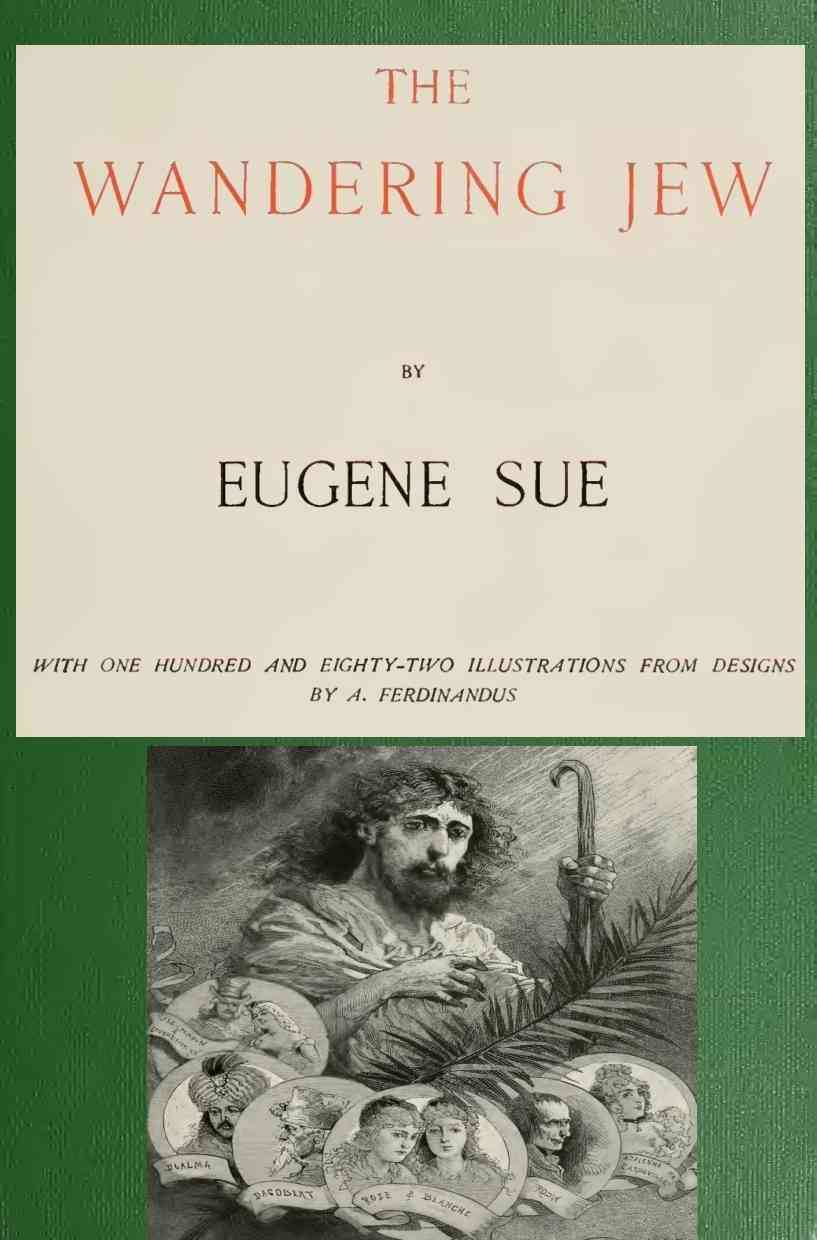
CHAPTER XVII. THE HOUSE IN THE RUE SAINT-FRANCOIS.
On entering the Rue Saint-Gervais, by the Rue Dore (in the Marais), you would have found yourself, at the epoch of this narrative, directly opposite to an enormously high wall, the stones of which were black and worm-eaten with age. This wall, which extended nearly the whole length of that solitary street, served to support a terrace shaded by trees of some hundred years old, which thus grew about forty feet above the causeway. Through their thick branches appeared the stone front, peaked roof and tall brick chimneys of an antique house, the entrance of which was situated in the Rue Saint-Francois, not far from the Rue Saint Gervais corner. Nothing could be more gloomy than the exterior of this abode. On the entrance-side also was a very high wall, pierced with two or three loop-holes, strongly grated. A carriage gateway in massive oak, barred with iron, and studded with large nail-heads, whose primitive color disappeared beneath a thick layer of mud, dust, and rust, fitted close into the arch of a deep recess, forming the swell of a bay window above. In one of these massive gates was a smaller door, which served for ingress and egress to Samuel the Jew, the guardian of this dreary abode. On passing the threshold, you came to a passage, formed in the building which faced in the street. In this building was the lodging of Samuel, with its windows opening upon the rather spacious inner court yard, through the railing of which you perceived the garden. In the middle of this garden stood a two-storied stone house, so strangely built, that you had to mount a flight of steps, or rather a double-flight of at least twenty steps, to reach the door, which had been walled up a hundred and fifty years before. The window-blinds of this habitation had been replaced by large thick plates of lead, hermetically soldered and kept in by frames of iron clamped in the stone. Moreover, completely to intercept air and light, and thus to guard against decay within and without, the roof had been covered with thick sheets of lead, as well as the vents of the tall chimneys, which had previously been bricked up. The same precautions had been taken with respect to a small square belvedere, situated on the top of the house; this glass cage was covered with a sort of dome, soldered to the roof. Only, in consequence of some singular fancy, in every one of the leaden plates, which concealed the four sides of the belvedere, corresponding to the cardinal points, seven little round holes had been bored in the form of a cross, and were easily distinguishable from the outside. Everywhere else the plates of lead were completely unpierced. Thanks to these precautions, and to the substantial structure of the building, nothing but a few outward repairs had been necessary; and the apartments, entirely removed from the influence of the external air, no doubt remained, during a century and a half, exactly in the same state as at the time of their being shut up. The aspect of walls in crevices, of broken, worm-eaten shutters, of a roof half fallen in, and windows covered with wall-flowers, would perhaps have been less sad than the appearance of this stone house, plated with iron and lead, and preserved like a mausoleum. The garden, completely deserted, and only regularly visited once a week by Samuel, presented to the view, particularly in summer, an incredible confusion of parasites and brambles. The trees, left to themselves, had shot forth and mingled their branches in all directions; some straggling vines, reproduced from offshoots, had crept along the ground to the foot of the trees, and, climbing up their trunks, had twined themselves about them, and encircled their highest branches with their inextricable net. You could only pass through this virgin forest by following the path made by the guardian, to go from the grating to the house, the approaches to which were a little sloped to let the water run off, and carefully paved to the width of about ten feet. Another narrow path which extended all around the enclosure, was every night perambulated by two or three Pyrenees dogs—a faithful race, which had been perpetuated in the house during a century and a half. Such was the habitation destined for the meeting of the descendants of the family of Rennepont. The night which separated the 12th from the 13th day of February was near its close. A calm had succeeded the storm, and the rain had ceased; the sky was clear and full of stars; the moon, on its decline, shone with a mild lustre, and threw a melancholy light over that deserted, silent house, whose threshold for so many years no human footstep had crossed.
Original
A bright gleam of light, issuing from one of the windows of the guardian’s dwelling, announced that Samuel was awake. Figure to yourself a tolerably large room, lined from top to bottom with old walnut wainscoting browned to an almost black, with age. Two half-extinguished brands are smoking amid the cinders on the hearth. On the stone mantelpiece, painted to resemble gray granite, stands an old iron candlestick, furnished with a meagre candle, capped by an extinguisher. Near it one sees a pair of double-barrelled pistols, and a sharp cutlass, with a hilt of carved bronze, belonging to the seventeenth century. Moreover, a heavy rifle rests against one of the chimney jambs. Four stools, an old oak press, and a square table with twisted legs, formed the sole furniture of this apartment. Against the wall were systematically suspended a number of keys of different sizes, the shape of which bore evidence to their antiquity, whilst to their rings were affixed divers labels. The back of the old press, which moved by a secret spring, had been pushed aside, and discovered, built in the wall, a large and deep iron chest, the lid of which, being open, displayed the wondrous mechanism of one of those Florentine locks of the sixteenth century, which, better than any modern invention, set all picklocks at defiance; and, moreover, according to the notions of that age, are supplied with a thick lining of asbestos cloth, suspended by gold wire at a distance from the sides of the chest, for the purpose of rendering incombustible the articles contained in it. A large cedar-wood box had been taken from the chest, and placed upon a stool; it contained numerous papers, carefully arranged and docketed. By the light of a brass lamp, the old keeper Samuel, was writing in a small register, whilst Bathsheba, his wife, was dictating to him from an account. Samuel was about eighty two years old, and, notwithstanding his advanced age, a mass of gray curling hair covered his head. He was short, thin, nervous, and the involuntary petulance of his movements proved that years had not weakened his energy and activity; though, out of doors, where, however, he made his appearance very seldom, he affected a sort of second childhood, as had been remarked by Rodin to Father d’Aigrigny. An old dressing-gown, of maroon-colored camlet, with large sleeves, completely enveloped the old man, and reached to his feet.
Samuel’s features were cast in the pure, Eastern mould of his race. His complexion was of a dead yellow, his nose aquiline, his chin shaded by a little tuft of white beard, while projecting cheek-bones threw a harsh shadow upon the hollow and wrinkled cheeks. His countenance was full of intelligence, fine sharpness, and sagacity. On his broad, high forehead one might read frankness, honesty, and firmness; his eyes, black and brilliant as an Arab’s, were at once mild and piercing.
His wife, Bathsheba, some fifteen years younger than himself, was of tall stature, and dressed entirely in black. A low cap, of starched lawn, which reminded one of the grave head-dresses of Dutch matrons, encircled a pale and austere countenance, formerly of a rare and haughty beauty, and impressed with the Scriptural character. Some lines in the forehead, caused by the almost continual knitting of her gray brows, showed that this woman had often suffered from the pressure of intense grief.
At this very moment her countenance betrayed inexpressible sorrow. Her look was fixed, her head resting on her bosom. She had let her right hand, which held a small account-book, fall upon her lap, while the other hand grasped convulsively a long tress of jet-black hair, which she bore about her neck. It was fastened by a golden clasp, about an inch square, in which, under a plate of crystal, that shut in one side of it like a relic-case, could be seen a piece of linen, folded square, and almost entirely covered with dark red spots that resembled blood a long time dried.
After a short silence, during which Samuel was occupied with his register, he read aloud what he had just been writing: “Per contra, 5,000 Austrian Metallics of 1,000 florins, under date of October 19th, 1826.”
After which enumeration, Samuel raised his head, and said to his wife: “Well, is it right, Bathsheba? Have you compared it with the account book?”
Bathsheba did not answer. Samuel looked at her, and, seeing that she was absorbed in grief, said to her, with an expression of tender anxiety: “What is the matter? Good heaven! what is the matter with you?”
“The 19th of October, 1826,” said she, slowly, with her eyes still fixed, and pressing yet more closely the lock of black hair which she wore about her neck; “It was a fatal day—for, Samuel, it was the date of the last letter which we received from—”
Bathsheba was unable to proceed. She uttered a long sigh, and concealed her face in her hands.
“Oh! I understand you,” observed the old man, in a tremulous voice; “a father may be taken up by the thought of other cares; but the heart of a mother is ever wakeful.” Throwing his pen down upon the table, Samuel leaned his forehead upon his hands in sorrow.
Bathsheba resumed, as if she found a melancholy pleasure in these cruel remembrances: “Yes; that was the last day on which our son, Abel, wrote to us from Germany, to announce to us that he had invested the funds according to your desire and was going thence into Poland, to effect another operation.”
“And in Poland he met the death of a martyr,” added Samuel. “With no motive and no proof, they accused him falsely of coming to organize smuggling, and the Russian governor, treating him as they treat our brothers in that land of cruel tyranny, condemned him to the dreadful punishment of the knout, without even hearing him in his defence. Why should they hear a Jew? What is a Jew? A creature below a serf, whom they reproach for all the vices that a degrading slavery has engendered. A Jew beaten to death? Who would trouble themselves about it?”
“And poor Abel, so good, so faithful, died beneath their stripes, partly from shame, partly from the wounds,” said Bathsheba, shuddering. “One of our Polish brethren obtained with great difficulty permission to bury him. He cut off this lock of beautiful black hair—which, with this scrap of linen, bathed in the blood of our dear son, is all that now remains to us of him.” Bathsheba covered the hair and clasp with convulsive kisses.
“Alas!” said Samuel, drying his tears, which had burst forth at these sad recollections, “the Lord did not at last remove our child, until the task which our family has accomplished faithfully for a century and a half was nearly at an end. Of what use will our race be henceforth upon earth?” added Samuel, most bitterly. “Our duty is performed. This casket contains a royal fortune—and yonder house, walled up for a hundred and fifty years, will be opened to-morrow to the descendants of my ancestor’s benefactor.” So saying, Samuel turned his face sorrowfully towards the house, which he could see through the window. The dawn was just about to appear. The moon had set; belvedere, roof, and chimneys formed a black mass upon the dark blue of the starry firmament.
Suddenly, Samuel grew pale, and, rising abruptly, said to his wife in a tremulous tone, whilst he still pointed to the house: “Bathsheba! the seven points of light—just as it was thirty years ago. Look! look:”
Indeed, the seven round holes, bored in the form of a cross in the leaden plates which covered the window of the belvedere, sparkled like so many luminous points, as if some one in the house ascended with a light to the roof.
CHAPTER XVIII. DEBIT AND CREDIT.
For some seconds, Samuel and Bathsheba remained motionless, with their eyes fixed in fear and uneasiness on the seven luminous points, which shone through the darkness of the night from the summit of the belvedere; while, on the horizon, behind the house, a pale, rosy hue announced the dawn of day.
Samuel was the first to break silence, and he said to his wife, as he drew his hand across his brow: “The grief caused by the remembrance of our poor child has prevented us from reflecting that, after all, there should be nothing to alarm us in what we see.”
“How so, Samuel?”
“My father always told me that he, and my grandfather before him, had seen such lights at long intervals.”
“Yes, Samuel—but without being able, any more than ourselves, to explain the cause.”
“Like my father and grandfather, we can only suppose that some secret passage gives admittance to persons who, like us, have some mysterious duty to fulfil in this dwelling. Besides, my father warned me not to be uneasy at these appearances, foretold by him, and now visible for the second time in thirty years.”
“No matter for that, Samuel, it does strike one as if it was something supernatural.”
“The days of miracles are over.” said the Jew, shaking his head sorrowfully: “many of the old houses in this quarter have subterraneous communications with distant places—some extending even to the Seine and the Catacombs. Doubtless, this house is so situated, and the persons who make these rare visits enter by some such means.”
“But that the belvedere should be thus lighted up?”
“According to the plan of the building, you know that the belvedere forms a kind of skylight to the apartment called the Great Hall of Mourning, situated on the upper story. As it is completely dark, in consequence of the closing of all the windows, they must use a light to visit this Hall of Mourning—a room which is said to contain some very strange and gloomy things,” added the Jew, with a shudder.
Bathsheba, as well as her husband, gazed attentively on the seven luminous points, which diminished in brightness as the daylight gradually increased.
“As you say, Samuel, the mystery may be thus explained,” resumed the Hebrew’s wife. “Besides, the day is so important a one for the family of Rennepont, that this apparition: ought not to astonish us under the circumstances.”
“Only to think,” remarked Samuel, “that these lights have appeared at several different times throughout a century and a half! There must, therefore, be another family that, like ours, has devoted itself, from generation to generation, to accomplish a pious duty.”
“But what is this duty? It will perhaps be explained today.”
“Come, come, Bathsheba,” suddenly exclaimed Samuel, as if roused from his reverie, and reproaching himself with idleness; this is the day, and, before eight o’clock, our cash account must be in order, and these titles to immense property arranged, so that they may be delivered to the rightful owners”—and he pointed to the cedar-wood box.
“You are right, Samuel; this day does not belong to us. It is a solemn day—one that would have been sweet, oh! very sweet to you and me—if now any days could be sweet to us,” said Bathsheba bitterly, for she was thinking of her son.
“Bathsheba,” said Samuel, mournfully, as he laid his hand on his wife’s; “we shall at least have the stern satisfaction of having done our duty. And has not the Lord been very favorable to us, though He has thus severely tried us by the death of our son? Is it not thanks to His providence that three generations of my family have been able to commence, continue, and finish this great work?”
“Yes, Samuel,” said the Jewess, affectionately, “and for you at least this satisfaction will be combined with calm and quietness, for on the stroke of noon you will be delivered from a very terrible responsibility.”
So saying, Bathsheba pointed to the box.
“It is true,” replied the old man; “I had rather these immense riches were in the hands of those to whom they belong, than in mine; but, to day, I shall cease to be their trustee. Once more then, I will check the account for the last time, and compare the register with the cash-book that you hold in your hand.”
Bathsheba bowed her head affirmatively, and Samuel, taking up his pen, occupied himself once more with his calculations. His wife, in spite of herself, again yielded to the sad thoughts which that fatal date had awakened, by reminding her of the death of her son.
Let us now trace rapidly the history, in appearance so romantic and marvellous, in reality so simple, of the fifty thousand crowns, which, thanks to the law of accumulation, and to a prudent, intelligent and faithful investment, had naturally, and necessarily, been transformed, in the space of a century and a half, into a sum far more important than the forty millions estimated by Father d’Aigrigny—who, partially informed on this subject, and reckoning the disastrous accidents, losses, and bankruptcies which might have occurred during so long a period, believed that forty millions might well b e considered enormous.
The history of this fortune being closely connected with that of the Samuel family, by whom it had been managed for three generations, we shall give it again in a few words.
About the period 1670, some years before his death, Marius de Rennepont, then travelling in Portugal, had been enabled, by means of powerful interest, to save the life of an unfortunate Jew, condemned to be burnt alive by the Inquisition, because of his religion. This Jew was Isaac Samuel, grandfather of the present guardian of the house in the Rue Saint-Francois.
Generous men often attach themselves to those they have served, as much, at least, as the obliged parties are attached to their benefactors. Having ascertained that Isaac, who at that time carried on a petty broker’s business at Lisbon, was industrious, honest, active, laborious, and intelligent, M. de Rennepont, who then possessed large property in France, proposed to the Jew to accompany him, and undertake the management of his affairs. The same hatred and suspicion with which the Israelites have always been followed, was then at its height. Isaac was therefore doubly grateful for this mark of confidence on the part of M. de Rennepont. He accepted the offer, and promised from that day to devote his existence to the service of him who had first saved his life, and then trusted implicitly to his good faith and uprightness, although he was a Jew, and belonged to a race generally suspected and despised. M. de Rennepont, a man of great soul, endowed with a good spirit, was not deceived in his choice. Until he was deprived of his fortune, it prospered wonderfully in the hands of Isaac Samuel, who, gifted with an admirable aptitude for business, applied himself exclusively to advance the interests of his benefactor.
Then came the persecution and ruin of M. de Rennepont, whose property was confiscated and given up to the reverend fathers of the Company of Jesus only a few days before his death. Concealed in the retreat he had chosen, therein to put a violent end to his life, he sent secretly for Isaac Samuel, and delivered to him fifty thousand crowns in gold, the last remains of his fortune. This faithful servant was to invest the money to the best advantage, and, if he should have a son, transmit to him the same obligation; or, should he have no child, he was to seek out some relation worthy of continuing this trust, to which would moreover be annexed a fair reward. It was thus to be transmitted and perpetuated from relative to relative, until the expiration of a century and a half. M. de Rennepont also begged Isaac to take charge, during his life, of the house in the Rue Saint-Francois, where he would be lodged gratis, and to leave this function likewise to his descendants, if it were possible.
If even Isaac Samuel had not had children, the powerful bond of union which exists between certain Jewish families, would have rendered practicable the last will of De Rennepont. The relations of Isaac would have become partner; in his gratitude to his benefactor, and they, and their succeeding generations, would have religiously accomplished the task imposed upon one of their race. But, several years after the death of De Rennepont, Isaac had a son.
This son, Levy Samuel, born in 1689, not having had any children by his first wife, married again at nearly sixty years of age, and, in 1750, he also had a son—David Samuel, the guardian of the house in the Rue Saint Francois, who, in 1832 (the date of this narrative), was eighty-two years old, and seemed likely to live as long as his father, who had died at the age of ninety-three. Finally, Abel Samuel, the son whom Bathsheba so bitterly regretted, born in 1790, had perished under the Russian knout, at the age of thirty-six.
Having established this humble genealogy, we easily understand how this successive longevity of three members of the Samuel family, all of whom had been guardians of the walled house, by uniting, as it were, the nineteenth with the seventeenth century, simplified and facilitated the execution of M. de Rennepont’s will; the latter having declared his desire to the grandfather of the Samuels, that the capital should only be augmented by interest at five per cent.—so that the fortune might come to his descendants free from all taint of usurious speculation.
The fellow men of the Samuel family, the first inventors of the bill of exchange, which served them in the Middle Ages to transport mysteriously considerable amounts from one end of the world to the other, to conceal their fortune, and to shield it from the rapacity of their enemies—the Jews, we say, having almost the monopoly of the trade in money and exchanges, until the end of the eighteenth century, aided the secret transactions and financial operations of this family, which, up to about 1820, placed their different securities, which had become progressively immense, in the hands of the principal Israelitish bankers and merchants of Europe. This sure and secret manner of acting had enabled the present guardian of the house in the Rue Saint-Francois, to effect enormous investments, unknown to all; and it was more especially during the period of his management, that the capital sum had acquired, by the mere fact of compound interest, an almost incalculable development. Compared with him, his father and grandfather had only small amounts to manage. Though it had only been necessary to find successively sure and immediate investments, so that the money might not remain as it were one day without bearing interest, it had acquired financial capacity to attain this result, when so many millions were in question. The last of the Samuels, brought up in the school of his father, had exhibited this capacity in a very high degree, as will be seen immediately by the results. Nothing could be more touching, noble, and respectable, than the conduct of the members of this Jewish family, who, partners in the engagement of gratitude taken by their ancestor, devote themselves for long years, with as much disinterestedness as intelligence and honesty, to the slow acquisition of a kingly fortune, of which they expect no part themselves, but which, thanks to them, would come pure, as immense, to the hands of the descendants of their benefactor! Nor could anything be more honorable to him who made, and him who received this deposit, than the simple promise by word of mouth, unaccompanied by any security save mutual confidence and reciprocal esteem, when the result was only to be produced at the end of a century and a half!
After once more reading his inventory with attention, Samuel said to his wife: “I am certain of the correctness of my additions. Now please to compare with the account-book in your hand the summary of the investments that I have just entered in the register. I will assure myself, at the same time, that the bonds and vouchers are properly arranged in this casket, that, on the opening of the will, they may be delivered in order to the notary.”
“Begin, my dear, and I will check you,” said Bathsheba.
Samuel read as follows, examining as he went on, the contents of his casket:
Statement of the account of the heirs of M. DE RENNEPONT, delivered by DAVID SAMUELS.
DEBIT.
in the French 5 P. C.,
bought from 1825 to 1832,
at an average price of 99f.
50c............ 39,800,000
900,000 francs, ditto, in
the French 3 P. C.,
bought during the
same years, at an average
of 74f 25c........ 22,275,000
5;000 shares in the Bank
of France, bought at 1,900 9,500,000
3,000 shares in the Four
Canals, in a certificate
from the Company,
bought at 1,115f..... 3,345,000
125,000 ducats of
Neapolitans, at an average
of 82. 2,050,000 ducats,
at 4f. 400....... 9,020,000
5,000 Austrian Metallics,
of 1,000 florins, at 93
—say 4,650,000 florins,
at 2f. 50c........ 11,625,000
75,000 pounds sterling
per annum, English
Consolidated 3 P. C.,
at 88 3/4—say 2,218,750,
at 25f......... 55,468,750
1,200,000 florins, Dutch
2 1/2 P. C., at 60-28,
860,000 florins, at 2f.
100........... 60,606,000
Cash in banknotes, gold
and silver........ 535,250
———
Francs 212,175,000
Paris, 12th February, 1832.
CREDIT.
150,000 francs
received from M.
de Rennepont,
in 1682, by Isaac
Samuel my grandfather;
and invested by him,
my father, and myself,
in different securities,
at Five per Cent.
Interest, with a
settlement of account
and Investment of
interest every six
months, producing,
as by annexed vouchers, 225,950,000
Less losses sustained
by failures, expenses of
commission and
brokerage, and
salary of three
generations of
trustees, as per
statement annexed 13,775,000
—————
212,175,000
Francs 212,175,000
“It is quite right,” said Samuel, after examining the papers, contained in the cedar-wood box. “There remains in hand, at the absolute disposal of the heirs of the Rennepont family, the Sum Of TWO HUNDRED AND TWELVE MILLIONS, ONE HUNDRED AND SEVENTY-FIVE THOUSAND FRANCS.” And the old man looked at his wife with an expression of legitimate pride. “It is hardly credible!” cried Bathsheba, struck with surprise. “I knew that you had immense property in your hands; but I could never have believed, that one hundred and fifty thousand francs, left a century and a half ago, should be the only source of this immense fortune.”
Original
“It is even so, Bathsheba,” answered the old man, proudly. “Doubtless, my grandfather, my father, and myself, have all been exact and faithful in the management of these funds; doubtless, we have required some sagacity in the choice of investments, in times of revolution and commercial panics; but all this was easy to us, thanks to our relations with our brethren in all countries—and never have I, or any of mine, made an usurious investment, or even taken the full advantage of the legal rate of interest. Such were the positive demands of M. de Rennepont, given to my grandfather; nor is there in the world a fortune that has been obtained by purer means. Had it not been for this disinterestedness, we might have much augmented this two hundred and twelve millions, only by taking advantage of a few favorable circumstances.”
“Dear me! is it possible?”
“Nothing is more simple, Bathsheba. Every one knows, that in fourteen years a capital will be doubled, by the mere accumulation of interest and compound interest at five per cent. Now reflect, that in a century and a half there are ten times fourteen years, and that these one hundred and fifty thousands francs have thus been doubled and redoubled, over and over again. All that astonishes you will then appear plain enough. In 1682, M. de Rennepont entrusted my grandfather with a hundred and fifty thousand francs; this sum, invested as I have told you, would have produced in 1696, fourteen years after, three hundred thousand francs. These last, doubled in 1710, would produce six hundred thousand. On the death of my grandfather in 1719, the amount was already near a million; in 1724, it would be twelve hundred thousand francs; in 1738, two millions four hundred thousand; in 1752, about two years after my birth, four millions eight hundred thousand; in 1766, nine millions six hundred thousand; in 1780, nineteen millions two hundred thousand; in 1794, twelve years after the death of my father, thirty-eight millions four hundred thousand; in 1808, seventy-six millions eight hundred thousand; in 1822, one hundred and fifty-three millions six hundred thousand; and, at this time, taking the compound interest for ten years, it should be at least two hundred and twenty-five millions. But losses and inevitable charges, of which the account has been strictly kept, have reduced the sum to two hundred and twelve millions one hundred and seventy-five thousand francs, the securities for which are in this box.”
“I now understand you, my dear,” answered Bathsheba, thoughtfully; “but how wonderful is this power of accumulation! and what admirable provision may be made for the future, with the smallest present resources!”
“Such, no doubt, was the idea of M. de Rennepont; for my father has often told me, and he derived it from his father, that M. de Rennepont was one of the soundest intellects of his time,” said Samuel, as he closed the cedar-box.
“God grant his descendants may be worthy of this kingly fortune, and make a noble use of it!” said Bathsheba, rising.
It was now broad day, and the clock had just struck seven.
“The masons will soon be here,” said Samuel, as he replaced the cedar-box in the iron safe, concealed behind the antique press. “Like you, Bathsheba, I am curious and anxious to know, what descendants of M. de Rennepont will now present themselves.”
Two or three loud knocks on the outer gate resounded through the house. The barking of the watch-dogs responded to this summons.
Samuel said to his wife: “It is no doubt the masons, whom the notary has sent with his clerk. Tie all the keys and their labels together; I will come back and fetch them.”
So saying, Samuel went down to the door with much nimbleness, considering his age, prudently opened a small wicket, and saw three workmen, in the garb of masons, accompanied by a young man dressed in black.
“What may you want, gentlemen?” said the Jew, before opening the door, as he wished first to make sure of the identity of the personages.
“I am sent by M. Dumesnil, the notary,” answered the clerk, “to be present at the unwalling of a door. Here is a letter from my master, addressed to M. Samuel, guardian of the house.”
“I am he, sir,” said the Jew; “please to put the letter through the slide, and I will take it.”
The clerk did as Samuel desired, but shrugged his shoulders at what he considered the ridiculous precautions of a suspicious old man. The housekeeper opened the box, took the letter, went to the end of the vaulted passage in order to read it, and carefully compared the signature with that of another letter which he drew from the pocket of his long coat; then, after all these precautions, he chained up his dogs, and returned to open the gate to the clerk and masons.
“What the devil, my good man!” said the clerk, as he entered; “there would not be more formalities in opening the gates of a fortress!”
The Jew bowed, but without answering.
“Are you deaf, my good fellow?” cried the clerk, close to his ears.
“No, sir,” said Samuel, with a quiet smile, as he advanced several steps beyond the passage. Then pointing to the old house, he added: “That, sir, is the door which you will have to open; you will also have to remove the lead and iron from the second window to the right.”
“Why not open all the windows?” asked the clerk.
“Because, sir, as guardian of this house, I have received particular orders on the subject.”
“Who gave you these orders?”
“My father, sir, who received them from his father, who transmitted them from the master of this house. When I cease to have the care of it, the new proprietor will do as he pleases.”
“Oh! very well,” said the clerk, not a little surprised. Then, addressing himself to the masons, he added: “This is your business, my fine fellows; you are to unwall the door, and remove the iron frame-work of the second window to the right.”
Whilst the masons set to work, under the inspection of the notary’s clerk, a coach stopped before the outer gate, and Rodin, accompanied by Gabriel, entered the house in the Rue Saint-Francois.
CHAPTER XIX. THE HEIR
Samuel opened the door to Gabriel and Rodin.
The latter said to the Jew, “You, sir, are the keeper of this house?”
“Yes, sir,” replied Samuel.
“This is Abbe Gabriel de Rennepont,” said Rodin, as he introduced his companion, “one of the descendants of the family of the Renneponts.”
“Happy to hear it, sir,” said the Jew, almost involuntarily, struck with the angelic countenance of Gabriel—for nobleness and serenity of soul were visible in the glance of the young priest, and were written upon his pure, white brow, already crowned with the halo of martyrdom. Samuel looked at Gabriel with curiosity and benevolent interest; but feeling that this silent contemplation must cause some embarrassment to his guest, he said to him, “M. Abbe, the notary will not be here before ten o’clock.”
Gabriel looked at him in turn, with an air of surprise, and answered, “What notary, sir?”
“Father d’Aigrigny will explain all this to you,” said Rodin, hastily. Then addressing Samuel, he added, “We are a little before the time. Will you allow us to wait for the arrival of the notary?”
“Certainly,” said Samuel, “if you please to walk into my house.”
“I thank you, sir,” answered Rodin, “and accept your offer.”
“Follow me, then, gentlemen,” said the old man.
A few moments after, the young priest and the socius, preceded by Samuel, entered one of the rooms occupied by the latter, on the ground-floor of the building, looking out upon the court-yard.
“The Abbe d’Aigrigny, who has been the guardian of M. Gabriel, will soon be coming to ask for us,” added Rodin; “will you have the kindness, sir to show him into this room?”
“I will not fail to do so, sir,” said Samuel, as he went out.
The socius and Gabriel were left alone. To the adorable gentleness which usually gave to the fine features of the missionary so touching a charm, there had succeeded in this moment a remarkable expression of sadness, resolution, and severity. Rodin not having seen Gabriel for some days, was greatly struck by the change he remarked in him. He had watched him silently all the way from the Rue des Postes to the Rue Saint-Francois. The young priest wore, as usual, a long black cassock, which made still more visible the transparent paleness of his countenance. When the Jew had left the room, Gabriel said to Rodin, in a firm voice, “Will you at length inform me, sir, why, for some days past, I have been prevented from speaking to his reverence Father d’Aigrigny? Why has he chosen this house to grant me an interview?”
“It is impossible for me to answer these questions,” replied Rodin, coldly. “His reverence will soon arrive, and will listen to you. All I can tell you is, that the reverend father lays as much stress upon this meeting as you do. If he has chosen this house for the interview, it is because you have an interest to be here. You know it well—though you affected astonishment on hearing the guardian speak of a notary.”
So saying, Rodin fixed a scrutinizing, anxious look upon Gabriel, whose countenance expressed only surprise.
“I do not understand you,” said he, in reply to Rodin. “What have I to do with this house?”
“It is impossible that you should not know it,” answered Rodin, still looking at him with attention.
“I have told you, sir, that I do not know it,” replied the other, almost offended by the pertinacity of the socius.
“What, then, did your adopted mother come to tell you yesterday? Why did you presume to receive her without permission from Father d’Aigrigny, as I have heard this morning? Did she not speak with you of certain family papers, found upon you when she took you in?”
“No, sir,” said Gabriel; “those papers were delivered at the time to my adopted mother’s confessor, and they afterwards passed into Father d’Aigrigny’s hands. This is the first I hear for a long time of these papers.”
“So you affirm that Frances Baudoin did not come to speak to you on this subject?” resumed Rodin, obstinately, laying great emphasis on his words.
“This is the second time, sir, that you seem to doubt my affirmation,” said the young priest, mildly, while he repressed a movement of impatience, “I assure you that I speak the truth.”
“He knows nothing,” thought Rodin; for he was too well convinced of Gabriel’s sincerity to retain the least doubt after so positive a declaration. “I believe you,” went on he. “The idea only occurred to me in reflecting what could be the reason of sufficient weight to induce you to transgress Father d’Aigrigny’s orders with regard to the absolute retirement he had commanded, which was to exclude all communication with those without. Much more, contrary to all the rules of our house, you ventured to shut the door of your room, whereas it ought to remain half open, that the mutual inspection enjoined us might be the more easily practiced. I could only explain these sins against discipline, by the necessity of some very important conversation with your adopted mother.”
“It was to a priest, and not to her adopted son, that Madame Baudoin wished to speak,” replied Gabriel, in a tone of deep seriousness. “I closed my door because I was to hear a confession.”
“And what had Frances Baudoin of such importance to confess?”
“You will know that by-and-bye, when I speak to his reverence—if it be his pleasure that you should hear me.”
These words were so firmly spoken, that a long silence ensued. Let us remind the reader that Gabriel had hitherto been kept by his superiors in the most complete ignorance of the importance of the family interests which required his presence in the Rue Saint-Francois. The day before, Frances Baudoin, absorbed in her own grief, had forgotten to tell him that the two orphans also should be present at this meeting, and had she even thought of it, Dagobert would have prevented her mentioning this circumstance to the young priest.
Gabriel was therefore quite ignorant of the family ties which united him with the daughters of Marshal Simon, with Mdlle. de Cardoville, with M. Hardy, Prince Djalma, and Sleepinbuff. In a word, if it had then been revealed to him that he was the heir of Marius de Rennepont, he would have believed himself the only descendant of the family. During the moment’s silence which succeeded his conversation with Rodin, Gabriel observed through the windows the mason’s at their work of unwalling the door. Having finished this first operation, they set about removing the bars of iron by which a plate of lead was fixed over the same entrance.
At this juncture, Father d’Aigrigny, conducted by Samuel, entered the room. Before Gabriel could turn around, Rodin had time to whisper to the reverend father, “He knows nothing—and we have no longer anything to fear from the Indian.”
Notwithstanding his affected calmness, Father d’Aigrigny’s countenance was pale and contracted, like that of a player who is about to stake all on a last, decisive game. Hitherto, all had favored the designs of the Society; but he could not think without alarm of the four hours which still remained before they should reach the fatal moment. Gabriel having turned towards him, Father d’Aigrigny offered him his hand with a smile, and said to him in an affectionate and cordial tone, “My dear son, it has pained me a good deal to have been obliged to refuse you till now the interview that you so much desired. It has been no less distressing to me to impose on you a confinement of some days. Though I cannot give any explanation of what I may think fit to order, I will just observe to you that I have acted only for your interest.”
“I am bound to believe your reverence,” answered Gabriel, bowing his head.
In spite of himself, the young priest felt a vague sense of fear, for until his departure for his American mission, Father d’Aigrigny, at whose feet he had pronounced the formidable vows which bound him irrevocably to the Society of Jesus, had exercised over him that frightful species of influence which, acting only by despotism, suppression, and intimidation, breaks down all the living forces of the soul, and leaves it inert, trembling, and terrified. Impressions of early youth are indelible, and this was the first time, since his return from America, that Gabriel found himself in presence of Father d’Aigrigny; and although he did not shrink from the resolution he had taken, he regretted not to have been able, as he had hoped, to gather new strength and courage from an interview with Agricola and Dagobert. Father d’Aigrigny knew mankind too well not to have remarked the emotion of the young priest, and to have endeavored to explain its cause. This emotion appeared to him a favorable omen; he redoubled, therefore, his seductive arts, his air of tenderness and amenity, reserving to himself, if necessary, the choice of assuming another mask. He sat down, while Gabriel and Rodin remained standing in a respectful position, and said to the former: “You desire, my dear son, to have an important interview with me?”
“Yes, father,” said Gabriel, involuntarily casting down his eyes before the large, glittering gray pupil of his superior.
“And I also have matters of great importance to communicate to you. Listen to me first; you can speak afterwards.”
“I listen, father.”
“It is about twelve years ago, my dear son,” said Father d’Aigrigny, affectionately, “that the confessor of your adopted mother, addressing himself to me through M. Rodin, called my attention to yourself, by reporting the astonishing progress you had made at the school of the Brothers. I soon found, indeed, that your excellent conduct, your gentle, modest character, and your precocious intelligence, were worthy of the most tender interest. From that moment I kept my eyes upon you, and at the end of some time, seeing that you did not fall off, it appeared to me that there was something more in you than the stuff that makes a workman. We agreed with your adopted mother, and through my intervention, you were admitted gratuitously to one of the schools of our Company. Thus one burden the less weighed upon the excellent woman who had taken charge of you, and you received from our paternal care all the benefits of a religious education. Is not this true, my dear son?”
“It is true, father,” answered Gabriel, casting down his eyes.
“As you grew up, excellent and rare virtues displayed themselves in your character. Your obedience and mildness were above all exemplary. You made rapid progress in your studies. I knew not then to what career you wished to devote yourself, but I felt certain that, in every station of life, you would remain a faithful son of the Church. I was not deceived in my hopes, or rather, my dear son, you surpassed them all. Learning, by a friendly communication, that your adopted mother ardently desired to see you take orders, you acceded generously and religiously to the wish of the excellent woman to whom you owed so much. But as the Lord is always just in His recompenses, He willed that the most touching work of gratitude you could show to your adopted mother, should at the same time be divinely profitable by making you one of the militant members of our holy Church.”
At these words, Gabriel could not repress a significant start, as he remembered Frances’ sad confidences. But he restrained himself, whilst Rodin stood leaning with his elbow on the corner of the chimney-piece, continuing to examine him with singular and obstinate attention.
Father d’Aigrigny resumed: “I do not conceal from you, my dear son, that your resolution filled me with joy. I saw in you one of the future lights of the Church, and I was anxious to see it shine in the midst of our Company. You submitted courageously to our painful and difficult tests; you were judged worthy of belonging to us, and, after taking in my presence the irrevocable and sacred oath, which binds you for ever to our Company for the greater glory of God, you answered the appeal of our Holy Father(14) to willing souls, and offered yourself as a missionary, to preach to savages the one Catholic faith. Though it was painful to us to part with our dear son, we could not refuse to accede to such pious wishes. You set out a humble missionary you return a glorious martyr—and we are justly proud to reckon you amongst our number. This rapid sketch of the past was necessary, my dear son to arrive at what follows, for we wish now, if it be possible, to draw still closer the bonds that unite us. Listen to me, my dear son; what I am about to say is confidential and of the highest importance, not only for you, but the whole Company.”
“Then, father,” cried Gabriel hastily, interrupting the Abbe d’Aigrigny, “I cannot—I ought not to hear you.”
The young priest became deadly pale; one saw, by the alteration of his features, that a violent struggle was taking place within him, but recovering his first resolution, he raised his head, and casting an assured look on Father d’Aigrigny and Rodin, who glanced at each other in mute surprise, he resumed: “I repeat to you, father, that if it concerns confidential matters of the Company, I must not hear you.”
“Really, my dear son, you occasion me the greatest astonishment. What is the matter?—Your countenance changes, your emotion is visible. Speak without fear; why can you not hear me?”
“I cannot tell you, father, until I also have, in my turn, rapidly sketched the past—such as I have learned to judge it of late. You will then understand, father, that I am no longer entitled to your confidence, for an abyss will doubtlessly soon separate us.”
At these words, it is impossible to paint the look rapidly exchanged between Rodin and Father d’Aigrigny. The socius began to bite his nails, fixing his reptile eye angrily upon Gabriel; Father d’Aigrigny grew livid, and his brow was bathed in cold sweat. He asked himself with terror, if, at the moment of reaching the goal, the obstacle was going to come from Gabriel, in favor of whom all other obstacles had been removed. This thought filled him with despair. Yet the reverend father contained himself admirably, remained calm, and answered with affectionate unction: “It is impossible to believe, my dear son, that you and I can ever be separated by an abyss—unless by the abyss of grief, which would be caused by any serious danger to your salvation. But speak; I listen to you.”
“It is true, that, twelve years ago, father,” proceeded Gabriel, in a firm voice, growing more animated as he proceeded, “I entered, through your intervention, a college of the Company of Jesus. I entered it loving, truthful, confiding. How did they encourage those precious instincts of childhood? I will tell you. The day of my entrance, the Superior said to me, as he pointed out two children a little older than myself: ‘These are the companions that you will prefer. You will always walk three together. The rules of the house forbid all intercourse between two persons only. They also require, that you should listen attentively to what your companions say, so that you may report it to me; for these dear children may have, without knowing it, bad thoughts or evil projects. Now, if you love your comrades, you must inform me of these evil tendencies, that my paternal remonstrances may save them from punishment; it is better to prevent evil than to punish it.’”