
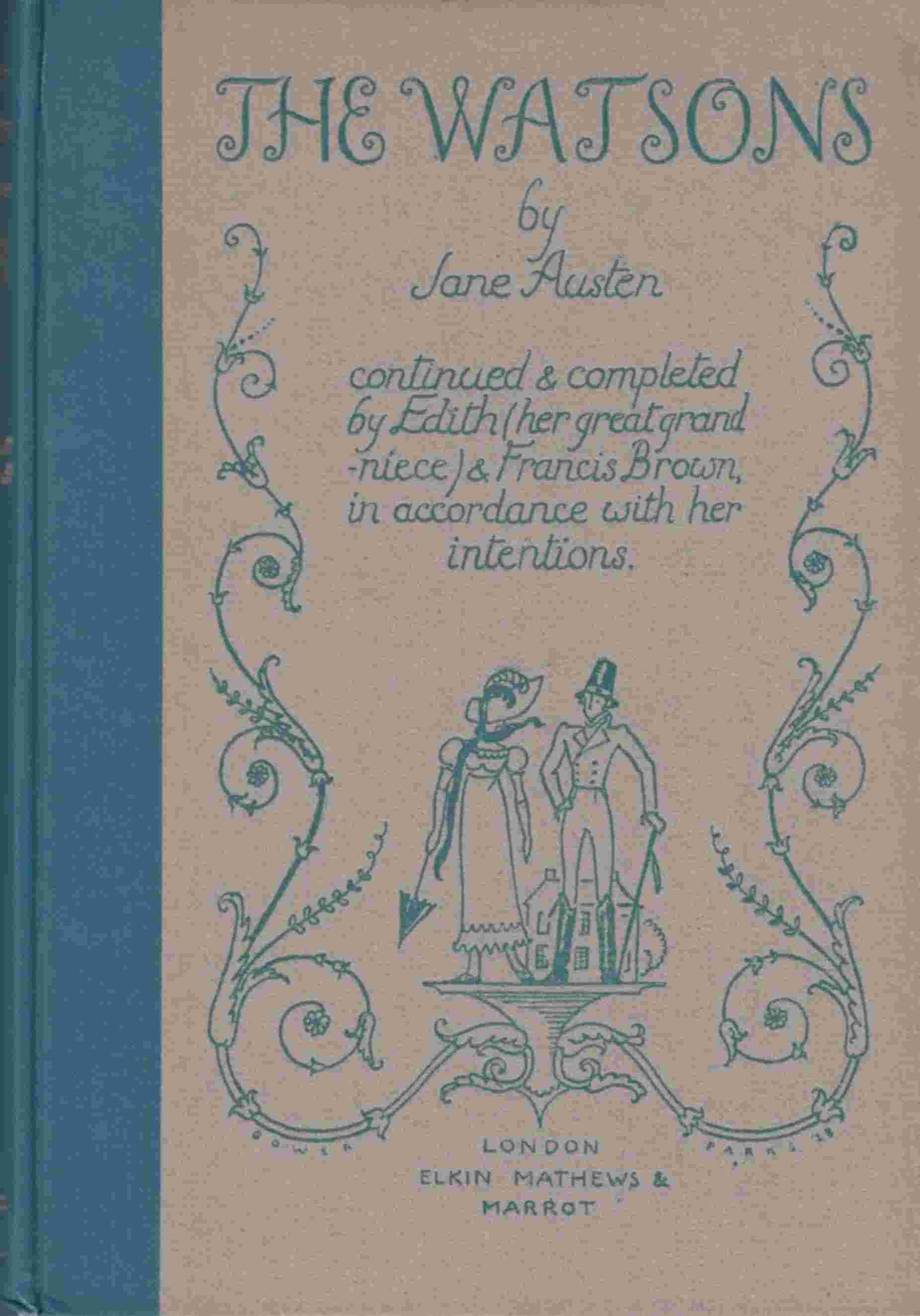
PREFACE
I will not apologise. I like my great-aunt Jane, and she would have liked me. She would have said, “I am pleased with your notion, and expect much entertainment.” Solemn people can say, if they like, that we should not do this, but I decline to be solemn about Aunt Jane. She was fun, much more than she was anything else, and this has been fun to do.
She meant to do it herself some day and told Cassandra all about it. After her death, Cassandra used to read The Watsons aloud to her nieces, and my grandmother, Mrs Hubback, was one of them. She was Catherine Austen then, the daughter of Frank, one of Jane’s sailor brothers. She was born too late to know Jane, but was a favourite with Cassandra.
Years afterwards in 1850, my grandmother wrote down from memory the story of the Watsons, and continued it, probably as she had been told Jane meant to continue it, but I think she got tired of those lines, and the story did not suit the Victorian atmosphere. This novel she called The Younger Sister.
Some years ago I took charge of a number of old family books. One day, as I was dusting them, the first volume of The Younger Sister fell out of the bookcase on to the floor, and lay there open, and as I knelt I read, and it was of Elizabeth Watson that I read. I carried the three volumes down to read them in peace by the fire. The first was Jane Austen through a haze of memory. Jane Austen incidents in the second. No connection with Jane Austen in the third. First to please ourselves, and secondly to please those who will be pleased, we have tried to disentangle Jane’s story from that of her niece.
Some people say Jane never meant to finish The Watsons and that the situation was beyond her scope. I entirely disagree. I think she had all the material to her hand. The story was there, and could only be continued in one way, and that way was barred for family reasons.
The Watsons begins with the assembly at D—— on “Tuesday the 13th of October.” I believe that to have been the date on which she began to write it. She might have made it begin on an indefinite Tuesday, or on a certain date in October, if she had been writing at another time of year, but so fixed a date as Tuesday the 13th of October is almost certainly a real one. It was in 1807 that the 13th of October was a Tuesday. What was Jane doing and feeling then?
Two years earlier her father had died. Her mother, Cassandra and herself were living at Southampton with Frank Austen and his wife. Not so long ago she had passed through Dorking, in which the scene of The Watsons is laid. The year before she and her mother had paid an unexpected visit to Stoneleigh, a very great house indeed, with a fine picture-gallery and a young heir. Here was material for Osborne Castle and its surroundings.
Why then was the novel left unfinished? I believe the reason was this. Jane was deeply devoted to her family, and quite aware that family life is a fine art. Her heroine, Emma Watson, was to lose her father and go to live with her brother and sister-in-law. But Jane had lost her father and gone to live with her brother and sister-in-law. Was it wise to write on that subject at that time? Think of the feelings involved! Again, was it possible? Those of us who have tried to write know the extraordinary difficulty of telling of anything deeply felt in the present.
I think Jane put The Watsons away because it was too near her own life, but she did not abandon it, for there it was in her desk after her death.
Of the characters, Elizabeth Watson is my special joy. Her sister Emma is not so brilliant or endearing as some of Jane’s heroines, but she is a very agreeable sensible young woman, and it is pleasant to follow her fortunes. Mr Watson is just enough like Mr Woodhouse to invite comparison, but Tom Musgrave has no parallel, and no rival. He began life in the “Letters of a young lady to her freind,” published in the volume Love and Freindship, and was brought thence unchanged to fulfil his destiny in The Watsons. Perhaps one reason for Cassandra’s love of the story was that it recalled the days when Jane was seventeen, “One of the best of ages.”
Jane Austen’s manuscript ends with Chapter X.