
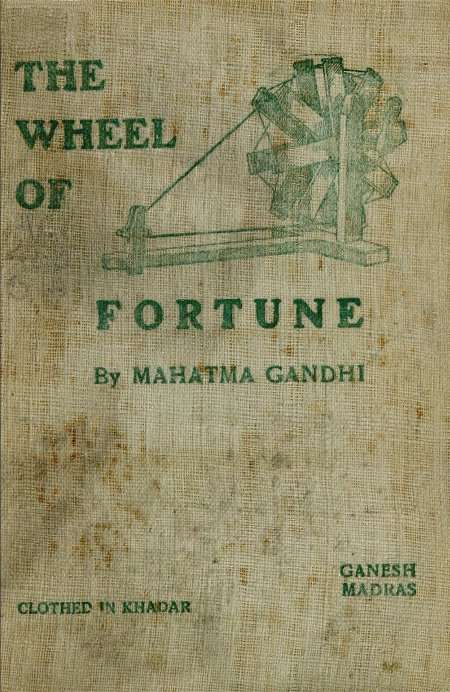
The Project Gutenberg eBook of The Wheel of Fortune
Title: The Wheel of Fortune
Author: Mahatma Gandhi
Commentator: Dvijendranatha Thakura
Release date: January 31, 2013 [eBook #41954]
Most recently updated: October 23, 2024
Language: English
Credits: Produced by sp1nd, ewkent and the Online Distributed
Proofreading Team at http://www.pgdp.net (This file was
produced from images generously made available by The
Internet Archive)
TRANSCRIBER'S NOTE:
The author often uses the South Asian numbering system where, besides the three least significant digits of the integer part, a comma divides every two rather than every three digits (for example 10,00,000 instead of 1,000,000). All corrections are underlined with a dotted line. The original text appears when hovering the cursor over the marked text. Inconsistencies in hyphenation and spelling have not been corrected. A list of corrections to the text can be found at the end of the document.
THE WHEEL OF FORTUNE
Freedom's Battle
Swaraj in One Year
Indian Home Rule
Mahatma Gandhi
His Life writings and speeches
Foreword by Mrs. Sarojini Naidu
3rd Edition. Revised and Enlarged
THE WHEEL OF FORTUNE
BY
MAHATMA GANDHI
Appreciation by
DWIJENDRANATH TAGORE
MADRAS
GANESH & CO.
1922
THE CAMBRIDGE
PRESS, MADRAS.
CONTENTS
- Page.
- Dawn of a New Era ix
- SWADESHI
- Non-Co-operation Programme 1
- Khilafat and Swadeshi 5
- The Secret of Swaraj 8
- Swadeshi 16
- Swadeshi in the Punjab 26
- Swadeshi Stores 31
- Indian Economics 34
- How to Boycott Foreign Cloth 44
- SPINNING
- The Music of the Spinning Wheel 53
- "Handlooms or Powermills?" 58
- Hand-spinning and Hand-weaving 64
- Hand-spinning again 71
- A Plea for Spinning 76
- The Duty of Spinning 80
- The Duty of Spinning 83
- The Doctrine of Charka 85
- The Message of the Charka 87
- The Charka in the Gita 93
- Spinning as Famine Relief 97
- The Potency of the Spinning Wheel 107
- The Wheel of Fortune 110
- The Spinning Wheel 116
- APPENDICES
- I. A Model Weaving-school 123
- I. Spinning Department 133
- I. The Advantage of the thin spindle 136
- I. Hand-Looms 140
- I. What Kind of Loom? 144
- I. Sizing Handspun Yarn 146
- II. The Wheel of Fortune 156
DAWN OF A NEW ERA
Many critics and some friends of Mahatma Gandhi have found fault with his desire to introduce simpler methods of spinning and weaving and to do away with much of the complicated machinery of Modern Civilisation. The reason why they object is that they fear such methods mean not progress towards a higher state but relapse into a primitive condition of civilisation or even of barbarism. His denunciation of the age of machinery and of the Industrial System has been criticised by many as the ravings of a visionary and of one who is merely an impracticable idealist. This is a strange criticism to come from those who give their allegiance to a form of civilisation or 'Culture' which has led to the unprecedented horrors of the late European War and the century-old disgraces of the Industrial System. Is this present modern civilisation so very desirable that we should wish it to continue in perpetuity? Every civilisation in the History of Man has reached a certain point after which there has been one possibility only for it and that was absolute relapse into semi-darkness in order to give place to a new and higher civilisation. The common starting point of all the civilisations is a kind of night-time. In order that the Babylonian (or Despotic) Civilisation might give way to the Roman (or Heroic), and the Roman give way to the Modern (or Intellectual) Civilisation, it was necessary for each in turn to sink completely into this common night-time. Without this entire destruction of the ancient structure, there would have been only a patchwork of the old, and not a harmonious building of the New. As Christ said: "Ye cannot put old wine into new bottles." The debris of the Past has to be cleared away in order to make way for the structure of the Future. Now with regard to Modern Civilisation, all the signs of the times show that it has failed lamentably and is gradually tottering to a dishonoured grave. Why make any attempts to prop up what Nature so evidently has decided to throw on the scrap-heap? Such attempts are contrary to the teaching of past history. But anything, which tends to reach the common roots of all civilisations, should be encouraged. In order that the spiritual civilisation of the Future may have a real chance of growing in an atmosphere congenial to it, Mahatma Gandhi's demonstration of the right path should be welcomed. His emphasis on simplicity of life and on the simplification of the machinery of living must be realised as a supremely essential condition of the coming of the new Era. In the civilisation of the Future, an Era of natural harmonious living will be inaugurated, and artificial, luxurious and pompous living will be entirely rooted out.
Simplicity of life being a condition of spiritual perfection, we may look forward to an Era of Civilisation in the Future, greatly superior to all the civilisations of the Past, if only we accept simplicity of life as the best method of living. The failure and decline of Western or Modern Civilisation need not alarm us; for the experience of History is full of similar declines of once powerful cultures. When Babylonian Civilisation had reached its height, it had to come down to what we may term the zero-point of all civilisation from which Roman Civilisation had made its start. But when Roman Civilisation had reached its zenith, it was much superior to the zenith Civilisation of Babylon, as the zenith Babylonian was superior to the zero-civilisation. And so also of full-fledged Modern Civilisation. We may say that until it returns to the common zero-point, there is no hope of a full and perfect development of a civilisation moulded by spiritual ideals.
Let critics of Mahatma Gandhi then look to History before they condemn him for trying to bring this much belauded Modern Civilisation down to the common starting point of all great civilisations. We are at the dawn of a New Era, and Mahatma Gandhi is the one leader who shows to us the right path. He at least is watering the roots, while all others who try to keep alive the Civilisation of the Western nations are like foolish gardeners who lavish water on the withering leaves of a dying tree and never think of watering its roots.
SWADESHI
THE WHEEL OF FORTUNE
BOYCOTT OF GOODS
vs.
NON-CO-OPERATION PROGRAMME
Mr. Kasturi Ranga Aiyangar was pleased to answer my argument in favour of the details of the first stage of non-co-operation that I had the honour of explaining at the great Madras Beach meeting. He expressed his dissent from all but the renunciation of titles. He suggested boycott of foreign goods in the place of the other items. Even at the risk of repeating arguments familiar to the readers of "Young India", I must deal with the question of boycott which has now received the imprimatur of so able a publicist as Mr. Kasturi Ranga Aiyangar.
In the first place, boycott of British goods has been conceived as a punishment and can have no place in non-co-operation which is conceived in a spirit of self-sacrifice and is a matter of sacred duty.
Secondly, any measure of punishment must be swift, certain and adequate for the effect intended to be produced. Resorted to by individuals, therefore, boycott is ineffectual, for, it can give no satisfaction unless it is productive of effect, whereas every act of non-co-operation is its own satisfaction.
Thirdly, boycott of British goods is thoroughly unpractical, for, it involves sacrifice of their millions by millionaires. It is in my opinion infinitely more difficult for a merchant to sacrifice his millions than for a lawyer to suspend his practice or for a title-holder to give up his title or for a parent to sacrifice, if need be, the literary instruction of his children. Add to this the important fact that merchants have only lately begun to interest themselves in politics. They are therefore yet timid and cautious. But the class, to which the first stage of non-co-operation is intended to appeal, is the political class which has devoted years to politics and is not mentally unprepared for communal sacrifice.
Boycott of British goods to be effective must be taken up by the whole country at once or not at all. It is like a siege. You can carry out a siege only when you have the requisite men and instruments of destruction. One man scratching a wall with his finger nails may hurt his fingers but will produce no effect upon the walls. One title-holder giving up his title has the supreme satisfaction of having washed his hands clean of the guilt of the donor and is unaffected by the refusal of his fellows to give up theirs. The motive of boycott being punitive lacks the inherent practicability of non-co-operation. The spirit of punishment is a sign of weakness. A strengthening of that spirit will retard the process of regeneration. The spirit of sacrifice is a determination to rid ourselves of our weakness. It is therefore an invigorating and purifying process and is therefore also calculated to do good both to us and to those who evoke the spirit of sacrifice in us. Above all, if India has a mission of her own, she will not fulfil it by copying the doubtful example of the West and making even her sacrifice materialistically utilitarian instead of offering a sacrifice spotless and pleasing even in the sight of God.
KHILAFAT AND SWADESHI
It was not without much misgiving that I consented to include Swadeshi as a plank in non-co-operation. But Maulana Hasrat Mohani by his sheer earnestness bore me down. I fear however that his reasons for including Swadeshi are different from mine. He is a protagonist of boycott of British goods, I cannot reconcile myself to the doctrine as I have explained elsewhere in this issue. But having failed to popularise boycott, Mohani Saheb has accepted Swadeshi as the lesser good. It is however necessary for me to explain how I have come to include Swadeshi in the programme of non-co-operation.
Non-co-operation is nothing but discipline in self-sacrifice. And I believe that a nation that is capable of limitless sacrifice is capable of rising to limitless heights. The purer the sacrifice the quicker the progress. Swadeshi offers every man, woman and child an occasion to make a beginning in self-sacrifice of a pure type. It therefore presents an opportunity for testing our capacity for sacrifice. It is the measure for gauging the depth of national feeling on the Khilafat wrong. Does the nation feel sufficiently to move it to go through even the preliminary process of sacrifice? Will the nation revise its taste for the Japanese silk, the Manchester calico or the French lace and find all its decoration out of hand-spun and hand-woven cloth, i.e., Khadi? If crores of people will refuse to wear or use foreign cloth and be satisfied with the simple cloth that we can produce in our homes, it will be proof of our organising ability, energy, co-operation and self-sacrifice that will enable us to secure all we need. It will be a striking demonstration of national solidarity.
Such a consummation cannot be achieved for the mere wish. It cannot be achieved by one man, no matter how capable and sincere he may be. It cannot be achieved by dotting India with Swadeshi stores. It can only be achieved by new production and judicious distribution. Production means lacs of women spinning in their own homes. This requires earnest men to be engaged in honestly distributing carded cotton and collecting yarn and paying for it. It means manufacture of thousands of spinning wheels. It means inducing the hereditary weavers to return to their noble calling and distributing home-spun yarn amongst them and selling their manufactures. It is thus only as an energising agent that I can think of Swadeshi as a plank in non-co-operation. But it is not to be despised in that capacity. And I hope that every worker for the cause, even if he can do nothing else, will have done something if he can advance Swadeshi first by increasing production and then distribution. He would be simply moving in a circle if he is satisfied with distributing cloth that is already being manufactured in India.
THE SECRET OF SWARAJ
The Congress resolution has rightly emphasised the importance of Swadeshi and the amount of greater sacrifice by merchants.
India cannot be free so long as India voluntarily encourages or tolerates the economic drain which has been going on for the past century and a half. Boycott of foreign goods means no more and no less than boycott of foreign cloth. Foreign cloth constitutes the largest drain voluntarily permitted by us. It means sixty crores of rupees annually paid by us for piece-goods. If India could make a successful effort to stop that drain, she can gain Swaraj by that one act.
India was enslaved for satisfying the greed of the foreign cloth manufacturer. When the East India Company came in, we were able to manufacture all the cloth we needed, and more for export. By processes that need not be described here, India has become practically wholly dependent upon foreign manufacture for her clothing.
But we ought not to be dependent. India has the ability to manufacture all her cloth if her children will work for it. Fortunately India has yet enough weavers to supplement the out-turn of her mills. The mills do not and cannot immediately manufacture all the cloth we want. The reader may not know that, even at the present moment, the weavers weave more cloth than the mills. But the latter weave five crore yards of fine foreign counts, equal to forty crore yards of coarser counts. The way to carry out a successful boycott of foreign cloth is to increase the out-put of yarn. And this can only be done by hand-spinning.
To bring about such a boycott, it is necessary for our merchants to stop all foreign importation, and to sell out, even at a loss, all foreign cloth already stocked in India, preferably to foreign buyers. They must cease to speculate in cotton, and keep all the cotton required for home use. They must stop purchasing all foreign cotton.
The mill-owners should work their mills not for their profits but as a national trust and therefore cease to spin finer counts, and weave only for the home market.
The householder has to revise his or her ideas of fashion and, at least for the time being, suspend the use of fine garments which are not always worn to cover the body. He should train himself to see art and beauty in the spotlessly white khaddar and to appreciate its soft unevenness. The householder must learn to use cloth as a miser uses his hoard.
And even when the householders have revised their tastes about dress, somebody will have to spin yarn for the weavers. This can only be done by every one spinning during spare hours either for love or money.
We are engaged in a spiritual war. We are not living in normal times. Normal activities are always suspended in abnormal times. And if we are out to gain Swaraj in a year's time, it means that we must concentrate upon our goal to the exclusion of every thing else. I therefore venture to suggest to the students all over India to suspend their normal studies for one year and devote their time to the manufacture of yarn by hand-spinning. It will be their greatest act of service to the motherland, and their most natural contribution to the attainment of Swaraj. During the late war our rulers attempted to turn every factory into an arsenal for turning out bullets of lead. During this war of ours, I suggest every national school and college being turned into a factory for preparing cones of yarns for the nation. The students will lose nothing by the occupation: they will gain a kingdom here and hereafter. There is a famine of cloth in India. To assist in removing this dearth is surely an act of merit. If it is sinful to use foreign yarn, it is a virtue to manufacture more Swadeshi yarn in order to enable us to cope with the want that would be created by the disuse of foreign yarn.
The obvious question asked would be, if it is so necessary to manufacture yarn, why not pay every poor person to do so? The answer is that hand spinning is not, and never was, a calling like weaving, carpentry, etc. Under the pre-British economy of India, spinning was an honourable and leisurely occupation for the women of India. It is difficult to revive the art among the women in the time at our disposal. But it is incredibly simple and easy for the school-goers to respond to the nation's call. Let no one decry the work as being derogatory to the dignity of man or students. It was an art confined to the women of India because the latter had more leisure. And being graceful, musical, and as it did not involve any great exertion, it had become the monopoly of women. But it is certainly as graceful for either sex as is music for instance. In hand-spinning is hidden the protection of women's virtue, the insurance against famine, and the cheapening of prices. In it is hidden the secret of Swaraj. The revival of hand spinning is the least penance we must do for the sin of our forefathers in having succumbed to the satanic influences of the foreign manufacturer.
The school-goers will restore hand-spinning to its respectable status. They will hasten the process of making Khaddar fashionable. For no mother, or father, worth the name will refuse to wear cloth made out of yarn spun by their children. And the scholars' practical recognition of art will compel the attention of the weavers of India. If we are to wean the Punjabi from the calling not of a soldier but of the murderer of innocent and free people of other lands, we must give back to him the occupation of weaving. The race of the peaceful Julahis of the Punjab is all but extinct. It is for the scholars of the Punjab to make it possible for the Punjabi weaver to return to his innocent calling.
I hope to show in a future issue how easy it is to introduce this change in the schools and how quickly, on these terms, we can nationalise our schools and colleges. Everywhere the students have asked me what new things I would introduce into our nationalised schools. I have invariably told them I would certainly introduce spinning. I feel, so much more clearly than ever before that during the transition period, we must devote exclusive attention to spinning and certain other things of immediate national use, so as to make up for past neglect. And the students will be better able and equipped to enter upon the new course of studies.
Do I want to put back the hand of the clock of progress? Do I want to replace the mills by hand-spinning and hand-weaving? Do I want to replace the railway by the country cart? Do I want to destroy machinery altogether? These questions have been asked by some journalists and public men. My answer is: I would not weep over the disappearance of machinery or consider it a calamity. But I have no design upon machinery as such. What I want to do at the present moment is to supplement the production of yarn and cloth through our mills, save the millions we send out of India, and distribute them in our cottages. This I cannot do unless and until the nation is prepared to devote its leisure hours to hand-spinning. To that end we must adopt the methods I have ventured to suggest for popularising spinning as a duty rather than as a means of livelihood.
SWADESHI
In criticising my article entitled 'The Music of the Spinning Wheel!' the "Leader" the other day attributed to me the ideas that I have never entertained. And it is necessary for the purpose of understanding the true value of Swadeshi, to correct some of the current fallacies. The Leader considers that I am putting back the hands of the clock of progress by attempting to replace mill-made cloth and mill-spun yarn by hand-woven and hand-spun yarn. Now, I am making no such attempt at all. I have no quarrel with the mills. My views are incredibly simple. India requires nearly 13 yards of cloth per head per year. She produces, I believe, less than half the amount. India grows all the cotton she needs. She exports several million bales of cotton to Japan and Lancashire and receives much of it back in manufactured calico although she is capable of producing all the cloth and all the yarn necessary for supplying her wants by hand-weaving and hand-spinning. India needs to supplement her main occupation, agriculture, with some other employment. Hand-spinning is the only such employment for millions. It was the national employment a century ago. It is not true to say that economic pressure and modern machinery destroyed hand-spinning and hand-weaving. This great industry was destroyed or almost destroyed by extraordinary and immoral means adopted by the East India Company. This national industry is capable of being revived by exertion and a change in the national taste without damaging the mill industry. Increase of mills is no present remedy for supplying the deficiency. The difficulty can be easily supplied only by hand-spinning and hand-weaving. If this employment were revived, it would prevent sixty million rupees from being annually drained from the country and distribute the amount among lacs of poor women in their own cottages. I therefore consider Swadeshi as an automatic, though partial, solution of the problem of India's grinding poverty. It also constitutes a ready-made insurance policy in times of scarcity of rain.
But two things are needful to bring about the needed revival—to create a taste for Khaddar and to provide an organisation for the distribution of carded cotton and collection of yarn against payment.
In one year, by the silent labour of a few men, several thousand rupees have been distributed in Gujarat among several thousand poor women who are glad enough to earn a few pice per day to buy milk for their children, etc.
The argument does not apply to the sugar industry as the "Leader" has attempted. There is not sufficient cane grown in India to supply India's wants. Sugar was never a national and supplementary industry. Foreign sugar has not supplanted Indian sugar. India's wants of sugar have grown and she therefore imports more sugar. But this importation does not institute a drain in the sense in which importation of foreign cloth does. Production of more sugar means more scientific agriculture, more and better machinery for crushing and refining. The sugar industry therefore stands on a different platform. Swadeshi in sugar is desirable, Swadeshi in cloth is an urgent necessity.
The Swadeshi propaganda has been going on in a more or less organised manner now for the past eighteen months. Some of its results are surprising and gratifying. It has taken a fairly firm hold in the Punjab, Madras and the Bombay Presidency. Hand spinning and hand-weaving are steadily increasing in these parts. Several thousand rupees have been distributed in homes where women never did any work before. And if more work of this kind has not been done, it is due to want of workers.
This is however written more to note the mistakes of the past than to sum up the bright side. My observations lead me to the conclusion that whilst the inauguration of the three vows and Swadeshi stores have greatly stimulated the Swadeshi spirit, it is no longer possible to advocate the taking of any of the three vows or the opening of new Swadeshi stores for the sale of mill-made cloth. The result of the propaganda has been to send up the prices of yarn and cloth rather than increase production. It is clear that the purpose of Swadeshi is not served until the quantity of yarn and cloth produced is increased. The gain therefore is merely moral and not material. The people have begun to perceive the desirability of wearing only Swadeshi cloth if the real interest of the country is to be advanced.
But it is clear that we must take practical steps for meeting the growing demand for Swadeshi cloth. One way, no doubt, is to increase the mills. But it is obvious that capitalists do not need popular encouragement. They know that India needs much more cloth than is manufactured by our mills. But mills do not spring up like mushrooms. It is a matter of getting machinery from outside, let alone the difficulty of getting labour. And after all, India cannot become truly and economically independent so long as she must rely on the supply of machinery from outside for the manufacture of her cloth.
The cleanest and the most popular form of Swadeshi, therefore, is to stimulate hand-spinning and hand-weaving and to arrange for a judicious distribution of yarn and cloth so manufactured. With a little talent and a little industry this thing is easy. Even as each home cooks its own food without difficulty, so may each home weave its own yarn. And just as in spite of every home having its own kitchen, restaurants continue to flourish, so will mills continue to supply our additional wants. But even as because of our private kitchens we would not starve if every restaurant was through some accident closed, so would we, by reason of domestic spinning, not have to be naked even if every mill, by a blockade from the west, had to stop work. Not long ago, we knew this secret of our own economic independence and it is possible for us to regain that independence by a little effort, a little organising agency and a little sacrifice.
Therefore true Swadeshi consists in introducing the spinning wheel in every household and every household spinning its own yarn. Many a Punjabi woman does it to-day. And though we may not supply our own cloth entirely, we shall be saving yearly crores of rupees. In any event there is no other Swadeshi than increased manufacture by hand-spinning and hand-weaving. Whether we take up hand-spinning and hand-weaving or we do not, it is at least necessary to understand what true Swadeshi is.
How to kill swadeshi—We are familiar with the official ban put upon the Khadi cap in various parts of India. In Bihar, I heard that a magistrate actually sent hawkers to sell foreign cloth. Mr. Painter of Dharwar fame has gone one better, and has issued an official circular in which he says:
"All officers subordinate to the Collector and District Magistrate are desired to take steps to make people realise, that in as much as India produces less than her population requires, a boycott of foreign cloth and its destruction or export must inevitably lead to a serious rise in prices, which may lead to a serious disorder and looting, and that these consequences will be the result, not of any action on the part of Government but of Mr. Gandhi's campaign."
In two other paragraphs means are indicated of combating the Swadeshi propaganda i.e. by holding meetings, and by dealers who are opposed to boycott attending the Collector's office at stated hours. The Madras Government have issued a still more pedantic circular. The meaning of these circulars is obvious. Pressure is to be put upon the dealers and others not to countenance boycott. The subordinate officials will take liberties which the authors of circulars may not even have contemplated. Fortunately for the country, these threats now produce little or no impression upon the public, and the Swadeshi movement will go on in the teeth of the official opposition, be it secret or open, unscrupulous or honourable.
The officials are so ignorant and obstinate, that they will not take the only effective course for avoiding the feared 'disorders and looting,' viz. making common cause with the public and stimulating production. Instead of recognising the agitation against foreign cloth as desirable and necessary, they regard it as an evil to be put down. And then it is complained, that I call a system which seeks to thwart healthy public agitation, satanic. Why should there be any dearth of indigenous cloth? Is there not enough cotton in India? Are there not enough men and women who can spin and weave? Is it not possible to manufacture all the required number of wheels in a few days? Why should not each home manufacture its own cloth, even as it cooks its own food? Is it not enough in times of famine to distribute uncooked grain among the famine-striken? Why should it not be enough to distribute raw cotton among those who need clothing? Why this hypocritical or false alarm about the dearth of cloth, when it is possible in India to manufacture enough for India's needs in a month even without the aid of the mills? The people have been purposely or ignorantly kept in the dark hitherto. They have been wrongly taught to believe, that all the cloth needed cannot be manufactured in India's homes as of yore. They have been figuratively amputated and then made to rely upon foreign or mill-made cloth. I wish the people concerned will give the only dignified answer possible to these circulars. They will forthwith burn or send out all their foreign cloth, and courageously make up their minds to spin and weave for their own requirements. It is incredibly easy for every one who is not an idler.
Y. I.—18th Aug, 1920.
SWADESHI IN THE PUNJAB
The Joint Secretaries of the Bharat Stri Maha Mandal, Punjab Branch, send a report of the Swadeshi activities of Shrimati Saraladevi Chaudhrani ever since her return to Lahore from Bombay. Miss Roy and Mrs. Roshandal, the Secretaries, state that meetings of women were held respectively on the 23rd, 24th and 25th June at three different places in Lahore. All the meetings were attended by hundreds of women who were deeply interested in what Shrimati Saraladevi had to say. The burden of her discourses was India's deep poverty. She traced the causes and proved that our poverty was primarily due to the abandonment of Swadeshi by the people. The remedy therefore lay in reverting to Swadeshi.
Saraladevi herself writes to say that her Khaddar Sari impressed her audiences more than her speeches, and her songs came next, her speeches last. The good ladies of Lahore flocked round her and felt her coarse but beautifully white Sari and admired it. Some took pity on her that she who only the other day was dressed in costly thin silk Saris now decked herself in hand-woven Swadeshi Khaddar. Saraladevi wanted no pity and retorted that their thin foreign scarves lay heavier on their shoulders with the weight of their helpless dependence on foreign manufacture whereas her coarse Khaddar lay light as a feather on her body with the joy of the knowledge that she was free because she wore garments in the manufacture of which her sisters and her brothers had laboured. This statement so pleased her audience that most of the women present resolved to discard foreign clothes. Saraladevi has now been charged by these ladies to open a shop where they could buy Swadeshi goods. She has since addressed more audiences. She spoke at the District Conference at Sialkot and to a meeting exclusively devoted to ladies numbering over one thousand. I hope that the men of Punjab will help Saraladevi in her self-imposed mission. They may harness her talents and her willingness in founding Swadeshi Sabha and organising Swadeshi propaganda on a sound basis. Both men and money are needed to make the work a success.
Swadeshi is more than reforms. There is much waste over reforms. There is none in Swadeshi. Every yard of yarn spun is so much labour well spent and so much wealth added to the national treasury. Every drop counts. Swadeshi spells first production and then distribution. Distribution without production means the raising of prices without any corresponding benefit. For to-day demand exceeds the supply. If we will not manufacture more cloth, more foreign imports must continue a painful and sinful necessity.
Punjab has a great opportunity. Punjab grows splendid cotton. The art of spinning has not yet died out. Almost every Punjabi woman knows it. This sacred haunt of the Rishis of old has thousands of weavers. Only the leaders need to have faith in their women and themselves. When Saraladevi wrote to me that she might want goods from Bombay, I felt hurt. The Punjab has all the time and all the labour and the material necessary for producing her own cloth. She has brave merchants. She has more than enough capital. She has brains. Has she the will? She can organise her own Swadeshi in less than a year, if the leaders will work at this great cause. It is playing with Swadeshi for the Punjab to have to import cloth from Bombay.
The Punjab has to right herself by putting her Swadeshi on a proper basis and by ridding herself of Messrs. Bosworth Smith and Company. She will then be both economically and politically sound. Geographically she stands at the top. She led the way in the older times. Will she again do so? Her men are virile to look at. Have they virility enough to secure without a moment's delay purity of administration? I have not strayed from Swadeshi to politics. My Swadeshi spirit makes me impatient of garments that denude India of her wealth and equally impatient of the Smiths, the O'Briens, the Shri Rams and the Maliks who denude her of her self-respect and insolently touch women's veils with their sticks, chain innocent men as if they were beasts, or shoot them from armoured cars or otherwise terrorise people into subjection.
Y. I.—7th July 1920.
SWADESHI STORES
In a previous issue I endeavoured to show how stores for the sake of selling mill-manufactures did not advance Swadeshi in any way whatsoever but on the contrary, tended to send up the price of cloth. I propose to show in this article how with a small capital, it is possible to advance true Swadeshi and earn a modest livelihood.
Suppose that there is a family consisting of husband, wife and two children one of whom is ten years old and the other five. If they have a capital of Rs. 500 they can manage a Khaddar Bhandar in a small way. They can hire, say in a place with a population of 20,000 inhabitants a shop with dwelling rooms for Rs. 10 per month. If they sell the whole of the stock at 10 p.c. profit they can have Rs. 50 per month. They have no servants. The wife and the children in their spare time would be expected to help in keeping the shop tidy and looking after it when the husband is out. The wife and children can also devote their spare time to spinning.
In the initial stages the Khaddar may not sell at the shop. In that case the husband is expected to hawk the Khaddar from door to door and popularise it. He will soon find a custom for it.
The reader must not be surprised at my suggesting 10 p.c. profits. The Khaddar Bhandars are not designed for the poorest. The use of Khaddar saves at least half the cost not necessarily because the Khaddar is more durable (though that it certainly is) but because its use revolutionises our tastes. I know what saving of money its use has meant to me. Those, who buy Khaddar from patriotic motives merely, can easily afford to pay 10 p.c. profits on Khaddar. Lastly the popularising of Khaddar means much care, devotion and labour. And the owner of a Khaddar Bhandar does not buy it at a wholesale shop but he must wander to get the best Khaddar, he must meet the local weavers and induce them to weave hand spun yarn. He must stimulate in his own district hand spinning among its women. He must come in touch with the carders and get them to card cotton. All this means intelligence, organisation and great ability. A man who can exhibit these qualities has a right to take 10 p.c. profits. And a Swadeshi Bhandar conducted on these lines becomes a true centre of Swadeshi activity. I commend my remarks to the attention of the managers of Swadeshi stores that are already in existence. They may not revolutionise their method at once but I have no doubt that they will advance Swadeshi only to the extent that they sell Khaddar.
Y. I.—7th July, 1920.
INDIAN ECONOMICS
A friend has placed in my hands a bulletin on Indian Piece Goods Trade prepared by Mr. A. C. Coubrough C. B. E. by order of the Government of India. It contains the following prefatory note: 'The Government of India desire it to be understood that the statements made and the views expressed in this bulletin are those of the author himself.' If so, why has the Government of India burdened the tax-payer with the expense of such bulletins? The one before me is 16th in the series. Do they publish both the sides of the question?
The bulletin under review is intended to be an answer to the Swadeshi movement. It is an elaborate note containing a number of charts showing the condition of imports and home manufacture of piece goods including hand-woven. But it does not assist the reader in studying the movement. The painstaking author has bestowed no pains upon a study of the present movement or its scope. That the Government of India treats the greatest constructive and co-operative movement in the country with supreme contempt and devotes people's money to a vain refutation instead of a sympathetic study and treatment is perhaps the best condemnation that can be pronounced upon the system under which it is carried.
The author's argument is:
(1) The movement if successful will act not as a protective but a prohibitive tariff.
(2) This must result in merely enriching the Indian capitalist and punishing the consumer.
(3) The imports are non-competitive in that the bulk of the kind of piece goods imported are not manufactured in India.
(4) The result of boycotting such piece goods must be high prices without corresponding benefit.
(5) The boycott therefore being against the law of supply and demand and against the consumer must fail in the end.
(6) The destruction of hand spinning which I have deplored is due to natural causes, viz. the invention of time-saving appliances and was therefore inevitable.
(7) The Indian farmer is responsible for his own ruin in that he has indolently neglected cotton culture which was once so good.
(8) The best service I can render is therefore to induce the agriculturist to improve the quality of cotton.
(9) The author concludes, 'If instead of filling homes with useless Charkhas he were to start a propaganda for the more intensive cultivation of cotton and particularly for the production of longer staple cotton, his influence would be felt not only at the present day but for many generations to come.'
The reader will thus see, that what I regard as the supreme necessity for the economical salvation of India, the author considers to be rank folly. There is therefore no meeting ground here. And in spite of the prefatory note of the Government of India reproduced by me, the author does represent the Government attitude. I have invited them and the co-operators definitely to make common cause with the people in this movement at any rate. They may not mind its political implications because they do not believe in them. And surely they need not feel sorry if contrary to their expectation, the rise of the Charkha results in an increase in the political power of the people. Instead of waging war against Khadi, they might have popularised its use and disarmed the terrible suspicion they labour under of wishing to benefit the foreign manufacturer at the expense of the Indian cultivator. My invitation is open for all time. I prophesy that whatever happens to the other parts of the national programme, Swadeshi in its present shape will bide for ever and must if India's pauperism is to be banished.
Even though I am a layman, I make bold to say that the so-called laws laid down in books on economics are not immutable like the laws of Medes and Persians, nor are they universal. The economics of England are different from those of Germany. Germany enriched herself by bounty-fed beet sugar. England enriched herself by exploiting foreign markets. What was possible for a compact area is not possible for an area 1,900 miles long and 1,500 broad. The economics of a nation are determined by its climatic, geological and temperamental conditions. The Indian conditions are different from the English in all these essentials. What is meat for England is in many cases poison for India. Beef tea in the English climate may be good, it is poison for the hot climate of religious India. Fiery whisky in the north of the British Isles may be a necessity, it renders an Indian unfit for work or society. Fur-coats in Scotland are indispensable, they will be an intolerable burden in India. Free trade for a country which has become industrial, whose population can and does live in cities, whose people do not mind preying upon other nations and therefore sustain the biggest navy to protect their unnatural commerce, may be economically sound (though as the reader perceives, I question its morality). Free trade for India has proved her curse and held her in bondage.
And now for Mr. Coubrough's propositions.
(1) The movement is intended to serve the purpose of a voluntary prohibitive tariff.
(2) But it is so conceived as neither unduly to benefit the capitalist nor to injure the consumer. During the very brief transition stage the prices of home manufactures may be, as they are, inflated. But the rise can only be temporary as the vast majority of consumers must become their own manufacturers. This cottage manufacture of yarn and cloth cannot be expensive even as domestic cookery is not expensive and cannot be replaced by hotel cookery. Over twenty-five crores of the population will be doing their own hand-spinning and having yarn thus manufactured woven in neighbouring localities. This population is rooted to the soil and has at least four months in the year to remain idle.
If they spin during those hours and have the yarn woven and wear it, no mill-made cloth can compete with their Khadi. The cloth thus manufactured will be the cheapest possible for them. If the rest of the population did not take part in the process, it could easily be supplied out of the surplus manufactured by the twenty-five crores.
(3) It is true that non-competitive imports are larger than those that compete with the manufactures of Indian mills. In the scheme proposed by me the question does not arise, because the central idea is not so much to carry on a commercial war against foreign countries as to utilise the idle hours of the nation and thus by natural processes to help it to get rid of her growing pauperism.
(4) I have already shown that the result of boycott cannot in the end be a rise in the price of cloth.
(5) The proposed boycott is not against the law of supply and demand, because it does away with the law by manufacturing enough for the supply. The movement does require a change of taste on the part of those who have adopted finer variety and who patronise fantastic combinations of colours and designs.
(6) I have shown in these pages, that the destruction of hand-spinning was designed and carried out in a most inhuman manner by the agents of the East India Company. No amount of appliances would ever have displaced this national art and industry but for this artificial and systematically cruel manner of carrying out the destruction.
(7) I am unable to hold the Indian farmer responsible for the deterioration in cotton culture. The whole incentive was taken away when hand-spinning was destroyed. The State never cared for the cultivator.
(8) My activity, I am proud to think, has already turned the cultivator's attention to the improvement of cotton. The artistic sense of the nation will insist on fine counts for which long staple is a necessity. Cotton culture by itself cannot solve the problem of India's poverty. For it will still leave the question of enforced idleness untouched.
(9) I therefore claim for the Charkha the honour of being able to solve the problem of economic distress in a most natural, simple, unexpensive and business-like manner. The Charkha, therefore, is not only not useless as the writer ignorantly suggests, but it is a useful and indispensable article for every home. It is the symbol of the nation's prosperity and therefore, freedom. It is a symbol not of commercial war but of commercial peace. It bears not a message of ill-will towards the nations of the earth but of good-will and self-help. It will not need the protection of a navy threatening a world's peace and exploiting its resources, but it needs the religious determination of millions to spin their yarn in their own homes as to-day they cook their food in their own homes. I may deserve the curses of posterity for many mistakes of omission and commission but I am confident of earning its blessings for suggesting a revival of the Charkha. I stake my all on it. For every revolution of the wheel spins peace, good-will and love. And with all that, inasmuch as the loss of it brought about India's slavery, its voluntary revival with all its implications must mean India's freedom.
Y. I.—8th Dec. 1921.
HOW TO BOYCOTT FOREIGN CLOTH
It is needless to say at this time of the day, that the proposed boycott of foreign cloth is not a vindictive measure, but is as necessary for national existence as breath is for life. The quicker, therefore, it can be brought about, the better for the country. Without it, Swaraj cannot be established or retained after establishment. It is of the highest importance to know how it can be brought about even before the first day of August next.
To arrive at the boycott quickly, it is necessary (1) for the mill-owners to regulate their profits and to manufacture principally for the Indian market, (2) for importers to cease to buy foreign goods. A beginning has already been made by three principal merchants, (3) for the consumers to refuse to buy any foreign cloth and to buy Khadi wherever possible, (4) for the consumers to wear only Khadi cloth, mill cloth being retained for the poor who do not know the distinction between Swadeshi and Pardeshi, (5) for the consumers to use, till Swaraj is established and Khadi manufacture increased, Khadi just enough for covering the body, (6) for the consumers to destroy Pardeshi cloth, as they would destroy intoxicating liquors on taking the vow of abstinence, or to sell it for use abroad, or to wear it out for all dirty work or during private hours.
It is to be hoped that all the parties referred to in the foregoing clauses will respond well and simultaneously. But in the end success depends upon the persistent determination of the consumer. He has simply to decline to wear the badge of his slavery.
Abusing the khaddar—A friend draws attention to the fact that many who have adopted the khaddar costume are using it as a passport for arrogance, insolence, and, what is worse, fraud. He says that they have neither the spirit of non-co-operation in them nor the spirit of truth. They simply use the khaddar dress as a cloak for their deceit. All this is likely, especially during the transition stage, i.e., whilst khaddar is beginning to become fashionable. I would only suggest to my correspondent that such abuse of khaddar must not even unconsciously be allowed to be used as an argument against its use. Its use to-day is obligatory on those who believe that there is not sufficient Indian mill-made cloth to supply the wants of the nation, that the wants must be supplied in the quickest way possible by increasing home manufacture, and that such manufacture is possible only by making home-spinning universal. The use of khaddar represents nothing more than a most practical recognition of the greatest economic necessity of the country. Even a scoundrel may recognise this necessity, and has therefore a perfect right to wear it. And if a Government spy wore it to deceive people, I would welcome his use of khaddar as so much economic gain to the country. Only I would not give the wearer of the khaddar more than his due. And I would therefore not ascribe to him any piety or special virtue. It follows, therefore, that co-operationists or government servants may wear khaddar without incurring the danger of being mistaken for non-co-operationists. We may no more shun khaddar, than a devout church-goer may renounce his church because bad characters go to it for duping gullible people. I recall the name of an M. P. who successfully cloaked many of his vices by pretending to be a staunch temperance man. Not very long ago a bold and unscrupulous speculator found entry into most respectable circles by becoming a temperance advocate. Well has a poet said that 'hypocricy is an ode to virtue.'
Some 'ifs'—If you are a weaver feeling for the country, the Khilafat and the Punjab,
(1) You should weave only hand-spun yarn, and charge so as to give you a living. You should overcome all the difficulties of sizing and adjusting your loom to the requirements of coarse yarn.
(2) If you cannot possibly tackle hand-spun yarn for warp, you must use Indian mill-spun yarn for it and use hand-spun for woof.
(3) Where even the second alternative is not possible, you should use mill-spun yarn for both warp and woof.
But you should henceforth cease to use any foreign yarn, whether it is silk or cotton.
If you are a Congress official or worker, you should get hold of the weavers within your jurisdiction, and place the foregoing propositions before them for acceptance and help them to the best of your ability.
If you are a buyer, insist upon the first class of cloth, but if you have not the sense or the courage to do so, take up the second or the third, but on no account purchase foreign cloth or cloth woven in India but made of foreign yarn.
If you are a householder,
(1) You should make a fixed determination henceforth not to buy any foreign cloth.
(2) You should interview the weaver in your neighbourhood, and get him to weave for you enough khadi out of home-spun and failing that to weave out of Indian mill-spun yarn.
(3) You should deliver to the Congress Committee all your foreign cloth for destruction or sending to Smyrna or elsewhere outside India.
(4) If you have not the courage to give up your foreign cloth, you may wear it out at home for all dirty work, but never go out in foreign cloth.
(5) If you have any leisure, you should devote it to learning the art of spinning even, properly-twisted yarn for the sake of the nation.
If you are a schoolboy or schoolgirl, you should consider it a sin to receive literary training, before you have spun, carded or woven for the nation for at least four hours per day till the establishment of Swaraj.
Y. I.—6th July 1921.
SPINNING
THE MUSIC OF THE SPINNING WHEEL
Slowly but surely the music of perhaps the most ancient machine of India is once more permeating society. Pandit Malaviyaji has stated that he is not going to be satisfied until the Ranis and the Maharanis of India spin yarn for the nation, and the Ranas and the Maharanas sit behind the handlooms and weave cloth for the nation. They have the example of Aurangzeb who made his own caps. A greater emperor—Kabir—was himself a weaver and has immortalised the art in his poems. The queens of Europe, before Europe was caught in Satan's trap, spun yarn and considered it a noble calling. The very words, spinster and wife, prove the ancient dignity of the art of spinning and weaving. 'When Adam delved and Eve span, who was then a gentleman,' also reminds one of the same fact. Well may Panditji hope to persuade the royalty of India to return to the ancient calling of this sacred land of ours. Not on the clatter of arms depends the revival of her prosperity and true independence. It depends most largely upon re-introduction, in every home, of the music of the spinning wheel. It gives sweeter music and is more profitable than the execrable harmonium, concertina and the accordian.
Whilst Panditji is endeavouring in his inimitably suave manner to persuade the Indian royalty to take up the spinning wheel, Shrimati Sarala Devi Chaudhrani, who is herself a member of the Indian nobility, has learnt the art and has thrown herself heart and soul into the movement. From all the accounts received from her and others, Swadeshi has become a passion with her. She says she feels uncomfortable in her muslin saris and is content to wear her khaddar saris even in the hot weather. Her khaddar saris continue to preach true Swadeshi more eloquently than her tongue. She has spoken to audiences in Amritsar, Ludhiana and elsewhere and has succeeded in enlisting the services, for her Spinning Committee at Amritsar, of Mrs. Ratanchand and Bugga Chowdhry and the famous Ratan Devi who during the frightful night of the 13th April despite the Curfew Order of General Dyer sat, all alone in the midst of the hundreds of the dead and dying, with her dead husband's cold head in her lap. I venture to tender my congratulations to these ladies. May they find solace in the music of the spinning wheel and in the thought that they are doing national work. I hope that the other ladies of Amritsar will help Sarala Devi in her efforts and that the men of Amritsar will realise their own duty in the matter.
In Bombay the readers are aware that ladies of noted families have already taken up spinning. Their ranks have been joined by Dr. Mrs. Manekbai Bahudarji who has already learnt the art and who is now trying to introduce it in the Sevasadan. Her Highness the Begum Saheba of Janjira and her sister Mrs. Atia Begum Rahiman, have also undertaken to learn the art. I trust that these good ladies will, having learnt spinning, religiously contribute to the nation their daily quota of yarn.
I know that there are friends who laugh at this attempt to revive this great art. They remind me that in these days of mills, sewing machines or typewriters, only a lunatic can hope to succeed in reviving the rusticated spinning wheel. These friends forget that the needle has not yet given place to the sewing machine nor has the hand lost its cunning in spite of the typewriter. There is not the slightest reason why the spinning wheel may not co-exist with the spinning mill even as the domestic kitchen co-exists with the hotels. Indeed typewriters and sewing machines may go, but the needle and the reed pen will survive. The mills may suffer destruction. The spinning wheel is a national necessity. I would ask sceptics to go to the many poor homes where the spinning wheel is again supplementing their slender resources and ask the inmates whether the spinning wheel has not brought joy to their homes.
Thank God, the reward issued by Mr. Rewashanker Jagjiwanagjiwan bids fair to bear fruit. In a short time India will possess a renovated spinning wheel—a wonderful invention of a patient Deccan artisan. It is made out of simple materials. There is no great complication about it. It will be cheap and capable of being easily mended. It will give more yarn than the ordinary wheel and is capable of being worked by a five years old boy or girl. But whether the new machine proves what it claims to be or it does not, I feel convinced that the revival of hand-spinning and hand-weaving will make the largest contribution to the economic and the moral regeneration of India. The millions must have a simple industry to supplement agriculture. Spinning was the cottage industry years ago and if the millions are to be saved from starvation, they must be enabled to reintroduce spinning in their homes, and every village must repossess its own weaver.
Y. I.—21st July 1920.
"HANDLOOMS OR POWERMILLS?"
Whenever an attempt has been made, as it is being made to-day, to encourage the use and production of hand-spun and hand-woven cloth, many have looked askance whether it is intended in this age of mechanical industrialism to supplant the latter by medieval handlooms. The issue is placed between the hand power and the power mill. A correspondent of the Janmabhumi falls into this common error. Apparently agitated at the idea of reviving the home industries, he exclaims, "The real question for consideration with us or with any people to-day is not whether the handloom will or will not be able to hold its own against the power loom, or whether it cannot feed millions of families or clothe millions more in home-made dress; but which will contribute to the economic and political power of a nation or country, whether it is the handloom or the power-mill? Handicrafts or machine industries—that is the real issue."
It is not quite clear from the above what the notions of the correspondent are about the economic and political power of this country. We cannot imagine him to seriously believe—though his argument runs as if he does—that that power can be achieved without feeding and clothing the millions of our half-starving and half-naked men, women and children. The political and economic power of a nation depends even in this "age of mechanical industrialism," not on its powerful machines but on its powerful men. Germany was equipped with the best and most powerful and modern machinery, but it failed because at the last moment the power of its nation failed. We want to organise our national power. This can be done not by adopting the best methods of production only but by the best method of both the production and the distribution. Production that is the manufacture of cloth in this particular instance can be brought about in two ways; (1) by establishing new mills and increasing the output or producing capacity of each mill and (2) by increasing the number of hand-looms and improving them. All these activities can go together. The notion of a competition between the hand-loom and the power mill has been shown by such an eminent economist as Prof. Radha Kamal Mukerjea to be "altogether wrong." Says Mr. Mukerjea in his Foundations of Indian Economics:
"The hand-loom does not compete with the mill, it supplements it in the following way:
(1) It produces special kinds of goods which cannot be woven in the mills.
(2) It utilizes yarn below and above certain counts which cannot at present be used on the power-mill.
(3) It will consume the surplus stock of Indian spinning mills which need not then be sent out of the country.
(4) Being mainly a village-industry, it supplies the local demand, at the same time gives employment to small capitalists, weavers and other village workmen and
(5) lastly it will supply the long-felt want of, and honest field of, work and livelihood for educated Indians."
But even this is not all that can be said in favour of hand-loom industry. Mill industry no doubt can be a powerful aid to the promotion of Swadeshi. But apart from the bitter struggle, strife and demoralisation of the capitalist and the workman (as explained by the eminent scholar, administrator and economist, the late Mr. Romesh Chundra Dutt) it has led to, the question is: Can it solve the problem which pure Swadeshi is designed and sought to do and which arises only because of its abandonment? Every writer of note on the industries of India, whatever his ideas and conclusions about the future of Indian Industrialism may be, has shown that there was a time and that was even till the Early British Rule in India—where spinning and weaving, only next to agriculture, were the great national industries of India, when all the cotton was spun by hand and every portion of the work was done by the farming population which augmented its resources by spinning and weaving. Mr. Dutt has given extracts from the statistical observations of Dr. Francis Buchanan's economic enquiries in Southern and Northern India, conducted between 1798 and 1814. They show how many hundreds of thousands of our men, women and children worked on this industry—mostly in their leisure time—each day and earned crores of rupees annually.
How our home-industries came to the sad plight they are in to-day is an open secret, admitted by all authorities and need not be repeated here. Suffice it to say that the problem to-day is not to bring about that political and economic re-organisation of our country, which disturbs the West to-day—an organisation which has led to the breaking up of the society by ceaseless struggles, bitterness and rupture between Capital and Labour. We want to work out the real political and economic regeneration of the country by Swadeshi. And the problem of the Swadeshi is the problem of 80 per cent. of our population who spend more than six months of the year in enforced idleness, eking, throughout the year, a miserable, half-starving and half-naked existence. We must find out suitable work for them during their idle hours. We must make them a real asset and power to the nation. Pure Swadeshi alone can do it.
Y. I.—28th July 1920.