
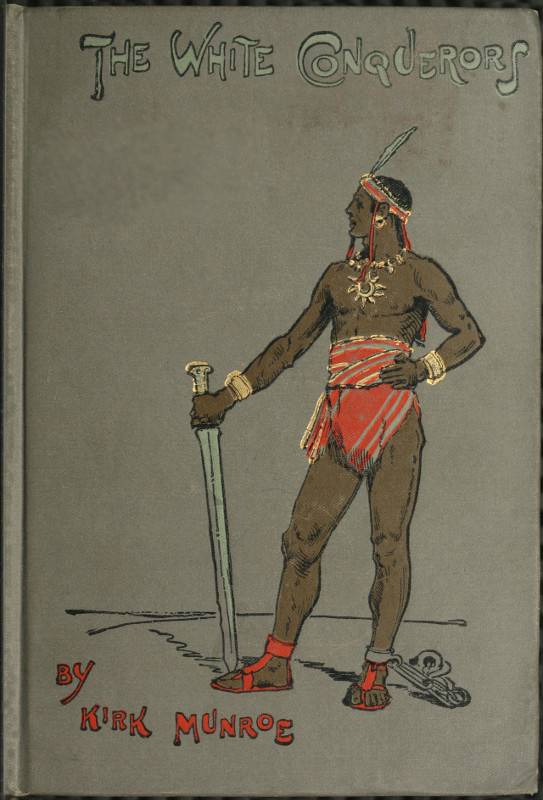
The Project Gutenberg eBook of The White Conquerors: A Tale of Toltec and Aztec
Title: The White Conquerors: A Tale of Toltec and Aztec
Author: Kirk Munroe
Illustrator: W. S. Stacey
Release date: December 29, 2014 [eBook #47810]
Most recently updated: October 24, 2024
Language: English
Credits: Produced by Shirley McAleer, Shaun Pinder and the Online
Distributed Proofreading Team at http://www.pgdp.net (This
file was produced from images generously made available
by The Internet Archive)
THE WHITE CONQUERORS
| BOOKS BY KIRK MUNROE PUBLISHED BY CHARLES SCRIBNER'S SONS |
|
| A SON OF SATSUMA | |
| Illustrated. 12mo | net $1.00 |
| BRETHREN OF THE COAST | |
| Illustrated. 12mo | 1.25 |
| MIDSHIPMAN STUART | |
| Illustrated. 12mo | 1.25 |
| IN PIRATE WATERS | |
| Illustrated. 12mo | 1.25 |
| WHITE CONQUEROR SERIES | |
| WITH CROCKETT AND BOWIE | |
| Illustrated. 12mo | 1.25 |
| THROUGH SWAMP AND GLADE | |
| Illustrated. 12mo | 1.25 |
| AT WAR WITH PONTIAC | |
| Illustrated. 12mo | 1.25 |
| THE WHITE CONQUERORS | |
| Illustrated. 12mo | 1.25 |
| The Set, 4 volumes, in a box, $5.00 | |
THE WHITE CONQUERORS
A TALE OF TOLTEC AND AZTEC
BY
KIRK MUNROE
AUTHOR OF "WAKULLA," "THE FLAMINGO FEATHER," "DERRICK STERLING,"
"THE GOLDEN DAYS OF '49," THE "MATE" SERIES, ETC.
ILLUSTRATED BY W. S. STACEY
NEW YORK
CHARLES SCRIBNER'S SONS
1908
Copyright, 1893, by
CHARLES SCRIBNER'S SONS
TABLE OF CONTENTS
| CHAPTER | PAGE | |
|---|---|---|
| I. | A Captive Warrior, | 1 |
| II. | "Remember that Thou Art a Toltec!" | 9 |
| III. | In the Market-place of Tenochtitlan, | 17 |
| IV. | Tlahuicol's Last Battle, | 25 |
| V. | Huetzin's Miraculous Escape, | 33 |
| VI. | Two Slaves of Iztapalapan, | 41 |
| VII. | Loyalty Outweighs Gold and Freedom, | 48 |
| VIII. | Trapping a King's Courier, | 56 |
| IX. | Who are the White Conquerors? | 64 |
| X. | The Sign of the God of the Four Winds, | 73 |
| XI. | How the Tlascalans Fought, | 82 |
| XII. | A Son of the House of Titcala, | 90 |
| XIII. | How Peace was Brought About, | 99 |
| XIV. | A Challenge and Its Result, | 108 |
| XV. | Marching on Cholula, | 116 |
| XVI. | A Sacrifice of Children and What It Portended, | 125 |
| XVII. | Punishment of the Conspirators, | 133 |
| XVIII. | First Glimpse of the Mexican Valley, | 141 |
| XIX. | Montezuma Welcomes the Conquerors to Tenochtitlan, | 149 |
| XX. | Huetzin in the Power of the Chief Priest, | 158 |
| XXI. | A Superstitious King, | 166 |
| XXII. | Sandoval Plights his Troth, | 174 |
| XXIII. | In the Passages Beneath the Temple, | 182 |
| XXIV. | Montezuma is Made Prisoner, | 190 |
| XXV. | Cortes Captures and Enlists the Army of his Rival, | 198 |
| XXVI. | Tiata's Brave Death and Sandoval's Grief, | 206 |
| XXVII. | The Conquerors are Besieged in Their Quarters, | 213 |
| XXVIII. | A Battle in Mid-air, | 221 |
| XXIX. | The Glorious Triumph of Tlalco, | 228 |
| XXX. | Montezuma's Successor Defies the Conquerors, | 236 |
| XXXI. | The Retreat from Tenochtitlan, | 244 |
| XXXII. | A Night of Fighting, Despair, and Death, | 253 |
| XXXIII. | Marina is Lost and Saved, | 261 |
| XXXIV. | Sorrow Turned into Joy, and Darkness into Light, | 270 |
| XXXV. | The Desperate Battle of Otampan, | 278 |
| XXXVI. | Victory Snatched from Defeat, | 286 |
| XXXVII. | Once More in the Mexican Valley, | 293 |
| XXXVIII. | Launching the First American Warships, | 302 |
| XXXIX. | Alderete's Fatal Error, | 310 |
| XL. | Final Overthrow of the Aztec Gods, | 319 |
LIST OF ILLUSTRATIONS
| PAGE | |
|---|---|
| I Will Never Forget, | Frontispiece |
| Huetzin Wasted no Time, | 62 |
| The Blind Chieftain Placed His Hands, Etc., | 122 |
| The Figure of Topil the Chief Priest, | 170 |
| Sandoval Meets Tiata, | 176 |
| Sandoval Pulled up His Head, | 236 |
| Marina is Saved by the Tlascala Slaves, | 268 |
| This They Dragged from Its Pedestal, | 310 |
THE WHITE CONQUERORS:
A TALE OF TOLTEC AND AZTEC
CHAPTER I.
A CAPTIVE WARRIOR
Night had fallen on the island-city of Tenochtitlan, the capital of Anahuac, and the splendid metropolis of the Western world. The evening air was heavy with the scent of myriads of flowers which the Aztec people loved so well, and which their religion bade them cultivate in lavish profusion. From every quarter came the sounds of feasting, of laughter, and of music. The numerous canals of salt-water from the broad lake that washed the foundations of the city on all sides, were alive with darting canoes filled with gay parties of light-hearted revellers. In each canoe burned a torch of sweet-scented wood, that danced and flickered with the motions of the frail craft, its reflection broken by the ripples from hundreds of dipping paddles. Even far out on the placid bosom of the lake, amid the fairy-like chinampas, or tiny floating islands, the twinkling canoe-lights flitted like gorgeous fire-flies, paling the silver reflection of the stars with their more ruddy glow.
In the streets of the city the dancing feet of flower-wreathed youths and maidens tripped noiselessly over the smooth cemented pavements; while their elders watched them, with approving smiles, from their curtained doorways, or the flat flower-gardened roofs, of their houses. Above all these scenes of peaceful merriment rose the gloomy pyramids of many temples, ever-present reminders of the cruel and bloody religion with which the whole fair land was cursed.
Before the hideous idols, to which each of these was consecrated, lay offerings of human hearts, torn from the living bodies of that day's victims, and from the summit of each streamed the lurid flames of never-dying altar fires. By night and day they burned, supplied with fuel by an army of slaves who brought it on their backs over the long causeways that connected the island-city with the mainland and its distant forests. These pillars of smoke by day, and ill-omened banners of flame by night, were regarded with fear and hatred by many a dweller in the mountains surrounding the Mexican valley. They were the symbols of a power against which these had struggled in vain, of a tyranny so oppressive that it not only devoted them to lives of toil, hopeless of reward, but to deaths of ignominy and torture whenever fresh victims were demanded for its reeking altars. But while hatred thus burned, fierce and deep-seated, none dared openly to express it, for the power of the all-conquering Aztec was supreme. Far across the lofty mountains, to the great Mexican Gulf on the east, and westward to the broad Pacific; from the parched deserts of the cliff-dwelling tribes on the north, to the impenetrable Mayan forests on the south, the Aztec sway extended, and none might withstand the Aztec arms. If the imperial city demanded tribute it must be promptly given, though nakedness and hunger should result. If its priests demanded victims for their blood-stained altars, these must be yielded without a murmur, that the lives of whole tribes might not be sacrificed. Only one little mountain republic still held out, and defied the armies of the Aztec king, but of it we shall learn more hereafter.
So the mighty city of the lake drew to itself the best of all things from all quarters of the Western world, and was filled to overflowing with the wealth of conquered peoples. Hither came all the gold and silver and precious stones, the richest fabrics, and the first-fruits of the soil. To its markets were driven long caravans of slaves, captured from distant provinces, and condemned to perform such menial tasks as the haughty Aztec disdained to undertake.
During the brilliant reign of the last Montezuma, the royal city attained the summit of its greatness, and defied the world. Blinded by the glitter of its conquests, and secure in the protection of its invincible gods, it feared naught in the future, for what enemy could harm it?
The evening with which this story opens was one of unusual rejoicing in Tenochtitlan, for the morrow was to mark one of the most notable events of Montezuma's reign. The great Aztec calendar stone, the result of years of ceaseless labor, had at length reached the inner court of the principal temple. On the following day it was to be bathed in the blood of victims, and dedicated by the priests. This huge mass of shining porphyry, weighing more than fifty tons, and quarried from the distant mountains beyond the lake of Chalco, had been subjected to the unremitting labors of the most famous astronomers and skilled artisans for so long, that the king had almost despaired of living to witness its completion. Finally, polished like a mirror and cunningly engraved with a countless but orderly array of hieroglyphics, it started on its journey to the city, drawn by the united efforts of ten thousand slaves. Inch by inch, slowly and painfully, costing a thousand lives for every mile of progress, it traversed leagues of rugged country. Even on the great causeway, when it had nearly reached its destination, where the iron-wood rollers ran smoothly and all difficulties seemed at an end, it had broken through a bridge and plunged into the lake, crushing a score of human beings beneath it. With infinite toil and human suffering it had been recovered from the waters, and, as the straining slaves cringed under the biting lashes of their drivers, its triumphal progress was resumed.
At length the huge stone had reached the end of its weary journey, and the morrow was to witness the closing scenes of this great national undertaking. The feasting had already been kept up for a week, or ever since the mighty monolith entered the city. Scores of victims had been sacrificed on the temple altars to insure the favor of the gods during those last days of its progress. But all this was as nothing compared with what would be witnessed on the morrow. For that day the bravest warriors taken in battle had been reserved, and the most beautiful captives. The former would be made to fight against each other under false promises that the lives of the victors should be spared. The latter—handsome youths, delicate maidens, and even little children—would dance a dance of death with wild beasts and deadly serpents, many cages of which had been brought from distant parts for the purpose. Oh! it was truly to be a rare and enjoyable festival, and the hearts of the dwellers in Tenochtitlan thrilled high in anticipation of its pleasures.
And yet, despite the universal joy that reigned in every quarter of the crowded city, it contained at least two hearts that were heavy with the forebodings of sorrow. One was that of its mighty ruler, the priest-warrior, Montezuma, and the other beat in the breast of one even more redoubtable as a warrior than the king himself, who, as a captive, was destined to fight for his life against overwhelming odds on the morrow.
In all that land of warriors there was none so famed as Tlahuicol. To all men he was known as the Tlascalan; but ever to himself and to Huetzin, his son, he whispered that he was Tlahuicol the Toltec. For years he had been the dreaded war-chief of the dauntless little mountain republic of Tlascala, which, alone of all those now occupying the land of Anahuac, had resisted the all-conquering Aztec arms, and retained its freedom. In spite of this he was not a Tlascalan, but had joined them in one of their times of sorest need, when it seemed as though their surrender to the swarming legions of Montezuma was inevitable. Their army had been defeated, its leaders killed or taken captive, and another day must have witnessed the overthrow of the republic. That night Tlahuicol appeared among them, a young warrior in the first flush of manhood, and addressed them with such fervid eloquence that their sinking spirits were again inflamed, and they gathered courage for one more desperate effort.
In the morning the young stranger led them to an attack against the Aztecs, whose vigilance was relaxed in anticipation of an easy triumph over their enemies. So marvellous was his strength, so admirable his skill, and so reckless his bravery, that the signal victory gained by the Tlascalans that day was afterward said to have been won by Tlahuicol alone. In their excess of gratitude and admiration his brave, but superstitious, followers hailed him as a god, declaring that never in mortal were combined the qualities shown by him that day. From that time forth the fortunes of this stranger were linked with those of the Tlascalans, and all the honors at the disposal of the simple republic were showered upon him. The position of war-chief was accorded to him without question, and for more than a score of years he led his hardy mountaineers to victory in every battle that they fought against the cruel Aztecs. Very early in his new career he was wedded to a beautiful Tlascalan maiden, an only daughter of the noble house of Titcala, the chief of which was the acknowledged head of the republic. The fruits of this marriage were two children: Huetzin, who inherited his father's indomitable bravery, and Tiata, who, even as a child, gave promise that all of her mother's great beauty was to be hers.
As the years rolled on Tlahuicol lost none of his popularity with his troops nor with the people at large; only with the priests was he ever at enmity. He abhorred their bloody human sacrifices, and strove by every means in his power to have them abated. In return, the priests continually strove for his overthrow and to wean the affections of his soldiers from him. For many years their efforts were in vain, but finally their subtle craft gained them a few malcontent adherents. In the very heat of a fierce battle with an Aztec army, commanded by Montezuma in person, a cowardly blow, struck from behind, stretched the Tlascalan war-chief senseless on the ground. When he recovered consciousness he was a prisoner and being hurried toward the Aztec capital. Thither his devoted wife and her children followed him, resigning themselves to a willing captivity, that might even result in death, for the sake of sharing his fortunes.
For more than a year, though every avenue of escape was closely guarded, the noble prisoner was treated with the utmost consideration, and every effort was made to induce him to renounce his allegiance to Tlascala. Honors and riches were promised him if he would devote his sword to the service of the Aztec monarch; but every offer was disdainfully refused, and at length Montezuma reluctantly yielded to the cruel clamor of the priests, and condemned him to sacrifice.
CHAPTER II.
"REMEMBER THAT THOU ART A TOLTEC"
Knowing the cruelty of his Aztec captors as well as he did, Tlahuicol had hoped for no mercy from the first. He even attempted to hasten the fate that he foresaw was inevitable, by bitter denunciations of the Aztec priesthood and their horrid rites. Even Topil, the chief priest, whom Montezuma sent to the prisoner with the hope that his awful threats might terrify the bold warrior into an acceptance of his terms, was treated with such scornful contempt, that when he returned to his royal master the priest's dark face was livid with rage. Under penalty of the wrath of the gods, which should be called down upon the whole nation in case his request was not granted, Topil then and there demanded that not only the impious warrior, but his family as well, should be delivered to him for sacrifice.
To this the monarch granted a reluctant consent, only stipulating that they should be reserved for the greatest and most important feasts of the year, and that their fate should not be announced to them until the very hour of sacrifice. Although Topil agreed to these terms, he had no intention of keeping his word. The opportunity of prolonging his enemies' sufferings by anticipation was too precious to be neglected. So he caused the information to be conveyed to Tlahuicol's wife that her husband was doomed to death by torture. At the same time it was intimated, with equal secrecy, to the brave warrior himself, that unless he held himself in readiness to put to death with his own hands a number of Tlascalan captives then awaiting their doom in the dungeons of the great temple, and to lead an Aztec army against the mountain republic, his wife and children should die on the altars of Huitzil. With these cruel threats hanging over them the several members of this unfortunate family were kept apart, and no communication was allowed to pass between them.
Although the stern warrior continued in his defiant attitude, and refused to be moved by either threats or promises, he fell into a state of settled melancholy. This was soon afterward deepened by the sad news that the loving wife, who had shared his captivity as cheerfully as she had his former triumphs, was dead. Of his children he could learn nothing. It was of them that he was thinking, with a heart well-nigh breaking from its weight of sorrow, on the night of rejoicing that preceded the festival of the great calendar stone.
In pursuance of his policy of kindness, by which he hoped to win this redoubtable warrior to his own service, Montezuma had caused Tlahuicol to be lodged in one of the numerous dwellings that formed part of the royal establishment. These buildings, which were occupied by Aztec nobles in attendance upon the king, and by royal hostages from conquered nations, stood with the palace in an immense walled enclosure, hard by the great temple. They were surrounded by gardens planted with a wealth of tropical trees, shrubs, and flowers, traversed by a labyrinth of shaded paths and cool grottoes, watered by canals, lakes, and fountains, and containing immense aviaries of every bird known to the kingdom, as well as cages of serpents and wild animals. Ten large tanks, some filled with salt-water, and others with fresh, were stocked with every procurable variety of fish and marine animal; while for the care of these creatures, whose habits the king was never tired of studying, an army of attendant slaves was maintained. Besides these features of the royal museum, there was a building containing every form of warlike weapon and defensive armor known to the Aztecs, another for rare fabrics, and one for exquisitely wrought vessels of gold, silver, and the prized pottery of Cholula. There was also an establishment for dwarfs and other human monstrosities, which the monarch took pleasure in collecting from all parts of his kingdom.
In this place of beauty, and surrounded by all that royalty could command of things best calculated to interest and amuse, Tlahuicol chafed at his captivity, and dreamed of his home in the distant mountains. If he could but once more lead his trusty troops to battle against the hated Aztec, how gladly would he pay for the privilege with his life! He was allowed the freedom of the gardens, though always under guard, and sometimes he would stroll to the training-field where the king's sons and other noble youth vied with each other in feats of arms. As he watched them his lip would curl with scorn at their puny efforts, and a fierce desire to show them what a mountain warrior could do with those same weapons would seize upon him. But no weapon was allowed within his reach, and with an air of disgust he would turn and walk back to his own quarters, always closely followed by his watchful guards.
On the evening preceding the day of the great feast, Tlahuicol sat moodily just outside the door of the house in which he was lodged, and which, beautiful as it was, still seemed to him the most hateful of prisons. Two motionless guards, armed with keen-edged maquahuitls, or Aztec swords, stood close at hand at either side, with their eyes fixed upon him. Should he escape, or should he even do himself bodily harm, their lives would be forfeit, and with this knowledge their vigilance was never relaxed.
Tlahuicol sat with downcast eyes and listened to the sounds of revelry that came faintly to him from the city. Clearly he understood their meaning, and wondered if on the morrow he was to meet the doom that he believed to be in store for him. He thought of the wife who was gone from him, and of the son and daughter concerning whose fate he had long been kept in ignorance. From these thoughts he was roused by the sound of approaching footsteps, and at once rose to his feet. In a moment the king, followed at a short distance by armed torch-bearers, stood before him.
Abruptly, and in a tone that proved him to be greatly agitated, Montezuma said:
"Tlahuicol, I am come to thee once again as a friend. As such I would serve thee, and as such I claim thy service."
"Thy friendship I reject, O king, and my service thou shalt never have," returned the other, proudly.
"Hear me to the end," replied the king, calmly; "for many days I have known what thou hast had no means of learning, but which will interest thee. An army of strange beings, white-skinned and bearded, but whether gods or men cannot be determined, have come out of the eastern sea, and landed on our coast. Since their earliest appearance my spies have noted their every movement, and brought me hourly word concerning them. I had hoped they would depart in peace, but was disappointed in the hope. Even now is word brought me that they have attacked and captured my city of Cempoalla, destroyed its gods, and are preparing to advance into the interior. If they be gods my power may not prevail against them. If they be men, as I hope, then will I fight them until they are swept from the face of the earth, and their hearts smoke upon the altars of Huitzil. In such a fight all other feuds should be forgotten, and all the nations of Anahuac united. It is in this service that I would have thy aid. With thy word that thou wilt enlist thy Tlascalans against this common foe, and lead them to battle as of old, both thou and thy children are free. Refuse it, and thy heart shall lie on Huitzil's altar ere the setting of the morrow's sun."
In spite of this startling intelligence, in spite of the tempting offer thus made, and in spite of the terrible threat by which it was accompanied, Tlahuicol's voice, as he answered the king, was as calm as though he was discussing some topic of ordinary interest.
"O king," he said, "know what I have told no man ere now, that I am no Tlascalan, but am a Toltec of the Toltecs. For many generations have my ancestors dwelt in the country of the Mayas. From there I came to this land to battle against thy accursed gods. Since the day that I left the Mayan people have I ever been in communication with them. Thus did I learn long since of strange and terrible beings, white-skinned and bearded as thou dost describe, who had landed on the Mayan coast. I was told much concerning them, and one thing I learned that thou wouldst give half thy kingdom to know for a certainty."
"Tell it me then, I command thee?" cried the king.
"I will tell it," answered Tlahuicol, "upon condition that thou first grant me a few minutes private converse with my children."
"Thy daughter is removed from here, but thy son is at hand. In return for thy secret, I will grant thee a single minute with him, but no more."
"It is all I ask," replied the prisoner.
The king gave an order to one of the guards and handed him his signet. The soldier departed. In a few minutes he returned accompanied by a tall, finely proportioned youth, of noble bearing, just entering upon manhood. It was Huetzin, who, at sight of his father, whom he had feared was dead, sprang into Tlahuicol's arms, and was enfolded in a close embrace. Quickly releasing himself, the elder man said hurriedly, but in too low a tone for the bystanders to hear:
"Huetzin, my son, by tomorrow's set of sun I may be with thy mother, therefore do thou take these as my latest words. Remember always that thou art a Toltec, that the Aztecs and the Aztec gods are mortal enemies of thy gods and thy people. If thou art spared, as I feel thou wilt be, devote thy life to their overthrow. The white conquerors, of whom I have so often spoken to thee, are even now in the land. If thou canst escape from this den of murderers, make thy way to them, join thyself to them, and lead them to this place. As for little Tiata, I trust thee——"
"Thy time is ended!" interrupted the stern voice of the king; "and now for thy secret?"
There was one more straining embrace between father and son, then the latter, exclaiming, "I will never forget!" was roughly dragged away and disappeared in the darkness.
Folding his arms, and turning grandly to the king, Tlahuicol said: "The secret that thou wouldst hear, O Montezuma, is that the strange beings who trouble thee are not gods, but men. At the same time they be men possessed of powers so terrible that they will sweep thee and thy false gods from the face of the earth, as the breath of the north wind scattereth chaff. Know, too, that sooner than lift hand to stay their coming, I will pray for their success with my latest breath."
"Thy prayers will be few and short, then," answered the king, in a tone of suppressed rage, as he turned away; "for on the morrow thy false heart shall be torn from thy body, and the wild fowls of the air shall feast upon thy carcass."
CHAPTER III.
IN THE MARKET-PLACE OF TENOCHTITLAN
On the morning of the last and greatest day of the festival by which the mighty calendar stone was dedicated, the rising sun shone from an unclouded sky upon the fair city of Tenochtitlan. All night long a thousand slaves had been busy sweeping and watering its streets, until now their smooth pavements of cement fairly shone with cleanliness. As there were no horses nor other beasts of burden in all the land, as all heavy traffic of the city was carried on in boats by means of the numerous intersecting canals, and as water was everywhere abundant, the cleansing of the ancient city of Tenochtitlan was a much easier task than is that of Mexico, its modern successor.
From earliest dawn troops of country people had thronged the three great causeways leading from the mainland, and poured over them into the city. Fleets of canoes from Tezcuco, on the opposite side of the lake, and from various smaller cities and villages on its border, were constantly arriving laden with parties of expectant sight-seers. Thus the avenues, streets, and squares, as well as the enclosures of the six hundred teocallis or temples of the city, were filled, soon after sunrise, by an eager and joyous multitude.
Especially animated was the scene in the tinguez, or great market-place, of Tlateloco. Here, displaying their wares in its shaded porticos, under booths of green leaves, or beneath awnings of gayly-striped cloth, were gathered traders from all parts of the kingdom, each in the quarter allotted to his particular class of goods. Among them were the goldsmiths of Azapozalco, the potters of Cholula, the weavers of Tezcuco, the stone-carvers of Tenojocan, the hunters of Xilotepec, the fishermen of Cuitlahuac, the mat and chair makers of Quauhtitlan, the florists of Iztapalapan, the fruit-dealers of the tierra templada, and the skilled artisans in feather-work of Xochimilco. Here were armorers displaying arrows, darts, and javelins, headed with an alloy of copper and tin as hard as steel, and tougher, heavy maquahuitls, resembling somewhat both a battle-axe and a sword, with keen blades of glistening itztli or obsidian. Escaupils, or doublets of quilted cotton which no arrow might penetrate, fierce-looking casques, fashioned like the grinning heads of wild animals, and shirts of golden mail, which only nobles might wear. In other places were quantities of meat, poultry, bread of maize, cakes, pastry, confectionery, smoking bowls of chocolate, flavored with vanilla, which, with the intoxicating pulque, shared the name of national beverage. Barber-shops, and booths for the sale of drugs and herbs abounded. Nor were book-stalls wanting, though the books displayed in them bore slight resemblance to those of modern times. They were formed of broad sheets of cotton cloth, parchment, or a paper made from the leaves of the agave, folded in the shape of fans, and covered with the minute colored pictures by means of which the Aztecs, ignorant of letters, reproduced their ideas on paper. Thus all Aztec writers were artists, and in the education of youth drawing was taught instead of reading and writing. To name all the commodities offered for sale in this vast market-place would be a tedious task, for in all Tenochtitlan were no stores, nor shops, nor places for trade, save this. The money used was in the shape of quills of gold-dust, small bags of cacao beans, and rudely stamped bits of tin.
Besides being a market-place, the tinguez was the centre where all news was exchanged, and to it came all those who wished to hear or tell some new thing. On this particular day two subjects of intense interest agitated the multitude who thronged it, to the exclusion of all other topics. One was the appearance on the coast of the white strangers, who were invariably spoken of as gods, and the other was the spectacle with which the great festival was to conclude that afternoon.
"They do say," exclaimed one portly individual, clad in a flowing tilmatli, or robe of purple cotton cloth, belted at his waist with a broad yellow sash, to the armorer whose store of obsidian daggers he was inspecting, "that the white gods are coming this way, and have even now set forth from Cempoalla."
"So I have heard," replied the other, "but I care not. If the king so wills, they may come. If he forbids, they may not."
"But," continued he of the purple robe, "they do say that the king has already forbidden their advance, and that the strangers pay no heed to his words."
"Then will Huitzil, the all-powerful, awake, and destroy them with a breath."
"But they do say that some of them are gods mighty and terrible in themselves, having the forms both of men and beasts greater and more frightful than ever were seen. And they do say," he almost whispered in his earnestness, "that they breathe fire and smoke like Popocatepetl himself, and that their weapons are thunderbolts."
"Aye, and they do say truly," interrupted a book-seller who had overheard these remarks, "for here it is pictured out in detail, a copy made from one of the reports sent to the king himself."
With this the new-comer unfolded a fan-like sheet of parchment, on which were drawn likenesses of white men in armor, some on horseback and others on foot, of cannon belching forth fire and smoke, and of many other things so strange and wonderful to Aztec eyes that in a few moments the trio were surrounded by a gaping crowd, eagerly pushing and struggling for a glimpse of the marvellous pictures.
Amid the excitement caused by these evidences that the rumors of the white gods, busily circulated for many months, were only too true, the armorer remained calm and self-possessed. He even expressed a contempt for the strange beings who, he declared, were but sea-monsters, after all.
"Can such creatures harm the children of the sun so long as Huitzil, the god of gods, watches over them from his seat above the clouds?" he cried. "Not that he will be called upon to so much as lift a finger; for is not Montezuma, our lord and the lord of lords, able of his own might to drive them into the sea, whence they came? Shall he who overcame Tlahuicol, the greatest warrior of the age, forbid the advance of men, monsters, fire-breathing beasts, or even of gods, in vain? Shame on you for thus belittling your own gods and your king! Alas! that I, in my poverty, am compelled to forge weapons for such as you!"
"They do say," here interposed he of the purple robe, anxious to change the subject, "that Tlahuicol the Tlascalan, who is doomed to sacrifice this day, has demanded the privilege of a warrior who has never turned back to foe, and that the king has granted it."
"Not the battle of despair?" exclaimed the armorer.
"Even so," nodded the other.
"Then will I at once put away my wares, and hasten to secure a place within the serpent wall, for if he meet with worthy foemen the sight of this battle will be worth all the other sights of earth, and I would not miss it, though with my right hand I was forced to pay for admission within the sacred wall."
It was even so. Tlahuicol was to lend a crowning glory to the great festival of his enemies by fighting, for their entertainment, the battle of despair. This was the poor privilege granted to any captive warrior who had never turned back to foe, of fighting for his life and liberty, with a single weapon, and with one foot tethered, against any six who might challenge him, and who might attack him singly or in couples, as they chose. In all Aztec history no captive had ever gained his freedom in this manner, and even so famous a warrior as Tlahuicol was not supposed to have the slightest chance of victory in so unequal a contest. It was well known that he had been out of practice, and had taken almost no exercise for a year. Thus it was held by many that he was now no more than equal to a warrior of ordinary attainments. As to his overcoming six, selected from the throng of young Aztec nobles who eagerly sought this opportunity for acquiring fame and the order of knighthood, which would be conferred upon him who should deal a fatal blow to the redoubtable Tlascalan, the idea was unworthy of consideration. Nevertheless all agreed that Tlahuicol would make a pretty fight, and even to witness the death-struggle of the warrior whose name had so long been a terror to Aztec ears, was deemed so great a privilege that, hours before the time set for the battle, every inch of available space in the amphitheatre adjoining the great temple was occupied by the eager populace.
This amphitheatre was but a small portion of the vast area reserved in the heart of the city, and enclosed by a stone wall eight feet high, called the Coatapantli, or wall of serpents, for the temple of Huitzil, the war-god. Here were the dwellings of thousands of priests, and quarters for ten thousand troops, granaries, arsenals, seminaries for the priestly education of youth of both sexes, and numerous monuments, the most notable of which was that constructed of one hundred thousand human skulls of victims sacrificed on Huitzil's altars. In the exact centre of the whole towered the great temple, a lofty pyramid of masonry rising in five terraces, which were gained by as many flights of stairs. Each of these gave access to a single terrace, and they were so arranged that from the top of one the entire circuit of the pyramid must be made ere the next flight could be reached.
The top of this mighty pyramid presented a flat surface of nearly an acre in extent. On it, rising to a height of sixty feet, was a shrine sheltering a hideous image of the god and its bloody altar, on which was laid daily offerings of human hearts torn from living bodies. Outside of the shrine stood another altar, on which burned the never-dying fire. It was commonly believed that if by any chance this should be extinguished some dire calamity would overtake the nation. Near by stood the great war-drum of serpents' skins, which was only struck in times of emergency, when the awe-inspiring sound of its hollow boomings could be heard for leagues.
The only other object on the broad level space was a large block of jasper, slightly convex on its upper side. It was the stone of sacrifice, across which victims were laid for the greater convenience of the priests in cutting open their breasts and tearing out the still palpitating hearts in which the blood-loving god delighted. The whole place bore the aspect of a shambles, and was pervaded by a sickening stench. The priests who officiated here, and of whom Topil was the chief, were blood-besmeared from head to foot, and allowed their long hair, also clotted with blood, to hang in elf-locks over their shoulders. Thus their appearance was more savage and terrible than can well be imagined.
CHAPTER IV.
TLAHUICOL'S LAST BATTLE
The amphitheatre in which Tlahuicol was to make so desperate a fight for his life was enclosed on three sides by low buildings, having terraced roofs on which a vast number of spectators could be accommodated. In its centre was an immense circular stone, like a gigantic mill-stone, on the flat surface of which were fought all gladiatorial combats. Late in the afternoon of the day of feasting, when the thousands of spectators were weary of the brutal games by which until that time they had been entertained, an expectant murmur suddenly swept over the vast assemblage, and then broke into a roar of applause. Six warriors of noble birth, wearing on their heads golden casques in the likenesses of a dog, a fox, a wolf, a bear, an ocelot, and a mountain-lion, with a carriage that bespoke their martial training, had entered the amphitheatre, and were marching slowly around the outer edge of the great stone. When they reached the point nearest the pavilion in which, beneath a canopy of royal green, reclined the king, surrounded by his attendant nobles, the six warriors prostrated themselves until their foreheads touched the pavement. Then they continued their measured march until they reached the side of the amphitheatre opposite that by which they had entered.
Now, to the barbaric music of drums, attabals, and shells, there entered a single figure between a double file of soldiers, and the hurricane of applause by which he was greeted would have proclaimed his identity even had not his name been heard on all sides.
"Tlahuicol the ocelot!" "Tlahuicol the wolf!" "Tlahuicol the mountain-lion!" "Tlahuicol the terrible!" shouted the spectators, and the eyes of the great warrior lighted with a momentary gleam of triumph at these tributes from his enemies. He was conducted directly to the centre of the great stone, where one of his ankles was tethered by a short chain to a ring-bolt let into the unyielding rock. Then one of his guards stripped the tilmatli from his shoulders, disclosing the fact that he was naked, save for a cloth about his loins, and unprotected by armor of any kind. At the same moment another soldier handed the prisoner the maquahuitl with which he was to defend his life.
Tlahuicol balanced it for a moment in his hand, then suddenly snapped its tough staff in two without apparent effort, and disdainfully flung the pieces from him. Turning toward the king he cried, in a loud voice:
"It was but a toy! a child's plaything, and yet it was given me for the defence of my life! Let me, I pray thee, O king, have my own good sword. Then will I show thee a fight that may prove of interest."
The king nodded his assent. A soldier was despatched for the weapon, and shortly returned, bearing in both hands a maquahuitl so huge that a murmur of amazement arose from the spectators, who deemed it impossible that any man could wield it. But Tlahuicol received it with a smile of satisfaction, swung it lightly twice or thrice above his head, and then leaned upon it with an expectant air as though inviting his enemies to approach. No further invitation was needed, for no Aztec warrior worthy of the name was ever lacking in bravery. The young noble who wore the head of a fox sprang forward, and, with guarded movements, approached the chained but still terrible champion.
Cautiously the fox circled about his adversary seeking an unguarded point at which to strike. On account of his fettered leg Tlahuicol could only turn half-way round, but he would then whirl about so quickly that, in spite of his disadvantage, he presented no opening for attack for some minutes. At length, wearying of such fruitless play, he purposely made his movements slower, until the Fox, thinking his opportunity had come, sprang forward to deliver a deadly blow. In an instant his sword was struck from his hand. Broken and useless it was sent spinning to the further side of the arena, and the Fox reeled backward with the force of the blow. Recovering himself he sprang to a soldier who stood near, snatched a javelin from his hand, and hurled it with deadly aim at Tlahuicol's head. Without moving his body, the Toltec bent his head to one side, caught the hurtling weapon in his left hand, and, almost with the same motion, flung it back with such terrible force that it passed completely through the body of the Aztec and fell to the ground behind him. He staggered, fell, and was borne, dying, from the scene.
Instantly two of his companions took his vacant place. Filled with rage they advanced impetuously and somewhat incautiously. As their weapons were raised to strike, the terrible maquahuitl of Tlahuicol crushed the skull of one like an egg-shell, and then, with a fierce backward blow, sent the other reeling a dozen paces away, so severely wounded that it was doubtful if he might ever recover. Marvellous as this feat was, it did not wholly save the Toltec from the descending sword of his third enemy. The keen obsidian blade cut a frightful gash in his side, and he was instantly bathed in his own blood.
But the wounded warrior had no time to consider his own condition, for, almost before he realized that he had been struck, two fresh assailants were upon him. One of these was cleft from casque to shoulders by Tlahuicol's awful weapon, which seemed to the breathless spectators like a thunderbolt in the hands of a god. Ere the Toltec could recover himself, the other rushed in and bore him to the ground, where, falling uppermost, the Aztec hoped to deal a fatal blow with his dagger. Before he could accomplish his purpose the champion's arms had enfolded him in an embrace so deadly that the breath was driven from his body with a sound that might be heard in all parts of the amphitheatre, and his ribs were crushed like pipe-stems. Leaping to his feet, amid thunders of applause from the frenzied spectators, the Toltec flung the lifeless body from him, and regained his ponderous sword just in time to meet the onset of his sixth, and most powerful, assailant, he whose casque was fashioned in the likeness of an ocelot.
Now the breath of the champion came in sobbing gasps, and he was so weakened by loss of blood that it seemed impossible for him to withstand the furious onslaught of this fresh adversary. For the space of two minutes the exchange of blows was so rapid that there was but one continuous crash of sound. Then the ocelot leaped back beyond reach of his tethered opponent. The Toltec staggered and seemed about to fall. Suddenly, rallying his failing strength, he hurled his heavy weapon so truly, and with such mighty force, that the last of his assailants was swept over the edge of the platform on which they had fought, and rolled, to all appearance lifeless, to the base of the royal pavilion.
For an instant there was a silence as of death in the vast amphitheatre. Then it was broken by a thrilling cry in the Mayan tongue of "Father! oh, Father! you have conquered! you are free!"
Tlahuicol, who had fallen to his knees with the force of his last effort, lifted his drooping head and looked to where Huetzin struggled in the grasp of two brawny priests. Then, very feebly, with his right hand, he made a sign such as but two persons in that vast concourse recognized. He touched his forehead, his breast, and both shoulders. It was the sign of the God of the Four Winds, the almost forgotten symbol of the Toltec faith. Huetzin knew it, and so did one of the priests who held him.
With the making of this sacred symbol of his race, the mighty warrior fell forward and lay prone on the bloody stone, unmindful of the wild storm of plaudits by which his unprecedented victory was hailed.
Suddenly, while all was confusion, the fierce figure of Topil, the chief priest, sprang to the platform, and, snatching the dread knife of sacrifice from his girdle, bent over the prostrate man. The next moment he rose, and with a savage cry of triumph held aloft the heart of the bravest son of Anahuac. The cheering of the multitude sank into a shuddering cry of horror at this dastardly act. Had another committed it he would have been rent in pieces, but the person of the chief priest was sacred.
Even the elements seemed aghast at the dreadful deed; for, though the sun had not yet set, the sky was darkened by a veil of inky blackness, and an ominous moaning filled the air.
Paying no heed to these portents, nor to the black looks of those about him, Topil screamed to his fellows that the son should share the fate of the father, and that the god was weary of waiting for the offering of their hearts. Then, bidding them follow him with the prisoner, he sprang up the steps of the great temple. With shrill cries the obedient priests forced a passage through the surging multitude, and hurried Huetzin in the same direction. Even the king had no power to stop them, for in Tenochtitlan the chief priest was mightier than he.
So the compact body of white-robed priests mounted flight after flight of steps, and swept around the four sides of the teocal along terrace above terrace. Finally they gained the summit of the lofty pyramid, and disappeared from the view of the silent throngs who gazed, as though fascinated, after them.
Inevitable and awful as was the fate before him, Huetzin had but one thought as he was dragged up those weary flights, and along those interminable terraces. It was not for himself, but for his sister Tiata, the dear one who, with his last words, the dead father had entrusted to his care. Without father, mother, or brother, what would be her fate? What would become of her? As they stripped him and stretched his naked body on the dread stone of sacrifice, he cried aloud in his agony:
"Tiata! sister! To the god of the Toltecs, our father's god and our god, I commend thee!"
CHAPTER V.
HUETZIN'S MIRACULOUS ESCAPE
At this supreme moment in the life of Huetzin, the young Toltec, the scene, of which he formed the central figure, was of such a character as to inspire a nameless fear in the hearts of all beholders. To the silent multitude who, with upturned faces, were gathered about the temple of their most dreaded god, awaiting the wild chant of priests that should proclaim the sacrifice accomplished, the summit of the lofty pyramid was lost in the pall-like blackness of the heavens. Only a fitful gleam of altar-fire formed a point of light on which the eye could rest. The broad space surmounting the temple was the dramatic focus of the weird scene. About it moaned the spirits of upper air, as though with the voices of the innumerable dead who had breathed their last on that accursed spot. There was an absolute calm, and no breath of wind disturbed the straight column of altar-flame that cast a lurid light across the blood-stained platform. In front of the altar, and clustered in a dark mass about the stone of sacrifice, were the priests of Huitzil. Their white robes had been thrown aside, and all the hideous features of their blood-smeared bodies and streaming locks of matted hair were revealed. In their midst, cruelly outstretched on the mass of polished jasper, lay the naked body of the beautiful youth whose death was to close the pagan rites with which the great calendar stone was dedicated.
Suddenly the dread silence was broken by a single stroke upon the huge drum of serpent skins. Out through the blackness rolled its booming echoes, proclaiming to the utmost limits of the city, and far beyond, that the final act of the drama was about to be consummated. As the significant sound smote upon the ears of those gathered at the base of the teocal, a shuddering cry broke from the vast concourse. It was heard by Topil, the chief priest, who had just sounded the signal, and now strode, knife in hand, toward his waiting victim; but it only caused him to smile scornfully. It was but another tribute to his power, and he exulted in the natural accessories that rendered this final scene so impressive.
As Topil stood beside his victim, Huetzin gave utterance to the prayer recorded in the preceding chapter. Then the dread knife, that had drunk the blood of thousands, was uplifted. Ere it could descend there came, from out the enveloping blackness, a flash of light so vivid, and a crash of thunder so awful, that the very earth trembled with the shock and the mighty pyramid rocked on its foundations. A huge globe of fire, a veritable thunderbolt of the gods launched with unerring aim and irresistible force, had fallen on Huitzil's temple. It burst as it struck the rock-paved summit of the teocal, and for a moment the whole space was bathed in leaping flames of such dazzling intensity that no mortal eye might gaze upon them. Many of the stone blocks were shattered into fragments, the altar on which burned the eternal fire was overthrown and its sacred flame extinguished. The priests, gathered about the stone of sacrifice, were flung, stunned and breathless, in every direction. Some of them, in the madness of their terror, even leaped from the edge of the trembling platform, and were dashed to the pavement of the courtyard far below.
An instant of darkness followed this first exhibition of the storm god's power. While it lasted, cries of terror and lamentation arose from all parts of the wide-spread city. From every quarter it was seen that the sacred fire no longer burned, and into every mind flashed the foreboding of calamity thus portended. Only for a moment was the wrath of the storm god stayed, and then bolt upon bolt crashed above the devoted city, their awful din mingled with the wild shriekings of unfettered winces, and a downpour of rain that seemed like to deluge the world.
With the first outbreak of the tempest, Huetzin, released by the terrified priests who had held him, rolled unconscious to the pavement beside the stone of sacrifice. When he recovered his senses and staggered to his feet, a furious storm of wind and rain was buffeting his naked body, while lightning glared and thunder crashed incessantly about him. But he still lived, and of those who so recently condemned him to death, not one was to be seen. A sudden hope sprang into his breast, and he glanced about for a way of escape. There was none. If he descended the long flights of steps he would certainly be apprehended in the walled court below. He might seek a temporary refuge in the shrine at one end of the platform; but at the best, that would only prolong his existence for a few wretched hours. Last of all, he might end his misery at once by a leap from the giddy verge of the platform on which he stood. Yes, that was best. There was no other way. As he was about to carry out this intention, a human figure rose from beyond the sacrificial stone, and stepped to where he stood. It was that of a priest, and, as a flash of lightning betrayed his presence, Huetzin's impulse to seize him and force him also to take the death-leap was checked by a sight that filled him with amazement.
A second gleam of lightning revealed the startling fact that this priest of Huitzil was making the sacred symbol of the Toltec faith, the sign made by his own father as his dying act, and which he deemed unknown to any in all Tenochtitlan save himself. As he stood motionless with amazement, the strange priest cried, in a voice to be heard above the tumult of the storm:
"Follow me and I will save you, for I, too, know the holy sign of the Four Winds! I, too, am a Toltec!"
With this he seized the youth's hand, and the latter allowed himself to be led away. Instead of turning toward the outer stairway, as Huetzin fancied they would, they entered the foul and evil-smelling shrine of the Aztec war-god. The monstrous image, with its hideous features, was dimly revealed by the intermittent flashes of lightning, and Huetzin shuddered as he stood before it. To him it was the embodiment of that cruel and cowardly religion with which the fair land of his ancestors was cursed, and could he have destroyed it at the expense of his own life, he would gladly have done so.
Passing swiftly to the back of the image, the priest, who had just proclaimed himself to be of the Toltec race, caused a panel of stone to slide noiselessly back in polished grooves, and disclosed a place of utter blackness. Entering this he drew Huetzin after him. Then he closed the opening, and, bidding the other stand motionless, passed his hands carefully over the stone floor at their feet. There was a slight grating sound, and Huetzin knew, by a sudden upflow of damp air, that some concealed passage-way had been opened.
"Now," whispered his guide, "we are about to descend a secret stairway known only to the chief priest and myself. Moreover, should he even suspect that I was possessed of its knowledge, my heart would smoke on Huitzil's altar. For this reason I claim thy oath, by the immortal God of the Four Winds, never to reveal this secret, so long as Huitzil sits upon his throne."
"By the sacred name of the Four Winds I swear never to reveal it," answered the youth.
Then they began to descend, carefully closing the opening above them, and feeling their way with the utmost caution. The air was damp and chill, the narrow stone steps were slippery with moisture. They formed a stairway of zigzags, and to Huetzin it seemed as though they must penetrate below the foundations of the temple, so long was it before the bottom of the last flight was reached.
At the terminus of the stairway was a closed door, which only those initiated into its secret might open. It admitted them to a long narrow passage, from which branched other passages, as Huetzin learned by coming upon them with his groping hands. His guide took careful note of the number of these passages, and finally turned into one that led at right angles to that they had been following. After a while it sloped upward, and at its end they found themselves in a small room, which at the same time seemed large and airy as compared with the suffocating narrowness of the various passages they had just traversed.
Bidding Huetzin remain here for a moment, the priest left him standing in darkness and silence that were absolute. So long a time elapsed before his companion returned, that the young Toltec wondered if he had escaped the altar of sacrifice only to be buried alive in this mysterious place. While he dwelt with a sinking heart on the awful possibilities thus presented, a door was noiselessly opened, and a flood of light poured into the apartment. The priest, bearing a torch in one hand and a packet in the other, entered. He was followed by a slave, carrying a basket, at sight of whom Huetzin shrank back in alarm.
"Be not afraid," whispered the priest, noting the movement; "he is blind and knows naught of thy presence."
As the slave set down his burden, he was dismissed and retired, closing the door behind him. From the packet that he bore the priest produced a robe of the coarse cotton (nequen) worn by the lower classes, with which Huetzin gladly covered his naked body, a pair of grass sandals, and a dagger of itztli. The basket yielded materials for a bountiful meal, to which the young man, who had tasted no food since the night before, sat down with the appetite of one who is famished. His companion also ate heartily, and as he did so conversed with Huetzin, principally of his own affairs. Of himself he only said:
"My name is Halco, and like thyself I am of the Toltec race. Why I am here in this accursed guise, and how I came to know the secrets of Topil, I cannot now explain. Suffice it that I am one of the bitterest enemies of Aztec priesthood and Aztec gods. Until the moment of his death I knew not that thy father, the brave Tlahuicol, was a Toltec, or I might have saved him; when he made the sign it was too late. Now I can provide thee with means of escape. Make thy way to the camp of the white conquerors, of whom thou must have heard, and lead them to this city. In them lies our only hope for the overthrow of Huitzil and his bloody priesthood; when thou comest again thou shalt hear from me."
"But Tiata, my sister! I cannot leave her unprotected," interrupted Huetzin.
"Fear not for her. For the present she is safe, and if she were not thou couldst do nothing to help her. I will keep watch, and if dangers beset her while thou art with the white conquerors, thou shalt be informed. Now that thou hast eaten and regained thy strength, thy flight must be continued. Already Topil is aware of thy escape, and he has sworn by all the gods that thy heart shall yet smoke on Huitzil's altar."