
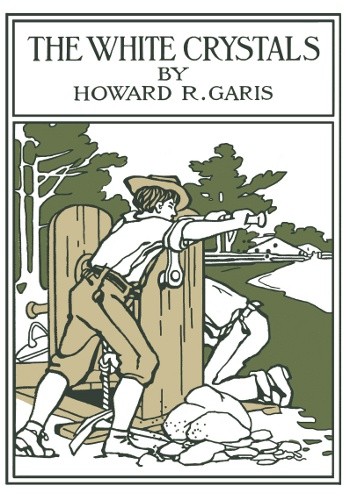
"Its forepaws struck the boy on the shoulders"
Then there was a howl and a yelp of pain and surprise from the brute, followed by a roar. Roger felt the cruel claws sinking deeper into his flesh. He screamed in agony, and then to his great wonderment he noted a sudden ceasing of the weight that was pressing him down. The claws no longer stuck into him, and the cat leaped from his back. Like a flash the boy rolled over, to get away from the fire which had spread and was scorching him.
Then he ventured to rise to his knees. He saw the wild-cat sneaking off in the darkness. The burning leaves had served their purpose and frightened the animal away.
While the boy stood there, his heart palpitating with fright, he suddenly saw a bright streak, like a sliver of flame, shoot through the trees in front of him. Accompanying it there was the sharp report of a rifle, followed by a wild howl of agony. By the combined light of the fire and the moon Roger saw the cat leap high in the air.
There was a crackle of broken tree limbs, as the beast fell back. Then something else stirred in the woods, and into the circle of the blaze stalked a tall dark man whose face exhibited the features of an Indian, and who, after a glance at the boy, uttered one word:
"Sagoola!"
CHAPTER IX
OUT OF THE WOODS
For nearly a minute Roger stood and stared at the Indian, who, despite his modern clothes was yet sufficiently a redman to make the boy wonder how in the world he ever came there. On his side the newcomer glanced at Roger by the light of the flickering fire, and a smile came on his bronzed face.
"Sagoola! Sagoola!" he repeated. "How do!"
"Oh!" said Roger, faintly comprehending that his companion had only greeted him in the Indian tongue. "Oh, how do you do yourself?"
"Fine—good," answered the Indian.
"I'm glad you came along just when you did," went on Roger. "The wild-cat had me down, and I thought I was a goner."
"Hu!" grunted the redman. "Smart boy. Light fire. Wild-cat heap 'fraid fire. Ole Johnny Green shoot 'um."
"Johnny Green?" repeated Roger in an inquiring tone.
"Yep. Me ole Johnny Green. My boy, he young Johnny Green."
"Why, I thought Indians had different names from that," said the boy. "Names like Yellow Tail, Eagle Eye, and Big Thunder."
"Hu! Good names wild Injun. Me tame Injun. Have tame name. Live to Reservation at Castle. Where yo' from?"
"My name is Roger Anderson," and he spoke slowly, so his new friend would have no trouble in understanding, "I am staying with my uncle, Bert Kimball, at Cardiff, and got lost in the woods. I was riding with my cousin, and the horse ran away."
"Bert Kimball yo' say yo' uncle?"
"Yes."
"Over by Cardiff?"
"Yes, do you know him?"
"Sure, sartin. Bert an' me good frens. Yo' loss?"
"Well, I guess that's what you'd call it; I'm lost," admitted Roger, whose spirits had improved very much in the last few minutes. He was no longer in fear of the wild-cat, and, as for the Indian, he thought, rightly, that he need be in no worry as to his intentions, though it was the first time he knew how near he was to an Indian encampment.
He briefly explained how he had come to be in the woods, and then he waited to see what Johnny Green would propose. The Indian stood his rifle up against a tree, stalked off into the darkness, and returned presently, lugging the body of the wild-cat, which he threw on the ground near the smouldering fire. Seeing that the blaze was dying out for lack of fuel, Roger cast on some twigs and branches, until the flames leaped up brightly. Johnny Green squatted down on a log, and Roger followed his example. For a moment there was silence between them. Then the Indian spoke.
"Not much good for eat," he said, indicating the carcass of the dead animal he had shot. "Radder have coon. Fur of 'um good; that all."
"Were you out hunting coons?" asked Roger, and Johnny Green nodded that he was.
"Will you show me the way back home, when you are through hunting?" asked the boy, after a pause.
The Indian nodded his head once more, to indicate that he would act as guide. He looked to the loading of his rifle, and then proceeded to tie the legs of his prize. He slung the body about his neck, picked up his gun, and looking at Roger, said: "Come 'long. We go to Bert Kimball. I show yo'."
He paused to trample out the embers of the fire, that it might not spread in the dry woods, and then he started off through the forest, seeming to strike the path without even looking for it. Roger hesitated a moment, then followed.
The boy kept close behind his guide, who walked at rather a swift pace, as though he was on a country road, instead of being in the depths of the wood, with only a pale moon, now half obscured by clouds to light him. The boy could not help admiring the unhesitating manner in which the Indian picked his way through the maze of trees. It was what might be expected of a wild Indian, Roger thought; of one who had lived all his life in the open. But here was apparently a civilized redman, who had not a chance to exercise his woodcraft in years, perhaps. Yet he made no false steps and moved as swiftly through the dark woods as Roger could have done on a brilliantly lighted street. It must be a sort of animal instinct the boy concluded.
For a few minutes after he started Roger could not help feeling a bit distrustful. How could he be sure that the Indian was what he said he was? How could he know that Johnny Green would guide him safely to his uncle's house? Once he was almost on the point of turning back, but the thought of the dark forest into which he would have to plunge, without knowing where the path was, and the fear that there were hiding behind the trees more and uglier wild animals than he had yet encountered, deterred him.
Besides, Johnny Green did not seem to care much whether the boy followed him or not. He had promised to guide him out of the wood, and if Roger didn't want to be taken home, what concern was it of Johnny Green's? Reasoning thus, the boy concluded it must be all right, and then he began to follow with swift steps, keeping up as well as he was able, with his silent leader.
In what seemed to Roger to be a very short time, he and Johnny Green emerged from the deeper forest into a sort of clearing, where a number of trees had been cut down. Traversing this was a rough wagon road, used, it seemed, by the wood choppers. Johnny Green struck into this with a grunt of satisfaction at the easier going, and he increased his pace so that Roger, exhausted and wearied as he was, found it difficult to keep his guide in sight. Perhaps the Indian heard the boy breathing rather heavy because of the exertions, or he might have recalled that his legs were longer and tougher than his companion's. At any rate, Johnny Green slackened his pace, and Roger was glad of it. Half a mile of travel along the wood trail brought the two out into the main road, and Roger, feeling the hard-packed dirt under his feet, saw that he was on the same highway where he and Adrian had driven with the grapes. It seemed almost a week ago, though it was but a few hours. There was considerable light now, even though the clouds did darken the moon at times, and Roger could distinguish dimly the fields, fenced in and extending to right and left away from the road.
"Tree mile now," grunted Johnny Green. It was the first time he had spoken since they started.
"To where?" asked Roger.
"Tree mile Bert Kimball," and the boy was glad to learn how near home he was. It was slightly down hill going now, and the walking was good, so both stepped out at a lively pace. The night was chilly, and the damp wind made Roger shiver, so he was glad of the vigorous exercise that kept his blood in circulation. It was lonesome too, even though Johnny Green was just ahead of him, and the boy listened, with a sort of dread, to the mournful hooting of the owls, the cheeping of the tree-toads and the chirping of the crickets. For some time the two kept on in silence. Then the Indian suddenly halted in the middle of the road. He bent his head as if to catch some sound in the distance.
"Hark!" he cautioned, and held up his hand warningly.
Roger stopped. Yes, there was some noise quite a way in front, but at first its character could not be distinguished. Then in a few moments it resolved into a sort of confused shouting.
"What yo' name?" asked Johnny Green, turning quickly to the boy at his side.
"Roger."
"They callin' yo'," he announced. "Bert Kimball I tink"
"Is it?" joyfully.
"Yep. Listen."
Faintly Roger heard a voice shouting. He could make out no words, however. It increased his respect for Johnny Green's attainments that the Indian could understand a name called from such a distance.
Then Roger's companion raised his voice in a long, loud, shrill, far-carrying halloo: "Hi! Bert Kimball! Here yo' boy Roger!"
There came an answering shout, in which the boy could scarcely distinguish his own name, and he, too, cried out: "Here I am, Uncle Bert! I'm all right!"
A few minutes later there flashed from behind a bend in the road the gleam of a lantern, and soon another flickering light appeared. Roger ran toward them, and Johnny Green hurried on also. Nearer and nearer came the lights, and then in a few minutes the seekers and the lost were together.
While Adrian, who was with his father, was shaking hands with Roger and telling him how glad he was to see him again, Mr. Kimball was exchanging greetings with the Indian and looking at the wild-cat slung across his shoulders. It didn't take long for Roger to tell his experience, and the words of praise that came from his uncle and cousin, at his wise and brave conduct in the fight with the beast, more than repaid him for the fright and discomfort he had undergone. The cuts and scratches on his back proved to be only slight ones, when Mr. Kimball insisted on looking at them by the light of the lanterns.
"Ye got off mighty lucky," commented the farmer, as Roger put on his coat again.
"What happened?" asked Roger of Adrian. "Did something scare the horse?"
"The wagon struck a stone," explained Adrian, "and you were pitched out. I suppose you must have lost your senses by hitting your head on the hard ground. I tried to grab you when I saw you going, and I must have frightened the horse, for he bolted as if a bear was after him. I guess it was the first time he ever ran away and he rather liked it, for he never stopped galloping until I got to Enberry Took's house, though I sawed on the lines for all I was worth. When I found I was so near home I thought I'd better go on, put the rig up, and get dad to come back with me to find you, for I thought we'd meet you walking in. We figured on seeing you within the first mile, but you must have turned around and gone back toward Tully. We went slow, for it was dark at first, and we didn't want to miss you. It was lucky you happened to find that one match in your knife, wasn't it?"
"It was luckier that Johnny Green came along just when he did," said Roger, "or the fire might not have done me much good."
"Wa'al, I reckon it's lucky all around," interposed Mr. Kimball. "Now, ef it's all th' same t' ye two boys, we'll git 'long hum, 'n' relieve th' women folks, fer they most hed a caniption fit when they heard what happened."
So the four started on toward Cardiff, the two boys walking behind Mr. Kimball and Johnny Green.
"Say," began Roger in a low tone, "is he a real Indian?"
"Sure," replied Adrian. "He's one of the Onondaga tribe. There's a reservation of them at a place they call the Castle, which is what they name their Council House. It's about three miles from Cardiff. I meant to tell you about them, but I forgot it. They're full-blooded Indians, but they're not wild, though some of the older ones were once, I suppose. We'll take a trip down and see 'em soon, and get 'em to make us some bows and arrows. Most of 'em know dad, from buying honey from him."
Without further incident the little party reached Cardiff. While Roger, with his uncle and cousin turned in at the welcome farmhouse, Johnny Green, with a grunted good night, kept on to his cabin. Roger found his aunt and pretty cousin waiting for him in great anxiety, and very glad indeed were they to see him again, and to learn that he had come to no great harm, though he had been in grave danger. Mrs. Kimball insisted on putting some home-made salve on the cuts and scratches in Roger's back, which were now beginning to smart a little, though they were not deep.
"That stuff'll draw the soreness out," said Mrs. Kimball.
"It feels good, at any rate," said Roger.
"Now I reckon you'll like some supper," went on his aunt, bustling about.
"Supper? Breakfust'd be nearer th' mark," spoke up Mr. Kimball, looking at his big silver watch, which showed two o'clock.
"Anything, as long as it's something to eat," said Roger. "I'm as hungry as a bear."
"Or a wild-cat," laughed Clara, as she set the coffee on to boil.
A few minutes later they all drew up to the table with good appetites, for when the others heard what happened to Roger they had been in no mood for supper earlier in the evening.
The whole story had to be gone over again by Roger, and when he had finished Mr. Kimball packed them all off to bed.
CHAPTER X
BAD NEWS
Roger slept late that morning, and his aunt would not let Adrian awaken him, much as the country boy desired to hear more of his cousin's adventures. It was almost ten o'clock when Roger came downstairs, rubbing his eyes. He found no one about the house but Clara, who greeted him with a smile and an invitation to sit down to a fresh hot breakfast she had prepared.
"Well, I must say I'm getting into lazy ways," was the boy's remark. "I'm used to getting up earlier than this when I'm home. Where's everybody except you?"
"Oh, father's picking some apples, Ade's gone up in the vineyard, mother's gone over to Mrs. Took's to borrow some molasses, the hired man's picking cucumbers, and I—"
"You have to stay home to bother getting me some breakfast," finished Roger. "I'm sorry to put you to so much trouble."
"It isn't any trouble at all," protested Clara, earnestly. "Mother said you must have a good sleep to make up for what you lost last night. My! But you must have been frightened. How's your back? We're all so glad you are safe that you can sleep until noon if you want to. Did you dream of wild-cats and Indians?"
"Answering your last question first, I will say I didn't dream at all," said Roger, smiling. "As for my back, I'd hardly know I was scratched. That's fine salve. I've had plenty of sleep, thank you, and I feel very well. Quite ready for breakfast, too, for I'm hungry," he added, as he sat down in front of the nicely browned cakes, the hot coffee, and the meat. He ate heartily, and just as he finished his aunt came in from the neighbor's. She was glad to see he had suffered no ill effects from his exposure in the woods, and his encounter with the wild-cat. While he was talking to Mrs. Kimball and Clara, Adrian came to the house.
"Sagoola!" said the country boy, smiling at his cousin.
"Sagoola!" replied Roger. "Say, Ade, what does that mean? Johnny Green called it to me when he met me in the woods. I had to guess at it."
"That's Onondaga Indian for 'How do you do?' or 'Hello!' just as it happens."
"Oh," said Roger, comprehending. "Well, I sagoola pretty well. How are you?"
"Same."
"Say," broke in Mr. Kimball, who had come in unperceived, "I want t' say you boys was purty smart t' pitch in 'n' sell them grapes th' way ye did arter ye found Andrews didn't want 'em. Mighty smart 'n' good I call it. Too bad ye hed t' hev a accident jest when ye was gittin' back, but then it come out all right. Each a' ye is entitled t' a dollar fer th' day's work."
"We didn't do it for money," spoke up Roger, "and besides, I only helped a little bit."
"I know all 'bout thet," said Mr. Kimball, "but ye got a leetle better price 'n Andrews would 'a' paid, 'n' I'm used t' givin' commissions on sales, so it's a matter a' business 'ith me."
He pulled out a canvas bag from deep in his trousers pocket, extracted from it two big shining silver dollars, and gave one to each of the boys.
"Thar's yer pay," he said. "Mind, I ain't givin' it t' ye. Ye airned it fair 'n' square, 'n' ye kin do jest's ye like 'ith it."
The money was more than either of the boys were in the habit of receiving except, perhaps, around Christmas, and they hardly knew what to do with the coin. Roger held his in an undecided manner.
"I'll tell you what we'll do," said Adrian. "This will do to buy some ammunition with, and we can go squirrel hunting. I was just wishing for some cash to get the cartridges, and now we have it. Did you ever go after squirrels, Roger?"
"I never had a chance."
"Well, we'll go some day next week. I've got a gun, and I can borrow Porter Amidown's for you. It'll be lots of sport, and besides, we can get a mess of squirrels for dinner, and that'll save buying meat."
"I'll wait 'til I see yer squirrels 'fore I let th' butcher go by," remarked Mrs. Kimball, dryly.
"Wa'al, I've got t' git back t' th' orchard," said Mr. Kimball, after a pause, and he left to resume his work.
"Want to come up in the vineyard and watch me pick grapes?" asked Adrian of his cousin.
"I'll come up if you'll let me help a little," agreed the city boy. "I don't want to simply look on."
"Now ye must be careful, Roger," cautioned Mrs. Kimball. "Land, a body'd never think ye'd spent all night in th' woods, keepin' company 'ith a wild-cat thet most took yer skin off. Don't ye go t' pickin' grapes 'n' openin' th' sores agin. Ef ye go Ade'll hev t' make ye keep still."
"All right, mother," agreed Roger's cousin, and the two boys started off.
The place where the grapes grew was on the side of a gently sloping hill, about a quarter of a mile back of the house. The vines were twined over wires strung between posts, and were planted in rows about ten feet apart, so there was plenty of chance for the sun to get at the fruit, Old Sol's rays being needed to ripen the big purple, red, and white clusters. The boys walked up a little path back of the farmhouse, through the barnyard, up past the corn-crib, and the melon patch, past the yard where a flock of white Wyandotte chickens were cackling, and so on, up to where the air was fragrant with the bloom of the grapes.
"I'm picking Wordens," said Adrian, referring to the variety of the fruit he was gathering.
"How many kinds have you?" asked Roger.
"Well, we've got Concords, Isabellas, Niagaras, Delawares, Wordens, and Catawbas."
"I thought all grapes were alike."
"They're as different as people," said Adrian. "Some folks won't eat anything but Concords. Others want Wordens, and I like them best myself, but dad, he won't eat any but the white Niagaras."
Adrian reached over, cut off a big bunch of purple beauties, and ate them, while Roger did likewise, and it seemed that he had never before tasted such sweet grapes. The ones he occasionally had in New York were not nearly as fresh and good as these, right off the vines.
"Well," announced Adrian finally, throwing down the cleaned-off stem, "I must get to work. I've only got to fill forty more baskets, and then I can have the rest of the day to myself."
In between the rows of vines he had scattered small unfilled grape baskets. These were to be packed with the ripe bunches and loaded on a wheelbarrow, to be taken to the barn, and then the next day they would be sent to Syracuse. Adrian began to work, and Roger insisted that at least he be allowed to scatter the empty receptacles where they would be handy for his cousin. He also took the filled ones out to the end of the rows as Adrian finished with each.
Snip-snap went the scissors Adrian used to cut off the finest bunches. Before laying them in the baskets he removed any spoiled or imperfect fruit, so that the clusters would present a uniformly fine appearance, and bring a better price than if sent to market carelessly. Adrian worked rapidly, now that he did not have to stop to distribute the empty baskets or carry the full ones to the end of the row, and in much shorter time than Roger expected the forty were filled. As he placed the last one on the wheelbarrow Adrian remarked:
"Well, that's done. Want to go to Cardiff now?" for that was the way every one spoke of going up to the centre of the village.
"Would we have time to go to the Indian Reservation?" asked Roger, eagerly, for he had been thinking with anticipation all the morning of the news he had heard concerning the near location of the redmen.
"Well, hardly before dinner," replied Adrian. "It's three miles there. But we can go this afternoon."
"Then let's go."
"All right. We'll take a rest until the dinner horn blows."
So the boys went down to the barn with the last of the grapes. As they approached they were greeted by the barking of a dog, and a brown setter ran out to gambol about Adrian.
"Whose dog?" asked Roger, looking at the beautiful animal.
"Mine," replied Adrian. "He ran off to the woods Saturday, and he must have just come back. He does it every once in a while. Gets sort of wild and likes to strike out for himself. But he's always glad to come back. Hi! Jack, old fellow!" and Adrian, setting the wheelbarrow down, ran along swiftly, to be followed by the joyfully barking dog.
The two had a regular romp on the grass.
"Here, old chap!" called Adrian, suddenly, and Jack stopped short in his running to look at his young master with bright eyes and cocked-up ears. "Come here, sir! I'll introduce you to my cousin Roger."
Adrian led the dog by one ear up to Roger. The intelligent animal sniffed the boy a bit, and then the tail which had dropped began to wag quickly to and fro.
"He likes you all right," announced Adrian. "Shake hands with him, Jack."
The animal lifted his right paw up to Roger, who took it in his hand.
"He's a fine bird dog," commented Adrian, the introduction over. "We'll take him along when we go hunting."
Then Jack decided he was hungry, so he raced to the house, barking loudly. The boys took the grapes into the barn, and after they had been stowed away, Adrian lifted from a basket two large fine muskmelons. Next he produced a knife and a small bag of salt, when he and Roger proceeded to eat the fruit.
"This is the way dad and I like our melons," he announced to his cousin, as he cut off a luscious slice. It didn't take long to finish the fruit, and about an hour later, after they had amused themselves by jumping around in the hay, they were quite ready for dinner, when they heard Mrs. Kimball blow the horn vigorously. They announced at the table their intention of going to the Indian Castle, and after the meal was over and they had rested up a bit they started, Jack the dog barking joyously on ahead of them.
The way to the Reservation, or the Castle, as every one in Cardiff called it, was up the main road to the north, a long level stretch of highway, lying between pleasant farm lands. The three miles seemed rather short to Roger, and after a little more than an hour's tramp, they came to a group of log cabins.
"What are those?" asked the city boy.
"Indian houses."
"Is that where they live? I thought they had tents," and Roger's voice showed his disappointment.
"These aren't wild Indians," said Adrian. "They have to live here all the year. The government gives them this land and they raise crops on it, or rather their squaws do; for the Indians let the women do most of the work, same as they did when Columbus discovered this country, as we read in our history books."
Just then, at the door of one of the cabins, appeared a man who seemed to be a negro, and Roger could see several dark-skinned children peeping out from behind the man.
"What are colored folks doing on the Reservation, Adrian?"
"They're not colored; that's an Indian. He's Pete Smith. You see lots of the Indians are very dark, and they look a little like negroes at a distance."
"Well, he certainly don't look like the Indians you see in pictures," commented Roger.
The boys kept on. The little log cabins became more numerous now, and in the fields about them could be observed many Indian squaws at work, husking corn or gathering pumpkins and tomatoes. Once in a while a male Indian would be seen at work, probably because he had no squaw.
The boys now approached a cabin larger than any of the others near it. Adrian, coming opposite it, pointed to something fastened on the front wall.
"Do you know what that is?" he asked his cousin.
"What? Where?"
"Tacked up on the side of the cabin."
"Oh, that? Why, it looks like a piece of fur."
"Don't you know what it is?"
"No."
"That's the varmint which tried to eat you up last night."
"Not the wild-cat?"
"The very same. This is where Johnny Green lives. He's skinned the animal. That's its hide."
Roger stared with much interest at the fur, stretched out to tan. A few hours before it had been a wild-cat bent on doing him mischief. Just then Johnny Green stalked out of his cabin.
"Sagoola!" he exclaimed, pleasantly, grinning expansively in recognition of Roger and Adrian.
"Sagoola!" replied Adrian. "Glad to see you, Johnny. Get home all right last night?"
"Sartin, sure. Got coon, too."
"You did? Where?"
"Down back Bill Eaton's place. Here um hide," and he held up the pelt of a raccoon he had shot and skinned.
"Have you got any bows and arrows you don't want?" asked Adrian, with the freedom of an old acquaintance.
"Mebby so," grinned Johnny, and he went back into his cabin to return with two small but well-made hickory bows and several arrows, feather tipped, but with blunt ends. He gave the weapons to the boys, who thanked him heartily.
"Stop and get some honey when you're up our way," said Adrian, giving the invitation as a sort of payment for the gift. Then the boys kept on.
They walked to nearly the centre of the Reservation, where the Castle, as the long white Council House was called, stood. It was the most substantial building in the Indian village, being constructed of boards.
"The braves have their green corn and succotash dance here every year," explained Adrian. "They had one about two months ago. I wish you'd been here. They give a regular performance like a war dance, only it's to make the Great Spirit, so they think, give a good corn harvest. The Indians rattle dried corn in bladders and circle about the middle of the room, howling and shouting as if they were crazy. It's great, I tell you. Dad took me once."
"I'd like to have seen it," said Roger. "Maybe I'll stay until next year; then I can."
From the Castle the boys went to the bridge which spanned a little stream that flowed through the Indian village.
"They say a terrible battle was once fought along this creek," said Adrian, as they cast pebbles into the brook. "The early white settlers in this part of the country and the old Onondaga Indians pitched into each other right on the bank of this stream, and lots were killed on both sides. The story goes that the waters ran red with blood that day, and even to the present time the Indians here have a name for this creek which means 'bloody water.'"
"Well," said Roger, after they had been walking about for some time looking at the different sights, "I guess we'd better be getting back. Hadn't we? It'll be pretty near dark when we reach Cardiff."
Adrian agreed with him. The sun was already dipping well over toward the western hills, and whistling to Jack, who was romping about with some Indian dogs, Adrian and Roger started homeward. They tried shooting with their bows, sending the arrows far on ahead of them and then picking them up, to give them another flight into the air. They moved on briskly, and just as the sun was sinking out of sight, they arrived at Hank Mack's store. A few minutes later the boys were at their home. They stopped at the spouting spring for a drink of cool, sparkling water, and then entered the house.
They had no sooner reached the kitchen than they were aware that something had occurred. Mr. Kimball was standing in the middle of the floor, holding a letter in his hand. Mrs. Kimball sat in a chair, and it could be seen that she had been crying. Clara stood near her mother.
"Wh—what's the matter?" asked Adrian, in great alarm. "Has something happened?"
For a moment no one answered him.
"What is it, dad," he persisted, "bad news?"
"Yep, son, it's bad news," replied his father, brokenly.
"What is it?"
"Th' money your father invested in railroad sheers is all lost," burst out Mrs. Kimball, "'n' Nate Jackson has wrote t' say he's goin' t' foreclose th' mortgage."
This was bad news indeed, and Adrian sank limply in a chair, while Roger looked helplessly on.
CHAPTER XI
COPPER AND OLD BONES
Though Roger and Adrian knew little of the business connected with mortgages and railroad shares, they realized nevertheless, that something serious had occurred. Adrian never recalled seeing his father look so helpless and worried but once before, and that had been when his mother was dangerously ill. Mr. Kimball's face was pale, and his blue eyes, usually so bright and snapping, were dull, and seemed to be gazing at something far away.
For a moment after Mrs. Kimball's announcement no one spoke. Then, as a man recovering from some heavy blow, the farmer straightened up, shook himself like a big dog emerging from the water, and said:
"Wa'al, boys, it's true, jest's mother here says. It's bad news, sure 'nuff, 'n' I don't know when I've bin so knocked out. It's so suddint, jest like one a' them heavy thunder claps thet comes on ye 'fore ye know there's a storm brewin'."
"Is it very bad?" asked Adrian, softly. "Is all the money gone? Can't you get any of it back?"
"Seems not, son. Leastwise ef I kin, it won't be soon 'nuff fer me, 'cause th' mortgage is agoin' t' be foreclosed, 'n' t' stave thet off I've got t' hev ready cash. Ef either a' th' calamaties hed happened one at a time, I could a' stood it, but havin' 'em both together kinder flambusts me, thet's what it does. I'm reg'lar flambusted, thet's what I be; flambusted, thet's it," and he sank down in a chair, muttering this one word over and over.
Then, by degrees, Roger and Adrian gathered enough of the matter to understand it somewhat. When Mr. Kimball purchased his farm, some years ago, he did not have enough money to pay all of the price, and he gave a mortgage for the balance, that being a paper, by the terms of which he agreed, after a certain number of years, to pay the rest of the money due or forfeit the farm.
As time went on he prospered with his crops and paid off some of the mortgage. Then his father died and left him a neat sum of money. But instead of using this to cancel the mortgage, Mr. Kimball was induced by his brother Seth to invest it in the stock of a certain railroad. Seth told him that there the money would earn good interest, and when the time came to pay off the mortgage, Mr. Kimball could sell his railroad stock and with the money settle the debt on his farm, with something left.
This would have been a good plan if matters in the financial world hadn't gone wrong just before Mr. Kimball was to draw his money from the investment in the railroad shares. The mortgage was nearly due, and he expected to pay it off. But there came a panic in the stock market, and the shares the honest farmer had put his money in dropped below par, so far, in fact, that it seemed hopeless ever to expect them to rise again. And then, with all his money gone, to be informed that unless he paid off the balance of the mortgage the farm would be taken from him was blow enough to discourage any one.
"Wa'al," said Mr. Kimball, after a long silence, and with more cheerfulness in his tones than his family had heard since he got the bad news, "wa'al, there's no use cryin' over spilt milk, 'n' what can't be cured must be endured. Th' money's gone, thet's sure. Now I'll hev t' pitch in 'n' airn some more. I'm young yit. I guess I kin do it. Never say die, 'n' don't guv up th' ship. Them's my mottoes," and he blew his nose with a vigor that seemed to be uncalled for.
"It's turrible," spoke up Mrs. Kimball, "jest 's ye were gittin' ready t' take things a leetle easier, Bert. It's a shame, thet's what 't is, 'n' ef I could see some a' them railroad directors I'd tell 'em so, thet's what I would."
"Easy, easy," said Mr. Kimball. "It's tough luck, t' be sure, but from what th' newspapers says, I ain't th' only one. There's lots went down in the Wall Street crash. Plenty a' others lost their money. Th' thing fer me 'n' you t' do now, is t' consider what's t' be done. No use settin' down 'n' foldin' our hands. Cryin' never mended matters yit. I must go t' th' city t' see Jackson 'bout th' mortgage. Ef he'll hold off a bit mebby I kin straighten things out. Ef he won't—"
He didn't finish the sentence, but they all knew what he meant.
"I'm hungry," announced Mr. Kimball, suddenly. "Why," looking at the clock, "here 't is near seven, 'n' th' chores ain't done yit, 'n' no table set."
"I didn't think any 'bout eatin'," said Mrs. Kimball, "but I'll git supper right away."
She and Clara started to put the meal on, and in bustling about they forgot for a time the bad news. Roger and Adrian went out to help lock up the barn and various out-houses, to bed down the horses, and see that everything was in good shape for the night.
"It's too bad, isn't it?" ventured Roger, noting his cousin's unusual silence and guessing the cause.
"Well, as dad says, it might be worse," answered Adrian. "I'm going to pitch in and help all I can."
"And I will too, as long as I'm here," said Roger heartily, and by reason of this trouble the two boys felt more like brothers than cousins.
"I don't s'pose there's much we can do though, Ade."
"I know how I can make considerable loose change," replied the country boy. "If it wasn't so near winter I could clear twenty-five dollars easy, and that'd pay some of the interest."
"How could you make twenty-five dollars?" asked Roger.
"I'll show you to-morrow. There goes the supper horn," and the two boys hurried into the house.
If Roger expected the bad news to have any immediate effect on life at his uncle's house, he was agreeably disappointed. He looked at the table closely to see if there had been any change made in the quality or quantity of the food, but the board seemed more bountifully spread than ever. There were meat and potatoes, a big plate of salt-rising bread, a large pat of sweet golden butter, cakes, cookies, preserves, cheese, and some dark brown buckwheat honey, enough for a dozen hungry boys. Then Roger felt his heart a little lighter when he saw there was no need to put the household on short rations. Adrian too, appeared relieved when he saw the well-spread table, and he gazed on it with a feeling of thankfulness that things were not as bad as they might have been.
Under other circumstances there might have been a more cheerful party gathered around the board, but then it is hard to be light-hearted when trouble is in the air and when there are worries to be met. However, Mr. Kimball did his best to shake off the feeling of gloom, and he really succeeded so well that, before the meal was over, he had Roger laughing at his recital of some of the queer doings of the people of Cardiff.
After supper, which was not finished until rather later than usual, Mr. Kimball busied himself with various papers and account books. Roger and Adrian feeling tired from their day's tramp went to bed, where, in spite of the memory of the trouble hanging over the house, they slept soundly. In the morning Mr. Kimball went to Syracuse by the early stage, and as the hired man had to take a load of grapes to the city, the two boys were left with the farm to themselves. There were a few chores to do, which they made short work of, and then Adrian, taking a large bag from the barn, started off across the fields.
"Where to now?" asked Roger.
"I told you I'd show you how to make a little money, didn't I?" said Adrian. "This is one of the ways. I used to do it when I was a small chap, but lately I haven't had much chance, so now I'm going to start in again."
"What are you going to do?"
"Gather bones."
"Bones?"
"Yes, bones."
Roger thought his cousin was joking, but a look at the face of the country lad convinced the city boy there was a serious purpose back of the words.
"You see it's this way," explained Adrian. "Bones are good to make fertilizer of, and there's a factory over to Tully where they buy 'em. They pay half a cent a pound, and farmers that have lots of bones around send 'em to the factory. But there's plenty of bones lying around loose in the fields, and at the back doors of houses. When I was about ten years old, me and Chot Ramsey used to make a half dollar, easy, gathering up the old bones and selling 'em when the collecting wagon came from Tully. That's what I'm going to do now. But I'm going to do it different. I know a number of women folks that'll save their meat bones for me if I ask 'em, and I'm going to. Besides collecting all I can lying around loose, you see I'll have a sort of private supply to collect from. But maybe you don't want to come along. It's not much fun, but it's not dirty, for the bones are all clean ones."
"Of course I'll come along and help," said Roger. "Didn't I say I would?"
It was rather a novel idea, this one of Adrian's, so Roger thought. But plenty of country boys know the value of bones, though they may never have taken the trouble to collect and sell them. Roger and Adrian started off over the fields. The country lad seemed to know just where to go, and, before proceeding far, he had come across several big beef bones, clean and white.
They were tossed into the bag which the boys carried between them, slung on a long pole. They visited several back-yards of houses, where Adrian knew the people, and, when he had collected all the bones in sight, he asked the women if they wouldn't save any more they might have, as he would be around again in a week. Most of them promised, for they liked the boy, who had often done favors for them.
"Just throw 'em in one place always, and I can gather 'em up every week," said Adrian, at house after house.
Good luck seemed to be with the boys, for they found more bones than ever Adrian had hoped for. The bag got so heavy they could hardly carry it, and so were forced to make a trip back to the house, to get rid of the load.
"We must have fifty pounds there," reckoned Adrian, proudly, as he piled the contents of the bag in a heap back of the barn, "and there's fifty more we can get to-day. Not bad for a start, eh, Roger? One hundred pounds of fertilizer. That's fifty cents."
"I call it fine," said Roger. "But of course we can't expect to do as well as this every day."
"No, we'll have to tramp farther for our next hundred pounds," agreed Adrian, as they started off on their second trip.
They went over the fields and roads. The bag was almost full a second time when Adrian, who had picked up a smooth, round stone to throw, stopped short as it fell in the midst of some corn stubble, with a resounding clang.
"That hit something," he declared, as he set off on a run, much to the surprise of Roger. "Hurrah! I thought so," shouted Adrian a second later, as he stooped over where he had seen the stone fall. He held up to view a battered old wash-boiler.
"What good is that?" asked Roger.
"Good? Why, can't you see it has a copper bottom. Copper brings fifteen cents a pound from the junk man, and there's three pounds here."
He caught up a heavy sharp rock and soon had cut and hammered the bottom off the boiler, the upper part of which was of tin. The copper he beat up into a compact mass and placed it in the bag with the bones. Then having a pretty good load, the boys started home. On the way Adrian came across a large bottle, which he picked up.
"I wish I knew where there were a lot of these," he remarked.
"'Cause George Bennett gives three cents apiece for large ones like this. We must keep our eyes peeled for 'em as we go along."
And they did, but they found no more that day.
"Let's see," said Adrian, as they were washing up for dinner. "A hundred pounds of bones is fifty cents, and we'll reckon forty cents for the copper. With three cents for the bottle, that makes ninety-three cents for the morning. My half is forty-six and a half cents; not bad for a starter, eh?"
"Well, I guess you're a little wrong in the figuring," said Roger.
"How so?"
"Why, it's all yours. I won't take half. I'm only helping you in this. I don't want any share."
"But you've got to take it."
"Well, I won't. It's all going into a general fund to help pay that mortgage," said Roger, stoutly. "Probably we'll not get an awful lot, but every little helps, and your father is going to have all my share."
"Well—well," began Adrian, somewhat affected by his cousin's offer, but what he would have said was never known, for the dinner horn blew just then, and the boys were so hungry they forgot everything else save their appetites.
In the afternoon they picked more grapes, and neither of them suggested stopping to rest or play. The fascination of business was on them, and they seemed to have taken the responsibility of wanting to do all they could.
"Might as well get a lot picked," suggested Adrian, as he and Roger snipped away at the big bunches, "then dad can hurry to the city with them while the price is high;" and they gathered the fruit as long as they could see.
When Mr. Kimball returned home from the city that night he seemed to feel a little easier than when he left. He told his wife, and the boys overheard him, that he had succeeded in getting a delay of the mortgage foreclosure until May first, and that would give him several months to try to get the money together. True, it seemed but a respite, for there was not much chance of his securing the cash, he said, since later news of the failure of the railroad shares only confirmed the first report, that they were gone beyond hope of ever getting anything from them. But for all that, Mr. Kimball was hopeful. There was not much chance of using the money he would get from the present crops, as that would be needed for ordinary household expenses. Nevertheless the farmer found a chance to laugh a little, and he was greatly pleased and touched when he learned what the boys had done.
"We must hurry 'n' git th' rest a' th' grapes picked to-morrow," he said. "Cold spell's a-comin', 'n' a frost'll nip 'em so they won't sell. My! But I'm hungry, though, mother. Hungry's a b'ar. So we'll hev supper, 'n' talk arterwards."
The meal progressed more pleasantly than the one of the night before, and when it was over and the dishes and chores were done, they all took their chairs in the "settin' room," as Mrs. Kimball called it. There Clara played the organ, and the boys sang songs and hymns until it was time to go to bed. Roger was tired with the day's experience, and he was anxious, too, about his uncle. But this did not prevent him from sleeping, and he dropped off, feeling that busy and exciting as his life in the country had been, it had already done him good. But there were more lively times ahead of him.
CHAPTER XII
JACK FROST
Roger had been at his uncle's a week when he received a second letter from home. It told him all the folks were well and were hoping he was improving in health. He answered it as soon as he had read it, for beyond the short note he had sent off telling of his safe arrival, he had not yet written much to his mother. So in this second letter he related all of his experiences since coming to Cardiff, from the wrestling match to the adventure with the wild-cat and his partnership with his cousin in the old bone and copper business.
For the next few days the two boys were busy about the farm and garden, Roger helping Adrian as much as he could in the various tasks the country boy had to look after, or which he undertook of his own accord. When there was nothing else to do they gathered old bones, until they had quite a heap back of the barn. One day the collector came from the fertilizer factory and paid Adrian two dollars for what there was, and the boys were as much pleased as older persons would have been over a larger sum.
Thus the time passed for several weeks, during which the remainder of the crops were gathered in. The potatoes were stored in bins in the cellar, and along side of them were the beets, the turnips, the carrots, the cabbages and onions; enough vegetables, Roger thought, to feed a regiment. Barrels of apples were stowed away in dark corners, with the promise of many pies and dishes of sauce. The swing shelves of the cellar groaned and squeaked under the weight of canned fruit,—peaches, pears, quinces, plum-sauce, apple-butter, and grape jelly,—and it was quite a treat for the boys to go down and gaze at the rows of glass jars which held the sweets in reserve.
The barn was well filled with hay, the oat-bin bulged with fodder, and the silo, where the cornstalks were kept as feed for the cows, seemed like to split apart with its rich contents. The corn-crib, through the openings on the sides, showed a wealth of golden grains, which indicated not only johnny-cake for the house, but plenty of eating for the chickens. In short, there was every indication that whatever else happened there would be no lack of meals in the Kimball home that winter.
While grim care was not altogether absent from Mr. Kimball, owing to the fear that his money matters were hopelessly involved, he seemed to have lost some of his outward signs of worry. He became more cheerful, and as the days went by and the others tried to imitate his example, the household was a more happy place. At any rate, nothing was likely to happen until spring, and by that time something might turn up. At least that is what they all hoped.
The weather was getting colder now, the mornings being rather raw and chill, though there was an invigorating feeling in the air which was noticeably absent from the atmosphere of the city. The nights, too, had grown frosty, though so far only a thin white coating on the ground had greeted the boys as they crawled, shivering, out of bed. But winter was at hand and its coming was anticipated by the animals who, in the woods and fields, were busy laying up their food supplies.
One evening, when Roger and Adrian were returning from Hank Mack's store, they noticed the clear brightness of the stars overhead.
"Whew!" whistled Adrian, as he turned his coat collar up, "there's going to be a black frost to-night," and he ran on a few steps, with hops and jumps, to warm up his blood.
"What's a black frost?" asked Roger.
"I don't know, only that's what they call it when it freezes real hard and there ain't any white frost on the ground. A white frost is a white frost, and a black frost is a black frost, that's all I know."
"And you think there'll be a black frost to-night?"
"I bet there will. Then we can go chestnutting to-morrow. The burs will be down by the wagonload, and I know where we can get bushels of nuts."
"Bushels of chestnuts?" questioned Roger, who had only seen as many of the shiny brown fellows at one time as could be heaped on some street vendor's stand.
"Yes, sir, bushels," maintained Adrian, "and, do you know, they'll sell for about five dollars a bushel this year."
"I should think they might, judging by the few you get from the Italians for a dime," said Roger, thinking of how often he had bought the roasted or boiled nuts from the stand at the corner near his home.
The boys now set off, racing towards the house. They spent the evening reading and talking. About nine o'clock, when Adrian stepped to the spout at the side door to get a fresh drink of water, he came back with red cheeks and announced that it was growing much colder.
That night Jack Frost descended on Cardiff valley with all his forces. It got colder and colder, a tingling, vigorous cold that snapped the nails in the clapboards on the house. The morning dawned clear, and a breath of the fresh bracing air made the blood race through the veins.
"This is suthin' like weather," observed Mr. Kimball, rubbing his hands briskly, as he went out to the barn before breakfast to feed and water the cows and horses. "I'm glad it didn't catch us nappin', 'ith th' grapes not picked."
He broke a thin sheet of ice on the horse trough.
"Thar'll be skatin' ef this keeps on," he added with a twinkle in his blue eyes, as he saw Roger and Adrian racing out after him. They leaped and bounded, for the bracing air made them feel like young colts running in a big field. Roger seemed to have improved very much in his health in a short time, and he was now a good second to his cousin, a most sturdy youth.
"Reckon it's goin' t' snow," said Mr. Kimball, as he carried a pail of water into the barn.
"To-day, dad?" asked Adrian, anxiously.
"Not afore night, I guess," said the farmer, "but I kin smell snow," and he sniffed hard.
"Well, I'm glad you can't smell it until night," laughed Adrian. "Roger 'n' I are going after chestnuts to-day."
"Wa'al, I haint no objections," remarked Mr. Kimball, holding the pail of water where Ned, the horse, could reach it. "Guess a trip chestnuttin' 'll be good fer both on ye. I'm goin' t' kill hogs t'-morrow, snow er no snow."
"That'll be lots of fun," said Adrian to Roger. "Come on, let's eat, 'n' then we'll go."
The boys made a hurried breakfast and then, warmly clad, they started for the woods, carrying bags in which to gather the nuts. They had about two miles to walk, and when they reached the chestnut grove, Adrian saw he had not been wrong in his surmise that there would be a heavy fall. They found the ground covered with the burs, which had burst open, showing the shining brown nuts inside.
"Hurrah!" shouted Adrian. "Get to work! Here they are! Don't let the squirrels and chipmunks beat us."
Indeed, it was high time the boys started in, for there were scores of red and gray squirrels and the prettily striped chipmunks scampering about on the ground and in the trees, filling their pouch-like cheeks with the nuts, and then leaping and bounding away to their nests with the store of winter provender. The boys began to hustle, threshing the burs from the nuts, and then scooping the latter into the bags they had brought. It wasn't long before they had gathered several pecks, and they didn't have to cover much ground to get them either.
Adrian packed nearly a bushel into his sack before he was satisfied, but Roger was content to lug home a little more than two pecks, as he was hardly strong enough to bear the weight of more. They tramped slowly back, stopping frequently to rest. Emptying the nuts into baskets they went again to the woods for more, for as Adrian said, the squirrels would soon make short work of the harvest unless the boys were lively. On their second trip the hired man went with them, trundling' a wheelbarrow, and this time they brought away over three bushels, leaving as many more piled in a heap, the hired man going after them alone later.
"Got about seven bushels," announced Adrian, proudly, at the supper table. "Not bad, eh, pop?"
"I should say not," replied Mr. Kimball. "'N Porter Amidown were tellin' me yist'day they'd gone t' six dollars a bushel."
"Then we'll send out six bushels in the morning, when Porter goes to the city," said Adrian. "One bushel'll be more than we can eat. That'll be thirty-six dollars toward the mortgage, dad."
"Bless yer heart," exclaimed Mr. Kimball, pretending that he suddenly had a very bad cold. "Bless yer hearts, boys, I—I—don't want yer money."
"But you've got to take it," decided Adrian and Roger in one breath, immensely pleased with their day's work, which had only been a pleasure, and feeling proud that it would amount to so much in money.
There was a light flurry of snow that night, and when the boys awoke next morning they found the ground hidden under a white, fleecy blanket. They were not up early enough to see their chestnuts put on the stage to be sent to Syracuse, but Mrs. Kimball told them at the breakfast table that they went all right.
"Where's dad?" asked Adrian.
"Gittin' ready t' kill pigs," answered Mrs. Kimball.
"Hurrah! Roger! That'll be sport! Hurry up. Who's going to help him, mother?"
"I guess old man Hounson's comin' over. I heard yer father say suthin' 'bout him."
"Well, I reckon we can lend a hand at starting the fire, or something," said Adrian.
The boys went out to the barnyard as soon as possible, where they found Mr. Kimball getting ready to start a fire under a big caldron of water that was to be used at a later stage in the proceedings.
"Let us make the fire, dad," begged Adrian, and getting permission, he and Roger soon had a fine blaze going.
The snow was soon trampled down and melting near the fire of hickory logs, which crackled, sputtered, and sparked, filling the cold, bracing air with a pleasant nutty smell. The boys as well as Mr. Kimball and his hired man had heavy boots on, and they wore their oldest clothing, since preparing pigs for sausage and pork chops is not exactly clean work.
"Wa'al, I see yer gettin' ready fer me," spoke a high-pitched voice suddenly, and a tall, spare man, with a much wrinkled face and a little bunch of gray beard on his chin, walked up the driveway to where Mr. Kimball and the boys were gathered about the heat. He too wore boots and an old overcoat. His arms were long and his hands bony and knotted.
"Yep, we're prepared fer ye, Hounson," said Mr. Kimball. "I see ye've got yer instruments a' death 'n' destruction 'ith ye," noting some hooks and a number of long, shining, sharp knives which the old man laid on the rough plank bench near the boiling water.
"Good nippin' weather fer th' middle a' November," observed Hounson, warming his hands at the crackling blaze and nodding to the boys.
"'T is thet," replied Mr. Kimball, while he tried the temperature of the water with his finger. "Hot 'nuff," he said, as he drew his hand hurriedly away from the boiling fluid. "Might's well start in," and he motioned to the hired man. Hounson took up a long sharp knife, and the three men started for the pig-sty, which contained half a dozen squealing porkers, all unconscious of the fate in store for them.
Then came a busy period. While Mr. Kimball and his hired man held the hog down on its back, old man Hounson skilfully and quickly killed it by cutting its throat. Cruel as it seemed to Roger, the animals really suffered very little pain, so rapidly was the knife thrust into a vital part. Then the carcass was dragged over to the incline, made of planks, which led down into a barrel of hot water filled from the steaming caldron, and soused up and down in this until the bristles were softened, so they could easily be removed by the three-sided iron scraper. Next the pig was cleaned and made ready for the market, or for storing away for winter. The boys got the bladders, which they carefully preserved, as Adrian said he could sell them to the Indians at the Reservation, who put dried corn in them and rattled them at their dances.
It was hard work for the three men, this business of pig killing and cutting up and preparing the meat for winter use, and it took the most of the day. The next two were spent in separating the various portions of the hogs, while preparations were made for smoking the hams, with a fire started in the smoke-house, the smouldering blaze being fed with hickory chips, sawdust, and corncobs.
Next Mrs. Kimball, Clara, and Mrs. Hounson, who had been called in to help, got ready to make sausage into links. This work was kept up late one night, when several neighbors dropped in to give assistance. Roger and Adrian took spells at turning the crank of the machine which ground the meat up, and then they worked the lever which forced the plunger down and shoved the sausage into the links. Mrs. Kimball stood near as the long slender skin was filled. About every four inches she gave the skin a twist, which separated the sausage into the familiar lengths. Clara held a big needle, and whenever an air bubble appeared on the surface of the skin, she skilfully pricked it, that the sausage might last better, the admission of air to the meat hindering it from keeping well. It was a new and interesting experience to the city boy, and he enjoyed it very much.
When the work was finished there was a lunch of doughnuts, cheese, cookies, apples, cider, and nuts, and the boys listened while the womenfolks talked of the doings in Cardiff.
Thus was the long, cold, severe winter provided against in the Kimball homestead, which now held a bountiful supply of the various meats that pigs are noted for,—sausage, hams, bacon, salt pork, and spare-ribs. Never was there such sweet cured hams, never such clean, cunning, appetizing links of sausage, never such evenly streaked bacon, and never such lean pork chops, with just enough fat on. There might come great blizzards, but in the big farmhouse none would be hungry.
The days passed swiftly now, and the weather grew more severe. Preparations for enduring the winter went on in all the Cardiff homes, and Roger began to anticipate the delights of this season in the country, where the snow comes down to stay for months at a time.
It was the end of November, and a cold, blustery night, with banks of big gray clouds blowing up from the west.
"Thar's snow in 'em," prophesied Mr. Kimball.
And so it proved, for the next morning when the boys peered from the frost-encrusted window, they saw the air full of swirling, feathery flakes which covered the ground to a depth of two feet.
"This is fine!" shouted Adrian. "This means coasting on Lafayette hill."
The boys hurried into their clothes, for there was no fire in their bedrooms, and the only heat upstairs came from the stove-pipe, which passed up through the chambers. From the kitchen came the smell of hickory wood burning in the range. It mingled with the odor of buckwheat cakes, fried sausage, and hot coffee.
"My! But that smells good!" cried Roger.
"You bet!" agreed Adrian, earnestly. "I can eat a dozen cakes this morning, with the maple syrup and the sausage gravy mother makes."