
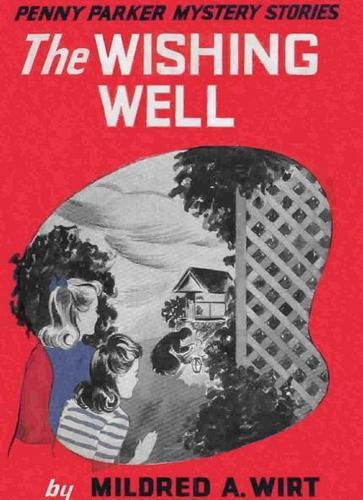
“Yes, he is eating breakfast,” Penny responded. “Won’t you come in, please?”
Mr. Franklin walked ahead of her into the living room.
“Good morning, Jay,” called the editor, who was able to see the caller from his chair at the breakfast table. “Will you have a cup of coffee with us?”
Ignoring the invitation, Mr. Franklin entered the dinette, blocking the doorway. From his pocket he took a copy of the morning Star.
“Parker,” he said curtly, “I’ve just read your editorial and I demand an explanation! Do you realize what you’ve done?”
“Written a pretty fair stickful—or so my daughter tells me,” Mr. Parker smiled undisturbed.
“You’ve deliberately tried to smear me,” the real estate man accused.
“I don’t recall that your name was mentioned in the editorial.”
“No, but you know I expect to sell those two stones to the museum. This editorial of yours may queer the sale!”
“Then it will have fulfilled its purpose. The stones are fakes. If you aren’t aware of it, I suggest that you acquaint yourself with the true facts.”
“Those stones bear genuine Elizabethan writing. There’s no connection with any cheap Indian show, and I defy you to prove it!”
“Consider your challenge accepted,” replied Mr. Parker evenly. “I expect to publish the true facts very shortly in the Star.”
“If you prevent me from making a sale to the museum, I’ll sue you!” Jay Franklin threatened. “That’s all I have to say. Good morning!”
In his anger he turned so quickly that he ran into Penny who stood directly behind him. Without bothering to apologize, he brushed past her, out the front door.
“What a dreadful man!” remarked Mrs. Weems who had heard the conversation from the kitchen.
“I rather expected him to call, although not so early in the morning,” the publisher remarked, reaching for a slice of toast. “His attitude doesn’t bother me in the least.”
“He may actually sue you if you don’t make good on producing facts,” Penny commented. “How are you going to do it?”
“DeWitt informs me that the Indian Show is playing at Bryan this week. I’ll drive over there today and see what I can learn.”
Bryan was a small city located sixty-nine miles from Riverview. Although Penny ordinarily would have spent the day in school, she immediately decided that her father would need her assistance. Accordingly, she begged so hard to accompany him that he finally gave his consent.
Early afternoon saw Mr. Parker and his daughter at the outskirts of Bryan where two large blue and red show tents had been set up. A band played, and townspeople were pouring past the ticket-taker, an Indian who wore the headdress of a chieftain.
“It looks rather interesting,” Penny remarked wistfully.
Mr. Parker stripped a bill from his wallet and gave it to her.
“Go buy yourself a ticket,” he said, smiling. “I’ll meet you here by the entrance in an hour.”
“Don’t you want to see the show, Dad?”
“I’ve outgrown such foolishness,” he rejoined. “I’ll find the publicity agent and have my little talk with him.”
The enticing sound of tom-toms and Indian war whoops caused Penny to forget her desire to meet the show’s publicity man. Saying goodbye to her father, she bought a ticket and hastened into the big top. For an hour she sat through a very mediocre performance, consisting in the main part of cowboy and Indian horseback riding. The concluding event, a tableau, depicted an attack by redskins upon an early English colony settlement. It was all very boring, and Penny left in the middle of the performance.
Mr. Parker was not waiting at the entrance way. Loitering about for a time, she inquired of a workman and learned that her father was in one of the small tents close by. The flap had been rolled back, permitting her to see a sharp-faced man of thirty who sat at a desk piled with papers.
“Is that the show’s publicity agent?” she asked the workman.
“Yep, Bill McJavins,” he answered. “He’s sure put new life into this outfit. We’ve been packin’ them in ever since he took over.”
Within a few minutes Mr. Parker joined Penny and from the expression of his face, she immediately guessed that his interview had not been very successful.
“I take it that Bill McJavins didn’t break down and confess all?” she inquired lightly.
“He denied any connection with those stones found in Riverview,” Mr. Parker replied. “But in the next breath he admitted he knew all about them and intends to capitalize on the story.”
“Just how will it help the show?”
“From what McJavins told me, I gather the program includes an historical pageant.”
“That would be a flattering name for it.”
“In the pageant, Indians attack a white settlement. A beautiful maiden escapes, and chisels on a stone tablet an account of the massacre—then she, too, succumbs to the tomahawk.”
“You seem to know more about the show than I,” Penny laughed. “Anyway, I’m glad to learn how it came out!”
“It’s my guess that McJavins hopes to profit by a tie-up between the stone writing of the pageant and the finding of similar rocks near Riverview. It’s a cheap trick, and the hoax would have been exposed a long time ago if museum authorities were awake!”
Neither discouraged nor too much elated by the results of the trip, Mr. Parker and Penny returned to Riverview. It was exactly noon when they reached the newspaper office.
“I trust you plan to attend school this afternoon,” the editor reminded his daughter. “By lunching downtown you’ll have plenty of time to get there.”
Loitering about the newsroom as long as she dared, Penny crossed the street to have a sandwich at a quick-lunch cafe. As she reached the restaurant she observed a familiar figure coming toward her.
“Rhoda Wiegand!” she exclaimed. “Aren’t you going in the wrong direction?”
“I’m cutting classes for the afternoon,” the trailer camp girl replied, pausing. “Mr. Coaten expects me to meet him at the Fischer Building. Can you tell me where it is?”
“Three blocks straight down the street,” Penny directed. She hesitated and then said: “Rhoda, it’s none of my affair, but I do hope you’re not agreeing to Mr. Coaten’s proposal.”
“The adoption? Yes, I am, Penny. I’ve tried to hold out against them all, but I can’t do it. Ted signed the papers two days ago. Since then I’ve had no peace. Ted keeps after me, the Breens want me to do it, and Mr. Coaten says I am selfish.”
“We both know Mr. Coaten intends to profit in some way at your expense.”
“I do feel that way about it. If only I dared stand firm—”
“You must,” Penny said earnestly. Deliberately taking Rhoda’s arm she turned her about. “You’re to break that appointment and have luncheon with me. I’ll assume all the responsibility.”
CHAPTER
20
RHODA’S PROBLEM
Rhoda allowed herself to be dissuaded, but not without misgiving. As she lunched with Penny at the Dolman Cafe, she painted a gloomy picture of what lay before her.
“You don’t understand how it is,” she said, slowly stirring a cup of hot chocolate. “I really haven’t a good reason for refusing to consent to the adoption. If I had one scrap of evidence against Mr. Coaten it would be different.”
“Can’t you write to Texas and inquire about him and his friend?”
“I did,” Rhoda admitted. “The answer came back that Mr. Coaten was unknown at the address he gave the Breens.”
“I should think that would be sufficient reason for distrusting him.”
“Oh, Mr. Coaten explained it by saying that his family just moved to a new house, and that he inadvertently had given me the wrong address.”
“Did you ask for the second one, Rhoda?”
“Yes, he gave it to me. So far I’ve not had time for a reply.”
“My advice is to stall for time,” Penny said. “If we have even a few days more we may dig up some information. However, I’ll confess I haven’t an idea at the moment.”
“Mr. Coaten will be furious because I didn’t keep the appointment,” Rhoda sighed. “He’s certain to come to the trailer camp tonight and demand an explanation.”
“Just tell him you changed your mind and refuse to say anything more. I wish I could talk to him.”
“So do I,” declared Rhoda with emphasis. “Why not take dinner with us tonight—if you can stand our brand of hospitality.”
“Well, I don’t know,” Penny hesitated. “Louise and I plan to go to Mrs. Marborough’s place directly after school—”
“Oh, I wish I could go with you!” Rhoda declared impulsively. “I never have had an opportunity to finish my sketch. Mrs. Marborough is such an interesting character, too.”
“You don’t know the half of it,” laughed Penny. “You’re welcome to come along. I think Mrs. Marborough will be willing to share our secret with you.”
“Secret?”
“No questions now, please,” Penny requested, capturing both luncheon checks. “We must hurry or we’ll be late for school.”
Having assured Mrs. Marborough that she would disclose nothing about the lost pearl necklace, she could not honorably share the adventure with her friend. However, it was her hope and belief that the widow would be willing to allow Rhoda to aid in the exciting search of the premises.
Penny’s surmise proved entirely correct. Later that afternoon when the three girls called at Rose Acres, Mrs. Marborough scarcely noticed that Rhoda was an uninvited member of the party. At once she began talking of the missing pearls, which to the satisfaction of Louise and Penny, necessitated a complete explanation.
“Imagine finding a tunnel leading from the old wishing well to the house!” Rhoda cried in delight. “Take me through it! Show me everything!”
“Perhaps you can find the pearls,” Penny laughed. “So far Louise and I have failed.”
“They’re supposed to be hidden somewhere near the old wishing well,” Louise contributed. “That’s the only real clue we have.”
“I suppose you looked under the flagstones?”
“I did that many days ago,” answered Mrs. Marborough. “In fact, I don’t think there’s a single place I haven’t searched.”
“The roof of the well?” Rhoda suggested.
“We never once thought of that place!” Louise exclaimed. “But how could the necklace be secreted there?” She frowned as she stared at the steep-pitched, shingled covering which formed a protection over the well.
“It’s worth looking at anyhow!” Penny declared. “I’ll get a ladder if I can find one.”
“In the woodshed,” directed Mrs. Marborough.
Penny soon returned carrying a dust-laden step-ladder which had not seen service in many years. Bracing it against the well, she mounted and began to inspect the roof.
“Find anything?” inquired Rhoda impatiently.
“Two birds’ nests. There seems to be a hole under the edge of the roofing—”
Penny broke off as she ran her hand into the narrow opening.
“Yes, there is something here!” she exclaimed a moment later. “It feels like a tiny box!”
Mrs. Marborough and the two girls waited tensely, hardly daring to hope. Penny withdrew her hand from the hole, triumphantly holding up a small leather case.
“This isn’t it?” she asked.
“Oh, yes, yes!” Mrs. Marborough cried. “It is the old jewel case. The pearls must be inside!”
In her haste to climb down from the ladder, Penny missed one of the steps. Rhoda seized her arm saving her from a hard fall. Recovering her breath, Penny politely offered the jewel case to Mrs. Marborough.
With the three girls clustered about her, the mistress of Rose Acres ceremoniously opened the lid. In a nest of yellowed silk lay a string of matched pearls, so beautiful and lustrous that no one could find words to admire it.
“The famous Marborough pearls,” the widow murmured at last. “This necklace brought only unhappiness to our family. Now, however, they shall serve a useful purpose!”
The girls gazed at Mrs. Marborough expectantly, waiting for her to continue:
“I shall sell the pearls,” she said quietly. “They represent a small fortune, and by disposing of them I’ll be well-provided for in my old age. It won’t be necessary for me to pinch and skrimp. I’ll be able to hold my head up in society—live like a human being again instead of a recluse.”
Realizing that she was revealing a great deal, Mrs. Marborough snapped shut the jewel case and smiled at the girls.
“I never should have found the pearls by myself. To tell you that I am grateful scarcely expresses my feelings. You’ve saved me from poverty.”
“Rhoda did it,” Penny declared, giving full credit to the trailer-camp girl. “Louise and I never would have thought of searching the roof of the well.”
“Do come inside,” Mrs. Marborough invited gaily. “We’ll have tea in my kitchen. It’s not much to offer, but I did bake a little sponge cake this morning.”
No longer ashamed of the barren condition of the old mansion, the widow led the girls through the great empty rooms. By daylight, notwithstanding the stained condition of the walls, the house seemed more elegant than ever. There was a large fan-shaped window of stained glass which Penny had not noticed before, and dozens of candle holders attached to the walls.
“How gorgeous this place would look if all the candles could be lighted at one time,” she remarked admiringly.
“And if the house had a little furniture in it,” added Mrs. Marborough. “You know, a few days ago I did a very foolish thing.”
Louise glanced quickly at Penny but said nothing.
“I was a bit hard pressed for money,” the widow resumed. “On an impulse I sold all my furniture to Mr. Butterworth. Do you suppose he will sell it back to me?”
“He should,” declared Penny.
“I like Riverview for I was born here,” Mrs. Marborough went on, talking as if to herself. “By selling the pearls I can refurnish the house, have the grounds restored to their original beauty, and live as I formerly did!”
“Oh, I do hope you decide to stay here,” Penny said eagerly.
Mrs. Marborough started a fire in the kitchen stove and put a kettle of water on to boil. Soon the tea was ready, and was served with generous slices of yellow sponge cake.
“I suppose everyone in Riverview considers me a crotchety old woman,” Mrs. Marborough remarked presently. “I haven’t been very friendly because I didn’t want folks to know I had sold my furniture. Some days ago a group of women came to see me about opening the house for some sort of Festival—”
“Pilgrimage Week,” Penny supplied.
“I turned them down, not because I wasn’t eager to help, but because I couldn’t let folks know all my furniture was gone. I wonder if they would still care to include Rose Acres in the tour of houses?”
“Oh, Mrs. Marborough, it would practically save the Festival!” Penny cried. “A cheap Indian show is coming to town the same week. I know for a fact that the Festival tickets aren’t selling very well.”
“Everyone wants to see Rose Acres,” Louise added enthusiastically.
“If I can re-purchase my furniture, I’ll be glad to open the house to the public,” Mrs. Marborough said, her eyes twinkling as she gazed directly at Penny. “That was the wish you made at the well, I believe?”
“Oh, it was! And you’ll make it come true!”
“It’s little enough to do in return for the favor you have bestowed upon me.”
“Nothing will please me more than to see this old house in all its glory!” Penny declared enthusiastically. “May we light all the candles at one time?”
“If you like.”
“And wouldn’t it be fun to hold a grand ball here with everyone dressed in colonial costume!” Penny went on. “Can’t you just see the place with beaux and their ladies dancing a quadrille?”
“I’ll talk to the members of the Festival Committee tomorrow,” Mrs. Marborough promised. “My first call, however, will be upon Mr. Butterworth.”
Long shadows were falling, and the girls soon arose to depart. During the walk into Riverview, Rhoda became rather sober and Penny shrewdly guessed that she had forgotten about the Marborough pearls and was thinking of the dreaded interview with Mr. Coaten.
“You’re really afraid to meet that man aren’t you?” she asked curiously.
“Not exactly afraid,” Rhoda responded. “He’ll be waiting though, I’m sure. I just don’t know what to tell him.”
“Will it be easier for you if I go with you to the camp?”
“Oh, I wish you would, Penny!” Rhoda said gratefully.
Louise soon parted with her friends, and the two girls went on to the trailer camp. Mrs. Breen immediately informed them that Mr. Coaten had called earlier in the afternoon and expected to return again.
“I hope you didn’t make trouble about signing the papers,” she said severely. “He acted quite upset.”
“I broke our appointment,” Rhoda responded briefly. “So far I’ve not made up my mind what to do.”
There followed a lengthy argument in which Mrs. Breen assured the girl that she was making a serious mistake by antagonizing such a kind, generous man as Mr. Coaten. Penny took no part in the conversation, although she readily could see how difficult had become Rhoda’s position.
“You’ll have to stay to dinner now,” Rhoda whispered to her. “Mr. Coaten is certain to come, and I can’t stand against them all.”
Penny had no desire to remain for a meal, but feeling that she should support her friend, accepted the invitation. Ted soon came home from working at Judge Harlan’s office, and he too expressed displeasure because his sister had broken the appointment with Mr. Coaten.
During dinner the subject was studiously avoided. Somewhat to Penny’s disapproval, Rhoda began to tell the Breens about everything that had occurred at Rose Acres. At mention of the pearl necklace, Ted’s fork clattered against his plate and he forgot to eat.
“You actually found a string of pearls?” he asked incredulously. “Real ones?”
“They must be worth many thousand dollars,” Rhoda assured him. “Mrs. Marborough intends to sell them and use the money to remodel her place.”
Ted was about to ask another question, then seemed to reconsider.
“More stew?” Mrs. Breen asked as an awkward silence fell.
“No thanks, Mom,” he answered. “If you’ll excuse me, I’ll skip out. I have a date uptown with a fellow.”
Mrs. Breen made no reply and the boy left the trailer. Penny thought that she too should be leaving, but before she could speak, there came a light tap on the door. Mr. Breen thrust his head out the open window.
“It’s Mr. Coaten,” he announced in a hoarse whisper. “What are you going to tell him Rhoda?”
“I don’t know,” she answered, gazing helplessly at Penny.
CHAPTER
21
MRS. MARBOROUGH’S LOSS
Mrs. Breen hastily removed her apron and opened the door to admit the caller.
“Good evening,” said Mr. Coaten. His gaze roved from one person to another in the crowded little room, coming to rest upon Rhoda.
“I’m sorry I couldn’t keep our appointment this afternoon,” she said stiffly. “The truth is, I’ve changed my mind about signing that paper.”
“I’ve tried to talk sense into her,” Mrs. Breen broke in. “I don’t know what’s come over the girl lately.”
Mr. Coaten seated himself on the day bed, smiling at Rhoda in a friendly way.
“I understand how you feel,” he said. “You are afraid you don’t know me well enough to agree to the adoption.”
“I never heard of you until you came to Riverview.”
“Rhoda, that’s no way to talk!” Mrs. Breen reprimanded. “What would we have done without Mr. Coaten? He’s given us money, bought groceries, and made everything much easier.”
“I appreciate everything. It’s just that—well, I don’t care to be adopted. I like things as they are.”
Mrs. Breen’s kindly face tightened into hard lines.
“Rhoda,” she said firmly, “this is an opportunity for you, and you ought to be smart enough to realize it. Mr. Coaten will give you good clothes and schooling. Pop and I can’t do it.”
“You’ve given me too much now,” Rhoda murmured, her gaze on the linoleum rug.
“I’ve been patient with you, but now I’m going to have my say. We can’t keep you any more.”
“You’re telling me to go?” Rhoda gasped, scarcely believing that she had heard correctly.
“I’m asking you to sign whatever it is that Mr. Coaten wants you to.”
Rhoda gazed at Penny, her lips trembling. There seemed but one course open to her, for she had no money and no relatives. Fully aware of her predicament, Mr. Coaten smiled triumphantly. From his pocket he whipped out a fountain pen and a folded, neatly-typed paper.
“Rhoda, don’t sign unless you really wish to,” Penny said quietly.
“But I’ll have no home—”
“You may stay with me. I’ll find a place for you.”
Directing her gaze upon Mr. Coaten, Penny resumed:
“May I ask why you are so eager to obtain a guardianship over Ted and Rhoda? What do you expect to gain by it?”
“My dear young lady—” Mr. Coaten’s voice was soft but his eyes glinted angrily. “I expect to gain nothing.”
“I gathered a different impression when I heard you and your friend talking a night or so ago at the Marborough place.”
At first Mr. Coaten did not appear to understand, then as Penny’s meaning dawned upon him, he arose from the couch.
“I have no wish to discuss this matter with you—a stranger,” he said coldly. “For some reason you are prejudiced against me, and have deliberately influenced Rhoda to go against Mrs. Breen’s desires.”
“It’s a question for our own family to settle,” Mrs. Breen added.
“I’ll go at once,” said Penny. She gazed questioningly at Rhoda.
“Do you really think you could take me in at your place?” the girl asked.
“Of course. My offer holds.”
“Then I’ll come with you!” Darting to a wardrobe closet, Rhoda began to toss garments into a suitcase.
“Rhoda, you can’t go like this!” Mrs. Breen cried in protest. “Why won’t you listen to reason?”
“Let her go!” Mr. Coaten said harshly. “She’ll come back in a day or two glad to accept my offer.”
Rhoda paid no heed to the conversation which flowed about her. Swiftly she packed her suitcase and told Penny that she was ready to leave.
“Mrs. Breen,” she said, squeezing the woman’s hand in parting, “you and Pop have been wonderful to Ted and me. I’ll never forget it—never. Someday I’ll repay you, too.”
“This is the way you do it,” Mrs. Breen retorted bitterly. “By defying my wishes.”
There was nothing more to be said. Penny and Rhoda quickly left the trailer, carrying the suitcase between them.
“I shouldn’t have done it,” the girl murmured contritely. “I don’t know how I’ll ever manage to make a living. Ted likely will side against me, too.”
“Don’t think of anything tonight,” Penny advised, although she too was worried. “We’ll find something for you. Dad may have an opening on the Star.”
Mrs. Weems long ago had ceased to be surprised by anything that Penny did, and so, when the two girls arrived at the Parker home, she did not ask many questions. Rhoda was comfortably established in the guest room and made to feel that she was welcome. However, ultimately learning what had occurred, the housekeeper was not at all certain that Penny had done right by helping the girl to leave home. Nor was Mr. Parker encouraging about the prospects of finding employment.
“Can she type or take shorthand?” he asked bluntly.
“I don’t think so,” Penny admitted.
“The Star can’t be made a catch-all for your unemployed friends,” Mr. Parker resumed severely. “My advice is to send her back to the Breens.”
“I can’t do that, Dad. You don’t understand.”
“Well, let it ride for a few days,” her father replied, frowning. “I’ll see what I can do.”
Penny tried to keep Rhoda from realizing that her presence in the household had created a problem. In the morning the girls went to school together, returned for lunch, and then attended the afternoon session. Rhoda became increasingly gloomy.
“Penny, this can’t go on indefinitely,” she protested. “I’ll have to get a job somehow.”
“Let me worry about that.”
“Ted hasn’t come to see me either,” Rhoda went on nervously. “I—I’m beginning to think I should go back and sign that paper.”
“Don’t even consider it,” Penny said firmly. “You need diversion to keep your mind off the problem. Let’s hike out to the Marborough place!”
Carrying their books, the girls set off for Rose Acres. Several windows on the lower floor of the house had been opened to admit fresh air and the blinds no longer were drawn. For the first time since Mrs. Marborough’s return, the old mansion actually had a “lived in” appearance. However, although Penny knocked many times, the widow did not come to the door.
“She can’t be here,” Rhoda remarked at last.
“The windows are open,” Penny said thoughtfully. “I doubt that Mrs. Marborough would go very far away without closing them.”
The girls wandered to the wishing well, and then made a complete tour of the grounds. Mrs. Marborough was nowhere in the yard.
“Shall we go?” Rhoda asked.
“I’ll knock on the door just once more,” Penny said. “I can’t help feeling that she is here.”
Circling the house to the side entrance, the girls again rapped and waited.
“Listen!” commanded Penny suddenly.
“I don’t hear anything,” declared Rhoda, startled by the manner in which her companion had given the command.
“I thought someone called or groaned—the sound came from inside the house.”
“You must have imagined it.”
“Maybe I did,” Penny acknowledged, “but I don’t think so.”
Testing the door, she found it unlocked. As it swung back a tiny crack, she called loudly: “Oh, Mrs. Marborough, are you at home?”
Distinctly, both girls heard an answering cry, but the words were unintelligible. The sound had come from the direction of the kitchen.
“Mrs. Marborough must be ill!” Penny gasped, for the voice had been very weak.
Hesitating no longer, she entered the house, and with Rhoda trailing close behind, ran to the kitchen. Mrs. Marborough, still garbed in night clothing, lay on the daybed, her face ashen. The woman breathed with the greatest of difficulty, and both girls knew at once that she was seriously ill.
“My heart—” Mrs. Marborough whispered. “An attack—last night.”
“Rhoda, run as fast as you can and get Doctor Hamilton,” Penny said tersely. “I’ll stay here.”
As soon as her friend had gone, she busied herself trying to make Mrs. Marborough comfortable. She rearranged the disordered blankets, and fanned air toward the woman, making it easier for her to breathe.
“My pearls,” Mrs. Marborough whispered after a moment. “They’re gone.”
Penny thought little of the remark, deciding that the widow was not entirely rational.
“Oh, you have the necklace,” she said soothingly. “Don’t you remember? We found it yesterday.”
“Gone—” Mrs. Marborough repeated. “It gave me such a shock—I had hidden the pearls in the teapot. This morning—”
Penny bent closer, suddenly realizing that the old lady was in possession of her faculties and was trying to disclose something of great importance.
“I went there this morning,” Mrs. Marborough completed with difficulty. “The pearls were gone. They’ve been stolen. Now I have nothing.”
CHAPTER
22
THE MISSING NECKLACE
Penny tried to quiet the old lady by assuring her that the pearl necklace must be somewhere in the house.
“No—no, it is gone,” Mrs. Marborough insisted. “A thief entered the house during the night. The shock of it brought on this attack.”
Spent by the effort required to speak, the widow closed her eyes, and relaxed. Thinking that she had gone to sleep, Penny left the bedside for a moment. A quick glance assured her that the kitchen window was open, and far more alarming, the screen had been neatly cut from its frame. An empty China teapot stood on the kitchen table.
“It must be true!” Penny thought with a sinking heart. “The pearls have been stolen, and the shock of it nearly killed Mrs. Marborough! But who could have known that she had the necklace here in the house?”
Louise and Rhoda were beyond suspicion, and for a moment she could think of no others who had knowledge of the pearls. Then, with a start, it came to her that the story had been told the previous night at the Breens.
“Ted knew about it and he was interested!” she thought. “But I can’t believe he would do such a contemptible thing—even if he did once steal a chicken.”
Penny’s unhappy reflections were broken by the arrival of Rhoda with Doctor Hamilton. For the next half hour the girls were kept more than busy carrying out his instructions.
“Mrs. Marborough, in a way you have been very fortunate,” the doctor said as he finally prepared to leave the house. “Your attack has been a light one and with proper care you should be on your feet again within a week or two. I’ll arrange to have you taken to the hospital at once.”
The widow tried to raise up in bed. “I won’t go!” she announced. “Hospitals cost money—more than I have to spend.”
“It won’t cost you anything, Mrs. Marborough. I’ll arrange everything.”
“I refuse to be a charity patient,” the widow declared defiantly. “I’ll die first! Go away and take your pills with you!”
“Then if you refuse hospital care, I must arrange for a nurse.”
“I can’t afford that either,” the old lady snapped. “Just go away and I’ll get along by myself. I’m feeling better. If I could only have a cup of tea—”
“I’ll make it for you,” Rhoda offered eagerly.
Penny signaled to the doctor, indicating that she wished him to follow her into another room. Once beyond the hearing of the old lady, she outlined a plan.
“Mrs. Marborough likes Rhoda very much,” she said to the doctor. “I think she might be perfectly satisfied to be looked after by her.”
“The girl seems sensible and efficient,” Doctor Hamilton replied. “But would she be willing to stay?”
“I think she might for she has no home of her own.”
Relieved to have the problem solved so easily, the doctor declared that the plan could be tried for a few days at least.
“I’ll drop in again late tonight,” he promised, picking up his bag.
Consulted by Penny, Rhoda said at once that she would be happy indeed to remain with Mrs. Marborough as long as her services were required. The widow too seemed pleased by the arrangement.
“It’s very good of you,” she murmured to Rhoda. “I can’t pay you though. Not unless my pearls are recovered.”
“Your pearls?” the girl echoed in astonishment.
Penny drew her friend aside, explaining what had occurred. Rhoda was shocked to learn that the necklace had been stolen.
“How dreadful!” she gasped. “Who could have taken the pearls?”
Apparently it did not occur to her that her own brother Ted might be regarded with suspicion. Penny was much too kind to drop such a hint, and kept her thoughts strictly to herself.
However, later in the day, with Mrs. Marborough’s permission, she made a full report of the theft to local police. An officer visited Rose Acres, but aside from establishing exactly how the house had been entered, obtained few useful clues. Questioned at considerable length, Penny disclosed that so far as she knew only Louise Sidell, the trailer camp family, Ted, Rhoda and herself had known that the pearls were in the mansion.
“We’ll keep that Breen family under surveillance,” the officer promised. “I’ll let you know if anything develops.”
Another problem immediately confronted Penny. An inspection of the cupboards of the Marborough home had revealed that there was barely enough food to last a day.
“Buy whatever you need,” the widow instructed. “You’ll find money in the top bureau drawer.”
By diligent search, the girls found four dollars and twenty-four cents which they felt certain was all the money the old lady possessed.
“Why, the medicines Doctor Hamilton ordered will take almost this much!” Penny said in dismay. “Something must be done.”
Both girls respected Mrs. Marborough’s desire for secrecy, but they knew it would not be possible to help her and, at the same time, prevent the townspeople from learning of her dire poverty. Deeply troubled, Penny placed the problem in Mrs. Weems’ hands.
“Why, that poor woman!” the housekeeper explained. “To think that she is sick and hasn’t the things that she needs. I’ll send a basket of food at once. I am sure many people will be eager to help.”
Mrs. Weems busied herself at the telephone, and within a few hours, all manner of useful gifts began to arrive at Rose Acres. Neighbors came to help Rhoda with the housework and to care for the widow.
As was inevitable, the entire story of Mrs. Marborough’s poverty, including the loss of the pearl necklace, circulated throughout Riverview. Since there no longer was any excuse for secrecy, Penny disclosed to members of the Pilgrimage Committee what had become of the old lady’s furniture and why she had refused to open her house during Festival Week. To her delight, a fund immediately was raised for the purpose of re-purchasing the valuable antiques. Mr. Butterworth, pleased to cooperate, agreed to sell the furniture for exactly the price he had paid.
The days drifted slowly along. Under Rhoda’s faithful care, Mrs. Marborough soon was able to sit up in a wheel chair. Much subdued since the heart attack, she had little to say even when a moving van arrived with her household furnishings. But one afternoon while Penny was inserting new candles in the glass candelabrum she so much admired, the old lady watched her from her chair by the window.
“You and Rhoda have fixed the house up so nicely,” she said. “You’ve been very kind to me, and so have all the folks in Riverview.”
“You have a great many friends, Mrs. Marborough,” Penny replied, smiling. “You never gave them a chance to show it before.”
“Perhaps I have been unfriendly,” the widow acknowledged. “I didn’t mean to be. Now that I’d like to show my appreciation, there’s no way to do it. If only the police would get busy and find the rascal who stole my necklace—”
Penny did not reply immediately, for she could think of nothing encouraging to say. She and Rhoda both believed that the thief who had taken the pearls never would be apprehended.
“Mrs. Marborough,” she said at length, “there is a way you could show the people of Riverview how you feel—but I’m sure you wouldn’t care to do it.”
“By opening my home for the Pilgrimage?” the widow asked, smiling.
“That’s what I had in mind, but of course—”
“When is the Festival?” Mrs. Marborough broke in. “I’ve lost track of time since I’ve been sick.”
“It starts day after tomorrow.” Penny drew a deep sigh. “I’m afraid the Festival may be a failure, for not half enough tickets have been sold.”
“Would it help to include this house in the Pilgrimage?”
“It would save the Festival!” cried Penny. “You’re not well enough to go through with it, though!”
“Fiddlesticks!” Mrs. Marborough snapped, her spirits reviving. “I’d like nothing better than a big party. What pleasure is it sitting in a wheel chair staring at a cracked wall? Now you go ahead and plan it just the way you like.”
With time so short, Penny flew into action. She contacted members of the Festival Committee and immediately a new publicity campaign was launched. It was announced that Rose Acres would be included in the Pilgrimage and that a grand costume ball at the mansion would be open to the public.
“The affair is certain to be a success,” Penny told her father enthusiastically. “I wish though that the Indian Show wasn’t playing Riverview at the same time. By the way, have you made any further progress in proving that Jay Franklin’s record stones are fakes?”
“Not very much,” Mr. Parker ruefully admitted. “A report came back on that tool you picked up at Truman Crocker’s shack.”
“What was the verdict, Dad?”