
CHAPTER XXI.
THE LIGHT OF OTHER DAYS.
Yes, at last, reason had resumed its throne, and Alaska was no longer the “mad queen of the Shawnees.”
Torches enabled her to gaze long and deeply into the hermit’s face, before her lips parted to utter his name:
“William!”
He started, and bent nearer her face.
The renegade’s hatchet had brought reason back to its own, even as a blow had hurled that peerless queen from her throne.
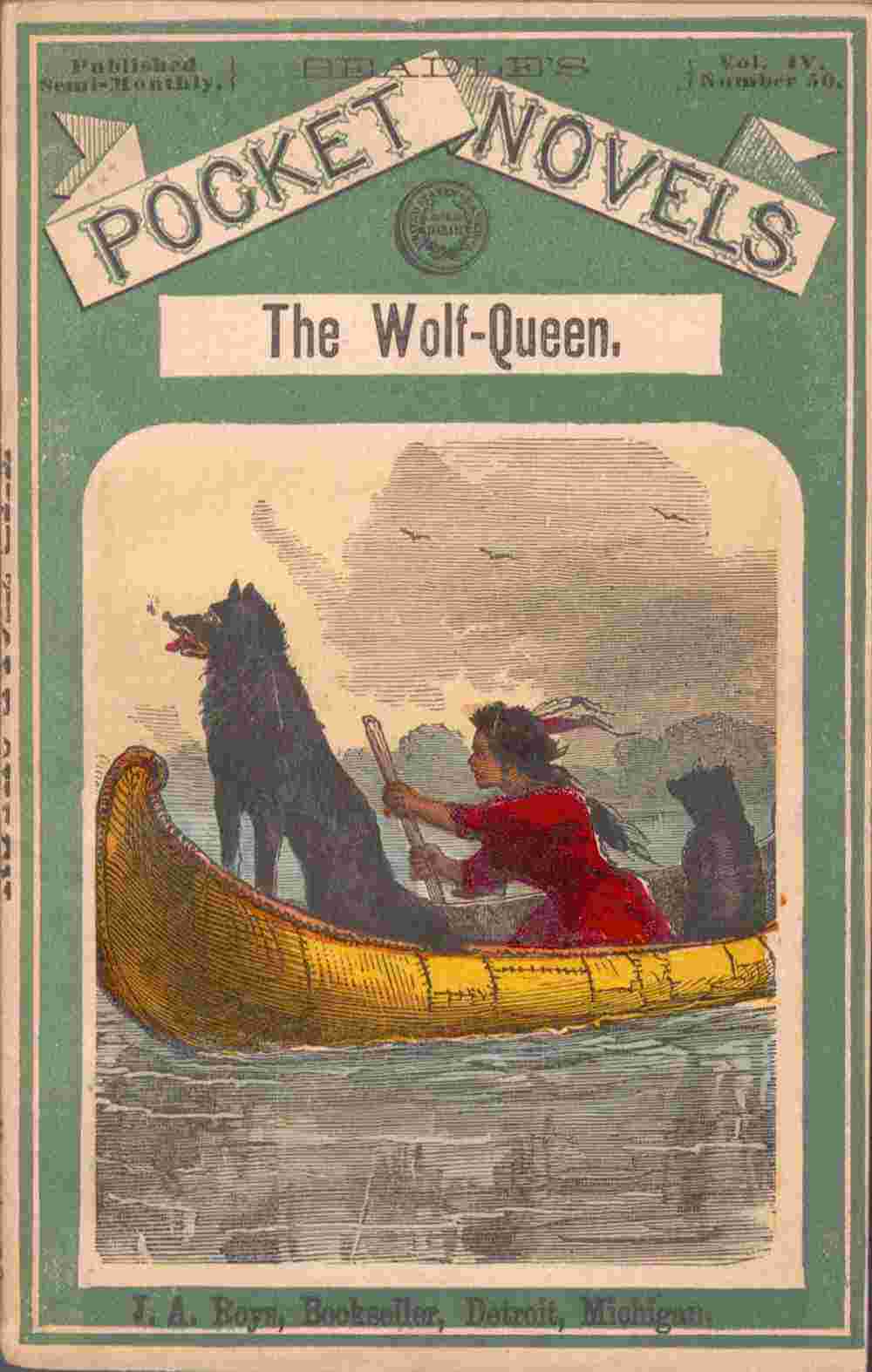
She had forgotten the wild life she had led; and when her eyes fell upon her wolves, a shudder crept over her frame, and she motioned for the animals to be removed from her sight.
“Oh! William, I am so glad that you have returned,” she continued. “He did not die—my brother, whom some bad man shot through the window of our cabin.”
The hermit’s face lighted up into a joyful smile, and he murmured:
“Her brother! Oh, God, I thank thee that I am not a murderer!”
“Where is my boy—my Edgar?” and her eyes wandered around, as though they were searching for a particular object.
At length they fell upon Mayne.
“Edgar!” she cried, stretching forth her hands. “Come to me.”
Unable to speak, the young hunter advanced.
“William, this is our boy,” she said, taking our hero’s hands, and looking up at Hewitt. “Long I waited for your return, William; but you came not. At last I resolved to go to Richmond, where I thought you were detained. I took our boy—a little babe—to Ronald Fairfax, and told him to keep him till I should return. Then, all alone, I plunged into the wilderness, but soon the Shawnees circled around me, and I was a prisoner. While they were conducting me to the village I tried to escape, but a chief struck me with his tomahawk, and then all was dark. Oh, William, how long have I been in darkness? You are so old now, and our Edgar a man!”
“For twenty years, Agnes, you have lived among the Shawnees, reft of reason,” whispered Hewitt.
A shudder crept to the woman’s heart.
“Twenty years a maniac! My God!” she cried. “Oh, William, speak not to me of that time. I would forget it. Let us leave this horrid place.”
Almost unassisted, she gained her feet, and Tecumseh bade the hermit conduct her to his beaded lodge, while the chief chivalrously occupied a meaner one near by.
The hours of that night were sacred to the reunited trio; and beyond earshot a band of warriors encircled the beaded wigwam.
Tecumseh would keep his vow.
During the late war-expedition the knife of a vengeful mother struck at his heart; but the intervention of a white prisoner, whom he liberated, saved his life.
When the Indians saw the whites beyond the portals of the chief’s lodge, they returned to the bloody spot for the purpose of attending to the wounded and the dead.
The wolves had deserted Jim Girty, and during the absence of Tecumseh’s band, one of his spies had borne his insensible form to the river, where they entered a boat, and the spy rowed away. After much suffering the renegade recovered, and remained from the sight of his brother Simon the remainder of his life.
While the savages were attending to the wounded, a groan rose from a dark form on the earth. It grew into a death-song.
“Oonalooska is near the great waters! Oonalooska’s dream was from spirit land! Now let Oonalooska die, for he has seen the Lone Man find his long-lost squaw and pappoose. Oonalooska is not afraid to die. Tecumseh can not torture him now, ha! ha! ha!” and thus, stoically—proud of having cheated his enemies, the soul of the bravest chief of the Shawnee tribe stepped upon the “trail of death.”
When morning came Tecumseh tenderly bade the whites farewell, and a band of trusty warriors escorted them to Chillicothe.
Thence they set out for Virginia, and Edgar Hewitt—Mayne Fairfax no longer—presented his long-lost parents to those who had been a father and mother to him from childhood to manly years.
A month after the happy reunion in the wood, Edgar wedded the beautiful girl who had led him to a father and a mother in the wilderness, and not far from Fairfax Manor arose a stately mansion, where the quartette peacefully and pleasantly passed the remaining days of life.
To this day eleven miles south of Chillicothe on the Portsmouth road is still to be seen the cave occupied by the hermit for many years, and over it stands a monument, erected to his memory by the people of Ross county, Ohio.
The subsequent life of Tecumseh, and his brother, the Prophet, are too well known to be rehearsed here. Often, in disguise, the great chief visited the home of the Hewitts, whose salt he ate with welcome; but suddenly his visits ceased—he lay dead before Colonel Johnson.
A few years subsequent to the incidents related in the foregoing pages, Simon Girty met the doom he richly deserved. In Proctor’s defeat he was literally ground to atoms by Johnson’s mounted men. James, too, fell beneath the arm of white avengers; while Giangomah, his tool, fell beside his chief at the battle of the Thames.
After his son’s death, Okolona, the old Medicine, fled to the neutral Mingoes, where he died a natural death. It was upon his ears, that Eudora’s shriek first fell, while he and the rescuing party stood, horror-stricken, before the empty lodge, and its murdered guards.
And now, reader, having seen mystery unraveled, the actions of wicked men result in good, and the triumph of right, in a startling drama of the forest, we lay aside the pen, hoping soon to renew it for the record of other scenes.
THE END.
THE ILLUMINATED DIME
POCKET NOVELS!
PUBLISHED SEMI-MONTHLY.
Comprising the best works only of the most popular living writers in the field of American Romance. Each issue a complete novel, with illuminated cover, rivaling in effect the popular chromo,
AND YET SOLD AT THE STANDARD PRICE, TEN CENTS.
Incomparably the most beautiful and attractive series, and the most delightful reading, ever presented to the popular reading public.
Distancing all rivalry, equally in their beauty and intrinsic excellence as romances, this new series will quickly take the lead in public favor, and be regarded as the Paragon Novels!
NOW READY, AND IN PRESS.
| No. 1—Hawkeye Harry, the Young Trapper Ranger. By Oll Coomes. | No. 26—The Black Ship. By John S. Warner. |
| No. 2—Dead Shot; or, The White Vulture. By Albert W. Aiken. | No. 27—Single Eye, the Scourge. By Warren St. John. |
| No. 3—The Boy Miners; or The Enchanted Island. By Edward S. Ellis. | No. 28—Indian Jim. A Tale of the Minnesota Massacre. By Edward S. Ellis. |
| No. 4—Blue Dick; or, The Yellow Chief’s Vengeance. By Capt. Mayne Reid. | No. 29—The Scout. By Warren St. John. |
| No. 5—Nat Wolfe; or, The Gold-Hunters. By Mrs. M. V. Victor. | No. 30.—Eagle Eye. By W. J. Hamilton. |
| No. 6—The White Tracker; or, The Panther of the Plains. By Edward S. Ellis. | No. 31—The Mystic Canoe. A Romance of a Hundred Years Ago. By Edward S. Ellis. |
| No. 7—The Outlaw’s Wife; or, The Valley Ranche. By Mrs. Ann S. Stephens. | No. 32—The Golden Harpoon; or, Lost Among the Floes. By Roger Starbuck. |
| No. 8—The Tall Trapper; or, The Flower of the Blackfeet. By Albert W. Aiken. | No. 33—The Scalp King. By Lieut. Ned Hunter. |
| No. 9—Lightning Jo, the Terror of the Santa Fe Trail. By Capt. Adams. | No. 34—Old Lute, the Indian-fighter; or, The Den in the Hills. By E. W. Archer. |
| No. 10—The Inland Pirate. A Tale of the Mississippi. By Captain Mayne Reid. | No. 35—Rainbolt, the Ranger; or, The Ærial Demon of the Mountain. By Oll Coomes. |
| No. 11—The Boy Ranger; or, The Heiress of the Golden Horn. By Oll Coomes. | No. 36—The Boy Pioneer. By Edward S. Ellis. |
| No. 12—Bess, the Trapper. A Tale of the Far South-west. By Edward S. Ellis. | No. 37—Carson, the Guide; or, the Perils of the Frontier. By Lieut. J. H. Randolph. |
| No. 13—The French Spy; or, The Fall of Montreal. By W. J. Hamilton. | No. 38—The Heart Eater; or, The Prophet of the Hollow Hill. By Harry Hazard. |
| No. 14—Long Shot; or, The Dwarf Guide. By Capt. Comstock. | No. 39—Wetzel, the Scout; or, The Captives of the Wilderness. By Boynton Belknap, M. D. |
| No. 15—The Gunmaker of the Border. By James L. Bowen. | No. 41—Wild Nat, the Trapper. By Paul Prescott. |
| No. 16—Red Hand; or, The Channel Scourge. By A. G. Piper. | No. 42—Lynx-cap; or, The Sioux Track. By Paul Bibbs. |
| No. 17—Ben, the Trapper; or, The Mountain Demon. By Maj. Lewis W. Carson. | No. 43—The White Outlaw, or, The Bandit Brigand. By Harry Hazard. |
| No. 18—Wild Raven, the Ranger; or, The Missing Guide. By Oll Coomes. | No. 44—The Dog Trailer. By Frederick Dewey. |
| No. 19—The Specter Chief; or, The Indian’s Revenge. By Seelin Robins. | No. 45—The Elk King. By Capt. Chas. Howard. |
| No. 20—The B’ar-Killer; or, The Long Trail. By Capt. Comstock. | No. 46—Adrian, the Pilot. By Col. Prentiss Ingraham. |
| No. 21—Wild Nat; or, The Cedar Swamp Brigade. By Wm. R. Eyster. | No. 47—The Man-hunter. By Maro O. Rolfe. |
| No. 22—Indian Jo, the Guide. By Lewis W. Carson. | No. 48—The Phantom Tracker. By Frederick Dewey. Ready. |
| No. 23—Old Kent, the Ranger. By Edward S. Ellis. | No. 49—Moccasin Bill. By Paul Bibbs. Ready May 9th. |
| No. 24—The One-Eyed Trapper. By Capt. Comstock. | No. 50—The Wolf Queen. By Captain Charles Howard. Ready. |
| No. 25—Godbold, the Spy. A Tale of Arnold’s Treason. By N. C. Iron. | No. 51—Tom Hawk, the Trailer. By Lewis Jay Swift. Ready June 6th. |
☞ Beadle’s Dime Pocket Novels are always in print and for sale by all newsdealers; or will be sent,
post-paid, to any address: single numbers, ten cents; six months (13 Nos.) $1.25; one year (26 Nos.) $2.50.
Address,
BEADLE AND ADAMS, Publishers, 98 William Street, New York.