
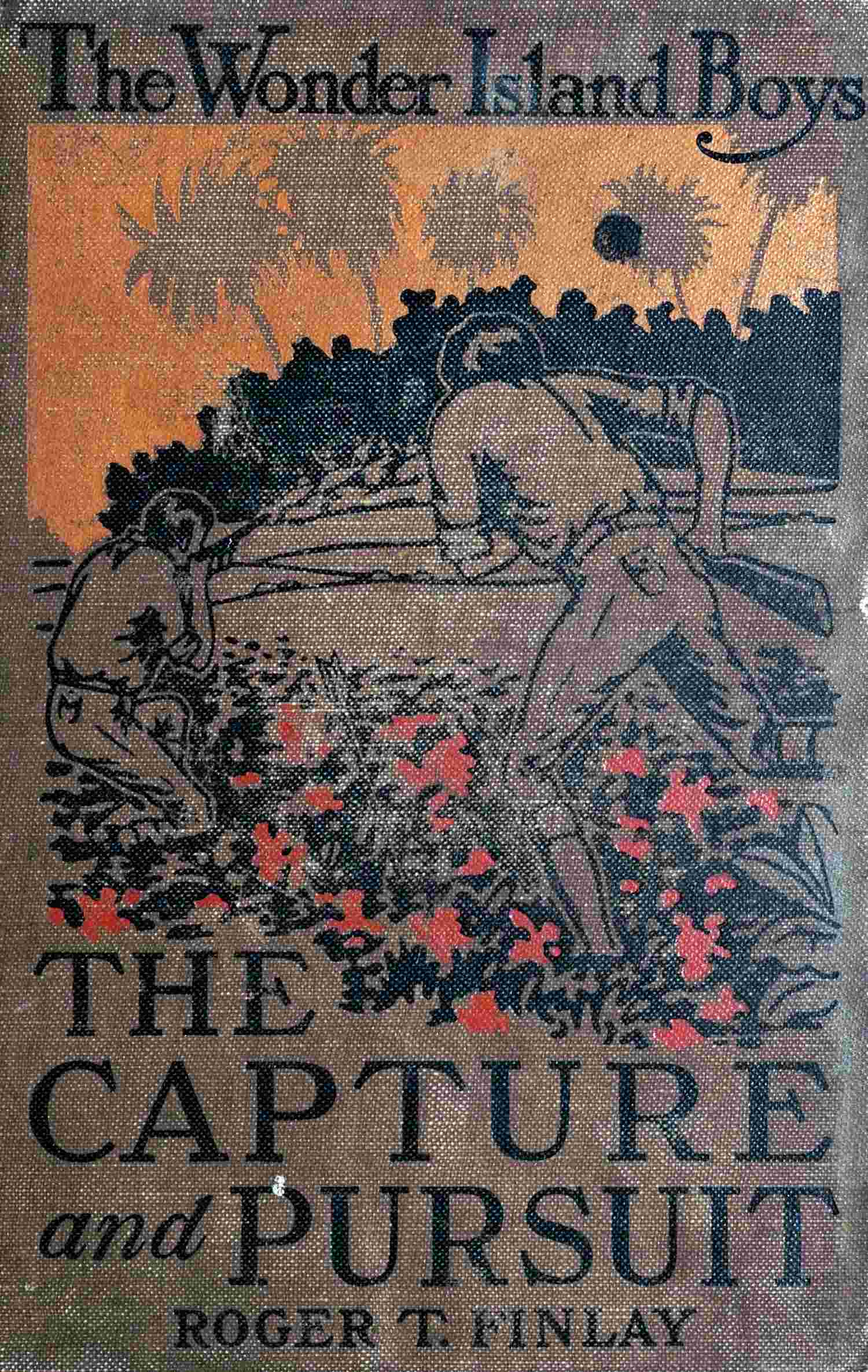
The wagon was set in motion as fast as it could be driven, and within an hour Muro discovered a band ahead, and as it was a large one, and was moving to the southwest, he could not account for it.
With his gun he went forward while the wagon was halted, and soon came back with the intelligence that the Kurabus had circled their position, and were heading in the direction of the two warring forces.
It thus seemed that at every turn, some unfortunate element would bar their progress. John considered the situation from every standpoint, and in the consultations with Muro, decided that it would be unwise to remain in the present position, as the results of the battle could not long be in doubt, with the two forces arrayed against the Brabos.
It would mean, either that the Brabos would be captured, en masse, or they would be driven eastwardly, and thus again bring the two forces against them. Where were the Saboros? Stut must have failed to reach his tribe. This was now apparent, and no hope was expected from that quarter. The situation was indeed desperate.
To add to their perplexities, not one thing had been learned from the Professor and his party since the arrival of Sutoto. The latter affirmed that they should now be in that vicinity, unless they took a more westerly route. He knew they intended to go first to the Osaga village, and then follow up the warriors from that tribe.
These reasons made an entire change in the decisions of John and Muro. Why not take the route to the west, and thus avoid both of the tribes, and assure them of a much quicker flight to the south, although it took them away from Muro’s country.
The wagon was headed due west, the object being to reach the river and thus move down its banks, until they reached the Osagas’ country, where Muro believed they would find shelter. They avoided the battle-ground which the Kurabus and Illyas occupied on one side, and the Brabos on the other side, the Brabos being to the southwest of the other forces.
This position was such, that as the two forces would, undoubtedly, quickly defeat the Brabos, who were not aware of the presence of the Illyas, the rout and the direction of the flight would be to the southeast, and the trail along the river would be left free from any enemies.
When the last messenger came from Uraso, stating that the Illyas and Brabos were maneuvering for a fight, and that they would await the result of that issue, he and Ralsea had not discovered the presence of the Kurabus.
The positions of the hostile forces, with the Illyas to the west and the Brabos to the southeast, with the Kurabus coming from the northeast, made the situation a difficult one for them to determine. Were the Kurabus on the way to aid the Brabos or the Illyas?
If they knew this they would be able to decide, just as Muro did, what direction would be the safest to go. Their only course was to escape the Kurabus, and then follow up their movements.
This description of the maneuvers will explain why the Professor did not get a messenger during the entire day, and he waited with the warriors, who watched the tribe to the west, until late in the afternoon, when the scouts reported that they had disappeared.
If the Professor had known that this tribe to the west was the Osagas, as was really the case, the settlement of all their troubles would have been more speedy, but they had no means of learning this, and the Osagas were much more intent, at this time, in watching the movements of the Illyas and the Kurabus.
CHAPTER XVII
THE SABOROS COMING TO THE RESCUE
Muro had just returned to the wagon from his position in the front, and John met him, as he expected some news from his actions.
“The Kurabus have joined the Illyas.”
“In which direction did the Kurabus come up?”
“From the northeast.”
“Where are the Brabos?”
“Directly to the south of the Illyas.”
“Do you think we had better go on?”
“No; we better wait until fight over.”
“Why do you think so? The Brabos are sure to be beaten.”
“The other tribes will go northeast to find us, and will leave this side free.”
Muro’s philosophy was now apparent. The wagon had been moved a long distance westwardly from the place where the Kurabus last saw it, and the presumption was that they would return to that position to look for it, and thus give an opportunity to make their escape.
It was certainly a well-devised scheme to outwit their enemies, but the best-laid plans come to nought where all the elements are not known.
“We might go a mile down the river, and reach the hill over there,” said Muro, pointing to the south.
“That will bring us about west of the battle-ground.”
“Yes.”
In a half hour the wagon reached the spot indicated, and the hill gave them a much better view of the conflict, and, besides, it afforded an opportunity to escape either by the north or the south, and the fort sections also furnished a means, in an emergency, to cross the river on their right.
The forces were now in position, and were both striving to outwit each other. They maneuvered back and forth for fully an hour.
“The Brabos do not know the Kurabus are with the Illyas,” said Muro.
“Why do you think so!”
“Because they are too confident.”
“How many warriors have the Brabos?”
“One hundred and thirty.”
“And how many do you think the others have all together?”
“About a hundred and seventy-five, or likely more.”
Suddenly the combined forces began the charge, first with the shower of arrows, followed by the usual rush.
“The Brabos are holding their ground,” exclaimed Muro.
“But the Illyas will be too much for them,” remarked Sutoto.
“Yes; they will win in the end.”
“But how well they are holding their line.”
“See, the Kurabus are advancing,” remarked John.
“They are trying to get around them,” ventured Harry.
“They won’t keep that up long,” said Sutoto.
Nor did they. For some reason the position of the Illyas was turned.
“What is that from the south?” asked Sutoto, as he drew himself up to a more advantageous position.
“They are Osagas,” exclaimed Ralph.
“There is a movement to the southeast; do you see it?” asked Sutoto.
“I see it plainly now,” answered John.
“There is another tribe there,” excitedly shouted Ralph.
“Are you sure?” said John.
“It does appear so; yes, you are right; a column is coming up.”
“Who are they!” asked Harry.
“Possibly they are the Saboros,” responded George.
Muro shook his head despairingly.
“It must be the Professor and his party,” exclaimed Blakely.
“Hurrah, if it is,” cried Tom. “Won’t that give us a chance?”
“I wonder who they are going to help?”
“Why, don’t you see, Harry, they are coming up behind the Brabos, and the latter see them now.”
“Yes; they will side with the Brabos.”
“How many can you see?”
Sutoto looked for a time, before answering: “About seventy-five or more.”
“Then it must be your people,” said John.
“I do not think so, as they would not be so far west.”
“They are, most likely, the Osagas,” was John’s comment.
“What is your reason for the conclusion?” asked Blakely.
“First, because it would be the natural direction for them to come; and second, the size of the band would be much greater were they Saboros.”
“The white man is right. Berees would not come along the river from Osaga village, nor would Saboros come that way.”
But some unusual movement was on foot, judging from the excitement now discernible in the ranks of the Illyas.
“The Illyas are being driven back.”
“They have discovered the new tribe. See them trying to hold their positions.”
“The Kurabus are in just as bad shape.”
“But they are really driving the Brabos forwardly.”
“That is only temporary, however. See; the Brabos and the new warriors are after them again.”
Back and forth the combatants surged. The noise of the conflict, which consisted mainly in the shouting and the shrieking, was plainly heard at the wagon.
“How I would like to take a hand,” said John, without taking his eyes off the fighters.
Muro looked at John. “I would like to go.” John looked around.
Blakely shook his head. “It would be unwise to mix up in their troubles, as we have enough of our own.”
“I should not think of doing it out of pleasure, or to gratify a spite, as I have neither of the desires, and it occurred to me a little while ago, that if we wiped out the Kurabus and the Illyas we would have pretty easy sailing with the Brabos.”
“That is to be considered,” said Blakely.
The unexpected reinforcements which the Brabos got, was the turning point in their fortunes. It was a hotly contested struggle, judged from the standard of island warfare.
“The Kurabus and Illyas are being licked,” cried out George.
“Good for the Brabos.”
“But won’t they come this way?”
“This seems possible, as they are making a pretty clean sweep.”
The force assisting the Brabos now made its way around to the right of the Illyas, and it was soon evident that the latter were beaten beyond all hope.
It thus turned out that the very plan, so apparently well selected on the part of John and Muro, was crushed by the defeat of the two tribes.
The runner which the Professor sent back to Uraso and Ralsea did not return. He should have been back before noon.
Calling one of the principal warriors he questioned him:
“Did you know the direction and distance that the runner went?”
“Yes; to the north.”
“Do you know what time he should have returned?”
“He should have been here when the sun was up there,” and he pointed to the position of the sun which was well before the noon hour.
“Can you send a fast runner there?”
“Yes.”
“What have you learned about the band toward the left?”
“We have not seen them since they left early this morning.”
“Bring the runner here as quickly as you can.”
The one indicated for the mission came up quickly, and the Professor, addressing him, said:
“Ralsea and Uraso have gone to the north, and I have had no word from them since last night. Go to them at once and tell them that I have moved the Berees to the northwest, and tell them, also, that a tribe moved away from us this morning, in that same direction, and they may be going toward my people.”
Then giving directions to the warriors, they started forward to follow in the trail of the mysterious tribe that had left them early in the morning.
Before three o’clock one of the scouts from the west appeared in their midst and hurriedly explained the situation.
“The tribe which left us was followed until they met another lot of warriors, and are now fighting with them.”
“How long will it take to reach them?”
He indicated two hours.
“Then lead us in that direction at once.”
In less than a half hour the Professor struck the trail of the tribe which had so peculiarly vanished in the morning, and it was now easy to track them.
For the past three days they had heard no sounds of the guns from the party in the wagon, and the Professor inferred, either that they had succeeded in resisting the assault made on them, or might have been captured, and were now in the possession of one or the other of the tribes which were fighting for possession.
Night came before they were able to reach the scene of the fight. The Professor stationed guards around the camp, and gave instructions to inform him of any suspicious movements in either direction.
It was singular, indeed, that the last runner sent to Uraso and Ralsea had not returned. Several times during the night the watchers from the east came to the Professor, and he hurried out with them to try and ascertain what the disturbances there might mean.
Early in the morning, however, it was seen that a war party was in the immediate vicinity on the east. This news was startling enough to cause the Professor to call in the pickets and investigate the position of the new enemy.
“Who are they?” he asked of the chief man left with him.
“They look like the Saboros.”
“Find out at once.”
Before the picket had time to return and report, others came rushing in with the announcement that the Saboros were now forming to charge them.
At this news the Professor ordered the warriors to move forward until they had reached the open. Then commanding the warriors to remain he marched forward alone and unarmed, to the amazement of those with him.
“Can we go with you?” pleaded the boys.
“Yes.”
The Saboros looked on him with astonishment. With a shout one of the warriors rushed out from the ranks and across the intervening space and embraced the Professor.
It was Stut. He looked at the boys as he was about to treat them in the same way, and started back in surprise.
“Where are the boys?”
“Still in the wagon.”
“Where is the wagon?”
“I do not know.”
Then, looking at the Berees, he was amazed at the situation.
“Tell me,” said the Professor, “why did you not come before?”
“The Kurabus captured me, and if it had not been for the Brabos I would have been killed. But do you know where Muro is?”
“I do not know. Three days ago they fought a battle with some one to the north, as we heard their guns, but we know nothing more since.”
The Saboros came up. Many of them had met the Professor before—once in the battle in the vicinity of West River, and once far to the east when they were allied with the Kurabus, at the time Stut was captured.
Stut told about the different ones, and what their stations were, and they crowded around this remarkable man about whom such wonderful tales had been told.
“Do you know who those people are that are fighting in the west?”
“We heard that the Illyas had gone to the west.”
“Do you know what they went there for?”
“They were going there to attack the Berees and Osagas.”
“Do you know why?”
“They claimed that the Osagas rescued their captives from them.”
“Do you know who the captives were?”
“Yes; some of your people.”
“Were your people coming here before you reached them?”
“Yes; that is why I met them so soon. I succeeded in getting away only three days ago, when the largest portion of the Brabos attacked and destroyed the Kurabus’ village.”
“Then they did not know Muro was with us?”
“No.”
“Why did they start on the warpath?”
“They learned that the white men who had killed Uraso were in the west, and they supposed that if Uraso had been killed I would also be offered up as a sacrifice.”
“Not killed? Where is he?”
“He and Ralsea are now up to the north, and watching the Illyas and the Kurabus.”
“Are they fighting?”
“Yes; but whom we do not know.”
“Then it must be the Brabos.”
“But the Osagas have also gone to the north.”
“How do you know that?”
“Because we came through their village, and have been following them.”
Stut and the Saboros looked at each other.
“If that is the case, then the Osagas have joined the Brabos.”
“No doubt, then, the force we saw to the west of us yesterday was the Osagas.”
“Where are they now?” asked Stut.
“To the northwest, and we are following them.”
This news that Osaga was safe produced a marked impression on the Saboros, because through family ties the heads of the two tribes were united, and these two peoples were always most friendly with each other.
“Did you know that Osaga was captured by the Illyas?” asked the Professor.
“No!” exclaimed Stut in astonishment.
He immediately imparted this news to his warriors, and the effect was such as to indicate that they held a most bitter resentment toward that tribe.
In the absence of Muro, Stut was the chief of the tribe, and this was gratifying news to the Professor. They must proceed to the north with their combined forces, and by uniting with the Brabos and Osagas, crush two of the most villainous people.
One of the chief men under Stut immediately came forward, and said: “We would not have gone to the assistance of the Osagas in their fight against the white men, but we learned that the Tuolos and the Kurabus had also made a treaty, and intended to destroy them, as well as the Brabos, so that we wanted to get the white men first.”
The Professor could hardly credit this startling piece of information.
“Do you think, then, that the Tuolos also are with the Kurabus and the Illyas?” asked the Professor earnestly.
“Yes.”
A commotion was noticed among the Berees, and one of the runners sent in advance, toward what now appeared to be the Osagas, reported that the latter and Brabos had routed the two other forces, and were pursuing to the north.
“If that is the case, the Tuolos have not yet come up.”
“We must go forward at once,” exclaimed the Professor.
The combined forces set out on the march. Together they numbered two hundred and twenty men. There was the utmost good feeling between the two people, as was evident.
“Isn’t this good!” cried Will. “What a sight it will be when we reach the Osagas!”
“I wish I knew where the boys were,” responded Jim.
And the Professor echoed that sentiment.
CHAPTER XVIII
THE TERRIBLE FIGHT AND FINAL VICTORY
“I suppose we are in for it again,” was John’s terse comment, when he saw how the tide of battle had turned.
“We must go to the north,” was Muro’s answer.
And sorrowfully and sadly the march began. It was not a march; it was a hurried retreat. They had nothing to hope from the Brabos, and if the force to the south had staked their fortunes with the latter, it was evident that they would not interfere with the desire of that tribe.
John knew that the Brabos were the first tribe they had seen and engaged on the island. If they had known that the Osagas were the allies of that tribe, they would have halted and shown fight to the fleeing warriors.
The day had been a most trying one to the poor yaks. The roads were terrible to travel over, and they had been forced every step of the way. Jill, the smaller of the two animals, began to show the effect of the pace, and would not be urged along.
Angel, as usual, was in the trees, wherever they were near the line of travel. While thus going forward, he was seen to spring down from a tree, and began setting up the most violent chatter.
George knew what that meant. “What is it, Angel? Which way?”
He selected a tree, and Angel was up alongside and looked to the north. Far in the distance could be seen a large body of warriors coming down rapidly.
Muro and Sutoto sprang to the tree, but not before George cried out: “A big party is coming in from the north.”
Sutoto looked at Muro, and then, addressing John, said:
“The Tuolos are coming.”
This information was almost overwhelming. They were about to be crushed between three of the bitterest and most vindictive foes on the island. It could not be helped. They must now fight to the last extremity, as the Professor had said.
“Our situation here will depend, largely, on the actions of the warriors who are pursuing the Illyas and Kurabus. If they follow up vigorously, it will surely involve us.” John’s conclusions were acquiesced in by Muro.
“How far are we from the river?” asked John.
Sutoto answered: “Probably a half hour,” which he indicated by the sun.
“Turn in that direction at once.”
The boys now saw where their salvation lay; but Muro and Sutoto at once protested. Chump now spoke: “You do not know what a wonderful way they have to cross streams. These pieces (pointing to the fort sections) are used to float the wagon across.”
“But what will they do with the curees (yaks)?”
There was no further protest. A half hour would not be long, and within ten minutes after they reached the river bank the floats could be ready, and from that vantage point they would be able to defy the island.
Muro kept his position in the wagon top and soon called out to John:
“They are driving the Kurabus toward the river. We had better stop.”
“If that is the case the fort should be erected,” answered John.
“By all means.”
“Harry, drive the wagon up to the large tree at the elevation to the right; and get ready, boys, to unload and place the sections in position.”
Within five minutes the wagon was turned around and one end abutted the tree. This was a small pine, with the branches not far from the ground, and the lower limbs could be easily reached by those in the wagon top.
The fort sections were installed within ten minutes thereafter, and the guns and ammunition arranged in the order agreed on. The victorious bands were having things their own way. The Illyas were next to the river, and the Kurabus were farther inland.
The pursuing Brabos were following direct after the Kurabus, and the other tribe, which had not yet been made out, were on the trail of the Illyas, and the latter were, therefore, moving directly toward the wagon.
John and Muro were up in the tree, watching the movements.
The former called down: “At the rate they are now coming forward, they will reach us in less than a half hour.”
“What shall we do when they pass us?” asked Harry.
“We shall certainly give them a salute,” was his response.
Muro called John’s attention to an object not far to the northwest. Both watched it intently. There was no doubt a savage there coming up stealthily.
With an expression John did not understand, Muro glided down the tree and leaped over the end of the wagon, and sprang out into the brush.
John saw him go forward unhesitatingly to the place of concealment, and finally the object appeared, and rushed toward Muro.
He saw them embrace, and both came forward, and long before they came to the wagon, John recognized Uraso.
“Uraso is here,” cried John, and the boys leaped up to the top of the fort, and each one tried to be the first to grasp him by the hand and welcome him.
He had never seen Blakely before, but nevertheless Blakely gave him a welcome, and when his eyes lighted on Sutoto, he could not wait to get over the barrier to extend a welcome to him.
“How did you happen to come here?”
“I escaped from the Illyas, and found the Professor at the head of the Berees, and he is below here following up the fighters.”
“My people are helping the Brabos.”
“Then they are the ones nearest the river?”
Uraso looked to the south, and his face lighted up as he said: “They are the Osagas,” and he felt proud to know that his people were in the coalition against the two tribes.
John pointed to the north: “Do you see that tribe coming?”
“Yes; and they are the Tuolos.”
“How did you know they were coming?”
“I found one of the Brabos that you wounded three days ago.”
“Did he tell you where we were?”
“Yes; without him, I should have returned to the Professor last night.”
“Where is the Professor now?”
“He is probably near the Brabos, or southeast of the position now occupied by the Osagas.”
“Why did you leave the Professor?”
“I came with Ralsea to find the Osagas, but when we came up, found that the Kurabus were coming from the north and had joined the Illyas, so that my route to the Osagas was cut off.”
“Why did the Professor try to follow the Osagas?”
“Because he was told at the Osaga village that they had gone to capture the wagon.”
“Why should the Osagas be at enmity with us?”
“They understood I had been killed by the white men.”
“Do you know where my people are?” asked Muro.
“They are with the Professor,” and when Muro learned this he danced around in delight.
The boys manifested every evidence of joy at this good news. The Professor was not only safe, but with the Berees and Saboros, and coming forward as rapidly as possible. This was glorious, indeed.
The first indications the Professor had that they were near the contending forces was during the afternoon, when they passed over the scene of the battle ground the day before. Here were bows and arrows, articles of clothing, broken spears, and here and there articles of food scattered about in confusion.
This is where the Kurabus made the first stand. The Osagas were not in sight, and, indeed, the Brabos were not yet in evidence. Before six o’clock Ralsea came in and at once sought out the Professor. “I have good news for you,” were his first words.
“Have you seen my people?” asked the Professor in excitement.
“No; but Uraso has gone to them.”
“Where are they now?”
“Somewhere north of the Kurabus and Illyas.”
“Then they must be in their line of retreat.”
“Yes.”
“Have you seen any signs of the Tuolos?”
“Yes, they are coming down direct to the position held by your people.”
“Is there anything we can do to assist them?”
“That is why I came to tell you, while Uraso went to them.”
“Can we go part of the way to-night?”
“Yes; I can lead the way.”
“Then send a messenger to the Osagas at once and inform them that you are here to assist them and that Uraso is here, and all are opposed to the Kurabus, the Illyas and the Tuolos.”
“I can get a good runner for that purpose.”
“Also tell the runner to inform the Osagas that the Tuolos are on the way from the north to aid their enemies.”
“How did you learn that the Tuolos have joined with the others?”
“Uraso and myself found one of the Brabos who had been wounded by your friends, and he informed us of this.”
“Why are the Brabos at war with the Kurabus?”
“Because on their last raid against the Berees, and while their warriors were absent, they captured and destroyed one of their principal villages.”
The Professor was further informed that at no time had the Brabos and the Saboros been at war with each other, and he thus learned sufficient to know that the meeting with the Brabos could be easily arranged so as to leave no resentment on their part.
This feature of the case was one which gave the Professor a great deal of concern. He desired to weld together the tribes in bonds of unity, and it was highly important that they should come up with the Osagas first, because, as the latter were allies, they could more forcibly impress on the Brabos the desirability of cementing a lasting peace.
Another thing of importance, which he had learned from the Chief Suros of the Berees, was the unstable character of the Brabos, and the more or less vindictiveness which was one of their traits.
The Professor hoped that they might be able to reach the field of battle before the fight was decided, because, now that the wagon and its occupants were safe, as they had reason to believe, he was anxious to prevent the Osagas and Brabos from wreaking terrible vengeance on the two vanquished tribes. It would be a poor beginning for the work of pacification.
Camp had to be made again that day without reaching the Osagas. Runners were again sent out to try and find the most direct trail, and none of them returned before morning, and the two columns were under way as soon as it was light enough to see.
Soon the first runner came in with the stirring news that the Brabos were engaged with a party of Kurabus, which had tried to break through to the east, and by ten o’clock the Professor was startled by the sound of the guns at the fort.
The firing came from a direction which was almost due north, and turning to Ralsea, said: “I supposed they were way to the left of that position.”
“No; the river makes quite a turn at the point where they are, and from the information we received from the wounded Brabo, the wagon must be somewhere near the bend, which projects out to the east.”
“Then to reach the Osagas we must go still farther west?”
“Yes.”
The firing was a rapid one, and showed that they must be attacked with vigor.
Soon the firing ceased, and the Professor breathed freer, and the column pushed forward directly to the river.
The runner came in with news that the Osagas were within two hours’ march, and renewed energy was put into the marching force.
Uraso danced about the boys and expressed his delight at the opportunity to help them. He told them about the Professor, and of the two boys, but he did not know their names. He also told about several other boys who were held by the Illyas, and of a white man.
This latter information interested John and Blakely, of course. All of them ached for an opportunity to go to the Illyas’ country and effect their release.
“That is the first thing which will be done after this little affair here is settled,” exclaimed John, with some energy.
“The Tuolos are close at hand,” cried out George. The latter came down the tree in a hurry now.
“Where are the Kurabus?”
“Some of them are trying to break across the country to the east.”
“Let us keep the same order we did four days ago.”
Uraso needed no instructions, but he had never yet fired one of the guns, and he really felt ashamed when he saw Muro, Chump and Sutoto with guns.
John saw the situation at once, and placed him by the side of Muro, who told him hurriedly what to do. The character of the attack on the part of the Tuolos was sufficient to inform the occupants of the wagon that they knew who were before them. It is singular, however, that neither the Kurabus nor the Illyas knew of it being in that spot.
This intimate knowledge of the situation was brought about by the Tuolos’ perfect system of scouting the country, and this ignorance on the part of the two fighting tribes could be excused only on the ground that they were making the fight of their lives, and had enough to do to keep out of the way of the advancing Brabos and Osagas.
As the Tuolos rushed to the wagon all the garrison were collected together at that side, and when they had come within less than a hundred and fifty feet, John ordered the first volley.
“Cease firing and reload,” he ordered.
The shot at this distance was a frightful one to the attacking party; but they considered for a moment only, and then, slightly wavering, were again urged forward by the chief.
“Take the reserve guns.” They had no time to reload before the rush was again on.
This second shot produced the indecision necessary to finish the reloading of the guns.
“Fire the moment you reload, and make every shot count,” was the next injunction.
“The Kurabus are coming.” Ralph saw the movement.
“The noise of the volleys is bringing them up, and we are going to be in for it now,” exclaimed Blakely. “Well, let us give the best we have.”
“This will be the best notice we can give to the Professor,” replied John, who was now on all sides of the wagon, and inspecting the guns and ammunition.
“Reserve your fire, and wait until you can get absolutely sure marks. From this time on we will fire as fast as we can reload.”
At no time in the history of their struggles did they face such a critical period. To the north were the Tuolos, to the southwest the Illyas, and to the south the Kurabus.
It is true that the two latter tribes were being pursued by the Brabos and Osagas; but the coming up of their allies, the Tuolos from the north, put quite another phase to the situation.
John turned to Uraso: “Did the Professor know that the Tuolos were coming to the assistance of their allies?”
“Yes; if Ralsea has been able to reach him.”
“Is it likely the Osagas and the Brabos know this?”
“I do not know.”
There was no further time for talk now. The Tuolos saw the Kurabus, who were the first to come up, and in the distance, hard pressed, were the Illyas.
The Osagas and the Brabos must have heard the firing of the guns. To them it added another exciting element to the situation. They now had an opportunity to capture the whites as well.
They had no news of the arrival of the Tuolos.
The three tribes waited until all were in position, and then with spears rushed forward to
overwhelm the little fort and its occupants by the force of numbers.
“Boys, never surrender!” cried out John, and they stood together and grimly awaited the oncoming hosts.
The Professor and the two tribes came up to the Brabos, and the surprise on their part was sufficient to cause a temporary stampede. Ralsea rushed forward to the chief, and held up his hands, but seeing the Professor and the two boys, could not understand this attitude of the chief.
“We are your friends. These white people are your friends. The Saboros are all here and have come to aid you. Where are the Osagas?”
“To our left. They are coming up.”
Just then the second attack was made on the wagon by the combined forces of Illyas, Kurabus and Tuolos.
Not far ahead, and to their left, were the Osagas, coming up in great excitement at the firing of the shots. The messenger from the Professor had reached them. At first the Brabos were inclined to be resentful, but as the Osagas came up they shouted:
“The Tuolos, the Tuolos,” and then they knew that unless they secured aid they might be defeated and driven back.
The Professor did not wait to argue the question, and, turning to Ralsea, shouted: “Order the men forward; go to the left and aim straight for the wagon.”
The Saboros now sprang directly to the front, passing between the Osagas and the Brabos, and when the three forces, which had attacked the wagon, were enveloping the brave defenders, the Professor and the two boys, Will and Jim, rushed up to the fort and the latter screamed: “Hurrah! Hurrah!”
The Sebrees, with the Professor, followed, and surrounded the wagon. The boys within sprang to the top of the fort the moment the shouts of Jim and Will rang out. John had seen the head of the Saboros and checked the firing.
The sudden appearance of the Sebrees and the Osagas was noticed by the Tuolos before the Illyas knew what was happening, and the grand retreat began. John and Muro and Sutoto leaped from the fort.
“After them,” shrieked John, and the Sebrees and Osagas were too much in earnest now to need the command. Uraso embraced the ones in his tribe that were nearest, and they followed him after the fleeing warriors.
A number of the Kurabus were too near to escape from the enveloping column, and were captured. Less of the Illyas were taken, but the Tuolos had time to make their escape. It was late that night when all the warriors returned.
The Saboros, Osagas, Berees and Brabos surrounded the wagon, and it was a sight. The sides were full of spears and arrows, but not a single shot had gone through, nor was one of the defenders wounded.
They came out, and after embracing each other with tears of joy, they all went around to the warriors and shook hands with them, and the first thing that the Professor did was to bring up the Brabo chief and rubbed his nose in token of friendship, and this was followed up by a similar sign on the part of the others.
But they all knew that the present victory did not mean the submission of all on the island. The three most powerful tribes were their enemies, and the following volume, “The Conquest of the Savages,” will tell of the thrilling exploits of the allied people under the wise guidance of the Professor, and those who were with him.
GLOSSARY OF WORDS
USED IN TEXT OF THIS VOLUME
| Accelerated. | Quickened; hurried. |
| Acquiesced. | Agreed to. |
| Admonished. | Warned; notified to be careful, or concerning an event. |
| Affirmed. | Proven; shown that the statement was true. |
| Alternative. | Either one or the other. |
| Anointing. | The rite of applying oil for the purpose of setting apart an individual for a certain purpose. |
| Aphasia. | The disease which causes loss of memory. |
| Appellation. | The term used to designate a name of a person. |
| Archeological. | Relating to the science of antiquities. |
| Arsenal. | A store house of weapons and ammunition. |
| Arteries. | The ducts in the body which carry the blood from the heart. |
| Averting. | The act of preventing; keeping from doing things. |
| Bacterial. | Pertaining to the infection of the blood or system by poisonous germs. |
| Cavalcade. | A parade; originally a troop of horsemen. |
| Cessation. | The act of quitting or stopping. |
| Cementing. | Bringing together; to cause to adhere. |
| Circulatory. | The term applied to anything which has free movement. |
| Circulation. | Applied to the movement of the blood through the arteries and veins. |
| Coveted. | Wished for; usually applied to a wrongful desire to take something from another. |
| Climatic. | Pertaining to the seasons or the weather. |
| Characterized. | Named; designated. |
| Cohesion. | Attracted; sticking together. |
| Consternation. | Awe; fear; afraid of consequences. |
| Consecrated. | Set apart for a purpose or a use. |
| Coagulated. | To curdle or form into a clot. |
| Confederate. | An ally; a friend in the same cause. |
| Concord. | In agreement with. Having the same feelings. |
| Congenial. | Friendly feeling; pleasant relations. |
| Congested. | To collect in a mass; an unhealthy accumulation. |
| Cowered. | Subdued; made to feel fear. |
| Cooperative. | The joining together for a mutual aid or encouragement. |
| Concerted. | Acting together. |
| Coalition. | The term applied to the uniting of various parties to effect a purpose in concert. |
| Deference. | Showing obedience, or willingness; to yield. |
| Delectable. | Pleasant; agreeable; satisfactory. |
| Detour. | Going around; making a sweeping movement about a certain point. |
| Detached. | Taken away from; separated from others. |
| Decomposition. | To go back into its original elements. |
| Derange. | Out of order; not in proper condition. |
| Desist. | To stop; to quit. |
| Depicted. | Explained, either by words or pictures. |
| Depleted. | To reduce; to lessen; to take away from. |
| Dissecting. | To cut apart or to pieces. |
| Disorganize. | To make disorderly; to badly arrange. |
| Diplomatic. | The term used to designate the science of conducting negotiations wisely. |
| Discerned. | Noticed; observed. |
| Diagnosed. | The course of a disease noted and discovered. |
| Exuberance. | Elated; exceedingly happy. |
| Eluding. | To avoid; to get away from. |
| Encounter. | To meet; to come into contact with. |
| Enveloping. | A term applied to a military movement, which has reference to a force surrounding or encircling another. |
| Extract. | To take out of; to obtain the essence. |
| Execution. | To perform; to carry out. |
| Exacted. | To demand of; to require some particular thing. |
| Facilitate. | To hurry up; speedily doing a thing. |
| Faction. | A small party or portion of a main body or people. |
| Gesticulate. | Bodily motions which indicate excitement, or a desire to impart information. |
| Gratification. | Satisfaction over the outcome; agreeable feeling. |
| Gruesome. | An object which excites loathsome feelings. |
| Groin. | The fold or crease where the thigh joins the abdomen. |
| Guttural. | Of or pertaining to the throat. |
| Hazardous. | Involving danger, risk or loss. |
| Hemorrhages. | Discharge of blood from a wounded blood vessel. |
| Hilarity. | Being jubilant; happy; joyous. |
| Imperious. | In a haughty manner. |
| Immeasurably. | Beyond measure; a large amount or quantity. |
| Impression. | An effect produced. |
| Initiative. | To start; to make the first effort. |
| Instinct. | A mental knowledge which precedes actual information. |
| Intuitively. | Knowing a thing without being directly told. |
| Injunction. | To warn; to advise concerning. |
| Inflamed. | The term applied to a portion of the body where the blood by congestion causes redness. Also exciting another to do a certain thing. |
| Infection. | To communicate a thing or a disease to another. |
| Incautiously. | Without much care; or in an unwise manner. |
| Intimately. | Closely associated with. |
| Inaction. | Quiet; not vigorous. |
| Injection. | To insert into; to place within. |
| Interred. | Buried. |
| Invariable. | The same; without any change. |
| Invasion. | To enter; to come into. |
| Incumbent. | Necessary; desirable. |
| Inaccessible. | Not easily gotten at; difficult to approach. |
| Insisted. | To continuing a request. |
| Intervening. | Placing between; something interposed. |
| Incantation. | The saying or singing of magical words, in a religious ceremony. |
| Intercept. | To go between; that which is cut off. |
| Infinite. | Without end; continuous. |
| Inventory. | To list; to take stock or account of. |
| Indignant. | Anger or scorn aroused by a wrong. |
| Isolation. | Left alone; without company. |
| Jargon. | Confused; unintelligible speech. |
| Limitation. | A small amount; a definite portion or part. |
| Malignant. | Having or exhibiting extreme viciousness. |
| Modified. | Changed to suit; newly arranged. |
| Momentary. | For the time being only. |
| Numerically. | Judged by numbers. |
| Nutriment. | Substances necessary to sustain life. |
| Obliterate. | To wipe out; to extinguish. |
| Obeisance. | To bow to; acknowledgment of superiority. |
| Obnoxious. | Unsavory; not pleasant; objectionable. |
| Parley. | To talk with; conference. |
| Paralysis. | A species of disease, wherein the motor nerves are deranged and made useless. |
| Pantomimic. | A show wherein the features and actions are designed to describe or display words or intentions. |
| Perplexities. | Difficulties not easily surmounted in the mind. |
| Peremptory. | Determined order; decision without delay. |
| Perceptible. | Noticeable: easily seen. |
| Perceived. | Something readily noticed. |
| Physique. | Pertaining to the outlines of the human form. |
| Physical. | Relating to the characteristics of the body. |
| Portable. | That which may be moved. |
| Presumption. | That which is judged from a certain act or thing. |
| Proximity. | Close to; very near. |
| Prediction. | Stating what will happen as a consequence, or in the future. |
| Privation. | Being denied what is necessary for comfort or convenience. |
| Pronounced. | Very evident; something that is plain. |
| Precaution. | Taking care; the act of making sure. |
| Protracted. | Stretching out; continuing for some time. |
| Putrefaction. | Matter which is in a state of decomposition, or being disorganized. |
| Recess. | A space cut out of material. Also an interim. |
| Refrain. | To keep from; to avoid. |
| Reluctantly. | Not willingly; drawing back. |
| Restraining. | Holding back; to keep from. |
| Reciprocate. | To repay; to do an act in exchange for another. |
| Reconnoiter. | To examine, or make preliminary survey of in military operations. |
| Recreation. | To put in its former condition. |
| Reinstalled. | To put in the same condition it was designed to be placed; to set up again. |
| Reversing. | In the opposite direction. |
| Reconciliation. | To have the affections restored; an agreement. |
| Requisition. | A demand; something that is required. |
| Reproachful. | Looking on the act of another with sorrow. |
| Resentment. | The act of repaying another for a wrong, or for some deed. |
| Rudimentary. | The elements which originally form the subject of matters of things. |
| Ruptured. | Breaking; torn; to rend asunder. |
| Saponify. | To convert into soap by the action of an alkali. |
| Semi-tropical. | Pertaining to or characteristics of regions near the tropics. |
| Septic. | That which is productive of putrefaction. |
| Sortie. | A rush upon a foe. |
| Spinal Column. | The backbone. |
| Species. | A group of animals or plants, which have slight changes from each other. |
| Speculation. | The act of man to theorize on certain subjects. Also business of investing and carrying on trade. |
| Surveyed. | Looking over. Also to lay out or describe meets and bounds. |
| Supremacy. | Having the power; one capable of commanding. |
| Stratagems. | The art of arranging troops. The act of planning. |
| Synthetic. | Making up from original elements. The opposite of analysis. |
| Symptoms. | Indications; in illness, the appearance of the body. |
| Talisman. | Something that produces or is capable of producing a wonderful effect. |
| Tissues. | The parts of the body, like the flesh and muscles. |
| Toxic. | A poison; that which has an effect like alcohol. |
| Tribute. | To give what is due; to repay. |
| Trepidity. | Trembling with fear. |
| Traversed. | Traveled over. |
| Tracts. | A term applied to the veins, pores, arteries, or any other ducts or passages in the body. |
| Tumult. | An uproar; a commotion. |
| Unique. | Something out of the ordinary. |
| Unstable. | That which is not rigid; yielding. |
| Vanished. | Gone out of sight; that which has left. |
| Vanquished. | Beaten; defeated. |
| Vantage. | A position of superiority; an advantage. |
| Venom. | Poison; that which has an ill effect; also applied to a wish which indicates harm. |
| Virulent. | Extreme; the desire to do wrong. |
| Vindictive. | An act which shows a design to do a wrong. |
| Voluble. | Very talkative. |
THE “HOW-TO-DO-IT” BOOKS
Carpentry for Boys
A book which treats, in a most practical and fascinating manner all subjects pertaining to the “King of Trades”; showing the care and use of tools; drawing; designing, and the laying out of work; the principles involved in the building of various kinds of structures, and the rudiments of architecture. It contains over two hundred and fifty illustrations made especially for this work, and includes also a complete glossary of the technical terms used in the art. The most comprehensive volume on this subject ever published for boys.
Electricity for Boys
The author has adopted the unique plan of setting forth the fundamental principles in each phase of the science, and practically applying the work in the successive stages. It shows how the knowledge has been developed, and the reasons for the various phenomena, without using technical words so as to bring it within the compass of every boy. It has a complete glossary of terms, and is illustrated with two hundred original drawings.
Practical Mechanics for Boys
This book takes the beginner through a comprehensive series of practical shop work, in which the uses of tools, and the structure and handling of shop machinery are set forth; how they are utilized to perform the work, and the manner in which all dimensional work is carried out. Every subject is illustrated, and model building explained. It contains a glossary which comprises a new system of cross references, a feature that will prove a welcome departure in explaining subjects. Fully illustrated.
Price 60 cents per volume
THE NEW YORK BOOK COMPANY
147 Fourth Avenue
New York
The Hickory Ridge Boy Scouts
A SERIES OF BOOKS FOR BOYS
Which, in addition to the interesting boy scout stories by CAPTAIN ALAN DOUGLAS, Scoutmaster, contain articles on nature lore, native animals and a fund of other information pertaining to out-of-door life, that will appeal to the boy’s love of the open.
I. The Campfires of the Wolf Patrol
Their first camping experience affords the scouts splendid opportunities to use their recently acquired knowledge in a practical way. Elmer Chenoweth, a lad from the northwest woods, astonishes everyone by his familiarity with camp life. A clean, wholesome story every boy should read.
II. Woodcraft; or, How a Patrol Leader Made Good
This tale presents many stirring situations in which some of the boys are called upon to exercise all their ingenuity and unselfishness. A story filled with healthful excitement.
III. Pathfinder; or, The Missing Tenderfoot
Some mysteries are cleared up in a most unexpected way, greatly to the credit of our young friends. A variety of incidents follow fast, one after the other.
IV. Fast Nine; or, a Challenge From Fairfield
They show the same team-work here as when in camp. The description of the final game with the team of a rival town, and the outcome thereof, form a stirring narrative. One of the best baseball stories of recent years.
V. Great Hike; or, The Pride of The Khaki Troop
After weeks of preparation the scouts start out on their greatest undertaking. Their march takes them far from home, and the good-natured rivalry of the different patrols furnishes many interesting and amusing situations.
VI. Endurance Test; or, How Clear Grit Won the Day
Few stories “get” us more than illustrations of pluck in the face of apparent failure. Our heroes show the stuff they are made of and surprise their most ardent admirers. One of the best stories Captain Douglas has written.
Boy Scout Nature Lore to be Found in The Hickory Ridge Boy Scout Series
| Wild Animals of the United States—Tracking—in Number I. |
| Trees and Wild Flowers of the United States in Number II. |
| Reptiles of the United States in Number III. |
| Fishes of the United States in Number IV. |
| Insects of the United States in Number V. |
| Birds of the United States in Number VI. |
Cloth Binding Cover Illustrations in Four Colors 40c. Per Volume
THE NEW YORK BOOK COMPANY
147 FOURTH AVENUE (near 14th St.) NEW YORK