
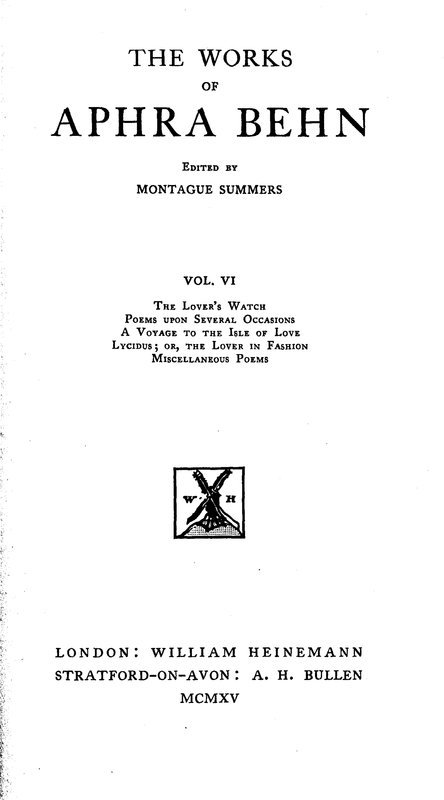
The Project Gutenberg eBook of The Works of Aphra Behn, Volume VI
Title: The Works of Aphra Behn, Volume VI
Author: Aphra Behn
Editor: Montague Summers
Release date: May 27, 2014 [eBook #45777]
Language: English
Credits: Produced by Richard Tonsing, Wendy Bertsch and the Online
Distributed Proofreading Team at http://www.pgdp.net
THE WORKS OF
APHRA BEHN.
VOL. VI.
THE WORKS
OF
APHRA BEHN
Edited by
MONTAGUE SUMMERS
VOL. VI
The Lover's Watch
Poems upon Several Occasions
A Voyage to the Isle of Love
Lycidus; or, the Lover in Fashion
Miscellaneous Poems
LONDON: WILLIAM HEINEMANN
STRATFORD-ON-AVON: A. H. BULLEN
MCMXV
CONTENTS.
| PAGE | |
| THE LOVER'S WATCH | 1 |
| POEMS UPON SEVERAL OCCASIONS (1684) | 113 |
| A VOYAGE TO THE ISLE OF LOVE | 223 |
| LYCIDUS; OR, THE LOVER IN FASHION (1688) | 293 |
| POEMS APPENDED TO LYCIDUS | 343 |
| WESTMINSTER DROLLERY (1671) | 364 |
| MISCELLANY (1685) | 365 |
| GILDON'S MISCELLANY (1692) | 387 |
| GILDON'S CHORUS POETARUM (1694) | 390 |
| MUSES MERCURY (1707) | 391 |
| FAMILIAR LETTERS (1718) | 395 |
| PROLOGUE TO ROMULUS | 398 |
| EPILOGUE TO ROMULUS | 399 |
| SATYR ON DRYDEN | 400 |
| PROLOGUE TO VALENTINIAN | 401 |
| TO HENRY HIGDEN, ESQ. | 403 |
| ON THE DEATH OF E. WALLER, ESQ. | 405 |
| A PINDARIC POEM TO DR. BURNET | 407 |
| NOTES | 411 |
| INDEX OF FIRST LINES OF POEMS | 439 |
| GENERAL INDEX | 446 |
THE LOVER'S WATCH.
INTRODUCTION.
La Môntre: or, The Lover's Watch, 'Licensed 2 Aug. 1686. R.L.S.' is taken by Mrs. Behn from La Môntre of Balthazar de Bonnecorse. After having received an excellent education at Marseilles, where he was born, de Bonnecorse was appointed consul at Cairo, and later transferred to Sidon in the Levant. Whilst at Cairo he composed La Môntre, a mixture of prose and verse, which he sent to the great arbiter of Parisian taste, Georges de Scudéri, under whose care it was printed in 1666 at Paris. It was followed in 1671 by the second part, la Boëte et le Miroir, dedicated to the Duke de Vivonne. Upon his return to France, de Bonnecorse abridged La Môntre and put it wholly into verse, in which form it appears in his collected (yet incomplete) works, 'Chez Theodore Haak.' Leyden, 1720. Bonnecorse died at Marseilles in 1706. He is always piquant and graceful in his madrigals and songs, though both sentiment and verse have faded a little with the passing of time. Boileau immortalized him in Le Lutrin: la Môntre is one of the missiles the enraged canons hurl at each other's reverend pates: 'L'un prend l'Edit d'amour, l'autre en saisit la Môntre.' Bonnecorse's attempted parody on Le Lutrin, le Lutrigot (Marseille, 1686), is of no value, and brought a caustic epigram down on his head.
To Peter Weston, Esq.;
Of The Honourable Society Of The Inner-Temple.
When I had ended this little unlaboured Piece, the Watch, I resolv'd to dedicate it to some One, whom I cou'd fancy, the nearest approacht the charming Damon. Many fine Gentlemen I had in view, of Wit and Beauty; but still, through their Education, or a natural Propensity to Debauchery, I found those Vertues wanting, that should compleat that delicate Character, Iris gives her Lover; and which, at first Thought of You, I found center'd there to Perfection.
Yes, Sir, I found You had all the Youth of Damon; without the forward noisy Confidence, which usually attends your Sex. You have all the attracting Beauty of my young Hero; all that can charm the Fair; without the Affectation of those, that set out for Conquests (though You make a Thousand, without knowing it, or the Vanity of believing it.) You have our Damon's Wit with all his agreeable Modesty: Two Vertues that rarely shine together: And the last makes You conceal the noble Sallies of the first, with that Industry and Care, You wou'd an Amour: And You wou'd no more boast of either of these, than of your undoubted Bravery.
You are (like our Lover too) so discreet, that the bashful Maid may, without Fear or Blushing, venture the soft Confession of the Soul with You; reposing the dear Secret in Yours, with more Safety than with her own Thoughts. You have all the Sweetness of Youth, with the Sobriety and Prudence of Age. You have all the Power of the gay Vices of Man; but the Angel in your Mind, has subdu'd you to the Vertues of a God! And all the vicious and industrious Examples of the roving Wits of the mad Town, have only served to give You the greater Abhorrence to Lewdness. And You look down with Contempt and Pity on that wretched unthinking Number, who pride themselves in their mean Victories over little Hearts; and boast their common Prizes with that Vanity, that declares 'em capable of no higher Joy, than that of the Ruin of some credulous Unfortunate: And no Glory like that, of the Discovery of the brave Achievement, over the next Bottle, to the Fool that shall applaud 'em.
How does the Generosity, and Sweetness of your Disposition despise these false Entertainments, that turns the noble Passion of Love into Ridicule, and Man into Brute.
Methinks I cou'd form another Watch (that should remain a Pattern to succeeding Ages) how divinely you pass your more sacred Hours, how nobly and usefully You divide your Time: in which, no precious minute is lost, not one glides idly by; but all turns to wondrous Account. And all Your Life is one continu'd Course of Vertue and Honour. Happy the Parents that have the Glory to own You! Happy the Man, that has the Honour of your Friendship! But, oh! How much more happy the fair She, for whom you shall sigh! Which surely, can never be in vain.
There will be such a Purity in Your Flame: All You ask will be so chaste and noble, and utter'd with a Voice so modest, and a Look so charming, as must, by a gentle Force, compel that Heart to yield, that knows the true Value of Wit, Beauty, and Vertue.
Since then, in all the Excellencies of Mind and Body (where no one Grace is wanting) you so resemble the All-perfect Damon, suffer me to dedicate this Watch to You. It brings You nothing but Rules for Love; delicate as Your Thoughts, and innocent as Your Conversation. And possibly, 'tis the only Vertue of the Mind, You are not perfectly Master of; the only noble Mystery of the Soul, You have not yet studied. And though they are Rules for every Hour, You will find, they will neither rob Heaven, nor Your Friends of ther Due; those so valuable Devoirs of Your Life; They will teach You Love; but Love, so pure, and so devout, that You may mix it, even with Your Religion; and I know, Your fine Mind can admit of no other. When ever the God enters there (fond and wanton as he is, full of Arts and Guiles) he will be reduc'd to that Native Innocency, that made him so ador'd, before inconstant Man corrupted his Divinity, and made him wild and wandring. How happy will Iris's Watch be, to inspire such a Heart! How honour'd under the Patronage of so excellent a Man! Whose Wit will credit, whose Goodness will defend it; and whose noble and vertuous Qualities so justly merit the Character Iris has given Damon: And which is believed so very much your Due, by
Sir,
Your most Obliged, and
Most Humble Servant,
A. Behn.
To the Admir'd ASTREA.
That where I do so much Devotion vow,
Brightest Astrea, to your honour'd Name,
Find my Endeavour will become my Shame.
'Tis you alone, who have the Art, and Wit
T' involve those Praises in the Lines y'have writ,
That we should give you, could we have the Sp'rite,
Vigour, and Force, wherewith your self do write.
Too mean are all th' Applauses we can give:
You in your self, and by your self, shall live;
When all we write will only serve to shew,
How much, in vain Attempt, we flag below.
Some Hands write some things well; are elsewhere lame:
But on all Theams, your Power is the same.
Of Buskin, and of Sock, you know the Pace;
And tread in both, with equal Skill and Grace,
But when you write of Love, Astrea, then
Love dips his Arrows, where you wet your pen.
Such charming Lines did never Paper grace;
Soft, as your Sex; and smooth, as Beauty's Face.
And 'tis your Province, that belongs to you:
Men are so rude, they fright when they wou'd sue
You teach us gentler Methods; such as are
The fit and due Proceedings with the Fair.
So stoop, as but pretend, you do translate?
Could you, who have such a luxuriant Vein,
As nought but your own Judgment could restrain;
Who are, your self, of Poesie the Soul,
And whose brave fancy knocks at either Pole;
Descend so low, as poor Translation, }
To make an Author, that before was none? }
Oh! Give us, henceforth, what is all your own! }
Yet we can trace you here, in e'ery Line;
The Texture's good, but some Threds are too fine:
We see where you let in your Silver Springs;
And know the Plumes, with which you imp his Wings.
Charles Cotton.
To the Incomparable Author.
We own, at least, your just Prerogative:
And tho' the Tribute's needless, which we pay;
It serves to shew, you reign, and we obey.
Which, adding nothing to your perfect Store,
Yet makes your polisht Numbers shine the more:
As Gems in Foils, are with Advantage shown;
No Lustre take from them, but more exert their own.
Copy Applause; and but at best, translate; }
While you, like the immortal Pow'rs, Create. }
Horace and Pindar (tho' attempted long }
In vain) at last, have learnt the British Tongue; }
Not so the Grecian Female Poet's Song. }
The Pride of Greece we now out-rival'd see:
Greece boasts one Sappho; two Orinda's, we.
To this most new, and happy piece of Art?
That renders our Apollo more sublime }
In Num'rous Prose, but yet more num'rous Rhime; }
And makes the God of Love, the God of Time. }
Love's wandring Planet, you have made a Star:
'Twas bright before, but now 'tis Regular.
While Love shall last, this Engine needs must vend: }
Each Nymph, this Watch shall to her Lover send, }
That points him out his Hours, and how those Hours to spend. }
N. Tate.
To the most ingenious ASTREA, upon her Book intituled, La Môntre, or the Lover's Watch.
You with that Glory, as this Piece hath done.
This Lover's Watch, tho' it was made in France,
By the fam'd Bonnecorse; yet you advance
The Value of its curious Work so far,
That as it shin'd there like a glitt'ring Star,
Yet here a Constellation it appears;
And in Love's Orb, with more Applause, it wears
Astrea's Name. Your Prose so delicate,
Your Verse so smooth and sweet, that they create
A lovely Wonder in each Lover's Mind:
The envious Critick dares not be unkind.
La Môntre cannot err, 'tis set so well;
The Rules for Lovers Hours are like a Spell
To charm a Mistress with: The God of Love
Is highly pleas'd; and smiling, does approve
Of this rare Master piece: His Am'rous Game
Will more improve: This will support his Fame.
May your luxuriant Fancy ever flow
Like a Spring tide; no Bounds, or Limits know.
May you, in Story, for your Wit, live high:
And summon'd hence, to blest Eternity,
Aged with Nestor's Years, resign to Fate;
May your fam'd Works receive an endless Date.
Rich. Faerrar.
To the Divine ASTREA, on her Môntre.
The Ages Glory, if but understood.
How are the Britains bound to bless the Name
Of great Astrea! Whose Eternal Fame,
To Foreign Clymes, is most deserv'dly spread;
Where Thou, in thy great Works, shalt live, tho' dead.
And mighty France, with Envy shall look on,
To see her greatest Wit by thee out-done:
And all their boasted Trophies are in vain,
Whilst thou, spight of their Salick Law, shall reign.
Witness La Môntre, from their Rubbish rais'd:
A Piece, for which, thou shalt be ever prais'd.
The beauteous Work is with such Order laid, }
And all the Movement so divinely made, }
As cannot of dull Criticks be afraid. }
Such Nature in the Truths of Love thou'st shew'd,
As the All-loving Ovid never cou'd.
Thy Rules so soft, so modest, and so right,
The list'ning Youths will follow with Delight:
To thy blest Name will all their Homage pay,
Who taught 'em how to love the noblest Way.
G. J.
To his admired Friend, the most ingenious Author.
Does in thy wondrous Works, once more, rejoyce.
Not the bright Mount, where e'ery sacred Tongue,
In skilful Choirs, immortal Numbers sung
Not great Apollo's own inspiring Beams,
Nor sweet Castalia's consecrated Streams,
To thy learn'd Sisters could so charming be.
As are thy Songs, and thou thy self, to me.
Æthereal Air, soft Springs, and verdant Fields;
Cool Shades, and Sunny Banks, thy Presence yields.
Never were Soul and Body better joyn'd;
A Mansion, worthy so divine a Mind!
No wonder e'ery Swain adores thy Name,
And e'ery Tongue proclaims thy Deathless Fame;
For who can such resistless Power controul,
Where Wit and Beauty both invade the Soul?
Beauty, that still does her fresh Conquests find;
And Sacred Wit, that ever charms the Mind:
Through all its Forms, that lovely Proteus chase;
And e'ery Shape has its Peculiar Grace.
Hail, Thou Heav'n-Born! Thou most transcendent Good!
If Mortals their chief Blessings understood!
Thou that, while Kingdoms, Thrones, and Pow'rs decay,
Hast, with Eternity, one constant Stay:
Liv'st, and will live, like the great God of Love;
For ever young, although as old as Jove.
While we, alas! in dark Oblivion lye,
Thou ne'er wilt let thy lov'd Astrea dye.
No, my good Friend, Thy Works will mount the Skies,
And see their Author's learned Ashes rise.
By skilful Writers, has been greatly told:
But all the boasted Titles they have gain'd
By others Labours, weakly are sustain'd;
While thou look'st down, and scorn'st so mean a Praise:
Thy own just Hands do thy own Trophies raise.
Yet Thou (Wit's Great Columbus) seek'st out more.
Through distant Regions spread'st thy Towring Wings,
And Foreign Treasure to thy Country brings.
This Work let no Censorious Tongue despise,
And judge thee wealthy with unlawful Prize,
We owe to thee, our best Refiner, more
Than him, who first dig'd up the rugged Ore.
The great Creator should not less be prais'd:
By its bright Form, his Pow'rs as much display'd,
As if the World had been from Nothing made.
And if we may compare great Things with Small,
Thou therefore canst not by just Censure fall;
While the rude Heap, which lay before unform'd,
To Life and Sense, is by thy Spirit warm'd.
Geo. Jenkins.
La Monstre.
The Lover's WATCH:
or, the ART of making LOVE.
The ARGUMENT.
'Tis in the most happy and august Court of the best and greatest Monarch of the World, that Damon, a young Nobleman, whom we will render under that Name, languishes for a Maid of Quality, who will give us leave to call her Iris.
Their Births are equally illustrious; they are both rich, and both young; their Beauty such as I dare not too nicely particularize, lest I should discover (which I am not permitted to do) who these charming Lovers are. Let it suffice, that Iris is the most fair and accomplisht Person that ever adorn'd a Court; and that Damon is only worthy of the Glory of her Favour; for he has all that can render him lovely in the fair Eyes of the amiable Iris. Nor is he Master of those superficial Beauties alone, that please at first sight; he can charm the Soul with a thousand Arts of Wit and Gallantry. And, in a word, I may say, without flattering either, that there is no one Beauty, no one Grace, no Perfection of Mind and Body, that wants to compleat a Victory on both sides.
The agreement of Age, Fortunes, Quality and Humours in the two fair Lovers, made the impatient Damon hope, that no thing would oppose his Passion; and if he saw himself every hour languishing for the adorable Maid, he did not however despair: And if Iris sigh'd, it was not for fear of being one day more happy.
In the midst of the Tranquillity of these two Lovers, Iris was obliged to go into the Country for some Months, whither 'twas impossible for Damon to wait on her, he being oblig'd to attend the King his Master; and being the most amorous of his Sex, suffer'd with extreme Impatience the Absence of his Mistress. Nevertheless, he fail'd not to send to her every day, and gave up all his melancholy Hours to Thinking, Sighing, and Writing to her the softest Letters that Love could inspire. So that Iris even blessed that Absence that gave her so tender and convincing Proofs of his Passion; and found this dear way of Conversing, even recompensed all her Sighs for his Absence.
After a little Intercourse of this kind, Damon bethought himself to ask Iris a Discretion which he had won of her before she left the Town; and in a Billetdoux to that purpose, prest her very earnestly for it. Iris being infinitely pleas'd with his Importunity, suffer'd him to ask it often; and he never fail'd of doing so.
But as I do not here design to relate the Adventures of these two amiable Persons, nor to give you all the Billet-doux that past between them; you shall here find nothing but the Watch this charming Maid sent her impatient Lover.
IRIS to DAMON.
It must be confest, Damon, that you are the most importuning Man in the World. Your Billets have a hundred times demanded a Discretion, which you won of me; and tell me, you will not wait my Return to be paid. You are either a very faithless Creditor, or believe me very unjust, that you dun with such impatience. But to let you see that I am a Maid of Honour, and value my Word, I will acquit my self of this Obligation I have to you, and send you a Watch of my fashion; perhaps you never saw any so good. It is not one of those that have always something to be mended in it: but one that is without fault, very just and good, and will remain so as long as you continue to love me: But Damon, know, the very Minute you cease to do so, the String will break, and it will go no more. 'Tis only useful in my Absence, and when I return 'twill change its Motion: and though I have set it but for the Spring-time, 'twill serve you the whole Year round: and 'twill be necessary only that you alter the Business of the Hours (which my Cupid, in the middle of my Watch, points you out) according to the length of the Days and Nights. Nor is the Dart of that little God directed to those Hours, so much to inform you how they pass, as how you ought to pass them; how you ought to employ those of your Absence from Iris. 'Tis there you shall find the whole Business of a Lover, from his Mistress; for I have design'd it a Rule to all your Actions. The Consideration of the Work-man ought to make you set a Value upon the Work: And though it be not an accomplisht and perfect piece; yet, Damon, you ought to be grateful and esteem it, since I have made it for you alone. But however I may boast of the Design, I know, as well as I believe you love me, that you will not suffer me to have the Glory of it wholly, but will say in your Heart,
That forms anew, and fashions every Soul,
Refines the gross Defects of human Kind;
Humbles the proud and vain, inspires the dull;
Gives Cowards noble Heat in Fight,
And teaches feeble Women how to write:
That doth the Universe Command,
Does from my Iris' Heart direct her Hand.
I give you the Liberty to say this to your Heart, if you please: And that you may know with what Justice you do so, I will confess in my turn.
The Confession.
And Love instructs me all I do.
Prudence no longer is my Guide,
Nor take I Counsel of my Pride.
In vain does Honour now invade,
In vain does Reason take my part,
If against Love it do persuade,
If it rebel against my Heart.
If the soft Ev'ning do invite,
And I incline to take the Air,
The Birds, the Spring, the Flow'rs no more delight;
'Tis Love makes all the Pleasure there:
Love, which about me still I bear;
I'm charm'd with what I thither bring,
And add a Softness to the Spring.
If for Devotion I design,
Love meets me, even at the Shrine;
In all my Worships claims a part,
And robs even Heaven of my Heart:
All Day does counsel aud controul,
And all the Night employs my Soul.
No wonder then if all you think be true,
That Love's concern'd in all I do for you.
And, Damon, you, know that Love is no ill Master; and I must say, with a Blush, that he has found me no unapt Scholar; and he instructs too agreeably not to succeed in all he undertakes.
When he resolves, what God withstands?
But I ought to explain to you my Watch: The naked Love which you will find in the middle of it, with his Wings clipp'd, to shew you he is fixed and constant, and will not fly away, points you out with his Arrow the four and twenty Hours that compose the Day and the Night: Over every Hour you will find written what you ought to do, during its Course; and every Half-hour is marked with a Sigh, since the quality of a Lover is, to sigh day and night: Sighs are the Children of Lovers, that are born every Hour. And that my Watch may always be just, Love himself ought to conduct it; and your Heart should keep time with the Movement:
If by your Heart the Motion's set;
According as that's false or true,
You'll find my Watch will answer it.
Every Hour is tedious to a Lover separated from his Mistress: and to shew you how good I am, I will have my Watch instruct you, to pass some of them without Inquietude; that the force of your Imagination may sometimes charm the Trouble you have for my Absence:
My Heart may too much Credit give:
But, Damon, you can charm my Fear,
And soon my Error undeceive.
But I will not disturb my Repose at this time with a Jealousy, which I hope is altogether frivolous and vain; but begin to instruct you in the Mysteries of my Watch. Cast then your Eyes upon the eighth Hour in the Morning, which is the Hour I would have you begin to wake: you will find there written,
EIGHT o'CLOCK.
Agreeable Reverie.
Do not rise yet; you may find Thoughts agreeable enough, when you awake, to entertain you longer in Bed. And 'tis in that Hour you ought to recollect all the Dreams you had in the Night. If you had dream'd any thing to my advantage, confirm your self in that thought; but if to my disadvantage, renounce it, and disown the injurious Dream. 'Tis in this Hour also that I give you leave to reflect on all that I have ever said and done, that has been most obliging to you, and that gives you the most tender Sentiments.
The Reflections.
Reflects on things that charm and please,
You give me Proofs that you are kind,
And set my doubting Soul at ease:
For when your Heart receives with Joy
The thoughts of Favours which I give,
My Smiles in vain I not employ,
And on the Square we love and live.
Think then on all I ever did,
That e'er was charming, e'er was dear;
Let nothing from that Soul be hid,
Whose Griefs and Joys I feel and share.
All that your Love and Faith have sought, }
All that your Vows and Sighs have bought, }
Now render present to your Thought. }
And for what's to come, I give you leave, Damon, to flatter your self, and to expect, I shall still pursue those Methods, whose Remembrance charms so well: But, if it be possible, conceive these kind Thoughts between sleeping and waking, that all my too forward Complaisance, my Goodness, and my Tenderness, which I confess to have for you, may pass for Half Dreams: for 'tis most certain,
Are ever to the Lover dear;
Yet, lest he should reproach that easy Flame,
That buys its Satisfaction with its Shame;
She ought but rarely to confess
How much she finds of Tenderness;
Nicely to guard the yielding part,
And hide the hard-kept Secret in her Heart.
For, let me tell you, Damon, tho' the Passion of a Woman of Honour be ever so innocent, and the Lover never so discreet and honest; her Heart feels I know not what of Reproach within, at the reflection of any Favours she has allow'd him. For my part, I never call to mind the least soft or kind Word I have spoken to Damon, without finding at the same instant my Face cover'd over with Blushes, and my Heart with sensible Pain. I sigh at the Remembrance of every Touch I have stolen from his Hand, and have upbraided my Soul, which confesses so much guilty Love, as that secret Desire of touching him made appear. I am angry at the Discovery, though I am pleas'd at the same time with the Satisfaction I take in doing so; and ever disorder'd at the Remembrance of such Arguments of too much Love. And these unquiet Sentiments alone are sufficient to persuade me, that our Sex cannot be reserv'd too much. And I have often, on these occasions, said to my self,
The Reserve.
With all that pleases in his Form,
That can adorn the Just and Brave,
That can the coldest Bosom warm;
Tho' Wit and Honour there abound,
Yet the Pursuer's ne'er pursu'd,
And when my Weakness he has found,
His Love will sink to Gratitude:
While on the asking part he lives,
'Tis she th' Obliger is who gives.
Gives over play, since all the Stock is gone.
And what dull Gamester ventures certain Store
With Losers who can set no more?
NINE o'CLOCK.
Design to please no body.
I should continue to accuse you of that Vice I have often done, that of Laziness, if you remain'd past this Hour in bed: 'tis time for you to rise; my Watch tells you 'tis nine o'clock. Remember that I am absent, therefore do not take too much pains in dressing your self, and setting your Person off.
The Question.
Who in his Mistress' absence will be fine?
Why does he cock, and comb, and dress?
Why is his Cravat String in Print?
What does th' Embroider'd Coat confess?
Why to the Glass this long Address,
If there be nothing in't?
If no new Conquest is design'd,
If no new Beauty fill his Mind?
Let Fools and Fops, whose Talents lie
In being neat, in being spruce,
Be drest in Vain, and Tawdery;
With Men of Sense, 'tis out of use:
The only Folly that Distinction sets
Between the noisy fluttering Fools and Wits.
Remember, Iris is away;
And sighing to your Valet cry,
Spare your Perfumes and Care, to-day
I have no business to be gay,
Since Iris is not by.
I'll be all negligent in Dress,
And scarce set off for Complaisance;
Put me on nothing that may please,
But only such as may give no Offence.
Say to your self, as you are dressing, 'Would it please Heaven, that I might see Iris to-day! But oh! 'tis impossible: Therefore all that I shall see will be but indifferent Objects, since 'tis Iris only that I wish to see.' And sighing, whisper to your self:
The Sigh.
Ah! soft Idea of a distant Bliss!
That only art in Dreams and Fancy brought,
To give short Intervals of Happiness.
But when I waking find thou absent art,
And with thee, all that I adore,
What Pains, what Anguish fills my Heart!
What Sadness seizes me all o'er!
All Entertainments I neglect,
Since Iris is no longer there:
Beauty scarce claims my bare Respect,
Since in the Throng I find not her.
Ah then! how vain it were to dress, and show;
Since all I wish to please, is absent now!
'Tis with these Thoughts, Damon, that your Mind ought to be employ'd, during your time of Dressing. And you are too knowing in Love, to be ignorant,
With the dear Object he desires,
Ah! how indifferent are the rest!
How soon their Conversation tires!
Tho' they a thousand Arts to please invent,
Their Charms are dull, their Wit impertinent.
TEN o'CLOCK.
Reading of Letters.
My Cupid points you now to the Hour in which you ought to retire into your Cabinet, having already past an Hour in Dressing: and for a Lover, who is sure not to appear before his Mistress, even that Hour is too much to be so employ'd. But I will think, you thought of nothing less than Dressing while you were about it. Lose then no more Minutes, but open your Scrutore, and read over some of those Billets you have received from me. Oh! what Pleasures a Lover feels about his Heart, in reading those from a Mistress he entirely loves!
The Joy.