
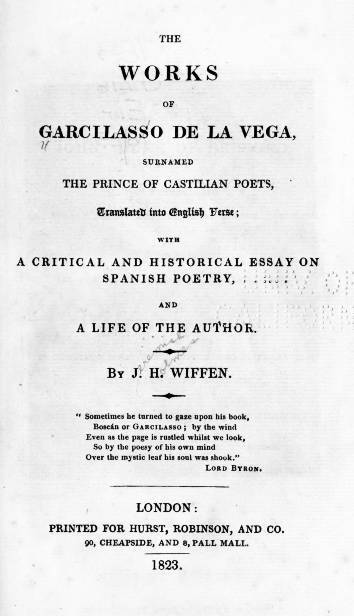
The Project Gutenberg eBook of The Works of Garcilasso de la Vega, Surnamed the Prince of Castilian Poets, Translated into English Verse
Title: The Works of Garcilasso de la Vega, Surnamed the Prince of Castilian Poets, Translated into English Verse
Author: Garcilaso de la Vega
Translator: Jeremiah Holmes Wiffen
Release date: July 10, 2015 [eBook #49410]
Most recently updated: October 24, 2024
Language: English
Credits: Produced by Josep Cols Canals, Judith Wirawan, and the
Online Distributed Proofreading Team at http://www.pgdp.net
(This file was produced from images generously made
available by The Internet Archive/American Libraries.)
THE
WORKS
OF
GARCILASSO DE LA VEGA,
ETC. ETC.
LONDON:
PRINTED BY JAMES MOYES, GREVILLE STREET.
Garcilasso de la Vega.
Nat. 1503.Ob. 1536.
Published March 1st. 1823. by Messrs. Hurst & Robinson.
THE
WORKS
OF
GARCILASSO DE LA VEGA,
SURNAMED
THE PRINCE OF CASTILIAN POETS,
Translated into English Verse;
WITH
A CRITICAL AND HISTORICAL ESSAY ON SPANISH POETRY,
AND
A LIFE OF THE AUTHOR.
By J. H. WIFFEN.
Boscán or Garcilasso; by the wind
Even as the page is rustled whilst we look,
So by the poesy of his own mind
Over the mystic leaf his soul was shook."
Lord Byron.
LONDON:
PRINTED FOR HURST, ROBINSON, AND CO.
90, CHEAPSIDE, AND 8, PALL MALL.
1823.
TO
JOHN, DUKE OF BEDFORD,
IN PUBLIC LIFE
THE STEADY FRIEND AND ASSERTOR OF OUR LIBERTIES;
IN PRIVATE LIFE
ALL THAT IS GENEROUS, DIGNIFIED, AND GOOD;
This Translation,
IN GRATEFUL ACKNOWLEDGMENT OF THE LITERARY EASE
THAT HAS LED TO ITS PRODUCTION,
IS, WITH DEEP RESPECT AND ADMIRATION,
Inscribed
BY THE AUTHOR.
PREFACE.
Till within the last few years but little attention appears to have been paid in England to Castilian verse. Our earliest poets of eminence, Chaucer and Lord Surrey, struck at once into the rich field of Italian song, and by their imitations of Petrarch and Boccaccio, most probably set the fashion to their successors, of the exclusive study which they gave to the same models, to the neglect of the cotemporary writers of other nations, to those at least of Spain. Nor is this partiality to the one and neglect of the other to be at all wondered at; for neither could they have gone to more suitable sources than the Tuscans for the harmony and grace which the language in its first aspirations after refinement wanted, nor did the Spanish poetry of that period offer more to recompense the researches of the student than dry legends, historical ballads, or rude imitations of the Vision of Dante. But it is a little singular that this inattention should have continued when the influence of the Emperor Charles the Fifth became great in the courts of Europe, and the Spanish language, chastised into purity and elegance by Boscán, Garcilasso, and their immediate successors, obtained a currency amongst the nations correspondent with the extent of his conquests. The hostile attitude in which England stood to Spain under Elizabeth, may be regarded as perhaps the principal cause why we meet in the constellation of writers that gave lustre to her reign, with so few traces of their acquaintance with the literature of that country; whilst the strong jealousy of the nation to Spanish influence, catholicism, and jesuitical intrigue, no less than the purely controversial spirit of the times, had, I doubt not, their full effect under the Stuarts, in deterring the scholars of that period from any close communion with her poets. Meanwhile the corruption of style which had so baneful an effect on her literature, was silently going forward under Gongora, Quevedo, and their numerous imitators. Before the reign of Philip the Fifth, this corruption had reached its height; his accession to the crown of Spain, and the encouragement he gave to letters, might have re-established the national literature in its first lustre, if the evil had not struck root so deeply, and if another cast of corrupters had not opposed themselves to the views of this monarch, viz. the numerous translators of French works, who disfigured the idiom by forming a French construction with native words. Thus the curiosity of the poets of Queen Anne's time, if it was ever excited, must have been speedily laid asleep; and (though we may notice in Dryden, and perhaps in Donne, a study of Castilian,) it was scarcely before the middle of the last century that this study began permanently to tinge our literature. To Mr. Hayley, who first directed public attention to the great merits of Dante, must be ascribed the praise also of first calling our notice in any great degree to the Spanish poets. Southey followed, and by his "Chronicle of the Cid" and "Letters from Spain," quickened the curiosity excited by Mr. Hayley's analysis and translated specimens of the Araucana of Ercilla. Lord Holland's admirable dissertation on the genius and writings of Lope de Vega, gave us a clearer insight into the literature of Spain, whilst the French invasion brought us into a more intimate connexion and acquaintance with her chivalrous people; nor could the many English visitants which this drew to her shores view the remains which she keeps of Arabian and Moorish magnificence, or even listen to her language, which preserves such striking vestiges of oriental majesty, without having their imagination led back to her days of literary illumination, and without deriving some taste for the productions of her poets. The struggle which she then made, and that which she is now making, first against the unhallowed grasp of foreign coercion, and next of that priestly tyranny which has so long cramped her political and intellectual energies, have excited in every British bosom the most cordial sympathy; and it is evident that from these causes, there is a growing attention amongst us to her language and literature. Since the present volume was begun, a translation has appeared of the excellent work of Bouterewek, on Spanish and Portuguese poetry; another is going through the press of Sismondi "Sur la Littérature du Midi de l'Europe;" and Mr. Lockhart has just given us a choice selection of those beautiful old Spanish ballads, which, as Mr. Rogers observes of the narratives of the old Spanish chroniclers, 'have a spirit like the freshness of waters at the fountain head, and are so many moving pictures of the actions, manners, and thoughts of their cotemporaries;' like rough gems redeemed from an oriental mine, they have assumed under his hand a polish and a price that must render them indispensable to the cabinets of our men of taste. Nor, in speaking of those whose labours have tended to spread a knowledge of Hesperian treasure, must we pass over without due praise the masterly notices on Spanish poetry, which Mr. Frere and Mr. Bowring are understood to have given forth in the Quarterly and Restrospective Reviews.
In this situation of things, it may not be wholly unacceptable to the public to receive, though from an inferior hand, a translation of Garcilasso de la Vega, the chastest and perhaps the most celebrated of the poets of Castile. A desire to vary the nature of my pursuits, with other reasons not necessary to mention, first led me to his pages; but the pleasure I derived at the outset from his pastoral pictures and harmony of language, soon settled into the more serious wish to make his merits more generally known, and thus to multiply his admirers amongst a people ever inclined, sooner or later, to do justice to foreign talent. I would, however, deprecate any undue expectations that may be raised by the high title bestowed on Garcilasso by his countrymen—a title conferred in their enthusiastic admiration of his success in giving suddenly so new and beautiful an aspect to the art, and in elevating their language to a point of perfection, truly surprising, if we consider all the circumstances connected with that revolution; but this peculiar merit, so far at least as relates to the language, must necessarily from its nature be wholly untranslateable, and he is thus compelled to lose much of the consideration with the merely English reader that is his real due. But it would be unjust in an English reader, who glances over the subjects of his fancy, to conclude that because Garcilasso has written little but Eclogues and Sonnets, compositions, he may say, at best but of inferior order, he is therefore worthy of but little regard in this age of poetical wonders. I will be bold to assert, that the poets, and readers of the poets of the day, will be no way degraded by coming in contact with his simplicity: our taste for the wilder flights of imagination has reached a height from which the sooner we descend to imitate the nature and unassuming ease of simpler lyrists—the Goldsmiths and Garcilassos of past ages, the better it may chance to be both for our poetry and language. Nor let the name of Eclogues affright the sensitive reader that has in his recollection the Colins and Pastoras that sickened his taste some thirty or forty years ago. The pastorals, as they were called, of that period, are no more to be compared with the rime boschereccie of Garcilasso, than the hideous distortion of the leaden Satyr that squirts water from its nostrils in some city tea-garden, and that is pelted at irresistibly by every boy that passes,—with the marble repose and inviolable beauty of the Piping Faun in a gallery of antique sculptures.
Whilst employed on this translation, I was struck with the lucid view which Quintana gives, in the Essay prefixed to his "Poesias selectas Castellanas," of the History of Spanish Poetry, and I thought that it might be made yet more serviceable to the end which its author had in view, by a translation that would disclose to the English reader what he might expect from a cultivation of the Spanish language. The only fault perhaps of this Essay is, that Quintana has judged his native poets too strictly and exclusively by the rules of French criticism and French taste, which ought not I think to be applied as tests to a literature so wholly national as the Spanish is, so especially coloured by the revolutions that have taken place upon the Spanish soil, and so utterly unlike that of any other European nation. Still the Essay will be found, if I mistake not, as interesting and instructive to others as it has proved to me: from it a more compact and complete view of the art in Spain may be gathered, than from more extensive histories of the kind; nor was I uninfluenced in my purpose by the advantage which the judgment of a native, himself one of the most distinguished of the living poets and lettered men of Spain, would have over any original Essay derived from the writings of foreigners, who, whatever may be their critical sagacity and literary repute, can neither be supposed to be so intimately acquainted with the compositions of which they treat, nor such good judges of Castilian versification.
It is time to conclude these prefatory observations; yet I cannot forego the pleasure of first acknowledging the great advantage I have derived from the kind revision of my MSS. by the Rev. Blanco White. That gentleman's desire to aid in any thing that might seem to serve the reputation of his country—the country, whose customs and institutions he has pourtrayed with such vivid interest, originality, and talent, joined to his native goodness of heart, could alone have led him to volunteer his services, in a season of sickness, to one nearly a stranger; and if I submit the following pages to the public with any degree of confidence in its favour, it is from the many improvements to which his friendly and judicious criticisms have led.
To Mr. Heber also, who, with the spirit of a nobleman, throws open so widely the vast stores of his invaluable library, I feel bound to express my obligations for the use of Herrera's rare edition of the works of Garcilasso, which I had in vain sought for in other collections of Spanish books, both public and private: his voluntary offer of this, on a momentary acquaintance, enhances in my mind the value of the favour.
The astonishing number of authors which the Bibliotheca Hispanica of Don Nicolás Antonio displays, is a sufficient proof of the great intellect that Spain would be capable of putting forth, if her mind had a play proportioned to its activity. No nation has given to the light so many and such weighty volumes upon Aristotle, so many eminent writers in scholastic theology, so many and such subtle moral casuists, or so many profound commentators on the Codices and Pandects. And if she has produced these works in ages when the withering influence of political and religious despotism, like the plant which kills the sylvan it embraces, searched into every coigne of her literary fabric, what may not be expected from her, when the present distractions, fomented by the accursed gold of France, are composed into tranquillity, and the inquiries of her talented men embrace under free institutions a wider range of science than they have yet dared to follow, except by stealth! There is not one lettered Englishman but will rejoice with his whole heart when the winged Genius that is seen in Quintana's poems, chained to the gloomy threshold of a Gothic building, looking up with despondency to the Temple of the Muses, may be represented soaring away for ever from the irons that have eaten into its soul.—
The present work will be shortly followed by a Spanish Anthology, containing translations of the choicest Specimens of the Castilian Poets, with short biographical notices, and a selection of the Morisco ballads.
Woburn Abbey,
4th Month 8th, 1823.
CONTENTS.
| PAGE | ||
| ESSAY ON SPANISH POETRY | 1 | |
| LIFE OF GARCILASSO | 93 | |
| VERSES ON THE DEATH OF GACILASSO | 169 | |
| ECLOGUES. | ||
| I. | TO DON PEDRO DE TOLEDO, VICEROY OF NAPLES | 181 |
| II. | 196 | |
| III. | TO THE LADY MARIA DE LA CUEVA, COUNTESS OF UREÑA | 266 |
| ELEGIES. | ||
| I. | TO THE DUKE OF ALVA | 283 |
| II. | TO BOSCA'N | 293 |
| EPISTLE TO BOSCA'N | 300 | |
| ODES, &c. | ||
| I. | TO THE FLOWER OF GNIDO | 305 |
| II. | TO HIS LADY | 309 |
| III. | TO THE SAME | 312 |
| IV. | WRITTEN IN EXILE | 315 |
| V. | THE PROGRESS OF PASSION FOR HIS LADY | 319 |
| SONNETS. | ||
| I. | "WHEN I SIT DOWN TO CONTEMPLATE MY CASE." | 327 |
| II. | "AT LENGTH INTO THY HANDS I COME—TO DIE." | 328 |
| III. | "AWHILE MY HOPES WILL TOWER ALOFT IN AIR." | 329 |
| IV. | "LADY, THY FACE IS WRITTEN IN MY SOUL." | 330 |
| V. | "BY RUGGED WAYS I REACH TOWARDS A BOURN." | 331 |
| VI. | "HE WHO HAS LOST SO MUCH, STERN DEITY." | 332 |
| VII. | "FROM THAT ILLUMINED FACE, PURE, MILD, AND SWEET." | 333 |
| VIII. | "IF I LIVE ON, DEAR LADY, IN THE VOID." | 334 |
| IX. | "OH LOVELY GIFTS, BY ME TOO FATAL FOUND!" | 335 |
| X. | "IN ORDER TO RESTRAIN THIS MAD DESIRE." | 336 |
| XI. | "STRANGE ICY THROES THE ARMS OF DAPHNE BIND." | 337 |
| XII. | "AS A FOND MOTHER, WHOSE SICK INFANT LIES." | 338 |
| XIII. | "IF LAMENTATIONS AND COMPLAINTS COULD REIN." | 339 |
| XIV. | EPITAPH ON HIS BROTHER, D. FERNANDO DE GUZMAN. | 340 |
| XV. | "FATE! IN MY GRIEFS SOLE AGENT, HOW HAVE I." | 341 |
| XVI. | "THINKING THE PATH I JOURNEYED LED ME RIGHT." | 342 |
| XVII. | "IF I AM WAX TO THY SWEET WILL, AND HENCE." | 343 |
| XVIII. | TO JULIO CÆSAR CARACCIOLA | 344 |
| XIX. | "SO STRONGLY ARE THE CRUEL WINDS COMBINED." | 345 |
| XX. | TO D. ALONSO DE AVALO, MARQUIS DEL VASTO. | 346 |
| XXI. | "WITH KEEN DESIRE TO SEE WHAT THE FINE SWELL." | 347 |
| XXII. | "AS, LOVE, THE LILY AND PURPUREAL ROSE." | 348 |
| XXIII. | "PROSTRATE ON EARTH THE LOFTY COLUMN LIES." | 349 |
| XXIV. | FROM AUSIAS MARCH | 350 |
| XXV. | TO BOSCA'N | 351 |
| XXVI. | "WILD DOUBTS, THAT FLOATING IN MY BRAIN DELIGHT." | 352 |
| XXVII. | "WITHIN MY SPIRIT WAS CONCEIVED IN TRAIN." | 353 |
| XXVIII. | "I AM FOR EVER BATHED IN TEARS, I REND." | 354 |
| XXIX. | "PAST NOW THE COUNTRIES OF THE MIDLAND MAIN." | 355 |
| XXX. | TO BOSCA'N, FROM GOLETTA | 356 |
| XXXI. | "I THANK THEE, HEAVEN, THAT I HAVE SNAPT IN TWAIN." | 357 |
| XXXII. | TO MARIO GALEOTA | 358 |
| XXXIII. | "MY TONGUE GOES AS GRIEF GUIDES IT, AND I STRAY." | 359 |
| XXXIV. | "ENTERING A VALLEY IN A SANDY WASTE." | 360 |
| XXXV. | "LOUD BLEW THE WINDS IN ANGER AND DISDAIN." | 361 |
| XXXVI. | TO THE MARCHIONESS OF PADULA | 362 |
| XXXVII. | "FAIR NAIADS OF THE RIVER| THAT RESIDE." | 363 |
| TO HIS LADY, HAVING MARRIED ANOTHER | 364 | |
| TO THE SAME | 365 | |
| ON A DEPARTURE | 366 | |
| IMPROMPTU TO A LADY | 367 | |
| TRANSLATION FROM OVID | 368 | |
| COMMENT ON A TEXT | 369 | |
| TO FERNANDO DE ACUÑA | 370 | |
| APPENDIX | 371 | |
⁂ The Drawing of Garcilasso is by Mr. Louis Parez; the Designs and Engravings of the Wood-cuts by Mr. S. Williams.
ESSAY ON SPANISH POETRY.
CHAPTER I.
OF THE ORIGIN OF SPANISH POETRY, AND ITS PROGRESS TO JUAN DE MENA.
To poetry is given by general assent the first place amongst the imitative arts. Whether we regard the antiquity of its origin, the range of objects which it embraces, the duration and pleasure of its impressions, or the good it produces, we must be struck alike with its dignity and importance; and the history of its advances must ever go hand in hand with that of the other branches of human improvement. It is said that poetry and music civilized the nations; and this proposition, which, rigorously examined, is exaggerated, and even false, shows at least the influence that both have had in the formation of society. The lessons given by the first philosophers to men, the first laws, the most ancient systems, all were written in verse; whilst the fancy of the poets, the flattering pictures and pomp of rites, which they invented, interrupted, with a pleasing and necessary relaxation, the fatigue of rural labours.
It is true that poetry does not afterwards present itself with the dignity attendant upon the absolute and exclusive exercise of these various services; yet it preserves an influence so great in our instruction, in our moral perfection, and our pleasures, that we may consider it as a dispenser of the same benefits, though under different forms. It serves as an attraction to make truth amiable, or as a veil to screen her; it instructs infancy in the schools, awakens and directs the sensibilities of youth, ennobles the spirit with its maxims, sublimes it with its pictures, strews with flowers the path of virtue, and unbars to heroism the gates of glory. So many advantages, united with charms so fascinating, have excited in mankind an admiration and a gratitude eternal.
Its primary and essential business is to paint nature for our delight, as that of philosophy is to explain her phenomena for our instruction. Thus, whilst the philosopher, observing the stars, inquires into their proportions, their distances, and the laws of their motion, the poet contemplates and transfers to his verses the impression they make upon his fancy and feelings, the lustre with which they shine, the harmony that reigns amongst them, and the benefits which they dispense to the earth. The difficulty of fulfilling worthily and well the object of poetry is extreme, even though, considering the rapid progress which it sometimes makes, it might appear easy. From the vague maxim or insipid tale, rendered vigorous by the charm of an uncertain rhyme or rude measure, to the harmony and sustained elegance of the Iliad or Eneid; from the waggon and winelees of Thespis to the grand spectacle offered by the Iphigénie or Tancrède, the distance is immense, and can only be overcome by the greatest efforts of application and genius.
Some nations, the favourites of Heaven, accomplish it with more promptitude, and pass quickly from the feebleness of first essays to the vigour of thoughts more grand, and combinations more perfect. Such was the case with Greece, where the genius of poetry, scarcely numbering a few moments of infancy, grew and raised itself to the height of producing the immortal poesies of Homer. Such, though with less brilliancy and perfection, was the case with modern Italy, where in the midnight of the barbarous ages that succeeded Roman refinement, appeared on the sudden Dante and Petrarch, bringing with them the dawn of the arts and of good taste. Other nations, less fortunate, wrestle entire centuries with rudeness and ignorance, and become more slowly sensible to the blandishments of elegance and harmony; and perfection, in the degree that men can attain it, is conquered by them solely by force of time and toil. This is found to be the case with the greater number of modern nations, and amongst them, we must of necessity mention Spain.
In Spain, as in almost all countries, written verse was anterior to prose; the Poem of the Cid having appeared, being the first known book in Castilian, as well as the first work of poetry. In the midst of the confusion of languages caused by the invasion of the northern barbarians, the Romance, which was afterwards to be presented with so much splendour and majesty in the writings of Garcilasso, Herrera, Rioja, Cervantes, and Mariana, was assuming a definite form. Considering the work for the argument alone, few would have the advantage over it, at the same time that few warriors might dispute with Rodrigo de Bivar the palm of prowess and heroism. His glory, which eclipsed that of all the kings of his time, has been transmitted from age to age down to the present, by means of the infinite variety of fables which ignorant admiration has accumulated in his history. Consigned to poems, to tragedies, to comedies, to popular songs, his memory, like that of Achilles, has had the fortune to strike forcibly and occupy the fancy; but the Castilian hero, superior without doubt to the Greek in strength and in virtue, has not had the advantage of meeting with a Homer.
It was not possible to meet with one at the period when the rude writer of that poem sat down to compose it. With a language altogether uncouth, harsh in its terminations, vicious in its construction, naked of all culture and harmony; with a versification devoid of any certain measure and marked rhymes, and a style full of vicious pleonasms and ridiculous puerilities, destitute of the graces with which imagination and elegance adorn it; how was it possible to produce a work of genuine poetry, that should sweetly occupy the mind and ear? The writer is not however so wanting in talent, as not to manifest from time to time some poetic design, now in invention, now in sentiment, and now in expression. If, as Don Tomas Sanchez, the editor of this and other poems previous to the fifteenth century, suspects, there be wanting to that of the Cid merely a few verses at the beginning, it is surely a mark of judgment in the author that he disencumbered his work of all the particulars of his hero's life anterior to his banishment by Alfonso the Sixth. There the true glory of Rodrigo begins, and there the poem commences; relating afterwards his wars with the Moors and with the Count of Barcelona, his conquests, the taking of Valencia, his reconciliation with the king, the affront offered to his daughters by the Infantes of Carrion, the solemn reparation and vengeance which the Cid took for it, and his union with the royal houses of Arragon and Navarre, with which the work finishes, slightly indicating the epoch of the hero's death. In the course of his story, the writer is not wanting in vivacity and interest, great use of the dialogue, which is a point most to the purpose in animating the narration, and in occasional pictures that are not without merit in their art and composition. Such, amongst others, is the farewell of Rodrigo and Ximena, in the church of San Pedro de Cardeña, when he departs to fulfil the royal mandate. Ximena, prostrate on the steps of the altar where divine service is celebrated, makes a prayer to the Eternal in behalf of her husband, which concludes thus:
Thee I adore, in thee I trust with all my heart and mind;
And to divine San Pedro pray to help me in praying still,
That thou wilt shield my noble Cid the Campeador from ill,
And since we now must part, again to my embrace restore!'
Her orison thus made, high mass is offered, and is o'er;
They leave the church, they mount their barbs—with sad and solemn pace,
The Cid to Donna Ximena went to take a last embrace;
Donna Ximena, she bent down to kiss the hand of the Cid,
Sore weeping with her bright black eyes, she knew not what she did;
He turned, and kissed his little girls with all a father's love,
'Bless you, my girls,' he said, 'I you commend to God above,
To your sweet mother and ghostly sire! When we shall meet again
God only knows, but now we part.' Not one could say Amen.
Thus, weeping in a way that none e'er saw the like, at length
They part like nail from finger torn with agonizing strength.
My Cid with his vassals thought to ride, and took the onward track;
Waiting for all, his plumed head he evermore turned back.
Out then, with gallant unconcern, Don Alvar Fanez spake:
'Come, come, my Cid, what means all this? cheer up for goodness' sake;
In happy hour of woman born! fast wears the morn away;
Since we must go, let us begone, nor dally with delay;
A happier time shall turn to joy the very ills we rue;
God, who has given us souls to feel, shall give us counsel too.'
There is doubtless a great distance between this parting and that of Hector and Andromache in the Iliad, but the picture of a hero's sensibility at the time of separation from his family is always pleasing; beautiful is that turning of his head when at a distance, and fine the idea that those same warriors to whom he gives in battle an example of fortitude and constancy, should then fortify and cheer him. Superior, in my opinion, for art and dramatic effect, is the act of accusation which the Cid makes against his traitor sons-in-law before the Cortes assembled to receive it. The first shock of the Infantes and the champions of Rodrigo in the lists has much animation and even style.
Bowed are their crested helms until they touch the saddle-bow;
Fiercely they strike their horses' sides with streaming rowels red,
And onward to the encounter run: earth trembles to their tread.
****
Don Martin Antolinez, with the drawing of his sword,
Illumined all the field.——
No record is left for us to ascertain who was the author of this first faint breath of Spanish poetry. Two writers flourished in the following age, in whom we trace the improvement and progress which the versification and language had now made. In the sacred poems of Don Gonzalo de Bercéo, and in the Alexandro of Juan Lorenzo, are discovered more fluency, more connexion, and forms more determinate. The march of these authors, although difficult, is not so trailing and jejune as that of the preceding poet. The difference that subsists between the two later poets is, that Bercéo, if we except his narrative and some of his moral counsels, shows neither copiousness of erudition, variety of knowledge, nor fancy for invention; a deficiency arising from the nature of his subjects, which for the most part turn upon legends of the saints. Juan Lorenzo, on the contrary, is more rapt with his subject, and manifests an information so extensive in history, mythology, and moral philosophy, as to make his work the most important of all that were written in that age. The following verses on the same subject may serve to show the style of both.
On pilgrimage, came one day to a mead,
Green, and well-peopled with fair plants, which blowing
Made it a place desirable indeed
To a tired traveller; the sweet-scented flowers
Gave forth a smell that freshened not alone
Men's faces, but their fancies, whilst in showers
Clear flowing fountains to the sky were thrown,
Each singing to itself as on it rolled,
Warm in midwinter, and in summer cold."
Bercéo.
When merry music make the birds in boughs,
Dressed are the meads with beauty far and wide,
And sighs the ladye that has not a spouse:
Tide sweet for marriages; flowers and fresh winds
Temper the clime; in every village near
Young girls in bevies sing, and with blythe minds
Make each to each good-wishes of the year.
Young maids and old maids, all are out of doors,
Melting with love, to gather flowers at rest
Of noon—they whisper each to each, amours
Are good—and the most tender deem the best."
Lorenzo.
Alfonso the Tenth was then reigning in Castile; a prince, to whom, to render his glory complete, fortune ought to have given better sons, and vassals less ferocious. Posterity has given him the surname of The Wise; and beyond all doubt it was merited by the extraordinary man, who in an age of darkness could unite in himself the paternal and beneficent regards of the legislator, the profound combinations of the mathematician and astronomer, the talent and knowledge of the historian, and the laurels of the poet. He it was who raised his native language to its due honours, when he gave command that the public instruments, which before were engrossed in Latin, should be written in Spanish. Mariana, less favourable to his merits, asserts that this measure was the cause of the profound ignorance that afterwards ensued. But what was known before? The Latin then in use was as barbarous, was yet more barbarous than the Romance. The new uses to which the Romance was applied by that decree, the dignity and authority it acquired, influenced its culture, its polish, and its progress. Can it by any chance be believed that these advantages of the language had no literary influence, or that there can be diffused knowledge and a national literature, whilst the native language remains uncultivated? The assertion of Mariana then must be considered as a result of the somewhat pedantic prejudices of the age in which he lived; but, even leaving out of consideration the political convenience of the law, let us regard it as one of the causes, which having had an influence on the improvement of the language, must necessarily have influenced also the advancement of Spanish poetry.
There is an entire book of Cantigas or Letras to be sung, composed in the Galician dialect by this king, specimens of which are to be seen in the Anales de Sevilla of Ortiz de Zuñiga; another entitled El Tesoro, which is a treatise on the philosopher's stone, as far as can be judged, for to the present day a great part remains undeciphered; and to him likewise is attributed that of Las Querellas, of which two stanzas only are preserved. Both are written in verses of twelve syllables, with rhymes crossed like those of the sonnet, to which is given the name of coplas de arte mayor, and which was a real improvement in Spanish poetry; as the rhythm of the Alexandrine verse, the measure used both by Bercéo and Lorenzo, was insufferable from its heaviness and monotony. Let us compare the coplas with which the book El Tesoro commences, with the stanzas alluded to.