
WeRead Powered by ReaderPub
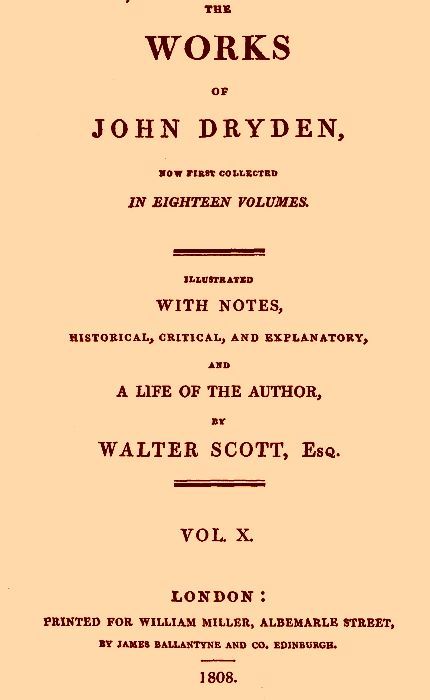
The works of John Dryden, now first collected in eighteen volumes. Volume 10 cover

The works of John Dryden, now first collected in eighteen volumes. Volume 10

Chapter 44: A PROLOGUE.
Open in WeRead

About This Book

This volume assembles a range of occasional and argumentative poems that move between theological debate, political commentary, and satirical attack. It includes an epistolary meditation on faith and reason, a formal funeral pindaric ode, a multipart allegorical poem confronting religious factions, occasional celebratory verses, a collection of stage prologues and epilogues, and a mock-heroic satire aimed at a literary rival. The pieces combine classical forms, polemical rhetoric, and comic invective, and are presented with editorial notes that clarify historical references and interpretive points.

Poets, your subjects, have their parts assigned,
To unbend, and to divert their sovereign's mind;
When tired with following nature, you think fit
To seek repose in the cool shades of wit,
And, from the sweet retreat, with joy survey
What rests, and what is conquered, of the way.
Here, free yourselves from envy, care, and strife,
You view the various turns of human life;
Safe in our scene, through dangerous courts you go,
And, undebauched, the vice of cities know.
Your theories are here to practice brought,
As in mechanic operations wrought;
And man, the little world, before you set,
As once the sphere of crystal[341] shewed the great.
Blest sure are you above all mortal kind,
If to your fortunes you can suit your mind;
Content to see, and shun, those ills we show,
And crimes on theatres alone to know.
With joy we bring what our dead authors writ,
And beg from you the value of their wit:
That Shakespeare's, Fletcher's, and great Jonson's claim,
May be renewed from those who gave them fame.
None of our living poets dare appear;
For muses so severe are worshipped here,
}
That, conscious of their faults, they shun the eye,  }
And, as profane, from sacred places fly,  }
Rather than see the offended God, and die.  }
We bring no imperfections, but our own;
Such faults as made are by the makers shown;
And you have been so kind, that we may boast,
The greatest judges still can pardon most.
Poets must stoop, when they would please our pit,
Debased even to the level of their wit;
Disdaining that, which yet they know will take,
Hating themselves what their applause must make.
But when to praise from you they would aspire,
Though they, like eagles, mount, your Jove is higher.
So far your knowledge all their power transcends,
As what should be, beyond what is, extends.

EPILOGUE
SPOKEN
AT OXFORD, BY MRS MARSHALL.


The date of this Epilogue is fixed by that of Bathurst's vice-chancellorship, which lasted from 3d October, 1673, to 9th October 1675.

Oft has our poet wished, this happy seat
Might prove his fading muse's last retreat:
I wondered at his wish, but now I find
He sought for quiet, and content of mind;
Which noiseful towns, and courts, can never know,
And only in the shades, like laurels, grow.
Youth, ere it sees the world, here studies rest,
And age, returning thence, concludes it best.
What wonder if we court that happiness
Yearly to share, which hourly you possess,
Teaching e'en you, while the vext world we show,
Your peace to value more, and better know?
'Tis all we can return for favours past,
Whose holy memory shall ever last,
For patronage from him whose care presides
O'er every noble art, and every science guides;[342]
Bathurst, a name the learned with reverence know,
And scarcely more to his own Virgil owe;
Whose age enjoys but what his youth deserved,
To rule those muses whom before he served.
His learning, and untainted manners too,
We find, Athenians, are derived to you;
}
Such antient hospitality there rests  }
In yours, as dwelt in the first Grecian breasts,  }
Whose kindness was religion to their guests.  }
}
Such modesty did to our sex appear,  }
As, had there been no laws, we need not fear,  }
Since each of you was our protector here.  }
Converse so chaste, and so strict virtue shown,
As might Apollo with the muses own.
Till our return, we must despair to find
Judges so just, so knowing, and so kind.

ORIGINAL
PROLOGUE TO CIRCE,
BY
DR CHARLES D'AVENANT, 1675.


Dr Charles D'Avenant, the author of "Circe," was son of the Rare Sir William D'Avenant, whom he succeeded as manager of the Duke's company. He practised physic in Doctor's Commons, which he afterwards abandoned for politics. He became a member of Parliament, and inspector of the exports and imports, of which office he died possessed in 1714. He wrote many tracts upon political subjects, especially those connected with the revenue. "Circe," his only drama, is an opera, to which Bannister composed the music. Besides the Prologue by our author, it was honoured by an Epilogue by the famous Rochester, and thus graced was received favourably. It contains some good writing, considering it was composed at the age of nineteen; a circumstance alluded to in the following Prologue. The original Prologue is from the 4to edition of "Circe," London, 1677. It was afterwards much improved, or rather entirely re-written, by our author.

Were you but half so wise as you're severe,
Our youthful poet should not need to fear;
To his green years your censures you would suit,
Not blast the blossom, but expect the fruit.
The sex, that best does pleasure understand,
Will always chuse to err on t'other hand.
They check not him that's aukward in delight,
But clap the young rogue's cheek, and set him right.
Thus heartened well, and fleshed upon his prey,
The youth may prove a man another day.
For your own sakes, instruct him when he's out,
You'll find him mend his work at every bout.
}
When some young lusty thief is passing by,  }
How many of your tender kind will cry,—  }
"A proper fellow! pity he should die!  }
He might be saved, and thank us for our pains,
There's such a stock of love within his veins."
These arguments the women may persuade,
But move not you, the brothers of the trade,
}
Who, scattering your infection through the pit,  }
With aching hearts and empty purses sit,  }
To take your dear five shillings worth of wit.  }
The praise you give him, in your kindest mood,
Comes dribbling from you, just like drops of blood;
And then you clap so civilly, for fear
The loudness might offend your neighbour's ear,
That we suspect your gloves are lined within,
For silence sake, and cotton'd next the skin.
From these usurpers we appeal to you,
The only knowing, only judging few;
You, who in private have this play allowed,
Ought to maintain your suffrage to the crowd.
The captive, once submitted to your bands,
You should protect from death by vulgar hands.

PROLOGUE TO CIRCE,
AS CORRECTED BY DRYDEN.


Were you but half so wise as you're severe,
Our youthful poet should not need to fear;
To his green years your censures you would suit,
Not blast the blossom, but expect the fruit.
The sex, that best does pleasure understand,
Will always choose to err on t'other hand.
They check not him that's aukward in delight,
But clap the young rogue's cheek, and set him right.
Thus heartened well, and fleshed upon his prey,
The youth may prove a man another day.
Your Ben and Fletcher, in their first young flight,
Did no Volpone, nor no Arbaces write;[343]
}
But hopped about, and short excursions made  }
From bough to bough, as if they were afraid,  }
And each was guilty of some Slighted Maid.[344]  }
Shakespeare's own muse her Pericles first bore;[345]
The Prince of Tyre was elder than the Moor:
'Tis miracle to see a first good play;
All hawthorns do not bloom on Christmas-day.[346]
A slender poet must have time to grow,
And spread and burnish as his brothers do.
Who still looks lean, sure with some pox is curst,
But no man can be Falstaff-fat at first.
Then damn not, but indulge his rude essays,
Encourage him, and bloat him up with praise,
That he may get more bulk before he dies;
He's not yet fed enough for sacrifice.
Perhaps, if now your grace you will not grudge,
He may grow up to write, and you to judge.

EPILOGUE
INTENDED TO HAVE BEEN SPOKEN BY
THE LADY HEN. MAR. WENTWORTH.
WHEN CALISTO WAS ACTED AT COURT, IN 1675.


"Calisto, or the Chaste Nymph," was a masque written by John Crowne, who, by the interference of Rochester, was employed to compose such an entertainment to be exhibited at court, though this was an encroachment on the office of Dryden, the poet laureat. The principal characters were represented by the daughters of the Duke of York, and the first nobility. The Lady Mary, afterwards Queen, to whom the masque was dedicated, acted Calisto; Nyphe was represented by the Lady Anne, who also succeeded to the throne; Jupiter, by Lady Harriot Wentworth; Psecas, by Lady Mary Mordaunt; Diana, by Mrs Blague, and Mercury by Mrs Sarah Jennings, afterwards Duchess of Marlborough. Among the attendant nymphs and dancers were the Countesses of Pembroke and of Derby, Lady Catharine Herbert, Mrs Fitzgerald, and Mrs Fraser. The male dancers were the Duke of Monmouth, Viscount Dunblaine, Lord Daincourt, and others of the first quality. Although the exhibition of this masque, which it was the privilege of his office to have written, must have been somewhat galling to Dryden, we see that he so far suppressed his feelings as to compose the following Epilogue, which, to his farther mortification, was rejected, through the interference of Rochester.

The Lady Henrietta Maria Wentworth, Baroness of Nettlested, who acted the part of Jupiter on the present occasion, afterwards adapted her conduct to that of Calisto, and became the mistress of the Duke of Monmouth. He was so passionately attached to her, that upon the scaffold he vindicated their intercourse by some very warm and enthusiastic expressions, and could by no means be prevailed on to express any repentance of it as unlawful. This lady died about a year after the execution of her unfortunate lover, in 1685. Her mother, Lady Wentworth, ordered a monument of L. 2000 value to be erected over her in the church of Teddington, Bedfordshire.

As Jupiter I made my court in vain;
I'll now assume my native shape again.
I'm weary to be so unkindly used,
And would not be a God, to be refused.
State grows uneasy when it hinders love;
A glorious burden, which the wise remove.
Now, as a nymph, I need not sue, nor try
The force of any lightning but the eye.
Beauty and youth, more than a god command;
No Jove could e'er the force of these withstand.
'Tis here that sovereign power admits dispute;
Beauty sometimes is justly absolute.
Our sullen Cato's, whatsoe'er they say,
Even while they frown and dictate laws, obey.
You, mighty sir, our bonds more easy make,
And, gracefully, what all must suffer, take;
Above those forms the grave affect to wear,
For 'tis not to be wise to be severe.
True wisdom may some gallantry admit,
And soften business with the charms of wit.
These peaceful triumphs with your cares you bought,
And from the midst of fighting nations brought.[347]
You only hear it thunder from afar,
And sit, in peace, the arbiter of war:
Peace, the loathed manna, which hot brains despise,
You knew its worth, and made it early prize;
And in its happy leisure, sit and see
The promises of more felicity;
Two glorious nymphs of your own godlike line,
Whose morning rays, like noontide, strike and shine;[348]
Whom you to suppliant monarchs shall dispose,
To bind your friends, and to disarm your foes.

EPILOGUE
TO THE
MAN OF MODE; OR SIR FOPLING FLUTTER.
BY
SIR GEORGE ETHEREGE, 1676.


This play, which long maintained a high degree of reputation on the stage, presents us with the truest picture of what was esteemed good breeding and wit in the reign of Charles II. All the characters, from Dorimant down to the Shoemaker, were either really drawn from the life, or depicted so accurately according to the manners of the times, that each was instantly ascribed to some individual. Sir Fopling Flutter, in particular, was supposed to represent Sir George Hewit, mentioned in the Essay on Satire, and who seems to have been one of the most choice coxcombs of the period. A very severe criticism in the Spectator, pointing out the coarseness as well as the immorality of this celebrated performance, had a great effect in diminishing its popularity. The satire being in fact personal, it followed as a matter of course, that the Prologue should disclaim all personality, that being an attribute to be discovered by the audience, but not avowed by the poet. Dryden has accomplished this with much liveliness, and enumerates for our edification the special fopperies which went to make up a complete fine gentleman in 1676—differing only in form from those required in 1806, excepting that the ancient beau needed, to complete his character, a slight sprinkling of literary accomplishment, which the modern has discarded with the "sacred periwig."

Most modern wits such monstrous fools have shown,
They seem not of heaven's making, but their own.
Those nauseous Harlequins in farce may pass;
But there goes more to a substantial ass:
Something of man must be exposed to view,
That, gallants, they may more resemble you.
Sir Fopling is a fool so nicely writ,
The ladies would mistake him for a wit;
And, when he sings, talks loud, and cocks, would cry,
I vow, methinks, he's pretty company!
So brisk, so gay, so travelled, so refined,
As he took pains to graff upon his kind.
True fops help nature's work, and go to school,
To file and finish God Almighty's fool.
Yet none Sir Fopling him, or him can call;
He's knight o' the shire, and represents ye all.
From each he meets he culls whate'er he can;
Legion's his name, a people in a man.
His bulky folly gathers as it goes,
And, rolling o'er you, like a snow-ball, grows.
His various modes from various fathers follow;
One taught the toss, and one the new French wallow;
His sword-knot this, his cravat that designed;
And this the yard-long snake he twirls behind.
From one the sacred periwig he gained,
Which wind ne'er blew, nor touch of hat profaned.
Another's diving bow he did adore,
Which with a shog casts all the hair before,
Till he, with full decorum, brings it back,
And rises with a water-spaniel shake.
As for his songs, the ladies' dear delight,
These sure he took from most of you who write.
Yet every man is safe from what he feared;
For no one fool is hunted from the herd.

EPILOGUE
TO
MITHRIDATES, KING OF PONTUS.
BY
MR N. LEE, 1678.


This, as appears from the Prologue preserved in the Luttrell collection, was the first play acted in the season, 1698-9. It has, like all Lee's productions, no small share of bombast, with some strikingly beautiful passages.

}
You've seen a pair of faithful lovers die;  }
And much you care; for most of you will cry,  }
'Twas a just judgment on their constancy.  }
For, heaven be thanked, we live in such an age,
When no man dies for love, but on the stage:
And e'en those martyrs are but rare in plays;
A cursed sign how much true faith decays.
Love is no more a violent desire;
'Tis a mere metaphor, a painted fire.
In all our sex, the name examined well,
'Tis pride to gain, and vanity to tell.
In woman, 'tis of subtle interest made;
Curse on the punk, that made it first a trade!
She first did wit's prerogative remove,
And made a fool presume to prate of love.
Let honour and preferment go for gold,
But glorious beauty is not to be sold;
Or, if it be, 'tis at a rate so high,
That nothing but adoring it should buy.
Yet the rich cullies may their boasting spare;
They purchase but sophisticated ware.
'Tis prodigality that buys deceit,
Where both the giver and the taker cheat.
Men but refine on the old half-crown way;
And women fight, like Swissers, for their pay.

PROLOGUE
TO
THE TRUE WIDOW, 1679.


At this period Shadwell and our author were on such good terms, that Dryden obliged him with the following Prologue to the "True Widow;" a play intended to display the humours of various men of the town. Thus we have in the Dramatis Personæ,—

"Selfish. A coxcomb, conceited of his beauty, wit, and breeding, thinking all women in love with him, always admiring and talking to himself.

Old Maggot. An old, credulous fellow; a great enemy to wit, and a lover of business for business-sake.

Young Maggot. His nephew: an inns-of-court man, who neglects law, and runs mad after wit, pretending much to love, and both in spite of nature, since his face makes him unfit for one, and his brains for the other.

Prig. A coxcomb, who never thinks or talks of any thing but dogs, horses, hunting, hawking, bowls, tennis, and gaming; a rook, a most noisy jockey.

Lump. A methodical coxcomb, as regular as a clock, and goes as true as a pendulum; one that knows what he shall do every day of his life by his almanack, where he sets down all his actions before-hand; a mortal enemy to wit."


So many characters, so minutely described, lead us to suppose, that some personal satire lay concealed under them; and, accordingly, the Prologue seems to have been written with a view of deprecating the resentment which this idea might have excited in the audience. We learn, however, by the Preface, that the piece was unfavourably received, "either through the calamity of the time (during the Popish plot), which made people not care for diversions, or through the anger of a great many who thought themselves concerned in the satire." The piece is far from being devoid of merit; and the characters, though drawn in Shadwell's coarse, harsh manner, are truly comic. That of the jockey, since so popular, seems to have been brought upon the stage for the first time in the "True Widow." It is remarkable, that, though Dryden writes the Prologue, the piece contains a sly hit at him. Maggot, finding himself married to a portionless jilt, says, "I must e'en write hard for the play-house; I may get the reversion of the poet-laureat's place." This, however, might be only meant as a good-humoured pleasantry among friends.

After the deadly quarrel with Shadwell, our author seems to have resumed his property in the Prologue, as it is prefixed to "The Widow Ranter, or The History of Bacon in Virginia," a tragi-comedy by Mrs Behn, acted in 1690.


PROLOGUE
TO
THE TRUE WIDOW.
BY
THOMAS SHADWELL, 1679.


Heaven save ye, gallants, and this hopeful age!
Y'are welcome to the downfall of the stage.
The fools have laboured long in their vocation,
And vice, the manufacture of the nation,
O'erstocks the town so much, and thrives so well,
That fops and knaves grow drugs, and will not sell.
In vain our wares on theatres are shown,
When each has a plantation of his own.
His cause ne'er fails; for whatsoe'er he spends,
There's still God's plenty for himself and friends.
Should men be rated by poetic rules,
Lord, what a poll would there be raised from fools!
Meantime poor wit prohibited must lie,
As if 'twere made some French commodity.
Fools you will have, and raised at vast expence;
And yet, as soon as seen, they give offence.
Time was, when none would cry,—That oaf was me;
But now you strive about your pedigree.
Bauble and cap[349] no sooner are thrown down,
But there's a muss[350] of more than half the town.
Each one will challenge a child's part at least;
A sign the family is well encreased.
Of foreign cattle there's no longer need,
When we're supplied so fast with English breed.
Well! flourish, countrymen; drink, swear, and roar;
Let every free-born subject keep his whore,
And wandering in the wilderness about,
At end of forty years not wear her out.
But when you see these pictures, let none dare
To own beyond a limb, or single share;
For where the punk is common, he's a sot,
Who needs will father what the parish got.

PROLOGUE
TO
CÆSAR BORGIA.
BY MR N. LEE, 1680.


This play of Nathaniel Lee's was first acted at the Duke's theatre, in 1680. It is founded on the history of the natural son of Pope Alexander VI. The play fell soon into disrepute; for Cibber tells us, that when Powel was jealous of his fine dress in Lord Foppington, and complained bitterly, that he had not so good a suit to play "Cæsar Borgia," this bouncing play could do little more than pay candles and fiddles.—Apology.

The unhappy man, who once has trailed a pen,
Lives not to please himself, but other men;
Is always drudging, wastes his life and blood,
Yet only eats and drinks what you think good.
What praise soe'er the poetry deserve,
Yet every fool can bid the poet starve.
That fumbling letcher to revenge is bent,
Because he thinks himself, or whore, is meant:
Name but a cuckold, all the city swarms;
From Leadenhall to Ludgate is in arms.
Were there no fear of Antichrist, or France,
In the blest time poor poets live by chance.
}
Either you come not here, or, as you grace  }
Some old acquaintance, drop into the place,  }
Careless and qualmish with a yawning face:  }
You sleep o'er wit,—and by my troth you may;
Most of your talents lie another way.
You love to hear of some prodigious tale,
The bell that tolled alone, or Irish whale.[351]
News is your food, and you enough provide,
Both for yourselves, and all the world beside.
One theatre there is, of vast resort,
Which whilome of Requests was called the Court[352];
But now the great exchange of news 'tis hight,
And full of hum and buzz from noon till night.
Up stairs and down you run, as for a race,
And each man wears three nations in his face.
So big you look, though claret you retrench,
That, armed with bottled ale, you huff the French.
But all your entertainment still is fed
By villains in your own dull island bred.
Would you return to us, we dare engage
To shew you better rogues upon the stage.
You know no poison but plain ratsbane here;
Death's more refined, and better bred elsewhere.
}
They have a civil way in Italy,  }
By smelling a perfume to make you die;  }
A trick would make you lay your snuff-box by.  }
Murder's a trade, so known and practised there,
That 'tis infallible as is the chair.
But mark their feast, you shall behold such pranks!
The pope says grace, but 'tis the devil gives thanks.[353]

PROLOGUE
TO
SOPHONISBA; SPOKEN AT OXFORD,
1680.


Sophonisba was play of N. Lee, first acted about 1676. It is in the taste of the French stage, and of the romances of Calprenede and Scuderi. Hannibal and Massinissa are introduced in the character of whining love-sick adorers of relentless beauty. This prevailing taste is admirably ridiculed by Boileau, in a dialogue where a scene is laid in the infernal regions. In the prologue spoken at Oxford, which was always famous for Tory principles, our author ventures to ridicule the Popish Plot, and to predict the consequences of the predominance of fanatical principles to the studies cultivated in the University.

Thespis, the first professor of our art,
At country wakes, sung ballads from a cart.
To prove this true, if Latin be no trespass,
Dicitur et plaustris vexisse poemata Thespis.
But Æschylus, says Horace in some page,
Was the first mountebank that trod the stage:
Yet Athens never knew your learned sport,
Of tossing poets in a tennis-court[354].
But 'tis the talent of our English nation,
Still to be plotting some new reformation;
And few years hence, if anarchy goes on,
Jack Presbyter shall here erect his throne,
Knock out a tub with preaching once a day,
And every prayer be longer than a play.
Then all your heathen wits shall go to pot,
For disbelieving of a Popish-plot;
Your poets shall be used like infidels,
And worst, the author of the Oxford bells;[355]
Nor should we 'scape the sentence, to depart,
Even in our first original, a cart;
No zealous brother there would want a stone,
To maul us cardinals, and pelt pope Joan.
Religion, learning, wit, would be supprest,
Rags of the whore, and trappings of the beast;
Scot, Suarez, Tom of Aquin,[356] must go down,
As chief supporters of the triple crown;
And Aristotle's for destruction ripe;
Some say, he called the soul an organ-pipe,
Which, by some little help of derivation,
Shall then be proved a pipe of inspiration.

A PROLOGUE.


This Prologue was obviously spoken in 1680-1, from its frequent reference to the politics of that period: but upon what particular occasion I have not discovered.

}
If yet there be a few that take delight  }
In that which reasonable men should write,  }
To them alone we dedicate this night.  }
The rest may satisfy their curious itch
With city-gazettes, or some factious speech,[357]
Or whate'er libel, for the public good,
Stirs up the shrove-tide crew to fire and blood.
Remove your benches, you apostate pit,
And take, above, twelve pennyworth of wit;
Go back to your dear dancing on the rope,
Or see what's worse, the devil and the pope.[358]
The plays, that take on our corrupted stage,
Methinks, resemble the distracted age;
Noise, madness, all unreasonable things,
That strike at sense, as rebels do at kings.
The style of forty-one our poets write,
And you are grown to judge like forty-eight.[359]
Such censures our mistaking audience make,
That 'tis almost grown scandalous to take.
They talk of fevers that infect the brains;
But nonsense is the new disease that reigns.
Weak stomachs, with a long disease opprest,
Cannot the cordials of strong wit digest;
Therefore thin nourishment of farce ye choose,
Decoctions of a barley-water muse.
A meal of tragedy would make ye sick,
Unless it were a very tender chick.
Some scenes in sippets would be worth our time;
Those would go down; some love that's poached in rhime:
If these should fail——
We must lie down, and, after all our cost,
Keep holiday, like watermen in frost;
While you turn players on the world's great stage,
And act yourselves the farce of your own age.

EPILOGUE
SPOKEN AT
MITHRIDATES, KING OF PONTUS,
THE FIRST PLAY ACTED AT THE THEATRE ROYAL, 1681.


This Epilogue, which occurs in Luttrell's collection with many marginal corrections, seems to have been spoken by Goodman, who is mentioned with great respect by Cibber in his "Apology." It is now for the first time received into Dryden's poems.

Pox on this playhouse! 'tis an old tired jade,
'Twill do no longer, we must force a trade.
What if we all turn witnesses o' th' plot?—
That's overstockt, there's nothing to be got.
}
Shall we take orders?—That will parts require,  }
And colleges give no degrees for hire;  }
Would Salamanca were a little nigher!  }
Will nothing do?—O, now 'tis found, I hope;
Have not you seen the dancing of the rope?
When André's[360] wit was clean run off the score,
And Jacob's capering tricks could do no more,
A damsel does to the ladder's top advance,
And with two heavy buckets drags a dance;
The yawning crowd perk up to see the sight,
And slaver'd at the mouth for vast delight.
Oh, friend, there's nothing, to enchant the mind,
Nothing like that sweet sex to draw mankind:
The foundered horse, that switching will not stir,
Trots to the mare afore, without a spur.
Faith, I'll go scour the scene-room, and engage
Some toy within to save the falling stage. [Exit.
Re-enters with Mrs Cox.
Who have we here again? what nymph's i' th' stocks?
Your most obedient slave, sweet madam Cox.
You'd best be coy, and blush for a pretence;
For shame! say something in your own defence!
Mrs Cox. What shall I say? I have been hence so long,
I've e'en almost forgot my mother-tongue;
If I can act, I wish I were ten fathom
Beneath——
Goodman. O Lord! pray, no swearing, madam!
Mrs Cox. If I had sworn, yet sure, to serve the nation,
I could find out some mental reservation.
Well, in plain terms, gallants, without a sham,
Will you be pleased to take me as I am?
Quite out of countenance, with a downcast look,
Just like a truant that returns to book:
Yet I'm not old; but, if I were, this place
Ne'er wanted art to piece a ruined face.
When greybeards governed, I forsook the stage;
You know 'tis piteous work to act with age.
Though there's no sense among these beardless boys,
There's what we women love, that's mirth and noise.
These young beginners may grow up in time,
And the devil's in't, if I am past my prime.

EPILOGUE
TO A
TRAGEDY CALLED TAMERLANE, 1681.
BY CHARLES SAUNDERS.


This play was highly applauded at its first representation. Langbaine, following perhaps this epilogue, tells us, that the genius of the author budded as early as that of the incomparable Cowley; and adds, in evidence of farther sympathy, that Saunders was, like him, a king's scholar. The play is said to be taken from a novel called "Tamerlane and Asteria," and was complimented with a copy of commendatory verses by Mr Banks. It does not appear that Saunders wrote any thing else.