
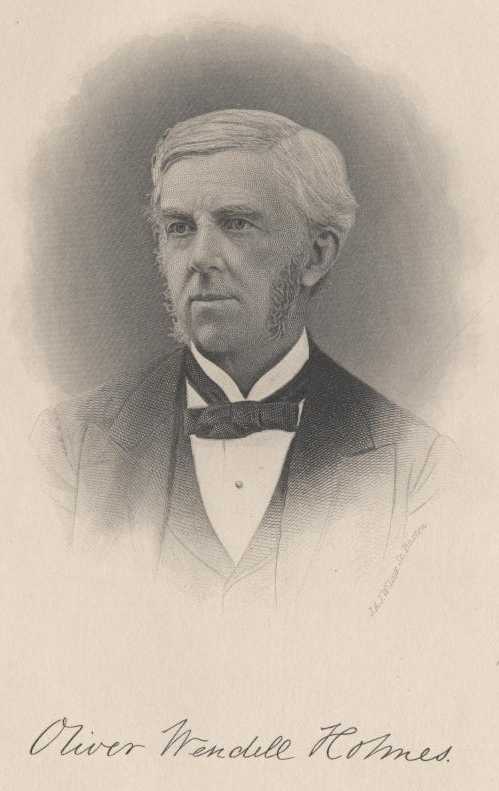
WITH REMARKS.
Being the Substance of a Report to the Royal Academy of the Biological Sciences by a Committee of that Institution.
“The singular nature of the case we are about to narrate and comment upon will, we feel confident, arrest the attention of those who have learned the great fact that Nature often throws the strongest light upon her laws by the apparent exceptions and anomalies which from time to time are observed. We have done with the lusus naturae of earlier generations. We pay little attention to the stories of 'miracles,' except so far as we receive them ready-made at the hands of the churches which still hold to them. Not the less do we meet with strange and surprising facts, which a century or two ago would have been handled by the clergy and the courts, but today are calmly recorded and judged by the best light our knowledge of the laws of life can throw upon them. It must be owned that there are stories which we can hardly dispute, so clear and full is the evidence in their support, which do, notwithstanding, tax our faith and sometimes leave us sceptical in spite of all the testimony which supports them.
“In this category many will be disposed to place the case we commend to the candid attention of the Academy. If one were told that a young man, a gentleman by birth and training, well formed, in apparently perfect health, of agreeable physiognomy and manners, could not endure the presence of the most attractive young woman, but was seized with deadly terror and sudden collapse of all the powers of life, if he came into her immediate presence; if it were added that this same young man did not shrink from the presence of an old withered crone; that he had a certain timid liking for little maidens who had not yet outgrown the company of their dolls, the listener would be apt to smile, if he did not laugh, at the absurdity of the fable. Surely, he would say, this must be the fiction of some fanciful brain, the whim of some romancer, the trick of some playwright. It would make a capital farce, this idea, carried out. A young man slighting the lovely heroine of the little comedy and making love to her grandmother! This would, of course, be overstating the truth of the story, but to such a misinterpretation the plain facts lend themselves too easily. We will relate the leading circumstances of the case, as they were told us with perfect simplicity and frankness by the subject of an affection which, if classified, would come under the general head of Antipathy, but to which, if we give it a name, we shall have to apply the term Gynophobia, or Fear of Woman.”
Here follows the account furnished to the writer of the paper, which is in all essentials identical with that already laid before the reader.
“Such is the case offered to our consideration. Assuming its truthfulness in all its particulars, it remains to see in the first place whether or not it is as entirely exceptional and anomalous as it seems at first sight, or whether it is only the last term of a series of cases which in their less formidable aspect are well known to us in literature, in the records of science, and even in our common experience.
“To most of those among us the explanations we are now about to give are entirely superfluous. But there are some whose chief studies have been in different directions, and who will not complain if certain facts are mentioned which to the expert will seem rudimentary, and which hardly require recapitulation to those who are familiarly acquainted with the common text-books.
“The heart is the centre of every living movement in the higher animals, and in man, furnishing in varying amount, or withholding to a greater or less extent, the needful supplies to all parts of the system. If its action is diminished to a certain degree, faintness is the immediate consequence; if it is arrested, loss of consciousness; if its action is not soon restored, death, of which fainting plants the white flag, remains in possession of the system.
“How closely the heart is under the influence of the emotions we need not go to science to learn, for all human experience and all literature are overflowing with evidence that shows the extent of this relation. Scripture is full of it; the heart in Hebrew poetry represents the entire life, we might almost say. Not less forcible is the language of Shakespeare, as for instance, in 'Measure for Measure:'
Making it both unable for itself
And dispossessing all my other parts
Of necessary fitness?'
“More especially is the heart associated in every literature with the passion of love. A famous old story is that of Galen, who was called to the case of a young lady long ailing, and wasting away from some cause the physicians who had already seen her were unable to make out. The shrewd old practitioner suspected that love was at the bottom of the young lady's malady. Many relatives and friends of both sexes, all of them ready with their sympathy, came to see her. The physician sat by her bedside during one of these visits, and in an easy, natural way took her hand and placed a finger on her pulse. It beat quietly enough until a certain comely young gentleman entered the apartment, when it suddenly rose in frequency, and at the same moment her hurried breathing, her changing color, pale and flushed by turns, betrayed the profound agitation his presence excited. This was enough for the sagacious Greek; love was the disease, the cure of which by its like may be claimed as an anticipation of homoeopathy. In the frontispiece to the fine old 'Junta' edition of the works of Galen, you may find among the wood-cuts a representation of the interesting scene, with the title Amantas Dignotio,—the diagnosis, or recognition, of the lover.
“Love has many languages, but the heart talks through all of them. The pallid or burning cheek tells of the failing or leaping fountain which gives it color. The lovers at the 'Brookside' could hear each other's hearts beating. When Genevieve, in Coleridge's poem, forgot herself, and was beforehand with her suitor in her sudden embrace,
And partly 't was a bashful art,
That I might rather feel than see
The swelling of her heart'
“Always the heart, whether its hurried action is seen, or heard, or felt. But it is not always in this way that the 'deceitful' organ treats the lover.
“This saying was not meant, perhaps, to be taken literally, but it has its literal truth. Many a lover has found his heart sink within him,—lose all its force, and leave him weak as a child in his emotion at the sight of the object of his affections. When Porphyro looked upon Madeline at her prayers in the chapel, it was too much for him:
Save wings, for heaven:—Porphyro grew faint,
She knelt, so pure a thing, so free from earthly taint.'
“And in Balzac's novel, 'Cesar Birotteau,' the hero of the story 'fainted away for-joy at the moment when, under a linden-tree, at Sceaux, Constance-Barbe-Josephine accepted him as her future husband.'
“One who faints is dead if he does not 'come to,' and nothing is more likely than that too susceptible lovers have actually gone off in this way. Everything depends on how the heart behaves itself in these and similar trying moments. The mechanism of its actions becomes an interesting subject, therefore, to lovers of both sexes, and to all who are capable of intense emotions.
“The heart is a great reservoir, which distributes food, drink, air, and heat to every part of the system, in exchange for its waste material. It knocks at the gate of every organ seventy or eighty times in a minute, calling upon it to receive its supplies and unload its refuse. Between it and the brain there is the closest relation. The emotions, which act upon it as we have seen, govern it by a mechanism only of late years thoroughly understood. This mechanism can be made plain enough to the reader who is not afraid to believe that he can understand it.
“The brain, as all know, is the seat of ideas, emotions, volition. It is the great central telegraphic station with which many lesser centres are in close relation, from which they receive, and to which they transmit, their messages. The heart has its own little brains, so to speak,—small collections of nervous substance which govern its rhythmical motions under ordinary conditions. But these lesser nervous centres are to a large extent dominated by influences transmitted from certain groups of nerve-cells in the brain and its immediate dependencies.
“There are two among the special groups of nerve-cells which produce directly opposite effects. One of these has the power of accelerating the action of the heart, while the other has the power of retarding or arresting this action. One acts as the spur, the other as the bridle. According as one or the other predominates, the action of the heart will be stimulated or restrained. Among the great modern discoveries in physiology is that of the existence of a distinct centre of inhibition, as the restraining influence over the heart is called.
“The centre of inhibition plays a terrible part in the history of cowardice and of unsuccessful love. No man can be brave without blood to sustain his courage, any more than he can think, as the German materialist says, not absurdly, without phosphorus. The fainting lover must recover his circulation, or his lady will lend him her smelling-salts and take a gallant with blood in his cheeks. Porphyro got over his faintness before he ran away with Madeline, and Cesar Birotteau was an accepted lover when he swooned with happiness: but many an officer has been cashiered, and many a suitor has been rejected, because the centre of inhibition has got the upper hand of the centre of stimulation.
“In the well-known cases of deadly antipathy which have been recorded, the most frequent cause has been the disturbed and depressing influence of the centre of inhibition. Fainting at the sight of blood is one of the commonest examples of this influence. A single impression, in a very early period of atmospheric existence,—perhaps, indirectly, before that period, as was said to have happened in the case of James the First of England,—may establish a communication between this centre and the heart which will remain open ever afterwards. How does a footpath across a field establish itself? Its curves are arbitrary, and what we call accidental, but one after another follows it as if he were guided by a chart on which it was laid down. So it is with this dangerous transit between the centre of inhibition and the great organ of life. If once the path is opened by the track of some profound impression, that same impression, if repeated, or a similar one, is likely to find the old footmarks and follow them. Habit only makes the path easier to traverse, and thus the unreasoning terror of a child, of an infant, may perpetuate itself in a timidity which shames the manhood of its subject.
“The case before us is an exceptional and most remarkable example of the effect of inhibition on the heart.
“We will not say that we believe it to be unique in the history of the human race; on the contrary, we do not doubt that there have been similar cases, and that in some rare instances sudden death has been the consequence of seizures like that of the subject of this Report. The case most like it is that of Colone Townsend, which is too well known to require any lengthened description in this paper. It is enough to recall the main facts. He could by a voluntary effort suspend the action of his heart for a considerable period, during which he lay like one dead, pulseless, and without motion. After a time the circulation returned, and he does not seem to have been the worse for his dangerous, or seemingly dangerous, experiment. But in his case it was by an act of the will that the heart's action was suspended. In the case before us it is an involuntary impulse transmitted from the brain to the inhibiting centre, which arrests the cardiac movements.
“What is like to be the further history of the case?
“The subject of this anomalous affliction is now more than twenty years old. The chain of nervous actions has become firmly established. It might have been hoped that the changes of adolescence would have effected a transformation of the perverted instinct. On the contrary, the whole force of this instinct throws itself on the centre of inhibition, instead of quickening the heart-beats, and sending the rush of youthful blood with fresh life through the entire system to the throbbing finger-tips.
“Is it probable that time and circumstances will alter a habit of nervous interactions so long established? We are disposed to think that there is a chance of its being broken up. And we are not afraid to say that we suspect the old gypsy woman, whose prophecy took such hold of the patient's imagination, has hit upon the way in which the 'spell,' as she called it, is to be dissolved. She must, in all probability, have had a hint of the 'antipatia' to which the youth before her was a victim, and its cause, and if so, her guess as to the probable mode in which the young man would obtain relief from his unfortunate condition was the one which would naturally suggest itself.
“If once the nervous impression which falls on the centre of inhibition can be made to change its course, so as to follow its natural channel, it will probably keep to that channel ever afterwards. And this will, it is most likely, be effected by some sudden, unexpected impression. If he were drowning, and a young woman should rescue him, it is by no means impossible that the change in the nervous current we have referred to might be brought about as rapidly, as easily, as the reversal of the poles in a magnet, which is effected in an instant. But he cannot be expected to throw himself into the water just at the right moment when the 'fair lady' of the gitana's prophecy is passing on the shore. Accident may effect the cure which art seems incompetent to perform. It would not be strange if in some future seizure he should never come back to consciousness. But it is quite conceivable, on the other hand, that a happier event may occur, that in a single moment the nervous polarity may be reversed, the whole course of his life changed, and his past terrible experiences be to him like a scarce-remembered dream.
“This is one, of those cases in which it is very hard to determine the wisest course to be pursued. The question is not unlike that which arises in certain cases of dislocation of the bones of the neck. Shall the unfortunate sufferer go all his days with his face turned far round to the right or the left, or shall an attempt be made to replace the dislocated bones? an attempt which may succeed, or may cause instant death. The patient must be consulted as to whether he will take the chance. The practitioner may be unwilling to risk it, if the patient consents. Each case must be judged on its own special grounds. We cannot think that this young man is doomed to perpetual separation from the society of womanhood during the period of its bloom and attraction. But to provoke another seizure after his past experiences would be too much like committing suicide. We fear that we must trust to the chapter of accidents. The strange malady—for such it is—has become a second nature, and may require as energetic a shock to displace it as it did to bring it into existence. Time alone can solve this question, on which depends the well-being and, it may be, the existence of a young man every way fitted to be happy, and to give happiness, if restored to his true nature.”
XX. DR. BUTTS REFLECTS.
Dr. Butts sat up late at night reading these papers and reflecting upon them. He was profoundly impressed and tenderly affected by the entire frankness, the absence of all attempt at concealment, which Maurice showed in placing these papers at his disposal. He believed that his patient would recover from this illness for which he had been taking care of him. He thought deeply and earnestly of what he could do for him after he should have regained his health and strength.
There were references, in Maurice's own account of himself, which the doctor called to mind with great interest after reading his brief autobiography. Some one person—some young woman, it must be—had produced a singular impression upon him since those earlier perilous experiences through which he had passed. The doctor could not help thinking of that meeting with Euthymia of which she had spoken to him. Maurice, as she said, turned pale,—he clapped his hand to his breast. He might have done so if he had met her chambermaid, or any straggling damsel of the village. But Euthymia was not a young woman to be looked upon with indifference. She held herself like a queen, and walked like one, not a stage queen, but one born and bred to self-reliance, and command of herself as well as others. One could not pass her without being struck with her noble bearing and spirited features. If she had known how Maurice trembled as he looked upon her, in that conflict of attraction and uncontrollable dread,—if she had known it! But what, even then, could she have done? Nothing but get away from him as fast as she could. As it was, it was a long time before his agitation subsided, and his heart beat with its common force and frequency.
Dr. Butts was not a male gossip nor a matchmaking go-between. But he could not help thinking what a pity it was that these two young persons could not come together as other young people do in the pairing season, and find out whether they cared for and were fitted for each other. He did not pretend to settle this question in his own mind, but the thought was a natural one. And here was a gulf between them as deep and wide as that between Lazarus and Dives. Would it ever be bridged over? This thought took possession of the doctor's mind, and he imagined all sorts of ways of effecting some experimental approximation between Maurice and Euthymia. From this delicate subject he glanced off to certain general considerations suggested by the extraordinary history he had been reading. He began by speculating as to the possibility of the personal presence of an individual making itself perceived by some channel other than any of the five senses. The study of the natural sciences teaches those who are devoted to them that the most insignificant facts may lead the way to the discovery of the most important, all-pervading laws of the universe. From the kick of a frog's hind leg to the amazing triumphs which began with that seemingly trivial incident is a long, a very long stride if Madam Galvani had not been in delicate health, which was the occasion of her having some frog-broth prepared for her, the world of to-day might not be in possession of the electric telegraph and the light which blazes like the sun at high noon. A common-looking occurrence, one seemingly unimportant, which had hitherto passed unnoticed with the ordinary course of things, was the means of introducing us to a new and vast realm of closely related phenomena. It was like a key that we might have picked up, looking so simple that it could hardly fit any lock but one of like simplicity, but which should all at once throw back the bolts of the one lock which had defied the most ingenious of our complex implements and open our way into a hitherto unexplored territory.
It certainly was not through the eye alone that Maurice felt the paralyzing influence. He could contemplate Euthymia from a distance, as he did on the day of the boat-race, without any nervous disturbance. A certain proximity was necessary for the influence to be felt, as in the case of magnetism and electricity. An atmosphere of danger surrounded every woman he approached during the period when her sex exercises its most powerful attractions. How far did that atmosphere extend, and through what channel did it act?
The key to the phenomena of this case, he believed, was to be found in a fact as humble as that which gave birth to the science of galvanism and its practical applications. The circumstances connected with the very common antipathy to cats were as remarkable in many points of view as the similar circumstances in the case of Maurice Kirkwood. The subjects of that antipathy could not tell what it was which disturbed their nervous system. All they knew was that a sense of uneasiness, restlessness, oppression, came over them in the presence of one of these animals. He remembered the fact already mentioned, that persons sensitive to this impression can tell by their feelings if a cat is concealed in the apartment in which they may happen to be. It may be through some emanation. It may be through the medium of some electrical disturbance. What if the nerve-thrills passing through the whole system of the animal propagate themselves to a certain distance without any more regard to intervening solids than is shown by magnetism? A sieve lets sand pass through it; a filter arrests sand, but lets fluids pass, glass holds fluids, but lets light through; wood shuts out light, but magnetic attraction goes through it as sand went through the sieve. No good reasons can be given why the presence of a cat should not betray itself to certain organizations, at a distance, through the walls of a box in which the animal is shut up. We need not disbelieve the stories which allege such an occurrence as a fact and a not very infrequent one.
If the presence of a cat can produce its effects under these circumstances, why should not that of a human being under similar conditions, acting on certain constitutions, exercise its specific influence? The doctor recalled a story told him by one of his friends, a story which the friend himself heard from the lips of the distinguished actor, the late Mr. Fechter. The actor maintained that Rachel had no genius as an actress. It was all Samson's training and study, according to him, which explained the secret of her wonderful effectiveness on the stage. But magnetism, he said,—magnetism, she was full of. He declared that he was made aware of her presence on the stage, when he could not see her or know of her presence otherwise, by this magnetic emanation. The doctor took the story for what it was worth. There might very probably be exaggeration, perhaps high imaginative coloring about it, but it was not a whit more unlikely than the cat-stories, accepted as authentic. He continued this train of thought into further developments. Into this series of reflections we will try to follow him.
What is the meaning of the halo with which artists have surrounded the heads of their pictured saints, of the aureoles which wraps them like a luminous cloud? Is it not a recognition of the fact that these holy personages diffuse their personality in the form of a visible emanation, which reminds us of Milton's definition of light:
The common use of the term influence would seem to imply the existence of its correlative, effluence. There is no good reason that I can see, the doctor said to himself, why among the forces which work upon the nervous centres there should not be one which acts at various distances from its source. It may not be visible like the “glory” of the painters, it may not be appreciable by any one of the five senses, and yet it may be felt by the person reached by it as much as if it were a palpable presence,—more powerfully, perhaps, from the mystery which belongs to its mode of action.
Why should not Maurice have been rendered restless and anxious by the unseen nearness of a young woman who was in the next room to him, just as the persons who have the dread of cats are made conscious of their presence through some unknown channel? Is it anything strange that the larger and more powerful organism should diffuse a consciousness of its presence to some distance as well as the slighter and feebler one? Is it strange that this mysterious influence or effluence should belong especially or exclusively to the period of complete womanhood in distinction from that of immaturity or decadence? On the contrary, it seems to be in accordance with all the analogies of nature,—analogies too often cruel in the sentence they pass upon the human female.
Among the many curious thoughts which came up in the doctor's mind was this, which made him smile as if it were a jest, but which he felt very strongly had its serious side, and was involved with the happiness or suffering of multitudes of youthful persons who die without telling their secret:
How many young men have a mortal fear of woman, as woman, which they never overcome, and in consequence of which the attraction which draws man towards her, as strong in them as in others,—oftentimes, in virtue of their peculiarly sensitive organizations, more potent in them than in others of like age and conditions,—in consequence of which fear, this attraction is completely neutralized, and all the possibilities of doubled and indefinitely extended life depending upon it are left unrealized! Think what numbers of young men in Catholic countries devote themselves to lives of celibacy. Think how many young men lose all their confidence in the presence of the young woman to whom they are most attracted, and at last steal away from a companionship which it is rapture to dream of and torture to endure, so does the presence of the beloved object paralyze all the powers of expression. Sorcerers have in all time and countries played on the hopes and terrors of lovers. Once let loose a strong impulse on the centre of inhibition, and the warrior who had faced bayonets and batteries becomes a coward whom the well-dressed hero of the ball-room and leader of the German will put to ignominious flight in five minutes of easy, audacious familiarity with his lady-love.
Yes, the doctor went on with his reflections, I do not know that I have seen the term Gynophobia before I opened this manuscript, but I have seen the malady many times. Only one word has stood between many a pair of young people and their lifelong happiness, and that word has got as far as the lips, but the lips trembled and would not, could not, shape that little word. All young women are not like Coleridge's Genevieve, who knew how to help her lover out of his difficulty, and said yes before he had asked for an answer. So the wave which was to have wafted them on to the shore of Elysium has just failed of landing them, and back they have been drawn into the desolate ocean to meet no more on earth.
Love is the master-key, he went on thinking, love is the master-key that opens the gates of happiness, of hatred, of jealousy, and, most easily of all, the gate of fear. How terrible is the one fact of beauty!—not only the historic wonder of beauty, that “burnt the topless towers of Ilium” for the smile of Helen, and fired the palaces of Babylon by the hand of Thais, but the beauty which springs up in all times and places, and carries a torch and wears a serpent for a wreath as truly as any of the Eumenides. Paint Beauty with her foot upon a skull and a dragon coiled around her.
The doctor smiled at his own imposing classical allusions and pictorial imagery. Drifting along from thought to thought, he reflected on the probable consequences of the general knowledge of Maurice Kirkwood's story, if it came before the public.
What a piece of work it would make among the lively youths of the village, to be sure! What scoffing, what ridicule, what embellishments, what fables, would follow in the trail of the story! If the Interviewer got hold of it, how “The People's Perennial and Household Inquisitor” would blaze with capitals in its next issue! The young fellows of the place would be disposed to make fun of the whole matter. The young girls-the doctor hardly dared to think what would happen when the story got about among them. “The Sachem” of the solitary canoe, the bold horseman, the handsome hermit,—handsome so far as the glimpses they had got of him went,—must needs be an object of tender interest among them, now that he was ailing, suffering, in danger of his life, away from friends,—poor fellow! Little tokens of their regard had reached his sick-chamber; bunches of flowers with dainty little notes, some of them pinkish, some three-cornered, some of them with brief messages, others “criss-crossed,” were growing more frequent as it was understood that the patient was likely to be convalescent before many days had passed. If it should come to be understood that there was a deadly obstacle to their coming into any personal relations with him, the doctor had his doubts whether there were not those who would subject him to the risk; for there were coquettes in the village,—strangers, visitors, let us hope,—who would sacrifice anything or anybody to their vanity and love of conquest.
XXI. AN INTIMATE CONVERSATION.
The illness from which Maurice had suffered left him in a state of profound prostration. The doctor, who remembered the extreme danger of any overexertion in such cases, hardly allowed him to lift his head from the pillow. But his mind was gradually recovering its balance, and he was able to hold some conversation with those about him. His faithful Paolo had grown so thin in waiting upon him and watching with him that the village children had to take a second look at his face when they passed him to make sure that it was indeed their old friend and no other. But as his master advanced towards convalescence and the doctor assured him that he was going in all probability to get well, Paolo's face began to recover something of its old look and expression, and once more his pockets filled themselves with comfits for his little circle of worshipping three and four year old followers.
“How is Mr. Kirkwood?” was the question with which he was always greeted. In the worst periods of the fever he rarely left his master. When he did, and the question was put to him, he would shake his head sadly, sometimes without a word, sometimes with tears and sobs and faltering words,—more like a brokenhearted child than a stalwart man as he was, such a man as soldiers are made of in the great Continental armies.
“He very bad,—he no eat nothing,—he—no say nothing,—he never be no better,” and all his Southern nature betrayed itself in a passionate burst of lamentation. But now that he began to feel easy about his master, his ready optimism declared itself no less transparently.
“He better every day now. He get well in few weeks, sure. You see him on hoss in little while.” The kind-hearted creature's life was bound up in that of his “master,” as he loved to call him, in sovereign disregard of the comments of the natives, who held themselves too high for any such recognition of another as their better. They could not understand how he, so much their superior in bodily presence, in air and manner, could speak of the man who employed him in any other way than as “Kirkwood,” without even demeaning himself so far as to prefix a “Mr.” to it. But “my master” Maurice remained for Paolo in spite of the fact that all men are born free and equal. And never was a servant more devoted to a master than was Paolo to Maurice during the days of doubt and danger. Since his improvement Maurice insisted upon his leaving his chamber and getting out of the house, so as to breathe the fresh air of which he was in so much need. It worried him to see his servant returning after too short an absence. The attendant who had helped him in the care of the patient was within call, and Paolo was almost driven out of the house by the urgency of his master's command that he should take plenty of exercise in the open air.
Notwithstanding the fact of Maurice's improved condition, although the force of the disease had spent itself, the state of weakness to which he had been reduced was a cause of some anxiety, and required great precautions to be taken. He lay in bed, wasted, enfeebled to such a degree that he had to be cared for very much as a child is tended. Gradually his voice was coming back to him, so that he could hold some conversation, as was before mentioned, with those about him. The doctor waited for the right moment to make mention of the manuscript which Maurice had submitted to him. Up to this time, although it had been alluded to and the doctor had told him of the intense interest with which he had read it, he had never ventured to make it the subject of any long talk, such as would be liable to fatigue his patient. But now he thought the time had come.
“I have been thinking,” the doctor said, “of the singular seizures to which you are liable, and as it is my business not merely to think about such cases, but to do what I can to help any who may be capable of receiving aid from my art, I wish to have some additional facts about your history. And in the first place, will you allow me to ask what led you to this particular place? It is so much less known to the public at large than many other resorts that we naturally ask, What brings this or that new visitor among us? We have no ill-tasting, natural spring of bad water to be analyzed by the state chemist and proclaimed as a specific. We have no great gambling-houses, no racecourse (except that for boats on the lake); we have no coaching-club, no great balls, few lions of any kind, so we ask, What brings this or that stranger here? And I think I may venture to ask you whether any, special motive brought you among us, or whether it was accident that determined your coming to this place.”
“Certainly, doctor,” Maurice answered, “I will tell you with great pleasure. Last year I passed on the border of a great river. The year before I lived in a lonely cottage at the side of the ocean. I wanted this year to be by a lake. You heard the paper read at the meeting of your society, or at least you heard of it,—for such matters are always talked over in a village like this. You can judge by that paper, or could, if it were before you, of the frame of mind in which I came here. I was tired of the sullen indifference of the ocean and the babbling egotism of the river, always hurrying along on its own private business. I wanted the dreamy stillness of a large, tranquil sheet of water that had nothing in particular to do, and would leave me to myself and my thoughts. I had read somewhere about the place, and the old Anchor Tavern, with its paternal landlord and motherly landlady and old-fashioned household, and that, though it was no longer open as a tavern, I could find a resting-place there early in the season, at least for a few days, while I looked about me for a quiet place in which I might pass my summer. I have found this a pleasant residence. By being up early and out late I have kept myself mainly in the solitude which has become my enforced habit of life. The season has gone by too swiftly for me since my dream has become a vision.”
The doctor was sitting with his hand round Maurice's wrist, three fingers on his pulse. As he spoke these last words he noticed that the pulse fluttered a little,—beat irregularly a few times; intermitted; became feeble and thready; while his cheek grew whiter than the pallid bloodlessness of his long illness had left it.
“No more talk, now,” he said. “You are too tired to be using your voice. I will hear all the rest another time.”
The doctor had interrupted Maurice at an interesting point. What did he mean by saying that his dream had become a vision? This is what the doctor was naturally curious, and professionally anxious, to know. But his hand was still on his patient's pulse, which told him unmistakably that the heart had taken the alarm and was losing its energy under the depressing nervous influence. Presently, however, it recovered its natural force and rhythm, and a faint flush came back to the pale cheek. The doctor remembered the story of Galen, and the young maiden whose complaint had puzzled the physicians.
The next day his patient was well enough to enter once more into conversation.
“You said something about a dream of yours which had become a vision,” said the doctor, with his fingers on his patient's wrist, as before. He felt the artery leap, under his pressure, falter a little, stop, then begin again, growing fuller in its beat. The heart had felt the pull of the bridle, but the spur had roused it to swift reaction.
“You know the story of my past life, doctor,” Maurice answered; “and, I will tell you what is the vision which has taken the place of my dreams. You remember the boat-race? I watched it from a distance, but I held a powerful opera-glass in my hand, which brought the whole crew of the young ladies' boat so close to me that I could see the features, the figures, the movements, of every one of the rowers. I saw the little coxswain fling her bouquet in the track of the other boat,—you remember how the race was lost and won,—but I saw one face among those young girls which drew me away from all the rest. It was that of the young lady who pulled the bow oar, the captain of the boat's crew. I have since learned her name, you know it well,—I need not name her. Since that day I have had many distant glimpses of her; and once I met her so squarely that the deadly sensation came over me, and I felt that in another moment I should fall senseless at her feet. But she passed on her way and I on mine, and the spasm which had clutched my heart gradually left it, and I was as well as before. You know that young lady, doctor?”
“I do; and she is a very noble creature. You are not the first young man who has been fascinated, almost at a glance, by Miss Euthymia Tower. And she is well worth knowing more intimately.”
The doctor gave him a full account of the young lady, of her early days, her character, her accomplishments. To all this he listened devoutly, and when the doctor left him he said to himself, “I will see her and speak with her, if it costs me my life.”
XXII. EUTHYMIA.
“The Wonder” of the Corinna Institute had never willingly made a show of her gymnastic accomplishments. Her feats, which were so much admired, were only her natural exercise. Gradually the dumb-bells others used became too light for her, the ropes she climbed too short, the clubs she exercised with seemed as if they were made of cork instead of being heavy wood, and all the tests and meters of strength and agility had been strained beyond the standards which the records of the school had marked as their historic maxima. It was not her fault that she broke a dynamometer one day; she apologized for it, but the teacher said he wished he could have a dozen broken every year in the same way. The consciousness of her bodily strength had made her very careful in her movements. The pressure of her hand was never too hard for the tenderest little maiden whose palm was against her own. So far from priding herself on her special gifts, she was disposed to be ashamed of them. There were times and places in which she could give full play to her muscles without fear or reproach. She had her special costume for the boat and for the woods. She would climb the rugged old hemlocks now and then for the sake of a wide outlook, or to peep into the large nest where a hawk, or it may be an eagle, was raising her little brood of air-pirates.
There were those who spoke of her wanderings in lonely places as an unsafe exposure. One sometimes met doubtful characters about the neighborhood, and stories were told of occurrences which might well frighten a young girl, and make her cautious of trusting herself alone in the wild solitudes which surrounded the little village. Those who knew Euthymia thought her quite equal to taking care of herself. Her very look was enough to ensure the respect of any vagabond who might cross her path, and if matters came to the worst she would prove as dangerous as a panther.
But it was a pity to associate this class of thoughts with a noble specimen of true womanhood. Health, beauty, strength, were fine qualities, and in all these she was rich. She enjoyed all her natural gifts, and thought little about them. Unwillingly, but over-persuaded by some of her friends, she had allowed her arm and hand to be modelled. The artists who saw the cast wondered if it would be possible to get the bust of the maiden from whom it was taken. Nobody would have dared to suggest such an idea to her except Lurida. For Lurida sex was a trifling accident, to be disregarded not only in the interests of humanity, but for the sake of art.
“It is a shame,” she said to Euthymia, “that you will not let your exquisitely moulded form be perpetuated in marble. You have no right to withhold such a model from the contemplation of your fellow-creatures. Think how rare it is to see a woman who truly represents the divine idea! You belong to your race, and not to yourself,—at least, your beauty is a gift not to be considered as a piece of private property. Look at the so-called Venus of Milo. Do you suppose the noble woman who was the original of that divinely chaste statue felt any scruple about allowing the sculptor to reproduce her pure, unblemished perfections?”
Euthymia was always patient with her imaginative friend. She listened to her eloquent discourse, but she could not help blushing, used as she was to Lurida's audacities. “The Terror's” brain had run away with a large share of the blood which ought to have gone to the nourishment of her general system. She could not help admiring, almost worshipping, a companion whose being was rich in the womanly developments with which nature had so economically endowed herself. An impoverished organization carries with it certain neutral qualities which make its subject appear, in the presence of complete manhood and womanhood, like a deaf-mute among speaking persons. The deep blush which crimsoned Euthymia's cheek at Lurida's suggestion was in a strange contrast to her own undisturbed expression. There was a range of sensibilities of which Lurida knew far less than she did of those many and difficult studies which had absorbed her vital forces. She was startled to see what an effect her proposal had produced, for Euthymia was not only blushing, but there was a flame in her eyes which she had hardly ever seen before.
“Is this only your own suggestion?” Euthymia said, “or has some one been putting the idea into your head?” The truth was that she had happened to meet the Interviewer at the Library, one day, and she was offended by the long, searching stare with which that individual had honored her. It occurred to her that he, or some such visitor to the place, might have spoken of her to Lurida, or to some other person who had repeated what was said to Lurida, as a good subject for the art of the sculptor, and she felt all her maiden sensibilities offended by the proposition. Lurida could not understand her excitement, but she was startled by it. Natures which are complementary of each other are liable to these accidental collisions of feeling. They get along very well together, none the worse for their differences, until all at once the tender spot of one or the other is carelessly handled in utter unconsciousness on the part of the aggressor, and the exclamation, the outcry, or the explosion explains the situation altogether too emphatically. Such scenes did not frequently occur between the two friends, and this little flurry was soon over; but it served to warn Lurida that Miss Euthymia Tower was not of that class of self-conscious beauties who would be ready to dispute the empire of the Venus of Milo on her own ground, in defences as scanty and insufficient as those of the marble divinity.
Euthymia had had admirers enough, at a distance, while at school, and in the long vacations, near enough to find out that she was anything but easy to make love to. She fairly frightened more than one rash youth who was disposed to be too sentimental in her company. They overdid flattery, which she was used to and tolerated, but which cheapened the admirer in her estimation, and now and then betrayed her into an expression which made him aware of the fact, and was a discouragement to aggressive amiability. The real difficulty was that not one of her adorers had ever greatly interested her. It could not be that nature had made her insensible. It must have been because the man who was made for her had never yet shown himself. She was not easy to please, that was certain; and she was one of those young women who will not accept as a lover one who but half pleases them. She could not pick up the first stick that fell in her way and take it to shape her ideal out of. Many of the good people of the village doubted whether Euthymia would ever be married.
“There 's nothing good enough for her in this village,” said the old landlord of what had been the Anchor Tavern.
“She must wait till a prince comes along,” the old landlady said in reply. “She'd make as pretty a queen as any of them that's born to it. Wouldn't she be splendid with a gold crown on her head, and di'monds a glitterin' all over her! D' you remember how handsome she looked in the tableau, when the fair was held for the Dorcas Society? She had on an old dress of her grandma's,—they don't make anything half so handsome nowadays,—and she was just as pretty as a pictur'. But what's the use of good looks if they scare away folks? The young fellows think that such a handsome girl as that would cost ten times as much to keep as a plain one. She must be dressed up like an empress,—so they seem to think. It ain't so with Euthymy: she'd look like a great lady dressed anyhow, and she has n't got any more notions than the homeliest girl that ever stood before a glass to look at herself.”
In the humbler walks of Arrowhead Village society, similar opinions were entertained of Miss Euthymia. The fresh-water fisherman represented pretty well the average estimate of the class to which he belonged. “I tell ye,” said he to another gentleman of leisure, whose chief occupation was to watch the coming and going of the visitors to Arrowhead Village,—“I tell ye that girl ain't a gon to put up with any o' them slab-sided fellahs that you see hangin' raound to look at her every Sunday when she comes aout o' meetin'. It's one o' them big gents from Boston or New York that'll step up an' kerry her off.”
In the mean time nothing could be further from the thoughts of Euthymia than the prospect of an ambitious worldly alliance. The ideals of young women cost them many and great disappointments, but they save them very often from those lifelong companionships which accident is constantly trying to force upon them, in spite of their obvious unfitness. The higher the ideal, the less likely is the commonplace neighbor who has the great advantage of easy access, or the boarding-house acquaintance who can profit by those vacant hours when the least interesting of visitors is better than absolute loneliness,—the less likely are these undesirable personages to be endured, pitied, and, if not embraced, accepted, for want of something better. Euthymia found so much pleasure in the intellectual companionship of Lurida, and felt her own prudence and reserve so necessary to that independent young lady, that she had been contented, so far, with friendship, and thought of love only in an abstract sort of way. Beneath her abstractions there was a capacity of loving which might have been inferred from the expression of her features, the light that shone in her eyes, the tones of her voice, all of which were full of the language which belongs to susceptible natures. How many women never say to themselves that they were born to love, until all at once the discovery opens upon them, as the sense that he was born a painter is said to have dawned suddenly upon Correggio!
Like all the rest of the village and its visitors, she could not help thinking a good deal about the young man lying ill amongst strangers. She was not one of those who had sent him the three-cornered notes or even a bunch of flowers. She knew that he was receiving abounding tokens of kindness and sympathy from different quarters, and a certain inward feeling restrained her from joining in these demonstrations. If he had been suffering from some deadly and contagious malady she would have risked her life to help him, without a thought that there was any wonderful heroism in such self-devotion. Her friend Lurida might have been capable of the same sacrifice, but it would be after reasoning with herself as to the obligations which her sense of human rights and duties laid upon her, and fortifying her courage with the memory of noble deeds recorded of women in ancient and modern history. With Euthymia the primary human instincts took precedence of all reasoning or reflection about them. All her sympathies were excited by the thought of this forlorn stranger in his solitude, but she felt the impossibility of giving any complete expression to them. She thought of Mungo Park in the African desert, and she envied the poor negress who not only pitied him, but had the blessed opportunity of helping and consoling him. How near were these two human creatures, each needing the other! How near in bodily presence, how far apart in their lives, with a barrier seemingly impassable between them!