
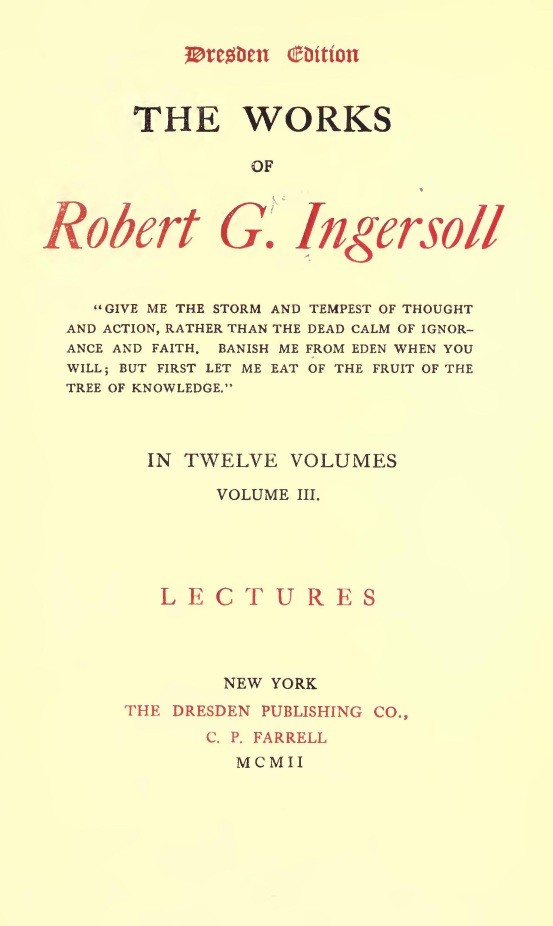
VOLUME VIII.--INTERVIEWS
EUROPEAN TRIP AND GREENBACK QUESTION
THE PRE-MILLENNIAL CONFERENCE.
THE SOLID SOUTH AND RESUMPTION.
THE SUNDAY LAWS OF PITTSBURG.*
POLITICS, RELIGION AND THOMAS PAINE.
MR. BEECHER, MOSES AND THE NEGRO.
HADES, DELAWARE AND FREETHOUGHT.
A REPLY TO THE REV. MR. LANSING.*
BEACONSFIELD, LENT AND REVIVALS.
ANSWERING THE NEW YORK MINISTERS.*
FUNERAL OF JOHN G. MILLS AND IMMORTALITY.*
THE REPUBLICAN DEFEAT IN OHIO.
JUSTICE HARLAN AND THE CIVIL RIGHTS BILL.
POLITICS, MORMONISM AND MR. BEECHER
WENDELL PHILLIPS, FITZ JOHN PORTER AND BISMARCK.
POLITICS AND BRITISH COLUMBIA.
RELIGION, PROHIBITION, AND GEN. GRANT.
HELL OR SHEOL AND OTHER SUBJECTS.
INTERVIEWING, POLITICS AND SPIRITUALISM.
REPLY TO THE REV. B. F. MORSE.*
TRIAL OF THE CHICAGO ANARCHISTS.
THE REPUBLICAN PLATFORM OF 1888.
SUMMER RECREATION—MR. GLADSTONE.
PROTECTION FOR AMERICAN ACTORS.
THE SACREDNESS OF THE SABBATH.
THE WESTMINSTER CREED AND OTHER SUBJECTS.
GROWING OLD GRACEFULLY, AND PRESBYTERIANISM.
THE TENDENCY OF MODERN THOUGHT.
WOMAN SUFFRAGE, HORSE RACING, AND MONEY.
WORD PAINTING AND COLLEGE EDUCATION.
PERSONAL MAGNETISM AND THE SUNDAY QUESTION.
MIRACLES, THEOSOPHY AND SPIRITUALISM.
STRIKES, EXPANSION AND OTHER SUBJECTS.
CATHOLICISM AND PROTESTANTISM. THE POPE, THE A. P. A., AGNOSTICISM
SENATOR SHERMAN AND HIS BOOK.*
REPLY TO THE CHRISTIAN ENDEAVORERS.
IS LIFE WORTH LIVING—CHRISTIAN SCIENCE AND POLITICS.
MUSIC, NEWSPAPERS, LYNCHING AND ARBITRATION.
THE VENEZUELAN BOUNDARY DISCUSSION AND THE WHIPPING-POST.
COLONEL SHEPARD'S STAGE HORSES.*
A REPLY TO THE REV. L. A. BANKS.
JOHN RUSSELL YOUNG AND EXPANSION.
PSYCHICAL RESEARCH AND THE BIBLE.*
CAPITAL PUNISHMENT AND THE WHIPPING-POST.
VOLUME IX.--POLITICAL
DETAILED CONTENTS OF VOLUME IX.
AN ADDRESS TO THE COLORED PEOPLE.
COOPER UNION SPEECH, NEW YORK.
ADDRESS TO THE 86TH ILLINOIS REGIMENT.
THE CHICAGO AND NEW YORK GOLD SPEECH.
DETAILED CONTENTS OF VOLUME IX.
AN ADDRESS TO THE COLORED PEOPLE.
(1867.)
Slavery and its Justification by Law and Religion—Its Destructive
Influence upon Nations—Inauguration of the Modern Slave Trade by the
Portuguese Gonzales—Planted upon American Soil—The Abolitionists,
Clarkson, Wilberforce, and Others—The Struggle in England—Pioneers
in San Domingo, Oge and Chevannes—Early Op-posers of Slavery in
America—William Lloyd Garrison—Wendell Phillips, Charles Sumner, John
Brown—The Fugitive Slave Law—The Emancipation Proclamation—Dread of
Education in the South—Advice to the Colored People.
(1868.)
Suspension of the Writ of Habeas Corpus—Precedent Established by the
Revolutionary Fathers—Committees of Safety appointed by the
Continental Congress—Arrest of Disaffected Persons in Pennsylvania
and Delaware—Interference with Elections—Resolution of Continental
Congress with respect to Citizens who Opposed the sending of Deputies
to the Convention of New York—Penalty for refusing to take Continental
Money or Pray for the American Cause—Habeas Corpus Suspended during the
Revolution—Interference with Freedom of the Press—Negroes Freed and
allowed to Fight in the Continental Army—Crispus Attacks—An Abolition
Document issued by Andrew Jackson—Majority rule—Slavery and the
Rebellion—Tribute to General Grant.
SPEECH NOMINATING BLAINE.
(1876.)
Note descriptive of the Occasion—Demand of the Republicans of the
United States—Resumption—The Plumed Knight.
(1876.)
One Hundred Years ago, our Fathers retired the Gods from Politics—The
Declaration of Independence—Meaning of the Declaration—The Old Idea
of the Source of Political Power—Our Fathers Educated by their
Surroundings—The Puritans—Universal Religious Toleration declared by
the Catholics of Maryland—Roger Williams—Not All of our Fathers in
favor of Independence—Fortunate Difference in Religious Views—Secular
Government—Authority derived from the People—The Declaration and
the Beginning of the War—What they Fought For—Slavery—Results of
a Hundred Years of Freedom—The Declaration Carried out in Letter and
Spirit.
(1876.)
The Hayes Campaign—Reasons for Voting the Republican Ticket—Abolition
of Slavery—Preservation of the Union—Reasons for Not Trusting the
Democratic Party—Record of the Republican Party—Democrats Assisted
the South—Paper Money—Enfranchisement of the Negroes—Samuel J.
Tilden—His Essay on Finance.
COOPER UNION SPEECH, NEW YORK.
COOPER UNION SPEECH, NEW YORK.
(1876.)
All Citizens Stockholders in the United States of America—The
Democratic Party a Hungry Organization—Political Parties
Contrasted—The Fugitive Slave Law a Disgrace to Hell in its Palmiest
Days—Feelings of the Democracy Hurt on the Subject of Religion—Defence
of Slavery in a Resolution of the Presbyterians, South—State of the
Union at the Time the Republican Party was Born—Jacob Thompson—The
National Debt—Protection of Citizens Abroad—Tammany Hall: Its Relation
to the Penitentiary—The Democratic Party of New York City—"What
Hands!"—Free Schools.
(1876.)
Address to the Veteran Soldiers of the Rebellion—Objections to
the Democratic Party—The Men who have been Democrats—Why I am a
Republican—Free Labor and Free Thought—A Vision of War—Democratic
Slander of the Greenback—Shall the People who Saved the Country Rule
It?—On Finance—Government Cannot Create Money—The Greenback Dollar
a Mortgage upon the Country—Guarantees that the Debt will be Paid-'The
Thoroughbred and the Mule—The Column of July, Paris—The Misleading
Guide Board, the Dismantled Mill, and the Place where there had been a
Hotel,
(1876.)
The Plea of "Let Bygones be Bygones"—Passport of the Democratic
Party—Right of the General Government to send Troops into Southern
States for the Protection of Colored People—Abram S. Hewitt's
Congratulatory Letter to the Negroes—The Demand for Inflation of the
Currency—Record of Rutherford B. Hayes—Contrasted with Samuel J.
Tilden—Merits of the Republican Party—Negro and Southern White—The
Superior Man—"No Nation founded upon Injustice can Permanently Stand."
(1877.)
On the Electoral Commission—Reminiscences of the Hayes-Tilden Camp—
Constitution of the Electoral College—Characteristics of the Members—
Frauds at the Ballot Box Poisoning the Fountain of Power—Reforms
Suggested—Elections too Frequent—The Professional Office-seeker—A
Letter on Civil Service Reform—Young Men Advised against Government
Clerkships—Too Many Legislators and too Much Legislation—Defect in the
Constitution as to the Mode of Electing a President—Protection of
Citizens by State and General Governments—The Dual Government in South
Carolina—Ex-Rebel Key in the President's Cabinet—Implacables and
Bourbons South and North—"I extend to you each and all the Olive Branch
of Peace."
(1878.)
Capital and Labor—What is a Capitalist?—The Idle and the Industrious
Artisans—No Conflict between Capital and Labor—A Period of Inflation
and Speculation—Life and Fire Insurance Agents—Business done on
Credit—The Crash, Failure, and Bankruptcy—Fall in the Price of Real
Estate a Form of Resumption—Coming back to Reality—Definitions of
Money Examined—Not Gold and Silver but Intelligent Labor the Measure
of Value—Government cannot by Law Create Wealth—A Bill of Fare not
a Dinner—Fiat Money—American Honor Pledged to the Maintenance of the
Greenbacks—The Cry against Holders of Bonds—Criminals and Vagabonds to
be supported—Duty of Government to Facilitate Enterprise—More Men must
Cultivate the Soil—Government Aid for the Overcoming of Obstacles too
Great for Individual Enterprise—The Palace Builders the Friends of
Labor—Extravagance the best Form of Charity—Useless to Boost a Man
who is not Climbing—The Reasonable Price for Labor—The Vagrant and his
strange and winding Path—What to tell the Working Men.
(1880.)
The Right to Vote—All Women who desire the Suffrage should have
It—Shall the People of the District of Columbia Manage their Own
Affairs—Their Right to a Representative in Congress and an Electoral
Vote—Anomalous State of Affairs at the Capital of the Republic—Not the
Wealthy and Educated alone should Govern—The Poor as Trustworthy as the
Rich—Strict Registration Laws Needed.
(1880.)
Obligation of New York to Protect the Best Interests of the
Country—Treason and Forgery of the Democratic Party in its Appeal to
Sword and Pen—The One Republican in the Penitentiary of Maine—The
Doctrine of State Sovereignty—Protection for American Brain and
Muscle—Hancock on the Tariff—A Forgery (the Morey letter) Committed
and upheld—The Character of James A. Garfield.
(1880.)
Introduced by Henry Ward Beecher (note)—Some Patriotic
Democrats—Freedom of Speech North and South—An Honest Ballot—
ADDRESS TO THE 86TH ILLINOIS REGIMENT.
THE CHICAGO AND NEW YORK GOLD SPEECH.
VOLUME X.--LEGAL
DETAILED CONTENTS OF VOLUME X.
ADDRESS TO THE JURY IN THE MUNN TRIAL.
CLOSING ADDRESS TO THE JURY IN THE FIRST STAR ROUTE TRIAL.
OPENING ADDRESS TO THE JURY IN THE SECOND STAR ROUTE TRIAL.
CLOSING ADDRESS IN SECOND STAR ROUTE TRIAL
ADDRESS TO THE JURY IN THE DAVIS WILL CASE.
ARGUMENT BEFORE THE VICE-CHANCELLOR IN THE RUSSELL CASE.
DETAILED CONTENTS OF VOLUME X.
ADDRESS TO THE JURY IN THE MUNN TRIAL.
Demoralization caused by Alcohol—Note from the Chicago
Times—Prejudice—Review of the Testimony of Jacob Rehm—Perjury
Characterized—The Defendant and the Offence Charged (p. 21)—Testimony
of Golsen Reviewed—Rehm's Testimony before the Grand Jury—Good
Character (p. 29)—Suspicion not Evidence.
CLOSING ADDRESS TO THE JURY IN THE FIRST STAR ROUTE TRIAL.
CLOSING ADDRESS TO THE JURY IN THE FIRST STAR ROUTE TRIAL.
Note from the Washington Capital—The Assertion Denied that we are
a Demoralized Country and that our Country is Distinguished among
the Nations only for Corruption—Duties of Jurors and Duties of
Lawyers—Section under which the Indictment is Found—Cases cited to
Show that Overt Acts charged and also the Crime itself must be Proved
as Described—Routes upon which Indictments are Based and Overt Acts
Charged (pp. 54-76)—Routes on which the Making of False Claims is
Alleged—Authorities on Proofs of Conspiracy (pp. 91-94)—Examination
of the Evidence against Stephen W. and John W. Dorsey (pp. 96-117)—The
Corpus Delicti in a Case of Conspiracy and the Acts Necessary to be Done
in Order to Establish Conspiracy (pp. 120-123)—Testimony of Walsh
and the Confession of Rerdell—Extravagance in Mail Carrying (p.
128)—Productiveness of Mail Routes (p. 131)—Hypothesis of Guilt and
Law of Evidence—Dangerous Influence of Suspicion—Terrorizing the
Jury—The Woman at Her Husband's Side.
OPENING ADDRESS TO THE JURY IN THE SECOND STAR ROUTE TRIAL.
Juries the Bulwark of Civil Liberty—Suspicion Not Evidence—Brief
Statement of the Case—John M. Peck, John W. Dorsey, Stephen W. Dorsey,
John R. Miner, Mr. (A. E. ) Boone (p.p. 150-156)—The Clendenning
Bonds—Miner's, Peck's, and Dorsey's Bids—Why they Bid on Cheap
Routes—Number of Routes upon which there are Indictments—The
Arrangement between Stephen W. Dorsey and John R. Miner—Appearance
of Mr. Vaile in the Contracts—Partnership Formed—The Routes
Divided—Senator Dorsey's Course after Getting the Routes—His Routes
turned over to James W. Bosler—Profits of the Business (p. 181)—The
Petitions for More Mails—Productive and Unproductive Post-offices—Men
who Add to the Wealth of the World—Where the Idea of the Productiveness
of Post routes was Hatched—Cost of Letters to Recipients in 1843—The
Overland Mail (p. 190)—Loss in Distributing the Mail in the District
of Columbia and Other Territories—Post-office the only Evidence
of National Beneficence—Profit and Loss of Mail Carrying—Orders
Antedated, and Why—Routes Increased and Expedited—Additional Bonds for
Additional Trips—The Charge that Pay was Received when the Mail was
not Carried—Fining on Shares—Subcontracts for Less than the Original
Contracts—Pay on Discontinued Routes—Alleged False Affidavits—Right
of Petition—Reviewing the Ground.
CLOSING ADDRESS TO THE JURY IN THE SECOND STAR ROUTE TRIAL.
Scheme of the Indictment—Story of the Case—What Constitutes Fraudulent
Bidding—How a Conspiracy Must be Proved—The Hypothesis of Guilt and
Law of Evidence—Conversation Unsatisfactory Evidence—Fallibility of
Memory—Proposition to Produce Mr. Dorsey's Books—Interruption of the
Court to Decide that Primary Evidence, having Once been Refused, can not
afterwards be Introduced to Contradict Secondary Evidence—A Defendant
may not be Presumed into the Penitentiary—A Decision by Justice
Field—The Right of Petition—Was there a Conspiracy?—Dorsey's
Benevolence (p. 250)—The Chico Springs Letter—Evidence of Moore
Reviewed—Mr. Ker's Defective Memory—The Informer System—Testimony
of Rerdell Reviewed—His Letter to Dorsey (p. 304)—The Affidavit of
Rerdell and Dorsey—Petitions for Faster Time—Uncertainty Regarding
Handwriting—Government Should be Incapable of Deceit—Rerdell's
withdrawal of the Plea of Not Guilty (p. 362)—Informers, their Immunity
and Evidence—Nailing Down the Lid of Rerdell's Coffin—Mistakes of
Messrs. Ker and Merrick and the Court—Letter of H. M. Vaile to the
Sixth Auditor—Miner's Letter to Carey—Miner, Peck & Co. to Frank A.
Tuttle—Answering Points Raised by Mr. Bliss (396 et seq.)—Evidence
regarding the Payment of Money by Dorsey to Brady—A. E. Boone's
Testimony Reviewed—Secrecy of Contractors Regarding the Amount of their
Bids—Boone's Partnership Agreement with Dorsey—Explanation of Bids
in Different Names—Omission of Instructions from Proposals (p.
450)—Accusation that Senator Mitchell was the Paid Agent of
the Defendants—Alleged Sneers at Things held Sacred—What is a
Conspiracy?—The Theory that there was a Conspiracy—Dorsey's Alleged
Interest—The Two Affidavits in Evidence—Inquiry of General Miles—Why
the Defendant's Books were not Produced—Tames W. Bosler's Testimony
Read (p. 500)—The Court shown to be Mistaken Regarding a Decision
Previously Made (pp. 496-502)—No Logic in Abuse—Charges against John
W. Miner—Testimony of A. W. Moore Reviewed-The Verdict Predicted—The
Defendants in the Case—What is left for the Jury to Say—Remarks of
Messrs. Henkle and Davidge—The Verdict.
ADDRESS TO THE JURY IN THE DAVIS WILL CASE.
Note from the Anaconda Standard—Senator Sander's Warning to the Jury
Not to be Enticed by Sinners—Evidence, based on Quality of Handwriting,
that Davis did not Write the Will—Evidence of the Spelling—Assertion
that the Will was Forged—Peculiarities of Eddy's Handwriting—Holes
in Sconce's Signature and Reputation—His Memory—Business Sagacity
of Davis—His Alleged Children—Date of his Death—Testimony of Mr.
Knight—Ink used in Writing the Will—Expert Evidence—Speechlessness
of John A. Davis—Eddy's Failure to take the Stand—Testimony of
Carruthers—Relatives of Sconce—Mary Ann Davis's Connections—The
Family Tree—The Signature of the Will—What the Evidence Shows—Duty
and Opportunity of the Jury.
ARGUMENT BEFORE THE VICE-CHANCELLOR IN THE RUSSELL CASE.
Antenuptial Waiving of Dower by Women—A Case from Illinois—At What
Age Men and Women Cease to Feel the Tender Flame—Russell's Bargain with
Mrs. Russell—Antenuptial Contract and Parole Agreement—Definition
of "Liberal Provision "—The Woman not Bound by a Contract Made in
Ignorance of the Facts—Contract Destroyed by Deception.