
WeRead Powered by ReaderPub
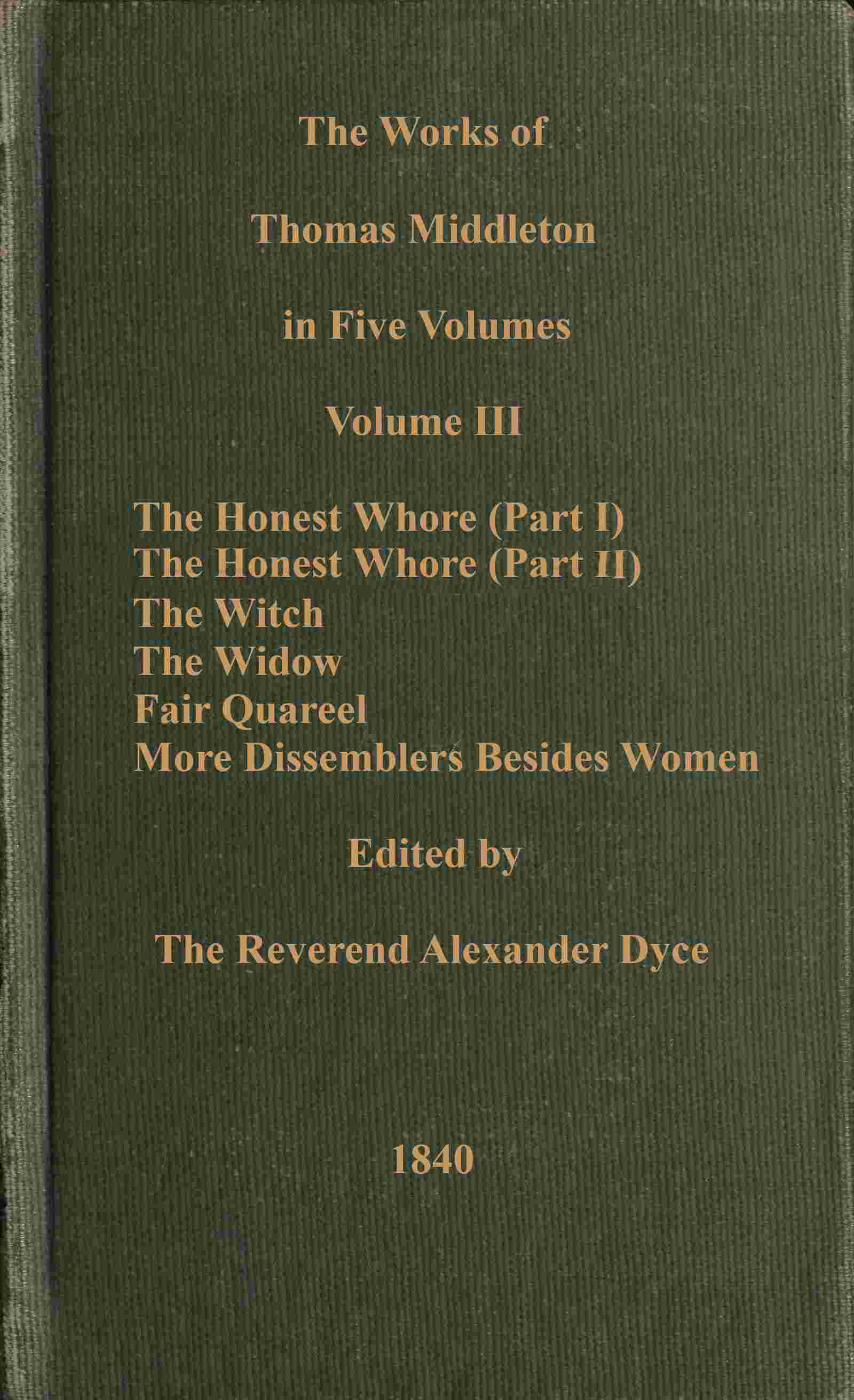
The works of Thomas Middleton, Volume 3 (of 5) cover

The works of Thomas Middleton, Volume 3 (of 5)

Chapter 72: SCENE III.
Open in WeRead

About This Book

A collected volume of early modern stage plays presents a set of tragicomic and satiric dramas that examine sexual politics, social hypocrisy, and the clash between public reputation and private desire. The pieces stage moral tests, disguises, and power struggles, alternating dark humor with moments of earnest pathos. Plots range from longer two-part narratives of fall and possible reform to shorter comedies of manners, and recurring motifs include deceit, female agency, legal and civic spectacle, and the theatrical staging of conscience. The overall effect balances sharp social critique with theatrical rhetoric and dramatic set pieces.

MORE DISSEMBLERS

BESIDES

WOMEN.

More Dissemblers Besides Women. A Comedy, By Tho. Middleton, Gent. London. Printed for Humphrey Moseley, 1657, forms part of a volume, the general title of which is Two New Playes.

Viz. { More Dissemblers
besides Women.
Women beware
Women.
}

Written by Tho. Middleton, Gent. London, Printed for Humphrey Moseley and are to be sold at his Shop at the Prince’s Arms in St Pauls Churchyard. 1657. 8vo. To this volume is prefixed the following address

To the Reader.

“When these amongst others of Mr. Thomas Middleton’s excellent poems came to my hands, I was not a little confident but that his name would prove as great an inducement for thee to read as me to print them; since those issues of his brain that have already seen the sun have by their worth gained themselves a free entertainment amongst all that are ingenious: and I am most certain that these will no way lessen his reputation nor hinder his admission to any noble and recreative spirits. All that I require at thy hands is to continue the author in his deserved esteem, and to accept of my endeavours which have ever been to please thee.

Farewell.”

Another play by Middleton, printed in the same year and for the same bookseller—No { Wit
Help } like a Woman’s
—is generally found appended to the volume just described.

The present drama has been reprinted in the 4th vol. of A Continuation of Dodsley’s Old Plays, 1816.

That More Dissemblers besides Women was produced a considerable time previous to the year 1623, we learn from the following entry by Sir Henry Herbert (Chalmers’s Suppl. Apol. p. 215);

“17 October [1623] For the King’s Company, An Old Play, called, More Dissemblers besides Women: allowed by Sir George Bucke; and being free from alterations was allowed by me, for a new play, called The Devil of Dowgate, or Usury put to use. Written by Fletcher.”

Immediately preceding act i. of the old ed. are the words “The First Part;” which would seem to imply that a Second Part had been written, or perhaps only designed.

DRAMATIS PERSONÆ.
  • Lord Cardinal of Milan.
  • Lactantio, his nephew.
  • Andrugio, general of Milan.
  • Father to Aurelia.
  • Governor of the fort.
  • Dondolo, servant to Lactantio.
  • Crotchet, a singing-master.
  • Sinquapace, a dancing-master.
  • Nicholao, his usher.
  • Captain of the Gipsies.
  • Lords, Gipsies, Servants, and Guards.
  • Duchess of Milan.
  • Celia, her waiting-woman.
  • Aurelia.
  • Page, Lactantio’s mistress in disguise.
Scene, Milan and the neighbourhood.
MORE DISSEMBLERS
BESIDES
WOMEN.

ACT I. SCENE I.

A Street.
Enter Lactantio, Aurelia, and Servant.
Song within.
To be chaste is woman’s glory,
’Tis her fame and honour’s story:
Here sits she in funeral weeds,
Only bright in virtuous deeds;
Come and read her life and praise,
That singing weeps, and sighing plays.
Lac. Welcome, soul’s music! I’ve been listening here
To melancholy strains from the duchess’ lodgings;
That strange great widow, that has vow’d so stiffly
Ne’er to know love’s heat in a second husband:
And she has kept the fort most valiantly,
To th’ wonder of her sex, this seven year’s day,
And that’s no sorry trial. A month’s constancy
Is held a virtue in a city-widow;
And are they excell’d by so much more i’ th’ court?
My faith, a rare example for our wives!
Heaven’s blessing of[864] her heart for it! poor soul,
She had need have somewhat to comfort her.
What wouldst thou do, faith, now,
If I were dead, suppose I were thy husband,
As shortly I will be, and that’s as good?
Speak freely, and[865] thou lov’st me.
Aur. Alas, sir,
I should not have the leisure to make vows;
For dying presently, I should be dead
Before you were laid out!
Lac. Now fie upon thee for a hasty dier!
Wouldst thou not see me buried?
Aur. Talk not on’t, sir,
These many years, unless you take delight
To see me swoon, or make a ghost of me.
Lac. Alas, poor soul! I’ll kiss thee into colour:
Canst thou paint pale so quickly? I perceive then
Thou’dst go beyond the duchess in her vow,
Thou’dst die indeed. What’s he?
Aur. Be settled, sir;
Spend neither doubt nor fear upon that fellow:
Health cannot be more trusty to man’s life
Than he to my necessities in love.
Lac. I take him of thy word, and praise his face,
Though he look scurvily; I’ll think hereafter
That honesty may walk with fire in’s nose,
As well as brave desert in broken clothes:
But for thy further safety, I’ve provided
A shape, that at first sight will start thy modesty,
And make thee blush perhaps, but 'twill away
After a qualm or two. Virginity
Has been put often to those shifts before thee
Upon extremities; a little boldness
Cannot be call’d immodesty, especially
When there’s no means without it for our safeties.
Thou know’st my uncle, the lord cardinal,
Wears so severe an eye, so strict and holy,
It not endures the sight of womankind
About his lodgings:
Hardly a matron of fourscore’s admitted;
Though she be worn to gums, she comes not there
To mumble matins; all his admiration
Is plac’d upon the duchess; he likes her,
Because she keeps her vow and likes not any;
So does he love that man above his book
That loves no woman: for my fortune’s sake then,
For I am like to be his only heir,
I must dissemble, and appear as fair
To his opinion as the brow of piety;
As void of all impureness as an altar:
Thine ear [whispers]; that, and we’re safe.
Aur. You make me blush, sir.
Lac. ’Tis but a star shot from a beauteous cheek,
It blazes beauty’s bounty, and hurts nothing.
Aur. The power of love commands me.
Lac. I shall wither
In comforts, till I see thee. [Exeunt severally.

SCENE II.

The Cardinal’s Closet.
Enter Cardinal and Lords.
Car. My lords, I’ve work for you: when you have hours
Free from the cares of state, bestow your eyes
Upon those abstracts of the duchess’ virtues,
My study’s ornaments. I make her constancy
The holy mistress of my contemplation;
Whole volumes have I writ in zealous praise
Of her eternal vow: I have no power
To suffer virtue to go thinly clad.
I that have ever been in youth an old man
To pleasures and to women, and could never
Love, but pity 'em,
And all their momentary frantic follies,
Here I stand up in admiration,
And bow to the chaste health of our great duchess,
Kissing her constant name. O my fair lords,
When we find grace confirm’d, especially
In a creature that’s so doubtful as a woman,
We’re spirit-ravish’d; men of our probation
Feel the sphere’s music playing in their souls.
So long, unto th’ eternising of her sex,
Sh’as kept her vow so strictly, and as chaste
As everlasting life is kept for virtue,
Even from the sight of men; to make her oath
As uncorrupt as th’ honour of a virgin,
That must be strict in thought, or else that title,
Like one of frailty’s ruins, shrinks to dust:
No longer she’s a virgin than she’s just.
First Lord. Chaste, sir? the truth and justice of her vow
To her deceas’d lord’s able to make poor
Man’s treasury of praises. But, methinks,
She that has no temptation set before her,
Her virtue has no conquest: then would her constancy
Shine in the brightest goodness of her glory,
If she would give admittance, see and be seen,
And yet resist, and conquer: there were argument
For angels; 'twould outreach the life of praise
Set in mortality’s shortness. I speak this
Not for religion, but for love of her,
Whom I wish less religious, and more loving:
But I fear she’s too constant, that’s her fault;
But ’tis so rare, few of her sex are took with’t,
And that makes some amends.
Car. You’ve put my zeal into a way, my lord,
I shall not be at peace till I make perfect:
I’ll make her victory harder; ’tis my crown
When I bring grace to great’st perfection;
And I dare trust that daughter with a world,
None but her vow and she. I know she wears
A constancy will not deceive my praises,
A faith so noble; she that once knows heaven
Need put in no security for her truth;
I dare believe her. Face,[866] use all the art,
Temptation, witcheries, slights,[867] and subtleties,
You temporal lords and all your means can practice——
Sec. Lord. My lord, not any we.
Car. Her resolute goodness
Shall as a rock stand firm, and send the sin
That beat[s] against it
Into the bosom of the owners weeping.
Third Lord. We wish[868] her virtues so.
Car. O, give me pardon!
I’ve lost myself in her upon my friends.
Your charitable censures[869] I beseech:
So dear her white fame is to my soul’s love,
’Tis an affliction but to hear it question’d;
She’s my religious triumph:
If you desire a belief rightly to her,
Think she can never waver, then you’re sure:
She has a fixed heart, it cannot err;
He kills my hopes of woman that doubts her.
First Lord. No more, my lord, ’tis fix’d.
Car. Believe my judgment;
I never praise in vain, nor ever spent
Opinion idly, or lost hopes of any
Where I once plac’d it; welcome as my joys,
Now you all part believers of her virtue!
Lords. We are the same most firmly.
Car. Good opinion
In others reward you and all your actions!
[Exeunt Lords.
Who’s near us?
Enter Servant.
Ser. My lord?
Car. Call our nephew. [Exit Servant.]—There’s a work too
That for blood’s sake I labour to make perfect,
And it comes on with joy. He’s but a youth,
To speak of years, yet I dare venture him
To old men’s goodnesses and gravities
For his strict manners, and win glory by him;
And for the chasteness of his continence,
Which is a rare grace in the spring of man,
He does excel the youth of all our time;
Which gift of his, more than affinity,
Draws my affection in great plenty to him:
The company of a woman’s as fearful to him
As death to guilty men; I’ve seen him blush
When but a maid was nam’d: I’m proud of him,
Heaven be not angry for’t! he’s near of kin
In disposition to me. I shall do much for him
In life-time, but in death I shall do all;
There he will find my love: he’s yet too young
In years to rise in state, but his good parts
Will bring him in the sooner. Here he comes.
Enter Lactantio with a book.
What, at thy meditation? half in heaven?
Lac. The better half, my lord, my mind’s there still;
And when the heart’s above, the body walks here
But like an idle serving-man below,
Gaping and waiting for his master’s coming.
Car. What man in age could bring forth graver thoughts?
Lac. He that lives fourscore years is but like one
That stays here for a friend; when death comes, then
Away he goes, and is ne’er seen agen.[870]
I wonder at the young men of our days,
That they can doat on pleasure, or what ’tis
They give that title to, unless in mockage:
There’s nothing I can find upon the earth
Worthy the name of pleasure, unless 't be
To laugh at folly, which indeed good charity
Should rather pity; but of all the frenzies
That follow flesh and blood, O reverend uncle,
The most ridiculous is to fawn on women;
There’s no excuse for that; ’tis such a madness,
There is no cure set down for’t; no physician
Ever spent hour about it, for they guess’d
'Twas all in vain when they first lov’d themselves,
And never since durst practise; cry Hei mihi,[871]
That’s all the help they’ve for’t. I had rather meet
A witch far north, than a fine fool in love,
The sight would less afflict me: but for modesty,
And your grave presence that learns men respect,
I should fall foul in words upon fond[872] man,
That can forget his excellence and honour,
His serious meditations, being the end
Of his creation to learn well to die,
And live a prisoner to a woman’s eye:
Can there be greater thraldom, greater folly?
Car. In making him my heir, I make good works,
And they give wealth a blessing; where,[873] on the contrary,
What curses does he heap upon his soul
That leaves his riches to a riotous young man,
To be consum’d on surfeits, pride, and harlots!
Peace be upon that spirit, whose life provides
A quiet rest for mine! [Aside.
Enter Page.[874]
Lac. How now? the news?
Page. A letter, sir [gives letter to Lactantio], brought by a gentleman
That lately came from Rome.
Lac. That’s she; she’s come;
I fear not to admit her in his presence,
There is the like already: I’m writ chaste
In my grave uncle’s thoughts, and honest meanings
Think all men’s like their own. [Aside.]—Thou look’st so pale!
What ail’st thou here a’ late?
Page. I doubt I’ve cause, sir.
Lac. Why, what’s the news?
Page. I fear, sir, I’m with child.
Lac. With child? peace, peace; speak low.
Page. 'Twill prove, I fear, so.
Lac. Beshrew my heart for that!—Desire the gentleman
To walk a turn or two.
Car. What gentleman?
Lac. One lately come from Rome, my lord, in credit
With Lord Vincentio; so the letter speaks him.
Car. Admit him, my kind boy. [Exit Page.]—The prettiest servant
That ever man was bless’d with! ’tis so meek,
So good and gentle; ’twas the best alm’s-deed
That e’er you did to keep him: I’ve oft took him
Weeping alone, poor boy, at the remembrance
Of his lost friends, which, as he says, the sea
Swallow’d, with all their substance.
Lac. ’Tis a truth, sir,
Has cost the poor boy many a feeling tear,
And me some too, for company: in such pity
I always spend my part. Here comes the gentleman.
Enter Aurelia disguised as a man.
Car. Welcome to Milan, sir: how is the health
Of Lord Vincentio?
Aur. May it please your grace,
I left it well and happy, and I hope
The same bless’d fortune keeps it.
Car. I hear you’re near him.
Aur. One of his chamber, my lord.
Lac. I’d ne’er wish one of her condition nearer
Than to be one of mine. [Aside.
Car. Your news is pleasing:
Whilst you remain in Milan, I request you
To know the welcome of no house but ours.
Aur. Thanks to your grace.
Car. I’ll leave you to confer;
I’ll to the duchess, and labour her perfection.
[Exit.
Lac. Then thus begins our conference: I arrest thee
In Cupid’s name; deliver up your weapon,
[Takes her sword.
It is not for your wearing, Venus knows it:
Here’s a fit thing indeed! nay, hangers[875] and all;
Away with 'em, out upon 'em! things of trouble,
And out of use with you. Now you’re my prisoner;
And till you swear you love me, all and only,
You part not from mine arms.
Aur. I swear it willingly.
Lac. And that you do renounce the general’s love,
That heretofore laid claim to you.
Aur. My heart bids me,
You need not teach me that; my eye ne’er knew
A perfect choice till it stood bless’d with you.
There’s yet a rival whom you little dream of,
Tax me with him, and I’ll swear too I hate him;
I’ll thrust 'em both together in one oath,
And send 'em to some pair of waiting-women,
To solder up their credits.
Lac. Prithee, what’s he?
Another yet? for laughter’ sake, discover him.
Aur. The governor of the fort.
Lac. That old dried neat’s tongue!
Aur. A gentleman after my father’s relish.
Enter Aurelia’s Father and Governor.
Fath. By your kind favours, gentlemen.
Aur. O, my father!
We’re both betray’d.
Lac. Peace; you may prove too fearful.—
To whom your business, sir?
Fath. To the lord cardinal,
If it would please yourself, or that young gentleman,
To grace me with admittance.
Lac. I will see, sir;
The gentleman’s a stranger, new come o’er;
He understands you not.—
Loff tro veen, tantumbro, hoff tufftee locumber shaw.

Aur. Quisquimken, sapadlaman, fool-urchin old astrata.

Fath. Nay, and[876] that be the language, we can speak it too:
Strumpettikin, bold harlottum, queaninisma, whore-mongeria!
Shame to thy sex, and sorrow to thy father!
Is this a shape for reputation
And modesty to masque in? Thou too cunning
For credulous goodness,
Did not a reverent respect and honour,
That’s due unto the sanctimonious peace
Of this lord’s house, restrain my voice and anger,
And teach it soft humility, I would lift
Both your disgraces to the height of grief
That you have rais’d in me; but to shame you
I will not cast a blemish upon virtue:
Call that your happiness, and the dearest too
That such a bold attempt could ever boast of.
We’ll see if a strong fort can hold you now.—
Take her, sir, to you.
Gov. How have I deserv’d
The strangeness of this hour?
Fath. Talk not so tamely.—
For you, sir, thank the reverence of this place,
Or your hypocrisy I’d put out of grace,
I had, i’faith; if ever I can fit you,
Expect to hear from me.
[Exeunt Father, Governor, and Aurelia.
Lac. I thank you, sir;
The cough o’ th’ lungs requite you! I could curse him
Into diseases by whole dozens now;
But one’s enough to beggar him, if he light
Upon a wise physician. ’Tis a labour
To keep those little wits I have about me.
Still did I dream that villain would betray her:
I’ll never trust slave with a parboil’d nose again.
I must devise some trick t’ excuse her absence
Now to my uncle too; there is no mischief
But brings one villan[y] or other still
Even close at heels on’t. I am pain’d at heart;
If ever there were hope of me to die
For love, ’tis now; I never felt such gripings:
If I can ’scape this climacterical year,
Women ne’er trust me, though you hear me swear.
Kept with him in the fort? why, there’s no hope
Of ever meeting now, my way’s not thither;
Love bless us with some means to get together,
And I’ll pay all the old reckonings. [Exit.

SCENE III.

Street before the Duchess’s House.
Enter on a balcony[877] Duchess and Celia.
Duch. What a contented rest rewards my mind
For faithfulness! I give it constancy,
And it returns me peace. How happily
Might woman live, methinks, confin’d within
The knowledge of one husband!
What comes of more rather proclaims desire
Prince of affections than religious love,
Brings frailty and our weakness into question
'Mongst our male enemies, makes widows’ tears
Rather the cup of laughter than of pity:
What credit can our sorrows have with men,
When in some months’ space they turn light agen,[878]
Feast, dance, and go in colours? If my vow
Were yet to make, I would not sleep without it,
Or make a faith as perfect to myself
In resolution, as a vow would come to,
And do as much right so to constancy
As strictness could require; for ’tis our goodness
And not our strength that does it. I am arm’d now
'Gainst all deserts in man, be’t valour, wisdom,
Courtesy, comeliness, nay, truth itself,
Which seldom keeps him company. I commend
The virtues highly, as I do an instrument
When the case hangs by th’ wall; but man himself
Never comes near my heart.
Enter Cardinal above.
Car. The blessing of perfection to your thoughts, lady!
For I’m resolv’d[879] they’re good ones.
Duch. Honour of greatness,
Friend to my vow, and father to my fame,
Welcome as peace to temples!
Car. I bring war.
Duch. How, sir?
Car. A harder fight: if now you conquer,
You crown my praises double.
Duch. What’s your aim, sir?
Car. T’ astonish sin and all her tempting evils,
And make your goodness shine more glorious.
When your fair noble vow shew’d you the way
To excellence in virtue, to keep back
The fears that might discourage you at first,
Pitying your strength, it shew’d you not the worst:
’Tis not enough for tapers to burn bright,
But to be seen, so to lend others light,
Yet not impair themselves, their flame as pure
As when it shin’d in secret; so, t’ abide
Temptations is the soul’s flame truly tried.
I’ve an ambition, but a virtuous one;
I’d have nothing want to your perfection.
Duch. Is there a doubt found yet? is it so hard
For woman to recover, with all diligence,
And a true fasting faith from sensual pleasure,
What many of her sex have[880] so long lost?
Can you believe that any sight of man,
Held he the worth of millions in one spirit,
Had power to alter me?
Car. No; there’s my hope,
My credit, and my triumph.
Duch. I’ll no more
Keep strictly private, since the glory on’t
Is but a virtue question’d; I’ll come forth
And shew myself to all; the world shall witness,
That, like the sun, my constancy can look
On earth’s corruptions, and shine clear itself.
Car. Hold conquest now, and I have all my wishes.
[Cornets, and a shout within.
Duch. The meaning of that sudden shout, my lord?
Car. Signor Andrugio, general of the field,
Successful in his fortunes, is arriv’d,
And met by all the gallant hopes of Milan,
Welcom’d with laurel-wreaths and hymns of praises:
Vouchsafe but you to give him the first grace, madam,
Of your so long-hid presence, he has then
All honours that can bless victorious man.
Duch. You shall prevail, grave sir.
[Exit Cardinal above.
Enter Andrugio, attended by the nobility, senators, and masquers.
Song.
Laurel is a victor’s due,
I give it you,
I give it you;
Thy name with praise,
Thy brow with bays
We circle round:
All men rejoice
With cheerful voice,
To see thee like a conqueror crown’d.
[A Cupid descending, sings:
I am a little conqueror too;
For wreaths of bays
There’s arms of cross,[881]
And that’s my due:
I give the flaming heart,
It is my crest;
And by the mother’s side,
The weeping eye,
The sighing breast.
It is not power in you, fair beauties;
If I command love, ’tis your duties. [Ascends.

[During the preceding songs Andrugio peruses a letter delivered to him by a Lord: the masque then closes with the following

Song.
Welcome, welcome, son of fame,
Honour triumphs in thy name! [Exeunt all except Lord.
Lord. Alas, poor gentleman! I brought him news
That like a cloud spread over all his glories:
When he miss’d her whom his eye greedily sought for,
His welcome seem’d so poor, he took no joy in’t;
But when he found her by her father forc’d
To the old governor’s love, and kept so strictly,
A coldness strook his heart. There is no state
So firmly happy but feels envy’s might.
I know Lactantio, nephew to the cardinal,
Hates him as deeply as a rich man death;
And yet his welcome shew’d as fair and friendly
As his that wore the truest love to him;
When in his wishes he could drink his blood,
And make his heart the sweetness of his food. [Exit.
Celia. Madam! madam!
Duch. Beshrew thy heart, dost thou not see me busy?
You shew your manners!
Celia. In the name of goodness,
What ails my lady?
Duch. I confess I’m mortal;
There’s no defending on’t; ’tis cruel flattery
To make a lady believe otherwise.
Is not this flesh? can you drive heat from fire?
So may you love from this; for love and death
Are brothers in this kingdom, only death
Comes by the mother’s side, and that’s the surest.
That general is wondrous fortunate,
Has won another field since, and a victory
That credits all the rest; he may more boast on’t
Than of a thousand conquests. I am lost,
Utterly lost! where are my women now?
Alas, what help’s in them, what strength have they?
I call to a weak guard when I call them;
In rescuing me they’d be themselves o’ercome:
When I, that profess’d war, am overthrown,
What hope’s in them, then, that ne’er stirr’d from home?
My faith is gone for ever;
My reputation with the cardinal,
My fame, my praise, my liberty, my peace,
Chang’d for a restless passion: O hard spite,
To lose my seven years’ victory at one sight!