
WeRead Powered by ReaderPub
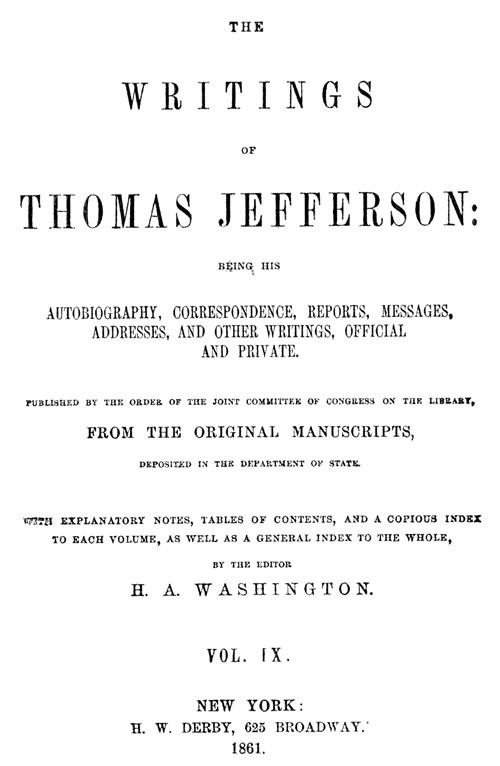
The Writings of Thomas Jefferson, Vol. 9 (of 9) / Being His Autobiography, Correspondence, Reports, Messages, Addresses, and Other Writings, Official and Private cover

The Writings of Thomas Jefferson, Vol. 9 (of 9) / Being His Autobiography, Correspondence, Reports, Messages, Addresses, and Other Writings, Official and Private

Chapter 33: SECTION XXVIII. BILL, RECOMMITMENT.
Open in WeRead

About This Book

This collected volume assembles the author’s autobiography, extensive private and official correspondence, legislative reports, public messages and addresses, and a variety of shorter writings and miscellaneous papers. It features a thorough manual of parliamentary practice that synthesizes constitutional provisions, senatorial rules, and parliamentary precedents for legislative procedure, alongside sections of anas and ephemera. Editorial organization and explanatory notes guide readers through practical guidance on governance, procedural form, and the political and personal concerns reflected across the documents.

SECTION XXVIII.
BILL, RECOMMITMENT.

After a bill has been committed and reported, it ought not, in an ordinary course, to be recommitted. But in cases of importance, and for special reasons, it is sometimes recommitted, and usually to the same committee. Hakew. 151. If a report be committed before agreed to in the House, what has passed in the committee is of no validity; the whole question is again before the committee, and a new resolution must be again moved, as if nothing had passed.—3 Hats. 131, note.

In Senate, January, 1800, the salvage bill was recommitted three times after the commitment.

A particular clause of a bill may be committed without the whole bill,—3 Hats. 131; or so much of a paper to one, and so much to another committee.