
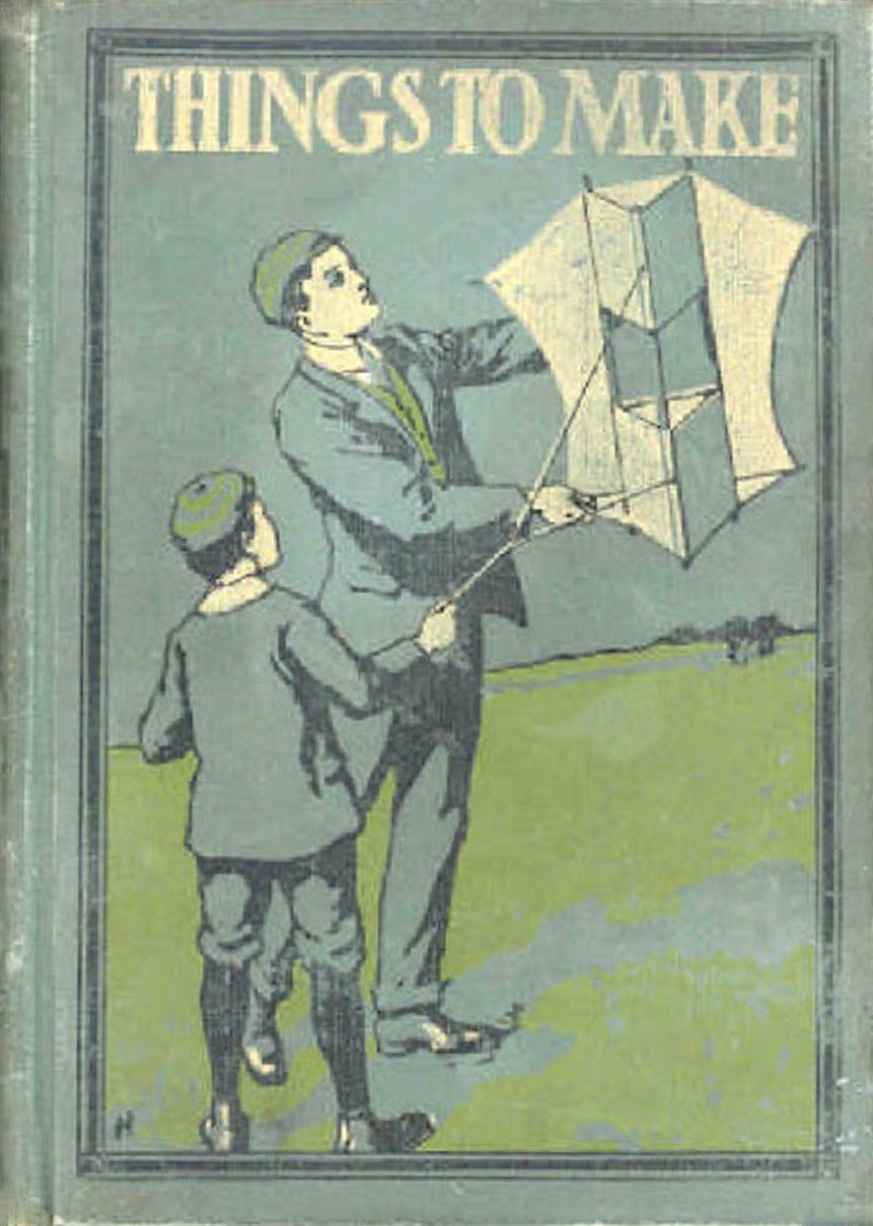
The Project Gutenberg eBook of Things To Make
Title: Things To Make
Author: Archibald Williams
Release date: January 11, 2005 [eBook #14664]
Most recently updated: February 21, 2021
Language: English
Credits: Don Kostuch
Transcriber’s Note:
If the pdf version of the book is viewed using facing pages with even numbered pages on the left, you will see a close approximation of the original book.
Notations of the form “(1,650) 2” appear at the bottom of some pages; they are probably printer’s references for assembling to book.
The text only version is of limited use because of the many figures used. I recommend the pdf or rtf versions.
Some of the projects should be approached with care since they involve corrosive or explosive chemicals, electricity and steam boilers.
Do not use lead solder, particularly on cooking utensils.
Whether you simply want to travel back into the mind of a young boy at the beginning of the twentieth century, or want to try your hand at some interesting projects in carpentry, machinery, kites and many other areas, have fun.
The following are definitions of unusual (to me) terms used frequently in the text.
Terms
Batten - Narrow strip of wood.
Bevel (Bevelling) - A cut that is not a right angle.
Bradawl - Awl with a beveled tip to make holes in wood for brads or screws.
Chamfer - Cut off the edge or corner; bevel.
Boss - Enlarged part of a shaft where another shaft is coupled or a wheel or gear is keyed.
Broach - To shape a hole with a tapered tool.
Carbide - Calcium carbide, used to produce acetylene (C2H2) gas for lighting and welding.
Compo - “Composition”, like plastic.
Creosote - An oily liquid containing phenols and creosols, obtained from coal tar. Used as a wood preservative and disinfectant. Can cause severe neurological disturbances if inhaled.
Deal - A fir or pine board of standard dimensions
Fish-plate - A plate bolted to the sides of two abutting railroad tracks.
Fretworking - Ornamental design, often in relief.
Gasholder Gasometer - Storage container for fuel gas, especially a large, telescoping, cylindrical tank.
Gland - The outer sleeve of a stuffing box that prevents leakage past a moving machine part.
Glass paper - Paper faced with pulverized glass, like sandpaper.
Gudgeon - A metal pivot or journal at the end of a shaft or an axle, around which a wheel or other device turns.
Joiner - A cabinetmaker.
Linoleum - A floor covering made in sheets by pressing heated linseed oil, rosin, powdered cork, and pigments onto a burlap or canvas backing.
Lissom - Easily bent; supple
Longitudinal - Relating to length.
Mortice - Cavity in a piece of wood or other material, prepared to receive a tenon and form a joint.
Panel saw - Handsaw with fine teeth.
Pinion - Gear with a small number of teeth designed to mesh with a larger gear.
Plinth - Architectural support or base.
Rasp - Coarse file with sharp, raised, pointed projections.
Sleeper - Railroad crosstie.
Spanner - Wrench
Spirit Lamp - Alcohol lamp; see example on page 188.
Spirit - Alcohol
Strake - Ridge of thick planking on the side of a wooden ship.
Strut - Any part designed to hold things apart or resist compressive stress;
Tap - Cut screw threads
Tenon - Projection on the end of a piece of wood shaped for insertion into a mortise to make a joint.
Tenon saw - Saw with a thin blade for cutting tenons.
Tinning - Coating with soft solder.
Turner - Person who operates a lathe or similar device.
Tyre - Tire
Vestas - Matches; Vestai is the Roman goddess of the hearth, worshiped in a temple containing the sacred fire tended by the vestal virgins.
Currency Conversion
Prices are quoted in old English currency, pounds, shillings, pence.
“12s. 6d.” is read as “12 Shillings and 6 Pence.”
Pence/penny
Shilling—12 pence.
Crown—5 shillings.
Pound—20 shillings.
Guinea—21 shillings.
The approximate value of 1900 prices in 2002 is:
| 1900 Unit | Value in 2002 Currency | |
| English Pound | US Dollars | |
| Pence | .26 | .48 |
| Shilling | 3.10 | 5.80 |
| Crown | 15.50 | 29.00 |
| Pound | 62.00 | 116.00 |
[End Transcriber’s note.]
[Illustration: Large model locomotive]
Photo: Daily Mirror. Large model locomotive built for one of the royal princes of Siam by Messrs. Bassett-Lowke, Limited. It is one-quarter the size of a modern express engine; weighs two tons, with tender; is fifteen feet long; will pull seventy persons; and has a highest speed of about thirty miles an hour.