
The Project Gutenberg eBook of Thirteen months in the Rebel Army
Title: Thirteen months in the Rebel Army
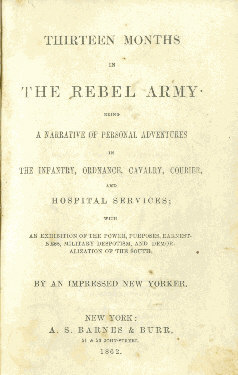
being a narrative of personal adventures in the infantry, ordnance, cavalry, courier, and hospital services; with an exhibition of the power, purposes, earnestness, military despotism, and demoralization of the South
Author: William G. Stevenson
Release date: April 17, 2005 [eBook #15644]
Most recently updated: December 14, 2020
Language: English
Credits: Produced by Janet Kegg and the Project Gutenberg Online Distributed
Proofreading Team (https://www.pgdp.net)
(Page 145.)
THIRTEEN MONTHS IN THE REBEL ARMY
[By William G. Stevenson]
BEING
A NARRATIVE OF PERSONAL ADVENTURES
IN
THE INFANTRY, ORDNANCE, CAVALRY, COURIER,
AND
HOSPITAL SERVICES;
WITH
AN EXHIBITION OF THE POWER, PURPOSES,
EARNESTNESS, MILITARY DESPOTISM, AND
DEMORALIZATION OF THE SOUTH.
BY AN IMPRESSED NEW YORKER.
NEW YORK:
A. S. BARNES & BURR,
51 & 53 JOHN-STREET.
1862.
Entered according to Act of Congress, in the year 1862,
By A. S. BARNES & BURR,
In the Clerk's Office of the District Court of the United States for the
Southern District of New York.
Rennie, Shea & Lindsay,
stereotypers and electrotypers,
81, 83, & 85 centre-street,
New York.
GEORGE W. WOOD, Printer,
No. 2 Dutch-st., N.Y.
Transcriber's note: The following appeared before the frontispiece and title page in the original book.
A VIEW OF THIS BOOK
in proof-sheets.
As our last form was going to press we received the
following note from a Minister of the Gospel of this
city, whose name is widely known, and as widely
respected, both in Europe and America.
A. S. BARNES & BURR, Publishers.
NEW YORK, Oct. 1, 1862.
Inscrutable "Dixie!" your "adversary has written a book," as damaging to Rebeldom as the Monitor to the Merrimac. The secrets of Rebel counsels and resources have been well concealed, while National plans have been penetrated by traitorous eyes and revealed by treasonable tongues. At last the vail has been uplifted, and we have more of valuable, reliable information, as to the internal condition of Jeff-dom and its armies, than has leaked out since the fall of Sumter.
"Thirteen Months in the Rebel Army" gave "An Impressed New Yorker" rare opportunities of knowing what is to be known outside of the Richmond Cabinet. Let a sharp-witted young man make his way from Memphis to Columbus and Bowling Green, and thence to Nashville, Selma, Richmond, and Chattanooga; put him into the battles of Belmont and Shiloh; bring him in contact with Morgan, Polk, Breckenridge, and a bevy of Confederate generals; employ him consecutively in the infantry, ordnance, cavalry, courier, and hospital services; then put a pen in his hand, and if his sketches of men and things in the land of darkness have not interest and value, pray what would you read in war-time?
The writer has been favored with the perusal of the proof-sheets of this remarkable book. Many of its incidents had had the charm of personal narration from the lips of the author; but it is only just to say, that the lucid, graphic style of the author gives all the vividness of personal description to the scenes and incidents of which he was an eyewitness. That so many and such varied adventures should have fallen to the lot of a single person, is passing strange; and that he should have survived and escaped to relate them, is, perhaps, yet stranger. That they were all experienced substantially as related, none will doubt, when the minute details of name, date, place, and surroundings are found to be sketched with palpable truthfulness.
The temper of the book is scarcely less noteworthy than its fund of incident and anecdote. Parson Brownlow's book and speeches are brimful of invective. He's a good hater, indeed. He claimed in his Academy of Music speech that, "If there was any thing on God's earth that he was made for, it was to pile up epithets against this infernal rebellion!" Chacun à son gout. Our young author has struck a harder blow at the Confederacy by his damaging facts, than if he had intensified them with the vocabulary of profanity and vituperation. There has been more than enough of bitter words, North and South; it is now a question of strength, and skill, and endurance. This book will teach us to respect the energy, while we detest the principles, of this stupendous rebellion.
PREFACE.
A WORD TO THE READER.
I give to you, in the following pages, a simple narrative of facts. I have no motive to misrepresent or conceal. I have an honest desire to describe faithfully and truly what I saw and heard during thirteen months of enforced service in the Rebel army.
If I should seem to you to speak too favorably of individuals or occurrences in the South, I beg you to consider that I give impressions obtained when in the South. If my book has any value it lies in this very fact, that it gives you an interior view of this stupendous rebellion, which can not be obtained by one standing in the North and looking at it only with Northern eyes.
I have confidence in truth; and unwelcome truth, is none the less truth, and none the less valuable. Sure am I, that if the North had known the whole truth as to the power, the unanimity, and the deadly purpose of the leaders in the rebellion, the government would have been far better prepared for promptly meeting the crisis. Look then candidly at facts, and give them their true weight.
As I am under no obligation, from duty or honor, to conceal what I was compelled to see and hear in the South, I tell it frankly; hoping it may be of value to my bleeding country, I tell it plainly. I have no cause to love the Confederate usurpation, as will fully appear, yet I refrain from abusive and denunciatory epithets, because both my taste and judgment enjoin it.
For the accuracy of names, dates, and places, I rely wholly upon memory. I kept memoranda during my whole service, but was compelled to leave every thing when I attempted escape, as such papers then found in my possession would have secured my certain death; but in all material things I can promise the accuracy which a retentive memory secures.
If an apology is needed for the constant recurrence of the personal pronoun in these pages, let it be said that the recital of personal incidents, without circumlocution, necessarily compels it.
With this brief word, I invite you to enter with me upon the Southern service; you can stop when you please, or go with me to the end, and give a huzza as you see me escape and reach the loyal lines.
WILLIAM G. STEVENSON.
New York City, Sept. 15th, 1862.
CONTENTS.
| CHAPTER I. | |
| HOW I VOLUNTEERED. | |
| Object in going to Arkansas. — Change of Purpose. — Young Acquaintances. — Questioned on Slavery. — Letter to my Parents. — Unfortunate Clause. — A Midnight Call. — Warlike Preparations. — Good Advice. — Honor among Lynchers. — Arrival at Court of Judge Lynch. — Character of Jury. — Trial commenced. — Indictment and Argument. — Excitement increases. — Butler Cavins and his Lariat. — The Crisis. — The Acquittal. — No Safety from it. — First Impulse and subsequent Reflection. — Attempted Escape. — Night Ride. — Helena. — An Uneasy Boat Ride. — Memphis. — "A Blue Jacket." — Committee of Public Safety. — A Surprise. — Dismissal followed by Unwelcome Letter and Policeman. — Recruiting Station. — Volunteering | 15 |
| CHAPTER II. | |
| INFANTRY SERVICE. | |
| Character of our Regiment. — No Escape. — A Fixed Resolve. — Randolph. — Camp Life. — Sabbath. — Father Daly. — Washing. — Fort Wright. — Grand Defect. — Rations. — Stolen Waters. — Mutiny. — Sentence. — Fort Pillow. — Slaves. — Aiding the Rebellion. — Deep Earnestness of the People. — Strength of the Fort. — "Pillow's Trot Line." — No Pay, and the Result. — General Pillow described. — Columbus, Ky. — Hard Work. — Pillow in the Ditch. — The Batteries. — Torpedoes. — Battle of Belmont. — False Report. — Troops cross. — Untimely Joking. — The Tide of Battle. — A Charge. — Cruelty. — Victory. — Why? — Loss. — Burial of the Dead. — How Not to Kill — Accident. — The Military Bishop | 40 |
| CHAPTER III. | |
| ORDNANCE SERVICE. | |
| Transferred to Ordnance. — Camp Beauregard. — Was my Oath binding? — Resources of the Rebels. — Cannon stolen. — Manufactured. — A Rifling Machine. — Beauregard's Bells. — Imported Cannon. — Running Blockade. — Silence of Southern Papers. — Small-Arms made. — Altered. — Abundant. — Earnestness of all Classes. — Imported Arms. — England's Neutrality. — Ammunition imported. — Manufactured. — Smuggled. — A Railroad Episode. — A Deserting Engineer. — A New Hand at the Throttle. — Caution. — A Smash Up and Pistols. — Reconciliation. — Result of Smash Up. — Bowling Green. — Size of Army. — Sickness. — Personal. — Kindness of Nashville People. — Moral and Religious Efforts for the Rebel Army. — Vices prevalent. — Seminaries and Schools disbanded | 79 |
| CHAPTER IV. | |
| CAVALRY SERVICE. | |
| New Field of Action. — Promotion. — Guerrilla Warfare. — Characteristics. — Tendencies. — Captain J.H. Morgan. — Character. — Personal Appearance. — Anecdotes. — Success. — Southern Cavalry superior to Northern. — Advantages. — Riding Courier. — General Johnson evacuates Bowling Green. — Excitement in Nashville. — Preparations for Defense. — Commissary Stores. — Vandalism. — Rear Guard. — Line of Retreat. — Dreadful Hardships. — Losses. — Forced March. — Desolation. — Cause of Retreat. — Other Counsel. — Accident. — No Union Feeling evident. — Intolerant yet Sincere | 108 |
| CHAPTER V. | |
| COURIER SERVICE. | |
| New Duties. — Battle approaching. — Deserters and Scouts. — A Providence. — Position and Forces of the Confederates. — Orders to prepare to move. — My New Position. — March to the Battle-field. — Federals off their Guard. — Care of the Confederates against Desertion. — Council of War. — A Dreary Night. — Awfulness of War. — The Fight opened. — Beauregard's Address. — The First Dead. — Détour. — Camp of 71st Ohio Volunteers. — Failure of Strategy. — General Johnson killed. — Death concealed. — Furious Fighting. — Horse killed. — Sad Scene. — Rebels gaining. — Struck by a Shell. — Another Horse killed. — The Wounded Cavalryman and his Horse. — Sleep in the Camp of the 71st Ohio. — Startling Reveille. — Result of First Day's Battle. — Victory for the Rebels. — Arrangements for Second Day. — Bloody Scenes. — Grant's Attack. — Rebels fall back. — Fluctuations of the Day. — General Hindman blown up. — Retreat determined on. — Leaving the Field. — Horrors of the Retreat. — Sleep among the Dying. — Reach Corinth. — Resolve | 138 |
| CHAPTER VI. | |
| HOSPITAL SERVICE. | |
| Wounded arriving. — Care of my own Men. — Appointment as Assistant-surgeon. — Discharge from Rebel Army. — Dreadful Scenes. — Sickness. — Nurses. — Stoicism. — Military Murder of a Deserter. — No Pay. — Go to Mobile. — Spirit of the People on the Way. — Met at Depot. — No Means of Escape. — The Stagnant City. — Surveillance of the Press. — Forced Charity. — In charge of a Hospital. — Selma. — Kindness of Ladies. — Piano. — Artesian Wells. — Model Hospital. — Furlough to Richmond. — Rigid Discipline. — Disappointment. — Bitter Thoughts. — Crinoline and Volunteering. — North asleep | 175 |
| CHAPTER VII. | |
| MY ESCAPE. | |
| Obstacles in the Way of Escape. — Farewell to Selma. — Gold versus Confederate Scrip. — An unnamed Friend — Conscription Act. — Swearing in a Regiment. — Soldier shot. — Chattanooga reached. — Danger of Recognition. — Doff the Military. — Transformation. — A Bivouac. — A Retired Ferryman. — Conscience versus Gold. — Casuistry. — Embarkation and Voyage. — Pistols and Persuasion. — An unwilling Pilot. — A Night-reverie. — My Companion's Pisgah. — Selim. — Secession a destructive Principle. — Practical Illustration. — A third Night in the Rocks. — Home and the Welcome. — The Dying Deserter. — One more Move—but how? — My loss and Selim's Gain. — Off for Home. — Federal Officer and Oath of Allegiance. — Plea for Treason. — Sanctity of an Oath. — Résumé. — Home | 196 |
THIRTEEN MONTHS IN THE REBEL ARMY
CHAPTER I.
HOW I VOLUNTEERED.
Object in going to Arkansas. — Change of Purpose. — Young Acquaintances. — Questioned on Slavery. — Letter to my Parents. — Unfortunate Clause. — A Midnight Call. — Warlike Preparations. — Good Advice. — Honor among Lynchers. — Arrival at Court of Judge Lynch. — Character of Jury. — Trial commenced. — Indictment and Argument. — Excitement increases. — Butler Cavins and his Lariat. — The Crisis. — The Acquittal. — No Safety from it. — First Impulse and subsequent Reflection. — Attempted Escape. — Night Ride. — Helena. — An Uneasy Boat Bide. — Memphis. — "A Blue Jacket." — Committee of Public Safety. — A Surprise. — Dismissal followed by Unwelcome Letter and Policeman. — Recruiting Station. — Volunteering.
Having spent my boyhood near Louisville, Kentucky, and falling in love with the character of the young men of that chivalric State, I found my way back to that region in the beginning of the year 1861, from my home in the city of New York. In March, I went down the Mississippi river to seek a school, and stopped in Arkansas, where I hoped to find a relative who was engaged in teaching. Failing to find either my kinsman or a remunerative school, I entered into partnership with a young man from Memphis named George Davis, for the purpose of getting out wine-cask staves, to be shipped to New Orleans and from thence to France. We located in Phillips county, Arkansas, bordering on the St. Francis river, more than 100 miles from Memphis. The venture proved profitable, and with five hired hands—Frenchmen—we were making money fast enough to satisfy a moderate ambition, and I had time to look about me and study the various phases of Arkansas society.
Frequent log-rollings—meetings of the neighbors to clear away the dead timber which falls during the winter—brought me into contact with the citizens for miles around. All sought acquaintance with the stranger youth, and were generally courteous and friendly. In trials of strength and skill, I occasionally gained an advantage which made me friends among the older, but evidently waked up envy in the breasts of some of the rougher young men. My refusal to drink with the crowd, also widened the breach which I noticed was forming without any cause on my part.
I was often sounded on the subject of slavery, which is the touchstone always used in the South to test the character of a new-comer. As a young man, I had no very fixed views upon the subject. I had the impression that where it existed it should be left to the control of those who were connected with it; and an outsider, as I was, had better keep hands off, so far at least as any direct efforts were concerned. Nor had I any disposition to promulgate the anti-slavery convictions of my boyhood, since I well knew they could have no good effect there; and as I had met a few radical and half-crazy men in the North, whom I could not avoid opposing, I was able to say some truthful things respecting them, which conciliated my questioners. Yet I would not include the great body of Northerners, whom I admitted I had met in my Kentucky residence (I hailed from Kentucky), as of that hated class called by them "abolitionist;" hence they still looked upon me with a shade of suspicion.
Freedom of opinion in the South upon this subject is not tolerated for a moment, and no honest anti-slavery man was safe for an hour in that section. But as I was only a youth, they were willing to suppose I knew but little of the subject, and I thought that they were satisfied I was not a dangerous resident of their State. While things were in this condition I concluded to write to my parents, who I knew were anxious to hear from me; but I dared not direct a letter to New York, and hence inclosed it in an envelope to a friend near Louisville, Kentucky, with the request that he would "hand it to my father as soon as convenient," not doubting that he would direct and mail it to New York. In this letter, cautiously written, I remarked, "This is a hard place to live in, as I had to ride ten miles to get paper and ink to write this letter;" an unfortunate statement, as will soon appear. The letter was deposited in the post-office on April 16th. I went home, and, as if urged by a guardian, though warlike, spirit, cleaned up my two six-shooters, and, after examining my ammunition, laid them away unloaded. On the night of April 17th, 1861, I was awakened out of a sound sleep about 11 o'clock by three men, who requested me to accompany them to Jeffersonville, a small town on the St. Francis river, eight miles distant. These men I had often met. One of them I regarded as a good friend, and had some confidence in the other two. I asked for time to dress and get ready, which they cheerfully granted. I carefully loaded and capped my "Navies," and saddling my horse started with them, like Paul, "not knowing what was to befall me there," but I fear without much of the spirit of the good apostle, of whom I had learned in the pious home of my childhood. I soon found these "carnal weapons" essential safeguards in that place, though if I had been an apostle I might not have needed them.
On the way to town my friend Buck Scruggs—he deserved a better name—asked me to ride forward with him, and gave me this information and advice. "You are now going to be tried by the Phillips County Vigilance Committee on suspicion of being a Northern man and an abolitionist. When you reach the grocery where they are assembled, seat yourself on the counter in the back part of the room, where if you have to defend yourself they cannot get behind you. Make no studied defence, but calmly meet the charges at the fitting time and in brief words. Keep cool, and use no language which can be tortured into an offensive sense, and if possible I will save you. If the worst comes, draw your pistols and be ready, but don't shoot while ever there is hope, for you will of course be killed the instant you kill any one else."
I listened very intently to this advice, given as coolly as if he had been chatting about an every-day concern, and concluded that all depended upon my coolness and steadiness of nerve when the final struggle came, and resolved to sell my life dearly if it must be sacrificed to the fury of a causeless persecution. To my proposition to escape then, having a fleet horse, he would not assent, as he had pledged his honor to take me to the Vigilance Committee. Honor is as essential among lynchers as among thieves, and all I could do was to brace myself for the encounter, of the nature of which I had but an imperfect conception. About 12 o'clock we reached the place, and I was ushered into the presence of fifty or sixty as graceless scoundrels as even Arkansas can present, who greeted me with hisses, groans, and cries of, "Hang him!" "Burn him!" &c. Two-thirds of the mob were maddened by the vile liquor which abounds in such localities, and few, if any, were entirely sober. The hope that my innocence would protect me, which I had cherished until now, vanished, for I well knew that drunken cut-throats were blind to reason, and rather offended than attracted by innocence.
Order was soon restored, and my friend Mr. Scruggs was called to the chair. In this I saw a ray of hope. The constitution and by-laws of the Vigilance Committee were read; the substance of which was, that in the present troubled state of the country the citizens resolve themselves into a court of justice to examine all Northern men, and that any man of abolition principles shall be hung. The roll was called, and I noticed that a large proportion of the men present were members of the Committee; the others were boatmen and loafers collected about the town. The court of Judge Lynch opened, and I was put upon trial as an "Abolitionist whose business there was to incite an insurrection among the slaves."
The first efforts of the chairman to get the witnesses to the point, were unsuccessful. A mob is not an orderly body, and a drunken mob is hard to manage. General charges were freely made without much point. One cried out, because I refused to drink with them: "This should hang him; he is too white-livered to take a dram with gentlemen, let him swing." "Yes," shouted another; "he is a cursed Yankee teetotaler, hang him." In a quiet way I showed them that this was not the indictment, and that hanging would be a severe punishment for such a sin of omission. To this rejoinder some assented, and the tide seemed for a moment to be setting in my favor, when another urged, "He is too 'tarnal smart for this country. He talks like a Philadelphia lawyer."—Arkansas would be a poor place for the members of the legal profession from the city of brotherly love.—"He comes here to teach us ignorant backwoodsmen. We'll show him a new trick, how to stretch hemp, the cursed Yankee." At length the chairman got them to the specified crime. "An abolitionist! An abolitionist!" they cried with intense rage,—some of them were too drunk to pronounce the word,—but the more sober ones prevailed, and they examined the evidence. The hearsay amounted to nothing, and they plied me with questions as to my views on slavery. I answered promptly, but briefly and honestly, that I held no views on that subject to which they should object, and that I had never interfered with the institution since I came among them, nor did I intend to do so. My calmness seemed to baffle them for a moment, but the bottle was passed, and I noticed that all reason fled from the great majority. Words grew hot and fierce, and eyes flashed fire, while some actually gnashed their teeth in rage. I saw that the mob would soon be uncontrollable unless the chairman brought matters to an end, and suggested, that as there was no evidence against me, they should bring the trial to a close, when to my surprise they produced the letter written to my father but thirty-six hours before, as proof conclusive that I was a Northern abolitionist. I then saw, what I have had abundant evidence of since, that the United States mail was subject to the inspection of Vigilance Committees in the South at their pleasure. The ruffianism of these scoundrels did not allow them even to apologize for their crime. The only phrase in the letter objected to was the unfortunate but truthful one, "This is a hard place." I never felt its force as at that instant. It served as a catch-word for more abuse. "Yes, we'll make it a hard place for you before you get out of it, you infernal spy," &c. The chairman argued rather feebly as I thought—but he understood his audience better than I did—that the letter was free from any proof against me, that I was an innocent-looking youth and had behaved myself correctly, that I evidently did not know much about their peculiar institution, and he thought I had no designs against it. They then went into a private consultation, while I kept my place upon the counter, though gradually moving back to the further edge of it. I saw the crisis was at hand, for smothered but angry argument was going on in knots of men all over the room; my life was suspended upon a breath, and I was utterly powerless to change the decision, whatever it might be; but I must say that my nerves were steady and my hand untrembling,—the unwonted calmness of one who knew that death was inevitable if they should decide in the affirmative on the charge, and who was determined to defend himself to the last, as I well knew any death, they could there inflict, was better than to fall into their hands to be tormented by their hellish hate.
During the consultation, one Butler Cavins, who had a good deal of influence (he owned about twenty slaves), left the grocery with five or six others and was absent about ten minutes. He returned with a coil of rope upon his arm, elbowing his way through the crowd, and exclaimed, "Gentlemen, I am in favor of hanging him. He is a nice, innocent young man. He is far safer for heaven now than when he learns to drink, swear, and be as hardened an old sinner as I am." I could not, even at the peril of life, refrain from retorting: "That, sir, is the only truth I have heard from you to-night." My friends, yet few, and feeble in the advocacy of my cause, seemed slightly encouraged by this rebuff, and gained the ear of the rabble for a little. Cavins could not be silenced. "This is a fine lariat, boys; it has swung two abolitionists. I guess it will hold another. Come on, boys," and a general gathering up in the form of a semicircle, crowding nearer the counter, occurred. At the same moment jumping back off the counter and displaying two six-shooters, I said, "If that's your game, come on; some of you shall go with me to the other world! The first man that makes another step toward me is a dead man." There was one moment of dread suspense and breathless stillness; hands were tightened on daggers and pistols, but no hand was raised. The whole pack stood at bay, convinced that any attempt to take me would send several of them to certain death. My friends, who had kept somewhat together, now ranged themselves against the counter before me, facing the crowd, and Buck Scruggs said, "He has not been convicted, and he shall not be touched." James Niel and Dempsey Jones, the other two who had aided in my arrest, joined Scruggs; and their influence, added to the persuasive eloquence of my pistols, decided the wavering. In twenty seconds, more than twenty votes were given for my acquittal, and the chairman declared in a triumphant voice, "He is unanimously acquitted." The unanimity, I confess, was not such as I would have desired; but all agreed the youngster had pluck, and would soon make as good a fighter as any of them. With a forced laugh, which on some faces ill concealed their hatred, while others made an unseemly attempt at coarse wit, they adjourned, voting themselves a drink at my expense, which I must perforce pay, as they had generously acquitted me! I confess to an amiable wish that the dollar I laid on the counter of Cavins for a gallon of whiskey might some day buy the rope to tighten on his craven throat, though I did not deem it wise to give expression to my sentiments just then.
As the bottle passed for the last time, the change of feeling was most rapid, and I was greeted quite patronizingly by some who had been fierce for hanging me. The more malignant shrunk away by twos and threes, and soon the grocery was empty. My special friends, who were now more than ever friends, having risked their own lives to save me (I even then thought of One who had given up His life to save me), advised, in earnest words—"Now, S., put thirty miles between you and these fellows before to-morrow; for some of them are enraged at their defeat, and if you stay here you are a doomed man."
My first impulse was to return home, attend to my regular business, defy them, and, if necessary, sell my life as dearly as possible. But what could one man, and he a youth and a stranger, do against a corrupt and reckless populace? When suspicion was once aroused, I knew that the least spark would kindle it into a flame. Society there was completely barbarous in its character, so far as law was concerned. The mob has ruled for years, and the spirit of rebellion, now rampant all over the South, had taken form and expressed itself in these vigilance committees, constituting as cruel courts of inquiry as was ever the Inquisition.
Instances of recent occurrence of most atrocious character were in my mind, showing that these men would persecute me to death, sooner or later, if I remained. Only two nights before, a part of this same gang had murdered a Mr. Crawford, who was a native of Sullivan county, New York, but had lived in Arkansas sixteen years—a man against whom no charge could justly be brought. A few days previous to this murder a man named Washburne was whipped to death by four ruffians, of whom Cavins was one. His only crime was that he was a Northern man. His body was thrown into the St. Francis river, after the diabolical deed was consummated. I had heard these horrible recitals until my blood curdled, and I saw there was no hope but in leaving this hell upon earth.
The simple knowledge that I had ever lived in New York would, I think, have hung me without fail that night.
The causes of this mad lawlessness I may not fully understand. Some of them lie upon the surface. Reckless men settled there originally, and, living beyond the control of calmly and justly administered law, they gradually resolved themselves into a court, the most daring and active-minded becoming the self-elected leaders.
Then the system of slavery gives them almost unlimited power over the persons and lives of large numbers of human beings, and this fosters a spirit of despotism so natural to all men, even the most civilized, when invested with supreme power.
And, still further, some fanatical men from the North, determined violently to break the bonds of the poor slave, had been found in recent years spreading incendiary works among the poor white population and the negroes who could read, thus endangering the lives of the masters and their families. As a matter of self-defence, Northern men were watched with unremitting and eagle-eyed vigilance.
But whether all this explains the fact or not, no Northern man's life was safe for an hour in that section of Arkansas at the time of which I speak. Hence I concluded that their advice was good, though I must lose what interest I had in my business partnership. Then, how was I to travel thirty miles before daybreak, as it was now two o'clock? I immediately took the road to Helena, on the Mississippi river. I will not record all my thoughts during that ride—homeless, friendless, and, though innocent of crime, hunted like a very murderer, in free and enlightened America!
How long is this system of terrorism to continue? This utter disregard of law and the sanctity of human life? Among the questions to be settled by this war, are not these important? Shall an American citizen be allowed in safety to travel or reside anywhere in his own land? Shall there be any freedom of opinion and speech upon the question of slavery?
If it be said that the institution of slavery can not tolerate freedom of thought and speech with safety to the master, then the system is barbarous, and can not exist in a free land. Let it be admitted that there are difficulties connected with the institution; that John Brown raids, and incendiary emissaries, are wicked; that unlicensed denunciations of all implicated in the system, are grossly wrong. Still, can there be no calm and considerate discussion of the rightfulness or sinfulness of the laws which define and regulate slavery? Must all the cruelties and iniquities which accompany its existence be left unchallenged, and their authors uncondemned? Then is the whole system to be swept away as a curse and enormity, which neither the civilization of the nineteenth century nor a just God will longer tolerate?
The blood of hundreds of American citizens, shed on Southern plains with dreadful tortures, cries from the ground, "How long, O Lord, holy and true, dost thou not judge and avenge our blood on them that dwell on the earth?" Has not the day of avenging already commenced?
The intensity of my emotions for three hours had exhausted me, and now the temporary escape from imminent peril allowed me to sink down almost to fainting, scarcely able for a time to keep my seat in the saddle. A feeling of loneliness and utter desertion, such as I have never else experienced, came over me, and I longed once more to be in the free North, and at the home of my affectionate parents.
But as the day broke, I aroused myself to the realities before me, and after procuring breakfast at a private house, rode into Helena, in time to take the Memphis boat, which left at ten o'clock, a.m. This boat, the St. Francis, No. 3, left Jeffersonville (where I was tried and released) at seven o'clock in the morning, on its way down the St. Francis river, thence to Helena, and thence up to Memphis. As it left Jeffersonville four hours after my escape from that place, the report that "an abolitionist had been tried that night and ran off," had reached the boat at the wharf. When I took the same boat at Helena at ten o'clock, I heard the excited crowds detailing the incidents in which I had been so deeply interested a few hours before.
It required all the skill in controlling the muscles of my face which I could possibly command, to appear neither too much nor too little interested in what was the theme of every tongue. I was pleased to see that no one thought of the probability of the escaped "abolitionist" having reached that boat, and hence I was not suspected: at least, I thought so. Yet there was nothing in my surroundings that gave me much encouragement, as the passengers, who were numerous, were chiefly violent men and full of denunciation of the North. I was already exhausted by the scenes through which I had passed, and poorly prepared for another and more trying one, which soon met me, and of course was not able to get much rest during the day and night passed on the way to Memphis.
As the St. Francis touched the wharf on the morning of the 19th of April, the very day that the blood of the Massachusetts sixth regiment dyed the streets of Baltimore, shed by her murderous rebels, I stepped upon the landing; meaning to look over the state of things in the city, and see if I could get out of it in the direction of Nashville, where I had friends who, I thought, would aid me homeward.
But I had not left the wharf, when a "blue jacket," the sobriquet of the military policemen that then guarded the city, stepped up and said, "I see you are a stranger." "Yes, sir." "I have some business with you. You will please walk with me, sir." To my expression of astonishment, which was real, he replied, "You answer the description very well, sir. The Committee of Public Safety wish to see you, come along." As it was useless to parley, I walked with him, and was soon ushered into the presence of that body, a much more intelligent and no less intensely Southern organization, than I had found in the grocery of Jeffersonville.
They questioned me as to my home, political opinions, and destination, and received such answers as I thought it wise to give. Whereupon they confronted me, to my amazement, with a member of the Vigilance Committee which had tried me at Jeffersonville, one hundred and twenty miles distant, thirty hours before. I was amazed, because I did not imagine that any one of their number could have reached Memphis before me. He had ridden after me the night of my escape, and when I stopped for breakfast, he had passed on to Helena, and taking an earlier up-river boat, had reached Memphis some hours in advance of the St. Francis; long enough before me to post the Committee of Public Safety as to my person and story when before his committee. Even with this swift witness against me, they were unable to establish any crime, and after consultation, they told me I could retire. I was immediately followed by the policeman, who handed me a letter written by the chairman, suggesting that I would do well to go directly to a certain recruiting office, where young men were enlisting under the Provisional Government of Tennessee, and where I would find it to my interest to volunteer, adding, substantially, as follows: "Several members of the committee think if you do not see fit to follow this advice, you will probably stretch hemp instead of leaving Memphis; as they can not be responsible for the acts of an infuriate mob, who may hear that you came from the North." I was allowed no time for reflection, as the policeman stood waiting, he said, "to show me the way." I now saw at a glance, that the military power of the city had resolved to compel me to volunteer, and in my friendlessness I could think of no way to escape the cruel and dread necessity.
Still the hope remained that perhaps I might make a partial promise, and ask time, and yet elude the vigilance of the authorities. As the M.P. grew impatient, and at length imperious, showing that he well knew that he had me in his power, I walked on to avoid the crowd which was beginning to gather, and soon reached the recruiting station. I saw, the moment I was inside, that the only door was guarded by bayonets, crossed in the hands of determined men. The Blue Jacket, in a private conversation with the recruiting officer, soon gave him my status; when, turning to me, the officer said, with the air of a man who expects to carry his point, "Well, young man, I learn you have come to volunteer; glad to see you—good company," &c.
To which I replied, "I was advised to call and look at the matter, and will take some time to consider, if you please."
"No need of time, sir—no time to be lost; here is the roll—enter your name, put on the uniform, and then you can pass out," with a glance of his eye at the policeman and the crossed bayonets, which meant plainly enough, "You do not go out before."
To my suggestion that I had a horse on the boat which I must see about, he replied very promptly, "That could all be done when this business was through."
The meshes of their cursed net were around me, and there was no release; and with as good a grace as I could assume, I wrote my name, and thus I volunteered!
Does any reader say, "You did wrong—you had better have died than have given your name to such an infamous and causeless rebellion?" I can only answer: It is far easier to say what a homeless youth, hunted for his life for two nights and a day, until exhausted, faint, and friendless, in the midst of an excited and armed populace, should do, than it was in the circumstances to do what will stand the test of a high, calm, and safe patriotism. Let none condemn until he can lay his hand upon his heart and say, "No conceivable pressure could overcome me."
CHAPTER II.
INFANTRY SERVICE.
Character of our Regiment. — No Escape. — A Fixed Resolve. — Randolph. — Camp Life. — Sabbath. — Father Daly. — Washing. — Fort Wright. — Grand Defect. — Rations. — Stolen Waters. — Mutiny. — Sentence. — Fort Pillow. — Slaves. — Aiding the Rebellion. — Deep Earnestness of the People. — Strength of the Fort. — "Pillow's Trot Line." — No Pay, and the Result. — Gen. Pillow described. — Columbus, Ky. — Hard Work. — Pillow in the Ditch. — The Batteries. — Torpedoes. — Battle of Belmont. — False Report. — Troops cross. — Untimely Joking. — The Tide of Battle. — A Charge. — Cruelty. — Victory. — Why? — Loss. — Burial of the Dead. — How Not to Kill. — Accident. — The Military Bishop.
The fine horse, which was to have carried me to Nashville and thence to Kentucky, was kindly disposed of by an auctioneer, and the price, minus a handsome commission, handed to me, and then I commenced service in the "Jeff. Davis Invincibles," Co. B, Second Tenn. Volunteers, under command of J. Knox Walker, of Memphis. I still entertained some hope of escape, as I had not yet taken the oath; and I worked hard to obtain information which might aid my purpose. I could find no one to trust, and dare not be too inquisitive about roads and distances.
The first regiment raised in Memphis was composed largely of the upper classes, and represented many millions of property. It was of the same type as the 7th regiment of New York, whereas the second contained about 750 Irishmen, chiefly Catholics, in character like the fine 69th New York. We camped in the Fair Ground, a short distance from the city, an inclosure of some seven acres, surrounded by a high board fence, and guarded by thickly stationed sentinels. As these sentinels were not from our newly-formed regiment, but from trusted companies of older standing, I was soon convinced there was no chance of escape, and resigned myself to the necessities of my lot.
This being once settled, my first resolution was to master all the details of military duty, and perfect myself in drill, feeling conscious of ability soon to rise above the station of a private soldier. This determination saved me from despondency, and was of signal advantage in subsequent adventures.
On May 6th we received orders to proceed to Randolph, sixty-five miles above Memphis, on the Tennessee shore of the Mississippi river, arriving by boat on the 7th. The town of Randolph, which formerly contained about three hundred inhabitants, is situated above high-water mark on a narrow strip of land nearly three hundred yards wide, behind which rises a bluff ninety feet high and very steep. On this bluff, overlooking the town and the river, we established our camp, and here commenced our real soldier's life. The daily routine was as follows: Reveillé at 5 a.m.; drill from 5½ to 7½; breakfast, 7½; fatigue call from 8 to 10; orderly call, 10; dinner, 12, m.; fatigue from 1 p.m. to 4; drill and dress parade from 4½ to 7½; supper, 8; tattoo, 9 p.m. The fatigue call did not mean rest, but work.
Thus we toiled for eight weary weeks without rest, except as the Sabbath—the blessed day of rest—gave us some relaxation. My observation, even so early in my military life, convinced me that the observance of the Sabbath is no less a physical necessity than a religious duty—though I can not say that our regiment kept it with a very intelligent view of its sacred character. Our chaplain, Father Daly, celebrated mass in the morning, preached a sermon in the afternoon, and in the evening settled the drunken rows—which were entirely too numerous to recommend to a Protestant youth the religion of which the priest was nevertheless a very favorable representative. His influence was vastly important as a governing power, and he wielded it wisely and kindly.
The idleness of the Sabbath was a great evil, as there was nothing to read, and card-playing and cock-fighting were the chief amusements. This was also our wash-day, and the ration of soap issued for six men was only enough to wash one shirt; hence this was given by lot to one of the mess, and the others were content with the virtue of water alone. While our regiment was often commended for its ability in building fortifications, no one ventured to compliment its cleanliness.
Soon after we camped at Randolph I was appointed third sergeant, and after serving a few days as such was promoted to orderly sergeant. This position, of course, exempted me from actual labor in the trenches, but I had to oversee a squad of workmen. During these two months we, with three other regiments, built Fort Wright, an irregular fortification, inclosing about thirty acres. The fort had no spring of water within the line of intrenchment; and after long deliberation about some means of supplying it with this indispensable article,—during which time we carried every bucket of water used from the river,—the engineers erected a small wheezy second-hand steam-pump on the bank of the river, which was intended to force the water up the bluff into a large cistern that had been constructed for that purpose. The cistern held about a week's supply for two thousand men; but they never seemed to think that a single cannon-ball could smash up the pump and cut off our supply of water. If this defect had been remedied, and the fort had been well armed and manned, it would have been hard to take; but it never availed any thing to the Confederate service. We built four batteries on the bank of the river, three of them mounting three guns each, and the lower one six guns. These guns were 32 and 64 pounders. Three miles further up, above the mouth of Hatchie river, another battery of three 32-pounders was built.
Our rations at this time were neither very lavishly given nor very choice in quality, yet there was no actual suffering. For the first month whiskey was served, and the men were satisfied to work for the promise of forty cents a day extra pay and three drams. In the fifth week the drams were stopped, and the extra pay never began. I am letting that little bill against the Jeff. Davis government, and some larger ones, run at interest. The reader will agree with me that they are likely to run some time.
"Stolen waters are sweet," says high authority, but some of our regiment seemed to set a higher value upon stolen liquor. While the whiskey ration was continued, there was little drunkenness. The men were satisfied with the limited amount given, and the general health of all was good. When the spirit ration was stopped, illicit trade in the "crathur" was carried on by Jews and peddlers, who hung around the camp a short distance out in the woods. The search after these traders by the authorities was so vigilant, that at last there was no whiskey vended nearer than the little town of Covington, eight miles distant. This, however, did not deter the men from making frequent trips to this place after it. Various expedients were resorted to, in order to bring it inside of the guard-lines. Some stopped the tubes on their guns, and filled the barrel with liquor. The colonel, while passing a tent one day, saw one of the men elevate his gun and take a long pull at the muzzle. He called out, "Pat, what have you got in your gun? Whiskey?"
He answered—"Colonel, I was looking into the barrel of my gun to see whether she was clean."
The colonel walked on, muttering something about the curiosity of a man's eyes being located in his mouth. He was no sooner out of sight than Pat inspected his weapon again, and from the sigh of regret which escaped him as he lowered it, I judged that it was "clean dry."
During our stay at Fort Wright, we were all thrown into commotion one day by a mutiny, which for a time threatened very serious consequences. Some of the members of Captain Cosset's company, of our regiment, having found a treasure in the shape of a barrel of whiskey, which an unlucky trader had not concealed securely from their vigilance, got drunk, "ov coorse," and determined to show their independence of military rule by absenting themselves from evening dress-parade. The colonel, noticing the small number present from this company, instructed Lieutenant Beard, then acting captain, to have all the absentees arrested and sent to the guard-house. When parade was dismissed, and the company returned to their quarters, the lieutenant gave the order to one of the sergeants, who was himself intoxicated. On attempting to carry out the order, the sergeant was badly beaten by one of the offenders. A private in the company by the name of Whalen, here interfered and rescued the sergeant from the hands of his assailant. At this moment the regimental quartermaster, Isaac Saffarrens, a brother of the redoubtable hero of Belmont, whose deeds of valor will be duly chronicled, appeared on the scene of action, and attempted to arrest the man Whalen, whose only crime had been committed in saving the sergeant from further beating. Whalen told him that he would not be arrested, as he had not created any disturbance. The quartermaster then tried to seize him, and was knocked down for his trouble. By this time a crowd of officers had hurried to the ground, and the surgeon of the regiment, Dr. Cavenaugh, came to the assistance of his brother officer, and got a pair of damaged eyes for his interference. The drunken company, who were really the proper subjects for punishment, now sided with Whalen, and loaded their guns with the avowed intention of shooting all the officers if they again attempted to take him. In the mêlée that followed, one of the officers shot Whalen, but the ball glanced from his forehead, leaving only a red line on the skin, and he was soon on his feet. He used no weapon but his fist; but he knocked the officers down as fast as they approached. Reinforcements now arrived for the officers. Colonel Walker, seeing that a general mutiny was imminent, ordered out two batteries of light artillery and two companies of infantry. The guns were placed so as to sweep the camp of the mutineers, and they were summoned to surrender. They had intrenched themselves behind a large mass of rock, whence it would have been difficult to dislodge them without serious loss of life. After some deliberation, they agreed to surrender if they were allowed to retain their arms and return to duty. This proposition was of course rejected, and the guns were double-shotted with grape, and a second summons to surrender sent to them. This time they obeyed and threw down their arms, which were secured, and they were soon strongly guarded. I was detailed the same evening, with a number of others, to guard these mutineers. During the night a fight occurred between one of the mutineers and a prisoner in the guard-house. I interfered between them, and was handsomely whipped by both of them. This was too much for any one to stand, and seizing a gun from a sentinel I pinned one of them to the wall of the guard-house with the bayonet, and the other was bound by the guard. I now released the man I had pinned to the wall, and was glad to find that he was only slightly wounded in the side. He was also ironed and confined in the black-hole.
Fourteen of these mutineers were tried in a few days by a general court-martial. Whalen was sentenced to death. Four of the others were sentenced to wear a ball and chain for a month, and lose six months' pay. Three of these being non-commissioned officers were publicly degraded, and put into the ranks. The remainder were sentenced to wear a ball and chain for a month, and lose three months' pay. Whalen's sentence was to have been carried out a month from the time he was tried; but as there was a strong feeling of indignation in the regiment about the severity of his sentence, a recommendation for pardon was presented to General Pillow, and Whalen was reprieved and sent to Memphis. He was at last pardoned, and transferred into a regiment which went to Virginia. This was done that he might not return to the regiment again and encourage others to mutiny, holding out his own example of pardon as a safeguard against punishment.
What effect this leniency had on the future conduct of this regiment will be hereafter seen. It will be observed that this mutiny might have occurred in any army. Others yet to be described had their origin in the defects of the Rebel discipline, and will demonstrate radical evils in their system.
One of the most serio-comic affairs that occurred during my service, may be worth the narration. Shortly after reaching Randolph, one of our sergeants named Brown imported his better-half from Memphis, and for some days they agreed remarkably well; but the sergeant obtaining a jug of whiskey one day, and imbibing too much of the potent fluid, made up his mind that Mrs. Brown should not drink any more, and informed her of his decision. He argued in a masterly way that, as they two were one, he would drink enough for both; and she being fond of the crathur, demurred to this proposition. Thereupon ensued a very lively scene. Mrs. Brown, who weighed some fourteen stone, and was fully master of her weight, intrenched herself behind some boxes and barrels, with the precious jug in charge. Mr. Brown first tried compromise, and then flattery, but she was proof against such measures.
Mr. Brown. Mrs. Brown, my dear, jist come over to me now and we'll argue the matter.
Mrs. Brown. No, you don't, Sergeant, ye don't catch me wid any ov ye'r compromises. I have the jug now, and I'll hould on to it. So I will.
Mr. B. Shure, Honey, I was only jokin' wid ye before. Ye may hev half o' the crathur.
Mrs. B. Now, Sergeant, ye may as well hould ye'r tongue, for a drap ov this liker ye'll never touch agin.
Maddened to desperation, the sergeant attacked Mrs. Brown, who valiantly defended herself with half of a tent-pole which lay near at hand. About this juncture, their "discussion wid sticks" was interrupted by the captain ordering out a guard of four men to take the pair and put them in confinement. As I was Orderly Sergeant, I immediately attempted to carry out this order, and arrested the sergeant first. I then advanced to seize Mrs. Brown, but she charged with the tent-pole, and as the four men were engaged in carrying off the sergeant, who resisted desperately, and called lustily to Mrs. Brown for assistance, I was forced to beat a hasty retreat and seek reinforcements, at the same time feeling a very unpleasant tingling sensation across my shoulders from a blow Mrs. Brown had administered with her stick. Being reinforced by several more men, we surrounded the enemy, and she surrendered at discretion, and was put under guard in the middle of the parade ground with her affectionate spouse. Then ensued a scene which almost beggars description.
Mrs. B. O Brown, ye cowardly spalpeen! to stand by and see yer wife abused in sich a manner!
Mr. B. Now, honey, be aisy, can't ye? Shure I was tied before they took ye.
Mrs. B. Shure it was meself that riz ye up out ov the streets, and give ye six hundred dollars that I had in bank, and made a gintleman ov ye; and now ye wouldn't rize yer hand to protect me!
Here Mrs. Brown again became very angry, and would have given her lord a good drubbing, if the guard had not interfered and separated them. Mrs. Brown became so furious that the colonel heard the disturbance, and walked down from his quarters to see what it meant. She immediately demanded to be released, but this the colonel refused; and she then cited many illustrious military men who had been tyrants in some cases, but never so daring as to put a woman under arrest.
Mrs. B. Now, Colonel, I want to tell ye a thing or two. Gineral Washington, nor the Duke of Willington, nor Napoleon niver put a woman under guard, nor ye haven't any right to do it; and I'll have ye court-martialed, accordin' to the Articles of War. So I will.
Colonel. Mrs. Brown, if you do not be quiet I will gag you.
Mrs. B. Ye'll gag me, will ye? Well, I'd like to see ye about it. Ye would make a nice reputation to yerself, gaggin' a woman!
Colonel. Very well, Mrs. Brown, I will show you that I am in earnest. Sergeant, place a gag in that woman's mouth.
Mrs. B. Och, Colonel dear, ye wouldn't be so bad as that, would ye? Shure, Colonel, I'll be jist as quiet as a lamb. So I will.
Colonel. Well, Mrs. Brown, if you will promise to behave yourself I will not gag you; but you must not make any more noise.
Mrs. Brown promised obedience and was soon after released, and went to her tent to search for the precious jug and drown her sorrows in another dram; but while the mêlée had been going on I had smashed the jug, and she came back again to bewail her sorrows with Brown, who was still under guard. He was soon after released, and they returned to their quarters a wiser if not a happier pair. That night Mrs. Brown was heard to say:
"Sergeant Brown, ye made a fool ov yerself to-day."
"Yis, Missus Brown, I think we both made a fool of ourself. So I do."
About the first of July we were ordered to Fort Pillow, which is by land fourteen miles above, on the same side of the river. When we reached that place, they were daily expecting an attack from the gunboats, of which we had heard so much, but had not yet seen or feared. Here the commanders wanted to exact the same amount of toil as at Fort Wright; but the men drew up petitions, requesting that the planters, who were at home doing nothing, should send their slaves to work on the fortifications. General Pillow approved of this plan, and published a call for laborers. In less than a month, 7000 able-bodied negro men were at work, and there would have been twice as many, if needed. The planters were, and are yet, in bloody earnest in this rebellion; and my impression, since coming North, is, that the mass of Union-loving people here are asleep, because they do not fully understand the resources and earnestness of the South. There is no such universal and intense earnestness here, as prevails all over the Rebel States. Refined and Christian women, feeling that the Northern armies are invading their homes, cutting off their husbands and brothers, and sweeping away their property, are compelled to take a deeper interest in the struggle than the masses of the North are able to do, removed as they are from the horrors of the battle-scenes, and scarcely yet feeling the first hardship from the war. Indeed, I do not doubt that regiments of women could be raised, if there was any thing they could do in the cause of the South. That they are all wrong, and deeply blinded in warring against rightful authority, makes them none the less, perhaps the more, violent.
The employment of slaves to do the hard work was of great advantage in several respects. It allowed the men to drill and take care of their health, as the planters sent overseers who superintended the negroes. It kept the men in better spirits, and made them more cheerful to endure whatever legitimately belongs to a soldier's life, when they had slaves to do the toilsome work. These slaves were not armed, or relied upon to do any fighting. I have no means of judging how they would have fought, as I never saw them tried.
The natural situation of Fort Pillow is the best I saw on the Mississippi river. It is built on what is called the First Chickasaw Bluff. Fort Wright is on the second, and Memphis on the third bluff of the same name. The river makes a long horseshoe bend here, and the fort is built opposite the lower end of this bend, so that boats are in range for several miles.
The first battery built here was just above high-water mark, and nearly half a mile long. Bomb-proof magazines were placed in the side of the hill; and more than twenty guns of heavy calibre, 32 and 64-pounders, were mounted on double casemate carriages; and it was intended to mount many more. A formidable defence was this expected to be against the gunboats.
We also made a fine military road, thirty feet wide, cut out of the side of the bluff, and ascending gradually to the summit. It served the double purpose of a road, and also a protection for riflemen; as a bank was thrown up on the outer edge of it breast high. Where the road reached the summit of the bluff, was placed a six-inch mortar, mounted on a pivot carriage; and a little further on was a battery, mounting three eight-inch mortars, which were cast in 1804, and looked as if they had seen much service. A great extent of ground was cleared on the summit, and extensive land defences laid out; but while these were in progress we were ordered away.
The river was blockaded a short distance below Fort Pillow in a novel, but not very efficient manner. Flat-boats were anchored in the river about one hundred yards apart, and heavy chain-cables stretched across them. This was intended to stop the boats which should attempt to run past the fort, until the land batteries could sink them. This all did very well, until a rise in the river, when the boats lifted the anchors, broke the chains, floated away down the river, and stuck on a bar several miles below. This blockade was facetiously called by the men, "Pillow's trot-line."
Here again the independent character of the men composing our regiment showed itself more strongly than at Fort Wright. The regiment had now been without pay or bounty for nearly four months, and the men determined to find out why it was not forthcoming. One morning, at drill-call, the men in my own company marched out and stacked their arms, refusing to drill. I then proceeded to call the roll, but no one answered. I then reported to the captain that no one had answered to roll-call, but that all the "absentees were present" in camp. He ordered me to take a guard and arrest every one who refused to fall into ranks. But the question now arose, where was the guard to come from—no one would answer to the guard detail?
The captain went to the colonel, and reported his company in a state of mutiny. Colonel Walker immediately mounted his horse, and galloping to our quarters, ordered the men to take their arms and proceed to the drill-ground. Not a man moved to obey this order, although a few would have done so had they not feared the vengeance of their comrades. The colonel stormed and swore, and assured them that he would have them all shot next morning, if they did not return to duty; but finally, cooling down a little, he demanded of them the reason for refusing to do duty. Some of them answered that they wanted their money. He scornfully asked them, if they came out to fight for the paltry sum of eleven dollars a month; upbraiding them with their lack of patriotism. One of the men remarked, that the officers could afford to be very patriotic, as they drew their pay regularly every month. The colonel then got wrathful again, and ordered out the rest of the regiment to quell the mutiny; but in the mean time they had come to the same resolution, and refused to move. He then placed all the commissioned officers of the regiment under arrest, for not quelling the mutiny. As there was but one other regiment at Fort Pillow at that time, they could not put it down by force. In two days we were paid, and all returned peaceably to duty. Colonel Walker was then put under arrest by General Pillow, and tried by a court-martial, for allowing his regiment to be off duty for two days, but he was acquitted.
General Pillow, from whom this fort received its name, is a short, stoutly built man, about fifty years of age; has a mild, pleasant expression when not excited; firm, large mouth; gray eyes; hair and whiskers sprinkled with gray. He is fond of the good opinion of his men, and does every thing consistent with military rigor to gain their good-will; nevertheless, he is a strict disciplinarian, and has punished several men with death for desertion and disobedience of orders.
About the middle of August, General Pillow's division, including my regiment, was ordered to Columbus. On our way we passed Island No. 10, which was then being fortified, and did not stop again until we landed at Columbus, Kentucky. This town is situated on the east bank of the Mississippi river, 140 miles above Fort Pillow, and 20 miles below Cairo; while, directly across the river, lie two or three houses which are designated by the name of Belmont.
The hardships of Fort Wright were here renewed; that is, hard work and harder drill. At one time we worked twelve hours out of every thirty-six, so that every other work-turn came at night. Generals Polk, Pillow, Cheatham, and McGown were present day and night, encouraging the men with words of cheer. General Pillow at one time dismounted and worked in the trenches himself, to quiet some dissatisfaction which had arisen. The night was dark and stormy, the men were worn out, and many gave utterance to their dissatisfaction at having to work on such a night. General Pillow was sitting on his horse near by, and occasionally urging on the men the necessity of pressing on with the work; when an old Mexican war veteran, named W.H. Thomas, who was allowed some little latitude by his general called out, "Old Gid, if you think there is so much hurry for this work, suppose you get down and help us a while." The general, seeing that he had an opportunity to gain popularity with the men, dismounted, and laying aside his sword and cloak, worked for several hours. This was a feather in his cap, in the eyes of the poor fellows, for many a day.
An immense amount of work was performed here, and Columbus was often called the "Gibraltar of the Mississippi river," and the Confederate generals fancied that it could not be taken. The town itself is built on a level plain scarcely above high-water mark, as it has been submerged by some of the great floods of former years. A range of hills running parallel to the river, rises directly north of the town. On these hills most of the batteries were erected, and extensive breastworks were also thrown up, since this was the terminus of the Mobile and Ohio railroad, which it was important to keep unobstructed, as the only land communication to Memphis and the interior, should the river navigation be interrupted below Columbus. On the river side were the heaviest batteries. A sand-bag battery mounting six heavy guns, was constructed at the upper end of the town, just in front of General Pillow's head-quarters. This battery was constructed by filling corn-sacks with sand, and piling them up in tiers, leaving embrasures for the guns. These tiers were carried several feet above the heads of the men employed in working the guns, so that they were comparatively safe; for if a ball struck the battery, it was merely buried in the sand and no damage done. These guns were thirty-two and sixty-four pounders, brought up from New Orleans. About a mile north of the town, where the bluff juts out flush with the river, a shelf had been formed by a landslide about half way between the level of the river and the summit of the bluff. This shelf was enlarged and leveled, and a battery constructed upon it which completely commanded the river in the direction of Cairo. This battery was large enough to mount ten or twelve heavy guns. On the summit of the bluff was placed a large Whitworth rifled gun, carrying a round shot weighing one hundred and twenty-eight pounds. Minie shot of much heavier weight were also used in this gun. This was one of four which ran the blockade in the Bermuda into Charleston, South Carolina, in the early autumn.