
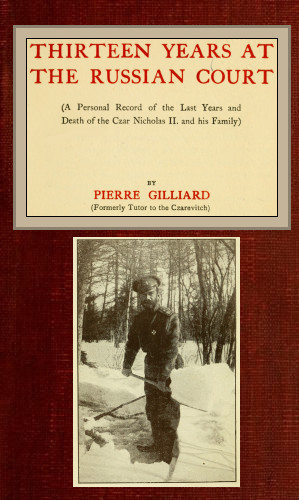
The Project Gutenberg eBook of Thirteen years at the Russian court
Title: Thirteen years at the Russian court
Author: Pierre Gilliard
Translator: F. A. Holt
Release date: October 21, 2019 [eBook #60546]
Most recently updated: October 17, 2024
Language: English
Credits: Produced by Chuck Greif and the Online Distributed
Proofreading Team at http://www.pgdp.net (This file was
produced from images available at The Internet Archive)
|
List of Illustrations (etext transcriber's note) |
THIRTEEN YEARS AT THE RUSSIAN COURT
IN CAPTIVITY AT TSARSKOÏE-SELO
March to August, 1917
THE CZAR CLEARING A PATH THROUGH THE SNOW IN THE PARK OF TSARSKOÏE-SELO AT THE END OF MARCH, 1917.
[Frontispiece.
THIRTEEN YEARS AT
THE RUSSIAN COURT
(A Personal Record of the Last Years
and
Death of the Czar Nicholas II. and his Family)
BY
PIERRE GILLIARD
(Formerly Tutor to the Czarevitch)
TRANSLATED BY
F. APPLEBY HOLT, O.B.E.
With 59 Illustrations
THIRD EDITION
LONDON: HUTCHINSON & CO.
PATERNOSTER ROW
INTRODUCTION
IN September, 1920, after staying three years in Siberia, I was able to return to Europe. My mind was still full of the poignant drama with which I had been closely associated, but I was also still deeply impressed by the wonderful serenity and flaming faith of those who had been its victims.
Cut off from communication with the rest of the world for many months, I was unfamiliar with recent publications on the subject of the Czar Nicholas II. and his family. I was not slow to discover that though some of these works revealed a painful anxiety for accuracy and their authors endeavoured to rely on serious records (although the information they gave was often erroneous or incomplete so far as the Imperial family was concerned), the majority of them were simply a tissue of absurdities and falsehoods—in other words, vulgar outpourings exploiting the most unworthy calumnies.[1]
I was simply appalled to read some of them. But my indignation was far greater when I realised to my amazement that they had been accepted by the general public.
To rehabilitate the moral character of the Russian sovereigns was a duty—a duty called for by honesty and justice. I decided at once to attempt the task.
What I am endeavouring to describe is the drama of a lifetime, a drama I (at first) suspected under the brilliant exterior of a magnificent Court, and then realised personally during our captivity when circumstances brought me into intimate contact with the sovereigns. The Ekaterinburg drama was, in fact, nothing but the fulfilment of a remorseless destiny, the climax of one of the most moving tragedies humanity has known. In the following pages I shall try to show its nature and to trace its melancholy stages.
There were few who suspected this secret sorrow, yet it was of vital importance from a historical point of view. The illness of the Czarevitch cast its shadow over the whole of the concluding period of the Czar Nicholas II.’s reign and alone can explain it. Without appearing to be, it was one of the main causes of his fall, for it made possible the phenomenon of Rasputin and resulted in the fatal isolation of the sovereigns who lived in a world apart, wholly absorbed in a tragic anxiety which had to be concealed from all eyes.
In this book I have endeavoured to bring Nicholas II. and his family back to life. My aim is to be absolutely impartial and to preserve complete independence of mind in describing the events of which I have been an eyewitness. It may be that in my search for truth I have presented their political enemies with new weapons against them, but I greatly hope that this book will reveal them as they really were, for it was not the glamour of their Imperial dignity which drew me to them, but their nobility of mind and the wonderful moral grandeur they displayed through all their sufferings.
CONTENTS
LIST OF ILLUSTRATIONS
Thirteen Years at the Russian Court
CHAPTER I
MY FIRST LESSONS AT THE COURT
(AUTUMN, 1905)
IN the autumn of 1904 I accepted a proposal which had been made to me to go to Duke Sergius of Leuchtenberg as French professor.
My pupil’s father, Duke George of Leuchtenberg, was the grandson of Eugène de Beauharnais; through his mother, the Grand-Duchess Marie Nicolaïevna, daughter of Nicholas I., he was a cousin of the Czar Nicholas II.
At the time the family were at the small estate they possessed on the shores of the Black Sea. They spent the whole winter there. It was there that we were surprised by the tragic events of the spring of 1905 and passed through many a poignant hour owing to the revolt of the Black Sea Fleet, the bombardment of the coast, the series of pogroms, and the violent acts of repression which followed. From the very start Russia showed herself to me under a terrible and menacing aspect, a presage of the horrors and sufferings she had in store for me.
At the beginning of June the family took up their residence in the attractive Villa Sergievskaïa Datcha, which the Duke possessed at Peterhof. The contrast was most striking as we left the barren coast of the southern Crimea, with its little Tatar villages snuggling in the mountains and its dusty cypresses, for the splendid forests and delicious fresh breezes of the shores of the Gulf of Finland.
Peterhof had been the favourite residence of its founder, Peter the Great. It was there that he rested from the exhausting work of building St. Petersburg, the city which at his command rose from the marshes at the mouth of the Neva as if by enchantment—a city destined to rival the great European capitals.
Everything about Peterhof recalls its creator. First of all there is Marly in which he resided for some time—a “maisonnette” out in the water on an isthmus of land separating two great lakes. Then comes the Hermitage, by the shores of the gulf where he liked to treat his helpers to banquets where the wine flowed freely. There is Monplaisir, a building in the Dutch style with a terrace sheer above the sea. It was his favourite residence. How curious that this “landsman” loved the sea so much! Last comes the Great Palace, which, with its lakes and the superb views in its park, he meant to rival the splendours of Versailles.
All these buildings, with the exception of the Great Palace, produce the impression of those abandoned, empty edifices which memories of the past alone can bring to life.
The Czar Nicholas II. had inherited his ancestors’ preference for this delicious spot, and every summer he brought his family to the little Alexandria Cottage in the centre of a wooded park which sheltered it from prying eyes.
The Duke of Leuchtenberg’s family spent the entire summer of 1905 at Peterhof. Intercourse between Alexandria and Sergievskaïa Datcha was lively, for the Czarina and the Duchess of Leuchtenberg were on terms of the closest friendship. I was thus able to get occasional glimpses of the members of the royal family.
When my time ran out it was suggested that I should stay on as tutor to my pupil and at the same time teach French to the Grand-Duchesses Olga Nicolaïevna and Tatiana Nicolaïevna, the two elder daughters of the Czar Nicholas II. I agreed, and after a short visit to Switzerland I returned to Peterhof in the early days of September. A few weeks later I took up my new duties at the Imperial Court.
On the day appointed for my first lesson a royal carriage came to take me to Alexandria Cottage, where the Czar and his family were residing. Yet in spite of the liveried coachman, the Imperial arms on the panels, and the orders with regard to my arrival which had no doubt been given, I learned to my cost that it was no easy task to enter the residence of Their Majesties. I was stopped at the park gates, and there were several minutes of discussion before I was allowed to go in. On turning a corner I soon observed two small brick buildings connected by a covered bridge. If the carriage had not stopped I should not have known I had arrived at my destination.
I was taken up to a small room, soberly furnished in the English style, on the second storey. The door opened and the Czarina came in, holding her daughters Olga and Tatiana by the hand. After a few pleasant remarks she sat down at the table and invited me to take a place opposite her. The children sat at each end.
The Czarina was still a beautiful woman at that time. She was tall and slender and carried herself superbly. But all this ceased to count the moment one looked into her eyes—those speaking, grey-blue eyes which mirrored the emotions of a sensitive soul.
Olga, the eldest of the Grand-Duchesses, was a girl of ten, very fair, and with sparkling, mischievous eyes and a slightly retroussé nose. She examined me with a look which seemed from the first moment to be searching for the weak point in my armour, but there was something so pure and frank about the child that one liked her straight off.
The second girl, Tatiana, was eight and a half. She had auburn hair and was prettier than her sister, but gave one the impression of being less transparent, frank, and spontaneous.
The lesson began. I was amazed, even embarrassed, by the very simplicity of a scene I had anticipated would be quite different. The Czarina followed everything I said very closely. I distinctly felt that I was not so much giving a lesson as undergoing an examination. The contrast between anticipation and reality quite disconcerted me. To crown my discomfort, I had had an idea that my pupils were much more advanced than they actually were. I had selected certain exercises, but they proved far too difficult. The lesson I had prepared was useless, and I had to improvise and resort to expedients. At length, to my great relief, the clock struck the hour and put an end to my ordeal.
In the weeks following the Czarina was always present at the children’s lessons, in which she took visible interest. Quite frequently, when her daughters had left us, she would discuss with me the best means and methods of teaching modern languages, and I was always struck by the shrewd good sense of her views.
Of those early days I have preserved the memory of a lesson I gave a day or two previous to the issue of the Manifesto of
THE FOUR GRAND-DUCHESSES. (CRIMEA, 1909.)
(From left to right: Anastasie, Tatiana, Marie, Olga).
[Facing page 2.
October, 1905, which summoned the Duma. The Czarina was sitting in a low chair near the window. She struck me instantly as absent-minded and preoccupied. In spite of all she could do, her face betrayed her inward agitation. She made obvious efforts to concentrate her thoughts upon us, but soon relapsed into a melancholy reverie in which she was utterly lost. Her work slipped from her fingers to her lap. She had clasped her hands, and her gaze, following her thoughts, seemed lost and indifferent to the things about her.
I had made a practice, when the lesson was over, of shutting my book and waiting until the Czarina rose as a signal for me to retire. This time, notwithstanding the silence which followed the end of the lesson, she was so lost in thought that she did not move. The minutes passed and the children fidgeted. I opened my book again and went on reading. Not for a quarter of an hour, when one of the Grand-Duchesses went up to her mother, did she realise the time.
After a few months the Czarina appointed one of her ladies-in-waiting, Princess Obolensky, to take her place during my lessons. She thus marked the end of the kind of trial to which I had been subjected. I must admit the change was a relief. I was far more at my ease in Princess Obolensky’s presence, and besides, she gave me devoted help. Yet of those first months I have preserved a vivid recollection of the great interest which the Czarina, a mother with a high sense of duty, took in the education and training of her children. Instead of the cold and haughty Empress of which I had heard so much, I had been amazed to find myself in the presence of a woman wholly devoted to her maternal obligations.
It was then, too, that I learned to realise by certain signs that the reserve which so many people had taken as an affront and had made her so many enemies was rather the effect of a natural timidity, as it were—a mask covering her sensitiveness.
I will give one detail which illustrates the Czarina’s anxious interest in the upbringing of her children and the importance she attached to their showing respect for their teachers by observing that sense of decorum which is the first element of politeness. While she was present at my lessons, when I entered the room I always found the books and notebooks piled neatly in my pupils’ places at the table, and I was never kept waiting a moment. It was the same afterwards. In due course my first pupils, Olga and Tatiana, were joined by Marie, in 1907, and Anastasie, in 1909, as soon as these two younger daughters had reached their ninth year.[2]
The Czarina’s health, already tried by her anxiety about the menace hanging over the Czarevitch’s head, by degrees prevented her from following her daughters’ education. At the time I did not realise what was the cause of her apparent indifference, and was inclined to censure her for it, but it was not long before events showed me my mistake.
CHAPTER II
ALEXIS NICOLAÏEVITCH—VISITS TO THE CRIMEA
(AUTUMN, 1911, AND SPRING, 1912)
SPALA (AUTUMN, 1912)
THE Imperial family used regularly to spend the winter at Tsarskoïe-Selo, a pretty little country town some thirteen miles south of Petrograd. It stands on a hill at the top of which is the Great Palace, a favourite residence of Catherine II. Not far away is a much more modest building, the Alexander Palace, half hidden in trees of a park studded with little artificial lakes. The Czar Nicholas II. had made it one of his regular residences ever since the tragic events of January, 1905.
The Czar and Czarina occupied the ground floor of one wing and their children the floor above. The central block comprised state apartments and the other wing was occupied by certain members of the suite.
It was there that I saw the Czarevitch, Alexis Nicolaïevitch, then a baby of eighteen months old, for the first time, and under the following circumstances. As usual, I had gone that day to the Alexander Palace, where my duties called me several times a week. I was just finishing my lesson with Olga Nicolaïevna when the Czarina entered the room, carrying the son and heir. She came towards us, and evidently wished to show the one member of the family I did not yet know. I could see she was transfused by the delirious joy of a mother who at last has seen her dearest wish fulfilled. She was proud and happy in the beauty of her child. The Czarevitch was certainly one of the handsomest babies one could imagine, with his lovely fair curls and his great blue-grey eyes under their fringe of long curling lashes. He had the fresh pink colour of a healthy child, and when he smiled there were two little dimples in his chubby cheeks. When I went near him a solemn, frightened look came into his eyes, and it took a good deal to induce him to hold out a tiny hand.
At that first meeting I saw the Czarina press the little boy to her with the convulsive movement of a mother who always seems in fear of her child’s life. Yet with her the caress and the look which accompanied it revealed a secret apprehension so marked and poignant that I was struck at once. I had not very long to wait to know its meaning.
During the years following I had increasing opportunities of seeing Alexis Nicolaïevitch, who made a practice of escaping from his sailor nurse and running into his sisters’ schoolroom, from which he was soon fetched. And yet at times his visits would suddenly cease, and for quite a considerable period he was seen no more. Every time he disappeared everyone in the palace was smitten with the greatest depression. My pupils betrayed it in a mood of melancholy they tried in vain to conceal. When I asked them the cause, they answered evasively that Alexis Nicolaïevitch was not well. I knew from other sources that he was a prey to a disease which was only mentioned inferentially and the nature of which no one ever told me.
As I have already said, when I was released from my duties