
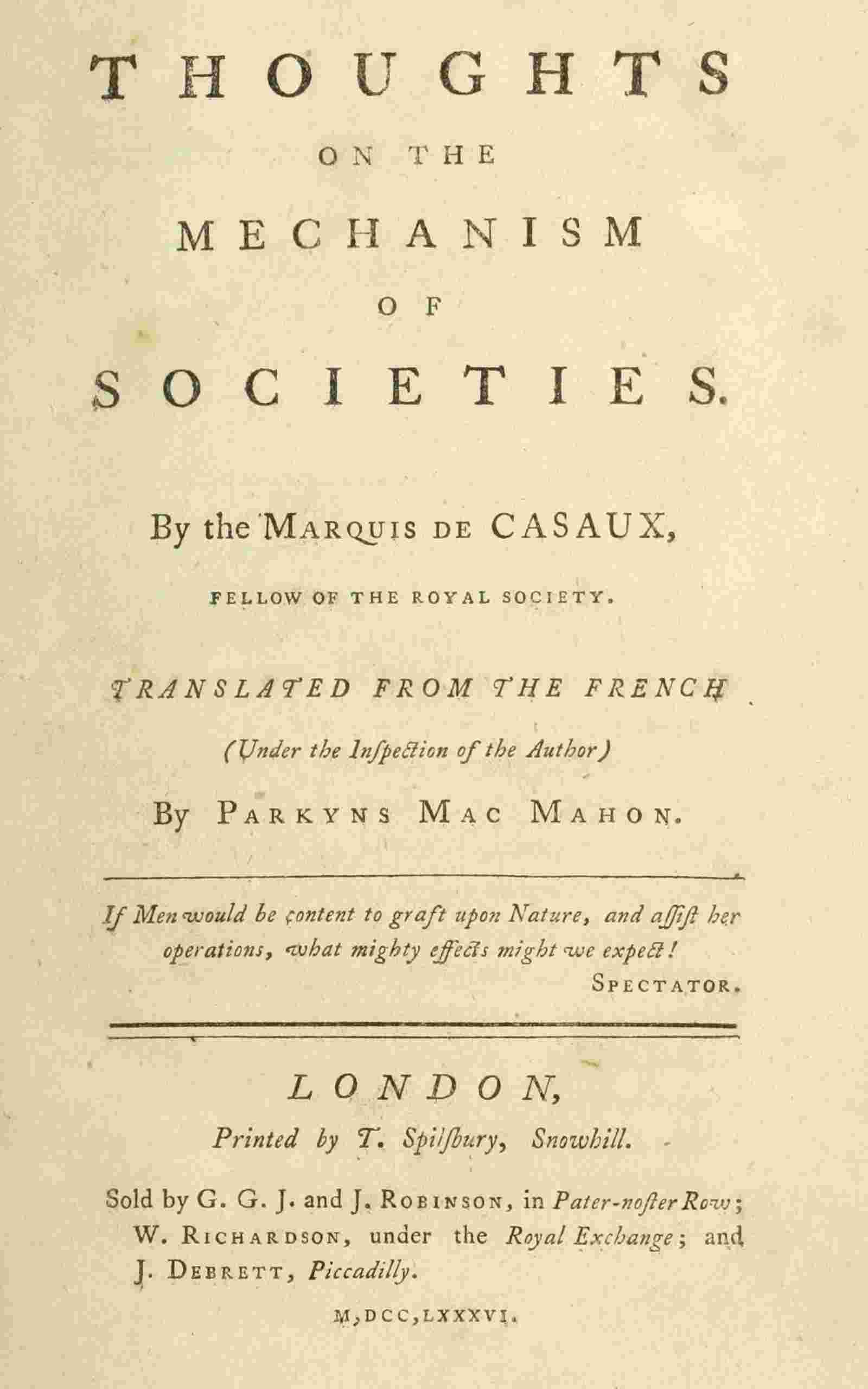
Thoughts on Imposts and Reimbursements.—The Accumulation of public Treasure considered as the Means of preventing Taxation.
The present impost in England, as the case is almost every where, consists of two parts widely different from each other: the one is certainly burdensome, but necessary;—of this hereafter. Might not the other, which concerns the national debt, however grievous it may appear, be considered as an useful establishment, so long as it shall be presumed that the increase of the national wealth, and its being divided amongst a greater number of individuals, is an advantage to the State; “or, in other words, until it shall appear evidently, that the welfare of the State requires that each of its members should lay out annually all that he is able to spend?” Before I attempt to deliver my opinion on these two subjects, I shall suppose the reimbursement possible, and resolved upon.
Nine millions of taxes, to pay off the annual interest of the debt, compose nearly one seventh of the landed revenue. These taxes, gradually laid on such objects of consumption as are supposed most likely to bear them, must have raised their price by one seventh, or something more; and that really, justly, and I think necessarily. The reader will perceive that I speak of the objects of taxation collectively, since some of them bring to the Exchequer twice their intrinsic value. The reimbursement being effected, would they fall back to their primitive value?—Yet this must be, in order to reap the pretended advantage; and this, in my opinion, would be of no manner of service. I shall endeavour to prove it; and then we shall examine whether the effect would not be more than doubtful.
It would be no easy matter to assign, for certain general facts, any other cause than the force of Nature; who, in the end, gets the better of all the regulations that thwart her. But let any one examine whether there be a single untaxed object, which, from 90 years back, or, to speak more to the purpose, from the origin of the national debt, is not raised more than one seventh, above the nominal value it had at that period. It is therefore sufficiently probable that the taxes have been felt, not only by the consumer of the taxed commodities, (according to the laudable intentions of Government) but also by the whole nation, by all the individuals that compose it:—And this, in my opinion, is equally just and unexceptionable.
Yet, it may be urged, that this increase in price is to be ascribed to the greater quantity of specie in circulation. Granted. In this case, a falling-off in the prices, accruing, as it is supposed, from a decrease in the taxes, which is represented as the effect of a reimbursement, cannot then take place:—besides, as the sequel will show, the taxes unavoidably bring in, one way or the other, even in the first year, the whole money required to pay the same. I shall argue on both suppositions. Is the increase in the prices owing to the taxation? It appears, evidently, that the taxes bring in the sums necessary to pay them, since they are actually and annually paid:—This money, then, must be withdrawn from the circulation, in order to lower the prices. Is this increase the effect of an augmentation of the specie? Then it will be necessary, in order to ascertain the primitive price, to recall from the circulation all the money which has been introduced since, and in spite of the taxes. Now if, in spite of the taxes, a country abounds with money, how should it not be so, supposing no duties had been laid?—How can the abolition of the taxes prevent the introduction of cash?—How will it come to pass, that the mass of specie being increased, the prices shall not be raised?—And if all of them augment, in a fair proportion, who will gain by it, who will suffer?
Be it supposed, nevertheless, for this is my main object, that the abolition of the taxes will lower the price of the mass of taxed commodities.—The same force of nature, which, without the intervention of any one, had raised the generality of untaxed objects up to the rate necessary to balance the imaginary value, which the tax added to the others, would operate in a contrary sense, and diminish, insensibly, the price of those articles which might have been overlooked:—What would be the advantage accruing to the State from a general and proportionable decrease?—Let us not think yet of the pretended profit that would result therefrom, in favour of trade, with relation to foreign competition: this matter requires a particular article. The only business now in hand, is to examine, whether, in case the reimbursement should be effected, this general decrease of prices, which I have just granted, could be effectually obtained.
The reflections which I have hitherto laid before the reader, suppose that the refunded 238 millions would irrevocably be transferred from the Exchequer into the hands of those unfortunate individuals who might have been forced to receive their reimbursement. But one must live. Government could not carry injustice so far as to compel them to bury, or cast into the deep, that precious metal, ripped up at so great an expence from the bowels of the earth. What consequence would then ensue, if that immense sum put into circulation, not in England alone, where such an addition of specie would, in less than six months, occasion a six-fold rise of prices, but over all Europe, where probably treble that stock never was in circulation?—The price of every commodity would treble, or at best double, perhaps universally.—What advantage could the State, or individuals, derive from such unavoidable, general, and proportionable rise?—Were the reimbursement practicable, instead of effecting it, I should vote for laying out the 238 millions in erecting a colossus of gold and silver, to be a standing monument of public gratitude towards those whose œconomy and confidence have served the State in its needful circumstances.
The absurdity which might be imputed to such an idea I shall partly do away, by stating the effects of laying up treasures, as has been the fancy of several princes, and which is supposed profitable by Mr. David Hume, who, methinks, ought to have been one of the first to rest assured of its inutility, after his excellent observations on money.
I shall suppose that the English government had preserved, seven years ago, the 60 millions and upwards, expended during the last war; and that, instead of laying those taxes so highly complained of, they had annually laid out of the Exchequer, the 12, 15, 20,000,000 sterling, which successively produced the last debt: what might have been the result?
First, If the very useless prohibition of the exportation of specie, however it might be profitable to those who could export it, could have possibly been put in force, 60 millions of real cash added, in a country where 20 millions perhaps are sufficient for circulation, must have doubled at least the price of every thing; a consequence diametrically opposite to what it was intended to effect. Would it not, in some respect, have ruined the Bank, by rendering useless its nominal stock, in lowering the interest of its real one, and reducing, in fine, its abilities so much below the level of public wants, when the general prices, two-fold increased, would have raised, in the same proportion, that of every engagement?
Secondly, The evil would have been less fatal than I describe it, if the prohibitory law, as all those that militate against justice and common sense, had been evaded; but the gold hoarded up heretofore, and now supposed to be circulated over England, would, by succession, have passed into France: and the latter, in order to continue the war, would have borrowed, even of the English, at four, and presently at three per cent. the monies which she could not procure at less than seven or eight per cent. Now money growing more common in France, the prices would be, as in England, and soon after every where else, increased in the same proportion; for it is essential to observe, that those two nations are too rich, their correspondence too extensive, their activity kept up by too many branches of industry, for them not to regulate the markets all over Europe: it is probable that both are now too enlightened any longer to refuse receiving it, not one from the other, but from Nature herself, who, constantly provident, ever above the reach of untoward regulation, at all times unbiassed in bestowing her favours, or equipoising one by the other, would settle, only a little later, notwithstanding all efforts to the contrary, that equilibrium necessary to the general good of Society, of which it is glorious enough for those two countries to constitute the preponderant parts.
Thirdly, Independent of this general and inevitable repartition of the 60 millions laid up heretofore, the 10, 15, and 20 millions, which England has found yearly, during the last war, in the purse of her subjects, were, beyond doubt, that portion of capitals, which the circumstances of such a war as the last was, would have rendered useless in the hands of the lenders, had government found in the Exchequer those sums which were obtained by way of a loan. Can it be doubted but that this portion, useless in England, in the supposition of a prior accumulation of money, would equally have been sent into France, on the first prospect of placing it to advantage?—It would have been carried there, just as the Dutch had formerly sent into England the dormant part of their capitals, and would send it any where, at all times when sure of benefiting by it, were it even against the interest of the United Provinces, saying with Camilla, in Corneille’s Tragedy of the Horatii,
It will appear by the sequel, that I am as far from cutting off such resources, as are deemed infallible, and dictated by prudence, in order to support with vigour a necessary war, as I am from raising the least doubt concerning the right of waging war, be it ever so unprofitable and unjust. My only intention was to prove, that treasures hoarded up in time of peace, and scattered afterwards during a war, in order to avoid taxation, would raise much higher the prices of everything, than taxes of any kind whatever could raise them. And I do now say—make war as long as you please, but do not accumulate for the purpose of waging it. Your monies, locked up in your strong chests, could not be sheltered from every kind of accidents; and whilst you can boast of subjects equally brave and industrious, you will never want money, nor means to carry on any war you may undertake: but then you must submit to that augmentation of prices, which must naturally follow. I flatter myself I shall be able to prove, that this very increase is subject to no manner of inconvenience.