
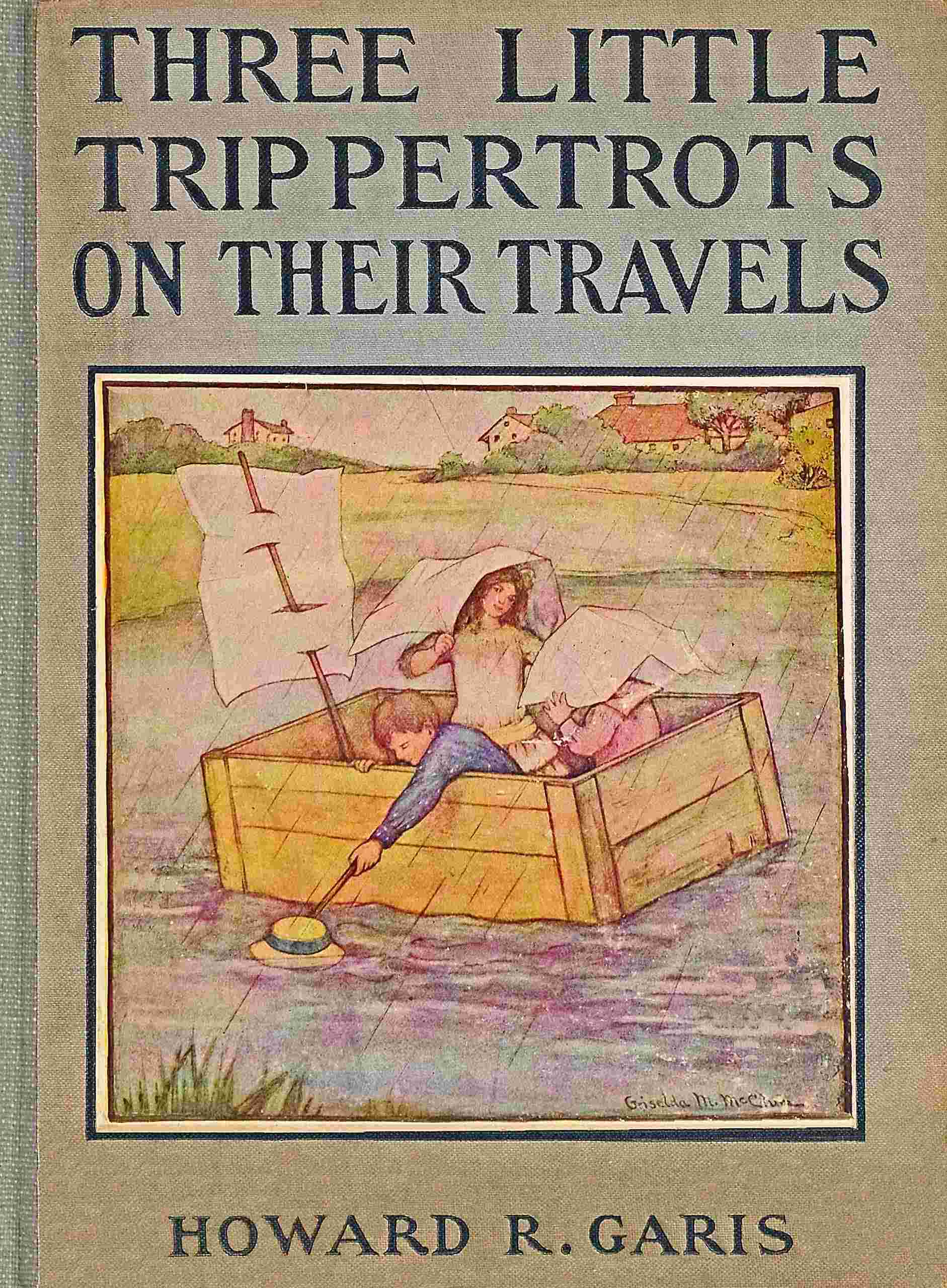
Three Little Trippertrots on
Their Travels.
ADVENTURE NUMBER ONE
THE TRIPPERTROTS AND THE LITTLE FAIRY
They were sitting around the fire after supper—Mary and Tommy and Johnny Trippertrot, their papa and mamma, and the old fisherman. The three children had just come home, after having had some wonderful adventures, and they were rather tired.
“I don’t believe I’m ever going away again,” said Mary, who was older than her two brothers. “Never again am I going away. Home is too nice.” And she cuddled close up to her papa and mamma.
“Yes, it is nice,” replied Johnny. “I guess we won’t go away any more.”
“But we had good times, didn’t we?” asked Tommy, as he looked over at the old fisherman, who was gazing at the fire as if wondering whether or not he could catch anything in the flames. “We had lots of good times.”
“Yes, you certainly did have lots of good times,” agreed the old fisherman.
“There was the time we met Simple Simon, and the pieman, and Jiggily Jig, the funny boy, who was always turning somersaults,” cried Mary.
“Yes, and there was the time we rode on the funny horses—the sawhorse, the clothes-horse and the rocking-horse,” went on Tommy. “And when we met the man with the dancing bears, and the man with the pink cow, and the little lost girl, who wanted to be a boy, and whose name was Jack. Remember that?”
“I guess I do,” replied Johnny. “And then there was the time we rode in the train, and met the little old lady, and when the fireman put out the blaze in our chimney, and then the false-face man! Oh, he was jolly!”
“Wasn’t he!” exclaimed Mary. “But I’m glad we have you with us,” she said to the old fisherman. “You are the only friend who came home with us to stay.”
“I am glad I did,” returned the old fisherman.
And now I suppose I had better tell you, children, that the Trippertrots were always running away, and getting lost, though they didn’t mean to, and they came home again as soon as they could. On their trips they met many strange people and animals, and I have told the stories of them in the book before this, called, “Three Little Trippertrots; How They Ran Away, and How They Got Back Again.” The people whom the children spoke about, as they sat around the fire, are all mentioned in that book. The Trippertrots, you know, lived with their papa and mamma in a house in a big city, and there was a nursemaid, named Suzette, who was supposed to look after them, although she didn’t always do it, being so busy.
“It was very good of you to bring the children home,” said Mrs. Trippertrot to the old fisherman. “Very kind of you, indeed.”
“Oh, it was a pleasure for me,” answered the fisherman, who had met the children on their last adventure, and who had taken care of them. “We had a nice ride home in the carriage.”
“And he caught a man’s tall hat by dangling a hammock-hook out of the carriage window,” explained Mary Trippertrot.
“And a lady’s bonnet,” added Tommy.
“And a little girl’s loaf of bread,” said Johnny.
“But he gave them all back,” exclaimed Mary. “And, oh, Mr. Fisherman, you promised to do some tricks for us,” she went on. “You really did, and I think you might do some now, to amuse us. It isn’t quite bedtime.”
“Oh, yes, I’d love to see some funny tricks,” said Tommy. “Can you make a rabbit come out of a hat, or take papa’s watch, and make a rice pudding out of it?”
“Yes, please do that trick!” cried Johnny. “Wouldn’t it be funny to see a rice pudding made from father’s watch? And could you leave the tick-tick part in the pudding, Mr. Fisherman?”
“Hold on!” exclaimed Mr. Trippertrot, “I am not sure that I want my watch made into a pudding. I need my watch to tell the time by, so I can go to work in the morning.”
“Oh, don’t worry about that,” spoke the old fisherman, with a jolly laugh. “Even if I should make a pudding of your watch, it would not hurt it in the least, or stop it from tick-ticking. But I think I will do some other trick. Mary,” he said, to the little Trippertrot girl, “please let me take your hair ribbon.”
So Mary handed him her hair ribbon, and her curls fell down all about her face, making it look very pretty in the light of the fire.
“Now, Johnny, you hold one end of this ribbon,” said the old fisherman, and Johnny did so.
“And, Tommy, you take hold of the other end,” went on the nice old fisherman, and there the two Trippertrot brothers stood, each one having hold of Mary’s hair ribbon by the end.
“What kind of a trick is this going to be?” asked Mrs. Trippertrot.
“Well, I don’t rightly know myself,” said the old fisherman, “for it never happens twice alike. Sometimes it comes out one way, and sometimes another.”
“Oh, do you think you will make a rabbit come out of my hair ribbon?” asked Mary, eagerly.
“I’d rather have an elephant,” said Tommy.
“Oh, an elephant would be too big to get in this house,” said Johnny. “Besides, he might break through the floor, and fall into the cellar, and we couldn’t get him out of the coal-bin.”
“That’s so,” said the fisherman. “Then I guess I’d better not make an elephant. But now we must go on with the trick. Close your eyes, all of you children, and I’ll say the magical words that will change the hair ribbon into something wonderful.”
So Mary and Tommy and Johnny closed their eyes, and the old fisherman waved his hands in the air. Then he recited this little verse. But please don’t any of you children say it, or I can’t tell what might happen. This is what the old fisherman said:
“Oh, will we really find a fairy?” asked Mary, when the old fisherman told Johnny and Tommy that they could open their eyes.
“You might,” said the old fisherman. “I never can tell what is going to happen when I say that verse. Now the trick is working, so I advise you all to go to bed.”
“But what about looking behind the parlor chair, when the clock is striking eight?” asked Mary. “It’s nearly eight now, and mayn’t we stay up until then, to see the finish of the trick?”
“Oh, I meant eight o’clock to-morrow morning,” said the old fisherman. “Get up then, and look.”
So the children said good-night to the old fisherman, and they were just trotting off to bed, when Mary exclaimed:
“Goodness gracious! We forgot to fold the hair ribbon tight. We must do that, or there won’t be any trick.”
So she and her brothers folded the hair ribbon as tightly as they could, and placed it far away under the big chair in the parlor, where it was out of sight, just as the fisherman said must be done. Then the Trippertrot children were soon fast asleep, and they could hardly wait until eight o’clock the next morning to come, so they could see how the trick worked.
“Where is the old fisherman?” cried Mary, as soon as she could run downstairs when it was daylight again.
“Oh, he had to go away,” said her mamma.
“Then let’s go look, and see if the hair ribbon has changed into a fairy,” suggested Tommy.
“No; Suzette says it isn’t eight o’clock yet,” objected Johnny. So they ate their breakfast, and got ready for school, and then they sat down and watched the clock until the hands should get to the place where it would be time to look behind the parlor chair, to see what would be hiding there.
“Now it’s time!” suddenly cried Mary, and she jumped up, and ran into the parlor, followed by her brothers, just as soon as the clock began to strike. The three children got there about the same time, but Mary was the first to look under the chair. No sooner had she done so than she screamed:
“Oh, my! Oh, dear! Look there!”
“What is it?” cried Johnny. “Has the hair ribbon turned into a doggie?”
“I wish it would turn into a camel with two humps on his back,” said Tommy. “A camel isn’t too big for the house.”
“Oh, look!” cried Mary again. “The ribbon hasn’t gone away at all! But look at that little animal sleeping on it!”
She pointed to something soft, and fuzzy, and furry, lying asleep on the middle of her folded hair ribbon, which was on the floor under the chair. And then Mary quickly hopped up on another chair.
“Why, it’s nothing but a little mousie!” said Tommy.
“A real, live mousie?” asked Johnny.
“Yes, that’s what it is,” said his brother, and at that Mary screamed, and tried to jump on another chair, further away.
“What’s the matter?” asked Johnny. “A mouse can’t hurt girls.”
“But this is no trick!” cried Tommy. “That fisherman didn’t change that hair ribbon into anything, and the mouse just came and slept on it because he wanted to. I don’t like this.”
“Oh, boys, wait!” suddenly cried Mary. “I see it all now. This mouse is a fairy. Yes, she really is. The fisherman made her come to sleep on my hair ribbon. Oh, it’s just like in a story! I’m so glad. Probably that mouse is a fairy princess in this shape until the magical spell is broken, and she can turn into her real self again.”
“Oh, I don’t think so,” said Tommy.
“Me either,” spoke Johnny. “It’s just an ordinary mouse, like Suzette catches in the trap.”
“It is not! It’s a fairy!” insisted Mary. “Aren’t you a fairy, little mouse?” she asked, and she liked the mousie so that she got down off the chair, and went close to the small creature.
“Squeak-squeak,” said the little mouse.
“There, it said ‘yes-yes,’” cried Mary.
“Well, I’m glad you understand mouse language,” said Tommy. “I don’t believe that’s a fairy.”
“Well, it is,” said Mary, “and pretty soon some wonderful things will begin to happen. You had better look out.”
And just then, if you will believe me, the little mouse ran out from under the chair, just like the one that was under the queen’s throne. And the mousie ran out of the parlor, into the hall, and out of the front door, that happened to be open.
“Oh, the fairy is running away! We must run after her!” cried Mary. “It would never do to have a fairy run away, and especially the first fairy we have ever seen! Run, boys, run!”
So Tommy ran and Johnny ran, and Mary ran, and in another minute the three little Trippertrots were running after the mouse—the fairy mouse it was, I guess—for some wonderful things really happened because of that same mousie. You see, the Trippertrots had now started on their travels.
“There she goes—down the street!” cried Mary. “Keep after the fairy mouse, Tommy and Johnny!”
So Tommy and Johnny and Mary kept on running, and they forgot that they were never to go away again—in fact, they forgot about everything, except that they were chasing the fairy mouse.
Faster and faster ran the mousie down the street, around the corner, in and out among the legs and feet of the people, faster and faster. But still the Trippertrots kept on after the little creature, running as hard as they could run, until, all of a sudden, the mouse saw a hole in a fence and ran through the hole, and when Mary and Tommy and Johnny got there, why—there wasn’t any mouse to be seen.
“She—she’s gone!” cried Mary.
“Disappeared!” gasped Tommy, who could use big words, sometimes.
“Maybe she’s run home, and is sleeping under the chair again,” suggested Johnny.
“Oh, then, we must go right back!” said Mary. “I want to get my hair ribbon, and we must soon go to school, and I guess maybe the fairy mouse is doing tricks now. Yes, let’s hurry back home, boys.”
“All right,” said Tommy and Johnny together, like twins, you know, only they weren’t. Well, then a funny thing happened. The Trippertrot children started to go home, but what do you think? They were lost! They looked all around, but they didn’t know any of the streets, and they didn’t see anybody whom they could ask where their house was, for all the people had suddenly gone away.
“Oh, dear!” cried Mary. “It’s happened again.”
“What has?” asked Tommy.
The Three Little Trippertrots Were Running After the Mouse
“Why, we’re lost,” said Mary. “Can’t you see? We can’t find our way home!”
“The fairy mouse did this,” said Johnny. “It’s all part of the game. Wait, maybe she’ll come back, and change into a trolley car, and take us home.”
And then, all of a sudden, it began to rain. Oh, my! How hard the drops splashed down. The children looked to see if they could find the kind fisherman, who might fish up an umbrella, or a pair of rubber boots, or a raincoat for them, but he was not in sight. And Tommy looked to see if the fairy mouse would come back, changed into an automobile, or a trolley car, but nothing like that happened.
All at once, along the street came a newsboy, with a bundle of papers under his arm. He didn’t seem to mind the rain, and he ran up to the children, crying:
“Don’t worry, now. I’ll take care of you. Here, take some of my papers, and hold them over your heads for umbrellas. Then you won’t get wet. Come with me and I’ll take you home.”
Then he handed some papers to Mary, to Tommy, and to Johnny, who held them over their heads like Japanese umbrellas, and they took hold of each others’ hands and ran on. And the rain came down harder than ever, and soon the streets were like little rivers of water.
“Don’t worry!” cried the newsboy. “I’ll look after you.”
“Oh, I think he must be the fairy mouse changed into a boy,” said Mary to her brothers, and Tommy and Johnny nodded their heads, for they thought the same thing.
And, then, all of a sudden, they saw a big wooden box floating down the street, which was now filled with water.
“Oh, this is just the thing!” cried the newsboy. “Come on, little ones,” and he ran toward the box. “We’ll go sailing!”