
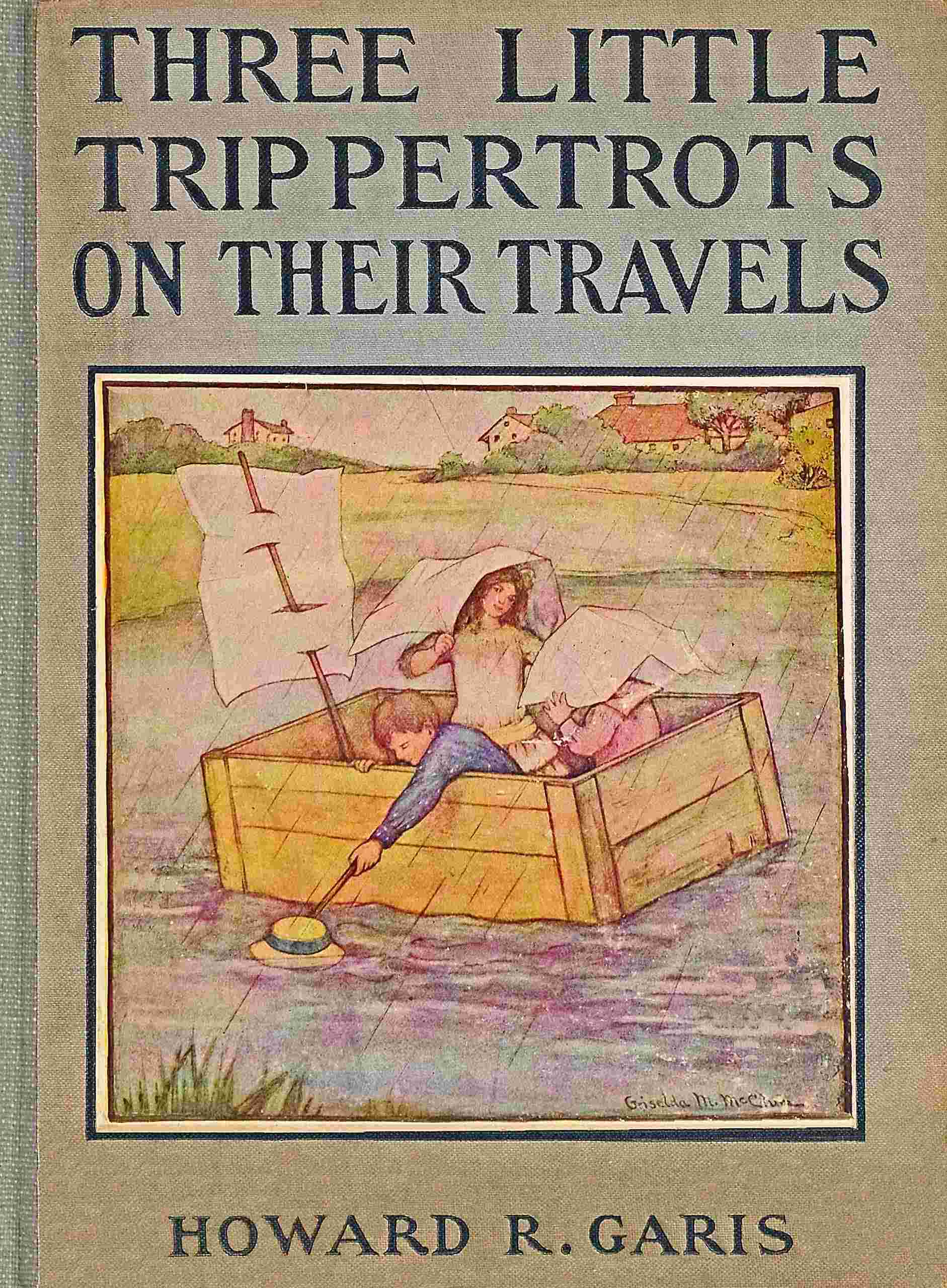
ADVENTURE NUMBER FIVE
THE TRIPPERTROTS IN A GROCERY WAGON
“Well, what game shall we play now?” asked Mary Trippertrot, of her brothers Johnny and Tommy, when they had finished playing the one called “Please Don’t Step on My Toes.” It was a game Mary made up herself, and was very nice.
“Oh, I don’t know,” answered Tommy. “Suppose we play ‘Hide the Knitting Needle’?”
“That’s no fun!” exclaimed Johnny. “Besides, some of us might get stuck by the needle.”
“That’s so,” agreed Mary. “But what can we do?”
“Oh, I know!” cried Tommy. “We’ll play that nice old game of looking out of the window and choosing things. We’ll let Mary have first choice, and maybe she can get an automobile.”
“Oh, goodie!” exclaimed the little Trippertrot girl. “Then we can go for a ride in it.”
“Oh, but mamma said we weren’t to go out of the house, unless something special, extra-extraordinary happened,” spoke Tommy, “so we couldn’t go out in your auto, Mary, even if you are lucky enough to get one.”
“But I only meant to take a make-believe ride in a make-believe auto,” explained the little girl. “Wouldn’t that be all right?”
“I guess it would,” said Johnny. “Anyhow, let’s go to the window, look out, and see what things we can choose.”
So that is how the three little Trippertrots happened to be looking out of the window. And, as truly as I’m telling you, the first thing that came along was a great big red automobile, with large, fat wheels, like sausages, and Mary cried:
“Oh, that’s mine! That’s mine!”
“Yes,” said Tommy, “and now let’s go for a make-believe ride in it.”
“Oh, but first let’s you and I choose something,” said Johnny to his brother.
“There comes a horse and carriage,” said Tommy. “I’m going to choose that for mine.”
“But you can’t take that in my auto,” said Mary. “It’s far too big.”
“So it is,” agreed Tommy. “Wait a minute, there comes a messenger boy with a box of candy. I’ll choose that.”
“Which, the boy or the candy?” asked Johnny.
“The candy, of course!” exclaimed Tommy, with a laugh. “There might not be room in the auto for the boy.”
“Well, you’d better be quick about what you’re going to choose, Johnny!” called Mary, “for my red auto is moving along pretty fast, and it may be out of our block before we get our ride in it. Hurry up, Johnny.”
“Well, I’ll choose that fruit-stand across the street,” spoke Johnny.
“That’s nice,” said Mary. “We shan’t be hungry on our trip, anyhow, with Tommy’s box of candy, and Johnny’s fruit-stand. Come on, now, get in my auto.”
So the boys made-believe help their sister into the make-believe auto, and they closed the doors and turned on the gasolene, and away they went as fast as anything, if you will kindly believe me. Only, of course, it was only make-believe, pretend riding, you know.
They went to New York, and a place called Osh-Kosh, and to Mumbly-Bumbly and to Kalamazoo and even part way to the moon, but, of course, all this while they were really only in the front room of their house, peeping out of the window.
And then, all of a sudden, Mary looked, and she saw a grocery wagon on the street, out in front, and the horse hitched to the wagon was walking slowly along, and there was no one driving him.
“Look at that!” cried Mary. “That horse is running away.”
“I guess you mean he’s walking away,” said Johnny. “He isn’t running.”
“Well, he’s going away, anyhow,” insisted Mary, “and the driver isn’t there and the horse may bunk the wagon into something, and smash it, and then the grocery man would lose a lot of money.”
“Well, what can we do about it?” asked Tommy.
“We might go out, and stop the horse from going away,” continued Mary, “and then we could telephone to the man who owns it, to come and get it from in front of our house.”
Johnny looked all around the room. So did Tommy. Their papa and mamma weren’t there. Neither was the nursemaid.
“Do you think going out to stop the horse would be a special, extra-extraordinary occasion?” asked Tommy, of Mary.
“Whoa There, Horsie!” She Called
“Oh, yes,” she said, “I do. And I think if mamma was here she’d want us to go out of the house to catch the walk-away grocery wagon and horse.”
“Then we’ll do it,” decided Tommy. “Come on, Mary and Johnny!”
So out of the house the three little Trippertrots went after the grocery wagon, and they never stopped to think that they might get lost again. They wanted to do a kind act, you see, and I think it was very nice of them; don’t you?
They ran after the walk-away horse, that was now some distance down the street, and soon the Trippertrots had caught up to him.
“Whoa, horsie!” called Tommy.
“Yes, you must stop,” added Johnny, most politely.
“Because it’s wrong to run away, or even walk away,” said Mary. “We came to catch you, so your master can find you. Otherwise, you might get lost, you know.”
“Horses can’t get lost!” declared Tommy.
“They might, when they were little girl or boy horses,” said Mary. “I should think a little horse could get lost, the same as we do, lots of times. Whoa there, horsie!” she called, for the grocery horse was still walking away.
“Well, perhaps ponies can get lost,” admitted Tommy, and just then the grocery horse stood still, because the three Trippertrot children had run out right in front of him. I think it was very brave of them; don’t you?
The horse looked at the children, and the Trippertrots looked at the horse, and then Mary said:
“Now we ought to tie him to a post, so he can’t get away any farther, and then go telephone to the man. Otherwise, we might get lost ourselves.”
“But we don’t know who owns the horse,” said Tommy.
“Yes, there is his name on the side of the wagon,” said Johnny, and, surely enough, there was the grocery man’s name in big letters.
“What name do you think it is?” asked Mary, of her brothers.
“Oh, how funny of us!” exclaimed Tommy. “None of us can read, because we’re only in the kindergarten class, so we can’t tell what the name is on the wagon.”
“I can read!” cried Johnny. “I can read words like ‘cat’ and ‘dog.’”
“But I don’t think the grocery man’s name is either cat or dog,” spoke Mary.
“Then what are we going to do?” asked Johnny.
“We can tie the horse to a post,” said Mary, “and then we can go home and tell papa about it, and he can come and read the name for us.”
“That’s a good idea,” declared Tommy. “But what shall we use to tie the horse to a post? Have you a piece of string in your pocket, Johnny?”
“Yes,” answered his brother, “I have.”
“Oh, you silly boys!” exclaimed Mary. “They don’t tie horses with string. They use a leather strap. There must be one in the wagon. You boys climb in and look.”
So Tommy and Johnny climbed up on the wagon step, and crawled back over the seat, for the horse was kind and gentle, and stood very still, looking up at the sky now and then, to see if it would rain, I guess.
“I can’t find any strap!” called Johnny, after a while.
“Nor I,” added Tommy. “There are a lot of groceries in the wagon, but no strap.”
“Oh, I suppose I’ll have to look myself,” said Mary. So she climbed up into the wagon where her brothers were. She looked in among the boxes and baskets, and she had just found the strap, which was in among some oranges, when, all at once, a queer thing happened. The horse suddenly started to walk away again, pulling the wagon after him, and the Trippertrot children were in the wagon. So, of course, the horse pulled them, too.
“Oh!” cried Mary. “We’re having a ride!”
“That’s fine!” exclaimed Johnny.
“Oh, but we mustn’t!” shouted Tommy. “The horse is taking us away from home, and mamma told us not to go! We must stop him!”
“That’s so,” admitted his brother.
“Whoa there! Whoa! Whoa!” called Mary to the horse. But the horse wouldn’t stop, and kept on going, taking the Trippertrot children farther and farther down the street.
“Oh, what shall we do?” asked Mary, of her brothers. “We will be lost again.”
“I guess we will,” spoke Johnny, but he didn’t seem to mind it very much.
“Can’t you pull on the lines and make the horse stop?” asked Tommy.
“The lines are too far out,” answered Johnny. “I might fall if I reached for them.”
“Then call to some one—a policeman or anybody—and ask him to please stop the horse,” suggested Mary. “Oh, boys! this time it isn’t our fault that we’re running away; is it?”
“No, indeed,” answered Tommy. “But the horse isn’t running, he is only walking. Maybe he’ll stop soon.”
“He’s running now,” suddenly exclaimed Johnny, and, surely enough, the horse began to go faster and faster, giving the Trippertrots a nice ride, but still taking them farther and farther away from home.
“Oh, we’re lost again!” cried Mary, as she and her brothers sat down in the back of the wagon, in among the boxes and baskets of groceries. “I wonder where we will end up?”
But none of the children seemed to know, so they just sat there in the wagon.