
The Project Gutenberg eBook of Three Years in the Service
Title: Three Years in the Service
Author: D. McCall
Release date: April 29, 2015 [eBook #48822]
Language: English
Credits: Produced by MWS and the Online Distributed Proofreading
Team at http://www.pgdp.net (This file was produced from
images generously made available by The Internet Archive)
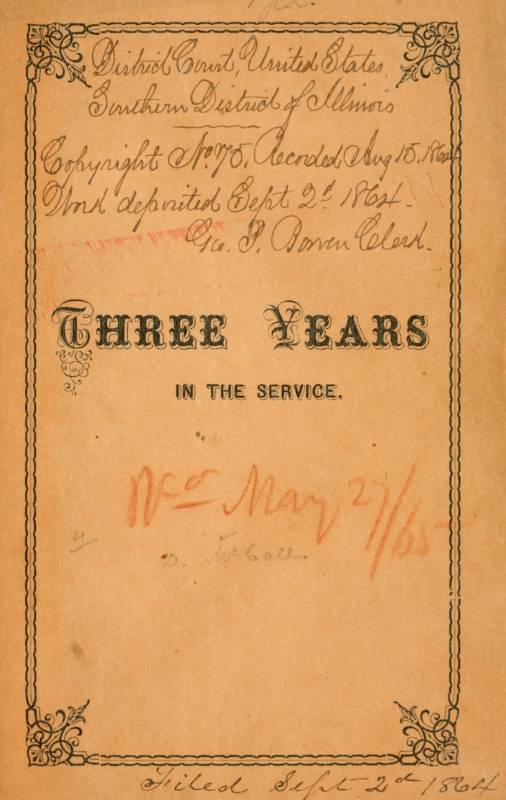
THREE YEARS
IN THE SERVICE.
A RECORD OF THE DOINGS
OF THE 11TH REG. MISSOURI VOLS.
BY D. McCALL, A PRIVATE OF CO. B.
SPRINGFIELD:
STEAM PRESS OF BAKER & PHILLIPS.
1864.
RECORD OF THE DOINGS
OF THE
11TH REG. OF MISSOURI VOLUNTEERS.
Being anxious to serve my country, I walked to Springfield, Illinois, a distance of twenty-five miles. I arrived there early in the evening, and took up lodging with a German that night, which was on the 14th day of July, 1861. There were several recruiting officers enlisting men for cavalry or infantry. Andrew J. Weber was enlisting a company for an infantry regiment, which I joined. There were then about thirty members. After remaining here, for a few days, boarding at the Owen House, we got on board the cars, which were in waiting, to carry us to our destination.
Sorrowful were the scenes at parting from friends to go from their homes to defend their rights and liberty, many to fall victims of this unholy rebellion. As I was a stranger to the company, I had no regrets at leaving, as my friends were far away. The cars blowed their whistle, and amid the cheers of the people, and waving of handkerchiefs, we left Springfield. Our destination being Missouri, we arrived at night at a place called Illinoistown, opposite St. Louis, and here we remained all night, and next morning we all went down to the river and washed. We were then ordered to fall in to go across the river. Company C accompanied us, commanded by Captain Moses Warner. The two companies fell in and formed in four ranks, and the command was given, and we started to the river; we soon arrived on the bank. There was a ferry boat in waiting to carry us across, we marched board, and the boat soon landed us below St. Louis, where the command was formed in line, and it was soon on its way to the arsenal. We arrived there early in the day. The day was warm, and the streets were dusty, which made it quite disagreeable marching. We were not molested on the way. Most of us were without arms. The people lined the sidewalks as we passed.
When we arrived at the arsenal rations were issued to us, and we eat what we got with a good relish, as we had eat nothing since leaving Springfield the day before. Most of the boys were without money. After staying here for a few hours, the command was ordered to fall in and we were went from here to Marine Hospital, where we remained several weeks. It was here we experienced the duties of a soldier. We quartered in a long low building, with straw and plank to lay on. Provisions were good enough, such as they were, and as we had no conveniences prepared, we labored under difficulties to get enough to eat.
Commenced drilling, and drilled eight hours a day. Our progress was very slow at first, as our commanders were not very proficient in drill. But we soon learned to keep step and the other changes. This continued until one day we marched down to the arsenal, were sworn in as a regiment, and drew our arms. We had previously no arms but some old flint lock muskets, most of them without bayonets. After drawing our equipments we returned to quarters, and in a few days the order came to prepare for marching.
The regiment marched to the bank of the river, stacked arms, and there we remained until evening, awaiting the boat, which arrived at last, and the bugle sounded, and the order came to go on board the boat. We fell in and marched about a mile, when we got on board of the boat awaiting us at the landing. Everything being ready, the boat soon left the landing, and she headed down the river. Next day we landed at Cape Girardeau, Missouri, August 7th, 1861. The regiment soon landed, stacked arms, and men were detailed out of each company to unload the boat. It was hard work, as we had to roll the barrels and hogsheads up a very high hill. But we were strong and healthy, soon put every thing on shore.
We carried our things into an old mill, which was deserted. This was to be our quarters for a while—company B on one side of the room, company C the other, in the second story. The regiment was under command of Col. David A. Bayles, a captain in three months' service. He was severe on us. We had to drill eight hours a day, and there was a great deal of fatigue duty to do. The situation of Cape Girardeau when we arrived:—The city is built on the bank of the Mississippi river, and back of it was very high bluffs, and it was defended by the 8th Missouri and 20th Illinois regiments, some Missouri home guards, cavalry and infantry. There was one small fort, partly finished, no guns mounted, every street was strongly guarded, sentinels standing on every corner, and no person allowed to pass without a written permit from headquarters. Patrols patrolled the town night and day. The citizens treated us quite civilly as long as we remained here.
We were here but a short time when the report was brought to headquarters that a rebel force was marching on us with a heavy siege piece. The report we found to be true, as a deserter informed us afterwards. The alarm soon spread through the camps, and all was in commotion. Every man was ordered under arms, and three companies of the 11th Missouri regiment were ordered to go out and act as picket. Company B was one of the companies detailed. It was early in the evening when we buckled on our belts, order was given fall into line, and our three companies formed in column and marched three miles, where was a heavy piece of timber. Here we deployed as skirmishers along the fence, which was built very high, and awaited the rebels until morning. Woods were on each side of the road. There was nothing worth mentioning occurred to us during our stay there, but the evening being far advanced, every one was roused to his feet; some were fast asleep, while others preferred walking up and down to sleeping, a shot was fired, and then several followed in quick succession. The sound came from camp. After a volley was fired, everything became silent, and all was still again, and we returned to camp, when we were informed that they were ordered out on the top of a high hill, a short time after the three companies left, and there they remained in line of battle, on the ground, with their arms by their side; as the night was quite dark, they could not distinguish friend from foe; they were attacked and had a skirmish, after several volleys were fired on each side, and three men were badly wounded. If there were rebels they had all disappeared in the morning. Plenty of tracks were visible of men and horses near where the firing was, and the supposition was that there was a considerable force there.
Men were busy all that evening throwing up entrenchments and placing guns in position, and thus continued night and day for some time.
One evening the order came to prepare for marching. We were soon in line, the command was given, forward, and off we started. Took the Jackson road and marched quite close to it, and the command halted to examine the front, and we were soon ordered forward, the town was quickly surrounded, cannon placed on both ends of the street, and a sentinel guarded every door and window, and the citizens when they arose in the morning, found themselves prisoners in the hands of the federal soldiers. All the stores were shut. It is a very good place for a town, and was at one time a smart place for business. There were several stores and groceries, a saddler's shop, and a fine place for fruit, and the soldiers fared well for a while on peaches and apples. The merchants would not sell goods to the Union boys, and they helped themselves. There were but few men in town, as they left when they heard of our coming, and did not wait for us to make our appearance, as this was their place of resort a short time before. After getting what apples and peaches we wanted, and frightening the citizens by firing several salutes and breaking some windows, we left.
A great many of the citizens of the surrounding country came in to see the soldiers, and were detained until we left next morning. When the regiment was ready to return to camp, the report came that General Prentiss was coming into town with a brigade of infantry, and the regiments were formed in open order, and at length the expected visitor arrived with his staff. He rode down through the lines, and back again to the head, and made a short speech to us. He said never take a word of insult from a rebel; if any one offered you any insult, shoot him down, for that was the way to end the rebellion. With a few more remarks, of not much import, he closed his speech, and the column was soon in motion, and we arrived at quarters early in the evening, much pleased with our trip.
Then commenced the work of building forts. Spades, shovels and wheelbarrows came into requisition, and all men fit for duty were compelled to work, throwing up breastworks until four strong forts were completed and mounted with heavy siege guns, 24-pounders; the timber was cut down all around within a mile of the fort. All kinds of reports were flying through camp.
One evening we were ordered to fall in, and without much ceremony some few companies were marched up through the town, until they reached an old two story building on the corner of a street. Halt, was heard along the line, and they stopped for a short time waiting for further orders. They were soon ordered forward, and marched into the house, up into the first story, and a lookout was placed at each window. I was one detailed for duty. The night was beautiful, and I could discern objects for some distance, but nothing disturbed the quiet of that still evening but the heavy snoring of the soldiers as they lay in deep sleep all around me. Some, perhaps, were thinking or dreaming of loved ones at home, of friends that were far away; so the night passed off without an enemy disturbing us, and in the morning we returned to camp. Several parties of soldiers were sent out to search for rebels, but they never encountered any, as they always evaded our scouts.
A man from Perryville, Perry county, came to the Cape asking Bayles to send a force to meet the rebels said to be advancing on it. About 300 men was ordered on board the old Illinois steamboat, and company B was chosen and parts of other companies volunteered to go. After getting on board, the old ark began to recede from shore. After numerous delays we found ourselves at Sandford's Landing, fifteen miles from Perryville, and this must be reached as quick as possible. After ascending a very high hill with the utmost difficulty, we started on our way. Two citizens took the oath of allegiance on the road, and were let go where they pleased. Company B was detailed to skirmish through that broken country, and we were put in advance, and was made to halt if we got too far ahead, and wait until the rear came up. In the evening company B was made the advance guard, and they encamped near a large spring of cold water, which was very acceptable to us, as we did not get much good water after leaving the river. Here a citizen of Perryville was made a prisoner. He was lurking near this spring, was well armed, but made no resistance, and he was soon disarmed. We found him quite an influential man among the citizens, and was then captain of a rebel company. He was owner of a hotel in town. We arrived within sight of the town, and were ordered to divide off into small squads and advance from all sides, and take the town by surprise. The order was quickly obeyed, and the band struck up the tune of Yankee Doodle, with drums beating and colors flying, marched into the court yard before the citizens could get away. There was a German ball in progress, but it was soon stopped and the people returned to their homes. Whisky flowed quite freely, and the officers and men had a good time generally with the ladies of the town. Beef was furnished to us by the people, and it was quite a treat to us to get to eat at a table. There were plenty of apples and peaches, also sweet potatoes, we found in great abundance. There was plenty to eat here, and the people would invite the soldiers to dine with them.
Next morning we drew our uniforms, and one of the men by the name of Ford, was drowned while in the river washing himself before changing his clothes. This was the first death in the company. A whole brigade followed this young man to his lonely resting place. The next death was one of Grant's staff, and the next was a John Headly.
About the middle of October we were ordered to prepare for marching, as we were to go out to meet Jeff. Thompson's forces, said to be at Fredericksburg. When we started the rain was falling sufficient to make it pleasant marching, during the whole of the trip. A brigade of infantry was encamped near the town, which informed us that Jeff. Thompson had left; so our brigade started in pursuit, consisting of the 17th Illinois, 5th Indiana cavalry, and one battalion. We met the rebels and repulsed them after a fight which lasted about twenty-four hours, which resulted in a loss to the rebels of about 600 in killed, wounded and prisoners. We came very near being surprised and our force taken. We were marching as if it were to our destruction, when an old negro warned us of our danger. He informed Plummer where the rebels were posted. They had planted two batteries so that when we got close enough they could rake our ranks. Plummer ordered up a battery and opened on them where we supposed the rebels were. Blank cartridges were fired from our side, and they replied with shot and shell, doing no damage, as they shot over us. The 17th Illinois and part of the 11th Missouri were ordered forward, and they advanced and poured in a heavy volley of Musketry, and the enemy could not stand it and fled, and left us masters of the field. The 1st Indiana cavalry made a charge, and Major Gavitt was killed with 250 men either killed or wounded. Infantry loss was slight. The 17th and 20th Illinois charged and took a battery. Col. Lowe was killed on the rebel side, and Thompson's army all dispersed. We followed them 12 miles, and they burned a bridge, so we could not follow them any farther. That was the death-blow to Jeff. Thompson's forces. There were about 3,000 rebels engaged. On our side about 1,700. The battle lasted six hours, and the rebels were completely routed.
The battle was fought on the 21st day of October, 1861. Nothing worth mentioning occurred to us until the 25th day of February, 1862, when we were ordered to prepare for leaving Cape Girardeau, where we had been encamped for over six months; where we had spent many days on fatigue duty in throwing up breastworks, and when we left there were four forts, strongly fortified, mounted with siege guns, and no force the rebels could send against it could take it, and I think we left it secure from invasion.
On the 26th the regiment got on board the steamer Empress, we landed at Commerce, and after staying there a short time we took up our line of march in pursuit of the enemy, said to be retreating from before us. Our advance had a short skirmish with part of Jeff's forces. Our cavalry routed them, and took four small cannon, with a few prisoners. The skirmish was a short distance from Sikestown. Jeff. escaped, but lost his horse and a white feather out of his hat. The next morning we resumed our march. Rain fell that day, and made it hard marching for us, and at length we found ourselves opposite New Madrid. We formed our line of battle and advanced within two miles of the rebel's stronghold, and they commenced shelling us with their heavy guns, but there was little damage done our side, and after remaining under fire for some time, we moved back and bivouacked for the night, as we did not think it advisable to storm the works then, as the rebels were protected by gunboats, and we could not hold them if we should gain possession of them. The weather was quite cold and some snow fell.
After staying here a short time we were ordered to move, and we were soon in motion again. We marched nearly all night, and at last came to a halt, and were ordered to lay down without any fire and make ourselves as comfortable as possible, and there we remained until morning. Such a night as we passed there will long be remembered by me. Some of us had no blankets, and we left our knapsacks at Sikestown. There was some snow on the ground; we waded through water over our shoes, and had to sleep with wet feet; but very little sleep we had that long night. We were four miles from a place called Point Pleasant, and at daylight were on the march for this place. We double-quicked about two miles. There were a few boats tied up at the landing, which our sharpshooters soon drove from there, and they all escaped. Some of the crews were killed.
After Plummer's men drove the rebels from the town, they took possession, and then commenced the work of plunder. Stores were broken into and everything of value was taken. One warehouse was filled with corn, sugar and molasses. Whisky and medicines in abundance, as there were several drug stores, and the boys helped themselves to what they wanted. Our camp was about a mile from the town, and most everything of value was carried off. It was in a low swampy piece of ground, we had no tents, and had to lay on the ground in water, at times the rain pouring in torrents upon us. A detail was made to go and dig rifle pits. The enemy had a gunboat, and they tried to drive Captain Weber and his working party away, but were unable to make the workers desist, and they soon had sufficient protection from the shot and shell that was continually falling around them. Batteries were planted, and they got a siege gun in operation, the enemy's gunboats found it not good policy to venture within reach of our guns; but they planted batteries on the opposite side of the river, and then could not make us leave. We had come to stay for a while, and we were determined on it. New Madrid was soon stormed and taken, and gunboat ran the blockade, and came down the river puffing and blowing, dismounting all the enemies batteries and scattering them in every direction, as if they were nothing but chaff.
After dismounting all the rebel batteries, we were ordered to get ready to move, and soon were in motion again. Mud was over our shoe tops, and it was very hard marching. After a while we arrived at New Madrid. I must mention an occurrence that transpired while at Point Pleasant. One night there was a heavy thunder shower, accompanied with wind and rain, and a good many trees were blown down, and several of the 7th Illinois cavalry men killed and wounded.
One evening a detail of men was made to go and haul a siege gun and plant it below camp about four miles at a place called Tiptonville. The work was performed by morning, the boys having hauled it through mud and mire by hand, and in the morning was ready to go into operation, and that one gun whipped five boats, and made them get out of reach of its shot, and no boats could pass there then, so they had to remain above. When we arrived at New Madrid boats were busy transporting troops across the river, the object being to attack Island No. 10; but while this was being done they evacuated, and about 4,000 prisoners were taken near Tiptonville. As they were trying to escape a floating battery came down the river and created quite an excitement amongst the men until they discovered what it was. Some men boarded with a skiff and found that there was no danger.
Several steamboats floated down passed our camp, and the rebels tried to sink them by cutting holes in them, but still they floated down to us, and our men soon put them in working order. The floating battery sunk near Tiptonville. We took possession of Island No. 10, and got all the heavy siege guns and an immense quantity of provisions, plenty of small arms and ammunition. After remaining at New Madrid for a few days, we took steamboats, steering our course down the river. Gen. Pope was in command at this time. Plummer was our Colonel. We passed several small towns on the way, and arrived at a place called Mosquito Landing, in Arkansas. It was well worth the name, for a worse place for mosquitos I never saw. There was no peace for us—a continual singing in our ears by these torments.
We were within about three miles of Fort Wright, and our mortars and gunboats commenced throwing shot and shell into the rebel works. We could plainly see the smoke and hear the report of our guns as they exploded. After remaining here for a short time we were ordered back up river to opposite Hamburg Landing, where we disembarked, and took up our line of march towards Corinth, where the rebels were making a stand to dispute our progress into the State of Mississippi. Our advance had a fight almost every day, but they drove the rebels before them at every skirmish. They could make but a poor resistance to our advance, and we gained very rapidly on the rebels, and drove them back step by step, until they arrived within about four miles of Corinth. Here a long line of rifle pits were dug, and heavy siege pieces were got into position. We encamped within about six miles of Corinth, and had our grand guard line established to within about three miles of Corinth. Pickets were shooting at one another most of the time, until the 8th of May, 1862, when a brigade of Infantry and some cavalry were ordered out to reconnoitre, when the rebels were drove inside their works. After the day had drawn to a close, and the dew was falling heavily, we retraced our steps, and rested for the night a short distance from Farmington.
Early the next morning our ears were saluted with the heavy boom of cannon. The rebels had planted several batteries during the night, and the 22d and 50th Illinois had barely time to throw off their knapsacks, for the rebels were pouring the shot and shell into them, and they had to take the cover of a heavy piece of timber. The rebels tried to dislodge them, but were unable to do so. The brigade was ordered to take a position on the left, and it was done as soon as possible. We could see the rebels as they charged in heavy masses on our men. They advanced with a yell and a rush, but were obliged to fall back from the heavy fire of our men, who were pouring heavy volleys of musketry into their columns. As their regiments were thrown into confusion the 2d Iowa cavalry made a charge, and drove the rebels back, but there were too many of them and they had to fall back with heavy loss. Their was but little artillery used on our side, as the object was not to bring on a general engagement. It was on this day that the Lieut. Colonel of the 47th Illinois was killed. He was very well liked by the regiment, and they suffered a great loss in his death.
The 11th Missouri regiment was formed in line of battle within a short distance of a rebel battery which was shelling our men with pretty good effect, but they never fired a shot at us. Their object was to flank us and take all prisoners. Our Colonel at this time was Joseph A. Mowers. Plummer was promoted to a Brigadier General, and he recommended Mower for our Colonel, and he was accepted by the regiment as a fit man to command it. He was riding up and down the lines surveying with an eagle eye the operations of the enemy, when he perceived their intention was to flank us, and he ordered us to about face in retreat, and we double-quicked about two miles, came to a halt, and formed our line, waiting to receive the rebels if they made their appearance. But they did not think it advisable to venture into the timber where we were posted. We remained there until evening, and then returned to camp. An advance was made along our whole line, and that night we planted several batteries, and next day dug rifle pits at Farmington. Our line of rifle pits extended along the whole line, a distance of fourteen miles. Two companies had to lay in the pits in case of an attack, but we were not molested.
On the 24th of May five companies of the 11th Missouri and some artillery were ordered out to drive in the rebel grand guard, and our gunners shelled the rebel camp awhile. They had to leave and go inside their works; we made a charge, and the rebels fled before us about half a mile. Companies H and F were thrown out as skirmishers. We passed through some heavy timber, and when we came out into view the rebels poured a heavy volley into us, but it passed over our heads and done us no injury. Company H was skirmishing in advance a short distance, when three of them were wounded, the whole regiment was ordered to fire. We fired one round and the rebels fell back. One man came in and give himself up. But few prisoners were taken. One rebel was carried from the field by our men, and he died before they could get him to the hospital.
Our General did not think it good policy to venture too close at this time, so we returned to camp.
It was in front of Corinth that Col. Worthington was killed. He was doing duty on guard, and the orders were very strict. The sentinels were ordered to allow no one outside of the lines after night. He gave the order himself, and that night he was killed by one of his own men. He belonged to the 5th Iowa infantry.
On the 28th another advance was made, and this day company B lay in between the fire of two batteries—ours and the rebels'—for two hours, as they had to fire right over them. They had skirmished to within 200 yards of the rebel works, and there they were ordered to lay down, and the shot and shell flew all around them, but not a man of company B was injured. A long line of rifle pits were dug and our men soon had protection from the enemy's shot and shell, as they were doing their best to drive them back, they held their position and could not get the federals to leave. They made several charges on our batteries, but were repulsed at every point, and were obliged to retire and leave us masters of the field. We lay in the pits all of the 29th, and on this night the rebels evacuated.
The attack was to be made along the whole line on the 30th. Everything being ready, the ball was to be opened on the morrow by Gens. Halleck and Pope, when the rebels evacuated, and we took possession. Our ears were startled by hearing a sound like the report of a hundred cannon being fired at once. It was the rebels blowing up their magazine before leaving. Our men took possession on the morning of the 30th, and started in pursuit of the retreating rebels. We followed them about twenty-five miles, to a place called Booneville. About 20,000 prisoners were taken altogether.
Col. Ellett, with a strong force of cavalry intercepted the cars at Booneville with about 2,000 men on board, and an immense amount of arms and ammunition, which was burned and the railroad destroyed.
When the rebel magazine was burning a heavy smoke arose, and the sky was dark with dense columns of smoke as it curled upwards from the burning timbers, and at last came the explosion. We thought that our men had made the attack—but no, the birds had flown, and left us nothing but their cage.
After remaining at Booneville several days, we returned to Corinth, and took our camp on Clear Creek, about four miles from that place. There we formed a camp of instruction. It was a very hard march from Booneville to our present camp. Our brigade was commanded by the Colonel of the 8th Wisconsin regiment of volunteers. Our Colonel drilled us in the battalion drill in the morning, brigade drill in the afternoon. We had our drills for several weeks.
At last we received marching orders, and all was bustle until we were on the move again. We marched from Clear Creek to Burnville, and from Burnville, we went to Iuka, where there are several fine springs of water, and was, in times of peace, a great resort for the aristocracy of the South, to spend their summer. From there we went to Tuscumbia, where we remained for some time. Tuscumbia was a flourishing town a short distance from the Tennessee River. Our gunboats threw a few shell into it and raised quite an excitement in town. There was no business carried on, only by a few sutlers. There was a fine spring and we had plenty of water, apples and peaches in great abundance; also sweet potatoes and corn. The negroes brought into camp watermelons, and we had a good supply of them for some time.
From here we were ordered back to Iuka, having received information that a force of rebel cavalry was in Russelville. We took up our line of march with two pieces of artillery, to go into the mountains in search of these marauders. We traveled all over the hills of Tuscumbia, but did not encounter an enemy, as the 3d Michigan cavalry met them and defeated them before we could get to their assistance, near Russelville. We passed through Russelville and Frankfort, and here rebel cavalry cut off some of our stragglers, and two were taken prisoners. At length we arrived at Iuka. After remaining there a short time we moved out about eight miles from there and throwed up breastworks. Several of the boys were out about one mile from the camp gathering watermelons, and six of them were taken prisoners. Our men went out in pursuit but they fled before them.
One evening six companies of the 11th Missouri went out to reconnoitre, and went out ten miles when we got intimation that the rebels were in strong force in our front, and came to a halt, and were ordered to lay down and rest our weary limbs. We remained here until about two o'clock, when we were ordered back to camp, where we arrived at day-light and found everything ready to move. When we returned we encamped at Burnville one night, and next day we returned to Camp Clear Creek, and we did not get rested before we were ordered back again to Burnville. We marched all night and at length we arrived again at Burnville, where we encamped for the night. Next day the 8th Wisconsin, 11th Missouri, 16th Iowa, and a battery of artillery and a battalion of cavalry, Berges' sharpshooters, acted as skirmishers, going in advance. We arrived to within about two miles of Iuka, we formed our line of battle and the command was given forward, guide centre, and the 11th moved forward, Colonel Mower at their head. He was in command of the expedition. We advanced to within a mile of Iuka. They disputed our advance, but we steadily moved on. Several shots were fired at the rebel cavalry, but they did not offer us battle, they did not know our numbers. After maneuvering around for several hours we started back, as we supposed, to Burnville, and got about two miles when we were ordered back again, to attack the pursuing rebels who intended to cut us off, but in this they were foiled by the Generalship of Col. Joseph A. Mower, and we drove the rebels into their stronghold. We could hear their bugle sound quite distinctly, and their intention was to send a force of cavalry and cut us off from Burnville. They burned a train of cars, killed several of our cavalry and tore up the road, but did not venture into Burnville. After going quite close to Iuka we retraced our steps, and after kindling numerous fires to deceive the enemy, we left, and they supposed that we were encamped close to them, and great must have been their chagrine and mortification when they surrounded the fires in the morning, to find the bird had flown. After building the fires we returned to camp at Boonville without molestation, where we stayed all of one day and next day until in the afternoon, when we were ordered to march again, and that night we encamped a short distance from Jacinto. It was here that we first saw Rosecrans. He had taken command of our division.
We were on the move again early next morning, and came to a halt at our old camping ground, about eight miles from Iuka, where we got our dinner. Skirmishing commenced with the enemy's pickets here, and two of our cavalry were killed at a white house a mile from our camp. The property was owned by a widow woman, and was burned by the infantry. We skirmished with the rebels to within two miles of Iuka, where we came to a halt, and what was it broke the stillness of this pleasant afternoon, the 19th of September, 1862? It was the heavy roar of cannon and musketry. The rebels occupied a strong position in front of Iuka, the 5th Iowa infantry was attacked by the rebels, as they were a support to the 11th Ohio battery; the rebels charged upon them and in spite of the heavy fire of artillery and musketry they drove our men from their guns and took possession of them. The 5th contested the ground bravely, as their thinned ranks could testify. Their loss was about two hundred killed and wounded. About this time our brigade came up and our regiment was ordered to the front. We formed in four columns. After loading our guns we marched to the regiment in double-quick; distant from a piece of timber about half a mile, and here we right-flanked and marched in line of battle until we gained the cover of the timber, and a heavy growth of underbrush. The rebels were advancing to meet us, and said they were our friends and begged us not to fire on them, and we labored under this mistake for some time, but company C, commanded by Capt. Warner, being in advance of the regiment, saw the rebels coming and charged bayonets, and took eleven prisoners, including a Lieutenant. They were sent to the rear. The rebels approached so close that they used their revolvers, as the smoke of powder made it quite dark where we were, they did no damage but scorched some of the boys' faces with the powder. When we discovered the rebels in such close proximity to us we were ordered to fire, which order was obeyed with alacrity, and volley after volley was poured into their advancing columns. They throwed column after column against our lines to break them and cut their way out, but were unable to break our ranks. They tried three times and were as often driven back, as our fire was undiminished until our ammunition was expended, when we were ordered to fall back. After enduring the fire of the enemy for an hour and a half we fell back, by order of commander, and the 10th Missouri took our place. During this time our men charged the rebels and retook our battery and two more guns. We lay on our arms all night; after getting ammunition and filling our cartridge-boxes we laid down to get some rest for our weary limbs; having no blankets, and as the air became quite cold, we had to keep ourselves in motion to keep from freezing. Our shirts were wet from the sweat, and when we laid down we expected every moment to renew the attack. A heavy volley was fired and every man sprung to his gun, but as there was no more firing we lay down again and tried to get some sleep, but that was out of the question, the air was too cold for that. That night General Price left. The attack was to have been made next morning, and an order to that effect was sent to General Rosecrans from Grant, but it was intercepted.—We were sent by the way of Jacinto, and General Grant had to go straight to Iuka, which was not half as far as we had to go, and if it were not for that accident General Price, with all of his force, would have been captured; as it was, they discovered we were too strong for them, and thought it the best policy to get away as soon as possible; so that night they left and next morning we started in pursuit. General Grant threw out his skirmishers and made his advance into the town, but they soon found the rebels had fled, and they went into town with their colors flying. When we passed through the town almost every house was filled with sick or wounded soldiers, which they left behind in their haste to get away. We followed them all day but they had too much the start of us, and at night we encamped, and in the morning were on our way back again. After marching night and day we arrived at Jacinto, where we rested for a short time; but we did not remain here long. We were soon ordered to move again, as there was not much rest for us. From Jacinto we went to Rienzi, and there encamped for some time, and got pretty well rested.
One evening when we were thinking of laying down and having a good night's sleep, we were ordered to prepare for marching, so, early in the evening we got started, and after marching until the night was far advanced, the command was ordered to halt, and here we remained until next morning. There we made our coffee and got plenty of good apples. After getting our breakfast we started again and came to a halt at the Hatchie River, where we remained until nearly night, when we were ordered to fall in and were soon on our way back. After following this road for some time we turned to the left, in the direction of Corinth. We marched all night until we came to a place called Cossouth, near which place we encamped one night, and next morning started again, and went within a mile of Corinth, and were ordered to meet the advancing enemy, who were said to be driving our men before them. We came to a halt, stacked our arms and supposed we were to have a rest, when the order in stern command came along our lines to fall in. We suffered greatly for want of water. We marched in quick time and could hear the heavy roar of cannon as we advanced. All at once we came to a halt, and formed our line of battle. What was it that made it so still? all at once everything seemed quiet. It was a calm before an approaching storm, for the rebels were advancing in solid column, and poured a heavy volley of musketry into our ranks, and one hundred of the 8th Wisconsin was either killed or wounded. Our loss was slight, one noble young man in company B, was killed. He was shot in the head and died without a struggle; and we had to leave him on the field. They shot at us at long range, but some of their skirmishers advanced quite close to us, and some of the 11th went out to meet them, and the firing was quite brisk for some time. The rebels did not advance any farther at this time. They got a cross fire on the 8th Wisconsin, and they suffered most in the brigade. The rebels had the advantage of position and numbers. Their intention was to outflank us but they were unable to do so, as we could fall back under the heavy siege guns, commanded by McWilliams. After holding the rebels in check for some time we fell back, the 11th went inside of Fort Robinette and there lay down, and made ourselves as comfortable as possible.
About two o'clock in the morning, the boys having built a number of fires along the line, the rebels advanced a battery to within five hundred yards of us and commenced shelling with grape and canister. The order was given to put out the fires, as the rebels were getting the range of us pretty well, and we had to lay close to the ground for fear of being hit. Several guns were injured as they stood in the stacks, and one of company A, was slightly injured. One man in the 27th Ohio was killed by the bursting of a shell, as the whole Ohio brigade lay right in front of us and we were behind them as support. They shelled us and most every shot went over us, and went crashing through the town, a building being a poor protection from balls. Some of them wasted their strength against the trees in the timber, whilst others exploded above us, and we could hear the grape shot as it fell all around us. It was singular that no more were injured as two brigades lay inside the works of Fort Robinette. Our gunners replied at intervals, until at length day began to dawn, when our artillerists could see where to direct their fire, and they soon stopped the rebels' guns.—They killed most all the rebels' horses and one gun was taken as a prize, and the Captain taken prisoner. There was eight brass field pieces, and it was almost impossible to get away with their battery. After the rebels' battery was silenced everything became silent except the occasional shot from the rebel sharpshooters. Their bullets would whistle over us and sometimes strike an officer or private and wound him, but not dangerously, as they were at too great a range to do us much damage, the strength of the balls being spent before they reached us. Sleep did not visit General Rosecrans that night. He was busy planning and placing batteries in position to give the rebels a warm reception if they made their appearance, as it was their intention to make a desperate effort to recover Corinth and drive Rosecrans out, and he was planning how he could best draw them on so he could bring all his guns to bear upon them. We were laying down in the rear of the Ohio brigade as a support to them, and the rebels could use no artillery upon us as they could not get a suitable position to use it. The timber was all cut down in front of us for a quarter of a mile, and the rebels had taken possession of a heavy piece of timber in our front, but on the right of us was an open space of ground where we had a battery planted.—Some of the rebel sharpshooters stationed themselves in trees, the better to see our skirmishers and pick them off. Our men soon discovered where they were, and many a rebel paid the penalty of climbing a tree, being picked off by our sharpshooters. Several were shot out of the tops of trees by the cannon. Our batteries were so fixed that they could rake any part of the field, our artillerists kept up a continual fire from their heavy siege pieces shelling the woods where the rebels in strong force were supposed to be preparing to attack us. At length we saw the long lines of the rebels advancing upon us. Col. Mowers selected two companies of the 11th Missouri to act as skirmishers. Mowers was riding a very fretful horse when he started out, he having his beloved Rock shot under him the day before, a horse that had carried him many a mile and never appeared tired, and that horse would go without flinching wherever his master required him, but he was killed at last, and he had to take another horse.—When we saw him riding at the head of the skirmishers we thought he would be killed or taken prisoner. He galloped on regardless of the many bullets aimed at him, until he was wounded and taken prisoner, but he gave warning to his men and they went back inside the fort, and the rebels came on in solid column. As they emerged from the woods their colors were thrown to the breeze and proudly waved o'er these sons of the South. They steadily advanced to take a battery on our right, and our men were waiting in line of battle to receive them. There was nothing to cover them, and volley after volley of musketry was poured into their advancing columns. As one man fell another took his place, and still they went on, tiring as they went, reached the battery, drove our men from their guns and turned them on our men. But they did not enjoy their triumph long, for a shell from a 64-pounder exploded right amongst them, spread death and destruction all around when they were thrown into confusion, our men rallied and drove them from the guns at the point of the bayonet. Some of the rebels went into town and began to plunder everything they could lay their hands upon. Three were killed in the Provost Marshal's office. It was here that the 5th Minnesota did good service. Many a rebel was made to bite the dust from the deadly aim of the 5th Minnesota rifles, and they were at length compelled to yield and fly before the impetuous valor of our men. All this passed much quicker than I can write.
How was it with the rebels? They were creeping upon us like snakes in the grass, firing as they came, led on by the brave Col. Rogers, of the 2d Texas cavalry. The 63d Ohio, also the 27th, was doing its best to keep them back, but still they came on and planted their colors on the fort, when the 11th was ordered to charge. They rose and fired a volley into their ranks and charged bayonets, but the rebels could not stand the cold steel. They broke and fled in all directions. Col. Rogers was ordered to surrender as prisoner of war, but he would not, but kept shooting with his revolver and giving command to his men, when one of the regulars shot him in the side with a revolver, and one of company B shot him through the breast. He reeled from his horse and fell to the ground within a short distance of the outer edge of the ditch. Several other officers were killed and lay close to him. A horse was laying dead and a man by his side; another laid a little in the rear; he had been struck by a shell in the head, and lay with his hand grasping some hair and brains; his head was nothing but a shell, the brains were scattered all over the ground. But few ever reached the woods that made the charge, and their loss must have been terrible. A good many came in and gave themselves up, as it was dangerous business to attempt reaching the timber. They would start up every little while from where they lay concealed, but few could escape our bullets. Many would rise up and cry for quarters; these would come in and be sent to the rear as prisoners. You can judge for yourself how bloody now was the conflict here and along the whole line. Twenty-five dead lay in the ditch, and we had to remove them in order to take their place, so that if the rebels returned we would be prepared for them, as we had gathered up the rebels' guns, we were well supplied. Two of the boys had fifteen guns, and most of them had two.
The battle was over by 12 o'clock. Our loss was slight compared to the enemy's. Their loss was about 4,000 killed, wounded and prisoners. Whole ranks were cut down by the cannon shot, every gun that could be brought to bare was used; the rebels could not stand such a decimating fire, they broke and fled in confusion. We laid in the ditches all night waiting the rebels' return, but they never made their appearance.
After the battle was over General Rosecrans came through the lines, and was cheered most heartily, as he had proved himself more than a match for Price and his staff. Defeated 40,000 rebel troops under Price with half that number, and gained a decisive victory over them.
While they were engaging us Gen. Hurlbut was marching with a strong force to get in the rear of the rebels, and they met at the Hatchie river, where a severe engagement ensued, and our men were victorious, drove them back, and we marched to intercept them. As we started in pursuit on the 5th, they were turned back and had to retrace their steps until they came to another crossing that was not occupied by federals. The rout became general, and all along the whole road was strewn guns, tents, &c. Caissons and cannon were captured, wagon loads of ammunition and wagons of every description. Flour was scattered all along the road, and cooking utensils of all kinds in their haste to get away; our men were close upon them all the time. They would turn and give battle, and then retreat, as our men would overtake them as they would get a pretty good start of them again. Almost every house contained either dead or sick soldiers. Stragglers became plenty, and came in by dozens, as the woods were full of them. They were paroled. The 2d brigade followed them to Ripley. The 11th went to within a short distance of Ripley and came to a halt, and stacked arms in a piece of timber, expecting to remain for some time. Some of the 11th were detailed as grand guard, company B being part of the detail, we went out in advance and deployed out the same as skirmishers, between a cornfield and a swamp. We stood on guard about two hours when we received orders to return to camp. On our return we were informed that we would remain here until evening, when we would go out and establish a grand guard line. At length we started through almost impassable roads, sometimes nothing but a path to guide us. Where we established our line was an old wheat field, and it was the intention of our commanders to cover our whole line with a strong guard; and here we supposed we would remain until next day. But no, there was no such good fortune awaiting us, as the order came for us to return to the regiment, as we were to march that night. We returned to camp again, and were informed that we were to march at 2 o'clock that night. We had sweet potatoes and fresh meat in great plenty, and after eating a good meal we lay down, and were roused from our slumbers by hearing the command to fall in. As we were rear guard to the wagon train, we were the last to get started. Such a march as that was; it was enough to wear out any man's patience. We had to stop every five minutes for the train to proceed. Some of the teams would refuse to pull, and this would stop the whole train. We lingered along this way all night; our progress being very slow and tedious; so next day we went ahead of the train, and did not stop much until we arrived at Corinth, where we established a camp about one mile from the town, and here we remained for some time, had our brigade and battalion drills under Colonel Loomis, of the 26th Illinois, who was acting as brigadier at this time. Every regiment was ordered to report with spade and shovel for fatigue duty, and we had to work from day to day until we considered Corinth impregnable, as there were strong earthworks all around the city. Most of the inhabitants had left, and the town was occupied by soldiers. After completing this work we received orders to prepare to march with two day's rations in our haversacks, also knapsacks with blankets. After every thing was got ready, the command was given along the whole line, and off they moved, one regiment after another. At length came a long line of wagons, extending as far as the eye could reach, and a strong guard was left to guard these trains. So we moved on from day to day, sometimes marching all night. We were not disturbed by an enemy, but the advance skirmished almost every day with the rebels, and at length the rebels were driven back to the Tallahatchie river, where they were in strong position, and had thrown up strong earthworks, and here they would have given us a warm reception if Sherman had not marched with a strong force to get in their rear. We could hear the heavy roar of artillery as our men advanced to the attack, as we had just reached the place where the brigade was establishing camp. Being rear guard we did not arrive at camp until 2 o'clock in the morning. Rations were distributed to us, and we lay down on our blankets and were soon fast asleep. We awoke much refreshed after our tedious march of the day before. Next morning we went about a mile from here, and pitched our tents, and remained several days. There was a grist mill near here, and the soldiers used it and ground corn as long as we remained. There was some ammunition captured here. A very good spring of water was near our camp, which was a rare thing to us.
The rebels did not wait long enough to see what Sherman's intentions were, but as soon as they got an intimation that there was a force to get in their rear, they left their stronghold and fled, but Sherman took a good many prisoners, and pursued them for some time. The rebels did not halt until they reached Grenada. After remaining several days here we moved to Cold Water, and remained a short time. There was a small town on the railroad. The next place we went to was Oxford, Mississippi, where we went into camp and remained for some time.
Here the report came into camp that the rebels had made a raid on Holly Springs, and taken all the soldiers stationed there prisoners and paroled them, also the commander of the post. Three weeks' provisions for Grant's whole army and an immense quantity of army clothing, several thousand pairs of cavalry boots were also captured, and an immense amount of cotton was burned, together with a train of cars just ready to start out. The raid was made by Van Dorn and about 7,000 mounted infantry, at the break of day. Report says that Murphy had knowledge of the intended raid on Holly Springs, but of that we have no certain information, but he did not prove himself true to the Government at first, as he was entrusted with removing all the commissary stores along the railroad from Corinth to Tuscumbia, as the rebels were said to be advancing in force. Tuscumbia valley is a very fine country, with an abundance of corn for forage for their cavalry.
Their advance soon arrived at Tuscumbia and took possession. Everything was removed to Corinth, and their cavalry followed the valley right up to Iuka, surrounded the pickets and took them prisoners. The 8th Wisconsin was scattered all over town, and there were few to resist the attack of the rebels. They returned to camp as soon as possible, but a large number were taken prisoners. Everything that could not be removed was ordered to be destroyed, and it was entrusted to an officer in the 7th Illinois cavalry to do the burning, but for some reason it was neglected, and an immense quantity of flour and commissary stores, which came very acceptable to them, fell into their hands. There were several sutler stores there, and the cavalry took almost everything, clothing, tobacco, and some good liquors. You may ask, where was Murphy all this time? He was retreating with his regiment towards Burnville. The rebels pursued them several miles, as there were a great many negroes following the regiment, the rebels would come up and shoot them down without mercy. After traveling several miles the rebels gave up the pursuit. Murphy was put under arrest for this and tried by court martial, but for some reason got clear, and was restored to confidence again, and entrusted with the post at Holly Springs, but abusing the confidence reposed in him, he was arrested, tried again, cashiered, and dishonorably discharged the service without any pay.
That stopped our forward movement, and we were ordered back to Corinth. We returned to Davis' Mills, where part of the 25th Indiana had a desperate engagement with the raiders, as it was their intention to surprise the guard and take them prisoners, but in this they failed in every attempt. A great many of them were killed and wounded. Their intention was to burn the mills and tear up the railroad here, and stop the cars from running, but Col. Morgan with his little band resisted all their attacks, as he was in a strong position near the mill. Earthworks were thrown up and our men were on the inside; some cotton bales were placed around the top as a protection to sharpshooters. Some of the men defended themselves from the mill, several were shot and fell in the water as they were attempting to cross over. After trying in vain to dislodge the federals, they gave it up and left without doing the Indiana boys any damage. But this was not the only place they visited. They went to Bolivar, Tennessee, and there met with as warm a reception as they got at the mills, and they very soon left, leaving some of their number either killed, wounded or prisoners, in the hands of our men. They tried several places along the railroad from Holly Springs, but met with no better success, as the guards were on the alert. They attacked a small force belonging to the 12th Michigan, numbering 115 men, in a small fort, and Van Dorn demanded their surrender, they refused, and informed him if he wanted them he must take them, while we were getting a warm meal they would get a cold bite. Alter receiving this answer to his demand, he made ready for the attack; 500 of the men dismounted and advanced from all sides to surround this little band of brave men; on they came, expecting an easy prize, they approached to within a short distance of the fort when the order was given to fire, and the rebels were met by a shower of bullets, and after trying in vain to get inside of the fort, they left and took their wounded with them, leaving about 30 dead around the fort. There was no artillery used on either side.
Such was the success of Van Dorn's raid along the railroad, they cut a few telegraph poles, and the wire in one or two places, and had to leave suddenly as our cavalry had got on their track and were but a short distance behind them, when they left the 12th Michigan infantry. Only one man of the brave little garrison lost his life, and that was by the accidental discharge of his gun. Our cavalry soon drove them inside of their lines, and here we will leave them for awhile.
You will return with me to camp again and leave the pursuit of the rebels. Our camp is situated on a rise of ground 100 yards from water, either way, and we did not suffer for that article while we remained there, which was several weeks. Grant's army had to subsist on the citizens of the country; army stores were quite scarce, and it became the duty of our Generals to look out for the welfare of their men, and long trains of wagons were sent with orders to take a certain amount of forage, when it arrived in camp it was distributed to each regiment. This forage consisted of fresh pork, newly packed coffee, sugar, molasses, cattle and hogs were also drove into camp, and we fared pretty well, as there were plenty of provisions in the country. We had plenty of everything but bread. One cracker was allowed us a day. Several thousand army overcoats were discovered concealed in a cellar, and the coffee we got belonged to us. It was stolen at the time of the raid, as the citizens participated in it.
They said they had just received it from Memphis, but our men were not to be deceived by such stories, and would take most all of it from them. Some of them had protection papers but this did not save them, as the soldiers had got tired of listening to such professions of Unionism and loyalty as these men made, which was only in vain, as there was but little friendship for the Yankees existing amongst them at this time. We lived on the country for more than two weeks. Everything was taken for miles from camp, and on New-Year's day we were ordered to prepare for marching, taking nothing but two day's rations in our haversacks, and blankets and arms, with forty rounds of ammunition in our cartridge boxes. We ascertained our destination was La Grange. The rebels were expected to make a dash on that place. We arrived in sight of the town about the middle of the afternoon, came to a halt, and remained until nearly evening, when we received orders to return to camp, and were soon treading our way back, as there was no use for us here. We arrived at camp early in the evening, broke ranks and went to our respective tents. As they were made to hold four men each, we lay down and soon were fast asleep. So passed the first day of 1863. But we were not destined to remain here much longer, as we received marching orders to return to Corinth, as a brigade came to take our place from Holly Springs, and they informed us that Oxford was destroyed by fire, also Holly Springs, in retaliation for shooting of our soldiers by the citizens of the town at the time of the raid. It was here that Col. Mowers returned to the regiment, having recovered from the wound which he received before being taken a prisoner by the rebels. He was taken back to their lines, and as he had nothing on him to denote his rank, dressed in a common blouse without any shoulder straps, he was not very closely guarded, and he managed to escape the same day by mounting one of the rebels horses and riding it into camp, or into the lines, as we had no camp at this time. He was cheered by the whole brigade as he rode through the lines without any hat. His wound was quite severe and he had to go to the hospital to receive proper attendance and care, and there he remained until he came here ready to take command of his regiment. General call was sounded and we were ordered to prepare for marching. The tents were soon struck and rolled up and loaded on the wagons, everything being ready we strapped on our knapsacks, fell into line waiting for the command forward, which at last we received, and are again on the tramp.
On our march to Corinth, by the way of Bolivar, we passed through several towns, La Grange and Grand Junction, near where the 11th was a guard for ten days, as they were moving towards Holly Springs. Our rations were scarce here as we drew nothing but flour, and as we had no means of cooking it we might as well have had none. We were well supplied with fresh meat as we found plenty of fat hogs in the country which we killed. We managed to get some of the flour baked by the negroes.
At length the order came for us to move, and we were glad to leave here, and then we went to Oxford from there. Grand Junction was a railroad station where two roads crossed, between Holly Springs and Corinth. We left it to our right and took the road to Bolivar, where we halted for the night, and the next morning was pleasant, and remained so until we arrived at Bolivar, when the rain commenced falling in torrents upon us, and it became very difficult to march. It rained without intermission most all night, and the brigade was urged forward until at length the men refused to proceed any farther, and fell out of ranks and commenced building fires.
There we remained until morning. The roads had become almost impassable. Teams had as much as they wanted to do to haul their loads. The rain ceased towards morning and the sun came out and the roads commenced drying as we proceeded.
After days of wearied marching we arrived at Corinth. That evening rain commenced falling, from rain it turned to snow, and after freezing the ground was covered with a crust of ice. After remaining here a few days when we had received our two months' pay, the regiment was ordered to strike tents and get ready for marching. Everything being packed the regiment was ordered to fall in, the rain was coming quite steady, and we arrived at Corinth wet through.—After waiting a short time the snow and ice was fast disappearing from the ground, it had all left the hills. When part of the 11th Missouri went on board, the iron horse began to puff and blow her steam from her pipes, the cars were soon in motion, and Corinth was soon left far behind. We passed through several small towns on our way, stopped at Jackson, Tennessee, for a short time, and was soon on our way again until we arrived at what was once a small town called Germantown, where we remained all night. Some of the boys found quarters in some old deserted buildings, but I chose to stay on the cars as the night was very dark and muddy. I slept soundly until morning. I arose, got off the cars and made me some coffee, and after eating my breakfast took a stroll through the town. It is not much of a town, about fifteen miles from Memphis, on the Memphis and Charleston Railroad.
The brigade remained several weeks here to guard the Memphis and Charleston Railroad. After we established camp the rest of the regiment came, and guards were stationed all around the camp as protection, and there was another line out near a mile. In time of peace this place was a great resort for sporting men from Memphis, but there was nothing but a few old houses now, and most of them deserted. Some people were living there then, but most of the men were in the rebel army, and most all of the corn was taken for forage, and there was very little of anything left for the people to subsist on. Hogs were killed until there were scarcely any left, all the fences were burned for fuel, every board that could be found was used to make bunks. Water was plenty and of good quality. The weather became quite pleasant and the roads soon dried up, and we had our daily battalion drill, and spade and shovel came again into requisition, and men were detailed to go and build a fort, as it was considered necessary. After working from day to day with the assistance of the 8th Wisconsin regiment, there was a fort built and a battery planted on the inside. The battery was manned by the 2d Iowa artillerists. After finishing this fort we were ordered to prepare for marching. It was shortly after moving our camp. We had the tent called the Cybley tent, and we could put fire in them and make them quite comfortable, as there was an aperture for the smoke to go out.—There was room enough for fifteen men in one of these tents. They were placed up about three feet from the ground and banked up with earth all around, and a door was made for an entrance.
At last our brigade was ordered to move, and we had to pull down our tents and leave our comfortable quarters and try the field again. The brigade moved to within two miles of Memphis, and there they encamped for the night, and men were detailed to go and load the boats, and passed one day loading the boats. The brigade marched down to the landing and were soon on board, as most everything was on board. Each regiment loaded their own things and it was done in short order, and the 11th Missouri was soon ready to go down the river. At last the boat got under way and stopped at Helena for a short time. General Prentiss was commander of this post at this time. Several of the boys got off the boat and got a little the worse of liquor and became quite noisy, and General Prentiss ordered his men to arrest them, but they were unable to do so, owing to the resistence made. Revolvers were drawn and missiles were thrown, and the guard was driven from the ground, and they soon returned with reinforcements, and Mowers went on shore to get the men to go on board their boats, and they soon went on board. The guards formed in line in front of the boats and loaded their guns. Chunks of coal were showered upon them and several of the officers and men were hit. General Prentiss came to give some orders to his men when he was struck in the head, and this so enraged him that he sent for a brigade of infantry and a battery of artillery, and they were coming on double-quick when the boats moved out for fear of a general outbreak, as there was one of the 47th Illinois shot through his leg, and when the sergeant shot he ran, pursued by several of the 47th, but I never learned the particulars as the pursuers had not returned when the boat left. We crossed the river and the boat was tied up to the shore and the regiment got off and then commenced the work of preparing our meals. We landed on a small island, there was plenty of wood for fuel and soon numerous fires were kindled and the work of cooking was soon over, and our meal was ready for eating, which was coffee, fried bacon and crackers, that constituted our bill-of-fare, also sugar to sweeten our coffee. After remaining here several hours the bell rang, and we were ordered on board, the boat was loosed from her mooring and we left this place and went down the river about six miles, and stopped and remained all night on the boats, and in the morning the brigade went on shore. Then commenced the work of clearing ground for a camp. The cane stood thick on the ground and all this was cut down and carried into piles to be burned. Here we got new tents, and there was a place soon cleared off to put them up. The tents were made to hold four men, and there was but little room, as the water was all around us; there was nothing but sand after the cane was carried off. The division was all camped here commanded by General Tuttle, and Joseph A. Mowers commanded the brigade. He received his promotion a short time before. The division remained here for nearly a month awaiting a boat to carry us away. At length the boats arrived, and we were glad to see the tall smoke stacks appear in sight, as we knew that we would soon leave this dull place. We were ordered on board the boats, and under a heavy fall of rain we struck our tents and stayed all night and next day until about four o'clock. The wind was blowing a very strong breeze, the rain had ceased and the weather became cool enough for overcoats. At length, after many hours impatient waiting, the boats got under way, and nothing occurred worthy of notice until we arrived at a place called Duckport, and there the division landed, and then commenced the work of unloading the boats. Provisions and army stores were soon carried from the boat on shore, and our camping ground was soon staked out. Tents were soon pitched and the soldiers were soon enjoying themselves. The division encamped near the Vicksburg canal, it had just been commenced and some soldiers and negroes were at work with spades and shovels, and some were using wheel-barrows to remove the earth from the middle of the ditch, as it was forty feet wide. The object was to turn the course of the father of waters into this canal. There were dredge boats at work at the mouth of it. Each regiment had to take their turn working on this great ditch, and some days there were over two thousand men engaged at once, as they came from Young's Point to assist in carrying on this great work. After three week's hard labor the water was let into it, and some barges and one small steamboat went down through to New Carthage, and then the water commenced falling and the dredge boats had to stop digging. There were three of them in operation deepening the canal at this time.
About the middle of April several transports and gunboats ran the blockade, passed all the batteries, and the rebels tried in vain to stop their progress, but still they kept on until they got out of reach of the enemy's guns. There was but few of the boats damaged and they ran the gauntlet several times. Orders came for the division to move camp, and General Mowers' brigade moved their camp about a mile and then commenced the work of leveling off the ground, which was once a cotton field, and a few days after moving camp, orders came to prepare for marching, take nothing but our haversacks and canteens, two days rations, one blanket, forty rounds of cartridges in our boxes and our guns in perfect order.
On the 2d day of May we left the mouth of this canal as it had proved of but little use and all our work was to no purpose, and we gave up the project as no use. The division left their camps, and owing to delays, the roads being bad, they had to stop to repair them, so teams could pass as we had to transport our provisions on wagons. They did not get but a short distance from camp the first day and the next day they marched about fifteen miles. They followed the course of the canal all the next day, and at last we arrived at Richmond, Louisiana, where we encamped for one night, and next morning resumed our march and camped as before, and the division kept marching from day to day until they arrived at Hard Times Landing. The water was getting low in the canal and a number of barges could be seen all along the route. Our forces followed the course of the canal until they came to a lake or bayou, and they followed this thirty miles below Vicksburg. A bridge had to be constructed for our forces to cross, and here we were delayed part of a day, and we remained all night waiting to cross a bayou that ran into Black Bayou. At length we arrived at Grand Gulf, on the opposite side of the river, where we were delayed in crossing for several hours. Several boats were busily engaged in transporting troops across the river, landing them on the shore. Our turn came at last, and the 11th Missouri soon got on board and were landed on the opposite shore, and here they remained over night, the weather being pleasant we enjoyed a good night's sleep, and awoke quite refreshed from our weary marches.
On the march from Duckport through the State of Louisiana, there were several fine plantations passed, and corn was growing finely, and indications of a good crop. Some splendid dwellings and gardens, and every convenience to make a person comfortable. Before this war broke out the owners of these plantations were living in luxurious ease, nothing to do, slaves to do their bidding and obey their commands, and they became so wealthy that they did not know what to do with their gold, they hardly knew the value of money, they had nothing to do but to get rich, and when this rebellion broke out they were ripe for anything that tended to mischief. They had all left their homes and engaged with their hearts and hands carrying on this unjust war, the almighty negro was the cause. Many valuable lives are lost on both sides, and many more will be lost before this unholy rebellion is crushed. All of these splendid dwellings were destroyed with fire by the soldiers. I will fail in describing the splendor of these dwellings and gardens. All were destroyed, costly furniture and pianos shared the same fate of the other things, nothing was left but smouldering ruins. Many thousand dollars worth of valuable property was destroyed, every deserted dwelling of any value was destroyed on this march, but we were not destined to remain at this place long. There was once a town here but there was nothing but the brick chimneys standing to mark the place, as it had been destroyed by a force of our men before the rebels were driven from this stronghold, as it was a very strong natural position, but a force of our men got in the rear of them and they left everything and fled. Tuttle's division did not arrive in time to take any part. A small force of our men were there to hold this position, as it was situated on a very high bluff it did not require a strong force to hold it.
Everything being in readiness for a forward movement the order was given and the division was soon on the move towards Jackson, the capital of Mississippi. We had to march up a very high hill and kept going from one hill up another until we had gone about two miles, and then it became easier marching.
We did not suffer for want of bacon, hams, sugar or molasses. Some of it was found hid away in the brush. This was taken by the soldiers and very little was left for the owners to use after our forces had passed.
Our advance had a short skirmish with the enemy on the march to Raymond, and five men were killed and wounded on our side. They met with no more opposition until they arrived near Raymond, when Greggs' brigade encountered our advance, and after a desperate resistance they were forced to give way and leave us in possession of the ground. The loss was about equal as they occupied a ditch. The 20th Ohio and 20th Illinois charged upon them and drove them from the ditch at the point of the bayonet. They fired a volley into our advance as they were marching past a heavy piece of timber and took our men partly by surprise, but they soon recovered and drove the enemy from the timber. They could not stand cold steel, as our men rushed with impetuosity right forward, and drove the rebels wherever they tried to make any resistance to our advancing columns; they were bayoneted in the ditch without mercy. Our division did not arrive in time to participate in this battle as the rebels had torn up a bridge we had to cross and burned it, and here we were delayed several hours waiting for the bridge to be repaired. At length the division got started again but the battle was over before we could get to our men's assistance. After passing through Raymond there were indications of an enemy being in advance, when the 5th Minnesota regiment was ordered in front to examine the timber. A line of battle was formed and the advance commenced, the 11th Missouri following the skirmishers. They soon gained a heavy growth of timber. It was with difficulty we could proceed. We had advanced but a short distance into this timber when the order was given to halt, and it being evening, the regiment remained here all night. Some rain fell during the early part of the evening, but it did not last long. As most of us had rubber blankets we did not suffer from the rain, and after preparing our coffee we lay down and slept until morning. Next morning very early the brigade was ordered to fall in, and we were soon on the way towards Jackson. We expected the rebels would dispute our possession of a certain spring, but they did not interfere with us here, as there was a force of cavalry here when the brigade passed in the morning. We halted here long enough to fill our canteens with good cool water. The roads were quite good for marching, as the rain had settled the dust. The bugle was sounded for the command to move forward, and every regiment was soon in motion. On to Jackson, was the word, where the rebels were supposed to be in strong force.