
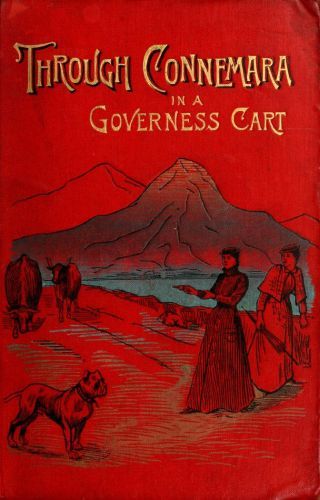
The Project Gutenberg eBook of Through Connemara in a governess cart
Title: Through Connemara in a governess cart
Author: E. Oe. Somerville
Martin Ross
Illustrator: W. W. Russell
Release date: April 25, 2019 [eBook #59349]
Most recently updated: January 24, 2021
Language: English
Credits: Produced by Chuck Greif and the Online Distributed
Proofreading Team at http://www.pgdp.net (This file was
produced from images available at The Internet Archive)
| CONTENTS |
| CHAPTER I., II., III., IV., V., VI., VII., VIII., IX., X. |
|
List of Illustrations (etext transcriber's note) |
THROUGH CONNEMARA
IN A
GOVERNESS CART.
BY
THE AUTHORS OF “AN IRISH COUSIN.”
Illustrated by W. W. Russell, from Sketches by
th Œ. Somerville.
LONDON:
W. H. ALLEN & CO., LIMITED,
13, WATERLOO PLACE, S.W.
—
1893.
The following pages, with their accompanying illustrations, originally appeared in the columns of “The Ladies’ Pictorial,” and are here reprinted by permission of the Proprietors.
LIST OF ILLUSTRATIONS.
THROUGH CONNEMARA IN A GOVERNESS-CART.
CHAPTER I.
MY second cousin and I came to London for ten days in the middle of last June, and we stayed there for three weeks, waiting for a fine day.
We were Irish, and all the English with whom we had hitherto come in contact had impressed upon us that we should never know what fine weather was till we came to England. Perhaps we came at a bad moment, when the weather, like the shops, was having its cheap sales. Certainly such half-hours of sunshine as we came in for were of the nature of “soiled remnants,” and at the end of the three weeks aforesaid we began to feel a good deal discouraged. Things came to a climax one day when we had sat for three-quarters of an hour in a Hungarian bread shop in Regent Street, waiting for the rain to clear off enough to let us get down to the New Gallery. As the fifth party of moist ladies came in and propped their dripping umbrellas against the wall behind us, and remarked that they had never seen such rain, our resolution first began to take shape.
“Hansom!” said my second cousin.
“Home!” said I.
By home, of course we meant the lodgings—the remote, the Bayswaterian, but still, the cheap, the confidential; for be they never so homely, there’s no place—for sluttish comfort and unmolested unpunctuality—like lodgings.
“England is no fit place for a lady to be in,” said my second cousin, as we drove away in our hansom with the glass down.
“I’d be ashamed to show such weather to a Connemara pig,” I replied.
Now Connemara is a sore subject with my second cousin, who lives within sight of its mountains, and, as is usually the case, has never explored the glories of her native country, which was why I mentioned Connemara. She generally changes the conversation on these occasions; but this time she looked me steadily in the face and said,
“Well, let’s go to Connemara!”
I was so surprised that I inadvertently pressed the indiarubber ball of the whistle on which my hand was resting, and its despairing wail filled the silence like a note of horror.
“Let’s get an ass and an ass-car!” said my cousin, relapsing in her excitement into her native idiom, and taking no notice of the fact that the hansom had stopped, and that I was inventing a lie for the driver; “or some sort of a yoke, whatever, and we’ll drive through Connemara.”
In the seclusion of the back bedroom we reviewed the position, while around us on the lodging-house pegs hung the draggled ghosts of what had been our Sunday dresses.
“That’s the thing I wore last night!” said my second cousin, in a hard, flat voice, lifting with loathing finger a soaked flounce. As she did so, the river sand fell from it into the boots that stood beneath.
“Soil of tea-garden, Kingston-on-Thames. Result of boating-picnic that has to fly for refuge to an inn-parlour ten minutes after it has started.”
“It will wash,” I answered gloomily. “But look at that!” Here I pointed to an evening gown erstwhile, to quote an Irish divine, “the brightest feather in my crown.” “That’s what comes of trailing through Bow Street after the opera, looking for a hansom during the police riots. Give me Irish weather and the R.I.C.! We will go to Connemara!”
. . . . . .
The Milford and Cork boat starts at eight, and at half-past eight a doomed crowd was sitting round its still stationary tea-table. My second cousin was feverishly eating dry toast and drinking a precautionary brandy and soda, but the others were revelling
on beefsteak and fried fish. The company was mixed. Opposite to us sat an American and his bride, both young, and both uncertain of the rules that govern the consumption of fish; the bride feeling that a couple of small forks, held as though they were pens, would meet the situation, while her big, red-headed husband evidently believed that by holding the fork in the right hand and the knife in the left the impropriety of using the latter would be condoned. Beside us were two elderly ladies, returning, like us, to their native land.
“Yes, me dear,” we heard one saying to the other; “I had nothing only my two big boxes and seven little small parcels, and poor little Charlie’s rabbit, and that porther wanted to get thruppence out o’ me!”
“D’ye tell me so?” remarked the friend.
“Yes, dear, he did indeed! He wanted thruppence and I gave him tuppence; he was tough, very tough, but I was shtubborn!”
“Ah, them English is great rogues,” said the friend, consolingly.
“More fish, Miss?” said the unobservant steward to my second cousin, thrusting a generous helping under her nose. It wanted but that, and she retired to the doubtful security of the ladies’ cabin.
We have travelled with many stewardesses on the various routes between England and Cork, and we have found that, as a species, they have at least two great points in common. They are all Irish, and they are all relentlessly conversational. They have no respect for the sanctity of the silence in which the indifferent sailor wishes to shroud herself; it is impossible for them to comprehend those solemn moments, when the thoughts are turned wholly inwards in a tumult of questioning, while the body lies in mummy stillness waiting for what the night shall bring forth. Their leading object seems to be to acquire information, but they are not chary of personal detail, and, speaking from experience, I should say that a stewardess will confide anything to the passenger by whose berth she has elected to take down her hair. For stewardesses generally do their hair two or three times in the course of a twelve hours’ crossing. When you go on board you find them at it. Your evening ablutions are embittered by the discovery of their hair-pins in the soap-dish, and at earliest dawn the traveller is aware of the stewardess combing her shining tresses over the washing-stand. I have sometimes wondered if from this custom arose the fable that the mermaid, when not decoying sailors to their fate, is incessantly “racking her poll,” as they say in the county Cork.
We will not linger on the details of the night, the sufferings of little Charlie, who, on the plea of extreme youth, had been imported by his mother into the ladies’ cabin; the rustlings and chumping of the rabbit, whose basket occupied the greater part of the cabin table, or the murmured confidences exchanged through the night hours by the stewardess and the friend of Charlie’s mother. These things are being forgotten by us as fast as may be; but my second cousin says she never can forget the waft of pigs that came to her through the porthole as the steamer drew alongside of the Cork quay.
The exigencies of return tickets had compelled us to go to Connemara viâ Cork and Milford, and it certainly is not the route we would recommend; however, it has its advantages, and we were vouchsafed a time of precious rest before the starting of our train for Limerick at 2.10, and we reposed in peace on the sofas of the ladies’ drawing-room in the Imperial Hotel. Much might be said, were there time, of the demeanour of ladies in hotel drawing-rooms; so hushed, so self-conscious, so eminent in all those qualities with which they are endued by the artist who “does” the hotel interiors for the guide-books. It is almost possible to believe that they are engaged for the season to impart tone, and to show how agreeable a lounge life can be when spent in the elegant leisure that is the atmosphere of hotel drawing-rooms.
We crossed Cork on an outside-car; and here, no doubt, we should enter on a description of its perils which would convulse and alarm English readers in the old, old way; but we may as well own at once that we know all about outside-cars; we believe we went to be christened on an outside-car, and we did not hold on even then—we certainly have not done so since.
Let us rather embark on a topic in which all, saving a besotted few, will sympathise. The nursery en voyage—the nurse, the nursemaid, the child, the feeding-bottle. These beset every traveller’s path, and we had considerably more than our fair share of them between Cork and Limerick. At Cork they descended upon the train, as it lay replete and helpless, a moment before starting, and before we had well understood the extent of the calamity, a nurse was glaring defiance at us over the white bonnet of a bellowing baby, and a nursemaid was already opening her basket of food for the benefit of two children of the dread ages of three and five respectively. Some rash glance on the part of my second cousin must have betrayed our sentiments to the nurse, and it is hard to say which was worse, her exaggerated anxiety to snatch the children from all contact with us, or the imbecile belief of the nursemaid that we wanted to play with them, and, of the two, enjoyed their wiping their hands on our rug in the intervals between the oranges. They never ceased eating oranges, those children. Oranges, seed cake, milk; these succeeded one another in a sort of vicious circle. An enterprising advertiser asks, “What is more terrible than war?” We answer unhesitatingly, oranges in the hands of young children.
However, everything, even the waits at the stations between Limerick and Athenry, comes to an end if you can live it out, and at about nine o’clock at night we were in Galway. Scarcely by our own volition, we found ourselves in an hotel ’bus, and we were too tired to do more than notice the familiar Galway smell of turf smoke as we bucketted through Eyre Square to our hostelry. It may be as well at this point to seriously assure English readers that the word “peat” is not used in Ireland in reference to fuel by anyone except possibly the Saxon tourist. Let it therefore be accepted that when we say “turf” we mean peat, and when, if ever, we say Pete, we mean the diminutive of Peter, no matter what the spelling.
We breakfasted leisurely and late next morning, serenaded by the screams of pigs, for it was fair day, and the market square was blocked with carts tightly packed with pigs, or bearing tall obelisks of sods of turf, built with Egyptian precision. We cast our eye abroad upon a drove of Connemara ponies, driven in for sale like so many sheep, and my second cousin immediately formed the romantic project of hiring one of these and a small trap for our Connemara expedition.
“They are such hardy little things,” she said, enthusiastically, “we had two of them once, and they always lived on grass. Of course they never did any work really, and I remember they used to bite anyone who tried to catch them—but still I think one of them would be just the thing.”
“I beg your pardon, Miss,” said the waiter, who was taking away our breakfast things, “but thim ponies is very arch for the likes of you to drive. One o’ thim’d be apt to lie down in the road with yerself and the thrap, and maybe it’d be dark night before he’d rise up for ye. Faith, there was one o’ them was near atin’ the face off a cousin o’ me own that was enticin’ him to stand up out o’ the way o’ the mail-car.”
My second cousin looked furtively at me, and rose from her seat in some confusion.
“Oh, I think we should be able to manage a pony,” she said, with a sudden resumption of the dignity that I had noticed she had laid aside since her arrival in Galway. “Is there—er—any two-wheeled—er—trap to be had?”
“Sure there is, Miss, and a nate little yoke it’d be for the two of ye, though the last time it was out one of the shafts——”
“Is it in the yard?” interrupted my second cousin, severely.
“It is, Miss, but the step took the ground——”
My cousin here left the room, and I followed her. A few moments later the trap was wheeled into the yard for our inspection. It was apparently a segment of an antediluvian brougham, with a slight flavour about it of a hansom turned the wrong way, though its great-grandfather had probably been a highly-connected sedan-chair. The door was at the back, as in an omnibus, the floor was about six inches above the ground, and the two people whom it with difficulty contained had to sit with their backs to the horse, rocking and swinging between the two immense wheels, of which they had a dizzy prospect through the little side windows.
“There it is for ye, now!” said the waiter, triumphantly. He had followed us downstairs and was negligently polishing a tablespoon with his napkin. “And Jimmy,” indicating the ostler, “’ll know of the very horse that’ll be fit to put under it.”
“No,” we said faintly, “that would never do; we want to drive ourselves.”
The ostler fell into an attitude of dramatic meditation.
“Would you be agin dhrivin’ a side-car?”
We said “No.”
Equally dramatic ecstasy on the part of both ostler and waiter. The former, strange to say, had a friend who was the one person in Galway who had the very thing we wanted. “Letyees be gettin’ ready now,” said Jimmy, “for I’ll go fetch it this minute.”
About half an hour later we were standing at the hotel doorsteps, prepared for our trial trip. On the pavement were clustered about us the beggarwomen of Galway—an awesome crew, from whose mouths proceeded an uninterrupted flow of blessings and cursings, the former levelled at us, the latter at each other and the children who hung about their skirts. We pushed our way through them, and getting up on the car announced that we were ready to start, but some delay in obtaining a piece of cord to tie up the breeching gave the beggars a precious opportunity. My second cousin was recognised, and greeted by name with every endearment.
“Aha! didn’t I tell ye ’twas her?” “Arrah, shut yer mouth, Nellie Morris. I knew the fine full eyes of her since she was a baby.” “Don’t mind them, darlin’,” said a deep voice on a level with the step of the car; “sure ye’ll give to yer own little Judy from Menlo?”
This was my cousin’s own little Judy from Menlo, and at her invocation we both snatched from our purses the necessary blackmail and dispensed it with furious haste. Most people would pay largely to escape from the appalling presence of this seventy-year-old nightmare of two foot nothing, and she is well aware of its compelling power.
The car started with a jerk, the driver boy running by the horse’s side till he had goaded it into a trot, and then jumping on the driving-seat he lashed it into a gallop, and we swung out of Eyre Square followed by the admiring screams of the beggars. The pace was kept up, and we were well out of Galway before a slightly perceptible hill suddenly changed it to a funeral crawl—the animal’s head disappearing between its forelegs.
“Give me the reins,” said my second cousin. “These country boys never know how to drive,” she added in an undertone as she took them from the boy. The horse, a pale yellow creature, with a rusty black mane and tail, turned his head, and fixing a penetrating eye upon her, slightly slackened his pace. My cousin administered a professional flick of the whip, whereon he shrank to the other side of the road, jamming the step of the car against a telegraph post and compelling me to hurriedly whirl my legs up on to the seat. We slurred over the incident, however, and proceeded at the same pace to the top of the hill. A judicious kick from the boy urged the horse into an amble, and things were going on beautifully when we drew near a pool of water by the roadside.
“You see he goes very well when he is properly driven,” my second cousin began, leaning nonchalantly
across the car towards me. As she spoke, the car gave a lurch and came to a standstill at the edge of the pool. Apparently the yellow horse was thirsty. He was with difficulty dragged into the middle of the road again, but beyond the pool he refused to go. The boy got down with the air of one used to these things.
“If ye bate him any more he’ll lie down,” he said to my cousin. “I’ll go to the house beyond and gether a couple o’ the neighbours.”
The neighbours—that is to say, the whole of the inhabitants of the house—turned out with enthusiasm, and, having put stones behind the wheels, addressed themselves to the yellow horse with strange oaths and with many varieties of sticks.
“’Tis little he cares for yer bating,” screamed the mother after several minutes of struggle. “Let him dhrink his fill o’ the pool and he’ll go to America for ye.”
We thought that on the whole we should prefer to return to Galway, and though assured by the boy of ultimate victory, we turned and made for the town on foot.
“I scarcely think that horse will do,” said my second cousin, after we had walked about half a mile, turning on me a face still purple from her exertions with the whip. “We want a freer animal than that.”
She had scarcely finished when there was a thundering on the road behind us, a sound of furious galloping and shouting, and the car appeared in sight, packed with men, and swinging from side to side as the yellow horse came along with a racing stride.
“Ye can sit up on the car now!” called out the boy as they neared us, “he’ll go aisy from this out.”
The car pulled up, and the volunteers got off it with loud and even devotional assurances of the yellow horse’s perfections.
CHAPTER II.
SHALL we admit that, after all, the first stage of our journey was accomplished by means of the mail-car? We had been assured, on reliable authority, that Oughterard, fourteen Irish miles from Galway, was the place where we should find what we wanted, and with a dubious faith we climbed the steep side of the mail car, and wedged ourselves between a stout priest and an English tourist. Above us towered the mail baskets, and a miscellaneous pile of luggage, roped together with that ingenuity that necessity has developed in the Irish carman, and crowning all, the patriarchal countenance of a goat looked down upon us in severe amazement from over the rim of an immense hamper.
We have said in our haste that we never hold on on jaunting-cars, but as the dromedary to the park hack, so is the mail-car to the ordinary “outside” of its species. It is large enough to hold six people on each side, and is dragged by three horses at a speed that takes no account of ruts and patches of stones and sharp corners, or of the fact that the unstable passenger has nothing to grasp at in time of need, except his equally unstable fellow-traveller. We held on to the priest and the tourist with all the power of our elbows, and derived at least some moral support from the certainty that when we fell off the car we should, like Samson, carry widespread disaster with us. But somehow people do not fall off these cars; and even the most unschooled of Saxons sits and swings and bows on the narrow seat with a security that must surprise himself.
An Irish mile is, roughly speaking, a mile and a quarter English, so we leave to the accomplished reader the computation of the distance from Galway to Oughterard according to the rightful standard. It is not in the ordinary sense a very interesting drive; the guide-books pass it over in a breath in their haste to blossom out into the hotels and fisheries of Connemara; but to the eye that comes fresh to it from the offensively sleek and primly-partitioned pastures of England this first impression of Galway and its untrammelled bogs and rocks will be as lasting as any that come after. We ourselves might have framed many moving sentences about the desolate houses standing amongst the neglected timber within their broken demesne walls, but “all our mind was clouded with a doubt,” and from the peculiar protrusion of my cousin’s nether lip, I could gather that her moodiness was the outward token of an agitated mental parade of all the Oughterard horseflesh with which she was acquainted.
We spent that night at Oughterard in Miss Murphy’s comfortable little hotel, and the next morning found us embarked once more in search of a means of travel. The trap had been unearthed—the trap of our brightest dreams—a governess-cart that would just hold two people and a reasonable amount of luggage; but the horse was the trouble. Various suggestions had been made: some had been feasible, and the one thing on which we were firmly decided, viz., the governess-cart, seemed an impossibility.
“Well, Miss, ye see, she’s only just in off grass; sure she’ll rejoice greatly in the coorse of the next few days, and she’d fit the shafts well enough so.”
Thus spoke the proprietor of many flocks and herds to whom we had addressed ourselves. “It’s a pity there’s nothing would suit ye only the little thrap, but surely ye might thry her whatever.”
“She” was a farm mare of mountainous proportions, who after violent exertions had been squeezed between the shafts of the governess-cart, and she now stood gazing plaintively at us, and switching her flowing tail, while the shafts made grooves for themselves in her fat sides.
“Sit in now, Miss, and dhrive her out o’ the yard.” My second cousin got in with ease, the step of the trap being almost on the ground, owing to the unnatural elevation of its shafts, and the mare strode heavily forward. My cousin clutched the front rail convulsively.
“I am slipping out!” she said with a sudden tension in her voice. Had she thought of it she might have held on by the tail, which hung down like a massive bell-rope above her, but as it was, after a moment or two of painful indecision, she made a hurried but safe exit over the door of the trap. The fate of the expedition trembled in the balance, and the group of spectators who had formed round us began to look concerned. The mare was extracted with some difficulty from the pinioning shafts, and all things were as they were, the governess-cart with its shafts on the ground, and my cousin and I with our hearts in our boots, when a voice came to us from the crowd—
“Johnny Flaherty have a nice jinnet.”
“A betther never shtud in Galway!” said another voice. “She’s able to kill anny horse on the road.”
An excited discussion followed, in the course of which it was brought forward as the jennet’s strongest
recommendation that she was the daughter of the lady whose majestic build had lost to us the enjoyment of her admirable moral qualities. Finally a portion of the crowd detached itself and ran up the street, returning in a few minutes with Johnny Flaherty and a long-legged, long-eared brown animal, which, as it approached, cast an eye of sour suspicion upon us and its mother. There was no doubt but that this creature would fit the trap, but with haunting memories of the iniquities of mules and their like we asked if it was gentle.
“She’s a little giddy about the head, Miss,” said the owner diffidently; “but if ye’ll not touch the ears she’s the quietest little thing at all. Back in, Sibbie!”
Sibbie backed in with an almost unwholesome docility, and was harnessed in the twinkling of an eye, the lookers-on assisting enthusiastically. She was led out of the yard. We got in with Mr. Flaherty, and before the crowd had time to cross themselves we were out of sight.
“Perfection!” I gasped, with the wind whistling in my teeth as Sibbie sped like a rat between the shafts that had given her good mother her first insight into tight lacing. “She goes splendidly—the very thing! but now isn’t it time to go back and get in our things?”
My cousin did not answer; she was driving, and something told me that the same idea had occurred to her. She was leaning rigidly back, and one of her gloves had burst at the knuckles. Johnny Flaherty extended a large hand and laid it on the reins.
“She’s over-anxious for the road,” he said apologetically, as he brought the jennet to a standstill; “but I’ll put a curb-chain on her for ye.”
We turned and wheeled back into Oughterard, a positive adoration for Sibbie, with her discreet brown quarters and slender, rapier-like legs, welling up in us. Now, thinking over these things, it seems possible that her week’s hire approached her net value, but at the time of bargaining we felt that her price was far above rubies.
As this is the record of a genuine expedition, it is perhaps advisable to say that our luggage consisted of a portmanteau, a dressing bag, a well-supplied luncheon basket, and a large and reliable gingham umbrella, purchased for the sum of three shillings in Oughterard. We viewed the elaborate stowing of
these in the governess cart, and then went to Mr. Flaherty for his final sailing orders.
“Ye’ll mind her passing Flanigan’s; she have a fashion of running in there; and as for passing our own place, I have a boy standin’ there now in the archway with a stick, the way he’d turn her back out of it if she’d make a dart for the stable, and I’ll put a rope in the thrap for fear anything might break on ye.”
Mr. Flaherty looked a little anxious as he gave us these directions, and when he had gone for the rope, an old woman, who had been regarding us with a sympathetic solicitude, came up to my cousin and took her by the arm.
“That the Lord may save yees! that’s all I’ll say,” she groaned; “if ’twas a horse itself, I’d say nothin’, but thim mules is nayther here nor there. Sure asthore, ye couldn’t tell the minnit he’d turn into a boghole, when he doesn’t know ye, and thim Cunnemarra roads has nothin’ before him to shtop him only the grace of God! and the wather up aich side of the road by yees as deep as a well!”
It was painful to find that Oughterard credited the jennet with the sole conduct of the expedition, and regarded us as helpless dependents on her will and pleasure. But the old woman’s agitation was quite unaffected, and the last thing we heard, as we flourished down the main street, was her voice uplifted in prayerful lamentation.
Owing possibly to the fact that Mr. Flaherty’s boy was demonstrating with the pitch-fork in the archway leading to the stable, Sibbie made no attempt to “dart” into it as her owner had anticipated, and nothing marred the dignity of our departure. We turned cautiously over the crooked bridge, and drove along beside the river, running black under tall trees, with patches of foam sailing fast on it. Villas with trimly clipped ivy and flower-beds all ablaze were on our other hand, suburban in self-respecting neatness, romantic by force of surroundings and of something old-fashioned and solid in their build.
“This is the best village for its size this side of Galway,” said my cousin, with a languid indifference that, as I well knew, masked the seething self-satisfaction of the resident in the neighbourhood. “And the place has improved so wonderfully. For instance, there’s the Widow’s Almshouse. It isn’t so very long ago since an old woman said to my grandmother, ‘That’s the Widdies’ Almhouse, and sorra widdy in it but one little owld man,’ and now it’s simply bursting with widows—at least, I mean——”
This remarkable illustration of the prosperity of Oughterard was suddenly interrupted. We had forgotten that the residence of the too fascinating Mr. Flanigan was at hand, but not so Sibbie. With the subtlety of her race, she cloaked her design in a fulsome submissiveness, as the deadly spirit is sheathed in the syrup of the liqueur, and turning in full career, without so much as an indication from her long expressive ears, she made for the gate of which we had been warned. By a special interposition of Providence it was closed, but we were both jerked forward in a very humiliating way, and there was much unseemly hectoring and lashing before we could drag her from the haven where she would be. The seeds of distrust were from that moment sown in our hearts, and we proceeded with a want of confidence that we had never afterwards reason to regret.
A few moments of steep ascent brought us out on to the moor that is the entrance to Connemara; a wide brown place of heather and bog, with the sinuous shining of the Oughterard river saving it from the suspicion of monotony. The level road ran out in front of us till it dwindled into a white thread, the distant hills were no more than confidential blue hints of what we were to see, the sun shone, the strong west wind made us rejoice that we had stitched elastic into our hats, and the exhilaration of our feelings found vent in one passion-fraught word—luncheon.
A great many people have asked us why we did not make our journey through Connemara on tricycles: the roads are so good, the mail-cars offer such facilities for the transport of baggage, the speed and simplicity are so great. To this we have our reply—what then of the luncheon hamper? These objectors have not taken into account the comfortable wayside halt by the picturesque and convenient lake; the unpacking of the spirit lamp, and its glittering bride the tin kettle, the dinner knives at sixpence apiece, the spoons at two-pence-halfpenny; the potted meats, the Bath Olivers, the Bovril and the Burgundy. In the abstract we are not fond of picnics, and agree with the Bard of “Ballads from Punch” in thinking that—