
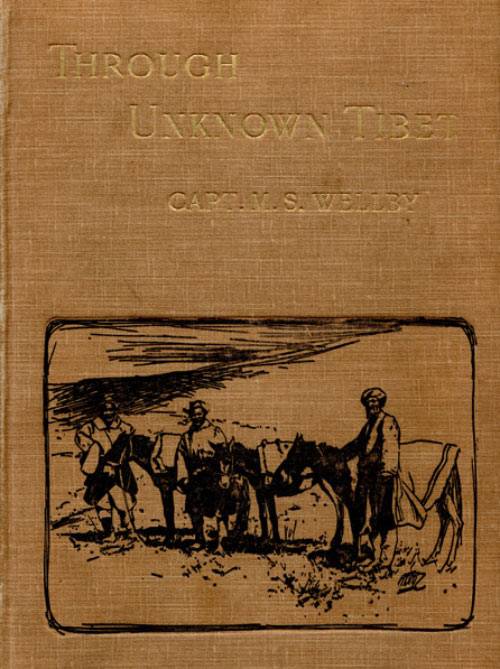
The Project Gutenberg eBook of Through Unknown Tibet
Title: Through Unknown Tibet
Author: M. S. Wellby
Release date: August 6, 2018 [eBook #57646]
Language: English
Credits: Produced by Melissa McDaniel, Sharon Joiner and the Online
Distributed Proofreading Team at http://www.pgdp.net (This
file was produced from images generously made available
by The Internet Archive)
Transcriber's Note:
Inconsistent hyphenation and spelling in the original document have been preserved. Obvious typographical errors have been corrected.
Inconsistent or incorrect accents and spelling have been left unchanged.
THROUGH UNKNOWN TIBET
THROUGH
UNKNOWN TIBET
By M. S. WELLBY
Capt. 18th Hussars
ILLUSTRATED
LONDON: T. FISHER UNWIN
PATERNOSTER SQUARE. 1898
[All rights reserved]
TO
OUR BROTHER OFFICERS
PREFACE.
In publishing the following account of a journey across Tibet and China, it has been my object to describe in a simple manner all that I did and saw from beginning to end, in the hope that some future traveller may learn, not so much what he ought to do, as what he ought not to do.
Those who have experienced the charms of a nomad's life, will, I trust, be once more reminded of happy days of freedom, will sympathise with us in our difficulties, and share the pleasures which they alone can appreciate. Should others, by chance, find some little interest in perusing these pages, and be tempted to taste for themselves the sweets of wandering through little known lands, they will be recompensed for doing so, and I shall have found my reward.
To those who patiently read to the end and close the book with a feeling of disappointment, I would appeal for leniency. Begun as it was at Lucknow, amid the distractions of polo, racing, and field-days, continued at Simla, India's summer capital, and finished in the wilds of Waziristan, it can lay no claim to literary or scientific merit, but only to being a plain story plainly told; and as such I give it to the public.
For the chapter on the Mohammedan rebellion in China, my thanks are due to my friend Mr. Ridley, of the "China Inland Mission," who lived in the very midst of the scene of trouble, and who kindly allowed me to make every use of his notes. They are likewise due to Sir Claude and Lady Macdonald, whose kindness and hospitality in Pekin can never be forgotten, and lastly, to those three faithful ones who stuck to us through thick and thin.
The names of Duffadar Shahzad Mir, Lassoo, and Esa Tsareng—known throughout as "Esau"—will always call to my mind three men without whom this journey could never have been accomplished, and in saying this I know that I am also expressing the feelings of my companion, Lieut. Malcolm.
Capt. 18th Hussars.
Waziristan,
November, 1897.
CONTENTS.
| PAGE | |
| CHAPTER I. | |
| PREPARATIONS FOR THE JOURNEY—MALCOLM GOES ON AHEAD | 1 |
| CHAPTER II. | |
| BALTAL—LEH—I REJOIN MALCOLM—THE CHINESE PASSPORT ARRIVES | 20 |
| CHAPTER III. | |
| FOLLOWING THE INDUS—EGU—WAITING AT SHUSHAL—A WARNING | 40 |
| CHAPTER IV. | |
| MUN—LUDHKONG—TOUCHING FRIENDSHIP OF MULE AND PONY—NIAGZU | 50 |
| CHAPTER V. | |
| MORTALITY AMONG SHEEP—LAKE TREB—THE NAPU LA PASS—SICKNESS OF BAKR HADJI—RUDOK OFFICIALS COMMAND US TO RETREAT | 60 |
| CHAPTER VI. | |
| OUR RETREAT—CROSSING THE BORDERLAND OF TIBET—A STRANGE ACCOUCHEMENT—SPORT—PONIES SHOT | 74 |
| CHAPTER VII. | |
| A COLD NIGHT—DEATH OF MULE—A FRESH-WATER LAKE—BAD WEATHER—DEATH OF THE FAVOURITE WHITE PONY—BY A SALT LAKE—ILLNESS OF TOKHTA—I SEARCH FOR MISSING ANIMALS | 81 |
| CHAPTER VIII. | |
| LAKE LIGHTEN—INTENSE HEAT—AN OLD FIREPLACE—SERIOUS ACCIDENT THROUGH OVER-HASTE OF MULES TO DRINK—A COUP D'ŒIL—THE FIRST FLOWER—OUR PET SHEEP—ANOTHER FRESH-WATER LAKE—A PLEASANT BATH—DEATH OF ANIMALS AND DEARTH OF GRAIN | 90 |
| CHAPTER IX. | |
| TERRIBLE GUN ACCIDENT—WE SEND OUT SCOUTS | 104 |
| CHAPTER X. | |
| I SHOOT A YAK—DEATH OF ANOTHER MULE—"HELMET HILL"—WE LEAVE TOKHTA AND SULLOO BEHIND—REDUCED TO TWELVE ANIMALS—A MULE'S ADVENTURE | 116 |
| CHAPTER XI. | |
| SHOOTING AN ANTELOPE—SNOW—A MYSTERIOUS TRACK—THE BED OF AN ANCIENT LAKE—EMOTION OF MAHOMED RAHIM—VARIABLE WEATHER—MORE ANTELOPES SHOT—THEODOLITE BROKEN—EXTRAORDINARILY SUDDEN WIND—HUNGER v. CEREMONY—NEW FINDS | 127 |
| CHAPTER XII. | |
| A FOOTPRINT—SHAHZAD MIR INDISPOSED—DESERTION OF MULETEERS—A RAINY NIGHT | 141 |
| CHAPTER XIII. | |
| RETURN OF THE DESERTERS—SHUKR ALI—LONG MARCHES—DEATH OF EIGHT MULES AND A PONY—A CHEERING REPAST | 152 |
| CHAPTER XIV. | |
| A SERPENTINE RIVER—HUNGER—MARMOTS—A PLEASANT CAMPING | 164 |
| CHAPTER XV. | |
| SHOOTING—A TROUBLESOME MULE—A YAK CEMETERY—I CHASE A KYANG—TENDER HEARTS—INSCRIBED STONES—LASSOO AND SHUKR ALI SICK—AN ARDUOUS CROSSING | 172 |
| CHAPTER XVI. | |
| ANOTHER CHULA—MOUNTAINS—A QUEER ILLUSION—STRANGE VOICES—WE FIND WE ARE DESCENDING—A TIBETAN CAMP—ESAU SENT AS AN AMBASSADOR—AN INVITATION | 185 |
| CHAPTER XVII. | |
| WE CATCH UP THE MERCHANT'S CAMP—TIBETAN HOSPITALITY—WE FIND THAT WE HAVE DISCOVERED THE SOURCE OF THE CHU MA—BARGAINING | 195 |
| CHAPTER XVIII. | |
| MANAGEMENT OF THE TIBETAN CARAVAN—TEA WITH THE MERCHANT—SHUGATZA RIVER—FRICTION—AN ALARM | 204 |
| CHAPTER XIX. | |
| WE LEAVE THE KUSHOK—A USELESS CLIMB—SIGNS OF A DISASTROUS JOURNEY—A HOUSE OF PRAYER—MALCOLM SHOOTS A BEAR—ANXIETY FOR FOOD | 218 |
| CHAPTER XX. | |
| FOLLOWING THE NAMORAN—WE SPLIT INTO THREE PARTIES—WE MEET SOME YOUNG MONGOLS—THEIR HOSPITALITY—LOBSAN—THE BANA TRIBES | 227 |
| CHAPTER XXI. | |
| WITH THE MONGOLS—A HOSPITABLE OLD LADY—ON THE WAY TO TANKAR—A POISONOUS STREAM—BANA TENTS—I ABSTRACT AN INSCRIBED BONE—OUR COLDEST NIGHT—A WONDERFUL PLACE—KANJUR RUNGYUM | 240 |
| CHAPTER XXII. | |
| ESAU AND I SET OFF—RECEPTION FROM THE BANAS—WE ARRIVE AT TANKAR—A FRIENDLY GUIDE—AN ABSURD TIP—DR. RIJNHART—TEA WITH LHASSA OFFICIALS—ARRIVAL OF MALCOLM AND THE MONGOLS—CHEN-LAO-PAN—CHINESE ETIQUETTE | 256 |
| CHAPTER XXIII. | |
| A VISIT TO CHEN-LAO-PAN—COLONEL YANG—THE DAUGHTER OF PRINCE KOKO NOR—A VISIT TO THE MONASTERY OF KUMBUM | 267 |
| CHAPTER XXIV. | |
| THE STORY OF THE FIRST BUDDHA OF THE EMPIRE—THE SACRED TREE—THE GOLD-TILED TEMPLE—PARTING FROM MINA FU-YEH—THE GREEN GLAZED-TILE TEMPLE—THE FLOWER TEMPLE—SIGNS OF THE MOHAMMEDAN REBELLION—AT THE MISSION HOUSE | 285 |
| CHAPTER XXV. | |
| THE MOHAMMEDAN REBELLION IN CHINA, 1895–6 | 298 |
| CHAPTER XXVI. | |
| PARTING FROM LOBSAN—STARTING FOR LANCHEO—A RUINED SUBURB—GOOD DONE BY MISSIONARIES—WE TAKE LEAVE OF MR. RIDLEY—OUR FIRST CHINESE INN | 315 |
| CHAPTER XXVII. | |
| SHANG TAN—HO TSUI TSI—FIRST VIEW OF THE YELLOW RIVER—ON A RAFT—AT LANCHEO—A TELEGRAPH TROUBLE | 325 |
| CHAPTER XXVIII. | |
| WE PAY OFF SHUKR ALI—LANCHEO TO CHONG WEI—OFFICIAL INCIVILITY—LOSE RUBY—SHAHZAD MIR MISTAKEN FOR A REBEL | 332 |
| CHAPTER XXIX. | |
| MISSIONARY YARNS—CHEAP LIVING—ON THE YELLOW RIVER AGAIN—CASH | 352 |
| CHAPTER XXX. | |
| PAO T'EO—THE SWEDISH MISSION-HOUSE—CHINESE SCHOOLS—CHINESE INNS—CHINESE BURIAL—KUEI HUA CHENG—FRICTION WITH CARTERS—WE LEAVE THE MONGOL COUNTRY—THE GREAT WALL | 367 |
| CHAPTER XXXI. | |
| HOW TO MANAGE INNKEEPERS AND CARTERS—SHUEN-HUA-FU—"SPIRIT'S PAPER"—SHAHZAD MIR LOST AND FOUND—ESAU'S PRESTIGE | 386 |
| CHAPTER XXXII. | |
| A TRUCULENT INNKEEPER—A SEDAN CHAIR—CHINESE WOMEN AND THEIR FEET—PEKIN—DEPARTURE OF RIJNHART—CARTERS EARN A BEATING | 398 |
| CHAPTER XXXIII. | |
| BACK TO INDIA—DISILLUSIONMENT OF OUR FOLLOWERS WITH REGARD TO SOME OF THE BLESSINGS OF CIVILIZATION—MILITARY HOSPITALITY—RETURN TO CALCUTTA | 415 |
| APPENDICES | 423 |
| INDEX | 437 |
LIST OF ILLUSTRATIONS.
| PAGE | |
| CAPTAIN WELLBY | Frontispiece |
| THE KUSHOK'S COOK | Title |
| LIEUTENANT MALCOLM | Facing 1 |
| CLUB OF NORTHERN INDIA, MURREE, IN SNOW | 5 |
| VIEW TOWARDS FIFTH BRIDGE, SRINAGAR | 8 |
| A MERCHANT'S HOUSE IN SRINAGAR | 9 |
| MOHAMMEDAN MOSQUE, SRINAGAR | 11 |
| HINDU TEMPLE, SRINAGAR | 12 |
| ON THE RIVER, SRINAGAR | 14 |
| DUFFADAR SHAHZAD MIR, 11TH BENGAL LANCERS | 15 |
| SHUKR ALI | 18 |
| THE GLACIERS, SONAMERG | 21 |
| FIRST SIGNS OF BUDDHISM BEYOND LEH, AT MULBECK | 25 |
| BRIDGE OVER THE SURV RIVER AT KARGIL, ON THE ROAD TO LEH. BRIDGE ON CANTILEVER PATTERN | 29 |
| SHAHZAD MIR AND OUR TEN MEN | 33 |
| CHINESE PASSPORT, ONE AND A HALF FEET SQUARE | 37 |
| MY RED CHINESE VISITING CARD, FIVE INCHES BROAD AND TEN INCHES LONG | 38 |
| ON THE BORDERS OF TIBET; OUR CAMP AT NIAGZU | 57 |
| CROSSING THE NAPU LA (18,500 FEET HIGH) | 64 |
| OUR THREE RUNDORE GUIDES | 67 |
| KERAMBUTABUK | 71 |
| LAKE "LIGHTEN" (WE LIGHTENED OUR LOADS HERE) | 91 |
| 17TH JUNE. THREE OF OUR TENTS ARE ABANDONED AT THIS SPOT | 95 |
| WE CAMP IN A GRASSY NULLAH | 98 |
| A DAY'S HALT BY A FRESH-WATER LAKE | 100 |
| OUR MULES BEING WATERED | 109 |
| WE CAMP IN A WILDERNESS AND STEER FOR "HELMET HILL" | 118 |
| MALCOLM AT BREAKFAST WITH ESAU | 121 |
| WE CAMP BY TWO FRESH-WATER POOLS | 124 |
| TWO ANTELOPES ARE SHOT CLOSE TO CAMP | 135 |
| SHAHZAD MIR AT WORK | 145 |
| AUTOGRAPH OF THE BUDDHA, page 275 | 151 |
| THE LAST CAMP OF OUR TWELVE MULES | 159 |
| RUBY | 165 |
| A DEAD ANTELOPE | 180 |
| AN ENORMOUS YAK | 183 |
| THE KUSHOK'S TAME YAK | 200 |
| SOME MEMBERS OF THE KUSHOK'S CAMP | 213 |
| TSOKPO MONGOLS LIVING IN THE BUSH | 231 |
| MALCOLM ENGAGES ATTENTION OF MONGOLS WITH "CADBURY": THEY THINK IT IS SNUFF | 235 |
| MONGOL LADIES ON THE BAYAN GOL | 238 |
| MONGOL CAMP: ONE OF OUR HALTS | 249 |
| THREE REMAINING MULES AT KOKO NOR | 253 |
| BUDDHIST PRAYER-WHEEL, WITH SCARF OF BLESSING | 268 |
| DR. RIJNHART. DAUGHTER OF THE PRINCE OF KOKO NOR | 269 |
| BRIDGE IN CHINA, FIVE MILES FROM TANKAR. MISSIONARY AND MULE ON BRIDGE | 271 |
| BRIDGE OF SHANG-HO-RI (SOUNDING RIVER) ON THE ROAD TO TANKAR | 273 |
| AUDIENCE ROOM OF THE KAMBO (ABBOT) OF KUMBUM | 275 |
| MINA FU-YEH (BUDDHA) | 277 |
| CHORTENS OF KUMBUM | 286 |
| KUMBUM | 287 |
| TWO SMALL SHRINES, WITH NUMBERS OF PRAYER-WHEELS | 291 |
| PRAYER-WHEELS, BOARDS, ROSARY FROM LUSAR | 295 |
| RUINS OF THE E. SUBURB OF SINING | 318 |
| A SEDAN CHAIR | 321 |
| THE ONLY WAY TO DRIVE IN NORTH CHINA | 333 |
| ON THE ROAD FROM LANCHEO, CHINA | 339 |
| STREET IN THE TONG KUAN (E. SUBURB), CHONG WEI, YELLOW RIVER | 343 |
| OUR INN AT CHONG WEI | 349 |
| OUR WOOL BOAT ON THE YELLOW RIVER | 355 |
| HALTING FOR THE NIGHT ON THE YELLOW RIVER | 357 |
| A FERRY ACROSS THE HUANG HO | 359 |
| ALL THE "CASH" ISSUED FROM THE FIRST OF THE EMPERORS OF THE TS'ING OR MANCHU DYNASTY | 361 |
| ON THE ROAD IN CHINA | 369 |
| ON THE ROAD FROM PAO T'EO TO PEKIN | 373 |
| BUDDHIST TEMPLE, OUTSIDE KUEI HUA CHENG, CHINA | 377 |
| MONGOL ENCAMPMENT | 382 |
| TEMPLE OUTSIDE SI-YANG HO | 384 |
| BRIDAL CHAIR | 387 |
| A GORGE WITH GREAT WALL IN DISTANCE | 390 |
| THE GREAT WALL AT CHA-TAO | 395 |
| BUDDHIST ARCHWAY BY NAN KOU | 399 |
| CLOSE TO THE CELESTIAL CAPITAL | 403 |
| A PORTION OF THE WALLS OF THE CAPITAL | 407 |
| STREET WHEREIN IS THE ENTRANCE TO THE BRITISH LEGATION | 409 |
| PEKIN | 413 |
| LASSOO AND ESAU | 420 |
THROUGH UNKNOWN TIBET.
CHAPTER I.
PREPARATIONS FOR THE JOURNEY—MALCOLM GOES ON AHEAD.
About the beginning of March, 1896, whilst the Inter-Regimental Polo Tournament was being held at Umballa, an occasion when representatives of regiments from all parts of India are gathered together, Lieutenant Malcolm, of the 93rd Argyll and Sutherland Highlanders, and I, agreed to join forces in an expedition through Tibet. Our resolve was to traverse the northern portions of this little-known country from west to east, to find out, if possible, what mysteries lay beneath the word UNEXPLORED with which alone our latest maps were enlightened; furthermore to discover and locate the source of the Chu Ma river, which was supposed to be a source of the Yangtse Kiang; finally to cross the Tsaidam and end up our wanderings at the celestial capital of China. During the few weeks that remained before we should be able to take our leave, we were unfortunately quartered at different places many miles apart, consequently all our arrangements had to be carried out by post and wire. It was towards the end of March when we left our respective stations of Nowshera and Umballa. I remember well the mail train to Rawal Pindi one bright morning gliding from the latter station past the well-known grassy maidan, then worn to a dirty dusty brown by reason of the morning tramp of small mixed armies, and by the equally keen and destructive work of numerous polo players during the latter half of the day.
On occasions like this, the thought quite naturally arises in one's mind, "Is everything here? Has my faithful bearer left anything behind?" Let us see what was with me in the carriage. In one corner lay my rifles; these consisted of a ·308 with Martini-Henry action, and 300 rounds of ammunition with Jeffery's split bullets, a sporting carbine with 200 rounds, a shot-gun with 300, and a couple of government cavalry carbines with 100. These latter we brought not in the hope of using, but rather to lessen the chance of a skirmish with any natives showing hostile intentions, by merely making a display of them. The knowledge of a caravan being well armed and equipped, however small it may be, is very often a battle half won amongst unsophisticated inhabitants of little-known countries. The other rifles, for game, we selected chiefly for their handiness and the lightness of the ammunition, although a double-barrelled express may be equally or more destructive. All the ammunition was placed in government tin-lined wooden boxes, with rope handles.
Here, too, were our scientific instruments: A three-inch theodolite and stand, a six-inch sextant, three aneroid barometers, a hypsometer, maximum and minimum thermometers, plane table and stand, prismatic compass, and field glasses. Besides this we had a drying press for flowers, skinning knives, with alum and arsenical soap, a butterfly net, and a kodak; also the best map of the country we could lay our hands on, and a few stiff books, such as the "History of the Indian Empire," where the dullest mind and imagination can find unlimited food, for there are times on trips of this description when bad weather or illness may prevent outdoor progress, and the brain will at once cry out for an innings. Close by lay a despatch box and medicine chest, containing, for man's ailments, quinine, Cockle's pills, chlorodyne, auberge for colds, antipyrine, antiseptic wool, vaseline, and kola nut, the last named being particularly useful, for a small piece the size of a pea has been known to sustain strength and energy at the most urgent times; there were also mustard plasters, which are always effective for sticking on natives of any uncivilized country, Tibetans themselves being especially partial to this kind of medicinal adornment. For the mules and ponies, whose chief and probably only ailment would be the suffering from sore backs, we carried sugar-of-lead ointment and cyona. There lay, too, a small chair, a bundle of warm blankets and waterproof sheets, and a box containing twenty chain hobbles with bolt screw. We had learnt from Bower, who had crossed Tibet some five years previously, that one of the greatest delays was caused by the straying of the animals at night-time, and against this annoyance we were resolved to protect ourselves. These were very simply made. By way of a portable kitchen we had laid in a box of cooking utensils, consisting of some steel degchies and a frying pan. The stores were placed in six boxes, each weighing about thirty pounds, and made up principally of tea, cocoa, Lazenby's soup squares, Brand's essences, candles, matches, some sardines and bully beef, with three bottles of good brandy. In the luggage van were also two government cavalry saddles, with carbine bucket, wallets, and wooden stirrups, for we had been led to believe that the cold would be intense, and that metal stirrups would probably produce a frost-bite. Lastly, though more precious, was my little fox terrier, Ruby, so full of life and spirits at starting, yet in happy ignorance of the undeserved fate that overtook her some seven or eight months later.
Unlike many Indian trains, where, too, the fashion would have suited me far better, this particular train landed me punctually at Rawal Pindi at 2 a.m. Despite this unearthly hour and the drizzling rain, I was a little surprised to find my special tonga awaiting me, though it proved insufficient for carrying all the luggage. Leaving my little terrier to take charge of this, I embarked on to a wooden springless box, pulled by a mule, and steered for the nearest serai, in hopes of being quickly able to find an ecka. Here I squeezed through some bars of the large wooden gates which were supposed to keep out night intruders, and any sleeping inmate who lay in the various rooms I prodded with my stick, and demanded an ecka. None of these, however, at such an hour, would accede with any kind of willingness to my proposals. Some absolutely refused to awake, while others who did, strongly objected to being roused and to helping me. The only arrangement that would suit any of these men at all was, that twenty-five rupees should be paid instead of the proper fare of eighteen. In that case, and providing that my luggage was brought to the serai, and that there were not too many things, they agreed to start for Baramula when they felt inclined. Bribes, threats, and even blows were of no avail, and finally, being opposed by superior numbers, I retreated, and sad to say not gracefully, for I had to squeeze through those bars again. Another ride in the box brought me to a second serai, where I luckily fell in with a choudrie, who produced an ecka with so stout a pony that he reached the station before I could in my mule box. Here the ecka was loaded and sent on in advance, shortly to be overtaken by my tonga, for a tonga will cover the journey of 160 miles to Baramula in two days, while an ecka takes about five. The only difficulty that arose this morning was the constant jibbing of the horses, and had they not the providential dodge of repeatedly collapsing and lying down, I should undoubtedly have rattled down some open precipice. Despite this delay, I reached the well-known hill station of Murree for 10 o'clock breakfast. From here the road was heavy, and had not some gangs of long-suffering coolies, who were working on the road, come to our assistance, the tonga would be there now. That evening we reached Domel, where a tumbledown shanty had supplanted, for the time being, a well-built bungalow which had recently been washed away by heavy rains and snow. In one respect this was an ill-chosen spot to spend the night at, as the horses had to be taken away for shelter some three miles off, I was told, and to induce natives to bring the tonga ready to start by daybreak was as difficult as to squeeze blood out of a stone.
By 7 o'clock, however, we were once more rolling along in dripping rain, with the everlasting but somewhat monotonous roar of the river Jhelum below us, so that it was a decided relief to stop for breakfast, even at an inn like that at Chagoti, where I could hardly mount the slippery steps that lead up to the entrance, benumbed as I was by wet and cold, and cramped from several hours of the same position, for the constant downpour prevented any stretching of legs when changing horses at the various stages. In somewhat heavier rain we journeyed on through slush and mud, and arrived at Baramula about sunset. It was my intention to have embarked here at once on to one of the river boats and reach Srinagar as quickly as possible. But darkness and rain, and an inviting light from the adjacent dak bungalow dissolved these plans, and I was soon ushered inside by a Kashmiri, by name Mahomed Malik. This man was to be our cook on the expedition; he was armed with several letters of recommendation, amongst others from Curzon and Littledale, and had doubtless travelled over a great portion of Asia, and we vainly congratulated ourselves on having managed to pick up a servant with so much experience. I was struck, too, by his pleasant appearance, his quiet yet quick and business-like way of doing things, little knowing at the time that he had at heart no real intention of accompanying us, but merely of buying the articles required for our expedition, and persuading us to buy a great many unnecessary ones, in order to reap a small fortune from the transaction.
From experience gained on this trip and on others, I prefer servants of all descriptions, with the exception of guides pure and simple, to be men who have made no previous journeys. Although the possession of letters explaining what good men they have been on previous journeys is a useful recommendation, still it can never guarantee what they will be like. Many of them, after receiving liberal and well-deserved pay for their services, become inflated with their own importance and vainly think that no expedition can manage without them. Besides, men of this description are far more expensive articles than the fresh and keener man, anxious to make his first essay. It is hardly worth while, too, to quote the proverb about the fish and the sea. The following morning, I found myself being towed up the river towards Srinagar, fairly sheltered from the incessant rain by the matting that forms a roof to these boats, or doongas, as they are locally called. The water was thick and brown, no view of the famous snow-capped peaks or pine-clad mountains could be seen, all was obscured in damp dreariness, and my thoughts fled back to those I had left to enjoy the sunny plains below. Nor was there any more inducement on the morrow to slip out from between the blankets and admire the wonderful scenery of these parts. I continued to prolong the night until my boat was suddenly boarded by one of the chief agents of Srinagar, a member of the Sumud Shah family, so renowned for their Jewish appearance and ways, and for their partiality in buying and selling all kinds of goods, and for lending or borrowing money to any amount in any shape or form. There was a second invader, a moment afterwards, by name Ramzana, who was a chapliwalla, or seller of chaplies, which are shoes made of leather and straps, and are worn by most sportsmen who shoot in Kashmir; besides these he sold everything that man's imagination could conceive as being made of leather, but, it should be added, of an inferior kind. They brought with them some large brass plates loaded with white almonds, sweets, and dried currants, and placing them beside my bed as a friendly initiative to business, began to ramble on, with beaming faces, about the superiority yet cheapness of their own goods, and of their eternal willingness to provide me and my friends who might come to Kashmir with them, at all places and at all times.
About midday the clouds began to lift, and having lightened my cargo of these persevering Jews, I decided to take a muddy walk and finish the last eight or nine miles on foot. Part of the way lay along the Baramula and Srinagar road, along which tongas should certainly be able to ply the following year, and if the many heaps of flints that were lying alongside were beaten down into the road itself, there is every chance of its being able to withstand the traffic. On either side, too, was a row of dwarf poplars, or "pruss" as they are called by the Kashmiris, beautifully planted in line at about a yard interval, doubtless helping to make the drive pleasant and shady enough.
By the river side were men breaking up between two stones black, spikey nuts called tinkara; these are gathered from the bottom of the river, and the outside appearance belies what lays hidden beneath, for they are rather good eating. About dusk, Sumud Shah's shop came in sight, and having climbed up the steep stairs into his showroom, which overlooked the river with its many opened windows, I was surrounded and made much of by numerous Sumuds, each of them inquiring amongst other things whether I carried any banknotes, and if so, whether they might take care of them for me. Soon afterwards they produced dinner, composed of about a dozen plates holding different coloured messes. Fortunately Malik came to my assistance and brought a mutton bone, and certainly saved me from an illness. I was glad to escape from so much civility and hospitality and descend the stairs again and wend my way to my bedroom, which was airy enough, for three sides could only be described as windows of perforated wood, whilst the fourth held two doors and no wall.