
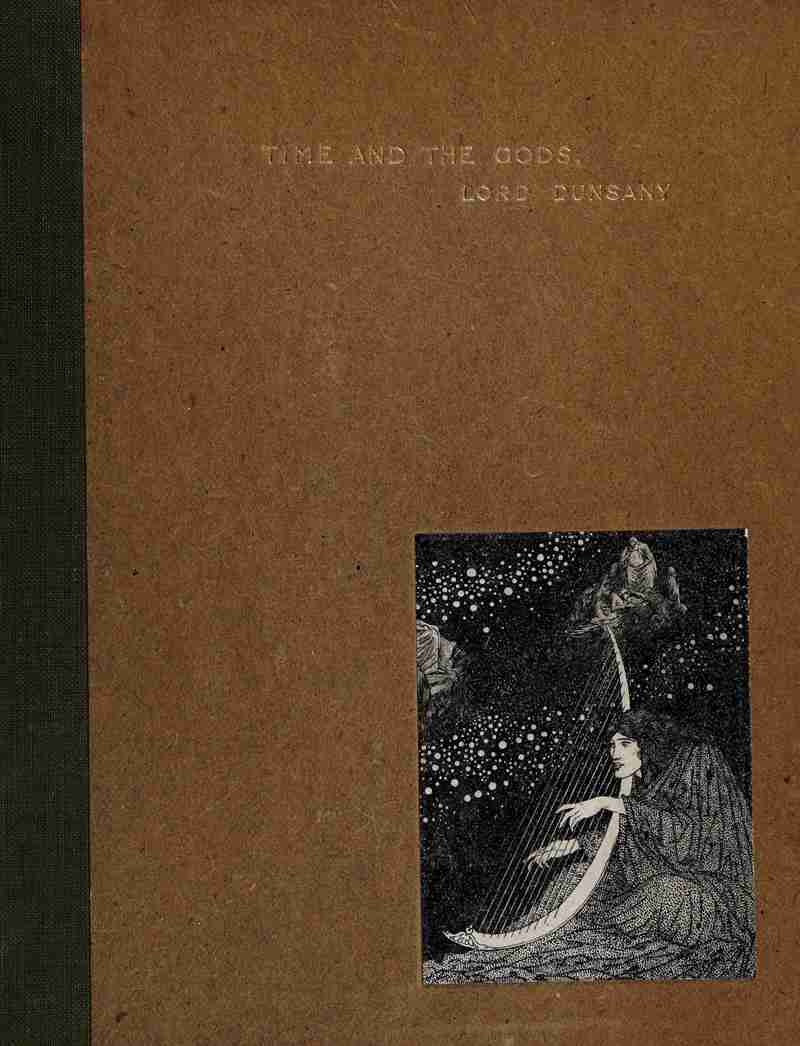
THE KING THAT WAS NOT
The land of Runazar hath no King nor ever had one; and this is the law of the land of Runazar that, seeing that it hath never had a King, it shall not have one for ever. Therefore in Runazar the priests hold sway, who tell people that never in Runazar hath there been a King.
Althazar, King of Runazar, and lord of all lands near by, commanded for the closer knowledge of the gods that Their images should be carven in Runazar, and in all lands near by. And when Althazar’s command, wafted abroad by trumpets, came tinkling in the ear of all the gods, right glad were They at the sound of it. Therefore men quarried marble from the earth, and sculptors busied themselves in Runazar to obey the edict of the King. But the gods stood by starlight on the hills where the sculptors might see Them, and draped the clouds about Them, and put upon Them Their divinest air, that sculptors might do justice to Pegāna’s gods. Then the gods strode back into Pegāna and the sculptors hammered and wrought, and there came a day when the Master of Sculptors took audience of the King, saying:
“Althazar, King of Runazar, High Lord moreover of all the lands near by, to whom be the gods benignant, humbly have we completed the images of all such gods as were in thine edict named.”
Then the King commanded a great space to be cleared among the houses in his city, and there the images of all the gods were borne and set before the King, and there were assembled the Master of Sculptors and all his men; and before each stood a soldier bearing a pile of gold upon a jewelled tray, and behind each stood a soldier with a drawn sword pointing against their necks, and the King looked upon the images. And lo! they stood as gods with the clouds all draped about them, making the sign of the gods, but their bodies were those of men, and lo! their faces were very like the King’s, and their beards were as the King’s beard. And the King said:
“These be indeed Pegāna’s gods.”
And the soldiers that stood before the sculptors were caused to present to them the piles of gold, and the soldiers that stood behind the sculptors were caused to sheath their swords. And the people shouted:
“These be indeed Pegāna’s gods, whose faces we are permitted to see by the will of Althazar the King, to whom be the gods benignant.” And heralds were sent abroad through the cities of Runazar and of all the lands near by, proclaiming of the images:
“These be Pegāna’s gods.”
But up in Pegāna the gods howled with wrath and Mung leant forward to make the sign of Mung against Althazar the King. But the gods laid Their hands upon his shoulder saying:
“Slay him not, for it is not enough that Althazar shall die, who hath made the faces of the gods to be like the faces of men, but he must not even have ever been.”
Then said the gods:
“Spake we of Althazar, a King?”
And the gods said:
“Nay, we spake not.” And the gods said:
“Dreamed we of one Althazar?” And the gods said:
“Nay, we dreamed not.”
But in the royal palace of Runazar, Althazar, passing suddenly out of the remembrance of the gods, became no longer a thing that was or had ever been.
And by the throne of Althazar lay a robe, and near it lay a crown, and the priests of the gods entered his palace and made it a temple of the gods. And the people coming to worship said:
“Whose was this robe and to what purpose is this crown?”
And the priests answered:
“The gods have cast away the fragment of a garment and lo! from the fingers of the gods hath slipped one little ring.”
And the people said to the priests:
“Seeing that Runazar hath never had a King, therefore be ye our rulers, and make ye our laws in the sight of Pegāna’s gods.”