
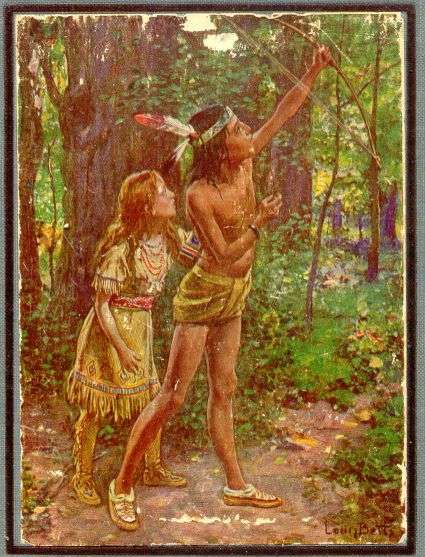
[Illustration: "I soon had a fire started."]
The youth shivered. Then he went on: "But I remembered how to keep wolves from drawing too near. They do not love fire. I piled the brush high, and flames leaped up in the air. All night long I did this, and now, my mother and my sister, I am with you once more. No harm befell me."
"You did well, my son," replied his mother. That was all, but her eyes shone with pride and gladness. So did those of Sweet Grass who exclaimed, "Those fearful wolves! How I hate them! But you are safe. They did not devour you; that is enough."
THE DOG FEAST
Soon after Timid Hare went to live in Bent Horn's lodge to serve his beautiful daughter, there was a good deal of excitement in the village. Messengers had come from other bands of the Dahcotas saying that their chiefs were about to make a visit to Bent Horn. They wished to talk over important matters in regard to the good of the whole tribe.
Both braves and squaws were busy preparing for the great time. There would be dances and feasts, games and wrestling matches. The warriors must make ready their best garments and noblest head-dresses. They must use much grease and paint to look as grand as possible when receiving their guests.
Sweet Grass and her mother had much to do getting ready for the celebration, and Timid Hare tried her best to help. She ran errands, pounded rice, brought wild sweet potatoes and dried berries from the pit in which the stores of food were buried, and tended the fire in which buffalo and bear meat were roasting, for much would be eaten during the visit which would last several days at least.
Sweet Grass smiled upon her little helper. So did her mother. Both of them were pleased with the child, and came near forgetting that she was not one of their own people.
Then came the day when word was sent through the village that the coming visit was to be celebrated by the Feast of the Dog. Different families would be asked to sacrifice the dog dearest to their hearts. Every one believed it would be a fit offering to the Great Spirit and would fill his heart with tenderness for his red children.
It would also bind the hearts of the chiefs more closely together.
As Timid Hare went through the village one morning--it was the last one before the visitors should arrive--she met Black Bull. It was the first time she had seen him since she had gone from his lodge. As she ran towards him he did not seem glad to see her. He simply looked at her pitifully.
"What is the matter, Black Bull? Is there trouble? Tell me. Everyone else is happy over the coming good time." Timid Hare spoke fast.
"My dog," he said brokenly. "My one friend must die. I must give him as a sacrifice, so my mother has said." The poor fellow began to cry.
"Your dear Smoke! I am so sorry for you, Black Bull." Timid Hare's own eyes filled with tears. "So sorry," she repeated.
"I will try to save him, though." The deformed youth looked wildly about him as he spoke, as though he feared some one besides Timid Hare would hear him. Then, without waiting for her to reply, he went off in the direction of the spring, beyond which was a sharp bluff. Below this bluff flowed a stream of water which in the autumn was deep--so deep that any one could drown in it easily.
"I wonder what Black Bull meant when he said he would try to save Smoke," thought Timid Hare, as she stood watching. "He cannot save the dog. How hard it is! No one in the village seems to care for Black Bull. The Stone, his own mother, treats him cruelly. The dog is his only friend, as he says. I will tell my young mistress about him. It may be she can help him."
As soon as Timid Hare had done her errand she ran home, still with the thought of Black Bull's trouble in her mind. She had been in the tepee only a few minutes before Sweet Grass noticed that something was the matter with her little maid.
"What has happened, Timid Hare?" she asked. "Your face is long--so!" She drew her own mouth down at the corners and made herself look so funny that Timid Hare, sad as she felt, broke into a laugh.
"It is Black Bull," she answered. "He is in trouble. It is greater than it would be with any one else in the village."
Then she went on to speak of the youth's lonely life, and that even his mother treated him badly. Only one loved him: this was the dog Smoke who followed him wherever he went and who did not mock him as the children of the village sometimes did. Smoke was ever ready to smile at him in the one way dogs can--with his tail. It was Smoke's love alone that made Black Bull glad to live. And now--Timid Hare's voice broke as she went on to tell of what must soon happen.
"Poor fellow!" said Sweet Grass softly. "Poor fellow," she repeated, half to herself.
As it happened, Young Antelope was in the lodge when Timid Hare was telling the story. He was busy making a shield; he intended to wear it when first allowed to go forth on a war party with the older braves. But though he was busy at his work, he listened with interest to the words of Timid Hare.
Soon afterwards he left the tepee and ran along the path leading to the spring. "If I see Black Bull," he thought, "I will speak kindly to him even if he is such a useless creature."
When Young Antelope reached the spring he heard some one talking angrily. This was followed by a cry of fear. The sounds came from the direction of the bluff beyond, but the youth could see no one because of clumps of brush which shut off the view from any one at the spring below.
Young Antelope hurried along, till suddenly he caught a glimpse of two figures on the very edge of the rocky summit of the bluff. One was that of Thunder Cloud, a worthless fellow; the other which he held struggling in his arms was that of The Stoned's deformed son. Black Bull was helpless; he was at the mercy of Thunder Cloud who was about to cast him into the stream below.
[Illustration: Black Bull was helpless.]
"What is this?" shouted Young Antelope. Thunder Cloud, startled, turned suddenly about.
"I would punish this worthless fellow as he deserves," he answered. "Do you know what he dared to do? He brought his dog to yonder brush and fastened him in the midst. He thought to keep the animal from the sacrifice. Ugh! A wretched creature indeed. His mother bade me follow him."
"Make him free," said Young Antelope with the air of a mighty chief. "My father will take care of him. As for you, go from my sight."
Thunder Cloud, who had already set Black Bull on his feet, though he still clutched him tightly, let go his hold, and skulked away.
"Let your dog loose," Young Antelope now ordered Black Bull who stood before him, still shivering from fright. "There! Now we will go to my father and let him settle the matter. Follow me."
Black Bull, with Smoke capering about him in the joy of being set free, followed Young Antelope silently till the two neared the council house where Bent Horn was busy planning for the coming celebration. There, in the autumn sunlight, they waited till the chief should appear and the son whom he loved dearly should have a chance to ask for a certain boon.
That night Black Bull went to sleep as happy as a king, even though his mother had just given him a beating. Smoke was safe! Another, Young Antelope, who had more treasures than he, was willing to make the sacrifice in his place.
THE FESTIVAL
The celebration was over and Timid Hare was tired out from excitement. Never before had she seen so many wonders. Why, the chief of chiefs, the chief of all the Dahcotas, had been one of the visitors and had slept in Bent Horn's tepee. Timid Hare herself had helped to serve him. And when he had gone forth to the council and to the feasts he was the grandest looking person she had ever beheld in her life. He wore a head-dress of war-eagle feathers. Thick and heavy was this head-dress, and beautiful were the feathers beyond compare. The great chief's face shone with grease, and was made fearful to look upon with much paint. On his robe were pictured the many battles in which he had taken part; it was trimmed with a heavy fringe of scalp-locks. His leggings and moccasins were richly embroidered with porcupine quills. He walked forth like a king. The children of the village trembled as they gazed upon him.
Bent Horn looked grand also in his own robes of state. Many a day had his wife spent embroidering this robe with porcupine quills and trimming it with fringes of his enemies scalp-locks. Heavy chains hung around his neck. His long hair, which he had greased well, had been divided into two parts and crossed on the top of his head, where it was then gathered into a knot.
"Bent Horn's head-dress is almost as handsome as that of the Great Chief," Timid Hare said to herself, as she watched the two men walking together towards the council house.
The sun shone brightly throughout the whole celebration and the feasts were spread outdoors. The chiefs and braves sat in a half-circle at these feasts and the food was passed to them from steaming kettles. There was bear meat in plenty, fat and rich; baked turtles; juicy buffalo steaks and stews; but at the principal feast of all, only dog flesh was served.
Then it was that the people of the village gathered in crowds around the feasters to watch and listen. Closest of all were the braves and their sons. Back of them were the squaws and their little daughters. Timid Hare, beside her young mistress Sweet Grass, listened with wonder to the noble speeches of the chiefs. Bent Horn spoke first of all.
"My brother," he said to the Great Chief, "our hearts are almost bursting with gladness that you are with us today.
"And you also"--Bent Horn continued, turning to one after another of the lesser chiefs, "we welcome you with gladness and feel that the Great Spirit has sent you to us. In token of our love we have killed faithful dogs that you may feast. May the Great Spirit bind us closely together. I say no more."
As Bent Horn ended his speech he lifted before the eyes of the feasters a carved necklace made of the claws of grizzly bears, and his own robe of elk skins which he had just taken from his shoulders. Then he slowly rose and, going to the side of the guest of honor, he laid the gifts before him. Next, he took other gifts--embroidered moccasins and leggings--and presented them to the lesser chiefs.
For a moment all were silent. Then the guests themselves made speeches, each one telling of his love for Bent Horn and his band, and giving rich gifts in return.
And now the pipe of peace was lighted and brought to Bent Horn. Solemnly he pointed the stem to the north, the south, the east, and the west. Last of all, he lifted it towards the sun. Then he spoke. "How--how--how," he said slowly. Then in silence he smoked it, but only to take one long whiff, after which he held it in turn to the mouths of the other chiefs, that they might smoke it also.
Not a word was spoken by any one during this solemn time. But as soon as the last guest had smoked, the dog-meat, floating in rich gravy, was brought from the steaming kettles and handed around in wooden bowls among the guests. All ate their fill. Then silently, they got up and went away. They had smoked and eaten the sacrifice together. Surely, they thought, there could be no better token of their friendship for each other.
Timid Hare looked on from afar. She felt pride in her dear mistress's brother who had given up his own pet dog, in place of Black Bull. She was also filled with wonder at the greatness of the Dahcotas.
"They are a mighty tribe," thought the little girl. She drew a long breath of sadness, feeling that she could never hope to go from among them. But when she afterwards looked on at the wrestling matches, races on horseback, and dances such as she had never seen before, she forgot everything else for the moment. Her eyes shone with excitement; her breath came quick. Never before, it seemed to her, had she seen such skill.
When the entertainment of each day ended, however, and Timid Hare went to her bed of buffalo skins, she would lie thinking of the old home, of the loving White Mink, the kind Three Bears, and the good foster-brother Big Moose. Then tears would roll down over the little girl's cheeks and she would choke back a sob.
"Can it be," she would think, "that the story White Mink told me before I was taken from her, is true? Am I truly a white child, and is she not my real mother?" Then the little captive would touch the baby's sock fastened by a cord of deer-sinews about her waist and next to her flesh.
"It is safe," she would whisper to herself, "and no one here has discovered it--not even The Stone. It did not save me from being captured, but it may yet bring good fortune, even as White Mink hoped."
MOVING DAY
The visitors had all gone away and the village was once more quiet--that is, as quiet as it might be among the Dahcotas, the lovers of the dance and of music.
Now and then some of the braves went forth on a war-party, or on a hunt after bears or buffaloes. But the buffaloes were scarce, they told their chief; the herds must have wandered far, and the hunters often returned empty-handed. This was bad, because the winter was drawing near and supplies of meat were needed for that long season of bitter cold.
One morning Bent Horn rose earlier than usual and made his way to the council house. There he staid for some time talking with the medicine men and other leading braves of the village.
Should there be a bear dance and a buffalo dance to call the attention of the Great Spirit to the needs of His people, that He might send plenty of prey nearer the village? Or should the band first move to a different part of the country, where no red man dwelt and where the buffaloes, at least, might be plentiful?
When the talk was ended the men who had gathered at the council went their way. Bent Horn's mind was made up. "My people must move to a new camping ground," he said to himself. "We will journey to the eastward. In that direction, the hunters say, we are likely to draw near the feeding grounds of large herds of buffaloes. Tomorrow morning at sunrise we must be on our way."
[Illustration: Bent Horn's mind was made up.]
The news was quickly carried from one tepee to another and the squaws set to work with a will to prepare for moving.
When Timid Hare heard the news she thought sadly: "Shall I go farther than ever from my dear White Mink?" The little girl had been so frightened at the time of her capture that she was not sure in which direction she travelled.
There was not a moment now, however, to consider herself, as Sweet Grass and her mother kept the child helping them prepare for the moving. The stores of grain and other dry food, the dishes and kettles and clothing must be packed in readiness for the early start on the morrow.
THE JOURNEY
"Awake, Timid Hare, for there is a faint light in the eastern sky. The sun is already rising from his bed."
At these words from Sweet Grass, Timid Hare's eyes burst wide open and she sprang from her bed. There was much to do at once, for the signal must be given to the whole village from the home of Bent Horn.
So quickly did his squaw and young daughter work that a half-hour afterwards the walls of the chief's tepee were flapping in the morning breeze. Immediately afterwards the same thing happened to every other home in the village. Next, down came the tent poles of the chief's tepee, and then those of all the others.
Timid Hare went quickly here and there, obeying the orders of her mistress. Ropes of skin must be brought to tie the poles into two bundles. The little girl must help hold these bundles in place, while Bent Horn's best pack horses were brought up and the bundles fastened against the sides of their bodies, and at the same time allowed to drag on the ground behind.
"Quick, Timid Hare," Sweet Grass would say, pointing now to this bundle of bedding, and now to another of dishes or clothing. The horses were restless and the bundles must be well-fastened to the poles before they should be ready to start. Some of Bent Horn's dogs were also loaded in the same way.
While Sweet Grass and her mother, with Timid Hare's help, were packing their own stores every other woman in the village was doing the same. In a wonderfully short time the procession was on its way, the squaws leading the pack horses. When they started out, however, the braves and youths, riding their favorite horses and ponies, were already far ahead.
Timid Hare trudged bravely along beside her young mistress who led one of the pack horses. She carried a big bundle on her back. So did Sweet Grass and her mother. So did all the other squaws except those who were too old and feeble.
"Let us move fast while we are fresh," Sweet Grass would say now and then when Timid Hare began to lag. "When the day grows old, then is the time to move like the turtle."
As they travelled along. Timid Hare passed The Stone who looked at her with ugly eyes. The old squaw was thinking, "Had it not been for my sending the girl that day to Sweet Grass she would now be making my load light. Fool that I was!"
Afterwards Timid Hare and her mistress talked with The Fountain, the pretty bride who lived near The Stone. The Fountain smiled pleasantly at the little girl. She said, "Sometime, Timid Hare, you shall come to see me in the new home. I may have a surprise for you."
The sun had nearly set when word came down the line: "The chief has chosen a place for the new camp. It is beside a stream of clear water and the tracks of buffaloes are not far distant."
Timid Hare was glad to hear the news, because her feet and back ached. She was not strong as an Indian girl of her own age should be and she knew it. "But I look like one," she said to herself. She was glad now that her body was stained. She had colored it afresh of her own accord just before the journey, for she felt she would not be jeered at by the children of the Dahcotas so long as her hair and body were of the same color as their own.
When the new camping ground was reached, she was very tired. "But I must not show it," she thought. "I must be bright and cheerful." So she moved quickly, helping to set up the tepee and get supper for the family. But her eyelids closed the moment she lay down to rest, and she knew nothing more till the barking of the dogs roused her the next morning. At the same time she heard Sweet Grass and her mother talking together.
"The Fountain was last seen when we stopped at a spring to get water in the late afternoon," one of them was saying.
"I hope she is safe," replied the other, "and that the gray wolf was not abroad."
Timid Hare shuddered. "Where can The Fountain be?" she wondered. "She is so good and so pretty, I hope she is unharmed."
The very next moment a neighbor appeared in the door. "The Fountain has just reached us," she said. "She spent the night by the spring, and she now brings with her a baby son. He is a lusty child. May he grow up to be a noble warrior!"
"I will go to her and give her my best wishes," declared the chief's wife. "It is a good sign for the new home that one more is added to our people."
Soon afterwards Timid Hare and her young mistress were also on their way to visit the young mother. She was very happy. So was her husband. So was her baby; at least it seemed happy to Timid Hare as she looked at it nestling quietly in its mother's arms. The little girl longed for it to open its eyes.
"By and by," The Fountain told her with a smile, "my son will awake. But now he must sleep, for he finds this world a strange one, and he is tired."
"The Great Spirit has been kind to The Fountain," said Sweet Grass as she walked homeward with her little maid.
"How powerful He must be," declared Timid Hare thoughtfully. "Whenever He speaks to us in the thunder and lightning I tremble with fear. But when I looked at the little baby just now I felt His love."
THE MEDICINE MAN
The next morning Timid Hare was allowed to go once more to visit The Fountain and her little son. The baby lay fastened into a pretty frame the young mother had made for him. The straps were embroidered with porcupine quills, and finished very neatly.
As Timid Hare entered the tepee, The Fountain was about to lift the baby in his frame to her back.
"I am going to see Black Bull," she said. "He is ill. He has not been well since before the Dog Feast."
Timid Hare at once thought of a reason for Black Bull's illness,--he had worried much over the thought of losing his dog. But Young Antelope had not told her that he came near losing his life and of his terrible fright at the time.
"Has the medicine man visited Black Bull?" asked Timid Hare.
"Not yet." The Fountain shook her head sadly. "I doubt if The Stone cares whether her son lives or dies. But I am going to see the poor creature. Afterwards, if the medicine man has not been sought, I will ask my husband to get his help."
The Fountain started on her errand, and Timid Hare went back to the chief's lodge to tell her young mistress what she had learned. On the way she passed a clump of trees beneath which she saw several people sitting and listening to the voice of a tall man who stood before them. He was one of the most powerful medicine men of the band.
"He must be speaking of some great mystery," thought Timid Hare. "How noble he is! How much he must know! It may be that he is telling of the secrets he reads in the fire."
Turning her eyes towards the listeners, she saw they were thinking deeply of his words. They looked with wonder at the medicine man. "Yes, he must be speaking of the secrets no one but he can discover."
[Illustration: They looked with wonder at the medicine man.]
When Timid Hare reached home she spoke of this medicine man to her mistress. "If only he could go to Black Bull, the sickness would leave the poor fellow," she said.
Soon afterwards Sweet Grass herself sought the medicine man. She brought him presents of buffalo marrow, deer meat, and a juicy, well-cooked land turtle. Then she asked his help for the deformed youth, and he promised to go to him.
The next day word came to the chief's lodge that Black Bull had gone to join the people of the grave. Though the medicine man had gone to him and worked his mysteries with songs and drum beating, the Great Spirit had not willed that he should live.
"Better so," declared Bent Horn, when the news was brought to the lodge. "Black Bull was of no help to his people. He suffered, and was not happy. Better so!"
"I will take his dog," Sweet Grass promised her sad little maid. "Smoke shall be cared for, though his master has left him."
THE WINTER HUNT
The new home proved to be a good one. Each time the hunters went forth they returned with a load of game. The squaws were kept busy drying buffalo and bear meat, packing away the marrow and cleaning the bones and skins. Every part of the animals was put to some use.
The days of the long, cold winter were at hand, and all must work busily. Timid Hare had much to do, but sometimes she was allowed to play outside of the tepee with other children; they were kinder to her now that she lived in the chief's home. She had plenty to eat, and Sweet Grass and her mother treated her well, but she longed for something that was lacking here but was freely given in the old home: it was love.
The snow fell thick and fast. It covered the prairie for miles in every direction. In some places it was deeper than Timid Hare was tall. A thick crust formed over the top.
Young Antelope set to work to make himself new snowshoes. As he bent the hoops for the frames and crossed them with networks of leather strings. Timid Hare looked on with longing. She had had snowshoes of her own before, and she had enjoyed skimming over the snow fields on them, but they were far away--very far away.
"I will help you make some shoes," Young Antelope told her, when he caught the look. "You can do the easy part, and I will do the hard."
Timid Hare was pleased because Young Antelope did not notice her very often. The snowshoes were soon made and the little girl longed to try them.
The very next day Young Antelope went out with the men on a winter hunt. There were large stores of meat in the village, but the cold was bitter and more warm buffalo robes were needed for beds and coverlets. Moreover, at this time of the year the fur of the animals was heaviest.
"It will be easy to get our prey," Bent Horn said to his son the night before the hunt. "There is little snow on the south slopes of the hills, where the buffaloes will be feeding. We can take them by surprise and drive them down into the ice-crusted fields. They are so heavy that their feet will fall through. Then the hunter can draw near on his swift snowshoes, and will pierce the heart of his prey with his spear without trouble."
"I will be such a hunter on the morrow," the youth had replied. "My spear is already sharpened. It shall bring death to more than one of the creatures that provide us with comfort through the moon of difficulty," as he had been taught to call the month of January.
As Young Antelope skimmed along over the snow fields next morning, he thought more than once of the little captive at home.
"She behaves well," he said to himself, "and she will be a good homekeeper when she is older. It may be--it may be--that I will yet choose her for my wife."
Young Antelope was only sixteen years old, but he was already thinking of getting married! It was the way of his people. The girls married even younger than the boys--sometimes when only twelve or thirteen years had passed over their heads. It was therefore not strange that the chief's son should be considering what wife he would choose.
With many of the braves away on the hunt, the village was quiet, and the squaws took a little vacation from their work, as on the morrow they must be very busy caring for the supplies brought home by the hunters.
In the afternoon Sweet Grass said kindly: "Timid Hare, you have been a good girl and worked hard of late. You may have the rest of the day for play. Try your new snowshoes, if you like."
The rest of the day--two whole hours before sunset! It seemed too good to be true. Never had such a thing happened to the child since she left the home of the Mandans.
Without wasting a moment, Timid Hare got the snowshoes and left the tepee. For a moment she looked about her to see if any other little girl would like to join her in a skim over the fields. But all seemed busy at their games, and even now she was not enough at home with any one of them to ask them to leave their own play and go off with her, a captive.
So, binding on the shoes, she started off alone. What fun it was to move so fast and so smoothly! How clear was the air! How delightful it was to feel the blood rushing freely through every part of her body! Her cheeks tingled pleasantly; her heart beat with joy.
Mile after mile the child darted on in the opposite direction from that taken by the hunters in the morning. So happy, so free felt the child that she forgot how far she was travelling. Sometimes there were little rolls in the land. She would get up her speed as she approached them, so as to have force enough to reach the summit of a roll with ease. And then what fun it was to travel like the wind down the other side!
On, on, on! and then suddenly, Timid Hare came to herself. Where was the village? In what direction? Could she not see smoke rising somewhere behind her, telling of the fires burning in the homes of the people?
There was nothing, nothing, to guide her back--only some fields apparently untrodden in every direction. So light was the little girl's body that her shoes had rarely pressed through the crust. The short winter day was near its end. A bank of clouds was gathering about the setting sun, they told of an approaching storm; so also spoke the chill wind that blew in the child's face.
Fright clutched at Timid Hare's heart. She thought of the power of the storm-king. Here, in the snowy wilderness, it seemed that she must perish. Was there no one to turn to in this time of danger? Yes.
"Help me, Great Spirit," cried the child, lifting her hands towards the sky where she believed He dwelt.
With that cry came a feeling that somehow her prayer would be answered. And at the same time Timid Hare remembered the little sock which she always carried in her bosom. She pressed a hand against the place where it should rest. Yes, it was safe.
"White Mink had faith in it. So will I," Timid Hare said to herself. Many a time during the hard days with The Stone, she had repeated the same words. It had always helped her to do so.
And now she turned in the direction she hoped was the village of the Dahcotas, but her feet felt numb. It was hard to travel. Hark! what was that? It seemed as though men's voices could be heard shouting to each other in the distance. They came nearer. Could it be that Sweet Grass had sent some of the village boys out after her?
Nearer! Nearer! Timid Hare stood still, listening. If they would only hurry! She suddenly felt drowsy--the snow-chill was benumbing her whole body, and somehow she no longer cared whether she was found or not. She tottered, fell.
The next thing she knew, she was lying in the arms of a man with kind blue eyes. He was smiling at her, and he was white! Another man, white like himself, was rubbing her arms and legs.
"All right now," the first man was saying to the other. "Poor little thing! How did she ever get out here? That Dahcota village is a good dozen miles from here, and the child's moccasins tell that she is of that tribe."
"We must waste no time in getting farther away from them ourselves," replied the other. "Little time would be wasted in taking our scalps if they caught us alone."
"But we can't leave this helpless creature," said the first speaker. "Do you know, Ben, she must be about the age of my own little daughter if--" The man's voice broke suddenly.
"Poor fellow--yes, I understand. You never will get over that blow. But, really, Tom, we must not stay here. The savages may be upon us any moment. Here, use this. It may bring her to."
The speaker held out a bottle of cordial which the man who held Timid Hare held to her lips. She tried to swallow, but it choked her.
"There," she said with a gasp, "it is enough," and she lifted herself up.
"Good," said both men, who knew a little of the Indian tongue.
"Oh, but my shoe!" cried the little girl in fright. It had slipped a little from its usual resting place, and she now missed it. In spite of being alone on the snow-covered prairie, with two strangers, her first thought was of the little talisman White Mink had given into her keeping. Oh! she could feel it pressing against her waist, and she gave a happy sigh.
In the meantime, the men had decided that it would be best to take the child to their camp. The rest could be settled afterwards.
"Can you trust yourself to your snowshoes again?" the man whom his friend called Tom asked her gently.
She nodded, and with the help of one of her companions, they were bound on her feet. A biscuit was now given her--she had never tasted its like before--and she ate greedily. This was followed by another swallow of the cordial, and the little girl was ready for the start.
Many miles were before her, but the men often took hold of her hands to give her fresh courage. Besides, she was greatly excited. What was coming? Were these strangers bringing her back to the village of the Dahcotas, or guiding her to something far different? From time to time one of the men struck a match--such a wonderful thing it seemed to Timid Hare--and looked at a tiny instrument he carried in his pocket. It seemed to tell him if they were travelling in the right direction. "How wise," thought Timid Hare, "the white people must be! Perhaps they are as wise as the medicine men!"
And she--why, she was of their own race, though her stained skin did not show it! At the thought, she lifted her hand to her side. Yes, her treasure was safe!
When it seemed to the child as if she could not move her feet longer, a faint light shone out in the distance. The camp of the white men would soon be reached.
When the travellers at last arrived at the journey's end there was great excitement among the men who were anxiously watching for the return of their two companions. They had feared that their friends had lost their way and been overcome by cold; or more probable, that they had been killed or captured by the Indians. They were in the Dahcota country,--this they knew; also that these Dahcotas were fierce warriors and hated the white men.
How surprised they were to see what they thought was an Indian child with their companions! How did it happen? What was to be done with her?
But now, as Timid Hare almost fell to the floor of the warm, brightly lighted tent, all saw that she was quite exhausted. She must be fed, and afterwards sleep. There would be time enough to question her next morning.
Hot soup was brought, and never, it seemed, had anything ever tasted so delicious to Timid Hare. And the heat of the burning logs--how pleasant it was! Timid Hare was too tired to be afraid, or even to think, and even as she ate, she fell sound asleep.
She awoke next morning with her hand clutching the place where the sock lay hidden, and saw a kind face bending over her. It belonged to the same man who had held her when she roused from the snow-chill.
"What is it?" he asked gently. He pointed to her hand.
"It is--my charm. It is to bring me good."
"May I see it?" The man's voice was so kind that it filled Timid Hare with perfect trust.
"You will--help me?" The child's eyes were full of pleading.
"Yes, little one."
Slowly Timid Hare drew forth the sock. It was faded and soiled, yet the pattern in which the silk had been woven into the worsted was quite plain.
"How did--Why, tell me at once how you got this." The man's voice was half stern, half pleading.
"It was--so." With this beginning Timid Hare repeated the story as White Mink had told it to her. Many a time she had since told it to herself during her hard life with The Stone. It was such a strange story--so full of wonder to her still. The wonder of it was in her voice even now.
The man listened with half-closed eyes, but saying never a word till she finished. Then, as in a dream, he said in a low tone: "It is my baby's sock--the pattern is one planned by my dear wife Alice who died out on this lonely prairie. And then--the sudden attack of the Dahcotas--and I made prisoner, while my baby Alice was left behind to perish. Afterwards I was rescued, though I cared little to live."
"But child, child," he burst out, "though your eyes have the same color, the same expression as those of my dear wife, your skin is that of the red people."
"I stained it--The Stone made me--and when I saw Sweet Grass liked me best so, I put on the color again and yet again."
"God be praised! I have found my darling who, I thought, was lost forever." The man lifted Timid Hare and clasped her tenderly in his arms. And she--well, the little girl rested there content and happy.
The next minute the rest of the party who had been out exploring, entered the tent with word that the start must be made at once. The clouds of the night before had lifted; the snow might not begin falling for several hours, and the most must be made of the morning towards reaching a larger camp where sledges would carry them a long ways towards a fur station.
Great was the joy of the others when they learned the good fortune that had come to their friend, and merry was the whole party as it made its way onward. Yes, Timid Hare, or rather Alice, now more like the Swift Fawn she had been, was merry too. But as she went on her way to the new and beautiful life that would soon be hers, she begged her father to take her back by-and-by for a visit to her foster-parents and Big Moose in the Mandan village on the river. And he promised gladly.