
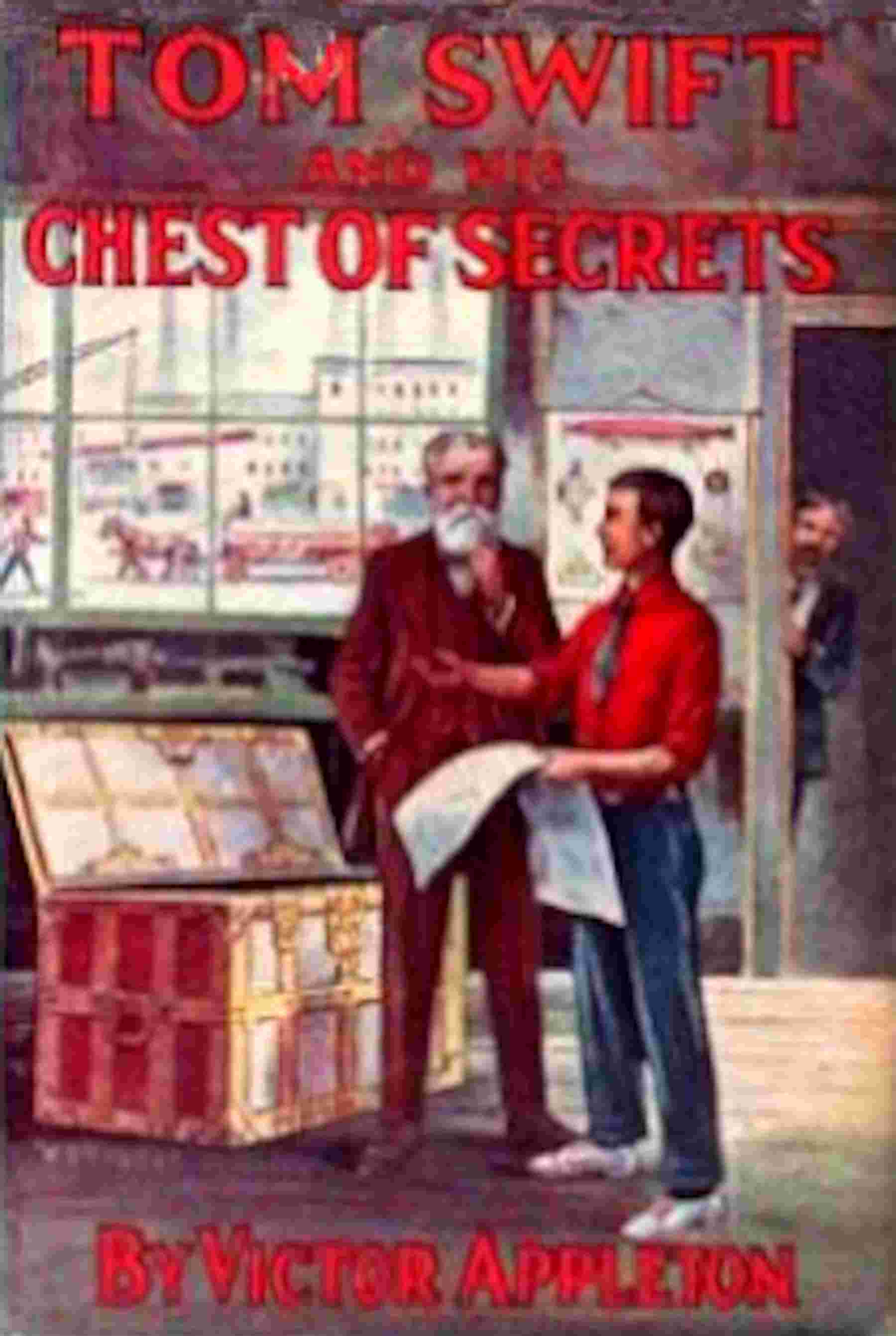
The Project Gutenberg eBook of Tom Swift and his chest of secrets
Title: Tom Swift and his chest of secrets
or, Tracing the stolen inventions
Author: Victor Appleton
Release date: January 8, 2024 [eBook #72659]
Language: English
Original publication: New York, NY: Grosset & Dunlap Publishers, 1925
Credits: Delphine Lettau, Greg Weeks, Cindy Beyer & the online Distributed Proofreaders Canada team at http://www.pgdpcanada.net
TOM SWIFT AND HIS
CHEST OF SECRETS
OR
Tracing the Stolen Inventions
By
VICTOR APPLETON
Author of
“Tom Swift and His Motor Cycle”
“Tom Swift Among the Diamond Makers”
“Tom Swift and His Great Oil Gusher”
“The Don Sturdy Series”
Etc.
ILLUSTRATED
NEW YORK
GROSSET & DUNLAP
PUBLISHERS
Made in the United States of America
| BOOKS FOR BOYS |
| By VICTOR APPLETON |
| 12mo. Cloth. Illustrated |
| ———— |
| THE TOM SWIFT SERIES |
| TOM SWIFT AND HIS MOTOR CYCLE |
| TOM SWIFT AND HIS MOTOR BOAT |
| TOM SWIFT AND HIS AIRSHIP |
| TOM SWIFT AND HIS SUBMARINE BOAT |
| TOM SWIFT AND HIS ELECTRIC RUNABOUT |
| TOM SWIFT AND HIS WIRELESS MESSAGE |
| TOM SWIFT AMONG THE DIAMOND MAKERS |
| TOM SWIFT IN THE CAVES OF ICE |
| TOM SWIFT AND HIS SKY RACER |
| TOM SWIFT AND HIS ELECTRIC RIFLE |
| TOM SWIFT IN THE CITY OF GOLD |
| TOM SWIFT AND HIS AIR GLIDER |
| TOM SWIFT IN CAPTIVITY |
| TOM SWIFT AND HIS WIZARD CAMERA |
| TOM SWIFT AND HIS GREAT SEARCHLIGHT |
| TOM SWIFT AND HIS GIANT CANNON |
| TOM SWIFT AND HIS PHOTO TELEPHONE |
| TOM SWIFT AND HIS AERIAL WARSHIP |
| TOM SWIFT AND HIS BIG TUNNEL |
| TOM SWIFT IN THE LAND OF WONDERS |
| TOM SWIFT AND HIS WAR TANK |
| TOM SWIFT AND HIS AIR SCOUT |
| TOM SWIFT AND HIS UNDERSEA SEARCH |
| TOM SWIFT AMONG THE FIRE FIGHTERS |
| TOM SWIFT AND HIS ELECTRIC LOCOMOTIVE |
| TOM SWIFT AND HIS FLYING BOAT |
| TOM SWIFT AND HIS GREAT OIL GUSHER |
| TOM SWIFT AND HIS CHEST OF SECRETS |
| ———— |
| THE DON STURDY SERIES |
| DON STURDY ON THE DESERT OF MYSTERY |
| DON STURDY WITH THE BIG SNAKE HUNTERS |
| DON STURDY IN THE TOMBS OF GOLD |
| DON STURDY ACROSS THE NORTH POLE |
| DON STURDY IN THE LAND OF VOLCANOES |
| ———— |
| Grosset & Dunlap, Publishers, New York |
Copyright, 1925, by
GROSSET & DUNLAP
————
Tom Swift and His Chest of Secrets
CONTENTS
| I. | A Crash on the Roof |
| II. | Big Offers |
| III. | Dirty Work |
| IV. | Liberty Bonds |
| V. | Ivan Barsky |
| VI. | Fire |
| VII. | A Hurried Exit |
| VIII. | A Secret Listener |
| IX. | Mary’s Message |
| X. | A Queer Story |
| XI. | A Double Peril |
| XII. | A Ring of Fire |
| XIII. | Just in Time |
| XIV. | A Queer Attack |
| XV. | The Trap |
| XVI. | Bound in Darkness |
| XVII. | Out of the Cistern |
| XVIII. | Two Disappearances |
| XIX. | Koku is Found |
| XX. | Many Strange Clews |
| XXI. | Scouting Around |
| XXII. | A Strange Message |
| XXIII. | The Blue Machine |
| XXIV. | A Night Watch |
| XXV. | The Round-Up |
IN THE LIGHT OF LANTERNS TOM COUNTED FIVE FIGURES.
TOM SWIFT AND HIS
CHEST OF SECRETS
CHAPTER I
A CRASH ON THE ROOF
There was a puffing as of labored breath, a shuffling of feet in the hallway, a banging and clattering sound, and then a voice cried:
“Where you have ’um, Master?”
Ned Newton looked up from his desk and glanced across the room at Tom Swift who was poring over a mass of blue prints. The young inventor smiled at his equally youthful business manager as Ned remarked:
“There’s your cute little giant Koku up to some of his interesting tricks again! Sounds as if he’d caught Eradicate by the hair of his bald head and was bringing him in upside down!”
“Plague take those fellows!” muttered Tom, a look of annoyance passing over his face. “If they don’t stop this everlasting clashing to see who is going to do things around here, I’ll get rid of them both! That’s what I will!”
Ned Newton laughed—laughed so hard that a pencil he had been using flew out of his hand and fell to the floor, breaking the fine point the young manager had put on in order to work over the financial affairs of the Swift Construction Company. Then Ned’s face sobered as he noted his broken pencil and he exclaimed:
“Oh, soapsuds!”
“Why the giggles?” asked Tom a bit impatiently. He had been buried in such deep thought that he resented the interruptions—not only the interruption of the noise outside his private office, but Ned’s laughter.
“Oh, I was only laughing because you’ve threatened so many times to get rid of Koku and Eradicate. But you’ve never done it,” went on Ned, “and you never will.”
“No, I never will, I suppose,” agreed Tom slightly chuckling. “Though they are mighty annoying at times with their everlasting——”
He did not finish the sentence, for again there came from the hall those strange sounds and once more the voice asked:
“Where you want ’um, Master?”
“It all depends, I should say, on who ‘ ’um’ is,” laughed Ned.
“It can’t be Rad,” remarked Tom, rising from his chair to go to the door. “If it were he’d have let out a yell long ago. It’s got so lately that he makes a fuss if Koku looks at him.”
“Afraid he’ll turn him white, I reckon,” chuckled Ned.
By this time Tom Swift had opened the door, revealing that Koku, the jungle giant, alone stood there, waiting for orders. Contrary to what Ned Newton had suggested, the big man did not have in his grasp Eradicate Sampson, the old colored servant of the Swift household. Between Koku and Eradicate there was an everlasting feud, due to the fact that each one loved and wanted to serve Tom and resented the other’s efforts in the same field of endeavor.
But Koku held something else—something that, when Ned caught a glimpse of it, caused the young manager to exclaim:
“My word, Tom, what’s the idea of the treasure chest?”
For it was nothing less than that which the giant held up on his shoulder—a great, massive oak chest bound with heavy strips of brass. And, as if that were not enough to hold the chest together, there were in addition two strips of wrought iron around either end of it, the strips terminating in hasps which dropped over massive staples, there to be fastened with heavy brass padlocks which tinkled and clanged with a suggestive sound as Koku stood holding the big box.
“Oh, Koku, I didn’t know this had come,” remarked Tom, and all his annoyance at the interruption to his thoughts passed. “I have been waiting for it.”
“Jes’ comed,” remarked Koku, whose English left much to be desired, though he generally managed to make himself understood. “Two mans bring ’um off truck. Want to fetch ’um up here. I laff an’ say Koku brung. Them mans laff say no can do. I laff two times and I give mans push and bring ’um here. Here ’um am.”
“So I see,” remarked Tom with gentle sarcasm. “And I suppose in refusing the offers of the truckmen who delivered my chest you knocked them seven ways or more.
“Just cast your gaze out of that window, Ned, and see if you can observe two huskies with fire in their eyes who will make a demand on the Swift Construction Company for damages caused by personal injuries from this little follower of mine. And as for you, Koku, how many times must I tell you not to go about pushing! You aren’t playing football, you know!”
“Where you want ’um?” was all Koku answered, still holding the heavy chest as though it were but a pasteboard box. “I put ’um down then I go bring up mans an’ show ’um I can do!”
“You let those men alone!” and Tom laughed in spite of himself. “You’ve got me into trouble enough, as it is. But put the chest down there, and then go and ask my father if he feels well enough to come here.”
“Boss Swift no come, I carry him,” said Koku simply.
“None of that, unless he wants you to, Koku!” ordered Tom in so sharp a tone that the giant knew he must obey.
“Aw right,” he murmured. He put the massive brass-bound chest down in the middle of the room, the keys, which were tied to the padlocks, jingling and clanking as he did so. Then, as the giant left the room, Ned drew his head in from the window and remarked:
“There are two huskies down there, dusting off their clothes and looking indignant.”
“Just as I thought,” groaned Tom. “I’ll have another demand on me for monetary damages on account of Koku’s confounded zeal in my behalf. Here, Ned, run down with these cigars, like a good chap, and stave off the row, will you?”
“Sure, Tom!” The young manager grabbed a handful of cigars from a box some one had sent Tom, but which the young inventor never used, and hurried out.
Meanwhile Tom Swift, left to himself, walked over to the great new chest, and, cutting loose the keys, fitted them into the locks, there being two, and threw back the cover.
“This will hold the most valuable of my secrets until I can get the concrete storage vault made,” he remarked.
He was still looking at and admiring the chest when Ned came back. In his hand the young man still held the cigars.
“Wouldn’t they take them?” asked Tom quickly.
“I didn’t get a chance to give them the smokes,” was the answer. “Just as I got down there Koku came out the back door, and you should have seen those fellows make a dash for their truck. They’re breaking the speed laws yet, I reckon,” and Ned sat down in a chair and laughed heartily. “They seem to have had enough of Koku’s pushes, Tom.”
“Hang it all!” muttered Tom. “Well, I’ll have to square those fellows next time I see them. Maybe they won’t make any trouble.”
“Judging from the way they streaked it down the road, they won’t come back here unless they’re hauled. But what’s the idea of the treasure chest, Tom? Some new invention?”
“No, it’s just a plain, strong chest. I had it made to store away my secret inventions—the formulae, plans, blue prints and so on—until I can put them properly in a vault that I’m going to construct underground.” As Tom spoke he began putting into the chest a number of bundles of documents and drawings. “I had the chest made in Mansburg, and I was just wondering when they were going to deliver it when Koku brought it up,” he added.
“Those plans and blue prints must be worth a lot of money,” remarked Ned, with an appraising glance at them.
“Well, yes, you might say that,” admitted Tom, though not at all boastfully. “The tidal engine alone, when I get it perfected, ought to bring in a pretty penny—that is, if dad and I decided to sell it.”
“When you perfect it!” exclaimed Ned. “Why, it works like a charm now!”
“Yes, I know the model does,” admitted Tom. “But that doesn’t say it’s commercially practical yet.”
“To judge by some of the offers you got for even a small interest in it, I’d say it was a humdinger!” exclaimed Ned. “But then your name goes a long way, Tom. Once let it be known that your company has something new on the market, and you’re overwhelmed with offers. Take that gyroscope air flier your father helped work out——”
“Not so loud, Ned!” cautioned the young inventor. “I’m not ready to let the latest news of that get out yet. As you know, with the new stabilizer, it works on quite a different principle.”
“Right! But there’s no one around here now to catch your secrets, Tom.”
“You never know when some one is around,” was the cautious observation as the young inventor continued to pack blue prints into the chest. “It’s best to be on the safe side. We didn’t think any one was listening when you and I discussed plans for the new turbine, and yet we nearly got dished out of that.”
“That’s so—my error!” apologized Ned. “Are the plans for that going into the new chest?”
“Yes; and for my new idea that may result in automatically stopping railroad trains and preventing accidents,” went on Tom. “I have great hopes of that and also of my new mammoth telescope.”
“Telescope!” exclaimed Ned. “You haven’t said anything to me about that, Tom. What’s the idea?”
“Well, it’s pretty hazy as yet. But I have a notion that we haven’t begun to reach the limits of telescope work yet. If by means of present instruments we can bring the moon to within apparently forty thousand miles, why can’t we double the size, or at least the power of the telescopes, and make the moon seem only a few hundred miles away? Then, by taking moving pictures and enlarging them, we may be able to settle the disputed point as to whether or not the moon is inhabited. Yes, I’ve got a lot of work to do on my telescope, and also on the farm tractor. I’ve got a notion I can improve the tractor, though I guess Ford beat me to it, and holds all the tricks, for he can make them in such vast quantities that he could outsell me and underbid me, even though I could better the machine a little.”
“Yes, I wouldn’t advise, as your financial manager, bucking up against the Ford interests,” remarked Ned dryly. “We’re in pretty good shape, have a nice balance in the bank, and all that, but I want to see it stay there.”
“So do I!” laughed Tom, as he continued to pack into the chest thousands of dollars’ worth of valuable patent papers. “I’m not going into any wild schemes, Ned.”
“I wouldn’t advise it,” went on the young manager. “Especially in view of what may happen soon,” he added.
“What’s going to happen?” asked Tom quickly and a bit apprehensively.
“Why, I thought I might soon be requested to act as best man at a certain ceremony in which the talented Tom Swift was a party of the second part, and a certain Mary Nestor party of the first part aforesaid in manner following, to wit, that is to say, and all the rest of it!”
“Cut it out!” laughed Tom, blushing slightly under his tan. “But if I ever do need a best man you’ll be it, Ned.”
“Thanks. I hoped as much. Well, when you get all your documents in that chest of secrets it will be worth a pretty penny, Tom.”
“Chest of secrets!” laughed Tom. “That’s a good name for it, Ned. Yes, quite a little fortune,” he went on. “I had the chest made secure and heavy on purpose so it couldn’t easily be carried away. Maybe I had it made a bit too heavy. Let’s see if we can shift it out of the middle of the room, Ned.”
The chest, nearly filled with documents which Tom had taken from his desk and the office safe, was not locked. The two young men attempted to lift it, but it was beyond their strength.
“We’ll have to send for Koku,” remarked Tom. “Though I expect him back any moment. I sent him to call dad here. He may have some papers he wants to put in the chest.”
“Hark!” exclaimed Ned, raising a hand for silence.
Immediately thereafter a great crash sounded on the roof of the building—a thundering, vibrating and nerve-racking crash, and above the din a voice cried:
“Bless my steering wheel! I didn’t want to land here!”
CHAPTER II
BIG OFFERS
Tom Swift and Ned Newton glanced at each other. In spite of the apparent gravity of the situation the young men could not help smiling. For well they knew that voice, and they could judge what had happened.
“It’s Mr. Damon!” exclaimed Ned.
“And he must have made a forced landing from an aeroplane on the roof above us!” added Tom. “Lucky for us he didn’t come through.”
“Lucky for him, too, I should say!”
Ned made a dash for a stairway leading to the broad, flat roof of the building that housed Tom’s executive offices and also one of the shops of the Swift Construction Company. The young inventor followed his financial manager. Others of the plant—workmen, machinists, and apprentices—were also on their way to the roof.
Tom and Ned, going up a private stairway and through a scuttle, were the first to reach the scene. There a curious sight met their eyes. Seated in a small monoplane—a kind invented by Tom Swift himself—was Mr. Wakefield Damon, a friend of the family, a very eccentric but lovable character, forever “blessing” any and everything that took his fancy.
“Hello, boys!” he greeted Tom and Ned, blinking his eyes at them in a curious fashion.
“Well, for the love of spark plugs!” cried Ned. “What happened?”
“Are you hurt?” Tom asked more practically, though a quick glance assured him that the plane was whole, though one landing wheel was slightly out of true, and that the solitary passenger was still in the small cockpit.
“Bless my porous plaster, Tom, I don’t know whether I’m hurt or not!” answered Mr. Damon. “I came down so suddenly! I was aiming to land in your regular flying field, but something went wrong with the controls—it’s a new plane, I haven’t had it long—and I find myself here.”
“Mighty lucky you are to find yourself, I’ll say,” murmured Ned, as a crowd of Tom’s men gathered about the plane on the roof.
“This smash,” remarked Tom, as he and Ned were helping the odd man from his aeroplane, “reminds me of the first time I ever saw you, Mr. Damon. You were riding a motorcycle.”
“And it tried to climb a tree with me! Bless my rubber boots, well do I remember that!”
It was owing to Mr. Damon’s disgust over the accident to his motorcycle that Tom had been able to secure it for a small sum. As related in the first volume of this series, “Tom Swift and His Motor Cycle,” the young inventor was started on his sensational career by the possession of this battered machine, which he repaired and got in running order. On it he had some exciting rides.
Tom was in his early manhood. He, and his aged and somewhat invalid father, an inventor of note, lived in the Swift homestead in the town of Shopton on Lake Carlopa. Tom’s mother was dead, but he and his father were well looked after by Mrs. Baggert, an efficient housekeeper. Of late years Barton Swift had not taken much active part in the rapidly growing business, though Tom always consulted his father on matters of importance.
It was at the suggestion of Mary Nestor, for whom Tom had a very great admiration, that the young inventor engaged his friend and boyhood chum, Ned Newton, to look after the business matters of the Swift Construction Company. Tom never had reason to regret that decision. For with Ned to look after money matters, see to contracts, and the like, Tom and his father were left free to exercise their inventive ability.
The Swift Company had gone into many lines of activity, from building airships and aeroplanes to constructing submarines and giant cannon for the government. These brought Tom and his associates money and fame, and also hard work.
Just prior to the opening of this story Tom had developed a new drill and a system of sinking shafts for oil wells, and when, as related in “Tom Swift and His Great Oil Gusher,” he successfully demonstrated how quickly he could get down to the oil-containing sand, he made another big amount of money, not only for the Swift Company, but for the Goby family as well.
It was after this that he began to think of getting together in one central place all his drawings, patent rights, secret formulae and the like. To this end he had had constructed the strong chest, and he and Ned had barely finished putting into it most of the valuable documents when the crash on the roof came.
“He doesn’t seem to be hurt, Tom,” remarked Garret Jackson, Tom’s shop manager, as he laid Mr. Damon on a pile of coats and jackets which some workmen hastily spread on the roof.
“Hurt! Bless my doctor’s bill, I’m not hurt at all!” exclaimed the odd man. “I’m shaken up, but I’m more worried about the plane than about myself. Is it all right, Tom? I tried to avoid the chimney, but I’m afraid one wheel grazed it.”
“Yes, that’s what happened,” replied the young inventor, as soon as he had made sure his friend was not hurt and had had time to inspect the craft. “You damaged it a little. But I can easily put on another wheel. I have some spare ones for that model.”
“Have you, Tom? That’s fine! Put one on and I’ll fly off your roof. You may charge me storage if I stay here too long,” and Mr. Damon laughed in a way which showed, better than anything else, that he had suffered no ill effects from the sudden ending of his flight.
“Are you going to trust yourself again to that plane?” asked Mr. Jackson.
“Of course I’m going to fly again!” cried the odd man. “A little bump like this doesn’t disturb me. I’ve been in worse smash-ups; haven’t I, Tom?”
“Off hand, I should say you had,” was the smiling answer.
“Besides, I want to learn how to run this jigger!” cried Mr. Damon, sitting up on the pile of workmen’s garments while the men gathered smilingly about him, for they all knew him. “What did I do wrong, Tom? Or is the steering gear out of order?”
“It seems to be all right,” answered the young inventor, who had been looking at the mechanism. “Tell me just what happened.”
“Well, as I say, I was coming over to see you. Or, if I didn’t say that before, I tell you now. I have a big offer for you, Tom Swift, a most important offer. I’ll get to that in a moment. But I was coming over in this plane, which I bought only yesterday, and I decided to fly across your shop and land in the meadow.
“But, just as I got here, I felt the machine dip suddenly. First I thought I had struck an air pocket, but I didn’t have time really to decide what it was before I came down with a crash. Luckily I was able to straighten her out a little before I struck, so I made a slanting landing. Otherwise I might have gone through the roof.”
“And right down on our heads!” exclaimed Ned. “Mighty glad you didn’t!”
“So am I,” said Mr. Damon. “But what’s wrong, Tom? I want to know so that the same thing won’t happen again.”
“I guess you forgot that you were in a monoplane instead of a biplane, Mr. Damon,” he answered. “You banked too much on the turn.”
“That’s it, Tom! I remember now! I was making the curve to head straight for the meadow, and it was then a sort of side slip came.”
“Yes,” remarked the young inventor, “you spilled too much air from beneath your wing tips. You see in a biplane, with two surfaces, the air is held in a sort of pocket and you can afford to make a sharper bank on the turn. But in monoplanes you must be more careful.”
“I will, after this,” promised Mr. Damon, as he arose and walked about, albeit a bit gingerly as though making sure he had no broken bones or strained tendons.
“Here, Koku!” called Tom to his giant helper. “Hold up this plane while some of the men take off the damaged wheel.”
“Sure, Master, Koku do,” was the reply.
“Go on!” cried another voice. “It doan need no big fat giant to lift a li’l machine like dat! I’ll do it fo’ you, Massa Tom!”
An old colored man with a fringe of white hair around his black pate pushed through the crowd of workmen toward the giant who was already preparing to tilt the plane so the wheel could be removed.
“You go or Koku push you!” warned the giant with a threatening look at Eradicate Sampson.
“Huh! You go on!” was the contemptuous response, and there might have been a battle then and there had not Tom interposed.
“Rad,” he said, “you let Koku attend to lifting the plane. It’s a bit heavy in spite of its small size. You go down to the storeroom and bring up the extra wheel.”
“Hah, you ain’t so smart as you t’inks you is!” taunted the colored man as he departed on his errand, satisfied now that he could help his young master.
“They’ll soon have the machine in shape for you, Mr. Damon, if you insist on trusting yourself to it again,” said Tom, as he gave instructions to his men. “And while you are waiting, came on down and talk to dad. He’s always glad to see you.”
“All right, Tom, I’ll do that. At the same time I can attend to the matter that brought me over here. Bless my Liberty Bonds, Tom, but it’s very important! Big business, you know!”
“Ned and dad and I are always ready to talk business,” remarked Tom, as he led the way to his office in which stood the new chest of secrets. Mr. Swift was there, looking over some papers. At the sight of the chest Mr. Damon exclaimed:
“Packing up to move, Tom?”
“No, just taking precautions so I won’t lose any of my secrets,” replied the young inventor. “There are so many of these plans and patents now that dad and I thought we ought to have them in one place, where we could easily get at them in a hurry if need be.”
“That’s right,” chimed in Mr. Swift. “You know I’m not as young as I once was, Damon. I can’t expect to live much longer, and I want everything in shape for Tom when I go.”
“Nonsense! Bless my life insurance policy!” laughed Mr. Damon, “you’ll be here for many years, Mr. Swift. And lest you may be losing interest in life, listen to this offer that I bring you.
“Tom, you remember Mr. Blythe?” he asked, turning to the young inventor.
“Surely! The man who got so excited when he found what my oil well drill had done?”
“The same, yes. Well, he called on me yesterday. He introduced some capitalists—big men they are, too, moneyed interests of New York and all that. Mr. Blythe introduced them to me, and the upshot of it was, Tom Swift, that they authorized me to make you a big offer for certain rights in your tidal engine and mill machinery patents. Now look here, Tom, there are millions in it for you—millions! Why, bless my bank book, it’s the biggest offer you ever listened to, Tom Swift!”
CHAPTER III
DIRTY WORK
Mr. Damon was easily excited and quite likely to become enthusiastic over small matters. None knew this better than Tom Swift, and that, perhaps, accounted for the calm manner in which the young inventor received the news of “big interests” being after some of his ideas.
“Well, Tom, what do you say to it?” asked the odd man, as he strode about the private office, all trace of his recent crash having disappeared. “Shall I tell my friend Mr. Blythe to bring over his men who have the money?”
“No,” answered Tom slowly. “Just as much obliged to you, Mr. Damon. But don’t do it.”
“What, Tom Swift? Do you mean you won’t sell a part interest in your tidal engine and mill machinery for—say a million dollars?”
“Look here, Mr. Damon,” laughed Tom. “If Mr. Blythe or his friends were to walk in here now and lay down a million dollars in cash, or certified checks, I’m not saying but what I might accept their offer. A million dollars is a lot of money.
“I hardly believe, however, they would make a bona fide offer of anything like that amount for something of which they can have heard only rumors, for neither of those inventions is on the market yet—in fact, the mill machinery is hardly past the experimental stage.”
“Well, Tom,” slowly remarked the odd character, “maybe they wouldn’t exactly give you a million in cold cash. I may have been a little hasty in saying that. But Blythe certainly said there would be millions in it.”
“Maybe he meant for him,” suggested Ned pointedly.
“Hardly,” observed Tom. “Mr. Blythe is a square man and you can depend on what he says. But, as a matter of fact, I prefer to develop these inventions myself rather than sell them, or even an interest in them, at this stage of the game. What do you say, Dad?” and he turned toward his father.
“I agree with you, Tom,” answered the elder inventor. “I haven’t gone as deeply into these two latest ideas of yours as I have into some of the other things, but from what I have seen I believe they will be very valuable, and will help along human progress.
“We must think of that, as well as of the money we might make in certain inventions. It may be that this syndicate of men wishes to keep off the market something that might displace some present method they control. And it might be that Tom’s ideas would help save human life. In that case it would be your duty, Tom, to develop the matter, even if you never got a cent for it.”
“That’s the way I feel about it,” said Tom.
“Then we don’t go into this?” asked Ned, who, as usual on occasions like this, was making shorthand notes of the talk to be preserved for future reference.
“No, we’ll just drop it,” decided Tom. “I’ll go on trying to perfect the two devices, and later on, Mr. Damon, if I decide to sell an interest, I’ll let you know and you can tell Mr. Blythe. Shall I send him a formal declination through Ned or will you tell him? I, personally, think that as long as the offer has come indirectly through you, you had better be the messenger.”
“Oh, bless my ketchup bottle, Tom! you aren’t going to turn down that offer like this, are you?”
“I’m afraid I am, Mr. Damon.”
“And you agree with him, Mr. Swift?”
“Whatever my son says I shall stand by,” answered the old inventor, with a smile. “No hard words to you, Mr. Damon, you understand, but——”
“Oh, I’m not interested in it—only to help Tom!” was the hasty answer. “It doesn’t mean anything to me. I’m not working on a commission. All I want is to learn to run my new little plane. But I’m not going to let you stand in your own light like this, Tom. I’m going to tell Blythe to send those men over to see you!”
“No use!” laughed Tom, waving his hands. “I won’t be so discourteous, of course, as not to see them, but I won’t do any business with them.”
“Oh, maybe you will,” suggested Mr. Damon hopefully. “You don’t know yet any details of their offer, you know.”
At that moment another noise was heard outside the room.
“I tell master!” boomed out the voice of Koku, the giant.
“Go ’way, big man!” cried Eradicate. “Didn’t he send me fo’ de wheel an’ ain’t de wheel on now? I’m gwin tell him dat de plane am ready to run offen de roof.”
“No! I tell!” disputed Koku.
“They’re at it again!” murmured Ned.
“Shivering hoptoads!” cried Tom testily. “If they don’t stop this everlasting contention I’ll fire them both!”
He strode to the door just as Eradicate’s voice, tense, calm, and ominous exclaimed:
“Look yeah, big man! I’s gwin in an’ tell Massa Tom ’bout de plane bein’ ready. An’ ef you all doan stand to one side I’s gwin to bust you a lambaste in de nose wif dis yeah monkey wrench.”
The dire threat evidently had its effect, for when Tom opened the door Eradicate stood there, proudly smiling, and Koku, vanquished by the firm bearing of his small enemy, was hurrying around the corner.
“Yes, sah, Massa Tom,” said the colored man, with a broad grin as he fingered the large monkey wrench in his hands, “I’s done come to tell you dat Mistah Damon’s machine am all salubrious now an’ he kin ride it down offen de roof if so be as he likes.”
“Thanks, Rad! I’m going to do that at once!” broke in the odd man.
“Well, Mr. Damon, we’ll leave it to you, then, to communicate with Mr. Blythe,” Tom said. “We won’t send any letter.”
“No, don’t turn the offer down just yet,” pleaded Tom’s friend from Waterford. “You may regret it. Wait a few days. Now I’ll see if I can do a little better with the plane than I did at first.”
“We’ll go up and see that you get started right,” said Tom. “I’ll leave you in charge of the chest of secrets, dad, until I come back. I have about all my papers in, but I thought you might like to put in some of yours.”
“Yes, Tom, I should, thank you. Rad, I’ll ask you to help me gather them up from my office.”
Knowing his chest of valuable papers would be safe in the care of his father and Eradicate, the young inventor went with Ned and Mr. Damon to the roof.
The workmen had put on a new wheel and made one or two other repairs to the slightly damaged plane. A test of the motor showed that it was in fine running order, and Mr. Damon took his seat in the small cockpit.
“I suppose it’s all right to take off from here, isn’t it, Tom?” he asked.
“Oh, yes,” replied the young inventor. “I’ve often done so with bigger planes than this.”
The roof over Tom’s office and the adjoining shop had been built with special adaptability to aeroplanes, and a little later, when the engine had throbbed and roared after starting, Mr. Damon had no difficulty in getting into the air.
The little plane gathered speed, sped across the roof, and, reaching the edge, dipped down a moment and then sprang into the air like a veritable bird, which it resembled more than it did anything else.
Mr. Damon was observed to lean over the edge of the cockpit, wave his hand and shout something down to those on the roof.
“Did you hear what he said?” asked Tom of his business manager.
“No; but it probably was that he’ll send Blythe over to see you,” chuckled Ned.
“He needn’t; it will be of no use. I’m going to work on the tidal engine and the mill machinery for my own purposes,” declared the young inventor.
Those on the roof watched for a time the soaring little plane, becoming smaller as it receded from view.
“He seems to know how to run it all right,” observed Ned, as he and Tom prepared to return to the office.
“Oh, yes, he just made that one mistake,” answered Tom. “He’s pretty careful as a rule. But I’ll never forget the look on his face as he sat on the ground after his motorcycle tried to climb a tree. It was the funniest thing I ever saw!” and Tom laughed at the recollection.
Mr. Swift was putting into the great oak chest some of his papers when the young men rejoined him. As Rad closed the lid and Tom snapped the locks, the telephone rang.
“I’ll answer,” offered Ned. “And shall I have Koku come here, Tom, and put that chest in the corner?”
“Yes, you’d better. We can’t budge it.”
“I’ll move it!” rashly offered Eradicate, but a tug at the handle on one end showed him the futility of pitting his feeble strength against the box. “By golly, she suah do stick to de flo’!” he gasped. “But ef I had mah strength I could do it!”
“Hello! Hello!” Ned was saying into the telephone. The room grew quiet and Tom heard his manager exclaim:
“You don’t mean it! No! The hound! Say, wait until I get over there!”
“What is it?” asked Tom, thinking perhaps some accident had befallen Mr. Damon. “What’s the matter, Ned?”
“Dirty work!” was the answer. “Dirty work, that’s what the matter is, Tom! My father has been falsely accused! I must go to him at once!”