
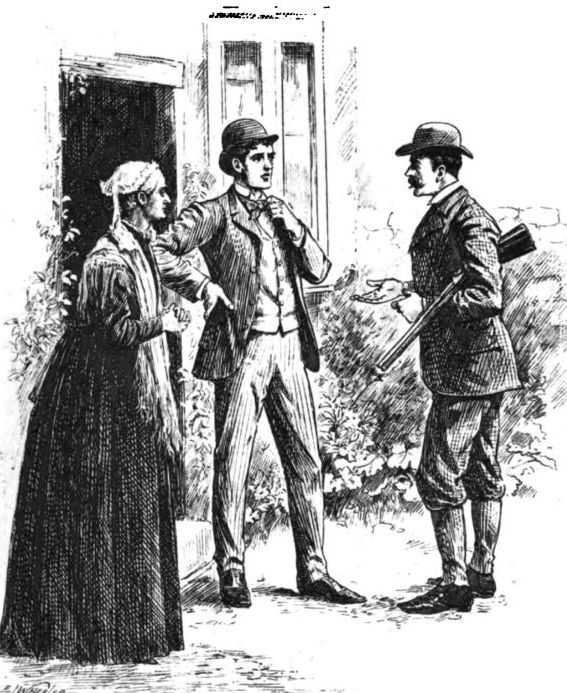
CHAPTER XLVI. “THE BAG NO. 18”
Almost overlooking the terraced garden where Damer and Tony dined, and where they sat smoking till a late hour of the night, stood a large palace, whose vast proportions and spacious entrance, as well as an emblazoned shield over the door, proclaimed it to belong to the Government. It was the Ministry of Foreign Affairs; and here, now, in a room projecting over the street beneath, and supported on arches, sat the Minister himself, with our two acquaintances, Mait-land and Caffarelli.
Maitland was still an invalid, and rested on a sofa, but he had recovered much of his former looks and manner, though he was dressed with less care than was his wont.
The Minister—a very tall thin man, stooped in the shoulders, and with a quantity of almost white gray hair streaming on his neck and shoulders—walked continually up and down the room, commenting and questioning at times, as Maitland read forth from a mass of documents which littered the table, and with which Caffarelli supplied him, breaking the seals and tearing open the envelopes before he gave them to his hand.
Though Maitland read with ease, there was yet that half-hesitation in the choice of a word, as he went on, that showed he was translating; and indeed once or twice the Prince-Minister stopped to ask if he had rightly imparted all the intended force to a particular expression.
A white canvas bag, marked “F. O., No. 18,” lay on the table; and it was of that same bag and its possible fortunes two others, not fully one hundred yards off, were then talking: so is it that in life we are often so near to, and so remote from, the inanimate object around which our thoughts and hopes, and sometimes our very destinies, revolve.
“I am afraid,” said the Prince, at last, “that we have got nothing here but the formal despatches, of which Ludolf has sent us copies already. Are there no 'Private and Confidential'?”
“Yes, here is one for Sir Joseph Trevor himself,” said Caffarelli, handing a square-shaped letter to Maitland. Maitland glanced hurriedly over it, and muttered: “London gossip, Craddock's divorce case, the partridge-shooting,—ah, here it is! 'I suppose you are right about the expedition, but say nothing of it in the despatches. We shall be called on one of these days for a blue-book, and very blue we should look, if it were seen that amidst our wise counsels to Caraffa we were secretly aware of what G. was preparing.'”
“It must be 'C. was preparing,'” broke in Caraffa; “it means Cavour.”
“No; he speaks of Garibaldi,” said Maitland.
“Garibaldi!” cried Caraffa, laughing. “And are there still gobemouches in England who believe in the Filibuster?”
“I believe in him, for one,” said Maitland, fiercely, for the phrase irritated him; “and I say, too, that such a Filibuster on our side would be worth thirty thousand of those great hulking grenadiers you passed in review this morning.”
“Don't tell the King so when you wait on him to-morrow, that's all!” said the Minister, with a sneering smile.
“Read on,” broke in Caffarelli, who was not at all sure what the discussion might lead to.
“Perhaps, too, you would class Count Cavour amongst these gobemouches,” said Maitland, angrily; “for he is also a believer in Garibaldi.”
“We can resume this conversation at Caserta to-morrow before his Majesty,” said Caraffa, with the same mocking smile; “pray, now, let me hear the remainder of that despatch.”
“'It is not easy to say,'” read he aloud from the letter, “'what France intends or wishes. C. says—'”
“Who is C.?” asked Caraffa, hastily.
“C. means Cowley, probably,—'that the Emperor would not willingly see Piedmontese troops at Naples; nor is he prepared to witness a new map of the Peninsula. We, of course, will do nothing either way—'”
“Read that again,” broke in Caraffa.
“'We, of course, will do nothing either way; but that resolve is not to prevent your tendering counsel with a high hand, all the more since the events which the next few months will develop will all of them seem of our provoking, and part and parcel of a matured and long meditated policy.'”
“Bentssimo!” cried the minister, rubbing his hands in delight. “If we reform, it is the Whigs have reformed us. If we fall, it is the Whigs have crushed us.”
“'Caraffa, we are told,'” continued Maitland, “'sees the danger, but is outvoted by the Queen-Dowager's party in the Cabinet,—not to say that, from his great intimacy with Pietri, many think him more of a Muratist than a Bourbon.'”
“Per Bacco! when your countryman tries to be acute, there is nothing too hazardous for his imagination; so, then, I am a French spy!”
“'What you say of the army,'” read on Maitland, “'is confirmed by our other reports. Very few of the line regiments will be faithful to the monarchy, and even some of the artillery will go over. As to the fleet, Martin tells me they have not three seaworthy ships in the fifty-seven they reckon, nor six captains who would undertake a longer voyage than Palermo. Their only three-decker was afraid to return a salute to the “Pasha,” lest her old thirty-two-pounders should explode; and this is pretty much the case with the monarchy,—the first shock must shake it, even though it only come of blank cartridge.
“'While events are preparing, renew all your remonstrances; press upon Caraffa the number of untried prisoners, and the horrid condition of the prisons. Ask, of course in a friendly way, when are these abuses to cease? Say that great hopes of amelioration—speak generally—were conceived here on the accession of the new King, and throw in our regrets that the liberty of the press with us will occasionally lead to strictures whose severities we deplore, without being able to arraign their justice; and lastly, declare our readiness to meet any commercial exchanges that might promise mutual advantage. This will suggest the belief that we are not in any way cognizant of Cavour's projects. In fact, I will know nothing of them, and hold myself prepared, if questioned in the House, to have had no other information than is supplied by the newspapers. Who is Maitland? None of the Maitlands here can tell me.'” This sentence he read out ere he knew it, and almost crushed the paper when he had finished in his passion.
“Go on,” said Caraffa, as the other ceased to read aloud, while his eyes ran over the lines,—“go on.”
“It is of no moment, or, at least, its interest is purely personal. His Lordship recommends that I should be bought over, but still left in intimate relations with your Excellency.”
“And I see no possible objection to the plan.”
“Don't you, sir?” cried Maitland, fiercely; “then I do. Some little honor is certainly needed to leaven the rottenness that reeks around us.”
“Caro Signor Conte,” said the Prince, in an insinuating voice, but of which insincerity was the strong characteristic, “do not be angry with my Ultramontane morality. I was not reared on the virtuous benches of a British Parliament; but if there is anything more in that letter, let me hear it.”
“There is only a warning not to see the Count of Syracuse, nor any of his party, who are evidently waiting to see which horse is to win. Ah, and here is a word for your address, Carlo! 'If Caffarelli be the man we saw last season here, I should say, Do not make advances to him; he is a ruined gambler, and trusted by no party. Lady C————believes in him, but none else!'”
This last paragraph set them all a-laughing, nor did any seem to enjoy it more than Caffarelli himself.
“One thing is clear,” said Caraffa, at last,—“England wishes us every imaginable calamity, but is not going to charge herself with any part of the cost of our ruin. France has only so much of good-will towards us as is inspired by her dislike of Piedmont, and she will wait and watch events. Now, if Bosco be only true to his word, and can give us a 'good account' of his treatment of Garibaldi, I think all will go well.”
“When was Garibaldi to set out?” asked Caffarelli.
“Brizzi, but he is seldom correct, said the 18th.”
“That Irish fellow of ours, Maitland, is positive it will be by the 13th at latest. By the way, when I asked him how I could reward this last piece of service he rendered us in securing these despatches, his reply was, 'I want the cordon of St. Januarius.' I, of course, remonstrated, and explained that there were certain requisites as to birth and family, certain guarantees as to nobility of blood, certain requirements of fortune. He stopped me abruptly, and said, 'I can satisfy them all; and if there be any delay in according my demand, I shall make it in person to his Majesty.'”
“Well,” cried Caffarelli,—“well, and what followed?”
“I yielded,” said the Prince, with one of his peculiar smiles. “We are in such a perilous predicament that we can't afford the enmity of such a consummate rascal; and then, who knows but he may be the last knight of the order!” In the deep depression of the last words was apparent their true sincerity, but he rallied hastily, and said, “I have sent the fellow to Bosco with despatches, and said that he may be usefully employed as a spy, for he is hand-and-glove with all the Garibaldians. Surely he must have uncommon good luck if he escapes a bullet from one side or the other.”
“He told me yesterday,” said Caffarelli, “that he would not leave Naples till his Majesty passed the Irish Legion in review, and addressed them some words of loyal compliment.”
“Why did n't he tell you,” said the Prince, sarcastically, “that seventy of the scoundrels have taken service with Garibaldi, some hundreds have gone to the hills as brigands, and Castel d'Ovo has got the remainder; and it takes fifteen hundred foot and a brigade of artillery to watch them?”
“Did you hear this, Maitland?” cried Caffarelli; “do you hear what his Excellency says of your pleasant countrymen?”
Maitland looked up from a letter that he was deeply engaged in, and so blank and vacant was his stare that Caffarelli repeated what the Minister had just said. “I don't think you are minding what I say. Have you heard me, Maitland?”
“Yes; no—that is, my thoughts were on something that I was reading here.”
“Is it of interest to us?” asked Caraffa.
“None whatever. It was a private letter which got into my hands open, and I had read some lines before I was well aware. It has no bearing on politics, however;” and, crushing up the note, he placed it in his pocket, and then, as if recalling his mind to the affairs before him, said: “The King himself must go to Sicily. It is no time to palter. The personal daring of Victor Emmanuel is the bone and sinew of the Piedmontese movement. Let us show the North that the South is her equal in everything.”
“I should rather that it was from you the advice came than from me,” said Caraffa, with a grin. “I am not in the position to proffer it.”
“If I were Prince Caraffa, I should do so, assuredly.”
“You would not, Maitland,” said the other, calmly. “You would not, and for this simple reason, that you would see that, even if accepted, the counsel would be fruitless. If it were to the Queen, indeed—”
“Yes, per Bacco!” broke in Caffarelli, “there is not a gentleman in the kingdom would not spring into the saddle at such a call.”
“Then why not unfold this standard?” asked Maitland. “Why not make one effort to make the monarchy popular?”
“Don't you know enough of Naples,” said Caraffa, “to know that the cause of the noble can never be the cause of the people; and that to throw the throne for defence on the men of birth is to lose the 'men of the street'?”
He paused, and with an expression of intense hate on his face, and a hissing passionate tone in his voice, continued, “It required all the consummate skill of that great man, Count Cavour, to weld the two classes together, and even he could not elevate the populace; so that nothing was left to him but to degrade the noble.”
“I think, meanwhile, we are losing precious time,” said Maitland, as he took up his hat “Bosco should be reinforced. The squadron, too, should be strengthened to meet the Sardinian fleet; for we have sure intelligence that they mean to cover Garibaldi's landing; Persano avows it.”
“All the better if they do,” said Caraffa. “The same act which would proclaim their own treachery would deliver into our hands this hare-brained adventurer.”
“Your Excellency may have him longer in your hands than you care for,” said Maitland, with a saucy smile. The Prince bowed a cold acknowledgment of the speech, and suffered them to retire without a word.
“It is fated, I believe,” said Caffarelli, as they gained the street, “that the Prince and you are never to separate without anger; and you are wrong, Maitland. There is no man stands so high in the King's favor.”
“What care I for that, Carlo mio? the whole thing has ceased to interest me. I joined the cause without any love for it; the more nearly I saw its working, the more I despised myself for acting with such associates; and if I hold to it now, it is because it is so certain to fail. Ay, my friend, it is another Bourbon bowled over. The age had got sick of vested interests, and wanted to show what abuses they were; but you and I are bound to stand fast; we cannot rescue the victim, but we must follow the hearse.”
“How low and depressed you are to-night! What has come over you?”
“I have had a heavy blow, mio Carlo. One of those papers whose envelopes you broke and handed to me was a private letter. It was from Alice Trafford to her brother; and the sight of my own name in it tempted me to see what she said of me. My curiosity has paid its price.” He paused for some minutes, and then continued: “She wrote to refuse the villa I had offered her,—to refuse it peremptorily. She added: 'The story of your friend's duel is more public than you seem to know. It appeared in the “Patrie” three weeks ago, and was partly extracted by “Galignani.” The provocation given was an open declaration that Mr. Maitland was no Maitland at all, but the illegitimate son of a well-known actress, called Brancaleone, the father unknown. This outrage led to a meeting, and the consequences you know of. The whole story has this much of authenticity, that it was given to the world with the name of the other principal, who signs himself Milo M'Caskey, Lieut.-Col. in the service of Naples, Count, and Commander of various orders.' She adds,” continued Maitland, in a shaken voice, and an effort, but yet a poor one, to smile,—“she adds: 'I own I am sorry for him. All his great qualities and cultivation seemed to suit and dignify station; but now that I know his condition to have been a mere assumption, the man himself and his talents are only a mockery,—only a mockery!' Hard words these, Carlo, very hard words!
“And then she says: 'If I had only known him as a passing acquaintance, and thought of him with the same indifference one bestows on such,-perhaps I would not now insist so peremptorily as I do on our ceasing to know him; but I will own to you, Mark, that he did interest me greatly. He had, or seemed to have,'—this, that, and t' other,” said he, with an ill-tempered haste, and went on. “'But now, as he stands before me, with a borrowed name and a mock rank—' There is half a page more of the same trash; for this gentle lady is a mistress of fierce words, and not over-merciful, and she ends thus: 'I think, if you are adroit, you can show him, in declining his proffered civility, that we had strong reasons for our refusal, and that it would be unpleasant to renew our former acquaintance.' In fact, Carlo, she means to cut me. This woman, whose hand I had held in mine while I declared my love, and who, while she listened to me, showed no touch of displeasure, affects now to resent the accident of my birth, and treat me as an impostor! I am half sorry that letter has not reached its destination; ay, and, strange as you will think it, I am more than half tempted to write and tell her that I have read it The story of the stolen despatch will soon be a newspaper scandal, and it would impart marvellous interest to her reading it when she heard that her own 'private and confidential' was captured in the same net.”
“You could not own to such an act, Maitland.”
“No. If it should not lead to something further; but I do yearn to repay her. She is a haughty adversary, and well worth a vengeance.”
“What becomes of your fine maxim, 'Never quarrel with a woman,' Maitland?”
“When I uttered it, I had never loved one,” muttered he; and they walked on now in silence.
Almost within earshot—so close, indeed, that had they not been conversing in Italian, some of their words must have been overheard by those behind—walked two other friends, Darner and Tony, in close confab.
“I most telegraph F. O,” said Skeffy, “that bag is missing, and that Messenger Butler has gone home to make his report Do you hear me?”
A grunt was the reply.
“I 'll give you a letter to Howard Pendleton, and he 'll tell what is the best thing to be done.”
“I suspect I know it already,” muttered Tony.
“If you could only persuade my Lord to listen to you, and tell him the story as you told it to me, he 'd be more than a Secretary of State if he could stand it.”
“I have no great desire to be laughed at, Skeffy.”
“Not if it got you out of a serious scrape,—a scrape that may cost you your appointment?”
“Not even at that price.”
“I can't understand that; it is quite beyond me. They might put me into 'Joe Miller' to-morrow, if they 'd only gazette me Secretary of Embassy the day after. But here's the hotel; a good sleep will set you all right; and let me see you at breakfast as jolly as you used to be.”
CHAPTER XLVII. ADRIFT
The dawn was scarcely breaking as Tony Butler awoke and set off to visit the ships in the port whose flags proclaimed them English. There were full thirty, of various sizes and rigs; but though many were deficient in hands, no skipper seemed disposed to accept a young fellow who, if he was stalwart and well grown, so palpably pertained to a class to which hard work and coarse usage were strangers.
“You ain't anything of a cook, are you?” asked one of the very few who did not reject his demand at once.
“No,” said he, smiling.
“Them hands of yours might do something in the caboose, but they ain't much like reefing and clewing topsails. Won't suit me.” And, thus discouraged, he went on from one craft to the other, surprised and mortified to discover that one of the resources he had often pictured to his mind in the hours of despondency was just as remote, just as much above him, as any of the various callings his friends had set before him.
“Not able to be even a sailor! Not fit to serve before the mast! Well, perhaps I can carry a musket; but for that I must return to England.”
He fell to thinking of this new scheme, but without any of that hope that had so often colored his projects. He owed the service a grudge. His father had not been fairly treated in it So, at least, from his very childhood, had his mother taught him to believe, and, in consequence, vehemently opposed all his plans to obtain a commission. Hard necessity, however, left no room for mere scruples; something he must do, and that something was narrowed to the one single career of a soldier.
He was practical enough in a certain sense, and he soon resolved on his line of action; he would reserve just so much as would carry him back to England, and remit the remainder of what he had to his mother.
This would amount to nigh eighty pounds,—a very considerable sum to one whose life was as inexpensive as hers. The real difficulty was how to reconcile her to the thought of his fallen condition, and the hardships she would inevitably associate in her mind with his future life. “Ain't I lucky,” cried he in his bitterness, and trying to make it seem like a consolation,—“ain't I lucky, that, except my poor dear mother, I have not one other in the whole world to care what comes to me,—none other to console, none other before whom I need plead or excuse myself! My failure or my disgrace are not to spread a widecast sorrow. They will only darken one fireside, and one figure in the corner of it.”
His heart was full of Alice all the while, but he was too proud to utter her name even to himself. To have made a resolve, however, seemed to rally his courage again; and when the boatman asked him where he should go next, he was so far away in his thoughts that he had some difficulty to remember what he had been actually engaged in.
“Whereto?”
“Well, I can't well tell you,” said he, laughing. “Isn't that schooner English,—that one getting underway yonder? Shove me aboard of her.”
“She's outward bound, sir.”
“No matter, if they 'll agree to take me,” muttered he to himself.
The craft was “hauling short” on the anchor as Tony came alongside and learned that she was about to sail for Leghorn, having failed in obtaining a freight at Naples; and as by an accident one of the crew had been left on shore, the skipper was too willing to take Tony so far, though looking, as he remarked, far more like a swell landsman than an ordinary seaman.
Once outside the bay, and bowling along with a smart breeze and a calm sea, the rushing water making pleasant music at the bow, while the helm left a long white track some feet down beneath the surface, Tony felt, what so many others have felt, the glorious elation of being at sea. How many a care “blue water” can assuage, how many a sorrow is made bearable by the fresh breeze that strains the cordage, and the laughing waves we cleave through so fast!
A few very eventful days, in which Tony's life passed less like reality than a mere dream, brought them to Leghorn; and the skipper, who had taken a sort of rough liking to the “Swell,” as he still called him, offered to take him on to Liverpool, if he were willing to enter himself regularly on the ship's books as one of the crew.
“I am quite ready,” said Tony, who thought by the time the brief voyage was completed he should have picked up enough of the practice and the look of a sailor to obtain another employment easily.
Accompanied by the skipper, he soon found himself in the consul's office, crowded with sailors and other maritime folk, busily engaged in preferring complaints or making excuses, or as eagerly asking for relief against this or that exaction on the part of the foreign government.
The consul sat smoking his cigar with a friend at a window, little heeding the turmoil around, but leaving the charge of the various difficulties to his clerks, who only referred to him on some special occasions.
“Here's a man, sir,” cried one of the clerks, “who wishes to be entered in the ship's books under an assumed name. I have told him it can't be done.”
“Why does he ask it? Is he a runaway convict?” asked the consul.
“Not exactly,” said Tony, laughing; “but as I have not been brought up before the mast, and I have a few relatives who might not like to hear of me in that station—”
“A scamp, I take,” broke in the consul, “who, having done his worst on shore, takes to the sea for a refuge?”
“Partly right,—partly wrong,” was the dry answer.
“Well, my smart fellow, there 's no help for it. You must give your name and your birthplace; and if they should prove false ones, take any consequences that might result.”
“What sort of consequences might these be?” asked Tony, calmly; and the consul, having either spoken without any distinct knowledge attached to his words, or provoked by the pertinacity of the question, half irritably answered: “I 've no time to throw away in discussing casualties; give your name or go your way.”
“Yes, yes,” murmured the skipper. “Who knows anything about you down here?—Just sign the sheet and let's be moving.”
The sort of good-humored tone and look that went with the words decided Tony, and he took the pen and wrote “Tony Butler, Ireland.”
The consul glanced at the writing, and said, “What part of Ireland? Name a town or a village.”
“I cannot; my father was a soldier, quartered in various places, and I 'm not sure in what part of the island I was born.”
“Tony Butler means Anthony Butler, I suppose?”
“Tony Butler!” cried the consul's friend, suddenly starting up, and coming forward; “did you say your name was Tony Butler?”
“Yes; that is my name.”
“And are you from the North of Ireland,—near the Causeway?”
Tony nodded, while a flush of shame at the recognition covered his face.
“And do you know Dr. Stewart, the Presbyterian minister in that neighborhood?”
“I should think so. The Burnside, where he lives, is not above a mile from us.”
“That's it,—the Burnside,—that's the name of it. I'm as glad as fifty pounds in my pocket to see you, Mr. Butler,” cried he, grasping Tony's hand in both his own. “There 's not a man from this to England I 'd as soon have met as yourself. I 'm Sam M'Grader, Robert M'Grader's brother. You have n't forgot him, I hope?”
“That I haven't,” cried Tony, warmly returning the honest pressure of the other's hand. “What a stupid dog I have been not to remember that you lived here! and I have a letter for you, too, from your brother!”
“I want no letter of introduction with you, Mr. Butler; come home with me. You 're not going to sea this time;” and, taking a pen, he drew a broad line of ink across Tony's name; and then turning, he whispered a few words in the consul's ear.
“I hope,” said the consul, “Mr. Butler is not offended at the freedom with which I commented on him.”
“Not in the least,” said Tony, laughing. “I thought at the time, if you knew me you would not have liked to have suggested my having been a runaway convict; and now that you do know me, the shame you feel is more than enough to punish you.”
“What could have induced you to go before the mast, Mr. Butler?” said M'Gruder, as he led Tony away.
“Sheer necessity. I wanted to earn my bread.”
“But you had got something,—some place or other?”
“I was a messenger, but I lost my despatches, and was ashamed to go home and say so.”
“Will you stop with me? Will you be a clerk?” asked the other; and a certain timidity in his voice showed that he was not quite assured as he spoke. “My business is like my brother's,—we 're 'in rags.'”.
“And so should I be in a few days,” laughed out Tony, “if I had n't met you. I 'll be your clerk, with a heart and a half,—that is, if I be capable; only don't give me anything where money enters, and as little writing as possible, and no arithmetic, if you can help it.”
“That will be a strange sort of clerkship,” said M'Gruder, with a smile; “but we 'll see what can be done.”
CHAPTER XLVIII. “IN RAGS”
If Tony Butler's success in his new career only depended on his zeal, he would have been a model clerk. Never did any one address himself to a new undertaking with a stronger resolution to comprehend all its details, and conquer all its difficulties. First of all, he desired to show his gratitude to the good fellow who had helped him; and secondly, he was eager to prove, if proven it could be, that he was not utterly incapable of earning his bread, nor one of those hopeless creatures who are doomed from their birth to be a burden to others.
So long as his occupation led him out of doors, conveying orders here and directions there, he got on pretty well. He soon picked up a sort of Italian of his own, intelligible enough to those accustomed to it; and as he was alert, active, and untiring, he looked, at least, a most valuable assistant. Whenever it came to indoor work and the pen, his heart sank within him; he knew that his hour of trial had come, and he had no strength to meet it. He would mistake the letter-book for the ledger or the day-book; and he would make entries in one which should have been in the other, and then, worst of all, erase them, or append an explanation of his blunder that would fill half a page with inscrutable blottedness.
As to payments, he jotted them down anywhere, and in his anxiety to compose confidential letters with due care, he would usually make three or four rough drafts of the matter, quite sufficient to impart the contents to the rest of the office.
Sam M'Gruder bore nobly up under these trials. He sometimes laughed at the mistakes, did his best to remedy,—never rebuked them. At last, as he saw that poor Tony's difficulties, instead of diminishing, only increased with time, inasmuch as his despair of himself led him into deeper embarrassments, M'Gruder determined Tony should be entirely employed in journeys and excursions here and there through the country,—an occupation, it is but fair to own, invented to afford him employment, rather than necessitated by any demands of the business. Not that Tony had the vaguest suspicion of this. Indeed, he wrote to his mother a letter filled with an account of his active and useful labors. Proud was he at last to say that he was no longer eating the bread of idleness. “I am up before dawn, mother, and very often have nothing to eat but a mess of Indian corn steeped in oil, not unlike what Sir Arthur used to fatten the bullocks with, the whole livelong day; and sometimes I have to visit places there are no roads to; nearly all the villages are on the tops of the mountains; but, by good luck, I am never beat by a long walk, and I do my forty miles a day without minding it.
“If I could only forget the past, dearest mother, or think it nothing but a dream, I 'd never quarrel with the life I am now leading; for I have plenty of open air, mountain walking, abundance of time to myself, and rough fellows to deal with, that amuse me; but when I am tramping along with my cigar in my mouth, I can't help thinking of long ago,—of the rides at sunset on the sands, and all the hopes and fancies I used to bring home with me, after them. Well! it is over now,—just as much done for as if the time had never been at all; and I suppose, after a while, I 'll learn to bear it better, and think, as you often told me, that 'all things are for the best.'
“I feel my own condition more painfully when I come, back here, and have to sit a whole evening listening to Sam M'Gruder talking about Dolly Stewart and the plans about their marriage. The poor fellow is so full of it all that even the important intelligence I have for him he won't hear, but will say, 'Another time, Tony, another time,—let us chat about Dolly.' One thing I 'll swear to, she 'll have the honestest fellow for her husband that ever stepped, and tell her I said so. Sam would take it very kindly of you if you could get Dolly to agree to their being married in March.
“It is the only time he can manage a trip to England,—not but, as he says, whatever time Dolly consents to shall be his time.
“He shows me her letters sometimes, and though he is half wild with delight at them, I tell you frankly, mother, they would n't satisfy me if I was her lover. She writes more like a creature that was resigned to a hard lot, than one that was about to marry a man she loved. Sam, however, does n't seem to take this view of her, and so much the better.
“There was one thing in your last letter that puzzled me, and puzzles me still. Why did Dolly ask if I was likely to remain here? The way you put it makes me think that she was deferring the marriage till such time as I was gone. If I really believed this to be the case, I'd go away tomorrow, though I don't know well where to, or what for, but it is hard to understand, since I always thought that Dolly liked me, as certainly I ever did, and still do, her.
“Try and clear up this for me in your next. I suppose it was by way of what is called 'sparing me,' you said nothing of the Lyles in your last, but I saw in the 'Morning Post' all about the departure for the Continent, intending to reside some years in Italy.
“And that is more than I 'd do if I owned Lyle Abbey, and had eighteen blood-horses in my stable, and a clipper cutter in the Bay of Curryglass. I suppose the truth is, people never do know when they're well off.”
The moral reflection, not arrived at so easily or so rapidly as the reader can imagine, concluded Tony's letter, to which in due time came a long answer from his mother. With the home gossip we shall not burden the reader, nor shall we ask of him to go through the short summary—four close pages—of the doctor's discourses on the text, “I would ye were hot or cold,” two sensations that certainly the mere sight of the exposition occasioned to Tony. We limit ourselves to the words of the postscript.
“I cannot understand Dolly at all, and I am afraid to mislead you as to what you ask. My impression is—but mind, it is mere impression—she has grown somewhat out of her old friendship for you. Some stories possibly have represented you in a wrong light, and I half think you may be right, and that she would be less averse to the marriage if she knew you were not to be in the house with them. It was, indeed, only this morning the doctor said, 'Young married folk should aye learn each other's failings without bystanders to observe them,'—a significant hint I thought I would write to you by this post.”
When Tony received his epistle, he was seated in his own room, leisurely engaged in deciphering a paragraph in an Italian newspaper, descriptive of Garibaldi's departure from a little bay near Genoa to his Sicilian expedition.
Nothing short of a letter from his mother could have withdrawn his attention from a description so full of intense interest to him; and partly, indeed, from this cause, and partly from the hard labor of rendering the foreign language, the details stuck in his mind during all the time he was reading his mother's words.
“So that 's the secret, is it?” muttered he. “Dolly wishes to be alone with her husband,—natural enough; and I'm not the man to oppose it. I hope she'll be happy, poor girl; and I hope Garibaldi will beat the Neapolitans. I 'm sure Sam is worthy of a good wife; but I don't know whether these Sicilian fellows deserve a better government. At all events, my course is clear,—here I mustn't stay. Sam does not know that I am the obstacle to his marriage; but I know it, and that is enough. I wonder would Garibaldi take me as a volunteer? There cannot be much choice at such a time. I suppose he enrolls whoever offers; and they must be mostly fellows of my own sort,—useless dogs, that are only fit to give and take hard knocks.”
He hesitated long whether he should tell Sam M'Gruder of his project; he well knew all the opposition he should meet, and how stoutly his friend would set himself against a plan so fatal to all habits of patient industry. “And yet,” muttered Tony to himself, “I don't like to tell him that I hate 'rags,' and detest the whole business. It would be so ungrateful of me. I could say my mother wanted to see me in Ireland; but I never told him a lie, and I can't bear that our parting should be sealed with a falsehood.”
As he pondered, he took out his pistols and examined them carefully; and, poising one neatly in his hand, he raised it, as marksmen sometimes will do, to take an imaginary aim. As he did so, M'Gruder entered, and cried out, laughing, “Is he covered,—is he dead?”
Tony laid down the weapon, with a flush of shame, and said, “After all, M'Gruder, the pistol is more natural to me than the pen; and it was just what I was going to confess to you.”
“You 're not going to take to the highways, though?”
“Something not very unlike it; I mean to go and have a turn with Garibaldi.”
“Why, what do you know about Garibaldi or his cause?”
“Perhaps not a great deal; but I've been spelling out these newspapers every night, and one thing is clear, whether he has right or wrong on his side, the heavy odds are all against him. He's going in to fight regular troops, with a few hundred trampers. Now I call that very plucky.”
“So do I; but courage may go on to rashness, and become folly.”
“Well, I feel as if a little rashness will do me a deal of good. I am too well off here,—too easy,—too much cared for. Life asks no effort, and I make none; and if I go on a little longer, I 'll be capable of none.”
“I see,” said the other, laughing, “Rags do not rouse your ambition, Tony.”
“I don't know what would,—that is, I don't think I have any ambition now;” and there was a touch of sorrow in the last word that gave all the force to what he said.
“At all events, you are tired of this sort of thing,” said the other, good-humoredly, “and it's not to be much wondered at. You began life at what my father used to call 'the wrong end.' You started on the sunny side of the road, Tony, and it is precious hard to cross over into the shade afterwards.”
“You 're right there, M'Gruder. I led the jolliest life that ever man did till I was upwards of twenty; but I don't believe I ever knew how glorious it was till it was over; but I must n't think of that now. See! this is what I mean to do. You 'll find some way to send that safely to my mother. There's forty-odd pounds in it, and I 'd rather it was not lost I have kept enough to buy a good rifle—a heavy Swiss one, if I can find it—and a sword-bayonet, and with these I am fully equipped.”
“Come, come, Tony, I'll not hear of this; that you are well weary of the life you lead here is not hard to see, nor any blame to you either, old fellow. One must be brought up to Rags, like everything else, and you were not. But my brother writes me about starting an American agency,—what do you say to going over to New York?”
“What a good fellow you are!” cried Tony, staring at him till his eyes began to grow clouded with tears; “what a good fellow! you 'd risk your ship just to give me a turn at the tiller! But it must n't be,—it cannot be; I 'm bent on this scheme of mine,—I have determined on it.”
“Since when? since last night?”
“Well, it's not very long, certainly, since I made up my mind.”
The other smiled. Tony saw it, and went on: “I know what you mean. You are of old Stewart's opinion. When he heard me once say I had made up my mind, he said, 'It does n't take long to make up a small parcel;' but every fellow, more or less, knows what he can and what he cannot do. Now I cannot be orderly, exact, and punctual,—even the little brains I have I can't be sure of keeping them on the matter before me; but I defy a horse to throw me; I 'll bring you up a crown-piece out of six fathoms water, if it 's clear; I'll kill four swallows out of six with a ball; and though these are not gifts to earn one's bread by, the man that has them need n't starve.”
“If I thought that you had really reflected well over this plan,—given it all the thought and consideration it required—”
“I have given it just as much consideration as if I took five weeks to it. A man may take an evening over a pint of ale, but it's only a pint, after all,—don't you see that?”
M'Gruder was puzzled; perhaps there was some force in the illustration. Tony looked certainly as if he thought he had said a clever thing.
“Well, Tony,” said the other, after a moment of grave thought, “you 'll have to go to Genoa to embark, I suppose?”
“Yes; the committee sits at Genoa, and every one who enrolls must appear before them.”
“You could walk there in four days.”
“Yes; but I can steam it in one.”
“Ay, true enough; what I mean to ask of you is this, that you will go the whole way on foot; a good walker as you are won't think much of that; and in these four days, as you travel along,—all alone,—you 'll have plenty of time to think over your project. If by the time you reach Genoa you like it as well as ever, I 've no more to say; but if—and mark me, Tony, you must be honest with your own heart—if you really have your doubts and your misgivings; if you feel that for your poor mother's sake—”
“There, there! I've thought of all that,” cried Tony, hurriedly. “I 'll make the journey on foot, as you say you wish it, but don't open the thing to any more discussion. If I relent, I 'll come back. There's my hand on it!”
“Tony, it gives me a sad heart to part with you;” and he turned away, and stole out of the room.
“Now, I believe it's all done,” said Tony, after he had packed his knapsack, and stored by in his trunk what he intended to leave behind him. There were a few things there, too, that had their own memories! There was the green silk cap, with its gold tassel, Alice had given him on his last steeple-chase. Ah, how it brought back the leap—a bold leap it was—into the winning field, and Alice, as she stood up and waved her handkerchief as he passed! There was a glove of hers; she had thrown it down sportively on the sands, and dared him to take it up in full career of his horse; he remembered they had a quarrel because he claimed the glove as a prize, and refused to restore it to her. There was an evening after that in which she would not speak to him. He had carried a heavy heart home with him that night! What a fund of love the heart must be capable of feeling for a living, sentient thing, when we see how it can cling to some object inanimate and irresponsive. “I'll take that glove with me,” muttered Tony to himself; “it owes me some good luck; who knows but it may pay me yet?”
CHAPTER XLIX. MET AND PARTED
Tony went on his way early next morning, stealing off ere it was yet light, for he hated leave-takings, and felt that they weighed upon him for many a mile of a journey. There was enough on the road he travelled to have interested and amused him, but his heart was too full of its own cares, and his mind too deep in its own plans, to dispose him to such pleasures, and so he passed through little villages on craggy eminences and quaint old towers on mountain-tops, scarcely observing them. Even Pisa, with its world-known Tower, and the gem-like Baptistery beside it, scarce attracted notice from him, though he muttered as he passed, “Perhaps on some happier day I 'll be able to come back here and admire it” And so onward he plodded through the grand old ruined Massa and the silent Sarzana, whose palaces display the quarterings of old crusading knights, with many an emblem of the Holy War; and by the beauteous Bay of Spezia he went, not stopping to see poor Shelley's home, and the terrace where his midnight steps had almost worn a track. The road now led through the declining ridges of the Apennines, gorgeous in color,—such color as art would have scarce dared to counterfeit, so emerald the dark green of the waving pines, so silver-like the olive, so gloriously purple the great cliffs of porphyry; and then through many a riven cleft, through feathery foliage and broad-leaved fig-trees, down many a fathom low the sea!—the blue Mediterranean, so blue as to seem another sky of deeper meaning than the one above it.
He noticed little of all these; he felt none of them! It was now the third day of his journey, and though he had scarcely uttered a word, and been deeply intent on his own fate, all that his thinking had done was to lead, as it were, into some boundless prairie, and there desert him.
“I suppose,” muttered he to himself, “I am one of those creatures that must never presume to plan anything, but take each day's life as I find it. And I could do this. Ay, I could do it manfully, too, if I were not carrying along with me memories of long ago. It is Alice, the thought of Alice, that dashes the present with a contrast to the past, and makes all I now attempt so poor and valueless.”
As the road descends from Borghetto, there is a sudden bend, from which, through a deep cleft, the little beach and village of Levanto are seen hundreds of feet beneath, but yet in that clear still atmosphere so near that not only the white foam of the breaking wave could be seen, but its rhythm-like plash heard as it broke upon the beach. For the first time since he set out had the charm of scenery attracted him, and, descending a few feet from the road, he reached a large square rock, from which he could command the whole view for miles on every side.
He took out his bread and cheese and a melon he had bought that morning, and disposed himself to eat his dinner. He had often partaken of a more sumptuous meal, but never had he eaten with so glorious a prospect at his feet.
A little lateen-sailed boat stole out from beneath the olives and gained the sea; and as Tony watched her, he thought if he would only have been a fisherman there, and Alice his wife, how little he could have envied all that the world has of wealth and honors and ambitions. His friend Skeffy could not do this, but he could. He was strong of limb and stout of heart; he could bear hardships and cold; and it would be so fine to think that, born gentleman as he was, he never flinched from the hardest toil, or repined at the roughest fare, he and Alice treasuring up their secret, and hoarding it as a miser hoards his gold.
Ay, down there, in that little gorge, with the pine-wood behind and the sea before, he could have passed his life, with never a longing thought for the great world and its prizes. As he ran on thus in fancy, he never heard the sound of footsteps on the road above, nor noticed the voices of persons talking.
At last he heard, not the words, but the tone of the speakers, and recognized them to be English. There is that peculiar sound in English utterance that at once distinguishes it from all other speech; and Tony, quite forgetting that his high-peaked Calabrian hat and massive beard made him far more like an Italian brigand than a British gentleman, not wishing to be observed, never turned his head to look at them. At last one said, “The little fishing-village below there must be Levante. John Murray tells us that this is the land of the fan palm and the cactus, so that at length we are in Italy.”
“Do you know—shall I confess it,” said the other, “that I am not thinking of the view, beautiful as it is? I am envying that peasant with his delicious melon on the rock there. I am half tempted to ask him to share it with me.”
“Ask him, by all means,” said the first speaker, laughing.
“You are jesting,” replied the other, “but I am in sober earnest. I can resist no longer. Do you, however, wait here, or the carriage may pass on and leave us behind.”
Tony heard nothing of these words; but he heard the light footsteps, and he heard the rustle of a woman's dress as she forced her way, through bramble and underwood, till at last, with that consciousness so mysterious, he felt there was some one standing close behind him. Half vexed to think that his isolation should be invaded, he drew his hat deeper over his eyes, and sat steadfastly gazing on the sea below him.
“Is that Levante I see beneath that cliff?” asked she, in Italian,—less to satisfy her curiosity than to attract fris attention.
Tony started. How intensely had his brain been charged with thoughts of long ago, that every word that met his ears should seem impregnated with these memories! A half-sulky “Si” was, however, his only rejoinder.
“What a fine melon you have there, my friend!” said she; and now her voice thrilled through him so strangely that he sprang to his feet and turned to face her. “Is my brain tricking me?—are my senses wandering?” muttered he to himself. “Alice, Alice!”
“Yes, Tony,” cried she. “Who ever heard of so strange a meeting? How came you here? Speak, or I shall be as incredulous as yourself!” But Tony could not utter a word, but stood overwhelmed with wonder, silently gazing on her.
“Speak to me, Tony,” said she, in her soft winning voice,—“speak to me; tell me by what curious fortune you came here. Let us sit down on this bank; our carriage is toiling up the hill, and will not be here for some time.”