
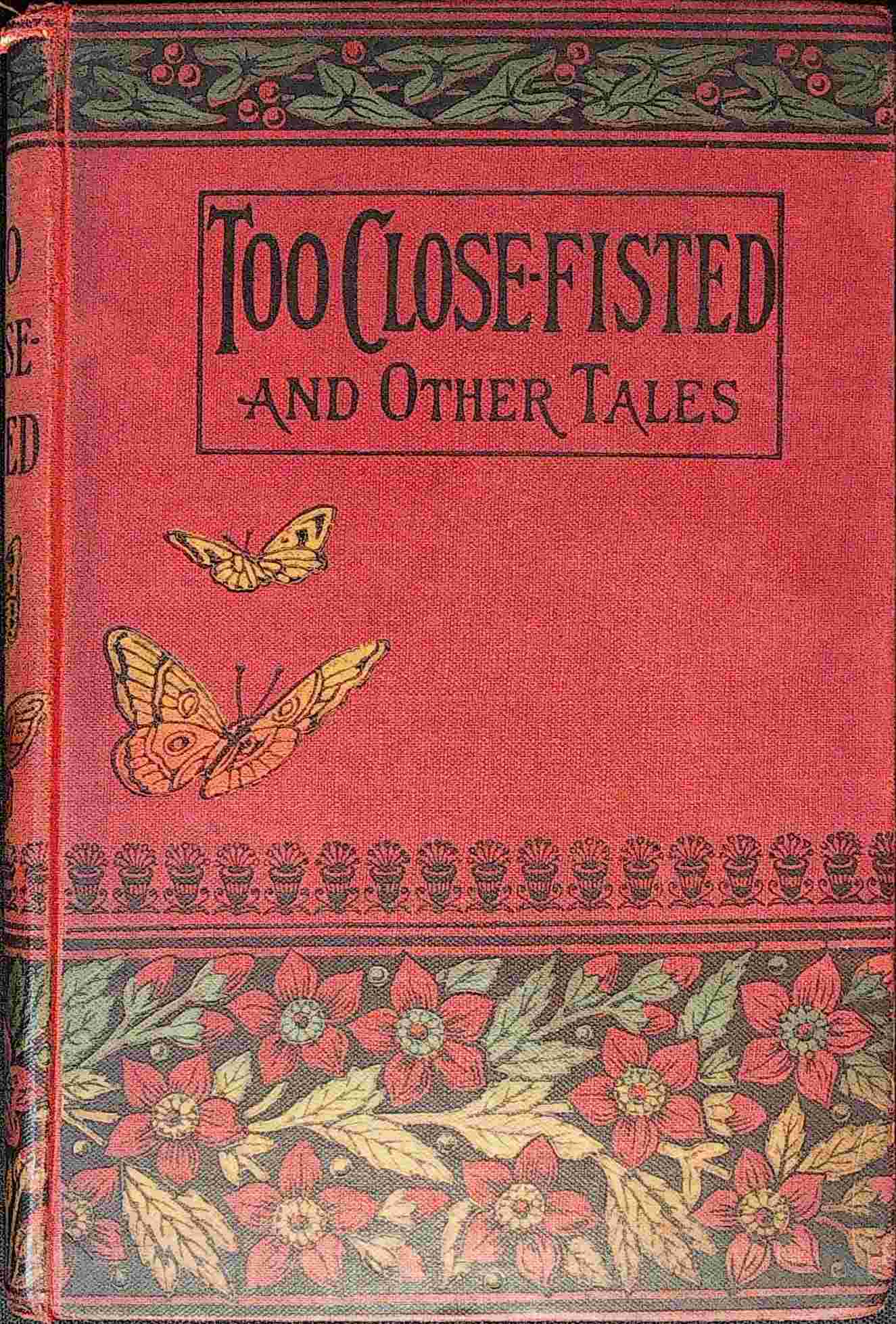
The Project Gutenberg eBook of Too close fisted, and other stories
Title: Too close fisted, and other stories
Author: Ruth Lamb
Release date: May 22, 2023 [eBook #70836]
Language: English
Original publication: United Kingdom: The Religious Tract Society, 1886
Transcriber's note: Unusual and inconsistent spelling is as printed.
MR. BURTON COULD HARDLY BEAR TO PART WITH HER.
TOO CLOSE FISTED,
And Other Stories.
BY RUTH LAMB,
AUTHOR OF
"THE LONGEST WAY ROUND FOR THE SHORTEST," ETC.
THE RELIGIOUS TRACT SOCIETY
56, PATERNOSTER ROW; 65, ST. PAUL'S CHURCHYARD;
AND 164, PICCADILLY.
CONTENTS.
CHAPTER II. MISTAKEN KINDNESS.
CHAPTER III. NEW ARRIVALS AT "THE NEST."
CHAPTER I. THE BEST KIND OF HELP.
CHAPTER II. LEARNING WISE LESSONS.
NOTHING BEATS TRYING BUT DOING.
TOO CLOSE FISTED.
CHAPTER I.
LOOKS AND WAYS.
"MR. BURTON and Mr. James are not a bit like brothers. They are as different as dark and light. Folks do say that you never find two alike in a family, however many there may be."
Mr. Duff, the baker, was very fond of talking about his neighbours, and he liked his listeners to say they agreed with him. He had a great opinion of himself, and could hardly understand that his customer, kind-hearted Mrs. Brown, could possibly have any decided ideas of her own which differed from those he thought fit to express.
If she had! Well, Mr. Duff would have said she was to be pitied; for, like most individuals who are constantly sitting in judgment on their neighbours, he felt quite certain that he was right, and whoever thought otherwise was in the wrong.
Mrs. Brown's reply was irritating. "I always think Mr. Burton and Mr. James favour one another in looks."
"Tut, tut! Looks are not of much account. People's ways are more than faces. It was their ways I was thinking of, Mrs. Brown."
"But you mentioned looks too, and it was looks I spoke about. As to ways, they are very unlike one another."
"Ay, you have it right this time. Mr. Burton is the elder brother with large means. Mr. James is the younger with far less means, though he must have a tidy income too. See how Mr. Burton uses his. Lives in such a quiet way, keeps very little company, and what he has of a sort most gentlemen wouldn't mind about. He cannot spend a quarter of his income. I say it isn't right. A man that has money ought to spend it for the good of his neighbours and to encourage business. That's what I say. His money is a talent, and it was never given him to hide away and do no good with."
"Perhaps he may have a reason for living quietly. All gentlemen do not care for great parties and a deal of show," replied Mrs. Brown. "Very likely he gives—"
Mr. Duff had not patience to hear the rest. With a look of pity for Mrs. Brown, and scorn at the idea of Mr. Burton's imaginary generosity, he exclaimed: "He give away his money! Not he, indeed. He's too close fisted for that; and it is his love of money that makes him hoard what it is his Christian duty to spend."
Mr. Duff brought his hand down on the counter with such a thump, that he made little Mrs. Brown start and colour, as she said, "Dear, how you startled me! I'm a little bit out of sorts, through losing my night's rest, and a trifle puts me about."
The baker apologised, and hoped there was nobody ill at Mrs. Brown's.
"It's only baby that is restless o' nights just now. She's about her teeth," she replied.
"I get so angry when I think of the good that man might do with his money, that I'm afraid I forget myself," said Mr. Duff. "Now I'll just give you a sample of those two gentlemen, and it was only yesterday I witnessed the whole affair. Mr. Burton was coming along in his steady, plodding way, never so much as giving a 'good-day' to anybody, when old Ann Willis hobbled towards him and asked him for a copper. He shook his head at the poor old body and went on his way.
"Just after, Mr. James came by, and old Ann never looked at him. I suppose she thought, if the rich brother had nothing to spare, the poorer one was certain not to have a penny handy. Would you believe it? Mr. James did not want to be asked, but he out with a sixpence and gave it to Ann, with as pleasant a look as I ever wish to see."
"And I dare say she took it straight to the public-house," replied Mrs. Brown, who seemed fated to take what Mr. Duff would have called "the shine" out of his remarks concerning the brothers Burton.
"That might be. Old Ann was certainly the worse for drink last night. But that doesn't say that Mr. James was not kind and generous in giving her the sixpence. She's dreadfully poor, you know."
"And I'm afraid she always will be," sighed little Mrs. Brown, without, however, saying hard words about the unfortunate woman's bad habit.
"Then there was Dick Pearson. He met Mr. James just opposite my door, but that was in the evening. He had been working at the Hall, and was on his way home. He touched his cap to Mr. James and got a pleasant, 'Good-evening, Dick. Done your work for to-day? Here's the value of a glass of beer for you. I'll be bound you got none at the Hall.'"
"That was how Mr. James spoke to him, and dropped the money for a pint into Dick's hand. Now, isn't he a generous, free-handed gentleman?"
Again Mrs. Brown gave no direct answer, but asked, "What did Dick say? Did he take the money?"
"He was going to say something, but Mr. James did not give him a chance. He just dropped the coppers into his hand, and, with a little nod to Dick, was off and out of sight round the corner without another word. He wanted no thanks, you see."
"Dick would not drink the money," said Mrs. Brown, in a tone of conviction. "He has more sense than to be enticed in that way. I dare say if Mr. James would have listened to him, Dick could have said that if Mr. Burton gave no beer at the Hall, he gave what was better. I know my husband was working up there, and they were not bound to give him anything but his bare wages, though it is the custom, and more's the pity, to send them a jug of beer now and again! Well, my Tom wants no allowance, because he doesn't drink, and those that like it got none from Mr. Burton. But more than once they were called into the kitchen, and a comfortable cup of hot coffee, with meat and bread, put before them, which did them good, for the weather was cold. When the job was finished Mr. Burton said to the men, 'I dare say you wonder that I have given you no allowance whilst you have been here, and I have my reason for it. There are some teetotallers among you, and those do not want beer. There are some drinking men among you, and I do not want to be the means of starting them on the wrong road. The gift of a glass of beer or spirits is often a present that costs him who gets it the price of many more. Sometimes it costs him his work or his place, doesn't it, my men?' They said, 'Yes, sir,' and there were those among them who hung down their heads, for the words went home, seeing the thing had happened to themselves. 'Well,' said Mr. Burton, 'I reckon that drink-giving is bad for those that like it and bad for those that don't. It leads the weak ones astray, and unless it is made up to the sober workers in some other way it puts a premium on drink. Now, you men have all worked heartily and satisfied me, so I shall divide amongst you the money I might have spent in beer for the drinkers, with a little extra, to show that I am satisfied. Only let it go to the wives, if you please.' Now, I don't call that being close fisted, Mr. Duff," continued Mrs. Brown, in her quiet way, "and I dare say Dick Pearson could tell you the same sort of tale."
The baker could not withstand such evidence, but he liked Mrs. Brown's words no better for being equally true and reasonable. He felt angry at the little woman for having proved him in the wrong, but she was a good customer, and he did not wish to offend her.
"Speak well of the bridge that carries you safe over the river," said he. "You are right to speak of Mr. Burton as you have found him. But, after all, what was a little present to a lot of workmen once in a way? I was talking of his general close fistedness. There's no mistake about this. Mr. Burton has much and spends little. He doesn't live up to his means and circulate his money as he should do. He may give a few shillings amongst a lot of workpeople, but what of that? See what he has left. I can't bear those close fisted folks. Give me a pleasant, free-spoken gentleman like Mr. James, that does not want to be asked to do a kindness."
Mrs. Brown had no time to waste in talk. Her articles were now ready and packed into the large square basket, for which two of her boys were to call on the way from school. But as she gave a civil "good-day" to Mr. Duff, and stepped into the street, she saw Mr. Burton passing the shop.
The baker saw him too, and wondered if by chance the gentleman had heard his loud-toned remarks, uttered as he followed his customer to the door. He looked disconcerted, and shrank back into his shop, whilst little Mrs. Brown, having the memory of no hard judgments on her conscience, dropped a respectful courtesy, and received a pleasant greeting from the owner of the Hall. As she walked briskly homeward she thought to herself, "Mr. James may be free-handed, as Duff says, and he may give so as to make a great show with very little money; for, after all, it was only a matter of ninepence that he gave to old Ann Willis and Dick Pearson. As to the sixpence, he might as well have thrown it into the gutter as given it to the poor old creature, who would be safe to spend it so as to do herself harm. Mr. James knows what she is. Dick Pearson is a bit proud in his way, and though Duff might think it generous of Mr. James to give him money for a pint of beer, I believe Dick would have sooner he had let it alone. Mr. Burton gives in a sensible way, both to do good and to please those he helps, and he makes no fuss about it. Duff may say what he likes, but he would never persuade me that he is one of the selfish sort, though I have only little things to go by."
Certain familiar words came into Mrs. Brown's mind as she went on her way, "When thou doest alms let not thy left hand know what thy right hand doeth."
Maybe neither of the brothers' little gifts could be called almsgiving; but, thought Mrs. Brown, "They show the spirit of the two gentlemen. One is for letting all the world see if he gives a copper; the other cares that his gifts shall be such as his Father which is in heaven will approve of."
Mrs. Brown was right. The one brother desired the good opinion of men, the other to act as in the sight of God.
CHAPTER II.
MISTAKEN KINDNESS.
CHRISTMAS was drawing near. Only a fortnight off. Winter had begun early, the ground was hard with frost, and a bitter north-east wind was making itself felt through every crevice. Old folk and little children shrank before it and cowered by the hearths, where, alas! in many a home both fire and food were scarce.
Strong men faced the cutting blast, and wandered many a mile in search of work, only to come back disappointed, footsore, weary in body and faint in heart. Wives met them at the threshold, and needed not to ask, "How have you fared?" They saw and read in their husbands' faces a tale of strength spent in vain and hope disappointed. And, poor things! many amongst them strove to smile a welcome, in spite of heavy hearts and sad forebodings. Such went hungry themselves in order to spread something like a meal for the tired wayfarer, whose only longing was for work, which he could not get, and the chance to win with his strong, willing hands, bread for wife and children.
"It will be a hard winter in-doors and out. God help us," were words uttered by many a tongue, and the thought was in many a heart that did not give it utterance, for fear of distressing still more those who were already sad enough at the prospect before them.
And yet, whilst there was so much that was sorrowful in many a poor home, it might have made angels rejoice to see the little acts of kindness that the inmates showed one to another. Little, if looked at apart from their surroundings. Great, when one saw what they cost to the self-devoting souls who out of their penury ministered to those who were in bitterer straits than themselves. The best morsel would be taken from the lips for a neighbour's sick child; a share of a scanty meal given, where the cupboard in some other poor home was quite empty, and kindly words and deeds were never lacking.
Only God knew what some apparently small gifts cost to those who bestowed them, but how sweet to think that Our Father does know all things, even the very thoughts of our hearts!
There were many sufferers at Halesford, the little country town where Mr. Duff dispensed his loaves and his opinions to all comers alike. There were not so many customers passing in and out as in more prosperous times, and some of those who entered the shop came empty-handed to ask for credit until better times.
Mr. Duff rarely refused this. Halesford working men were none of your runagates, here to-day and gone to-morrow, but mostly steady-going folk, who spent their lives within a narrow circle and knew little of the world beyond. Duff was a man of some capital, and not unkindly in the main. He was rather proud of being able to give credit, and would say, "I can afford to wait for my money, so long as I know who I am trusting."
Many of the customers had to wait for their loaves too, whilst Duff held forth on his favourite subjects. One of these was the absence of Mr. Burton.
The owner of Halesford Hall had been from home for some weeks. "Called to furrin parts, they say, by urgent business. Very convenient at a time like this, when he could not well be amongst all this distress without putting his hand in his pocket," said Mr. Duff, bitterly. "It's a shame, a burning shame, that the biggest landowner in the neighbourhood should keep out of the way, at the time of all others when he should be doing his duty to his neighbours. I can only give a little, but I can trust you folks that want a bit o' credit, and I hope those in the meat and grocery lines will do the same."
Mr. James Burton was at home. His house was a small one in comparison with the Hall, but, if report said truly, it abounded in creature comforts.
"Mine is a little nutshell of a place," Mr. James would say in his airy fashion, "but big enough to hold an old bachelor and his few traps. 'Man wants but little here below,' you know, Mr. Duff. The 'dry morsel,' the 'dinner of herbs' and quietness are better than the 'stalled ox' under certain circumstances."
Mr. James Burton looked meaningly, and nodded as if he would express volumes by the movement of his head, and Mr. Duff felt gratified at what sounded to him like a confidential remark.
He could not quite see the drift of Mr. James's words, though he was, as the baker subsequently put it, "quoting Scripture like a parson."
Everybody who knew Mr. James was sure that "a dry morsel and a dinner of herbs" would be the last meal he would be likely to relish; for, if ever a man loved everything of the best, both for home and person, he was the one.
"And why not? I should like to know," said Mr. Duff. "Money is made round so as it may run. Isn't it better to keep it going than to lay it by where it does good to nobody? I know what Mr. James meant. The 'dinner of herbs' is just his comfortable little place where everything is as bright as a button, and the 'stalled ox' is like, in a way, to Halesford Hall with the master away, the money increasing and the servants on board wages and saving out of 'em. 'Like master like man.' They spend precious little."
Beside airing his opinions in converse with the baker and others, Mr. James Burton continued to distribute small coin broad-cast.
"Poor fellow!" he would say, as he dropped sixpence into the hand of a labourer out of work, "I wish I could give you any help worth having. But I am a small man with small means, and can only deal in trifles. If I were placed as some people are, I could do differently."
And then Mr. James would look towards the Hall, thus giving people to understand how differently he would act were he its master, and at the same moment bestow a penny on some little curly head that crossed his path, bidding her run to Mr. Duff's for a bun.
No wonder the baker sang the praises of Mr. James, and was surprised that Mrs. Brown did not agree with him in so doing.
The little woman was better off than many of her neighbours. She and her husband had been industrious, striving folks, and had started their married life with "something at their backs." They owned the cottage in which they lived and some six acres of land. These had been bequeathed to Mrs. Brown by the uncle who took her an orphan girl to keep house for him, after the death of her parents. Her husband went out to work when employment was to be had, and Mrs. Brown had her cows, which found her enough to do in addition to her household affairs.
So, when most of the neighbours were suffering, the Browns were not only far above want, but ready with warm hearts and open hands to help those who were less fortunate than themselves.
Mrs. Brown felt a little impatient when, standing once more at Mr. Duff's counter, she had to listen to his praises of generous Mr. James.
"I don't see as you do, Mr. Duff," she answered, with more decision than usual. "It seems to me that Mr. James's way of giving costs him very little. You may make a big show in sixpences and pence out of five shillings, when you take care to give every halfpenny in the streets and the market places and with all eyes upon you. Mr. James does not stint himself. He has fine out o' season fruit and vegetables sent all the way from London, and anybody knows what such-like things cost. He looks very pleasant and he talks in that humble way, as if he were boasting of being poor. But he talks like a poor man and spends on himself like a rich one."
"'Better spend than hoard,' is my motto, Mrs. Brown, and I stick to it. Maybe Mr. James might show more judgment in his spendings and his givings, but your generous people are generally just a trifle thoughtless. It's their nature so to be."
At this moment another customer entered the shop. She was pale and trembling and seemed to be terribly shocked at something.
Mr. Duff was struck with her appearance, and gave her a chair to sit down on.
"I am afraid you are ill," he said. "You look as if you had seen a ghost."
"I've seen worse," replied the woman, when she had recovered herself a little. "You knew old Ann Willis?"
The baker and Mrs. Brown assented, and the former added, "Who did not know her that knew Halesford? What is amiss with her?"
"She's dead," replied the woman, solemnly.
"Dead! Why she was here only yesterday afternoon, and standing by this very counter, Mr. James Burton gave her a shilling. He said, 'You want something to make you comfortable, Ann, this bitter weather; so here's an extra sixpence for you this time.'"
"Ay, and no doubt that shilling has been the death of her. She left the 'Black Swan' sadly the worse for drink at about eight o'clock, to go home to that miserable hut of hers, where there was not a soul to expect her, or to look for her, if she did not come. You know the short cut by the field corner where you have to cross a little bridge. Ann mostly went home that way, to save a few steps: and last night, having more than she could carry, she must have missed her footing and fallen from the bridge."
"Well! She could not drown, for the beck has been frozen hard for the last ten days," said Mr. Duff.
"No, but her head struck on the ice, and the blow knocked all the bit of sense out of her that drink had left. If she ever came to herself, she would have little chance of getting out of the bed of the stream without help, for the banks are very straight up near the bridge, but those that found her thought she had never moved after her head struck the ice."
The speaker's face was full of horror, and tears were streaming down little Mrs. Brown's cheeks as she heard the sad tale.
"How dreadful!" she exclaimed. "To think of falling down helpless and senseless, with nobody near to save or to hear if she had been able to cry for assistance. To die there, all alone. And so unfit to die. Poor old Ann! I have grieved for her many a time when she was living, but I am most sorry for her now."
Mr. Duff's looks expressed the shock the news had given him. And only just before he had been praising Mr. James Burton for his generosity to this unfortunate old woman.
"She never could resist the drink whilst she had a penny in her pocket," said the woman who had brought the news. "It's an awful curse to some folks; and those that don't feel it a temptation cannot tell what a blessing they have to thank God for. Shame on those that put it into poor old Ann's power to stupefy herself with what could do her no good. If, instead of giving her money, they had done as you have done many a time, Mrs. Brown, called her in to have a comfortable meal, or sent her nice bits by the children, or a bundle of sticks to light her fire with, that would have been showing her real kindness. It seems to me that in putting money into her hand they gave her the means of killing herself by inches. I should lay the old woman's death at the door of whoever did it yesterday."
"Come, come, Mrs. Preston, that is going a little too far," said the baker. "Nobody could foresee that old Ann would fall from the bridge. Besides, no doubt Mr. James Burton meant to be kind when he made his little presents to Ann. I think she died from the cold and the fall, not from anything she had taken."
"But the fall and the cold were caused by the drink, and she could not have had the drink but for Mr. James, and such as he who would say, 'Poor old creature! she wants something to warm and comfort her.' Comfort! I pray that I and mine may always be kept from seeking comfort in such a way. The sight of that poor dead face and the lifeless body frozen all on a heap, as one may say, will be a warning to me while I live."
"You saw her, then, and that was what turned you white and faint?" said Mrs. Brown.
"Ay, and I should like to forget that picture," replied Mrs. Preston. "Well, you have nothing to reproach yourself with," added the woman, turning to Mrs. Brown. "You were her real friend, as you have been to many besides, and may God reward you."
Good Mrs. Brown blushed at words of praise, which came straight from her neighbour's heart. She had no desire that attention should be called to her quiet good-doing, and shrank from its being made public. But it was perhaps by examining her own motives and manner of helping others according to her means, that Mrs. Brown had learned to estimate the givings of Mr. Burton and Mr. James at something like their right value.
CHAPTER III.
NEW ARRIVALS AT "THE NEST."
ANN WILLIS'S terrible death caused great excitement in the quite little town, and all the miserable details in connection with it were repeated from house to house. It served to turn the people's minds from their own troubles for the moment, but the inquest was quickly succeeded by a pauper's funeral, which, however, had a large following, and then nearer anxieties drove old Ann out of mind.
It was known that the coroner had spoken sharply about those who had supplied her with drink until she was unable to take care of herself. The bridge was broad and firm, with a stout hand-rail and barrier at one side. The merest child, the weakest old lady, might have crossed it safely by day or night, and when Ann Willis fell from it the full moon was shining brightly overhead. But she had been allowed to drink herself blind and helpless, and then been turned out, as it were, to die. So Halesford people expressed a hope that Binns at the Black Swan would get his licence marked for it, and whispered amongst themselves that Mr. James had been to blame, though he might mean to be kind.
This was a fortnight before Christmas and still the frost held; the men were idle and their families were straitened for bread.
Next, Halesford folk were startled with the news that Mr. James Burton was gone away and no one knew when he would return. Mr. Duff was, as usual, ready with a reason for his departure.
"Mr. James was terribly cut up about old Ann," he said, "and it grieved him to hear of so much distress. If I had but a fall purse, or even one half full,' says he to me, 'I would stay and help while I had a sixpence left. But I have neither, Duff, and I must go away for a while. I cannot stop to see trouble which I am powerless to remove.' He borrowed a shilling from me to give to a poor woman that came begging into the shop, and he went away with his handkerchief to his eyes. He is a very feeling gentleman. I'm afraid he was often imposed on, but he means well, and he has a good heart at the bottom."
Scarcely, however, had Mr. James taken his departure when a couple of strangers came and dismantled the pretty little house hitherto occupied by him, and carried away the whole of its contents. As they had been seen in communication with Lawyer Smart, it was plain they knew what they were about, so the neighbours could only wonder and gaze inquiringly at the closed shutters of the empty house.
It seemed as if Mr. James might be gone for good, but, though he might set up housekeeping elsewhere, he would certainly come to the Hall, from time to time, when Mr. Burton returned. Duff would not see his shilling back again at present, but there was comfort in remembering that the woman to whom it was given promptly exchanged it for bread, which diminished the possible loss.
But the baker and others besides him blamed Mr. Burton more than they did his brother for keeping away from Halesford during these hard times.
"Mr. James said he would have helped us if he could. Mr. Burton might help us, if he would," were oft-repeated sayings. Then, when things seemed at the worst, relief came. The Rector of Halesford and the minister of its one place of worship, beside the gray old church, both received communications from some unknown friend, and food and warm clothing were soon forthcoming for the sustenance and comfort of all who were really in need. Relief was given wisely, for the two good men who were entrusted with the pleasant task well knew the circumstances and characters of those with whom they had to do. Joy and thankfulness took the place of heaviness and gloomy fears. The people thanked God for sending them this timely aid, and, grateful to the unknown, earthly benefactor, would fain have expressed their feelings to him also, but they were kept in ignorance of his name.
Of course, Duff had decided opinions on the subject.
"I am confident that Mr. James is at the bottom of it. Seeing that he could not find money himself, he has stirred up some of his great friends in London to make a collection for Halesford poor. It was next best to giving, and one man cannot do everything," he said.
A few agreed with the baker, but their faith was rudely shaken by a report that Mr. James's furniture had been seized under a bill of sale, and that, if he had not gone away when he did, he might not have had the chance of going at all.
Little Mrs. Brown, whose bright, kind face told of the gladness in her heart, said she was sure that whoever had sent money for the suffering people had been moved to do it by Him without whose knowledge not a sparrow falls to the ground.
"We can thank God," she said, "and ask Him to bless the kind earthly friend who has been His instrument in sending plenty and comfort to poverty-stricken homes."
"You say 'We,'" replied one of her neighbours. "You have no call to join, because you wanted nothing, and have been able to do something for those that did."
"Well, then, haven't I more cause still to be thankful?" she answered. "And if I had not, I should have a poor, narrow, selfish spirit in me if I could not rejoice when good comes to my neighbours."
Truly the dear little woman realised that God's children are members one of another. She was as full of thankfulness as if she had been the most needy amongst those relieved, and she sent up her hymn of praise to God with heart and voice.
Christmas was a week nearer them when Mr. James turned his back on Halesford. To the astonishment of the inhabitants, large furniture vans were seen in front of "The Nest," as the pretty house, lately inhabited by him, was called. The vans looked like those into which Mr. James's household goods had lately been packed. Could they be the same conveyances bringing back the furniture?
Doubts were soon set at rest. Mr. Burton's steward set several women to work to prepare the rooms, and in an astonishingly short time the Nest had all its pretty furniture replaced. Except that it had a rather formal, unused look, and the smell of cigar smoke was entirely absent, it presented its old appearance.
There was a stir at the Hall too, which indicated that Mr. Burton must be coming to keep Christmas there, and Duff said it was just as well, for the big pew had been empty long enough on Sundays.
As Mr. James, when at Halesford, was supposed to share the pew with his brother, Duff did not compliment him by his allusion to its emptiness; perhaps he thought of the implied censure on his favourite, for he added, "I've often heard Mr. James say that people oughtn't to be judged merely by their church-going, and that he believed in a man both praying and doing good in secret, for which he had the Scripture to back him, you know."
It was very annoying, but Duff never could get over Mrs. Brown. The little woman listened on this occasion with her usual patience. But she shook her head when Duff paused, and, though she did not contradict him, she spoiled the effect of his speech by replying, "It is quite right and according to the Bible, that those who love God should like to get away, even from their nearest of kin, and in a quiet place open their whole hearts to Him. There are times when you cannot take wife or husband, child or friend along with you, except in your hearts and words. And Jesus Himself set the example of going away on to the mountain side, or the desert places, for prayer of this kind. But I never can believe that those who love to pray in secret will not love to pray in God's house also, and with His people. To use one blessed privilege and neglect another is like taking breakfast and leaving dinner. You'll not find a healthy, hungry stomach do that. Neither will you find the soul that has an appetite for heavenly things neglect to seek for food when it's there for the having."
Duff found it hard to answer Mrs. Brown. Besides, in his own mind, he was beginning to doubt whether he had after all formed a correct judgment of Mr. James Burton's character. But he had upheld him so long that it would be very humiliating to own that he was mistaken. It was certain that Mr. James had shown little reverence either for God's house or His day, and that he seldom spent the Sabbath as a season of refreshment for soul or body. On the contrary, there was certain to be bachelor visitors at the Nest, and the servants there were kept at work ministering to their many wants. They had complained of this state of things, standing before Mr. Duff's counter, and wished they were at the Hall, where servants had a chance of a quiet Sunday, instead of at the Nest.
The baker was not sorry that a little rush of customers prevented him from answering Mrs. Brown, especially as conscience told him that her sober judgment came nearer the truth than his own.
Halesford people looked for Mr. James back again. Christmas fell on the Wednesday that year, and on the Saturday evening the carriage from the Hall was at the station, doubtless to meet Mr. Burton.
He arrived, but not alone. He was accompanied by a lady, young and fair, though very sad and worn-looking, and a beautiful sunny-haired child, whose face bore a strong likeness to that of Mr. James. They drove straight to the Nest, where they all got out. Then the luggage-cart came up, and left the greater part of its contents there, before conveying the remainder to the Hall.
Some one overheard Mr. Burton say to the lady, "Welcome home, Agnes. I trust you will be very happy with your dear child. You will be quite safe here, and none can disturb or molest you. The servants are trustworthy, and personally known to me. And now, my dear sister, try to forget the sorrows of the past, and look forward hopefully to a brighter future."
The young lady could hardly speak her thanks, but she took Mr. Burton's hand in hers, and prayed that God would bless and reward him. And she lifted her little one, and bade the child kiss her uncle, which she did, clasping her chubby arms round his neck, and then patting his cheek in such a pretty truthful way that Mr. Burton seemed as if he could hardly bear to part with her.
He dined at the Nest, and then went home to the Hall, whilst Halesford folk, as was natural, were longing to know who these new arrivals might be, for Mr. Burton had no sister of his own, though he had been heard to call the lady by that name.
CHAPTER IV.
THE KING'S STAMP.
MR. BURTON, the lady, and child were all at church and in the same pew on Sunday morning. The pretty little one stood on the seat beside Mr. Burton and gazed soberly down at the large prayer book, whilst the psalms were being chanted, in imitation of the older people, though she could not read a letter. Sometimes she would nestle more closely to him, and turn to look up at his kind face, as if she were happy to feel his arm encircling her.
The sight of that trustful morsel of a child, clinging in a way to the gentleman who had for several years lived such a lonely life, brought tears to many eyes.
No secret was made about these newcomers. They were the wife and child of Mr. James Burton, whom he had kept hidden away in a poor home at a distance, under the pretence that he should lose his income if his brother were made acquainted with his marriage.
Bit by bit it came out that Mr. James's life had been a miserable sham. He had long ago spent his own handsome fortune in riotous living and gambling, and was terribly in debt, when he threw himself on his brother's mercy and asked for help. In the hope of inducing him to give up his evil ways, Mr. Burton had furnished the Nest for him, and allowed him a sufficient income to keep him in comfort, but on condition that he never touched a card, or gambled in any way for the future.
Mr. James was ready to promise anything, and professed to be very penitent, and willing to settle down quietly at Halesford. He did spend most of his time there, and was so smiling, pleasant-spoken, and free in giving trifling sums, that some people, Duff for one, were quite deceived by him.
All the while he was spending his ready money in the old way, going on credit for everything, though not at Halesford, but for luxuries not to be had in the little town, and he had even given a bill of sale on the furniture which was none of his, but had been put into the Nest, for his use only, by Mr. Burton.
The dear kind gentleman whom Duff and a few like him were fond of calling "close fisted" had been living quietly and on less than became his position, that he might pay off his brother's debts.
"For the sake of the old name, those who have trusted my brother shall be paid at any cost of denial to myself," said Mr. Burton; and he kept his word. Only he drew a line at gambling debts, and Mr. James found that nothing could move him from his determination not to pay one penny of what his brother called his "debts of honour."
"They are the most dishonourable debts any person can have," he said; "for if men win when they gamble, they most likely help to ruin their neighbours, and if they lose, to ruin themselves. In your case, James, having nothing of your own to lose, and having promised that you would never run the risk of incurring such debts again, they are doubly dishonourable, and I will not break my word, though you have broken yours."
So it seemed Mr. James managed to raise money on the furniture which was not his, and went right away out of the country. His poor wife was in sore straits, as he neither wrote nor sent her money, so at last she sent a letter to Mr. Burton. Then everything came out, and Mrs. James discovered that she had been deserted by a worthless, selfish husband, but had found a true friend and brother in Mr. Burton, who provided such a home for her as she had never had in her life before since she was quite a child.
Mr. Burton could have got the furniture of the Nest back again, at very little cost, for he had taken care to have proof that it was his own property. But he found that the person who had advanced the money upon it had been deceived and, believed that Mr. James had a right to dispose of it. The sum advanced was not very large; for Mr. James had been too anxious to get hold of it, and too much afraid of being found out, to make very good terms, so Mr. Burton gave the lender his own back again, and had the furniture replaced in the Nest.
It turned out that Mrs. James was the orphan daughter of an old friend of the family, and was earning her bread as governess, in a home where she was loved and respected, when Mr. James met with her again. He had known her as a child, and his pleasant ways and pretence of affection induced the young lady to become his wife.
Very likely, he did love her after his fashion, for there are a great many people who deceive themselves on such matters.
They call that "love" which induces them to win a good girl's heart and take her from a happy home where she is useful, and contented, when they have nothing half so good to give her—not even as true a heart in exchange. There often seems to be a very narrow step between what people call "love" and downright selfishness. Sometimes, indeed, there is no step at all, as in Mr. James's case, though most likely his poor young wife, much as she has suffered, does not blame him as he deserves.
It is a beautiful and blessed thing to think of, that the better and more unselfish a good woman is, the more unwilling she is to think evil of others, and especially of the man she calls husband, and who is the father of her children. No doubt Mrs. James Burton, who is a sweet Christian gentlewoman, if ever there was one, blames bad companions for having drawn her husband aside from the right way. She will hope and pray and teach her little one to lisp out a petition to "Our Father" for that other father who has given her so little of a parent's love, though it pleased him to see how pretty she was, and, during his rare visits, to make her a toy and a plaything. Well, who knows but some day the prayers will have an answer, and Mrs. James will see her husband a true penitent, and little Mabel have a father of whom she will not be ashamed?
We have to go on praying, trusting, hoping, waiting, and leave results and times to God.
Though Halesford people had to find out Mr. James's character by degrees, they knew before Christmas Day came who had been their friend in need. All who still required help were invited to go to the schools on Christmas Eve, but early in the morning, where they were met by Mr. Phillips, the rector, and Mr. Henderson, the minister of the chapel.
It was only needful to look at these two friends' faces to know that there was some pleasure in store, and so it proved. Neatly laid out on benches were rows of joints of excellent beef and piles of groceries—plums for to-morrow's pudding not being forgotten. The size of joint or parcel was determined by the number of mouths to be filled in each home. And there was a little sum of money in addition, to provide such odds and ends as fuel, vegetables, and matters that could not well be purchased for the people by the kind friend who had resolved that there should be plenty in every Halesford cottage on Christmas Day.
Whilst the things were being distributed one man cried out, "We should like to know who we have to thank for all these things? We do know that God has stirred his heart, whoever he may be; but we want you to tell us his name, though I fancy some of us have not been far wrong in a guess we have made."
Mr. Phillips smiled, and answered that if the people would wait a few minutes they would perhaps see him, for he was no stranger to Halesford.
Just then Mr. Burton's face appeared in the doorway, looking the picture of happiness, and the sight was greeted with such a shout of welcome that, if Mr. Phillips and Mr. Henderson had not fairly taken possession of him, he would have been ready to run away again.
The master of Halesford Hall was as modest as he was kind—and that is saying a great deal. The mere act of good-doing, and the knowledge that others were made happier and less anxious by what he was able to do for them, abundantly rewarded Mr. Burton.
There was a large congregation in the old church on Christmas Day morning, for at Halesford there was a custom which has not died out in many country places yet. Christian folk put aside for the time all religious differences, and met under the one roof to worship, and to take up with heart and voice the angels' song, "Glory to God in the highest, and on earth peace, goodwill towards men."
Duff was there, and so were little Mrs. Brown and her husband, the old mother who was spending Christmas with them, having undertaken to see to the cookery, assisted by the eldest girl.
Duff was feeling not a little ashamed of himself, and he even owned to Mrs. Brown that he had been mistaken in his judgment of Mr. Burton and his brother.
"You see," he said, "it is not always easy to tell the difference between real gold and plated articles; and sometimes the imitations are so fair on the outside that people are deceived by looks, and take them for solid metal. It is so with human beings too, and I am afraid we are only too ready to judge people by outsides as well as plate. I'm free to own that I gave Mr. James credit for the good that was not in him, and where the good actually was I could not see it. I do feel as if coals of fire had been heaped on my head when I think that I have had the order for all the flour and bread that has been given away."
There was not much merit in owning that he had been mistaken now that the truth was made plain to everybody. Still, even this acknowledgment was the first step in the right direction from Mr. Duff. He got an answer from Mrs. Brown which gave him food for thought, and, it is to be hoped, assisted him to form a more correct judgment in future.
"It is easy enough to tell real silver from plated, if you look at the marks," she said. "The silver always has the King's stamp on it, and I take it that the life of the true disciple of Jesus has his King's stamp on it too. The man who has taken his sins to Jesus and found peace through His precious cleansing blood, and who is under the influence of God's Holy Spirit, cannot help showing the marks and signs in his daily life. It is a pity that we are not as anxious to look for them, and as ready to discern them, as we might be. Any way, seeing it is so easy to make mistakes in judging our neighbours, it would be well for us to remember what Jesus said, 'Judge not that ye be not judged.'"
"I was wrong about Mr. Burton," replied Duff. "Even in the matter of old Ann Willis, I said hard things about him. I know now that he wished to be her real friend; and, whilst I blamed him for not putting temptation in her way, he was actually trying to persuade her to give up the bad habit that was her ruin, to leave the miserable hut she called 'home' and accept a comfortable one where she would be properly cared for. I've got a lesson," added the baker, "and now my eyes are opened, maybe I shall keep my mouth shut oftener than I have done. To think I should have called Mr. Burton 'close fisted!' I feel as if I could not forgive myself. Well, may God bless him, say I, to-day. And may the poor lady at the Nest and the pretty little one be the means of brightening the Hall for its master, till he brings a mistress to the big house itself. Here's 'a happy Christmas to them and to everybody,'" to which farewell words Mrs. Brown, now arrived at her own door, responded by a hearty "Amen."