
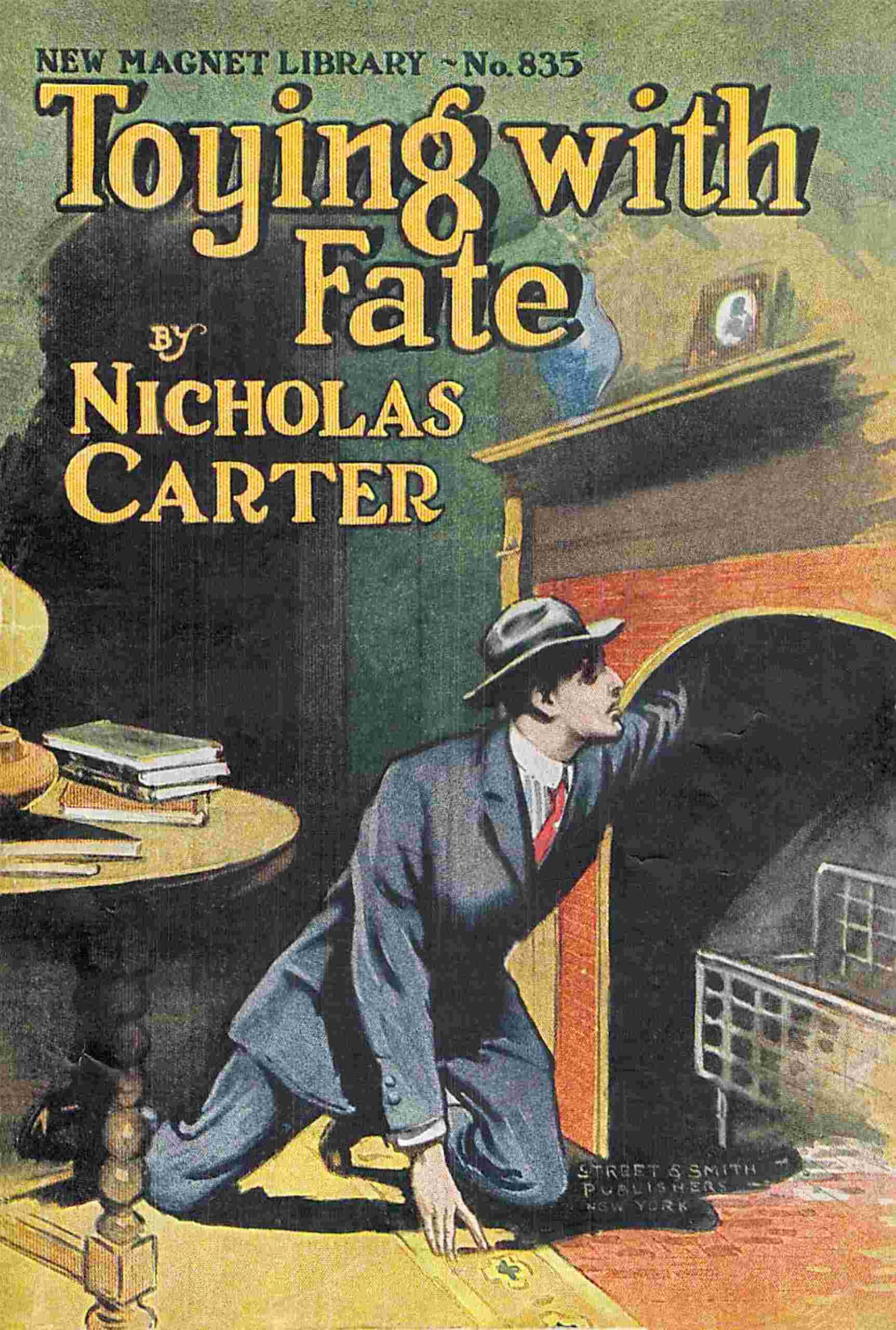
TOYING WITH FATE.
CHAPTER I.
THE MYSTERIOUS OLD MAN.
“Move on, old man, and go home!”
It was the stern voice of one of New York’s finest policemen that uttered these words.
“Home! I wonder where it is?” muttered the old man to whom the policeman had spoken, and a shudder ran through his frame, as he slowly moved down the street.
As he reached the corner near old St. John’s Church, on Varick Street, he paused, rubbed his eyes and gazed dreamily around him.
For some time before the policeman had addressed him he had been standing inside the church, looking through the railings into the churchyard.
His form was bent by decrepitude and sorrow, and his hair was as white as the flaky snow that clung to the steeple of the old church, the bells of which had just sounded the knell of the dying year.
The old man only halted on the corner for a minute, and then, crossing Beach Street, he shuffled along until he reached the center of the block, where he came to a standstill in front of an old-fashioned house, which was unoccupied.
Then, as if a faintness had come over him, he grasped the rusty iron railing to prevent himself falling to the ground, and he closed his eyes, as though the sight of the snow-covered houses was too much for him.
The policeman had followed him at a distance, and was watching him from where he was standing on the corner.
“Poor devil!” muttered the guardian of the peace, as he swung his nightstick back and forth. “I wonder who he is! He seems weak! Perhaps at one time he amounted to something. God save me from ever coming to his condition. I wonder why he stands so long in front of that old empty house, which has been closed for twenty years, to my knowledge! I’ll watch him a while, but I won’t molest him, poor devil!”
As the policeman concluded his soliloquy the old man straightened up and walked up to the door of the house, the old knocker on which he caught hold of and gave it a rap.
But suddenly, as if struck by some painful recollection, his hand fell to his side and he staggered back to the middle of the sidewalk.
“Strange,” the policeman ejaculated, noting this action. “Perhaps he lived there at one time.”
The old man looked up at the house, at which he gazed long and intently.
Then, suddenly arousing himself, he ambled back to the corner, stopping near the policeman. He looked confusedly around him, from the left to the right, and the policeman gazed at him closely, but spoke not a word. On his part, he did not seem to see the man in uniform. He stood bewildered, appearing not to know which way to turn.
“Why don’t you go home, old man?” the policeman asked, this time in a softened tone of voice.
“Home!” the old fellow ejaculated—his voice was like a wail, a heartbroken sob. “Home! where is it?”
“The Lord bless you, man, how can I tell you, if you can’t tell yourself?”
“Twenty years ago—twenty years behind darkened walls—and this——” He muttered the words in such a forlorn tone that the policeman stared at him.
“Your brain is turned, old gentleman.”
The old man laughed and looked up into his questioner’s face with a quizzical expression.
“My brain is clear, my friend,” he replied, in a clear, harsh tone. “I have come from a prison—the world is strangely altered since I was in it before.”
“In it before? Why, what do you mean? I suppose you will try and persuade me that you have been dead and have risen from the grave.”
“Figuratively speaking, I have—I have been dead to the world—in prison at Sing Sing. Mark me well—Sing Sing Prison—for twenty years—to-day I was released. See me now. I am old, decrepit, hardly able to walk. Once I stood erect, my hair was as black as the raven’s wing, and now—look at me, a wreck without home or friends. Wife, children, all gone! I have never seen nor heard of them since the day I was taken out of yonder house a prisoner, by the unjust, hard, and cruel decree of a so-called court of justice. Twenty years! A prisoner, buried alive, as it were.”
“You had committed a crime?”
“No. I was innocent, but powerful conspirators plotted against me—the evidence was perjured—and I—I—was entombed.”
“You say you lived in yonder house twenty years ago?”
“Yes, and no man carried his head higher than I did. I was rich—but bah! what is the use of rehearsing those things to a stranger! Hardened as you are by association with crime, you would not believe my story. You would think that I was romancing. Things have sadly changed in this neighborhood.”
“You may bet they have.”
“Once all these houses were occupied by rich people, but to-day they are the abodes of the poor and the outcast.”
“What is your name?”
“My name! It matters not. Good night.”
“Well, well, keep your secret, old man. God bless you, and may this new year bring you happiness.”
“Happiness! I shall never know that again. Good night, again.”
He moved off slowly, and the policeman watched him until he turned the corner into West Broadway, when he proceeded to patrol his beat.
As the policeman moved away, a dark form came out of a near-by doorway and hurried around the corner.
The man was tall, he wore a long ulster with the collar turned up around his neck, and a slouch hat was pulled down over his eyes. He followed closely in the old man’s trail.
The old man halted several times, and as he did so his form seemed to lose its decrepitude. As the light from the street lamps shone upon his face it could be seen that his eyes glared like two living coals; he threw his hand aloft, and so fierce and startling was the action that the man who was following him halted and shrank back for an instant, as if he had been struck.
“Vengeance!” the old man hissed, and then he started on again.
The street was deserted, save by the old man and the man who was following him.
The former walked on, looking up at the tall warehouses and store buildings, muttering to himself.
More than once he put his hand up to his head and gazed about in a bewildered manner.
His limbs shook under him, for a long time had passed since they had been used to such exertion.
The fresh air came so strangely upon him that he panted for breath.
Suddenly he halted in front of an old-fashioned three-story brick building near Chambers Street. A beacon-shaped red lamp was burning over the doorway, and upon the front pane of glass was painted:
THE RED DRAGON INN.
Established by William Sill—1776.
It was an old landmark in the neighborhood, and it had always been a hostelry. In revolutionary times it was a post roadhouse, and was famous as the headquarters of many of the British officers. During later days it became the resort, at the noonday hour, of many of New York’s most staid and solid merchants, whose places of business were in the vicinity.
At this time the ground floor was occupied by a man who ran a saloon and restaurant, and who rented out the upstairs rooms to transient lodgers. No improvements had been made about the place, and it stood just as it did when it was conducted by its original owner.
As the old man paused in front of the inn the sound of voices and the clinking of glasses came from within. He walked up to the door and opened it. Then he stepped into the saloon, staggered up to the bar and, in a low tone, ordered a glass of toddy, which was supplied to him.
A number of men were seated at the tables, drinking, and none of them paid any attention to the newcomer, who drank his toddy while standing and leaning against the bar.
The old man placed his empty glass back upon the counter, and facing the bartender, said:
“I want a room for the night.”
“There is only one empty,” the bartender replied. “It is in the attic.”
“That will answer my purpose.”
“It will cost you one dollar.”
The old man drew a purse out of his pocket, took out the amount, and handed it to the bartender, who asked:
“Do you want to retire now?”
“I do,” the old man answered.
“I will show you the way up.”
“It won’t be necessary. I am familiar with every room in the house. Many a time I have stopped here in other days. If you will tell me which room I am to occupy, I will go up to it.”
“The second room in the back part of the attic on the left of the stairway is the one. You will find a lamp on a table in the hall on the second floor.”
“All right.”
The old man left the room, while the bartender gazed after him with curiosity. He climbed the stairway and reached the second floor, where he found the lamp, and then proceeded upstairs to the attic room.
An hour after he retired, the house was silent, all the midnight revelers having gone home, and the bartender having closed up the saloon.
New Year’s Day dawned bright and clear.
The proprietor of the Red Dragon Inn opened the barroom, and at nine o’clock the bartender came downstairs.
For a time the two men stood talking.
There were no customers in the place.
At last the bartender asked the proprietor if he had seen anything of the strange old man who had come in after midnight.
The proprietor said that the old man had not appeared.
“Did he request you to call him?” he inquired.
“No,” the bartender answered. “Shall I go up and ask him if he wants breakfast?”
“Yes.”
The bartender ascended to the attic.
The door of the room which the old man had been assigned to stood ajar.
The man knocked, but there was no answer. He pounded again and shouted. Still no answer. Finally the man pushed the door open. A terrible sight met his gaze. Stretched out upon the bed he beheld the old man, with his throat cut from ear to ear. His hands were folded across his breast, and he was covered by the coverlet of the bed. Evidently there had been no struggle.
The bartender uttered a cry of alarm, but he did not enter the room.
As soon as he recovered from his surprise he dashed off downstairs, crying “Murder!” at the top of his voice.
Instantly the house was aroused, and in a short time a great crowd congregated in the street in front of the door.