
CHAPTER XXXI.
IN MOTHER FLINTSTONE’S DEN AGAIN.
The day following these exciting events George Richmond might have been seen bending over a manuscript in a small room some distance from Claude Lamont’s apartments.
He had been diligently at work upon the document for some hours, now and then refreshing himself from a bottle on the table.
The chirography was not his own.
It looked for all the world like the writing of an old person taken with the palsy, and the man at work smiled every now and then as he looked at his job.
“It’s good for the two hundred thousand,” said he, half aloud. “That was a cute bargain Claude made with the old nabob. I am to vanish, of course; but I’ll see that I don’t lose any of my share. I am to be killed off, and this paper is to fall into Lamont’s hands, to be consigned of course to the flames. He’ll probably consider it cheap at two hundred thousand, but I’ll take care that Claude doesn’t really carry out the bargain.”
The day had deepened into night, and still George Richmond worked.
He did not stop till the nearest clock struck eight, and then he finished his self-imposed task.
Once more, like a good accountant, he glanced over his pages and stuffed them into an old envelope prepared for the occasion.
“That settles it,” he remarked. “Now for the proof of my demise, ha, ha!”
He thrust the whole into his pocket and buttoned his coat over it.
After this he turned the gas low and filled the room with shadows, then pulled his soft hat over his forehead and left the house.
He did not know that he was seen to quit the place.
He was not aware of the fact that during the last part of his work a pair of foxlike eyes were watching him through a rent in the curtain, thanks to a broken slat in the shutter.
The owner of these eyes was on his trail.
It was a boy, shrewd and wiry, and he kept George Richmond in sight, no matter how many turns he made.
Mulberry Billy had not played spy upon this man for nothing.
While he could not see the writing, he felt that it was for no good, and thus he slipped after the man as he crossed one street after another, taking himself into a strange part of New York.
George Richmond visited a well-known cheap café on the Bowery and had a plain supper, after which, once more buttoning his coat to his chin, he sauntered out under the lights.
Billy was still his ferret.
The boy tracked the man to the house occupied at times by Claude Lamont.
He saw him mount the steps, but could not see beyond the door.
George Richmond entered the library and turned on the light.
There he looked around the room, but did not see any one.
Claude was not at home.
Richmond would have started if he could have seen the woman who all the time was closely watching him.
Bristol Clara, Carter’s friend, was on the alert, and, having seen him come in, was looking at him through the secret crack.
All at once Richmond started up.
“What a fool I am,” he said. “Why didn’t I think of it before? I forgot to look under the hearth—the very place an old woman like her would hide precious papers.”
He threw a hasty glance toward the door and was about to quit the house when he heard a step.
In another moment Claude Lamont stood before him.
“I’ve been waiting for you,” said Richmond.
“And I’ve been unavoidably detained. Couldn’t get here sooner. Well, have you got the papers?”
Richmond produced his work and threw the bundle upon the table.
Claude pounced upon it and ran over the documents.
“This is good. I didn’t know it was in you,” he cried, looking up at Richmond.
“I’ve been trained in more schools than one,” was the answer, and Claude looked away.
“Does it suit?” asked Richmond.
“Perfectly.”
“Will it deceive the governor?”
“Of course it will. Now you must vanish.”
“Yes, I’m to ‘die’ to his satisfaction. I believe you can’t draw any more money till I’m out of the way and the ‘confession’ in your father’s hands.”
“That’s the bargain.”
“Well, I thought of that and dashed off this.”
Another bit of paper fell on the table and Claude read:
“FATAL ACCIDENT.
“Last night at ten o’clock a man was seen to fall on the street near the Brussel Block, on Broadway. His companion, apparently frightened by his fall, hastened away, leaving his friend on the pavement. It was discovered that the stricken man was a well-known character named George Richmond, who of late has been subject to attacks of vertigo. The unfortunate man was conveyed from the spot by others who happened to know him, and taken to the rooms of a friend, where he died. Richmond once did time, but of late has not done anything that called for his arrest, though he was known as a shady character, liable to embark on some scheme that promised to add to his wealth, no matter how questionable the transaction.”
“That’s good!” exclaimed Claude Lamont. “You’re dead—as dead as a doornail, and please have the kindness to keep this in view. I don’t think you could have done better. Now, what newspaper?”
“I’ve made the proper arrangements. You can take it to the Item. It will cost one hundred to get it inserted, but that’s all right. It’s dirt cheap.”
Claude placed the writing in his pocket and smiled.
“It will hoodwink the old man nicely. He won’t want other ‘proof.’”
“I thought not.”
“I’ll see to that. Now I’ll attend to the matter. I understand that the item is to appear in but the one paper, and in but one copy at that.”
“That’s it. Too promiscuous publishing might spoil our plans.” The two men arose and left the house.
On the outside the same little figure saw them and again became Carter’s spy.
This time Billy tracked Claude Lamont, and saw him enter the office of a morning newspaper with a limited circulation.
He saw him in earnest conversation with a certain attaché of the office, and some money changed hands.
After this Claude Lamont, as Billy found out, seemed quite at ease, for he followed him to a large café, where he ate heartily like a man pleased with what he had done.
Meantime George Richmond had gone to another part of the city.
Once more he entered the locality known in the annals of the police as Hell’s Kitchen, and slipped into the room once occupied by Mother Flintstone.
The people who had moved into the place were already gone, a few hours sufficing, and he was alone in the old shell.
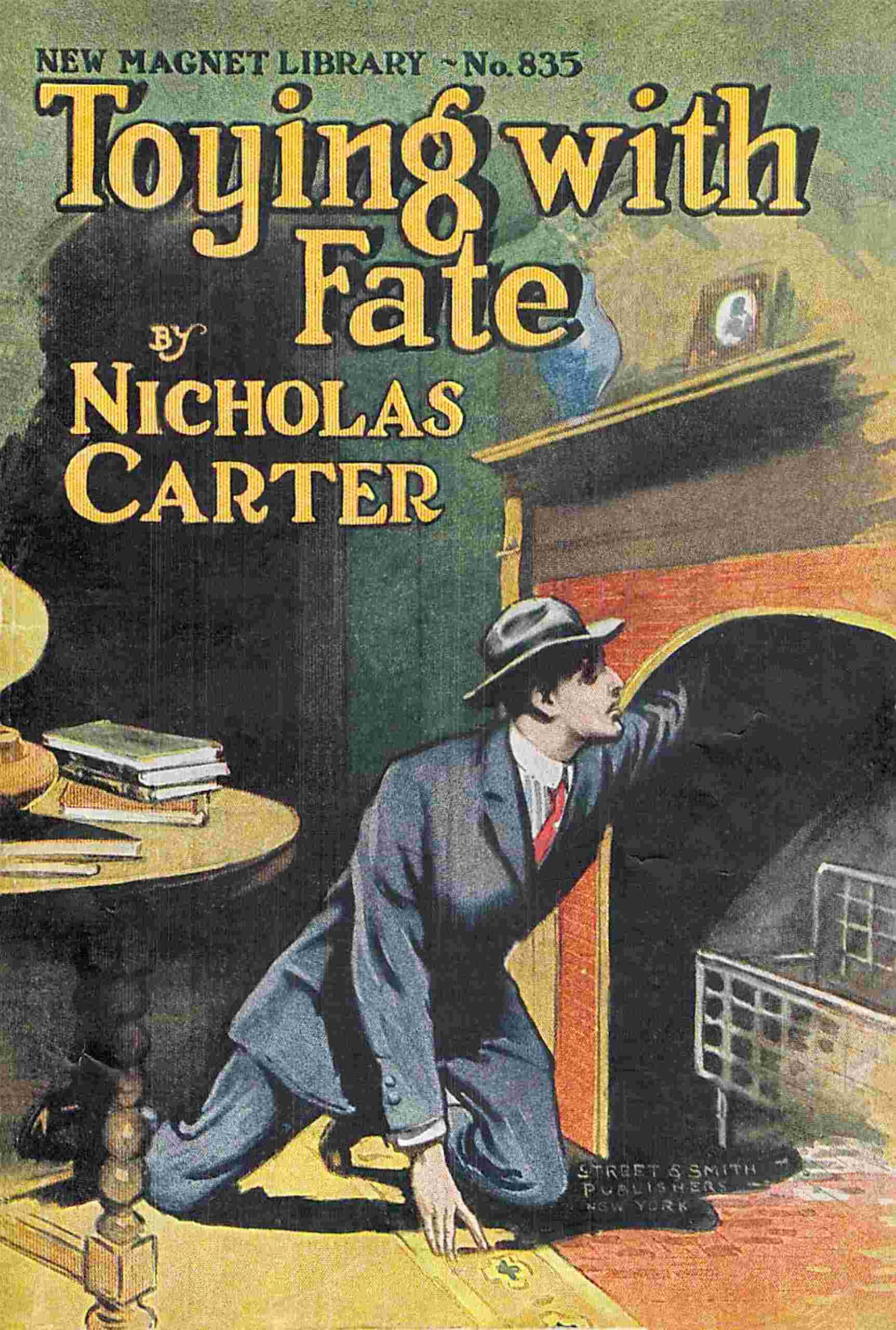
Instead of sounding walls and ceiling, as he had done on a former visit, he went straight to the old bricks on the hearth, and commenced lifting them one by one.
To accomplish his purpose the more readily he got down on his knees and worked like a beaver.
Each brick was carefully replaced, and he had gone over half the space when he was interrupted.
A door opened and shut behind him, and George Richmond started to his feet.
A man stood before him.
“There, don’t draw,” said the person at the door. “It would do you no good, George Richmond. Don’t let me disturb you. Go back to your work.”
Richmond did not stir.
“Go back to your work, I say. I’ll wait till you find it.”
“Find what?”
“You know. Your quest.”
The ex-convict smiled grimly.
“I was only seeing if the old woman placed anything under the bricks,” said he.
“Something valuable, eh?”
“Perhaps.”
“Not money, was it, George?”
“Perhaps not.”
“You’re a cool one. I thought your trip up the river reformed you. Don’t you remember how the newspapers exploited your return, and said you were quit of crime? It was a great fake, wasn’t it?”
The speaker smiled, but Richmond did not.
“Who are you?” he demanded.
“That’s another matter. Don’t let me disturb you. You haven’t taken up more than half the bricks. Go through the rest.”
“I don’t care to. You’re playing spy, and, by heavens! that’s dangerous work.”
“You mean that the man who watches you may live to regret it?”
“Yes.”
“Well call me spy, then. Don’t you think you’re playing a pretty bold hand just now, George?”
“I?”
“You. You are into it so deep that you don’t want to miss a good thing. There’s nothing buried under those bricks; there never was. Mother Flintstone hid it elsewhere.”
“That’s false. She hid it in this house, and unless you——”
“Come, George, don’t show your teeth like a tiger. It will do you no good. You can’t find the confession, but the other one will do just as well!”
“What other one?”
It was evident that the question had no sooner left Richmond’s lips than he regretted the utterance.
“You know; therefore I need not specify. I hope the work was well done.”
“Devil! you’ve got to fight for your life,” and the next instant George Richmond darted forward like a mad beast, and leaping clear of the floor flung himself upon the stranger.
That person braced himself for the ordeal, and warded off the initial blow with the dexterity of a practiced pugilist.
George found himself foiled, but he did not give up.
Again he darted at his enemy, and the pair came together in a deadly grapple.
Back and forth over the floor they writhed like wrestlers before an audience; now George obtaining a little advantage, now the other getting the best of it.
At last Richmond found himself held against the wall by a grip of iron.
He panted in his adversary’s power.
“But one man ever held me thus before this,” he cried.
“Who was he?”
“Nick Carter, and, by heavens! you must be that same man!”
There was no reply.