
CHAPTER XXXIII.
THE COST OF A SECRET.
George Richmond found himself suddenly free from his antagonist in Mother Flintstone’s den.
The battle ended sooner than he thought, for his enemy gave a lurch which disengaged them, and when George recovered he was the sole occupant of the place.
“Who was he?” the astonished man asked himself.
The reply came from his imagination, and he sprang to the door and looked out.
No one there.
“I accused him of being Carter, the detective, but he did not reply,” he went on. “Years ago I was in Carter’s hands and the grip to-night seemed the same. But I may have been mistaken. I mustn’t forget that years have passed since Carter caught me red-handed. I cannot believe that my foe to-night was the detective.”
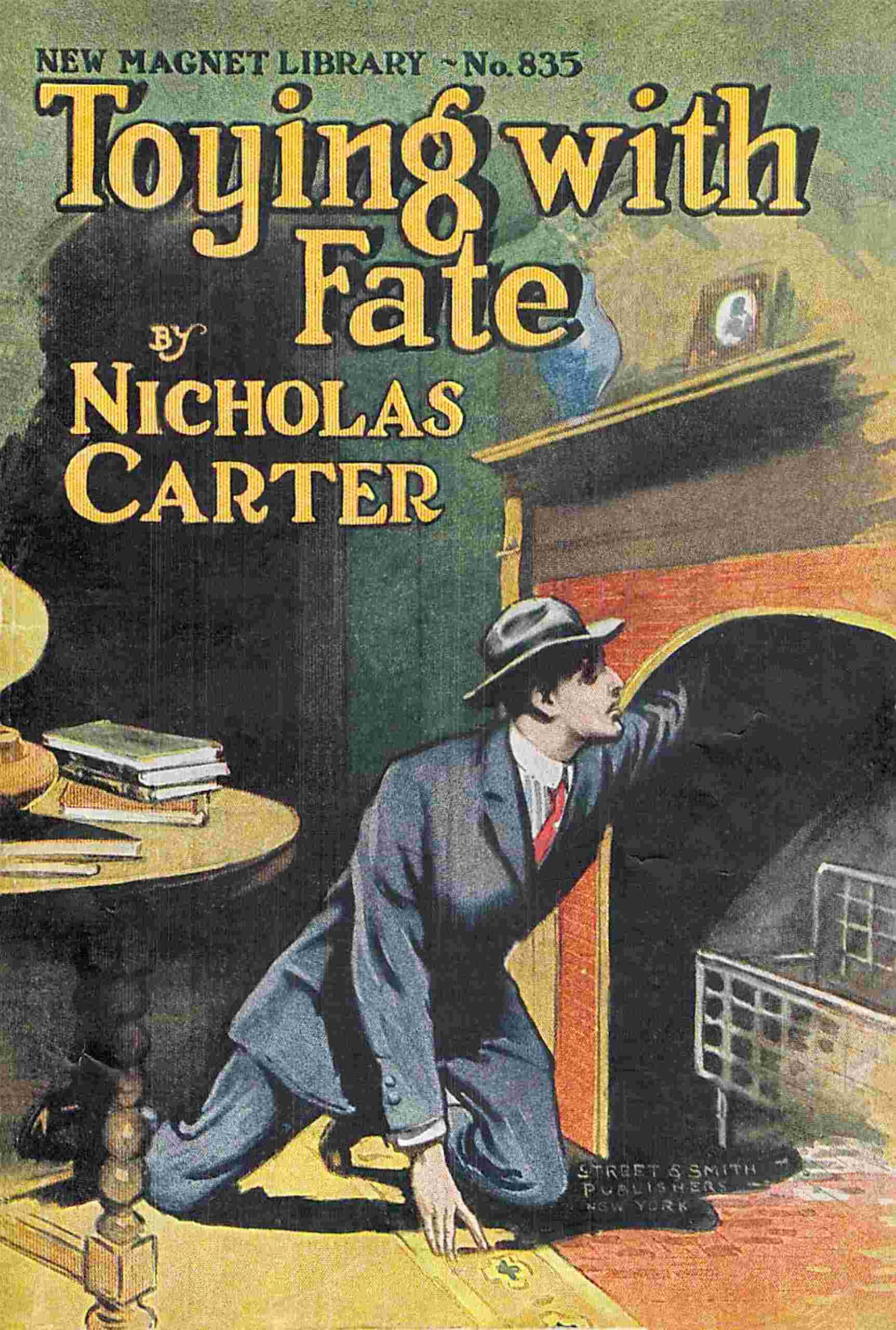
George did not resume his inspection of the old hearth, for he turned away after replacing the last brick and slipped into the street.
He was to vanish now.
That was his bargain with Claude Lamont, and he knew that the fictitious account of his death was even then in the hands of the printers.
He turned up later in another part of the city.
He crossed the bridge and vanished in Brooklyn.
Chuckling to himself, he thought of how he had played it on Perry Lamont.
In a small room he threw himself upon a couch to snatch a little sleep.
He was to be pronounced dead by the newspaper to Perry Lamont.
That was a part of the conspiracy.
Claude, the blackmailer of his own father, was to attend to that part of the work and he—George—was to get some of the blood money.
Thinking how easily the game moved onward to success, he fell asleep, nor waked till the next morning.
Then he set about disguising himself most thoroughly.
He changed his eyebrows, he darkened his hair and he gave his upper lip a sweeping mustache.
After his work no one would have called him George Richmond.
Meantime, over in the larger city, Perry Lamont, entering the library earlier than usual, as if he expected to hear some news, found Claude there.
Father and son looked at one another for a second, and Claude pointed at a newspaper on the desk.
The millionaire picked it up and his eager eyes discerned a pencil mark at a certain paragraph.
He devoured the falsehood eagerly and almost out of breath.
The young sport watched him like a cat.
“Thank Heaven!” cried Perry Lamont, as he shot a glance at Claude and dropped into his chair.
“It suits you, I see.”
“Suits me?” was the reply. “You know it does.”
A momentary silence followed between father and son, and then the elder Lamont said:
“Did you have any trouble?”
“Not much.”
“Did he suspect you?”
“Yes, he did that; but I had to go on, you know.”
“I know. He died for sure?”
It was a singular question, as if the speaker half suspected the truth, and Claude’s heart seemed to find a lodgment in his throat.
“What does the paper say?” cried Claude, a little irritated. “It records the death of the notorious George Richmond, doesn’t it?”
“It does.”
“That’s sufficient, I think. Do you want to see the—body?”
“My God, no!”
“Nor the burial certificate? They’ll probably hold a post mortem, but we’re safe all the same. It’s all right, I assure you. There’s no danger, but it took work.”
“I’m proud of you, Claude. Now, what about the papers?”
“I’ve got them, too.”
“Here?”
“Yes,” and Claude dived one hand into an inner pocket and drew forth a package, at sight of which Lamont’s eyes seemed to bulge from his head.
“There they are,” he resumed, throwing the packet upon the table.
The millionaire snatched at it and opened the package.
He found the documents forged by George Richmond, and opened the first one.
“Heavens! what have we escaped?” he ejaculated. “It was a very narrow escape. Did you read these papers, Claude?”
“No, never thought of that. I don’t care to know what the old hag was.”
“Great Cæsar! these papers would have destroyed us,” and Perry Lamont looked white. “She had it in her power to break me up, and I don’t see why she didn’t exercise it. Why, they’re worth a million almost.”
For some time Perry Lamont went over the papers in silence and did not look up again till he had reached the end of the last sheet.
Claude smiled inwardly all the time.
He knew that George had done his work well.
“Now, here they go,” said Lamont, senior, at last, as he moved toward the grate where a fire burned.
Claude saw his father hold the documents over the fire a few moments and then drop them into it.
As they caught fire the door opened and Opal came in.
Her face was white and she was agitated.
Perry Lamont pointed in silence at the hearth and looked toward his daughter.
Opal sprang to the fire and bent forward.
“Did you get it?” she asked, looking at her brother.
Claude said nothing.
“Did you have any trouble?”
“Some.”
“You paid him well for that service, didn’t you?” she inquired of her father.
“We had an understanding.”
“That’s good. It saved us. We are no longer in the toils of the secret-keeper. Now no one can say that Mother Flintstone was our near kin.”
The tall, regal-looking girl seemed almost beside herself with joy.
She would have embraced Claude had not his coldness repulsed her, and in a few moments she withdrew.
“I’ll take it now,” said Claude, addressing his parent.
“Oh, yes. You’ll place it to your account, I suppose?”
“Of course.”
Perry Lamont filled out a check for two hundred thousand dollars, and pushed it across the desk to his son.
Claude looked at it a moment, and then transferred it to his pocket.
It was the cost of a secret; it was also blood money, and the time was near at hand when that deed was to return to plague the doers.
“Safe at last!” exclaimed Perry Lamont, when he found himself alone. “It’s in the fire and he’s out of the way. I would like to know if Claude really had much trouble. The paper said it was vertigo, but we know better. Claude is sure the post mortem will not reveal anything. They won’t catch Claude!”
He chuckled to himself and looked at the darkened ashes of the false confession in the grate.
By and by he returned to the desk and sat down, his head falling on his breast like that of a weary man, and in a short time he was fast asleep.
The house grew still. Outside Claude Lamont was hurrying downtown, while Opal, in the parlor almost for the first time since her bout with the detective, thrummed the piano.
Some distance from the Lamont mansion Carter, the detective, was watching the actions of a man who mixed drinks behind a bar.
It was Caddy, the mixer at the Trocadero, and the detective, well disguised, seemed to take more than a passing interest in his movements.
By and by Caddy put on his coat and walked out, with Carter at his heels.
All at once the hand of the detective fell upon Caddy’s shoulder, and the little man stopped at once.
His face grew white when he looked up and saw the keen eyes that seemed to read his inmost thoughts.
“Don’t do it again,” said the detective.
“What have I done?”
“Don’t threaten Miss Marne again.”
“But I—I—didn’t.”
“You did. Please don’t try it any more. That’s all.”
Caddy did not catch his breath till Carter was out of sight, and even then he seemed to breathe hard.
“Won’t I?” he hissed. “Just let me get another chance at the girl, and I’ll make her think she isn’t anybody in particular. She refused to play her part of the game I’ve made up, but I’ll bring her around in spite of the two men, that I will.”
But for all his braggadocio Caddy was ill at ease, for instead of going on he retraced his steps to the Trocadero, took a “bracer,” and remained indoors.
Nick Carter proceeded on his way, and at last pulled up in front of Bristol Clara’s house.
The woman opened the door even before he knocked and led him into the parlor.
“George Richmond is dead,” she exclaimed, a smile coming to her lips. “Not quite dead, but I heard the arrangements made. It’s a cool scheme, isn’t it? Who are they going to beat out of two hundred thousand dollars?”
“Perry Lamont, the millionaire,” was the answer. “They’re all birds of the same feather, even the girl. I had a narrow escape from her, but a miss is just as good as a mile. She may know ere this that I don’t lie dead in the parlor of the old mansion on Cedar Street. I want a place at the peephole to-night, Clara.”
“It’s at your service.”
“I won’t need it after to-night.”
“Are you going to close in on them?”
The detective nodded.
“Which one did it?” eagerly asked the girl.
“Never mind, Clara. I won’t make any mistake.”
“Of course not. You never do,” proudly answered the tenant of the house.
Carter had set his time, but he could not prophesy what the coming hours were to bring forth.