
CHAPTER ONE
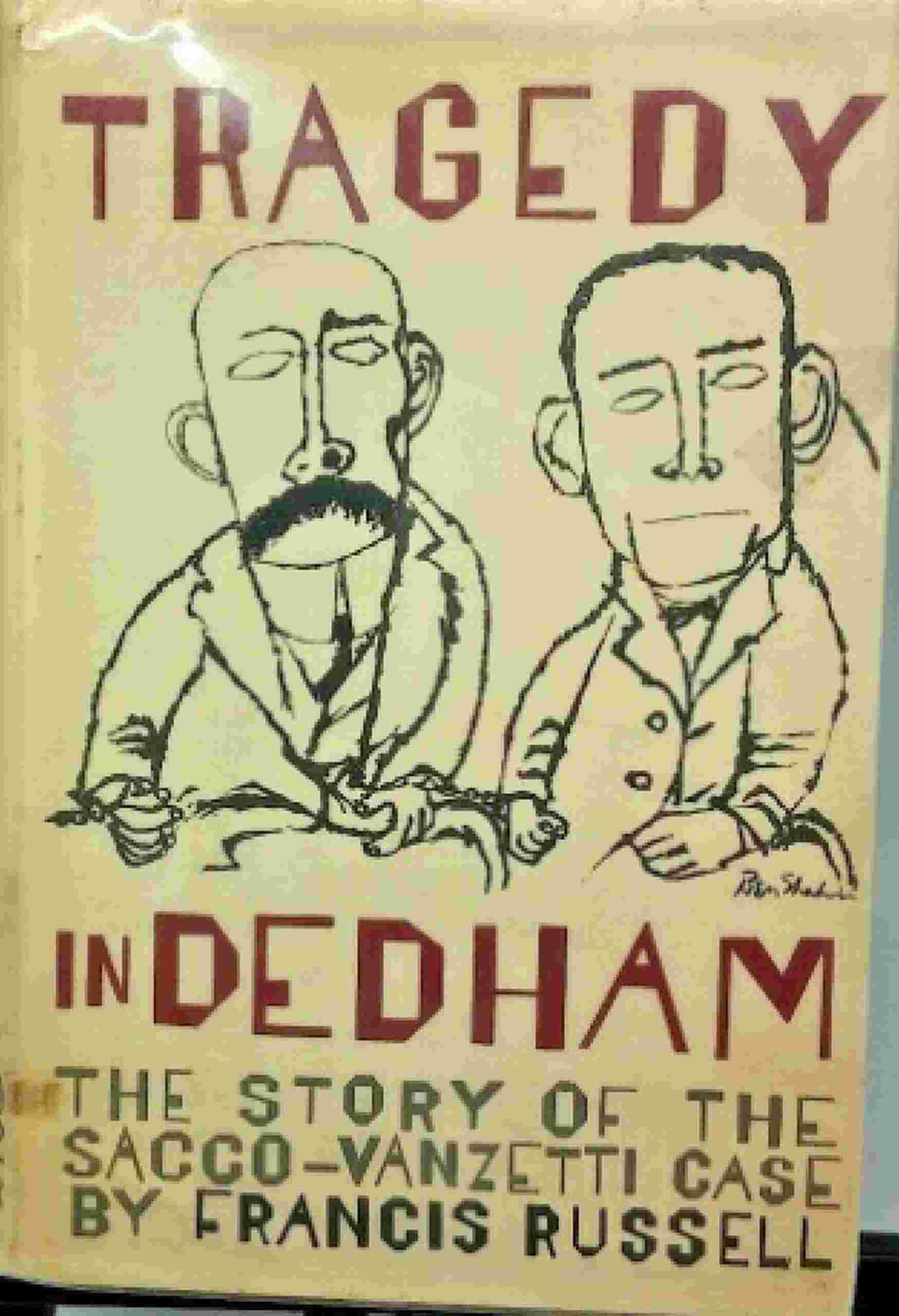
THE TRAGEDY IN DEDHAM
The case of Sacco and Vanzetti, which began as the prosecution for a commonplace if brutal murder, developed gradually into one of the world’s great trials. In the end it was much more than a trial. It became one of those events that divide a society. Although the issues that it raised have been overlaid by war and political events, they never wholly die. Even today middle-aged men and women, hearing by some chance the names Sacco and Vanzetti, still find themselves stirred by the passion and violence of their younger days. Sacco and Vanzetti have become a symbol, and, like all symbols, the meaning varies with those who adopt it.
I myself do not have any memory of the trial, being then in the sixth grade of the Boston public schools, but I do remember from my eighteenth year the agitation and excitement of those summer weeks in 1927 preceding the two men’s execution. The day they were to die I spent the better part of the afternoon walking over Beacon Hill and across the Common in the muted August sunshine. Police were everywhere, hard-faced and angry, some of them carrying rifles—a thing I had never seen before. Pickets with placards marched up and down before the Bulfinch façade of the State House. Periodically the police carted groups of them away in a patrol wagon to the Joy Street Station. Almost at once their places were filled by others. Buses kept arriving from New York hung with signs proclaiming SACCO AND VANZETTI MUST NOT DIE! and trailing red paper streamers. As the buses pulled into Park Square those inside began to sing “The Red Flag.” They looked like foreigners, most of them. I did not like their looks. I sensed in myself the hostility of the bourgeois world toward those two men. In spite of any pickets and red-streamered buses from New York, I knew that they were going to die that night. As I walked under the lindens on the Tremont Street side of the Frog Pond I felt a sense of oneness with the community that was asserting itself. I was glad Sacco and Vanzetti were going to die.
It never occurred to me that they might be innocent. In the shabby-genteel private school I went to in Roxbury none of the masters would have dreamt of such a thing. We took our opinions from them and from our parents. The father of one of my classmates was Reporter of Decisions of the Massachusetts Supreme Court. He published in 1927 a much-approved pamphlet on the trial in which he demonstrated the quasi-divine status of Massachusetts justice, a status that made even the appointment of the Lowell Committee to investigate the case a reflection on the Commonwealth’s judicial system. According to the reporter, that system, sanctified by the past, could not err. Such a conservative position was common enough in Massachusetts then. Nor did it change. Thirty years later the reporter still listed his pamphlet in Who’s Who as his single literary accomplishment.
By and large one’s view of the case depended on one’s status in the community. If one was middle-class and Republican and read the Herald mornings and the Transcript nights, one thought Sacco and Vanzetti guilty. Any latent doubts subsided after President Lowell of Harvard issued his report. But if one was a university liberal, one tended to think the trial unfair, and if one read the Nation or New Republic one was sure they were innocent.
My father was a lawyer and a Republican. He believed the two men guilty not from any particular study of the trial itself but because of his acquaintance with Captain Van Amburgh, a ballistics expert who testified at the trial. Van Amburgh, through laboratory examinations, was certain that one of the recovered murder bullets had been fired from Sacco’s gun. This convinced my father, although—as it came out later—it never convinced Captain Proctor of the State Police.
My Aunt Amy, who was a social worker and lived in the Elizabeth Peabody House, was equally convinced of the two men’s innocence. This again was not from studying the evidence—it was simply the way one had to feel if one was a social worker. Nobody could have continued to stay at the Elizabeth Peabody House who felt otherwise—not that such a person would ever have been there in the first place. One of the proud moments of Aunt Amy’s life was when she was arrested for picketing the State House and taken away in a patrol wagon. I think she was almost disappointed that the policeman who arrested her was so courteous about it.
I do not know when my views about Sacco and Vanzetti changed. It must have been sometime in the thirties, when I happened to read a book of their letters. Those letters were just not congruous with the sordid and mercenary Braintree murders. As to the question, Who were the murderers if Sacco and Vanzetti were not? I thought I found that answered later by one of their counsel, Herbert Ehrmann, whose book The Untried Case seemed to prove that the men who did the killing were from the Morelli Gang of Providence. If one accepted that explanation, reinforced by other evidence as time went on, everything apparently fitted together. One of the Morellis looked enough like Sacco to have been his brother.
Dedham, where the trial took place, is a colonial backwater. For the most part it is a mill town stretched along the loops of the Charles River, but the older section near the High—not Main—Street is a well-preserved relic, with spacious frame houses of the mid-eighteenth century and later and more grandiloquent mansions of the century’s end. The courthouse, built in 1827, is a stone building with massive Greek-revival columns. Its Roman dome, soberly proportioned to the columns, is the most conspicuous object in Dedham. From the flat country beyond the river it looms above the elms, flanked by white meeting-house spires, a symbol of authority. Almost always when I see the great dome so secure above the peaceful community I find myself thinking back to the Sacco-Vanzetti trial. Whatever one’s feelings about the trial, its presence still seems tangible in the courthouse and the High Street.
I felt the presence in 1953, thirty-two years after the trial, when I was called on to serve for a month as a juror in the same paneled room where Sacco and Vanzetti were tried and found guilty and, after all the exceptions and delays, were sentenced to death six years later. Scarcely a day of that month passed but there was some reference to the case.
Sometimes during the lunch hour one of us would ask the old sheriff about the trial. In his blue serge cutaway he had served the Dedham court for forty years. For him the law revealed there was majestically certain. I do not think he ever entertained the idea that it might err or that the Sacco-Vanzetti decision might have been unjust. To think this would have been to challenge the things that had become part of him—his engraved brass buttons, his white mace with the blue state seal on it. His office did not, however, keep him from having his personal feelings. He had come to like Sacco and Vanzetti. “They were good boys,” he told us. “I knew Nick best, but they were both good boys. Never any trouble.”
At the end of the afternoon session he occasionally took a few of us through the jail, two streets away, and—after showing us the reception hall and the dining room and the laundry—he would point out the cells Sacco and Vanzetti had occupied. “I was in the court,” he told us one afternoon, “that day when Judge Thayer sentenced them. Vanzetti made his speech first, that long speech—maybe you heard about it. And all the time he was talking Judge Thayer just sat there with his chin in his hand looking down at his desk. Never moved. But when Vanzetti finished, then he let him have it.”
On our way into the courtroom we would pass the prisoners’ cage, used in all Dedham murder trials. In this cage Sacco and Vanzetti had sat. The cage is often mentioned in the literature of the case, as if the men had been exhibited in court like monkeys in a zoo. But in spite of its name the cage is no cage at all. It is a topless enclosure of metal lattice about three feet high in front, rising to five feet in the back. Except for its symbolism there is nothing very formidable about it.
I was on a civil jury. Most of our cases concerned personal injuries. One of our last, involving a woman who had cut her leg in the door of a car, made the courtroom buzz as the lawyer for the plaintiff appeared. The clerk came over to the rail and muttered something to our foreman.
The lawyer was a portly man in his seventies, with a manner so assured that it was almost contemptuous. He was nearly bald, his face florid, with the flesh sagging under the cheeks. Behind his rimless spectacles his pale blue eyes watered. He was dressed with the conservatism of a Boston banker, wearing a hard-woven worsted suit cut in characteristic pear-shaped style. Two points of a linen handkerchief projected sharply from his breast pocket. His shoes were of Scotch grain. His voice was upper-class Bostonian—with that elastic prolongation of the vowel sounds that has come to be known as the Harvard accent. As soon as he opened his argument he lapsed into Victorian rhetoric.
The clerk’s remark was passed along the jury box. The man next to me nudged my elbow. “That’s Katzmann,” he said, “the fellow that got Sacco and Vanzetti.”
He seemed a culmination of the ghosts of the month. There he was again, in Judge Webster Thayer’s old courtroom, at the scene of his triumph of a generation before. As he faced us, spinning polysyllabic phrases out of nothing, I tried to form an impression of him divorced altogether from the Sacco-Vanzetti case. If I had seen him only at that moment, I should have thought him empty and pompous, but I should also have admitted his basic honesty.
He died the following autumn. Some months later I talked with a judge who had known Katzmann. When I told about seeing him at Dedham he asked me my opinion of the man. I said he was verbose, third-rate, not wholly grammatical. He laughed. “That describes most of us lawyers,” he said. “As for Katzmann, he was average—an average district attorney, a little tricky like most of them, but no worse than most out to get a conviction. He thought Sacco and Vanzetti were guilty. I’m sure he never changed his mind.”
Four decades have passed since the trial. Judge Thayer, Katzmann, President Lowell, Governor Fuller, and most of the jurors and witnesses are dead. What remains out of this shadowed past? Beyond all else, doubt. Refusing to face this doubt, the two sides became irreconcilable. One side felt, as did the court reporter in his pamphlet, that anything less than the execution of Sacco and Vanzetti would undermine the Massachusetts judiciary. The other side demanded that the whole proceedings of Judge Thayer’s court be repudiated. There should have been some middle way out, some face-saving formula that would at least have pacified if not contented the reporter and his kind and yet given the men their lives. Whatever the defense’s private opinion of Judge Thayer, it would have been better to have said less about him and to have concentrated on the evidence discovered after the trial. That this evidence changed nothing was preeminently the responsibility of President Lowell. Working as he did in private with his committee, unhampered by the strict rules of legal evidence, he had the opportunity to examine all the facts. A word from him, an indirect indication, and Governor Fuller would have stayed the death sentences and ordered a new trial.
Governor Fuller, of course, took his cue from the Lowell Report. If he, the parvenu, had not been so in awe of Lowell and the Back Bay ascendancy he represented, perhaps he would have acted otherwise. His jail meetings with Sacco and Vanzetti are said to have been friendly.
Once or twice a year in the decade after World War II, going into the State Street Trust Building, I used to see Fuller. The doorman would see him first and swing the door open with a ringing “Good morning, Governor.” I could slip through in the eddy. The old financial clipper would billow ahead of me under full sail. Self-esteem carried him along like a favoring wind. His was the pride of manner that had reached its goal. An Alger story of the new century. From a Malden bicycle shop to the head of the Packard agency for New England when Packard was the Rolls-Royce of America. A mansion on the water side of Beacon Street hung with Gainsboroughs and Romneys and Raeburns. That was the first stage. Then the governorship. And when Packard slipped in the Depression, the ex-governor sensed the moment of ebb and shifted to Cadillac.
There was a cragginess to his features in age. More and more he came to resemble the Back Bay Brahmins he so much admired. I suppose Sacco and Vanzetti, those men whose hands he had shaken so long ago in the death cells, had become blurred impressions, overlaid by eighteenth-century paintings and the tailfins of Cadillacs. “Our reputation is your protection,” said the governor’s used-car ads. Yet I never saw him sweeping into the State Street Trust but I thought of his role in the case.
Public opinion in Massachusetts was against Sacco and Vanzetti. To the community they were two murderers who had been given a fair trial and every opportunity for appeal afterward. The whole thing had gone on for much too long. Radicals and anarchists and Communists were trying to use the case as a lever to pry apart the foundations of law and order. But Massachusetts was not going to be dictated to by such people. There might be demonstrations in front of American embassies throughout the world, there might be more bombs planted in the houses of those concerned—as had already happened to a witness and one of the jurors. Nothing like that was going to change the course of justice! Conservative opinion more and more adopted the point of view that Sacco and Vanzetti had become a challenge to society that could be answered only by their deaths.
Literary talent was the forte of the other side. That side consisted of the literary left, radicals, liberals, Communists, woolly well-meaning progressives like my Aunt Amy, plus a large scattering of people who could not be labeled politically but whose sense of justice had been outraged. Some of these latter were starched conservatives. The crystallized view of the opposition was that Sacco and Vanzetti were the victims of a malignant conspiracy. Neither judge nor district attorney had really believed them guilty of murder. The trial was a put-up job to get rid of two troublesome agitators.
For the Communists—to whom this case in its later stages gave their first opportunity for an international mass appeal—Sacco and Vanzetti were martyrs of the proletariat, murdered by reactionaries trying to preserve an unjust social order. Seen from this point of view, two alien Reds could expect no justice from a Massachusetts court or a Dedham jury.
During my month in Dedham I used to wonder about that earlier jury. Drawn in much the same way that we were, the jurors could not have been so very different from ourselves. And what were we? Some middle class, some working class, a few of us stupid, a few opinionated, but most of us reasonable enough to weigh an issue. At least we tried to overcome our prejudices. The jury I sat on would have been prejudiced against Reds, but it would not have convicted a Communist on a capital charge because of his political beliefs. It did not seem to me the Sacco-Vanzetti jury could have been otherwise. Granted even that the foreman was prejudiced, some of the others would have stood out against injustice. I felt sure that when the jurors decided that Sacco and Vanzetti were guilty, it was because they were convinced that they were guilty of murder.
Thinking of the great trial, I found myself wondering how I should have voted, had I been on that jury. As soon as I had the time I read the transcript of the record. Much it could not offer—the atmosphere of the court, with its tensions, the appearance of the witnesses and the defendants, the subtleties that could be gathered from a tone of voice but could not be preserved in black and white. Yet the substance, the prime matter of the trial, endured, each word spoken during that six weeks pressed and dried between the now-yellowing pages. As the inchoate mass gradually took shape for me, I tried to disavow any preconceptions, to imagine myself in the jury box at Dedham occupied solely with the question of whether two men murdered two other men, and knowing no more about it in advance than the evidence offered. How should I have judged?
I knew one thing—that I should have disregarded the testimony of the experts. My month had taught me that. Experts canceled each other out as the paid bias of either side, and a jury then decided on other grounds. The real grounds in this case were the half-dozen or so witnesses who identified Sacco—and to a lesser extent Vanzetti—as being at or near the scene of the murder on that April day. In opposition to them were an equal number of witnesses who testified that these two were not the men. It was a question finally of which group to believe. The weakest part of the Commonwealth’s case was that it never established an adequate motive for the crime.
On the other hand Sacco and Vanzetti were armed the night the police picked them up, Sacco with an automatic of the type that fired the murder bullet, Vanzetti with a revolver that might have been taken from the murdered guard. This was the most damaging evidence against them. Sacco maintained that he had tucked his gun inside his belt that afternoon and forgotten about it. Vanzetti said that he carried his for protection. Both statements may have been true. Often the lame excuse is the truthful one. Yet here were two philosophical anarchists who maintained that the use of force was never justified, not even for the advancement of their beliefs, who boasted that they had never shed blood, but when they were picked up, they had on them weapons of force. If they had not been armed the chances are they would never have been tried.
The trial may well have been more unfair than seems apparent in the record. There the most glaring fault is the district attorney’s harrying interrogation of the two men as to their beliefs, their lack of patriotism, and their reasons for running away to avoid the draft. The impropriety stares out of the printed page. Here certainly was error, yet I cannot believe that this was primary in the jury’s verdict. On the other hand, the judge’s charge, which Felix Frankfurter so condemned, seems reasonable enough in cold print. I was finally left with the feeling that if I had been on the original jury, I should have voted with the others. Yet I was not really certain.
Looked back at over the lapse of years, the case of Sacco and Vanzetti becomes a tragedy in the classical sense. It was no melodrama, as many have seen it, with good neatly divided from evil. Katzmann was as sharp as most district attorneys out for a conviction, a limited man but not a bad one. Judge Thayer could not hide the bias of his obsessions. He was indiscreet and he was weak, but he made an effort to conduct the trial fairly. Both he and Katzmann believed to their dying day that Sacco and Vanzetti were guilty.
It was not a conspiracy of evil men against noble men, as Maxwell Anderson saw it in his play Gods of the Lightning. There was something more, something deeper and more embracing in the case. It was in fact fate that was the mover behind the events at the Dedham courthouse in the spring of 1921. And it was fate in the ironic Greek sense, dwarfing all the participants, ending in inexorable disaster.
Sacco and Vanzetti were figures of Greek tragedy: the doomed king’s son becomes in modern dress two Italian workmen. Fate lurks behind them at each step. Sacco scarcely misses a day at his factory except the day of the murders. If he had missed any other day, the factory records would have been his alibi. Without him it is agreed that Vanzetti could not have been convicted. Fate engineered the almost accidental arrest of the two men as they were riding on the Brockton streetcar. But for fate, Sacco would have been off to his native country in three days.
And as in Greek tragedy the hero condemns himself unknowingly in his own words, is doomed by his own inner weakness, so in the end are Sacco and Vanzetti doomed by theirs. The men of peace go armed. Fate plus human weakness—that is the basis of high tragedy, a tragedy such as theirs that they played out to the end with bravery and dignity. It was a tragedy for everyone concerned with the case, and in the end it is best accepted so, as it was by the Greeks.