
CHAPTER TWO
HISTORY, WRITTEN AND
OTHERWISE
Walking up State Street a third of a century after the executions, on another August afternoon, I wondered again about the enigma of the case. The whole drama had been played out within twenty miles of here: in South Braintree, in Bridgewater, in sedate Dedham, in the gilt-domed State House beyond the Common, and finally just across Prison Point Bridge in the granite fortress of the now-demolished state prison. Would it ever become as clear-cut as the Dreyfus affair, where everyone was at last satisfied of the grossness of the injustice done? That still seemed unlikely. In 1950 the seven surviving jury members were interviewed as to their later opinions. The decades had only confirmed their belief in the rightness of their verdict. In 1959 a judiciary committee of the Massachusetts legislature had refused to consider granting Sacco and Vanzetti a posthumous pardon.
Where the past is reduced to shelves of documents in a library it becomes manageable enough for the scholar or historian to make his evaluation. But where it is still an actual present in the contradictory minds of living men, what yardstick can one use except that of preconceptions? Was the chief of police who arrested Sacco and Vanzetti a forger of evidence? Did their first lawyers betray them? Was the district attorney a barrator with his hand out under the table? Was the judge mad? Was President Lowell of Harvard a Yankee bigot? Many upright men had maintained these things. Were Sacco and Vanzetti quietistic anarchists, or did they believe in the politics of the deed?
Boston seemed downcast, heatstruck. The Old State House at the head of State Street had, I noticed, been steam-cleaned, and the clock over the balcony had been replaced by a more authentic sundial. As I reached the subway entrance under the ancient foundations, an eddy of heat snapped in my face like a dirty towel. At that moment a herd of tourists following the Freedom Trail had paused at Point 9 to get Freedom Stamps from the slot machine for their souvenir albums. A shiny-faced man in a Hawaiian sport shirt was maneuvering against the sun to get a photograph of the lion-and-unicorn supports on the Old State House facade, no doubt thinking they went back to 1776 instead of merely to a twentieth-century Armenian tinsmith’s shop. Watching the tourists, I felt I ought to have some sort of souvenir book myself to paste with self-congratulatory stamps for interviewing people on an afternoon like this.
My first call was on a corporation lawyer who had spent years writing a book to prove that Sacco and Vanzetti were guilty. His firm, occupying the sixth floor of a large old-fashioned building on Federal Street, was ostentatiously shabby with a well-preserved Edwardian décor. A horseshoe-shaped receptionist’s desk dominated an outer office.
The man in his seventies who showed me into his private office without shaking hands was less the calcined Boston type than I had expected. There was a metallic quality about his eroding features. His wiry gray hair fluffed over the collar of a rumpled white shirt. He had taken off his coat, exposing waist-high trousers held up by police galluses. His eyebrows were tufted and he wore round gold-rimmed spectacles.
“I did not,” he announced, “like the tone of your Sacco-Vanzetti article in American Heritage at all. Nevertheless I am willing to see you. What is it you want to know?”
I told him I was trying to write an impartial study of all the events in the Sacco-Vanzetti case, that I knew he thought they were guilty, and that I wanted to include his point of view.
His knees creaked a little as he sat down opposite me. A smile broke through his clouded face. “If you want to write a book like your article you could probably finish it in four or five months; but if you really want to be honest, it will take you two years just to do the preliminary reading. The fundamental thing is to make the proper comparisons between the trial record and that of the governor’s committee. Of course if you tell the truth you’ll never find a publisher. Because if you really go into the case you can only conclude that those two Italians were guilty. And you’ll never get a hearing on that. Why? Because their innocence has become a liberal trademark. There has never been any real doubt about this case among those who know about it. It was just used by people—by the anarchists and that radical lawyer of theirs and then the Communists.
“The case was open and shut. Everyone at the Dedham trial was convinced they were guilty, except a few old women social workers and Frank Sibley of the Globe. Sacco and Vanzetti said the night they were arrested they were out to pick up anarchist literature from their friends because they were afraid of the Department of Justice raids. That was May fifth, though. All those anarchists knew beforehand that the raids were going to take place on May first. No, they weren’t out to pick up their anarchist papers that night. They were going to Bridgewater with guns on them to get a car because they knew that next day was payday at the factories. They needed money for the defense of their comrade Elia in New York, and they were going to get it in the only way they knew.”
I said that I could not imagine why, if a man had shot someone, he would be foolish enough to have the murder weapon in his belt three weeks later. Any sensible murderer would have thrown the gun away.
“Ordinarily, yes,” he went on, “but they had those guns on them very simply because they needed them, because they were planning a robbery next day. That radical business was an excuse they concocted afterward—and don’t forget it was the defense that introduced anarchism into the case. During the trial they had some Italian professor from the North End testify that he had seen Sacco in town the day of the South Braintree murders and that Sacco had left him to go to the Italian Consulate. But it took him over a year to tell that tale. If, as soon as he’d heard Sacco was arrested, this man had gone to Katzmann and told him he’d been with Sacco that day, then they could have gone directly to the Italian consul. And if the consul had confirmed the story, that would have been the end of the case. But they didn’t because they couldn’t fake that fast, because the whole alibi was something they concocted months afterward.”
“Moore, their counsel, knew they were guilty. He was just in it for the money. Why, all in all they collected a third of a million dollars for their defense fund. They say that Italian anarchist printer fellow who organized it made himself a small fortune. Moore finally had to quit the case or they’d have arrested him for perjury. He chased one witness, that poor fellow Goodridge, to Maine after the trial and pretended he was going to have him arrested if he didn’t change his testimony. The Andrews woman from Quincy who identified Sacco—he had her beaten up. Orciani—the third one they arrested—he probably was the one who did it. Orciani had a time-clock alibi for the day of the robbery so they couldn’t touch him, but you know it’s easy enough to get some other man to punch your time card. He was in the court for the early part of the trial. He was the one the defense said sold the gun to Vanzetti, but Moore could never get him to testify. That was the way it was all through with the defense—lies, cheating, evasion.”
I mentioned that some of the prosecution witnesses had changed their stories several times between the preliminary hearing and the Dedham trial.
“Sacco and Vanzetti weren’t convicted on the testimony of the witnesses,” he said. “It was the evidence of the bullets that convicted them. Some of the bullets they found on Sacco were so obsolete that the State Police experts couldn’t find any duplicates when they wanted to make firing tests. Yet the same kind of obsolete bullet was found in the guard’s body. As far as witnesses go, you may not be able to describe a man properly but if you see him again you’ll recognize him. Could you describe our receptionist now?”
I had to admit that I could not.
“Yet you just talked with her. But if you went out there you would know if another girl had taken her place. You see!”
He paused and I could hear the squeak of his swivel chair. “Maxwell Anderson wrote a play about the case just after the executions. He had dinner with me afterward and I told him he was barking up the wrong tree. I explained why, and I think I convinced him. Then he wrote Winterset, and in that he saw the case quite differently. To my mind the greatest wrong, the greatest injustice in the whole trial, was done to Webster Thayer. He was an upstanding man, and they took years off his life. The trial grew to be an obsession with him later, but it’s small wonder the way he was threatened. He once told me that every day at noon he telephoned home to see if his house was all right, and every day he felt sick inside thinking it might be blown up. You remember they finally did dynamite it.
“One of the jurors, Dever, became a lawyer afterward and he wrote an account of his experiences during the trial. Simon and Schuster would have published it. They found it all very interesting, if he’d only put in a happy ending: tell how he changed his original opinion and decided they were innocent. But Dever wouldn’t do it, so he never did find a publisher. That’s the situation I’ve been up against. That’s what you’ll face if you’re honest. It’ll take you five years, and you’ll come up against a stone wall.”
He stood up abruptly and stalked to a table on which were two piles of manuscript, each over a foot high. “Here’s my answer,” he said, patting them. “This is my book on the case, the definitive answer. But do you think any publisher will touch it? Of course not. Can’t you imagine what the Times and the Herald Trib and the Saturday Review would say to anything like this?”
The chapters of the book were bound separately. He let me leaf through the one on the ballistics testimony while he moved over to a row of filing cabinets labeled S-V. “Look,” he said, rolling open the drawers one after another. “That’s the raw material. It would take you years to get all that together, years. Much of it’s not even in the record. There’s the report from the Attorney General’s office, for example—never been released. I can’t even tell you how I got it.
“You aren’t a lawyer, your mind isn’t trained to evaluate,” he said, leading me out to the elevator. “If you’ll take my advice, kindly meant, just give up the whole business.”
When I stepped from the air-conditioned building onto sun-baked Federal Street the city growled. The sky beyond Post Office Square looked rancid. I remembered the World War II British Army expression for accumulated paperwork: bumf. Those tight-packed filing cabinets with their formidable accumulation of details were bumf. The transcript of the record itself ran to over six thousand pages, and on top of this was enough additional bumf to bury me.
My next call was to be on Aldino Felicani, the man the lawyer had dismissed as “that Italian anarchist printer fellow.” An extraordinary old man, Felicani. The organizer of the Sacco-Vanzetti Defense Committee, he seemed so much a part of the past that I could never quite get used to the idea of his still being around. He was an anachronism. Whenever I saw him in public he wore the red shirt, the black Latin Quarter tie, and the wide-brimmed hat that had been the anarchist uniform in Bakunin’s time. So I had seen him last at the legislature’s Judiciary Committee hearing for a posthumous pardon for Sacco and Vanzetti. As I watched him listening to the proceedings I thought of the charge Vanzetti had given him: “Avenge our blood! Clear our names!” I had heard Felicani repeat it many times in his heavy accent.
Sacco and Vanzetti had about as much chance of getting a pardon from that legislative committee as Benedict Arnold. The gum-chewing faces behind the oak desks in the State House’s Gardner Auditorium were implacable. When my father had been in the legislature during World War I, the characteristic member had been a lawyer, Republican, middle- to upper-class, interested more in maintaining the status quo than in himself. In 1959 the social revolution of forty years was apparent enough in these lower-middle-class legislators whose interest was mainly in keeping their feet in the trough.
Yet from these men representing a new emergent class I should somehow have expected more charity for the two dead Italians. Instead there was entrenched hatred, concentrating in the chairman as he interrogated Judge Musmanno.
Justice Michael Musmanno of the Supreme Court of Pennsylvania, one of Sacco and Vanzetti’s final counsel, was the main speaker in favor of the committee’s bill. Silver-maned and silver-tongued, he unwound reels of words until he was stopped by the chairman’s hard voice. The latter had the features of the ur-Celt: savage blue eyes, gray shaggy hair looped over the back of his collar like an old-time United States senator.
“Look, Judge, why did Vanzetti have the loaded revolver on him, and a pocketful of slugs that fit it and why did he go for it when the police grabbed him?”
Musmanno tried to explain that carrying revolvers was then a common custom in America, especially among Italians, and that it was a right guaranteed by the Constitution. The chairman’s voice, burred as a cat’s tongue, broke in.
“You mean to tell me that the district attorney, the judge, the jury, the governor, the president of Harvard, the Supreme Court of Massachusetts, the Supreme Court of the United States—they’re all wrong and you’re right?”
Musmanno maintained that this was just what he was trying to tell him. Applause from the audience, in which I saw old Felicani join, brought the familiar threat to have the hall cleared. That audience was a curious conglomeration of the elderly, a scattering of students, and a cluster of beatniks at the side in beards and blue denims tied up with rope.
The elderly were survivors of an old storm, their eccentricities accentuated by age, the crackpot label attached to their clothes, their hats, their gestures. Emotionally they were drawn to lost causes, and here they gathered again like old soldiers at a reunion. The Sacco-Vanzetti case with its drawn-out tragic climax had been for them a generation ago a self-fulfillment in indignation that they were now reliving. At one point a woman near the exit caused a stir, almost a suspension of the hearing, by holding up Sacco’s and Vanzetti’s death masks.
Felicani’s Excelsior Press was on the ground floor of a decrepit building near the foot of Milk Street under the shadow of the new John F. “Honey” Fitzgerald Expressway where the business district fringes into the Italian North End. Every time I saw the large red and green linoleum squares on the floor of that familiar little office I thought back to the hopscotch games of my childhood. The walls were of pebbled tin sheeting painted with mauve Chemtone. Next to Felicani’s desk was a pay telephone and just above it an oak-framed clock, invariably six minutes fast. On top of a filing cabinet next to a spindly philodendron plant was a plaster bust of the dead anarchist leader, Carlo Tresca.
I was glad to find the old man there on this hot August afternoon. A man who towered in any crowd and looked more like a viking than a Latin, he was wearing a brightly patterned sport shirt. His gray eyes peered with astigmatic blankness until he recognized me and smiled. I told him of the mass of bumf I had just encountered.
“Yes,” he said, offering me a chair, “but what were they, those papers? I have almost as many papers myself. If your lawyer’s wrong at the start, it doesn’t matter how many files he has. There are not many of us left from those days, the ones who really knew.”
I asked Felicani what he had done immediately after the two men’s arrest. He thought for a moment.
“It’s strange,” he said. “When you begin to think, then all the memories come back, just as clearly as if it all happened yesterday. I knew Vanzetti best. He was one of my closest friends. As soon as he was arrested he got word to me and I got the others together. We went to see them at the Brockton police station. We raised money—two or three dollars here, another dollar there. It’s all down in writing, every penny. Then, at the first trial for the Bridgewater holdup, Thayer gave Vanzetti twelve to fourteen years. When Tresca heard that he came on from New York. ‘What is going on here?’ he asked us. ‘Fourteen years? Is that what you do?’ So then he got Moore, the lawyer from the Lawrence strike, to come in and take charge of the case.”
“I know this may be painful to you,” I told him, “but I have a letter from Upton Sinclair, who talked with Moore after the executions. Moore told him then—his exact words were: ‘Sacco was probably, Vanzetti possibly guilty’.”
Felicani’s sport shirt rippled as he shrugged his vast shoulders. “I’ve heard things of that kind, so many rumors. You know, Sinclair wrote most of Boston right here in this office. I don’t see why he didn’t mention it to me. Moore was angry after he left the case. His anger just got too big.”
I knew that Sacco had come to distrust Moore, but I did not know the details of Moore’s leaving. Felicani was roundabout in answering me.
“I never say Moore kept money for himself. He was an honest man. But for all the money you gave him, he wanted more always—for witnesses, for travels, for new investigations. He had no idea of money. If you gave him a thousand dollars every other day Moore was all right, but we didn’t have that much, the committee. Finally I tightened the purse strings. Then Moore started his own committee to raise money. That was why he got into a fight with Sacco, how the bitterness started. That was why we let Moore go and got Thompson.”
His voice was heavy with regret. “Ah, if we had had Thompson from the beginning, then we would have got them off. When we first went to him he was cold. He listened to us and he said he’d take the case for twenty-five thousand dollars. When he started he didn’t know the difference between an anarchist and a Communist. You could tell that by an appeal he drew up that Vanzetti corrected. After he talked for some time with Vanzetti, he understood. It made all the difference. He took part then as if we were friends. A wonderful man, Thompson. An aristocrat, the way the word should mean. He would have made mincemeat of a man like Katzmann, if only we’d had him instead of Moore.”
One thing I had been wanting to ask was about the various bombings connected with the case. Would he agree that anarchists had been responsible for them? Sacco and Vanzetti themselves were said to have been philosophical anarchists, as opposed to violence as Tolstoy was. But where did the dividing line come?
Felicani stared at me with his guileless eyes. “You know,” he said, “there are times when a man is so desperate that he will do such a thing as set off a bomb. When that happens and to what man, I don’t know. Vanzetti never could have done anything like that—but, yes, in certain circumstances Sacco might have. That is the type of man he was. But a holdup murder, to kill innocent men like that? It was quite impossible.
“Think of the times,” he said, lifting his hands palms upward. “I carried a pistol in my pocket then. I never fired it, I didn’t even know how to load it, but it gave me strength to feel it in my pocket.” He stopped as if he were thinking again of those far-off days. I watched him, the peaceable elderly printer who had outlived his party and his time. Where the word anarchism had once aroused fear, it now brought a kind of nostalgia. Violent some of the anarchists may have been, but there had been an integrity about them, a trust in human nature that I could never have. Now here he was, gnarled and sturdy as an old oak, speaking to me of the lost comrades of his young manhood.
Afterward, as I walked out into the reverberant street, I felt I had put the bumf into perspective. I knew it was intuition rather than reason, that the historical method had fallen by the wayside, yet I did not see how anyone could spend an afternoon talking with Aldino Felicani and still feel that Sacco and Vanzetti were guilty. But that was the difficulty in trying to form any picture of an event by talking with the survivors. The three principals in the case whom I had seen in the flesh and who were now dead—District Attorney Katzmann, Governor Fuller, President Lowell of Harvard—I had judged harshly. But others I met, whom I had expected to find fools or knaves, I had found neither.
Among these was Michael Stewart, the Bridgewater police chief whose suspicions started the events that led to the arrest of Sacco and Vanzetti. Some time after the trial Stewart had left Bridgewater to become police chief of Scituate, a seaside town southeast of Braintree. He had a speech about the case that he liked to deliver at men’s-club meetings. Now retired, he lived with his son in a white bungalow near Scituate Harbor. I knew the inside of it well: the gumwood trim, the nicknacks on the tapestry-brick mantel, the Child Jesus of Prague under cellophane, the sofa and the overstuffed chairs. Whenever I rang the bell I could see Stewart through the glass as he came limping to the door, lame from some old police injury. There was an unmistakable Celtic look about him from the cut of his mouth to the blueness of his eyes and the wave to his white hair.
Never since the night in 1920 that he had driven down to the Brockton police station to interview Sacco and Vanzetti had he ever had any doubt about their guilt. To him, it was all very simple. Godless men, atheists like Sacco and Vanzetti, were capable of any crime. Yet his relations with them after their arrest were for a period amiable, and he had liked Vanzetti.
“Sacco I never paid much attention to,” he told me. “He was just a sap, but Vanzetti was a real interesting man. I used to drive him to the Plymouth trial from the jail, and each morning I saw him I’d say ‘Hello, Bertie,’ and he’d say ‘Hello, Mike.’ Sometimes he used to sing songs for us in Italian on the way over, and he had quite a voice. After he heard me testify in court though, the next time he saw me he raised his hands—he was handcuffed—and shook them at me. And he never spoke to me again. The thing I remember most about him is his eyes. He had terrible eyes, like fire when he looked at you.”
Though Orciani, who was with Sacco and Vanzetti just before their arrest, had produced a watertight alibi after he was picked up, Stewart was nevertheless convinced of his guilt. “For my money Orciani was the cleverest of the lot,” he told me. “That’s how he managed to rig himself up such a good alibi. He was one of those wise guys. During the trial he used to go to court every day. There was a little room in back the defense had for exhibits and things like that, and he had charge of it. Most of the time he’d stand in the doorway watching what went on in court. Well, Katzmann spotted him there and the day they were cross-examining Vanzetti and asking him about where he got his gun, Katzmann looked straight at Orciani and said, ‘I’ll tell you, Mr. Vanzetti, where you got that gun.’ You could hear his voice right down the corridor. ‘You got it from your friend Orciani after he took it off of Berardelli’s dead body.’ Katzmann pointed his finger right at him and Orciani ducked. That was the last time he ever showed up.”
One late-summer afternoon I drove to Billerica to meet Dr. Warren Steams, dean emeritus of Tufts Medical School, who as state prison psychiatrist had seen Sacco and Vanzetti regularly in the years following their conviction. I found him in the study of his classically square colonial mansion facing the common. He was listening to a middle-aged man in heavy tortoise-shell spectacles who held an open book in his left hand and pointed to a passage with his right.
“It says here,” the man explained, “ten thousand people were there to see him hanged. That was 1820. I wonder what would draw all those people to an execution?”
Steams, with his wreath of kinky white hair surrounding a bald dome, looked amiable, but his voice was tart. “Cruelty. If it were announced that I was going to be publicly tortured and hanged next Monday morning on Boston Common there’d be at least a hundred and fifty thousand people there to see it.”
He beckoned to me apologetically and then, when the other had left, pointed to a chair. “I’m the Billerica antiquary,” he said. “The local historians all call on me with their problems. Seventy-five years old I am. That gives me a life expectancy of five years—and it would take fifty for me to do all the things I have to do. You came here to ask me about Sacco and Vanzetti. What do you want to know?”
Without waiting for my answer he went on. “I don’t think the truth will ever be known. As to whether they did it or not, I don’t know and I’ve made a point of not trying to know. I tell you this, though. They weren’t criminal types. For a while I think I saw them as much as anyone. Sacco had a very winning way about him. Of course he was a more settled type, with a wife and family. Vanzetti reminded me of a trade-union leader. That rigid mentality. He once said to me that where he came from in Italy there was a castle above the town and one family living in it had been oppressing the ordinary people in the valley for eight hundred years. I told him that it wasn’t so in America, that a family scarcely lasted three generations here. He’d read a little, but he’d not digested it too well—an unstable, wandering type, paranoid at times. When I saw him once over in the Charlestown Prison he said to me, ‘I don’t deny the right of the state to execute a man, but they have no right to castrate me and make me a laughingstock.’”
The doctor had known personally almost everyone connected with the case on both sides. Katzmann was to him lazy and incompetent, though he thought better of his assistant, Harold Williams. Judge Thayer he gave credit for honest intentions, but found him irascible, a snob, and obsessed with the idea that the Communists were just about to take over the United States. Governor Fuller was merely a successful automobile salesman. Thompson he respected, but felt that he had gone into the case merely for the fee.
“I thought,” I said, making another stab at it, “that seeing Sacco and Vanzetti so closely, you might have formed some opinion as to their guilt or innocence.”
“I feel,” he said, “as William James did about psychic phenomena. I just do not know.”
When I left, he walked out with me through his back garden blooming with zinnias. “If you are interested,” he said finally, “I’ll try to find my files on Sacco and Vanzetti for you. There may be something there. I’ve had so many cases since that I can’t remember the details. But drop in when you’re by this way again.”
Three weeks later he was dead.
By chance I discovered that Beltrando Brini was living in Wollaston, a twenty-minute drive from my home in Wellesley. When a boy of thirteen, Brini had testified at Vanzetti’s first trial that the two of them had been delivering eels in Plymouth the day before Christmas, 1919—the day Vanzetti was to be found guilty of attempting a holdup in Bridgewater. As he grew up, Brini had broken away from the Italian community. He had graduated from Boston University and was now an elementary school principal. Community affairs seemed to take up most of his spare time. Two weeks passed before he could find a free evening to see me. I found his house easily enough, a decent inconspicuous house in a decent inconspicuous street. He was a small man in his fifties. Like many of the second generation he still looked Italian, but to a diminished degree. He showed me into his living room. His wife was standing near the fireplace, a thin fair-haired woman, not Latin at all. After he had introduced me to her we sat down, taking each other’s measure while she went into the kitchen to make coffee.
“You know,” he said finally, “I could have been a musician. I really could at one time have gotten into the Boston Symphony Orchestra. But I thought it was safer to be a teacher. That’s why I never seem to be home nights—always something they want a school principal to be doing, somewhere they want him to be.” He looked at me sharply. “You want to know about Vanzetti. He lived with us a long time. He paid more attention to me than my parents did. He was kind to all children. I remember one Halloween we all had jack-o’-lanterns. The others had theirs lighted but mine didn’t have a candle in it. Vanzetti came along and asked me why I didn’t get a candle. I said I hadn’t any money. He asked me how much candles cost and I said two cents, so he fished in his pocket and gave them to me. When I got to the hardware store I found he’d given me a cent and a dime. So I got my candle and I brought him back the nine cents. I’d never had that much money in my pocket before, but I remember how proud of myself I was that I brought that nine cents back to him.
“I remember the last time I saw him before his arrest. It’s a thing I somehow still feel ashamed about. A bunch of us were playing ball in Suosso’s Lane and somebody hit one over the fence into a garden. While I was climbing over to get it I trampled on some vegetables and the man who owned the garden came out and started to bawl me out. I answered him back, like any fresh kid. Then Vanzetti came along, took me over by the fence, and talked to me. He wasn’t angry, he didn’t raise his voice, but what he said made me feel ashamed. I didn’t feel like playing ball any more. I’ve often wished it hadn’t been that way, the last time I saw him free.
“You know, of course,” he went on, “that I testified I was delivering eels with him the morning he was supposed to have been holding up the pay truck in Bridgewater. That’s been the terrible thing for me. I was there with him all that morning long, and I couldn’t make them believe me. Sometimes I’ve asked myself, Could I have been wrong, could I have dreamed it all? Was Vanzetti really at Bridgewater? But then I know, I know that I was delivering eels with him that morning. It couldn’t have been any other day, because that’s the one day Italians always eat eels, no matter what they cost. And I remember how I started out that morning to go to Vanzetti’s house. It was muddy and I forgot my rubbers. At the corner I met my father and he sent me back for them, so I was late. Vanzetti was waiting for me with the pushcart. We delivered eels until, it must have been, two o’clock. It’s funny the things you remember. I remember a two-family house where I made a mistake and went to the wrong door. When we got all through Vanzetti paid me off at the corner of Cherry Lane and Court Street. And I know that it happened that way, that it was the day before Christmas, the same day and the same time they said he was holding up the truck in Bridgewater. When I told my story in court Katzmann complimented me on learning my part so well.
“I was only thirteen then and I was scared. I’d never been in a court before. Katzmann would go at me like a tiger, fire three questions at me at once. Thayer would never help me out. His face was so stern. He never said anything, but you could feel his hostility.”
Brini’s wife came in with a tray, and Brini took a pile of magazines from the coffee table to make room.
“Tell me,” I said, as she joined us. “If you had a friend in trouble you knew was innocent, could you lie to establish an alibi for him?”
He leaned back in his chair for some seconds, frowning slightly, while his wife poured the coffee. “I thought you might ask me something like that,” he said finally. “No, I couldn’t. I suppose you wanted me to say yes, but I couldn’t. I don’t know why I couldn’t, either.”
“Could you?” his wife asked me.
“Yes,” I said truthfully, “I could quite easily. Under oath too.”
“So could I,” she said, looking at her husband as if she thought he was being foolish.
“Well,” he said, “I know this, that I didn’t want to go to court. Young as I was, I knew what a disadvantage it would be for me to get mixed up in it. I wanted to be a musician, and whatever I might want, once I testified, I knew I’d find the way blocked. And it’s shadowed me ever since. They’ve pointed me out—Brini, the boy who testified for a murderer. In 1927 I told my story to Governor Fuller, and he said he believed me, but he never did anything about it. The day before they were executed I tried to see the governor again, but I couldn’t get past his secretary. I shouted at him, ‘If I lied, why don’t you arrest me for perjury?’ All he said was, if I was so brave why wasn’t I out picketing on the Common. I told him I’d been there the day before, and I asked to be locked up, but he just turned his back.”
He set down his coffee cup. “I don’t suppose what I’ve been telling you helps you much. These are just my feelings. Those others, where we delivered the eels that morning, they didn’t want to testify either. They were all good Catholics and Vanzetti was an anarchist. But they’d bought the eels, they’d seen Vanzetti, and my father talked to them. They had respect for him, not fear but respect, so they went.”
As we talked the lights of the suburban street began to wink out, and I could see it was time for me to go. “You’ll probably think of things you forgot to ask me,” he said at the door. “Just telephone me or come down, if there’s anything more you want to know. Any time.”
Driving home, I thought over what Brini had told me. What had a respectable school principal to gain by lying? If he had had anything to hide, forty years after the event, he could simply have refused to see me. Yet if Brini was telling the truth, Vanzetti was innocent of the Bridgewater holdup. And if he was innocent of the first crime, it seemed to me he was most probably innocent of the second. But Brini knew. If he had told me the truth, Vanzetti was an innocent man.
“I think you can sense whether a person is telling the truth or not,” I told a sergeant at the State Police headquarters a few days later. “You can judge a man by the sort of person he is, by the general impression he gives as much as by what he says. You can size him up, don’t you think?” The sergeant did not reply directly, but his laugh had a jeering ring.
For weeks I had been trying to get an interview with Michael Dray, Katzmann’s old law partner, but always, without quite turning me down, he had eluded me. Katzmann had been dead six years, but Dray still kept the firm’s name. After the trial Katzmann had never made any public comment on his great case. Nor since his death had his partner been less reticent.
Finally, unexpectedly, Dray offered to see me. I drove through Dedham again, past the rain-wet courthouse with its glistening columns, down the empty High Street and across the empty square, and then through the mean industrial section of East Dedham, following the loops of the Neponset River to Hyde Park. It was a strange feeling to be on that journey, as if I might at last be heading toward the center of the maze.
Katzmann & Dray—there was the name on the downstairs directory of the modernized office building on River Street. Upstairs it was not quite so modern. I followed the dark, creaking corridor until I faced the name painted on an open door, then walked into a narrow brown room with nothing in it but a table, a lamp, and a gilt-framed photograph of Katzmann. I recognized him at once from the afternoon at Dedham: the square domineering head with the close-cropped hair.
Dray came suddenly out of a back room, a short, pudgy man in his sixties, with thin mouse-gray hair and blue eyes. “Just go in there,” he said pointing to another room, “and I’ll be right with you.”
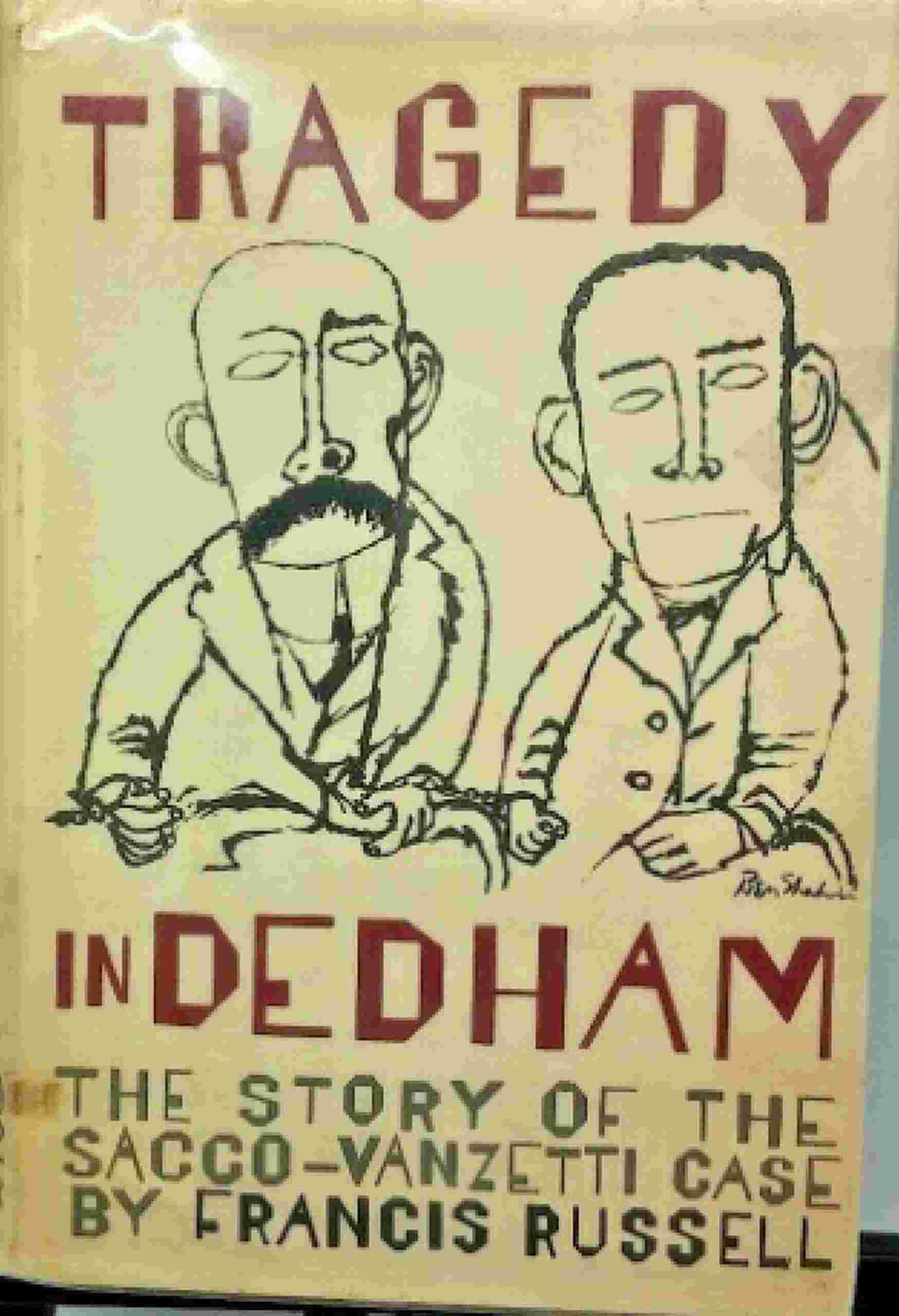
On the oak door were the faded letters F. G. KATZMANN, Room 12. Stepping inside, I found myself alone. An oak desk faced me. On its plate-glass top I noticed the issue of American Heritage containing my Sacco-Vanzetti article with the Ben Shahn illustrations—to my embarrassment, for my description of Katzmann in it was not flattering.
Dray strode in briskly, sat down at the desk, and stared at me several seconds before speaking. “I could have seen you at any time within the last two months,” he said finally, “but I couldn’t make up my mind whether to or not. This is what decided me.” He tapped the magazine. “You write here that though you thought they were innocent, just by reading the evidence alone you’d have found them guilty. When I read that I decided you at least were honest. But for that I’d not have seen you.
“You know that Fred, as long as he lived, refused to discuss this case publicly with anyone. Of course he mentioned it to me. I don’t suppose a day went by that he didn’t think of it in one way or another. I saw him come in sometimes with tears in his eyes and say, Why do they say these things about me? Why do they keep on attacking me?’ Don’t think he wasn’t hurt.
“Now he’s gone, thinking it over, I’m willing to tell you a few things I know to set the record straight, because so much has been said against him. Fred was almost like a father to me. I was twenty-four when I came here just after the trial, and I studied what law I know right here in this office. Fred never had a son of his own, just his two daughters, and I think he came to look on me sort of as a son. All I know is this: My son’s at law school now, and if I can teach him as much decency and as much law as Fred Katzmann did me, I’ll think I’m a lucky man. You think I admire Fred. I do.”
He opened the American Heritage. “Here you speak of Katzmann as being, in spite of his name, a Mayflower descendant. He wasn’t. His father was a German, his mother Scotch and came from Roxbury. They were poor. His mother used to work. Fred had nothing. I think when he went to Harvard an aunt helped him out a little, but he used to tend furnaces to work his way through. Sometimes he earned a bit singing. He had a fine voice. Even when he was starting up his practice he still used to sing sometimes at churches and funerals.
“We got pretty close over the years. I don’t think in the end there was anything he kept back from me. I knew about his family, his social life, his practice. I knew how he felt about the Sacco-Vanzetti case. In that he never changed. He didn’t just think they were guilty, he knew they were guilty. He wouldn’t have avoided the case, for he never did put off dirty jobs onto other people, but sometimes he’d say to me, ‘Mike, if I had my life to live over, I’d never want to go through that again.’ He always felt it shortened his wife’s life, the whole business. For years they had to have guards round his house. He said whenever he woke up nights he’d hear them tramping round.
“A lot of things I set myself out to tell you,” Dray went on, “but they slip through my mind right now. Just this, though. I’ve built up a good practice in Hyde Park. I’ve done all right here. But I always have the feeling somehow that it was Fred’s practice, that anything I’ve amounted to has been through him. I want to defend his memory, and that’s why I’m talking to you.
“I’ll tell you another thing. When Jerry McAnarney was on the Sacco-Vanzetti defense, he thought his clients were innocent. I never heard any of the Defense Committee boys criticize Jerry. He went to the governor’s committee afterward and he still thought they were innocent. But he and Fred stayed the same good friends all through the years. They were partners together on that Willett-Sears case. Maybe you remember, that case lasted fourteen months—the longest jury case in the history of Massachusetts. I suppose if anyone asked Fred to name his ten best friends, Jerry McAnarney would have been among them. And if Jerry named his best five, Fred would have been on the list. I remember, too, just a short while before Jerry died he said one day right in this office: ‘No matter what they said about you, Fred, you were all right.’”
So we talked—or rather, I listened—as the lawyer talked through the afternoon. Katzmann had avoided the Dedham courtroom the day Thayer passed sentence, but Dray had gone there deliberately, and had heard Vanzetti’s speech to the court and watched him point his finger at the judge. For Dray, Vanzetti had seemed a sinister figure at that moment with his glaring eyes, his heavy bobbing mustache, and his passionate foreign voice.
Inevitably, we got to the subject of the guns.
“There’s a church just across the street,” Dray said. “The priest, Father Fraher, had a brother who was in here after the trial. He told Fred, ‘You want to know where Berardelli got his gun? He got it from me, that’s where he got it.’ There was a crack or nick or some sort of mark on the handle, and this Fraher said, ‘If the one you found on Vanzetti has that mark on it, it’s the same gun.’ He hadn’t even seen the gun then, mind you, but when we showed it to him, there was the mark, just like he said.
“Ah,” he said at last, sadness in his voice, “I wish I could explain to you in words what Fred really was. You couldn’t really understand him, seeing him just that once. Perhaps you were fed up with being on a jury. Fred wasn’t tricky. He was honest all the way through. I remember some man came in here once and wanted Fred to defend him in a robbery case, offered him five thousand dollars. That was a lot more money then than it is today. When he came to pay Fred, he brought the money in a box, all in bills, done up in little piles. As soon as Fred saw it, he wouldn’t touch the case. That money looked too much like payroll money. But an assistant district attorney over in Suffolk County didn’t mind taking it. No, you couldn’t get Fred to do anything that had even a suspicion of being wrong. He was that kind of man.”
I left Dray in the anteroom. We shook hands beside Katzmann’s picture. “I’m glad you came,” he said finally.
Out I went into the slashing rain, to my car parked by the dark bulk of the Catholic church where Father Fraher or his successor was probably still hearing confessions. If only Dray could have whipped open one of his filing cabinets and taken out the ultimate document that would have satisfied everyone from Aldino Felicani in his sheet-metal office to the corporation lawyer on Federal Street. I would have settled for a villain, but I had found only decent-enough people in irreconcilable positions, and still at the core of the labyrinth two men who had died a third of a century earlier in the electric chair.